The personal finance roadmap is a sequential framework outlining essential financial steps from foundational stability through wealth building to financial independence—progressing systematically from emergency fund establishment ($1,000-$2,000 starter), high-interest debt elimination, full emergency fund (3-6 months expenses), retirement savings (15%+ of income), goal funding, debt payoff, and wealth accumulation. Unlike approaching finances chaotically or pursuing everything simultaneously, following a structured roadmap ensures foundation before growth, eliminates wasteful debt interest while building assets, and creates sustainable path from financial fragility to security to independence through prioritized sequential actions rather than overwhelming parallel efforts.
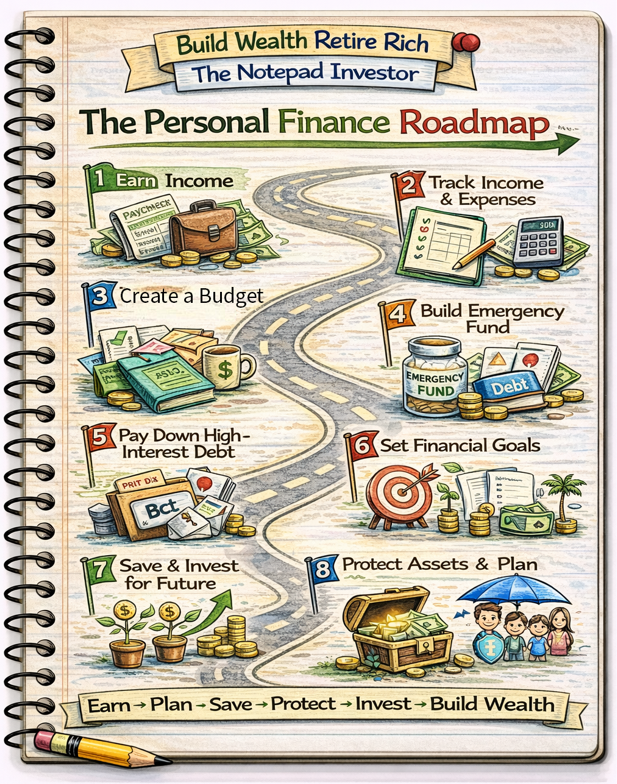
This article is designed for anyone seeking financial clarity, individuals overwhelmed by competing priorities, or those wanting systematic improvement plans. You do not need financial expertise, high incomes, or perfect situations to follow the roadmap—principles apply at all income levels and starting points, providing clear next steps regardless of current position from deep debt through comfortable wealth, transforming financial confusion into actionable direction.
Understanding the personal finance roadmap matters because pursuing goals in wrong order wastes resources (investing while carrying 20% APR credit card debt loses 15%+ annually), skipping foundation creates fragility (no emergency fund means job loss triggers catastrophic debt spiral), and paralysis from competing priorities prevents all progress—while roadmap followers systematically build financial security achieving milestones impossible through chaotic approaches, with each step strengthening foundation for subsequent advancement.
Educational disclaimer: This article provides general educational framework for financial planning. Individual circumstances, priorities, incomes, and timelines vary significantly. Roadmap represents common optimized sequence—personal situations may warrant modifications. This is not financial, investment, or planning advice. Consult qualified financial professionals for personalized guidance.
Understanding the Roadmap Concept
Why Sequential Steps Matter
Foundation before growth principle:
- Can’t build wealth without financial stability
- Can’t optimize without covering basics
- Each step enables and protects subsequent steps
- Skipping foundation creates collapse risk
Common wrong-order mistakes:
- Investing aggressively while carrying credit card debt (paying 20% to earn 8%)
- Buying investment property without emergency fund (forced to sell during crisis)
- Saving for home down payment while minimum-paying 18% credit cards (losing thousands in interest)
- Maxing retirement accounts while living paycheck to paycheck (no flexibility for emergencies)
Why roadmap sequence works:
- Emergency fund prevents debt accumulation during setbacks
- Debt elimination frees cash flow for wealth building
- Foundation creates stability enabling aggressive growth
- Each achievement builds momentum and confidence
- Clear priorities eliminate decision paralysis
Roadmap Flexibility
The roadmap is guide, not rigid law:
- Core sequence optimizes for most people most situations
- Personal circumstances may warrant modifications
- Life changes require roadmap adjustments
- Some steps can run simultaneously (retirement + goals)
- Understand principles to make informed adjustments
When to modify:
- Employer match: Always capture even during debt payoff (free money trumps optimization)
- Extremely low-interest debt: May invest simultaneously with payoff (mortgage 3% vs 8% expected returns)
- Time-sensitive opportunities: House purchase, education deadlines may justify temporary priority shifts
- Health/family emergencies: Pause wealth building, address crisis, resume roadmap
The Complete Personal Finance Roadmap
Step 1: Create Budget and Track Spending
Why this comes first: Can’t manage what you don’t measure
Actions:
- Track all spending for 1-3 months (apps, spreadsheet, or manual)
- Categorize expenses: housing, transportation, food, insurance, debt, discretionary, savings
- Calculate total monthly income (after-tax take-home)
- Create budget: Income = Expenses + Savings (prioritize savings, adjust expenses to fit)
- Identify spending leaks and optimization opportunities
Target outcome:
- Know exactly where money goes each month
- Positive cash flow (income exceeds expenses)
- Written budget allocating every dollar
- Foundation for all subsequent steps
Resources needed: Free budgeting app (Mint, YNAB, EveryDollar) or spreadsheet, 2-3 hours initial setup, 30 minutes monthly maintenance
Step 2: Build $1,000-$2,000 Starter Emergency Fund
Why this comes second: Prevents small emergencies from becoming debt crises
Actions:
- Save $1,000-$2,000 in high-yield savings account
- Keep separate from regular checking (reduce spending temptation)
- Use only for true emergencies (car repair, medical, unexpected essential expense)
- Replenish immediately if used
Typical timeline: 2-6 months saving $200-500 monthly
Why not invest starter emergency fund: Need immediate access without market risk—stocks too volatile for short-term emergency money
Step 3: Employer 401(k) Match (If Available)
Why this comes third: Free money—100% instant return beats debt payoff math
Actions:
- Contribute minimum percentage capturing full employer match
- Typical match: 50% or 100% of contributions up to 3-6% of salary
- Example: $60,000 salary, 50% match on 6% = Contribute $3,600, receive $1,800 match = $5,400 annual retirement savings
- Select low-cost target-date fund or total market index fund
Target outcome: Capture all free employer money while building retirement habit
Exception: If no employer match available, skip to Step 4
Step 4: Eliminate High-Interest Debt
Why this comes fourth: High-interest debt (15%+ APR) destroys wealth faster than investments build it
Target debts:
- Credit cards (typically 15-25% APR)
- Payday loans (400%+ APR—eliminate immediately)
- Personal loans over 10% APR
- Any debt above 8-10% interest rate
Payoff methods:
Debt avalanche (mathematically optimal):
- List debts highest to lowest interest rate
- Minimum payments on all debts
- Extra money to highest interest debt
- When paid off, move to next highest
- Saves most interest, fastest payoff
Debt snowball (psychological wins):
- List debts smallest to largest balance
- Minimum payments on all debts
- Extra money to smallest debt
- Quick wins create momentum and motivation
- Costs slightly more interest but higher completion rate
Intensity matters:
- Find extra $300-$1,000+ monthly through expense cuts and income increases
- Pause non-essential spending temporarily
- Aggressive focus: $15,000 debt paid in 12-18 months beats 5+ years of minimum payments
Typical timeline: 12-36 months depending on debt amount and payment intensity
Step 5: Build Full Emergency Fund (3-6 Months Expenses)
Why this comes fifth: With high-interest debt eliminated, build complete financial protection
Target amount:
- Single income household: 6 months expenses
- Dual income household: 3-4 months expenses
- Self-employed or unstable income: 6-12 months expenses
- Stable government job: 3 months expenses sufficient
Calculation example:
- Monthly expenses: $3,500
- Target: 6 months = $21,000
- Already have: $2,000 starter fund
- Need to save: $19,000
- At $500/month: 38 months
- At $1,000/month: 19 months
Where to keep emergency fund:
- High-yield savings account (4-5% currently)
- Money market account
- Liquid and safe, never invested in stocks
- Separate from checking to reduce spending temptation
Typical timeline: 12-24 months
Milestone achievement: Completing full emergency fund = financial stability achieved, foundation complete
Step 6: Retirement Savings (15% of Income)
Why this comes sixth: With stability secured, aggressively build long-term wealth
Target contribution: 15% of gross income minimum
Account priority order:
- 401(k) to employer match (already doing from Step 3)
- Max Roth IRA ($7,000 for 2024, $8,000 if 50+)
- Return to 401(k) increasing to 15% total
- If 15% maxes accounts, add to taxable brokerage
Example: $75,000 salary
- 15% target = $11,250 annually = $938 monthly
- $4,500 to 401(k) capturing full match (6% of salary)
- $7,000 to Roth IRA (max contribution)
- If available funds exceed $11,250, increase 401(k) contributions
Investment allocation:
- 10+ years to retirement: 80-100% stocks (total market index funds)
- Target-date funds appropriate for hands-off approach
- Low-cost index funds (expense ratios under 0.20%)
Why 15% minimum: Ensures comfortable retirement replacing 70-80% of pre-retirement income over 30-40 year career
Step 7: Save for Medium-Term Goals
Why this comes seventh: Foundation and retirement secured, fund 3-10 year objectives
Common medium-term goals:
- Home down payment (20% to avoid PMI)
- Vehicle replacement fund
- Major home renovations
- Children’s college savings (529 plans)
- Wedding or major life events
- Sabbatical or extended travel
Allocation by timeline:
- 3-5 years: 30% stocks, 70% bonds or high-yield savings
- 5-7 years: 50% stocks, 50% bonds
- 7-10 years: 60-70% stocks, 30-40% bonds
Parallel with retirement: Can pursue medium-term goals while maintaining 15% retirement contributions—both run simultaneously
Step 8: Pay Off Low-Interest Debt
Why this comes eighth: Eliminate remaining debt achieving complete debt freedom
Target debts:
- Mortgage (accelerated payoff optional)
- Student loans (especially higher than 4-5%)
- Auto loans remaining
- Any debt under 8% not yet eliminated
Acceleration strategies:
- Extra principal payments (specify “principal only”)
- Bi-weekly payments (26 half-payments = 13 full payments annually)
- Lump sum payments from bonuses, raises, windfalls
Mortgage payoff consideration:
- Guaranteed return = interest rate saved (3-5% typical)
- Vs investing: Expected 8%+ stock returns
- Math favors investing over low-rate mortgage payoff
- Emotional peace of debt-freedom has value beyond math
- Personal preference—both approaches valid
Typical timeline: 5-15 years depending on debt amounts and intensity
Step 9: Build Wealth and Additional Savings
Why this comes ninth: Debt-free with strong retirement savings, maximize wealth building
Actions:
- Increase retirement savings beyond 15% (20-30%+ of income)
- Taxable investment accounts for additional wealth
- Real estate investment if desired
- Business ownership or side income development
- 529 maximization for children’s education
Investment allocation:
- Diversified portfolio: US stocks, international stocks, bonds
- Asset allocation matching risk tolerance
- Regular rebalancing maintaining target allocation
- Tax optimization: Strategic asset location, tax-loss harvesting
Step 10: Financial Independence and Legacy Planning
Why this comes tenth: Ultimate financial goals and generational wealth
Financial independence:
- Calculate FI number: Annual expenses × 25-33
- Build investment portfolio supporting 3-4% withdrawal rate
- Achieve work optionality at any age
- Pursue FI through continued aggressive saving and investing
Estate planning:
- Will specifying asset distribution
- Beneficiary designations on all accounts
- Power of attorney (financial and medical)
- Healthcare directive/living will
- Trusts if estate over $13+ million (estate tax threshold)
Legacy goals:
- Generational wealth transfer
- Charitable giving strategies
- Family financial education
- Values-based wealth management
Roadmap Timeline Examples
Aggressive Path (High Income, Low Expenses)
Starting point: Age 25, $80,000 income, $45,000 expenses, $10,000 debt, $5,000 net worth
Step 1-2: Budget + Starter Emergency Fund (Months 1-4)
- Save $2,000 emergency fund
- Net worth: $7,000
Step 3: Employer Match (Month 5+)
- Begin 6% 401(k) contributions ($400/month)
- Employer adds $200/month match
Step 4: Eliminate Debt (Months 5-16)
- $10,000 debt paid off in 12 months ($833/month)
- Net worth: $15,000 (includes 401k growth)
Step 5: Full Emergency Fund (Months 17-28)
- Build $22,500 emergency fund (6 months × $3,750)
- Net worth: $40,000
Step 6: Increase Retirement to 15% (Month 29+)
- Add Roth IRA $583/month ($7,000 annually)
- Increase 401k to $417/month ($5,000 annually)
- Total retirement: $1,000/month ($12,000 annually = 15%)
Step 7-10: Wealth Building (Years 3-15)
- Continue 15%+ retirement savings
- Save home down payment
- Build taxable investment portfolio
- Age 40: Net worth $800,000+, approaching FI
Moderate Path (Average Income, Average Expenses)
Starting point: Age 35, $65,000 income, $52,000 expenses, $25,000 debt, $8,000 net worth
Steps 1-2: 6 months, emergency fund $2,000
Step 3: Month 7+, capture employer match
Step 4: 30 months eliminating $25,000 debt ($833/month)
Step 5: 24 months building $26,000 emergency fund (6 months expenses)
Step 6+: Year 6+, increase retirement to 15%, pursue medium-term goals
Age 55: Net worth $500,000+, traditional retirement on track
Recovery Path (Low Income, High Debt)
Starting point: Age 30, $45,000 income, $43,000 expenses, $35,000 debt, -$10,000 net worth
Phase 1: Stabilization (Year 1)
- Create budget, reduce expenses $43,000 → $38,000
- Build starter emergency fund $1,000
- Begin employer match contributions
Phase 2: Debt Elimination (Years 2-6)
- Aggressive debt payoff $600/month
- Increase income through raises, side hustles
- Eliminate $35,000 debt in 5 years
Phase 3: Foundation Building (Years 7-9)
- Build full emergency fund
- Increase retirement contributions
- Net worth positive, gaining momentum
Phase 4: Wealth Building (Years 10+)
- Continue roadmap Steps 6-10
- Age 50+: Retirement on track, financial stability achieved
Common Roadmap Questions and Challenges
“Should I invest or pay off my mortgage?”
After Step 6 (retirement funded 15%+), two valid approaches:
Option A: Invest (mathematically optimal)
- Mortgage 3-4% cost vs 8%+ expected investment returns
- 4-5% annual advantage compounds to hundreds of thousands over decades
- Mortgage interest tax-deductible (though limited post-2018 tax reform)
- Best mathematical outcome
Option B: Pay off mortgage (psychological peace)
- Guaranteed 3-4% return (interest saved)
- Debt-free living reduces stress and risk
- No payment = ultimate flexibility and security
- Emotional value beyond math for many
Hybrid approach: Split difference—extra $500 monthly: $250 to mortgage, $250 to investments
“Can I save for a house while building emergency fund?”
Short answer: Yes, but prioritize emergency fund first
Approach:
- Build starter $1,000-$2,000 emergency fund (Step 2)
- Eliminate high-interest debt (Step 4)
- Then split savings: 60-70% emergency fund, 30-40% home down payment
- Complete emergency fund before aggressive home saving
- Or extend timeline: Build full emergency fund, then save for home
Reasoning: Home buying without emergency fund = forced home sale or debt accumulation during crisis, risking everything
“What if I’m behind on retirement in my 40s-50s?”
Modified roadmap:
- Complete Steps 1-5 quickly (foundation essential)
- Increase retirement savings beyond 15%—aim for 20-30%+
- Catch-up contributions at 50+ ($7,500 additional 401k, $1,000 additional IRA for 2024)
- Extend working years 3-5 years if needed
- Delay Social Security to 70 (maximizes benefit 24%+ vs 67)
- Geographic arbitrage in retirement (lower cost-of-living area)
Reality: Starting late costs more but still achievable—10-15 years of aggressive saving at 50+ produces substantial retirement funds
“Should I stop retirement to pay off debt faster?”
General answer: Maintain employer match minimum, pause additional retirement for high-interest debt payoff
Exception: Never stop employer match contributions—100% return beats debt payoff math even at 20% APR
After capturing match: Pause additional retirement contributions, attack high-interest debt aggressively, resume retirement increases after debt-free
“What about kids’ college vs my retirement?”
Priority: Your retirement over children’s college
Reasoning:
- Can borrow for college, cannot borrow for retirement
- Scholarships, grants, work-study available for college
- Underfunded retirement becomes children’s burden
- Airplane oxygen mask principle: secure yourself before helping others
Balanced approach:
- Step 6: Fund retirement 15%
- Step 7: Add college savings (529 plans) if budget allows
- Don’t sacrifice retirement for college—both possible with planning
Why Following the Roadmap Matters
Without structured roadmap, people pursue competing priorities simultaneously achieving minimal progress on any, invest while carrying high-interest debt losing thousands annually, or skip emergency funds experiencing catastrophic setbacks during inevitable crises—while roadmap followers systematically build from stability to wealth achieving financial milestones impossible through chaotic approaches, with each completed step creating foundation enabling sustainable advancement toward financial independence.
Following the personal finance roadmap enables individuals to:
- Build financial stability through systematic foundation establishment
- Eliminate wasteful debt interest freeing cash flow for wealth building
- Achieve clear milestones creating motivation and momentum
- Make informed trade-off decisions through prioritization framework
- Progress from financial fragility to security to independence systematically
- Avoid common mistakes derailing financial progress through proper sequencing
The roadmap transforms overwhelming financial complexity into clear sequential steps building sustainable wealth through prioritized execution.
Common Misunderstandings
Many people assume they must complete entire roadmap before financial success happens. In reality, each step represents meaningful achievement improving financial position—completing emergency fund provides stability, debt elimination frees cash flow, retirement funding creates future security, with progress measurable and valuable at every stage proving incremental advancement beats waiting for complete transformation.
Another common misconception is that roadmap rigidity prevents individual circumstances accommodation. In practice, roadmap provides optimized framework for common situations while allowing informed modifications—understanding principles enables strategic adjustments when personal circumstances warrant deviation, proving structure and flexibility coexist when foundation principles guide decisions.
Some believe following roadmap requires extreme sacrifice making present life miserable. However, roadmap emphasizes sustainable progress over unsustainable extremes—completing steps over years through consistent moderate effort beats attempting everything simultaneously burning out quickly, proving steady systematic execution produces better outcomes than sporadic extreme efforts inevitably abandoned.
How the Roadmap Fits Into Financial Success
Personal finance roadmap provides comprehensive framework organizing all financial decisions and priorities, eliminating paralysis from competing objectives through clear sequential steps, creating measurable progress from financial fragility through stability to wealth, and enabling systematic advancement toward financial independence through prioritized execution building sustainable foundation before pursuing growth.
For example, two people age 28 earn $70,000 annually with $15,000 credit card debt. Person A pursues everything simultaneously—contributes 5% to 401k, makes minimum debt payments, invests $200 monthly in taxable account, occasionally saves for home down payment, has no emergency fund. After 10 years: Credit card debt still $8,000 (barely decreased through minimum payments), 401k $42,000, taxable account $31,000, no emergency fund, net worth $65,000. Person B follows roadmap—builds $2,000 emergency fund (3 months), captures employer match only during debt payoff, eliminates debt completely (18 months paying $833/month), builds $18,000 emergency fund (12 months), increases retirement to 15% ($875/month), adds $400 monthly taxable investments. After 10 years: Zero debt, $22,000 emergency fund, 401k $94,000, taxable account $52,000, net worth $168,000. Same income and timeframe, different approach—roadmap follower accumulated 2.5x more wealth through systematic prioritization versus chaotic parallel pursuits.
The roadmap separates systematic wealth builders from perpetual strugglers through structured sequential advancement creating compounding benefits impossible through unfocused efforts.
Recent Updates and Trends
In recent years, high-interest rates have affected roadmap priorities—mortgage rates 6-7% versus historical 3-4% makes accelerated payoff more attractive mathematically, while savings account rates 4-5% make emergency funds less costly in opportunity cost terms versus historical 1-2%.
Student loan payment pauses and forgiveness discussions have complicated debt prioritization—some people paused aggressive student loan payoff awaiting policy changes, though most experts still recommend systematic elimination following roadmap principles.
Rising healthcare costs have increased emergency fund requirements—many financial advisors now recommend 6-12 months expenses versus traditional 3-6 months, especially for families and self-employed individuals given healthcare expense unpredictability.
FIRE movement has popularized aggressive early roadmap steps—focus on Steps 1-6 completion in compressed timelines (3-5 years versus 10-15 years traditionally), enabling faster advancement to wealth building and FI pursuit through extreme optimization.
Fundamental roadmap principles remain timeless: build foundation before growth, eliminate high-interest debt before investing, create emergency cushion preventing debt accumulation during setbacks, fund retirement consistently, balance competing priorities through sequential focus, and progress systematically from stability to wealth to independence—regardless of interest rate environments, economic conditions, or policy changes, structured prioritized execution produces superior outcomes versus chaotic simultaneous pursuit of competing objectives.
3 Things You Can Do Today
Ready to start your roadmap journey? Here are three simple steps you can take right now:
1. Identify your current roadmap position – Review the 10-step roadmap. Which step are you currently on? Completed: Track spending, have budget, emergency fund exists, employer match captured, high-interest debt eliminated? Not completed: No budget, no emergency fund, carrying credit card debt? Write down: “I am currently on Step [X]” and “Next milestone: [specific goal with amount and timeline].” This creates clarity on current position and next priority. Most people discover they’re attempting Steps 6-7 while Steps 2-5 incomplete—explaining financial stress and lack of progress.
2. Calculate your next milestone target and timeline – Based on current step, calculate specific next goal. Step 2: Build $1,500 emergency fund. Step 4: Eliminate $8,000 credit card debt. Step 5: Build $18,000 full emergency fund (6 months × $3,000 expenses). Step 6: Increase retirement to 15% of income. Then calculate monthly amount needed and timeline. Example: $8,000 debt ÷ 12 months = $667 monthly payment. Or extend to 18 months = $445 monthly. Choose realistic aggressive timeline creating urgency without impossible burden. Write this down: “Save/pay $[X] monthly for [Y] months to complete Step [Z].”
3. Automate funding for your next milestone starting this week – Set up automatic transfer or payment for calculated monthly amount. Emergency fund: Auto-transfer to savings on payday. Debt payoff: Schedule extra payment beyond minimum. Retirement increase: Update 401k contribution percentage. Automation removes willpower requirement and ensures progress. Even if can’t fund full amount immediately, start with what’s possible—$200 monthly beats $0 monthly waiting for perfect conditions. Action today matters more than perfect planning tomorrow that never comes.
These actions transform roadmap from abstract concept into personal plan with clear current position, specific next milestone, and automated progress toward systematic financial advancement.
Quick FAQ
Do I really need to follow the exact order, or can I do steps simultaneously?
Core sequence (Steps 1-6) should generally follow order—foundation before growth prevents costly mistakes. However, some parallel work acceptable: employer match (Step 3) runs during debt payoff (Step 4), retirement savings (Step 6) continues while pursuing medium-term goals (Step 7). Key: Don’t skip foundation steps (1-5) to jump to growth steps (6-10). Understand why sequence exists, then make informed modifications if circumstances warrant.
What if I have low-interest student loans—should I pay those off before investing?
Depends on interest rate. Over 6-7%: Pay off in Step 4 with high-interest debt. 4-6%: Personal choice—math slightly favors investing but guaranteed return of payoff valuable. Under 4%: Generally continue minimum payments, invest instead (Step 6+). Also consider: loan forgiveness eligibility, payment flexibility, emotional value of debt-freedom. No universal answer—understand tradeoffs, choose based on priorities and math.
How long should completing the roadmap take?
Highly variable: Aggressive high-income low-debt: 3-5 years to Step 6, 10-15 years to Step 10. Moderate income average debt: 5-8 years to Step 6, 20-30 years to Step 10. Low income high debt: 7-10 years to Step 6, 30-40 years to Step 10. Timelines compress with income increases and expense optimization. Focus on steady progress, not comparison—your pace is your pace. Completing roadmap beats never starting.
What if I’m already in my 50s and haven’t started—is it too late?
Not too late but requires intensity. Compress Steps 1-5 into 2-3 years maximum (foundation essential), then aggressive retirement saving (Step 6) at 20-30%+ of income using catch-up contributions. May require: extending working years to 70, geographic arbitrage in retirement, part-time work early retirement years, aggressive expense optimization. 15-20 years of disciplined execution still produces substantial retirement funds. Starting today beats continuing delay—every year matters.
Should I save for my kid’s college before maxing my retirement?
No—Step 6 (your retirement 15%) before Step 7 (college savings). Can borrow for college, cannot borrow for retirement. Underfunded retirement becomes children’s burden eventually. After securing your retirement, add college savings. Many successfully fund both—but priority order matters. Kids have scholarships, grants, work-study, student loans as options. You have none of these for retirement. Secure your oxygen mask first.
What’s the most common roadmap mistake people make?
Skipping emergency fund (Step 5) to invest or pursue goals. Without emergency buffer, unexpected expenses trigger debt accumulation negating investment gains and derailing progress. Close second: investing while carrying high-interest debt—paying 18% to earn 8% loses 10% annually. Foundation steps exist for crucial reasons—skipping creates fragility leading to failure during inevitable setbacks. Complete boring foundation before exciting growth.
Explore More in Money Basics
Disclosure
This article is provided for educational purposes only and does not constitute financial planning, investment, or professional advice. The personal finance roadmap represents optimized sequence for common situations—individual circumstances may warrant modifications. Timeline estimates are generalizations—actual progress varies based on income, expenses, debt levels, and execution consistency. Investment return assumptions use historical averages—actual returns vary and are not guaranteed. Debt payoff priorities depend on interest rates and personal circumstances. Step sequence flexible based on informed decision-making understanding tradeoffs. Examples are illustrative using simplified scenarios—actual situations vary significantly. Consult qualified financial planners, advisors, and professionals for personalized guidance considering specific circumstances, goals, and constraints. Information current as of publication but financial products, tax laws, and best practices evolve. Advertisements or sponsored content may appear within or alongside this content. All information is presented independently.
Interactive Quiz: The Personal Finance Roadmap
Test your understanding of the personal finance roadmap.