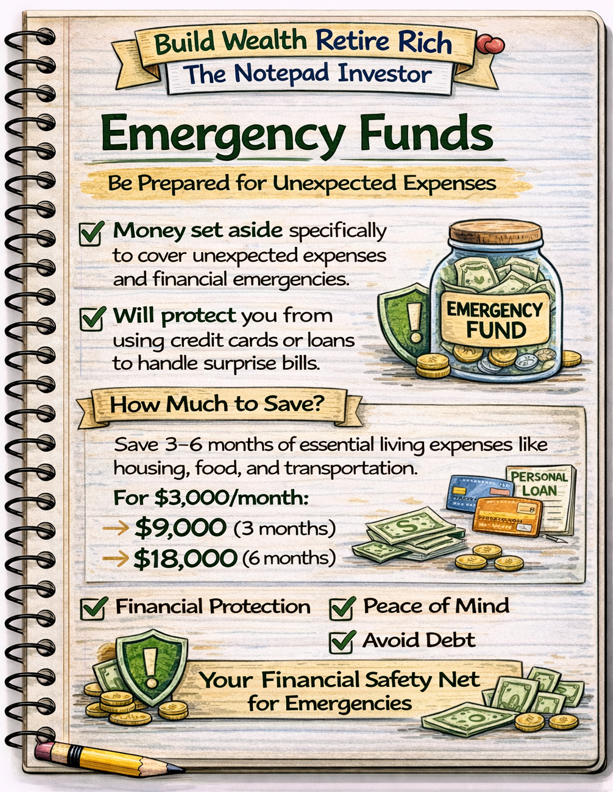
An emergency fund is a dedicated savings account containing 3-6 months of essential living expenses reserved exclusively for genuine unexpected financial emergencies—job loss, major medical expenses, urgent home or vehicle repairs, and other unforeseen crises requiring immediate cash access. Unlike general savings used for planned goals or discretionary purchases, emergency funds remain untouched except for true emergencies, providing financial safety net preventing debt accumulation, late payments, and financial catastrophe when unexpected expenses inevitably arise, transforming individuals from financially fragile (one crisis away from disaster) to financially resilient (able to weather normal life adversities without derailing financial stability).
This article is designed for anyone without savings cushion, individuals experiencing financial stress from unexpected expenses, or those wanting comprehensive understanding of emergency fund fundamentals. You do not need financial expertise, high income, or perfect circumstances to build emergency fund—simple systematic savings accumulation accessible to most income levels creates protective buffer, though obviously higher incomes enable faster building and larger absolute amounts while lower incomes require proportional smaller targets still providing equivalent protection relative to expenses.
Understanding emergency funds matters because life inevitably includes unexpected expensive disruptions making emergency savings essential not optional, lack of emergency cushion forces expensive solutions like high-interest debt or retirement account withdrawals creating long-term damage from temporary problems, and financial fragility from missing safety net creates chronic stress and prevents wealth building—while emergency fund holders weather crises calmly using dedicated reserves, avoid debt spirals and financial setbacks, and maintain forward financial progress impossible for those derailed by every unexpected expense requiring years recovering from events emergency fund would have easily absorbed.
Educational disclaimer: This article provides general educational information about emergency fund concepts and strategies. Individual circumstances, income levels, expenses, risk factors, and appropriate emergency fund sizes vary significantly. Emergency fund recommendations represent general guidelines—specific needs differ. This is not financial planning or professional advice. Consult qualified financial professionals for personalized guidance.
Understanding Emergency Funds
What Is an Emergency Fund?
Core definition: Liquid savings reserved exclusively for unexpected financial emergencies, separate from other savings goals
Key characteristics:
- Liquid: Immediately accessible without penalties or waiting periods
- Safe: Held in savings account or money market, not invested in stocks
- Dedicated: Reserved only for emergencies, not vacation or shopping
- Sufficient: 3-6 months of essential expenses typically recommended
- Separate: Distinct account from checking, reducing temptation
What Qualifies as an Emergency?
Genuine emergencies (use fund):
- Job loss: Unexpected unemployment requiring living expense coverage during search
- Medical emergencies: Urgent healthcare needs, deductibles, unexpected medical expenses
- Essential repairs: Car breakdown preventing work commute, broken HVAC in extreme weather, plumbing emergency, roof leak
- Urgent travel: Family emergency requiring immediate flight, funeral expenses
- Essential appliance failure: Refrigerator, washer, water heater when necessary for daily living
NOT emergencies (don’t use fund):
- Christmas gifts or holidays (predictable annual expense)
- Vacation opportunities (discretionary, can be saved for separately)
- Sales and deals (“limited time offer” marketing pressure)
- Wants disguised as needs (new phone when current works fine)
- Poor planning consequences (forgot to budget for annual insurance premium)
The test: Is it unexpected, necessary, and urgent? All three required for genuine emergency
Why Emergency Funds Matter
Without emergency fund:
- $1,500 car repair → credit card at 22% APR
- Taking 18 months to pay off costs $300 in interest
- Or payday loan costing $225 in fees (15% for two weeks)
- Or borrow from 401(k) losing growth and possibly paying penalties
- Job loss → immediately behind on rent, spiraling crisis
- One emergency creates debt that takes years to recover from
With emergency fund:
- $1,500 car repair → paid from emergency fund
- No interest, no debt, no long-term damage
- Replenish fund over 2-3 months
- Crisis contained and resolved cleanly
- Job loss → 3-6 months runway to find good fit, not desperate
- Financial stability maintained despite disruption

How Much to Save in Emergency Fund
The Standard Recommendation: 3-6 Months Expenses
Calculation method:
- Calculate monthly essential expenses (rent, utilities, food, transportation, insurance, minimum debt payments)
- Multiply by 3-6 months
- Result = emergency fund target
Example calculation:
- Monthly essential expenses: $3,200
- 3 months: $9,600 (minimum recommended)
- 6 months: $19,200 (ideal target)
Note: Based on essential expenses only, not total spending including discretionary
Factors Affecting Your Target Amount
Lean toward 3 months if:
- Dual income household (reduced job loss risk)
- Very stable employment (tenured position, government job)
- High demand skills (easy to find new job quickly)
- Low fixed obligations (can reduce expenses dramatically if needed)
- Strong family support network (could move in with family temporarily)
Lean toward 6+ months if:
- Single income household (total income loss if unemployed)
- Variable or commission-based income (irregular earnings)
- Niche profession (longer job search timeline)
- High fixed obligations (mortgage, multiple dependents)
- Health concerns (higher medical expense risk)
- Older vehicle or home (higher repair probability)
- Self-employed or business owner (no unemployment benefits)
Starter Emergency Fund: $1,000-$2,000
Before building full 3-6 months:
- Save $1,000-$2,000 starter fund quickly
- Covers most common emergencies (car repair, minor medical, appliance)
- Prevents small emergencies becoming debt
- Provides immediate protection while building full fund
Typical starter fund timeline:
- Saving $200 monthly: 5-10 months to starter fund
- Saving $500 monthly: 2-4 months to starter fund
After starter fund complete:
- If high-interest debt exists: Pause emergency fund building, attack debt
- If no high-interest debt: Continue building to full 3-6 months
Alternative Sizing Methods
Dollar amount approach:
- $5,000: Minimum for basic protection
- $10,000: Comfortable for most situations
- $15,000-25,000: Substantial coverage for larger obligations
Percentage of income approach:
- 15-20% of annual gross income
- Example: $60,000 income → $9,000-12,000 emergency fund
Risk-based approach:
- Calculate maximum realistic emergency cost
- Home: Deductible + max out-of-pocket ($5,000-10,000)
- Vehicle: Major repair or replacement down payment ($3,000-8,000)
- Medical: Annual out-of-pocket maximum ($5,000-8,000)
- Job loss: 3-6 months expenses
- Take highest amount as target
Building Your Emergency Fund
Step 1: Set Initial Target Amount
Starter fund approach:
- Phase 1: Save $1,000 (covers 60% of emergencies)
- Phase 2: Build to $2,500 (covers 80% of emergencies)
- Phase 3: Build to $5,000 (covers 95% of emergencies)
- Phase 4: Build to full 3-6 months expenses
Full fund calculation:
- List essential monthly expenses: Housing, utilities, food, transportation, insurance, minimum debt payments
- Total: $3,500 example
- Multiply × 4 months (middle ground): $14,000 target
Step 2: Open Dedicated Savings Account
Where to keep emergency fund:
High-yield savings account (recommended):
- Currently earning 4-5% APY (2024-2026 rates)
- FDIC insured up to $250,000
- Instant access via transfer (1-2 day typically)
- Online banks offer highest rates: Marcus, Ally, Capital One 360, American Express Personal Savings
Money market account:
- Similar rates to high-yield savings
- May include check-writing (convenient for emergencies)
- FDIC insured
Regular bank savings (acceptable but suboptimal):
- Lower interest (often 0.01-0.5% vs 4-5%)
- Immediately accessible
- FDIC insured
- Better than nothing but leaving money on table
NOT recommended for emergency funds:
- Checking account (too accessible, gets spent)
- Stock market (volatility risk, could lose value when needed)
- CDs (penalties for early withdrawal or not accessible)
- Crypto (extreme volatility, not appropriate for emergency savings)
Step 3: Automate Monthly Contributions
Pay yourself first for emergency fund:
- Set up automatic transfer from checking to emergency savings
- Schedule for day after payday
- Start with achievable amount: $100-500 monthly depending on income
Building timeline examples:
Target: $10,000 emergency fund
- $200 monthly: 50 months (4 years)
- $400 monthly: 25 months (2 years)
- $800 monthly: 12.5 months (1 year)
Acceleration strategies:
- Allocate windfalls: Tax refunds, bonuses, gifts directly to emergency fund
- Side income: Dedicate extra earnings to building fund faster
- Temporary expense reduction: Cut discretionary spending 3-6 months accelerating build
Step 4: Protect and Maintain
Usage rules:
- Only use for genuine emergencies (unexpected, necessary, urgent)
- If questioned whether emergency, probably isn’t
- When tempted, ask: “Will I regret using this if I lose job next month?”
Replenishment protocol:
- If emergency fund used, immediately replenish as top priority
- Temporarily pause other savings goals if needed
- Rebuild to full amount before resuming normal savings allocation
Annual review:
- Reassess target annually or after major life changes
- Expenses increased? Increase fund proportionally
- Family expanded? Increase fund
- Bought home? Increase fund for maintenance needs
Common Emergency Fund Challenges
Challenge 1: “I Can’t Afford to Save”
Reality check:
- Can’t afford NOT to save—one $2,000 emergency creates years of debt problems
- Most people have unconscious spending waste totaling $200-500 monthly
- Track spending one month revealing waste
- Cut lowest-value expenses first
- Start tiny if necessary: $25-50 monthly builds fund slowly but surely
Budget optimization for emergency fund:
- Cancel unused subscriptions: $50-150 monthly typical
- Reduce dining out: $100-300 monthly possible
- Meal planning reduces grocery waste: $50-100 monthly
- Total freed: $200-550 monthly → redirected to emergency fund
Challenge 2: Keep Dipping Into Fund for Non-Emergencies
Solutions:
Separate account at different bank:
- Transfer takes 1-2 days creating friction
- Prevents impulsive “emergency” spending
- Out of sight, out of mind
Create sinking funds for predictable “emergencies”:
- Annual expenses (insurance premiums, car registration): Save monthly
- Home maintenance: $100-200 monthly separate fund
- Car repairs: $75-150 monthly separate fund
- This prevents predictable expenses raiding emergency fund
Emergency fund rules written prominently:
- Unexpected? Necessary? Urgent? All three required.
- Keep visual reminder near where you check accounts
Challenge 3: Progress Feels Too Slow
Milestone approach:
- Celebrate $500 saved (first milestone)
- Celebrate $1,000 saved (covers many emergencies)
- Celebrate $2,500 saved (covers most emergencies)
- Celebrate $5,000 saved (substantial protection)
- Each milestone provides increasing security and psychological benefit
Remember immediate benefits:
- Even $500 prevents small emergency becoming debt crisis
- Every dollar saved is protection you didn’t have before
- Peace of mind increases with every contribution
Challenge 4: Prioritizing Between Emergency Fund and Debt
Standard recommended sequence:
- Build $1,000-2,000 starter emergency fund
- Attack high-interest debt aggressively (credit cards over 15% APR)
- After high-interest debt eliminated, build full 3-6 month emergency fund
- Then tackle moderate-interest debt while maintaining emergency fund
Rationale:
- Starter fund prevents new debt from small emergencies
- Without starter fund, unexpected $800 expense creates new debt negating payoff progress
- High-interest debt (20%+ APR) extremely expensive—attack immediately after starter fund
- Full emergency fund before moderate debt provides stability
Exception: Always capture employer 401(k) match
- Free money beats emergency fund or debt payoff math
- Contribute enough for full match, then focus on emergency fund and debt
Advanced Emergency Fund Strategies
Tiered Emergency Fund System
Layer 1: Checking buffer ($500-1,000)
- Prevents overdrafts from timing mismatches
- Covers very small emergencies immediately
- Always maintained as minimum checking balance
Layer 2: Primary emergency fund ($10,000-20,000)
- High-yield savings account
- Covers most emergencies
- 3-6 months expenses
Layer 3: Extended reserve (optional, for high earners)
- Additional 6-12 months expenses beyond primary fund
- May be partially invested in conservative investments (bonds, CDs)
- For those wanting extra security or contemplating career changes
Location Optimization
Keep emergency fund where it earns good rate but remains accessible:
- Primary recommendation: High-yield savings at 4-5%
- On $15,000 emergency fund: Earns $600-750 annually vs $15 in regular savings
- This is free money without taking risks
Hybrid approach for large emergency funds:
- First 3 months expenses: High-yield savings (maximum liquidity)
- Next 3 months expenses: 3-6 month CDs laddered (slightly higher rate, still accessible with small penalty)
- Balances liquidity with returns for larger funds
Tax Refund Strategy
Automatic allocation:
- Set up direct deposit splitting tax refund
- Entire refund or majority directly to emergency fund
- Typical refund $2,000-3,000 = substantial emergency fund boost
- Never see money in checking, never tempted to spend
Emergency Fund for Irregular Income
Larger target recommended:
- Standard: 3-6 months for regular income
- Irregular income: 6-12 months expenses recommended
- Smooths income variability
- Prevents panic during slow months
Building strategy:
- Save aggressively during high-income months
- Live on fund during low-income months if needed
- Maintain average over time
Why Emergency Funds Matter
Without emergency fund, unexpected expenses force expensive debt solutions creating years of financial damage from temporary problems, financial fragility from living one crisis away from catastrophe generates chronic stress and prevents wealth building, and lack of safety net traps individuals in suboptimal situations unable to take risks or pursue opportunities—while emergency fund holders weather inevitable life disruptions calmly using dedicated reserves preventing long-term damage, experience dramatically reduced financial anxiety through security cushion, and maintain forward wealth-building progress impossible for those derailed by every unexpected expense requiring years recovering from events emergency fund easily absorbs.
Understanding and building emergency funds enables individuals to:
- Prevent unexpected expenses from becoming debt spirals through cash reserves
- Weather job loss or income disruption without immediate crisis
- Handle major repairs or medical needs without derailing financial stability
- Experience dramatically reduced financial stress and anxiety
- Maintain wealth-building momentum through life’s inevitable disruptions
- Take calculated career risks impossible without financial cushion
- Negotiate from strength rather than desperation in all situations
Emergency funds transform individuals from financially fragile to financially resilient through protective cash cushion enabling continuation of normal financial life despite inevitable unexpected disruptions.
Common Misunderstandings
Many people assume credit cards serve as adequate emergency fund making dedicated savings unnecessary. In reality, using credit for emergencies creates expensive debt at 15-25% APR requiring years of payments with substantial interest, often totaling 150-200% of original emergency cost, proving emergency fund’s cash reserves dramatically superior to debt-based emergency solutions despite credit card availability and convenience.
Another common misconception is that emergency fund needs reaching full 6 months before providing any benefit making small amounts pointless. In practice, even $500 prevents many common emergencies from becoming debt crises, $1,000 covers approximately 60% of unexpected expenses, and $2,500 handles roughly 80% of emergencies, proving every dollar saved provides incremental protection with substantial benefits accruing well before reaching ultimate 3-6 month target.
Some believe high-yield savings rates so low that keeping emergency fund in stocks better strategy for growth. However, emergency fund’s purpose is protection not growth—stock market volatility means needing funds during market decline forces selling at loss, defeating entire purpose of emergency reserves requiring guaranteed availability at full value exactly when needed, proving safe liquid savings appropriate despite lower returns than long-term investments serving different purpose.
How Emergency Funds Fit Into Financial Success
Emergency funds provide essential financial foundation enabling all other wealth-building activities through protective safety net, prevent temporary setbacks from becoming permanent financial damage, and create psychological security reducing stress enabling focus on long-term goals impossible while living crisis-to-crisis, making emergency fund fundamental prerequisite for sustainable financial success and wealth building impossible without basic protective cushion preventing derailment from inevitable life disruptions.
For example, two coworkers both age 30 earning $60,000 with similar budgets and good intentions building wealth. Person A skips emergency fund building, invests aggressively saving $700 monthly directly to retirement accounts building portfolio. Year 3: $1,800 car repair needed, no emergency fund, uses credit card. Minimum payments require reducing retirement contributions to $400 monthly for 18 months paying off debt plus $350 interest. Year 5: $3,000 medical deductible after emergency, again no cash reserves, 401(k) loan taken paying back $3,500 with interest over 5 years while losing market growth on borrowed amount. Year 8: Job loss, no emergency fund, panic takes first offer at lower salary rather than finding best fit, income reduced $8,000 annually. After 10 years despite good intentions: Retirement accounts totaling $68,000 (less than expected from repeated disruptions), chronic stress from perpetual vulnerability, reduced earnings from desperate job choice. Person B builds $15,000 emergency fund first (18 months), then invests $700 monthly to retirement. Year 3: $1,800 car repair paid from emergency fund, no debt, replenished fund over 3 months, retirement contributions never interrupted. Year 5: $3,000 medical paid from emergency fund, no 401(k) loan, no lost growth. Year 8: Job loss, 6 months cushion enables selective search finding better position with $5,000 higher salary. After 10 years: Retirement accounts totaling $94,000 (uninterrupted contributions plus Person A’s lost growth), maintained emergency fund providing security, higher income from strategic job search, zero stress from financial resilience. Person B accumulated $26,000 more retirement wealth ($94K vs $68K) plus maintained $15K emergency fund—despite starting retirement investing 18 months later, superior outcomes through foundation preventing setbacks.
Emergency funds separate financially resilient wealth builders from fragile vulnerability strugglers through protective foundation enabling sustained progress impossible when every disruption creates years of recovery damage.
Recent Updates and Trends
In recent years, high-yield savings rates have improved dramatically—online banks offering 4-5% APY versus traditional 0.01-0.5% making emergency funds earn meaningful returns while remaining safe and liquid, transforming previous criticism of savings “doing nothing” when properly allocated to competitive accounts.
Economic volatility has reinforced emergency fund importance—pandemic job losses, inflation spikes, and recession fears demonstrating clearly those with emergency funds weathered storms while those without experienced catastrophic setbacks, validating emergency fund’s critical protective role previously dismissed during stable periods.
Gig economy prevalence has increased irregular income situations—more workers needing larger emergency funds (6-12 months) smoothing variable earnings versus traditional employment’s relative stability, making emergency fund planning more complex but more critical.
Financial independence movement has popularized larger emergency funds—many pursuing early retirement maintaining 1-2 years expenses in cash reserves providing extended runway versus traditional 3-6 months, though this represents specialized situation not universal recommendation.
Fundamental emergency fund principles remain timeless: unexpected expensive disruptions inevitably occur making reserves essential not optional, liquid safe cash prevents debt solutions creating long-term damage, 3-6 months expenses provides adequate protection for most situations, and protective foundation enables sustained wealth building impossible without basic safety net preventing derailment—regardless of interest rate environments, economic conditions, employment types, or FIRE ambitions, systematic emergency fund building produces financial resilience and stability impossible for those living perpetually one crisis away from catastrophe.
3 Things You Can Do Today
Ready to build your emergency fund? Here are three simple steps you can take right now:
1. Calculate your specific emergency fund target amount – List your essential monthly expenses: rent/mortgage, utilities, groceries, transportation, insurance, minimum debt payments (exclude discretionary like dining out, entertainment). Total these essentials. Example: $1,200 rent + $150 utilities + $400 food + $300 car/gas + $250 insurance + $200 debt minimums = $2,500 essential monthly. Multiply by 4-6 months: $10,000-15,000 target range. Write this down: “My emergency fund target is $X.” Also set milestone targets: $1,000 starter, $2,500 intermediate, $5,000 substantial, full target. Takes 15 minutes creating concrete goals making abstract “emergency fund” tangible and measurable.
2. Open dedicated high-yield savings account today for emergency fund only – Research online banks offering highest rates currently (Marcus, Ally, Capital One 360, American Express Personal Savings typically 4-5% APY). Application takes 15 minutes online. Fund with initial $25-100 if possible starting account. Label account clearly: “Emergency Fund ONLY.” This separates reserves from checking preventing unconscious spending. Different bank than checking creates healthy friction—transfers take 1-2 days preventing impulsive non-emergency withdrawals. Takes 20 minutes total setup creating dedicated protected location earning good returns. Without separate account, emergency money mixes with regular funds getting spent.
3. Set up automatic monthly transfer starting with next paycheck – Determine achievable monthly amount: $100-500 depending on income. Even $50 monthly if that’s sustainable—better than nothing. Log into checking account, set up recurring automatic transfer to new emergency fund savings. Schedule for day after payday. Amount and frequency: your determined monthly amount every month (or split across paychecks if paid bi-weekly). This implements pay-yourself-first for emergency fund—happens automatically without willpower or remembering. Calculate timeline to first milestone: saving $200 monthly reaches $1,000 in 5 months, $2,500 in 12.5 months. Takes 10 minutes setup creating systematic building requiring no further action. Review in 3 months adjusting amount if needed.
These actions create complete emergency fund system within one day—calculated target providing direction, dedicated account protecting reserves, and automated building ensuring progress—transforming abstract concept into concrete systematic accumulation starting immediately.
Quick FAQ
Should I build emergency fund before paying off debt?
Staged approach: (1) Save $1,000-2,000 starter emergency fund first—prevents small emergencies creating new debt negating payoff progress, (2) Attack high-interest debt aggressively (credit cards over 15% APR), (3) After high-interest debt eliminated, build full 3-6 month emergency fund, (4) Then tackle moderate debt. Exception: Always capture employer 401(k) match (free money beats both). Starter fund critical—without it, $800 unexpected expense forces new debt undoing payoff efforts creating perpetual cycle.
Where should I keep my emergency fund?
High-yield savings account at online bank earning 4-5% APY (Marcus, Ally, Capital One 360). Must be: Liquid (accessible within 1-2 days), Safe (FDIC insured, no market risk), Earning decent return (4-5% vs 0.01% regular savings). NOT in: Checking (too accessible, gets spent), Stocks (volatility risk—could lose value when needed), CDs (penalties or inaccessible), Crypto (extreme volatility inappropriate). Emergency fund purpose is protection not growth—guaranteed availability at full value when needed matters most.
What if I need to use my emergency fund—am I starting over?
No—replenish as top priority but you’re not starting from zero. Process: (1) Use fund for genuine emergency without guilt (this is what it’s for), (2) Immediately make replenishment top financial priority, (3) Temporarily pause other savings goals if needed focusing on rebuilding emergency fund, (4) Resume normal savings allocation once fund restored. Example: Had $10,000 fund, used $3,000 for car repair, you still have $7,000 protection remaining, rebuild $3,000 over 3-6 months. Fund provides protection even while being replenished.
How do I resist temptation to use emergency fund for non-emergencies?
Five strategies: (1) Separate bank—transfer takes 1-2 days creating friction, (2) Emergency test—Unexpected? Necessary? Urgent? All three required, (3) Sinking funds for predictable expenses—annual insurance, car maintenance, holidays funded separately preventing raid on emergency fund, (4) Visual reminder—write emergency criteria where you check accounts, (5) Mental reframe—each use delays ultimate goal (full protection) creating motivation to preserve. Also: Remember one impulsive use could leave you vulnerable when genuine emergency strikes days later.
Is 3-6 months of expenses too much sitting in savings not invested?
No—emergency fund serves different purpose than investments. Three-part financial system: (1) Emergency fund 3-6 months in savings (protection, not growth), (2) Short-term goals 1-5 years in conservative investments (stability), (3) Long-term wealth 5+ years in stocks (growth). Each serves distinct purpose. Emergency fund not “wasted”—it’s insurance premium through opportunity cost, provides peace of mind, prevents debt during crises, and enables risk-taking elsewhere. Once emergency fund complete, aggressive investing happens with remaining savings. Don’t compromise protection chasing returns.
What counts as essential expenses for calculating emergency fund size?
Include: Housing (rent/mortgage), utilities (electric, water, heat, internet for job search), food (groceries), transportation (car payment, insurance, gas/public transit), insurance (health, life, required), minimum debt payments, childcare if applicable. Exclude: Dining out, entertainment, subscriptions (Netflix, etc.), gym memberships, shopping, travel, hobbies. During emergency would cut discretionary spending to minimum. Calculate based on bare essentials only not current total spending. Example: Current monthly spending $4,500 but essentials only $3,000—emergency fund targets $3,000 × 3-6 months not $4,500 × 3-6.
Explore More in Money Basics
Disclosure
This article is provided for educational purposes only and does not constitute financial planning or professional advice. Emergency fund recommendations represent general guidelines—individual circumstances, risk factors, income stability, and appropriate targets vary significantly. High-yield savings rates fluctuate with market conditions—current rates mentioned may change. FDIC insurance limits apply per depositor per institution. Examples use simplified scenarios—actual situations more complex. Account features and interest rates vary by institution. Building timelines assume consistent contributions—reality includes interruptions. The staged approach to emergency fund and debt represents one methodology—alternatives exist. Consult qualified financial planners and advisors for personalized guidance. Advertisements or sponsored content may appear within or alongside this content. All information is presented independently.