Short-term savings goals are specific financial targets achievable within 1-5 years requiring dedicated systematic savings—vacations, vehicle down payments, home repairs, wedding expenses, emergency fund building, and major purchases too expensive for single paycheck but needed sooner than retirement timeline. Unlike long-term retirement investing spanning decades or emergency funds reserved for crises only, short-term goal savings bridge immediate needs and distant future through dedicated accounts funding specific upcoming objectives, transforming vague spending intentions into concrete achievable targets through planned accumulation preventing debt-financed purchases and enabling strategic timing of major expenditures impossible through hoping money somehow appears when needed.
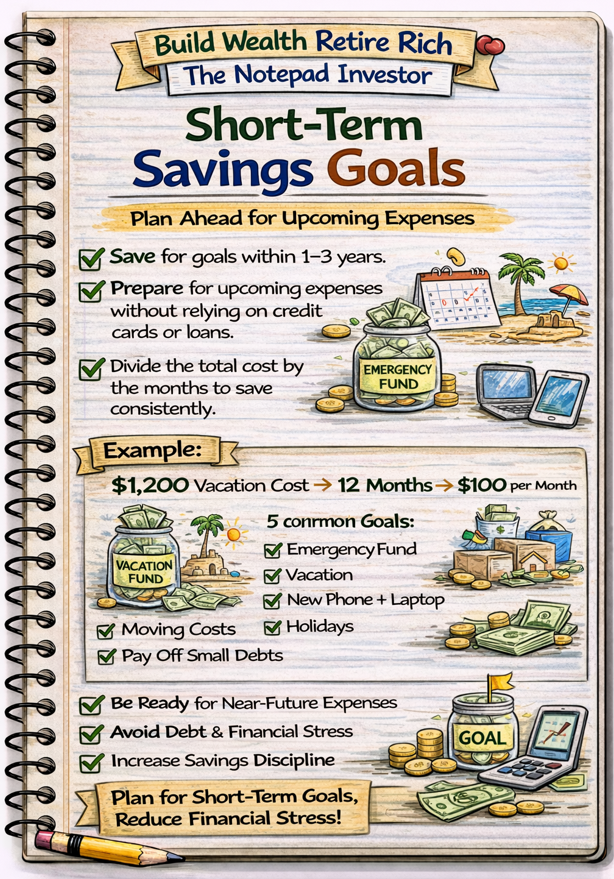
This article is designed for anyone with upcoming expensive purchases, individuals planning major life events requiring funds, or those wanting systematic approach achieving goals without debt. You do not need financial expertise, high income, or perfect circumstances to save for short-term goals—simple dedicated account allocation with timeline-based contributions creates achievable path to targets regardless of income level, though obviously higher incomes enable larger goals or faster achievement while lower incomes require proportional adjustment of goal scope or timeline extending realistic expectations.
Understanding short-term savings goals matters because major purchases financed through debt create years of payments with substantial interest costs versus saving enabling cash purchases, vague “someday” desires without concrete plans rarely materialize while specific targets with timelines create accountability driving systematic progress, and achieving visible short-term wins provides motivation sustaining long-term financial discipline impossible through delayed-gratification-only approaches lacking intermediate victories—making short-term goal setting essential for both practical achievement of upcoming needs and psychological reinforcement enabling sustained wealth-building behaviors through tangible progress markers.
Educational disclaimer: This article provides general educational information about short-term savings goal strategies. Individual circumstances, income levels, expenses, goal priorities, and appropriate timelines vary significantly. Short-term goal recommendations represent general approaches—specific situations require personalized planning. This is not financial planning or professional advice. Consult qualified financial professionals for personalized guidance.
Understanding Short-Term Savings Goals
What Are Short-Term Savings Goals?
Core definition: Specific financial targets achievable within 1-5 years requiring dedicated systematic savings
Time horizon:
- Very short-term: 1-12 months (holiday expenses, minor home improvements, small purchases)
- Short-term: 1-3 years (vacation, appliance replacement, car down payment, wedding)
- Medium-term: 3-5 years (home down payment, vehicle purchase, major home renovation)
Distinguishing characteristics:
- Specific dollar amount and target date
- Too expensive for single paycheck ($1,000-50,000 typical range)
- Too soon for long-term investing (need money within 5 years)
- Not emergency fund (planned expense, specific purpose)
- Dedicated savings approach rather than general accumulation
Common Short-Term Savings Goals
Major purchases:
- Vehicle down payment or cash purchase ($5,000-25,000)
- Home down payment ($15,000-60,000+)
- Furniture and appliances ($2,000-10,000)
- Electronics and technology ($1,000-5,000)
Life events:
- Wedding ($15,000-35,000 average)
- Honeymoon or major vacation ($3,000-15,000)
- Baby preparation and nursery ($2,000-8,000)
- Moving and relocation costs ($3,000-10,000)
Home and property:
- Home maintenance and repairs ($5,000-20,000)
- Renovations and upgrades ($10,000-50,000)
- Property improvements ($5,000-30,000)
Education and career:
- Professional certifications and courses ($1,000-10,000)
- Career transition expenses ($3,000-15,000)
- Business startup costs ($5,000-30,000)
Annual and periodic expenses (sinking funds):
- Holiday gifts and celebrations ($800-3,000 annually)
- Property taxes if not escrowed ($2,000-8,000 annually)
- Insurance premiums paid annually ($1,000-5,000)
- Vehicle registration and maintenance ($500-2,000 annually)
Why Short-Term Goal Saving Matters
Debt avoidance benefits:
- $15,000 wedding financed on credit card at 20% APR
- Paying $400 monthly takes 48 months, total paid $19,200 ($4,200 interest)
- Versus saving $400 monthly for 38 months, pay cash $15,000, zero interest
- 10 months faster payoff plus $4,200 saved
Strategic timing and negotiation:
- Cash buyer negotiates better prices (10-15% discounts possible)
- Can wait for optimal timing (sales, market conditions)
- Not desperate, can walk away from bad deals
- Versus financed purchase: Pressure to buy now, less negotiating power
Psychological benefits:
- Concrete progress toward visible goals maintains motivation
- Achieving short-term wins reinforces long-term discipline
- Reduces stress from knowing major expenses planned and funded
- Pride and satisfaction from achieving goals independently

Setting and Prioritizing Short-Term Goals
Step 1: Identify All Potential Short-Term Goals
Brainstorm exercise:
- List everything requiring savings within next 5 years
- Include both wants (vacation) and needs (car replacement)
- Estimate cost for each item
- Estimate ideal timeframe for each
Example comprehensive list:
- Vacation to Europe: $6,000, desired in 18 months
- Vehicle replacement: $20,000, needed in 3 years (current car aging)
- Home down payment: $30,000, desired in 4 years
- Wedding: $25,000, planned in 2 years
- Emergency fund: $15,000, needed ASAP
- Furniture replacement: $4,000, desired in 1 year
- Holiday expenses: $1,500 annually
Step 2: Prioritize Based on Need and Timeline
Priority framework:
Tier 1 – Essential and urgent:
- Emergency fund (if not yet established)
- Necessary items with deadline (car replacement if current unreliable)
- Non-negotiable upcoming events (committed wedding date)
Tier 2 – Important but flexible timing:
- Major quality-of-life improvements (home down payment)
- Significant planned events (vacation, home renovation)
- Career investments (education, certification)
Tier 3 – Desirable but optional:
- Upgrades and nice-to-haves (furniture, electronics)
- Discretionary experiences (additional vacations)
- Luxury purchases
Step 3: Calculate Required Monthly Savings
Formula: Goal amount ÷ months until target date = monthly savings needed
Example calculations:
- Europe vacation $6,000 in 18 months: $6,000 ÷ 18 = $333/month
- Vehicle $20,000 in 36 months: $20,000 ÷ 36 = $556/month
- Wedding $25,000 in 24 months: $25,000 ÷ 24 = $1,042/month
- Furniture $4,000 in 12 months: $4,000 ÷ 12 = $333/month
Total if pursuing all simultaneously: $333 + $556 + $1,042 + $333 = $2,264/month
Step 4: Reality Check Against Income
Assess feasibility:
- Calculate total available for goals after essentials and retirement
- Example: $5,000 monthly income, $3,500 expenses, $500 retirement = $1,000 available
- But goals need $2,264 monthly—not feasible
Adjustment options:
- Extend timelines: Wedding in 36 months not 24 ($694/month vs $1,042)
- Reduce scope: Wedding $15,000 not $25,000 ($625/month vs $1,042)
- Defer some goals: Furniture delayed until after wedding
- Sequential approach: Focus on one goal at a time versus simultaneous
- Increase income: Side hustle, overtime, raises to expand capacity
Revised realistic plan:
- Emergency fund: $300/month (priority, building to $15,000)
- Wedding: $625/month (reduced scope to $15,000 in 24 months)
- Holiday sinking fund: $75/month ($900 annually)
- Total: $1,000/month within budget
- Vehicle and home down payment: Addressed after wedding through saved wedding allocation
Implementing Short-Term Savings Strategy
Opening Dedicated Accounts
Separate account per major goal:
- Wedding savings account
- Vacation savings account
- Vehicle down payment account
- Home down payment account
Benefits of separation:
- Clear progress tracking per goal
- Prevents robbing one goal to fund another unconsciously
- Psychological satisfaction seeing specific goals grow
- Mental accounting reducing temptation to spend
Practical implementation:
- Many online banks allow multiple free savings accounts
- Name each account clearly for its purpose
- Or use single account with manual tracking spreadsheet if multiple accounts unavailable
Where to Keep Short-Term Savings
Timeline-based allocation:
0-12 months goals: High-yield savings account
- Currently 4-5% APY at online banks
- Completely liquid and safe
- No market risk when money needed soon
- FDIC insured
1-3 year goals: High-yield savings or short-term CDs
- Primarily high-yield savings for flexibility
- Optional: 6-12 month CD ladder for portion if timeline certain
- Slightly higher rates but less flexible
3-5 year goals: Conservative investment mix (optional)
- If timeline flexible and comfortable with minimal risk
- 60% bonds, 40% stocks typical conservative allocation
- Potential for higher returns but some volatility risk
- Only if can tolerate 10-20% temporary decline without disrupting goal
- Many prefer keeping even 5-year goals in savings avoiding all market risk
NOT recommended for short-term goals:
- Aggressive stock investments (too volatile for near-term needs)
- Crypto (extreme volatility inappropriate)
- Long-term CDs (inflexibility if timeline changes)
Automating Goal Contributions
Set up automatic transfers:
- Day after payday
- Specific amount to each goal account
- Pay yourself first for goals like you do for retirement
Example automation:
- Paycheck deposits: 1st and 15th monthly
- Automatic transfers on 2nd and 16th:
- $312.50 → Wedding savings (total $625/month)
- $150 → Emergency fund (total $300/month)
- $37.50 → Holiday fund (total $75/month)
Tracking Progress and Staying Motivated
Visual progress tools:
- Thermometer chart showing progress toward goal
- Percentage complete calculations
- Countdown to target date
- Milestone celebrations (25%, 50%, 75%, 100%)
Regular review schedule:
- Monthly: Check all goal account balances
- Quarterly: Assess if on track or adjustments needed
- Annually: Reassess priorities and timelines
Motivation maintenance:
- Keep visual reminder of goal (picture of destination, house, car)
- Calculate and celebrate milestones achieved
- Share progress with accountability partner
- Remind yourself of debt avoided and interest saved
Balancing Short-Term and Long-Term Savings
The Complete Savings Allocation
Total savings capacity: 20% of gross income example
Recommended allocation framework:
- Retirement (long-term): 10-15% – Non-negotiable foundation
- Emergency fund: Until 3-6 months saved – Priority before other goals
- Short-term goals: 5-10% – After emergency fund established
Example allocation at $5,000 monthly gross income:
- 20% savings capacity = $1,000 monthly total
- Retirement 401(k): $500 (10%)
- Emergency fund: $300 (6%, until complete)
- Short-term goals: $200 (4%)
After emergency fund complete:
- Retirement: $500 (10%)
- Short-term goals: $500 (10%, increased from $200)
- Emergency fund: $0 (complete, only replenish if used)
Prioritization Sequencing
Standard recommended order:
- Employer 401(k) match (free money, always capture)
- Starter emergency fund $1,000-2,000
- High-interest debt payoff (credit cards over 15% APR)
- Full emergency fund 3-6 months expenses
- Retirement savings to 15% of gross income
- Short-term goal savings
- Extra retirement or additional goals
Exception for time-sensitive goals:
- Wedding in 12 months may take temporary priority over aggressive retirement
- Maintain minimum 401(k) match capture
- Temporarily reduce retirement to 5-10% while funding urgent short-term goal
- Resume normal retirement savings after goal achieved
- Acceptable deviation for specific limited-time circumstances
When to Adjust or Abandon Goals
Signs goal needs revision:
- Consistently unable to maintain planned contributions
- Timeline unrealistic given actual saving capacity
- Priorities shifted (more important goal emerged)
- Income reduction making goal unaffordable
Adjustment options:
- Extend timeline giving more time to save
- Reduce scope making goal more affordable
- Pause temporarily focusing on higher priority
- Abandon entirely if no longer aligned with values
Example adjustment:
- Original: $30,000 home down payment in 3 years ($833/month)
- Reality: Can only save $400/month realistically
- Adjustment options:
- Option 1: Extend to 6 years at $400/month
- Option 2: Reduce to $15,000 in 3 years at $417/month
- Option 3: Save $400/month for 3 years = $14,400, accept smaller down payment
Advanced Short-Term Savings Strategies
Sinking Funds for Recurring Expenses
Concept: Convert irregular annual expenses to smooth monthly savings
Common sinking fund categories:
- Holiday gifts: $1,200 annually ÷ 12 = $100 monthly
- Car insurance: $1,800 annually ÷ 12 = $150 monthly
- Property taxes: $3,600 annually ÷ 12 = $300 monthly
- Car maintenance: $1,200 annually ÷ 12 = $100 monthly
- Home maintenance: $2,400 annually ÷ 12 = $200 monthly
Benefit: Large lump sums don’t disrupt monthly budget when due
Opportunity Fund Strategy
Purpose: Savings reserved for unexpected opportunities not emergencies
Examples:
- Limited-time investment opportunities
- Discounted bulk purchases of needed items
- Unexpected travel deals aligned with goals
- Career opportunities requiring upfront investment
Distinction from emergency fund:
- Emergency fund: Cover unexpected problems (job loss, repairs)
- Opportunity fund: Seize unexpected positive chances
- Keeps emergency fund preserved while enabling strategic opportunism
Goal Laddering
Sequential achievement approach:
- Focus full short-term goal allocation on single highest priority
- Achieve faster through concentrated effort
- After completion, redirect full allocation to next priority
Example ladder:
- Phase 1 (Months 1-5): $1,000/month → Emergency fund to $5,000
- Phase 2 (Months 6-11): $1,000/month → Vacation $6,000
- Phase 3 (Months 12-31): $1,000/month → Vehicle down payment $20,000
- Total 31 months achieving three goals versus spreading $333 each taking much longer
Pros: Faster achievement, maintained motivation through frequent wins
Cons: Other goals delayed, requires discipline not accessing funds for other goals
Windfall Allocation
Strategic use of irregular income:
- Tax refunds
- Work bonuses
- Gifts
- Inheritances
- Side income
Recommended allocation:
- 50% to short-term goals (accelerate progress)
- 30% to long-term savings/investments
- 20% to guilt-free spending
Example: $4,000 tax refund
- $2,000 → Wedding savings (major boost)
- $1,200 → Roth IRA contribution
- $800 → Enjoy guilt-free
Why Short-Term Savings Goals Matter
Without dedicated short-term goal savings, major purchases get financed through debt creating years of interest payments and financial burden versus cash purchases, vague “someday” desires without concrete plans rarely materialize lacking accountability and systematic approach, and absence of visible intermediate wins makes sustained long-term discipline psychologically difficult without tangible progress markers—while short-term goal savers avoid debt on major purchases saving thousands in interest, achieve concrete objectives through systematic planning and execution impossible with vague intentions, and maintain motivation for broader financial discipline through regular achievement of visible milestones reinforcing behaviors essential for ultimate financial success.
Understanding and implementing short-term savings goals enables individuals to:
- Achieve major life milestones debt-free through planned accumulation
- Avoid thousands in interest costs from financing large purchases
- Negotiate better prices through cash purchasing power
- Maintain psychological motivation through visible concrete progress
- Coordinate multiple goals through systematic prioritization and allocation
- Reduce financial stress through knowing major expenses planned and funded
- Build discipline and habits supporting broader long-term wealth building
Short-term savings goals transform vague aspirations into concrete achievements through systematic planning creating both practical financial benefits and psychological reinforcement essential for sustained wealth-building success.
Common Misunderstandings
Many people assume retirement savings must reach maximum before saving for any short-term goals making near-term objectives inaccessible. In reality, balanced approach saving 10-15% for retirement while simultaneously allocating 5-10% for short-term goals creates comprehensive strategy addressing both future security and present life milestones, proving retirement and short-term goal saving compatible through proportional allocation not either-or proposition requiring complete focus on one timeframe exclusively.
Another common misconception is that short-term goals under $5,000 don’t need dedicated accounts making simple spending from regular savings adequate. In practice, dedicated separate accounts create psychological commitment and tracking clarity dramatically improving achievement rates—even $2,000 vacation fund benefits from separation preventing unconscious spending and enabling progress monitoring, proving account separation valuable regardless of absolute goal size through mental accounting and commitment device effects.
Some believe investing short-term goal money in stocks provides growth opportunity justifying market risk for 2-3 year timelines. However, market volatility means needing funds during 20-30% decline forces selling at loss potentially destroying substantial portion of goal savings, proving safe liquid savings appropriate for short-term goals despite lower returns than stocks—purpose is preservation and availability when needed not growth maximization risking goal achievement through inappropriate risk exposure.
How Short-Term Savings Goals Fit Into Financial Success
Short-term savings goals provide essential bridge between immediate needs and long-term wealth building through systematic achievement of life milestones, create psychological reinforcement maintaining discipline through visible tangible progress markers impossible with delayed-gratification-only approaches, and enable debt-free major purchases avoiding interest costs while building saving habits transferable to all financial domains, making short-term goal setting critical component of complete financial success strategy impossible to achieve through exclusive focus on either present consumption or distant retirement without systematic middle-ground planning.
For example, two couples both age 28 planning weddings and eventually home purchases. Couple A focuses exclusively on retirement maxing 401(k)s contributing 15% income ($750 monthly each, $1,500 total) building long-term wealth—admirable retirement focus. But wedding in 18 months, no wedding savings, finances $20,000 on credit cards at 18% APR paying $500 monthly for 54 months, total paid $27,000 ($7,000 interest). Home down payment needed in 5 years, no savings, continues renting building no equity. After 10 years: Strong retirement accounts ($220,000 combined), but still renting, spent 5 years paying wedding debt, frustrated by lack of progress on life goals despite aggressive retirement saving. Couple B balanced approach: 10% retirement ($500 monthly each, $1,000 total), 10% short-term goals ($500 each, $1,000 total). Wedding fund: Saves $18,000 over 18 months paying cash. Home fund: Saves $60,000 over 5 years buying home. After 10 years: Solid retirement accounts ($147,000 combined), owns home building equity, achieved wedding debt-free, life progressing on all fronts. Couple A has $73,000 more retirement wealth but rents, endured years of debt payments, life goals perpetually deferred creating frustration. Couple B achieved balanced success—home ownership, debt-free wedding, retirement on track, life milestones accomplished systematically. Difference: Couple B recognized short-term goals matter for quality of life and psychology, creating comprehensive approach versus Couple A’s exclusive long-term focus leaving present life perpetually waiting for distant future.
Short-term savings goals separate balanced comprehensive financial success from narrow delayed-gratification approaches achieving retirement security but deferring all present life progress creating frustration undermining sustained discipline impossible to maintain indefinitely without intermediate rewards and tangible achievements.
Recent Updates and Trends
In recent years, high-yield savings rates improving to 4-5% have made short-term goal savings more attractive—meaningful returns while maintaining safety and liquidity, reducing opportunity cost of keeping funds accessible versus investing making conservative approach more appealing.
Multiple savings account availability has expanded—online banks offering unlimited free sub-accounts enabling dedicated account per goal without fees, dramatically simplifying goal separation and tracking previously requiring manual spreadsheets or physical envelope systems.
Wedding and home costs have increased substantially—average wedding rising from $20,000 to $30,000+ and down payments requiring larger absolute amounts due to housing appreciation, making systematic goal saving more critical than historical periods when absolute amounts smaller and more achievable through shorter-term saving.
Experience economy emphasis has shifted goals—younger generations prioritizing travel and experiences over material purchases, changing typical short-term goal mix toward experience-based objectives requiring different planning (timing-dependent, non-refundable deposits) versus traditional purchase goals offering more flexibility.
Fundamental short-term savings goal principles remain timeless: specific targets with timelines create accountability driving systematic progress, dedicated separation improves achievement through psychological commitment, balanced allocation addressing both long-term security and near-term life milestones produces comprehensive success, and visible achievement of concrete goals provides motivation essential for sustained broader financial discipline—regardless of interest rates, account availability, cost trends, or goal type preferences, systematic short-term goal planning produces debt-free achievement of life milestones while building financial habits supporting ultimate long-term wealth building success.
3 Things You Can Do Today
Ready to implement short-term savings goals? Here are three simple steps you can take right now:
1. Identify and prioritize your top 3 short-term goals with specific amounts and timelines – Make list of everything requiring savings within 5 years. For each item: estimate cost, determine target date. Examples: Vacation $4,000 in 12 months, vehicle down payment $8,000 in 30 months, home improvement $6,000 in 18 months. Choose top 3 priorities based on: necessity (need vs want), timeline urgency (soonest first), importance to quality of life. Write these clearly: “Goal 1: [Name] $[Amount] by [Date].” This transforms vague intentions into concrete targets. Takes 20 minutes creating clarity from ambiguous “someday” desires into specific measurable objectives with deadlines creating accountability.
2. Calculate required monthly savings for each goal and reality-check against budget – For each priority goal: Amount ÷ months until date = monthly savings needed. Example: $4,000 vacation in 12 months = $333/month. $8,000 vehicle in 30 months = $267/month. Total all goals: $333 + $267 = $600/month. Compare to available savings capacity after essential expenses and retirement. If total exceeds capacity, adjust: extend timelines (vehicle in 36 months = $222/month), reduce scope (vacation $3,000 = $250/month), or sequential approach (one at a time not simultaneous). Final realistic plan should fit budget. Takes 15 minutes ensuring goals achievable not fantasy creating guaranteed failure and discouragement.
3. Open one dedicated high-yield savings account for your #1 priority goal and automate first contribution – Choose highest priority goal from step 1. Open high-yield savings account at online bank (Marcus, Ally, Capital One 360) earning 4-5% APY. Application takes 15 minutes online. Name account clearly for goal: “Europe Vacation Fund” or “Vehicle Down Payment.” Set up automatic transfer from checking: calculated monthly amount (from step 2) scheduled day after payday. This implements pay-yourself-first for goal—happens automatically requiring no further action. Initial transfer if possible starting account with $50-100. Takes 30 minutes total creating systematic building. Without automation, good intentions rarely produce actual saving—automatic transfer ensures consistent progress regardless of motivation or busy life.
These actions create complete short-term goal system within one day—identified priorities with concrete targets, calculated realistic achievement path fitting budget, and automated execution removing willpower dependency—transforming vague future desires into systematic present accumulation producing guaranteed achievement impossible through hoping and waiting.
Quick FAQ
Should I save for short-term goals or maximize retirement contributions first?
Balanced approach: Minimum 10-15% retirement (including employer match), then 5-10% short-term goals. Not either-or—both matter. Retirement provides long-term security, short-term goals enable present life progress and psychological motivation through visible wins. Exception: Time-sensitive urgent goal (wedding in 6 months) may temporarily reduce retirement to minimum match while funding goal, resuming normal retirement after achievement. Complete neglect of either timeframe creates problems—only retirement focus defers all present life indefinitely, only short-term focus sacrifices future security. Balance produces comprehensive success.
Where should I keep money for goals 2-3 years away?
High-yield savings account (4-5% APY) recommended for most people—safe, liquid, no market risk when money needed. Conservative alternative if comfortable with minimal volatility: 60% bonds/40% stocks but only if timeline flexible and can tolerate potential 10-15% temporary decline without derailing goal. Most financial advisors recommend savings accounts for anything under 5 years avoiding market risk when timeline certain. Returns difference (maybe 2-3% higher in conservative investments) usually not worth risk of needing money during market decline destroying substantial portion of goal savings.
How many separate savings accounts should I have for different goals?
Ideal: One account per major goal (wedding, vacation, vehicle, home) if bank allows free unlimited sub-accounts. Minimum: Separate account for largest goal plus spreadsheet tracking other goals if multiple accounts unavailable or too complex. Maximum: Whatever number you can track without confusion (typically 5-7 max). Benefits of separation: Clear progress tracking, psychological commitment, prevents unconscious transfers between goals. But don’t let perfect be enemy of good—single savings account with manual tracking still far better than no goal saving at all.
What if I need money from short-term goal savings before reaching target?
Assess: Genuine emergency (use emergency fund not goal savings) or competing priority? If genuine higher priority emerged: Okay to redirect but do consciously—explicitly decide new priority worth sacrificing original goal. If temptation not genuine need: Resist by reminding yourself of original goal importance, visualizing disappointment if goal abandoned, calculating how long rebuilding takes. Create friction: Separate bank requiring 2-3 days transfer prevents impulsive withdrawals. Remember: Every withdrawal delays goal—$1,000 taken from $6,000 vacation fund sets achievement back 3 months at $333/month saving rate.
Should sinking funds for annual expenses count as short-term goals?
Separate category though mechanically similar. Sinking funds = predictable recurring expenses (property taxes, insurance premiums, holiday gifts) converted to monthly savings preventing budget disruption when due. Short-term goals = new purchases or experiences. Both use dedicated savings but different purposes: Sinking funds maintain current lifestyle smoothly, short-term goals enable new additions to lifestyle. Budget both: Sinking funds in “essential” category since recurring obligations, short-term goals in “discretionary savings” category since optional objectives. Together they prevent: (1) Surprises from predictable expenses, (2) Debt from major planned purchases.
How do I stay motivated when short-term goals take years to achieve?
Six strategies: (1) Visual tracking—thermometer chart showing progress, (2) Milestone celebrations—celebrate 25%, 50%, 75% achievement not just 100%, (3) Regular review—monthly balance checks showing growth, (4) Opportunity cost reminders—calculate interest saved by avoiding debt financing, (5) Goal imagery—pictures of destination, house, car reinforcing motivation, (6) Partial wins—consider smaller related achievements while building (weekend getaway while saving for Europe trip). Also: Front-load wins through goal laddering—achieve smaller goals first (6-month goals before 3-year goals) creating momentum through frequent victories maintaining motivation for longer-term objectives.
Explore More in Money Basics
Disclosure
This article is provided for educational purposes only and does not constitute financial planning or investment advice. Short-term savings goal strategies represent general approaches—individual circumstances, priorities, income levels, and timelines vary significantly. High-yield savings rates fluctuate with market conditions—rates mentioned may change. Conservative investment approaches for 3-5 year goals carry market risk—principal loss possible despite conservative allocation. Examples use simplified scenarios—actual situations more complex. Timeline recommendations represent general guidelines—specific needs differ. Account features and capabilities vary by institution. Building timelines assume consistent contributions—reality includes interruptions and adjustments. Consult qualified financial planners and advisors for personalized guidance tailored to specific circumstances. Advertisements or sponsored content may appear within or alongside this content. All information is presented independently.