Category: The Campus Investor

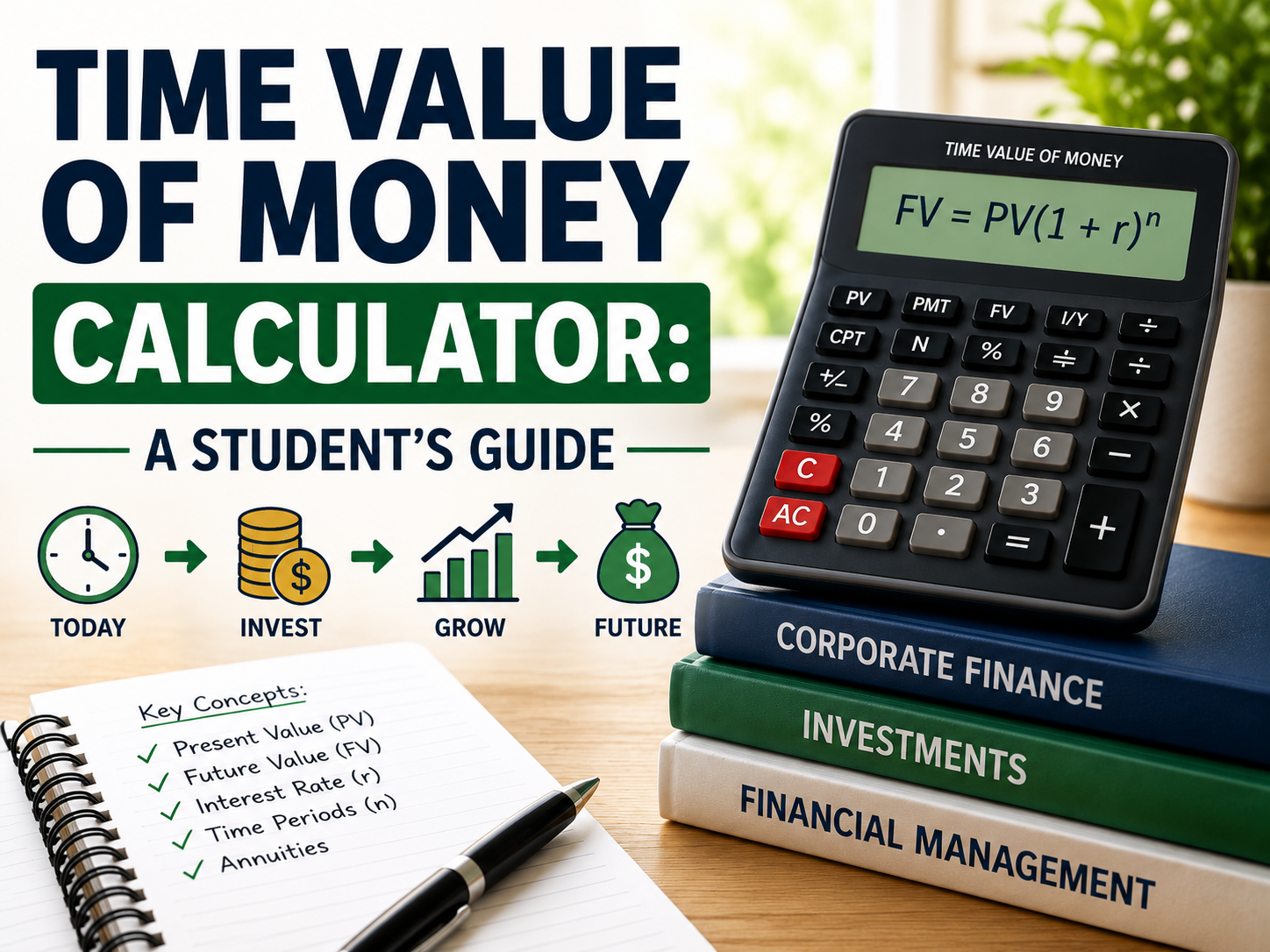
  • Time Value of Money Calculator: A Student’s Guide

    Time Value of Money Calculator: A Student’s Guide

    Time Value of Money Calculator: A Student’s Guide | The Campus Investor
    The Campus Investor
    Build Wealth from Day One
    🧮 Financial Tools  ·  Calculator Guide

    Time Value of Money Calculator: A Student’s Guide

    May 2026 | 8 min read | For College Students

    The Time Value of Money (TVM) Calculator is one of the most powerful financial tools a student can learn to use — and one of the most confusing at first glance. Five variables, a sign convention that trips everyone up, two modes that change your answer, and a compounding dropdown that most people ignore.

    This guide breaks every part of the calculator down — plainly, with real student examples — so you can use it confidently to solve any TVM problem: investment growth, loan payments, savings goals, and more.

    What is the Time Value of Money?

    The core idea behind every TVM calculation is simple: a dollar today is worth more than a dollar tomorrow. Why? Because a dollar you have right now can be invested and grow. A dollar promised to you in the future can’t be invested yet — so it’s worth less in today’s terms.

    This principle underpins almost every financial decision: how much a loan will cost you, how much you need to save to reach a goal, what your investments will be worth at retirement, and whether a lump sum payment or an annuity is the better deal.

    “Time value of money is not just a finance concept. It’s the reason investing early beats investing more — and the reason carrying debt costs you more than the interest rate suggests.”

    The Calculator — Every Field Explained

    Here is what the TVM calculator looks like — with every field labelled so you know exactly what you’re looking at before entering a single number:

    TVM Calculator

    Mode: End Beginning
    Label Value Compute
    Present Value: e.g. -200 PV
    Payments: e.g. -50 PMT
    Future Value: e.g. -1000 FV
    Annual Rate (%): e.g. 10 Rate
    Periods (years): e.g. 5 Periods
    Compounding:
    Annually
    Reset
    Build Wealth Retire Rich: Time Value of Money Calculator

    The logic is always the same: enter any four of the five variables, then click the Compute button for the fifth. The calculator solves for the unknown. The key is knowing what each variable means, what sign to give it, and which mode to use.

    The 5 Variables: PV, PMT, FV, Rate, Periods

    Every TVM problem involves five variables. You always know four of them and solve for the fifth. Here’s exactly what each one means in plain English — with real student contexts:

    PV

    Present Value

    The value of money today — either an amount you have right now, or the current worth of a future cash flow. In borrowing it’s the loan amount. In investing it’s your starting deposit.

    Student examples: $5,000 student loan taken out today $500 you deposit into a Roth IRA today Current value of a $1,000 bond maturing in 5 years
    PMT

    Payments (Annuity)

    A regular recurring payment made at equal intervals — either money going out (loan payments, regular savings contributions) or money coming in (income from an annuity). Enter 0 if there are no recurring payments.

    Student examples: $150/month loan repayment $50/month invested into an index fund $0 (lump-sum problems with no regular payments)
    FV

    Future Value

    The value of money at a specific point in the future, after growth or after a series of payments. This is what you’re solving for when asking “what will my investment be worth in 30 years?” or “how much will I owe at the end of this loan?”

    Student examples: What your Roth IRA will be worth at 65 The final payoff amount on a loan $0 (for a fully amortising loan that ends at zero)
    r

    Annual Rate (%)

    The annual interest rate — entered as a percentage, not a decimal (enter 7, not 0.07). For investments this is your expected annual return. For loans it’s the APR. The calculator adjusts for compounding frequency automatically.

    Student examples: 7 (for 7% average investment return) 6.5 (federal student loan rate) 24 (typical credit card APR)
    N

    Periods (Years)

    The total number of time periods — usually years, but can be months if your payment frequency is monthly. If you’re solving a 30-year mortgage with monthly payments, enter 30 years (the calculator accounts for compounding frequency). If your calculator uses periods in months directly, enter 360 (30 × 12).

    Student examples: 10 years of investing from age 20 to 30 45 years until retirement (age 20 to 65) 5 years on a car loan 4 years of college remaining

    The Sign Convention — Why Negative Numbers Matter

    This is where almost every beginner gets confused — and where most wrong answers come from. TVM calculators use a cash flow sign convention: money flowing out of your pocket is negative; money flowing into your pocket is positive.

    💡 The Sign Convention — Always Think From Your Perspective

    Negative (Money Out)

    Cash that leaves your hands. You invest it, pay it out, or deposit it somewhere. You no longer have this money in your pocket.

    Examples: loan payment you make, deposit into savings, money you invest today

    +
    Positive (Money In)

    Cash that arrives in your hands. You receive it, earn it, or withdraw it. This money is coming into your pocket.

    Examples: loan proceeds you receive, investment payout, cash you withdraw

    The most important rule: PV and FV must have opposite signs when money flows in one direction. If you enter a negative PV (money you invest today), FV will compute as positive (money you receive later). If you enter a positive PV (loan proceeds you receive), FV will compute as negative (amount you owe at the end).

    ⚠️ The Most Common Sign Mistake

    Entering PV and PMT with the same sign when they should have opposite signs is the single most common TVM error. If you’re making regular payments on a loan (PMT is negative — money leaving you), the loan you received (PV) must be positive — money that came to you. If you get an error or an absurd answer, check your signs first.

    End vs Beginning Mode

    The Mode selector at the top of the calculator — End or Beginning — determines when payments occur within each period. For most student problems, End mode is correct.

    End Mode (Ordinary Annuity)

    Payments at the End of Each Period

    The most common setting. Payments are made or received at the end of each period — after the interest for that period has been calculated.

    This is how most loans, mortgages, and regular savings plans work. Your monthly mortgage payment is due at the end of the month, after that month’s interest has accrued.

    ✓ Use for: student loan payments, car loans, monthly savings contributions, most investment problems
    Beginning Mode (Annuity Due)

    Payments at the Start of Each Period

    Less common. Payments occur at the beginning of each period — before interest is calculated for that period. This means each payment earns (or avoids) one extra period of interest.

    Beginning mode produces a slightly higher future value for investments and a slightly lower present value for loans, because money is working for one more period.

    ✓ Use for: rent paid at month start, lease payments, some annuities specified as “due”
    📐 How Much Does Mode Actually Change Your Answer?

    Switching from End to Beginning mode on a $200/month investment at 7% over 30 years changes the result from approximately $244,000 to approximately $245,000 — a difference of about $1,000. The effect grows with the rate and the number of periods. For most homework and real-life problems, End mode is correct unless the problem specifically states “annuity due” or “beginning of period.”

    Compounding Frequency Explained

    The Compounding dropdown controls how many times per year interest is applied to the balance. The more frequently interest compounds, the slightly more you earn (or owe). Here’s how the options compare on a $10,000 balance at 7% over 10 years:

    Compounding Option Times/Year Balance at 10 Years Interest Earned
    Annually $19,672 $9,672
    Semi-annually $19,898 $9,898
    Quarterly $20,016 $10,016
    Monthly Most Common 12× $20,097 $10,097
    Daily 365× $20,136 $10,136

    For most investment problems, select Monthly — this matches how most brokerages, savings accounts, and loan products compound. For problems where the question specifies a different frequency (e.g. “compounded quarterly”), match it exactly. The difference is small but matters for precise answers.

    Step-by-Step Examples for Students

    Here are four common student scenarios — each solved step by step using the TVM calculator.

    Example 1 · Investing

    “What will my $75/month investment be worth in 40 years?”

    You invest $75 every month into a Roth IRA starting at age 22. You expect a 7% average annual return. You want to know your balance at age 62.

    • 1

      PV = 0  — You’re starting with no lump sum today. Just monthly contributions.

    • 2

      PMT = −75  — $75 leaves your pocket each month. Negative because it’s money out.

    • 3

      FV = ?  — This is what you’re solving for. Leave it blank and click Compute FV.

    • 4

      Rate = 7  — Enter 7 for 7% annual return.

    • 5

      Periods = 40  — 40 years from age 22 to 62.

    • 6

      Mode = End  — Monthly contributions at end of each period. Compounding = Monthly.

    ✓ Result: FV ≈ $196,861 — Your $75/month grows to approximately $197,000 over 40 years. You contributed $36,000 — compound interest added ~$161,000.
    Example 2 · Loans

    “What are my monthly payments on a $15,000 car loan at 6% over 5 years?”

    You’re financing a used car. The loan is $15,000 at 6% APR over 5 years. You want to know your monthly payment.

    • 1

      PV = +15,000  — You receive $15,000 from the lender. Positive because money is coming to you.

    • 2

      PMT = ?  — This is what you’re solving for. Click Compute PMT.

    • 3

      FV = 0  — The loan fully pays off (ends at zero balance).

    • 4

      Rate = 6  — Enter 6 for 6% APR.

    • 5

      Periods = 5  — 5-year loan term. Compounding = Monthly.

    • 6

      Mode = End  — Standard loan payments at end of each period.

    ✓ Result: PMT ≈ −$289.99/month — The negative sign confirms money is leaving you each month. You’ll pay approximately $290/month, totalling ~$17,400 over 5 years. The extra $2,400 is interest.
    Example 3 · Savings Goal

    “How much do I need to save monthly to have $10,000 in 3 years?”

    You want $10,000 saved in 3 years for a down payment. You’ll earn 5% APY in a high-yield savings account. How much do you need to save each month?

    • 1

      PV = 0  — Starting from nothing today.

    • 2

      PMT = ?  — What you’re solving for. Click Compute PMT.

    • 3

      FV = +10,000  — The $10,000 you want to receive in 3 years. Positive because it’s money coming to you.

    • 4

      Rate = 5  — 5% APY savings account.

    • 5

      Periods = 3  — 3 years. Compounding = Monthly.

    • 6

      Mode = End  — Monthly deposits at end of each period.

    ✓ Result: PMT = −$258.04/month — You need to save approximately $258 per month to reach $10,000 in 3 years at 5% APY. Without interest you’d need $278/month — the HYSA saves you about $720 in required contributions.
    Example 4 · Interest Rate

    “What interest rate am I actually paying on this loan?”

    You borrowed $2,000 and agreed to pay $95/month for 24 months. What is the actual annual interest rate you’re being charged?

    • 1

      PV = +2,000  — You received $2,000. Positive.

    • 2

      PMT = −95  — You pay $95 per month. Negative.

    • 3

      FV = 0  — Loan fully paid off at end.

    • 4

      Rate = ?  — What you’re solving for. Click Compute Rate.

    • 5

      Periods = 2  — 2-year loan (24 months). Compounding = Monthly.

    • 6

      Mode = End.

    ✓ Result: Rate ≈ 12.9% APR — You’re paying 12.9% annually on this loan. If someone told you it was “only $95 a month,” that hides the true rate. Using the TVM calculator revealed what the actual cost of borrowing is — always check the rate before signing.

    Quick Reference — What to Enter for Common Problems

    Bookmark this. For each type of TVM problem, here’s exactly what to enter and what to solve for:

    PV PMT FV Rate N Solve for Use Case
    0 −monthly amt ? return % years FV Future value of regular investments (e.g. monthly Roth IRA)
    −lump sum 0 ? return % years FV Growth of a one-time deposit (e.g. $500 invested today)
    +loan amt ? 0 APR % years PMT Monthly loan or mortgage payment
    0 ? +goal amt return % years PMT Monthly savings needed to reach a goal
    +loan amt −payment 0 ? years Rate True interest rate on a loan
    0 −monthly amt +goal amt return % ? Periods How many years to reach a savings goal
    ? 0 +future amt rate % years PV Present value of a future amount (what is $50K in 10 years worth today?)
    ◆ ◆ ◆

    TVM Calculator — Common Mistakes to Avoid

    • Wrong signs: PV and FV should almost always have opposite signs. PMT direction matches whichever it flows with — money you pay is negative, money you receive is positive
    • Wrong mode: Default to End mode unless the problem specifically says “beginning of period,” “annuity due,” or “rent paid in advance”
    • Wrong compounding: Match the compounding frequency to the payment frequency or what the problem specifies — Monthly for most loan and savings problems
    • Entering rate as decimal: Enter 7, not 0.07. The field expects a percentage, not a decimal
    • Not clearing previous inputs: Always hit Reset before a new problem — leftover values from a previous calculation will corrupt your answer
    • Forgetting to enter FV = 0 for loans: A fully amortising loan ends at a zero balance — always enter FV = 0 unless the problem specifies a balloon payment

    Frequently Asked Questions

    What does the TVM calculator solve?
    The TVM (Time Value of Money) calculator solves for any one of five variables — PV (present value), PMT (regular payment), FV (future value), Rate (annual interest rate), or N (number of periods) — when you provide the other four. It applies the mathematical relationship between money today and money in the future, accounting for interest rates and compounding frequency.
    Why do I need to use negative numbers in a TVM calculator?
    TVM calculators use a cash flow sign convention: money leaving your pocket is negative, money entering your pocket is positive. This allows the calculator to correctly model the direction of cash flows. If you invest $500 today (money out = negative PV), the calculator knows to return a positive FV (money you’ll receive later). Entering both PV and FV as the same sign would produce an error or an incorrect result.
    What is the difference between End and Beginning mode?
    End mode (ordinary annuity) means payments occur at the end of each period — this is the default and covers most loans, mortgages, and regular investment contributions. Beginning mode (annuity due) means payments occur at the start of each period — used for rent paid in advance or leases. Beginning mode produces a slightly higher future value because each payment has one extra period to grow or save interest.
    Which compounding setting should I use for most problems?
    Use Monthly for most practical problems — it matches the payment frequency for most loans, savings accounts, and investment contributions. If a problem or financial product specifies a different compounding frequency (quarterly, annually, etc.), match it exactly. When comparing products, always make sure you’re using the same compounding setting for a fair comparison.
    How do I use the TVM calculator for student loan repayment?
    Enter: PV = your total loan balance (positive — you received this money), PMT = solve for this (click Compute PMT), FV = 0 (loan fully paid off), Rate = your loan’s annual interest rate, N = repayment period in years. Set Mode to End and Compounding to Monthly. The result will be a negative monthly payment — negative because it’s money leaving your pocket each month.

    The Campus Investor  ·  Financial Tools Guide  ·  TVM Calculator

    Written for students who want to graduate smart — and retire rich.

  • Why You Should Start Investing in Your 20s

    Why You Should Start Investing in Your 20s

    Why You Should Start Investing in Your 20s | The Campus Investor
    The Campus Investor
    Build Wealth from Day One
    📈 Issue No. 07  ·  Investing Series

    Why You Should Start Investing in Your 20s

    May 2026 | 7 min read | For College Students

    Here is a financial truth that nobody tells you loudly enough: your 20s are the single most powerful investing decade of your entire life. Not your 40s when you have more money. Not your 50s when you’re thinking seriously about retirement. Your 20s — right now — when time is working completely in your favor and every dollar you invest is worth more than any dollar you’ll invest later.

    Most people understand this in theory and do nothing about it. They’re waiting for more money, less debt, a better time, more certainty. Every year they wait costs them more than the entire amount they would have invested. This issue is about making that math so clear it becomes impossible to ignore.

    ~$323K
    What $100/month invested at 20 becomes by 65 at 6.5% return
    $160K
    What the same $100/month becomes if you start at 30 instead
    10 yrs
    The gap in start date that cuts your outcome nearly in half

    The Math That Makes Your 20s Irreplaceable

    Compound interest is the engine of wealth building — and it runs on one fuel: time. The longer money stays invested, the more aggressively it compounds. Each year of growth doesn’t just add to your balance — it multiplies it. And the multiplications in your 20s are the most powerful because they have the most future years to keep compounding.

    Here’s the simplest way to see it. A single $1,000 invested at age 20, never touched, grows at 7% average annual return:

    Age 20
    💰 $1,000 invested
    $1,000
    Age 30
    📈 First decade of growth
    ~$1,967
    Age 40
    📈 Two decades of growth
    ~$3,870
    Age 50
    📈 Three decades of growth
    ~$7,612
    Age 60
    📈 Four decades of growth
    ~$14,974
    Age 65
    🏆 45 years compounded
    ~$21,002
    Actively growing One $1,000 investment · 7% average annual return · no additional contributions

    A single $1,000 invested at 20 becomes over $21,000 by 65 — a 21x return — without a single additional dollar contributed. That same $1,000 invested at 40 becomes about $7,600. The money invested in your 20s earns returns for four decades. Money invested at 40 earns them for two and a half. The dollars are identical. The time is not.

    📐 The Rule of 72 — Applied to Your 20s

    At 7% annual return, money doubles every ~10 years. A dollar invested at 20 doubles four times before retirement — $1 → $2 → $4 → $8 → $16. A dollar invested at 40 doubles twice — $1 → $2 → $4. Same dollar. Same return. The difference is entirely when the clock started.

    Two Investors, One Number That Says Everything

    The most powerful way to understand early investing isn’t abstract math — it’s a direct comparison. Meet Alex and Jordan. Same age. Same investment return. Dramatically different outcomes.

    Early Investor
    Alex — Starts at 22
    Monthly contribution
    $100/month
    Investing period
    Age 22 to 65 (43 years)
    Total contributed
    $51,600
    Average annual return
    7%
    Balance at 65: ~$328,000
    Late Starter
    Jordan — Starts at 32
    Monthly contribution
    $300/month
    Investing period
    Age 32 to 65 (33 years)
    Total contributed
    $118,800
    Average annual return
    7%
    Balance at 65: ~$463,000
    Open TVM Calculator

    Jordan invested three times more money every month and contributed $67,200 more overall — yet ended with only about $135,000 more than Alex. Alex invested just $100 per month and still built a portfolio worth nearly $328,000 simply because he started 10 years earlier.

    This example highlights one of the most important lessons in investing: time matters more than the amount you invest early on. Starting sooner gives compound growth more years to work, allowing even smaller contributions to grow significantly over time.

    Now flip the scenario: what if Alex had also invested $300 per month starting at age 22 instead of $100? By age 65, the balance would grow to approximately $983,000. In comparison, Jordan’s balance would still be around $463,000.

    That means delaying investing by 10 years at the same contribution level could reduce potential wealth by more than $500,000. The biggest cost was not poor investing decisions — it was waiting to begin.

    “In investing, time does not just help. It is the primary variable. Everything else — the amount, the account type, the specific fund — is secondary to when you start.”

    6 Reasons Your 20s Are the Best Time to Start

    The math alone should be enough. But there are six additional reasons your 20s specifically are an extraordinary window for investing — reasons that go beyond just the numbers.

    01

    You Have the Longest Time Horizon of Your Life

    Time horizon is the number of years your investment has to grow before you need it. In your 20s, you have 40+ years of runway. This means you can invest almost entirely in growth assets like stock index funds, ride out every market crash, and benefit from the full power of long-term compounding. As you age, your time horizon shrinks and your portfolio needs to become more conservative. Right now, you have the luxury of maximum growth potential.

    02

    Your Tax Bracket Is Probably the Lowest It Will Ever Be

    Most college students and recent graduates are in the 10% or 12% federal tax bracket. A Roth IRA lets you pay tax on contributions now and withdraw everything — contributions and all growth — completely tax-free in retirement. Paying a low tax rate now to lock in decades of tax-free growth is one of the most effective legal tax strategies available. The older you get, the higher your income — and the worse this deal gets.

    03

    You Can Afford to Take More Risk — and Benefit From It

    Risk in investing largely means volatility — the market goes up and down. In your 20s, a market crash is not a disaster. It’s a buying opportunity. You have decades before you need the money, so short-term losses recover and your continued monthly contributions buy more shares at lower prices. Investors in their 20s who hold through market downturns consistently come out ahead. The same crash is devastating for someone who is 62 and about to retire.

    04

    You Build the Habit Before Life Gets Complicated

    Investing in your 20s isn’t just about the money — it’s about building the habit before the demands of adult life multiply. Before a mortgage, a family, aging parents, medical bills, and career pivots. The students who automate $50 a month at 21 tend to keep investing as their income grows — because it’s already part of how they operate. The ones who wait tend to find that life keeps providing new reasons to delay.

    05

    Mistakes Cost Less When Stakes Are Lower

    If you make an investing mistake in your 20s — buy a stock that drops, choose a slightly wrong fund, invest in the wrong account type — the dollar amounts are small and the recovery window is enormous. The same mistake at 55 with your entire life savings is catastrophic. Your 20s are the cheapest possible time to learn how investing works by actually doing it. Every lesson learned now is paid for with small dollars and long recovery time.

    06

    You Create Options — Not Just Money

    A growing investment portfolio in your 20s and 30s doesn’t just build retirement wealth. It creates options. The option to leave a job you hate. The option to take a pay cut to pursue meaningful work. The option to take a year off. The option to retire earlier than your peers. Financial independence isn’t about being rich — it’s about having enough invested that your choices are no longer controlled by your next paycheck. That freedom starts in your 20s or it starts much later.

    The Excuses vs The Reality

    Every reason not to invest in your 20s has a direct answer. Here are the most common ones — and what the math actually says:

    ❌ The Excuse ✓ The Reality
    “I don’t have enough money to invest.” Fidelity and Schwab have zero minimums. $25/month is enough to start. The amount is secondary to starting.
    “I need to pay off my student loans first.” Federal loans at 4–7% interest cost less than the historical 7–10% market return. You can do both. One doesn’t require waiting for the other.
    “I’ll start when I get my first real job.” The average first job starts at 22–23. Each year of delay at that stage costs $20,000–$30,000 in eventual retirement wealth at typical contribution levels.
    “The market is too volatile right now.” The market has always looked scary to someone. Every market high in history once looked like a terrifying new peak before going higher. Time in the market beats timing the market.
    “I don’t know enough about investing yet.” You need to know one thing: open a Roth IRA, buy a total market index fund, automate contributions. That is the entire strategy for most investors under 30.
    “I’ll invest seriously in my 30s when I earn more.” Jordan did this in the comparison above. Invested 3x as much per month starting at 32 — and barely matched Alex who invested $100/month from 22.

    The Real Cost of Waiting — Visualized

    Still not convinced? Here is what five years of waiting actually costs — not in missed contributions, but in the total wealth difference at retirement. These numbers assume $200/month invested at a 7% average annual return until age 65.

    The True Cost of Delaying $200/Month at 7% Return

    Start at Age 20
    Total contributed: $108,000
    Balance at 65: ~$758,000
    45 years of compounding
    Start at Age 25
    Total contributed: $96,000
    Balance at 65: ~$524,000
    Cost of 5-year delay: ~$234,000
    Start at Age 30
    Total contributed: $84,000
    Balance at 65: ~$360,000
    Cost of 10-year delay: ~$398,000
    Start at Age 35
    Total contributed: $72,000
    Balance at 65: ~$244,000
    Cost of 15-year delay: ~$514,000
    Open TVM Calculator

    A 15-year delay between starting at 20 vs 35 costs over $500,000 in retirement wealth — on just $200 a month. That is not the cost of bad investing decisions. It is the cost of doing nothing while life happened. The delay feels free. It isn’t.

    Mini-Case · The $12 a Day Decision

    Sam, Junior — Finance

    Sam was a finance major who understood investing theory perfectly — and still hadn’t opened a Roth IRA by junior year. His excuse was that he was “waiting until he understood it better.” He spent about $12 a day on food delivery and coffee shop runs without tracking it.

    One afternoon he did the math: $12 a day was $360 a month. He redirected $100 of that — cutting two delivery orders a week — into a Fidelity Roth IRA invested in FSKAX. He didn’t feel the difference in his daily life.

    At 7% average return, $100/month started at 21 projects to over $352,000 by age 65 — completely tax-free in his Roth IRA. He’d been walking past that number every day on his way to pick up a delivery order.

    The lesson: The money to start investing is almost always already there. It just isn’t labeled “investing” yet. Sam didn’t change his income — he changed where $100 of it went. The rest is compound interest’s job.

    What to Do This Week

    The gap between knowing this and acting on it is where most people lose. The information is not the barrier. The first step is. So here is the first step, made as small as possible:

    Your Action List — This Week, Not Next Month

    • Open a Roth IRA at Fidelity.com, Vanguard.com, or Schwab.com — free, takes 10 minutes, no minimum balance required
    • Make your first deposit — any amount. $25 is a real start. $50 is better. The number matters less than the account existing
    • Buy a total market index fund: FSKAX (Fidelity), VTI (Vanguard), or SWTSX (Schwab)
    • Set up automatic monthly contributions — even $50 — so it happens without you deciding each month
    • Identify one current spending habit worth $50–$100/month that doesn’t bring proportional value — redirect it
    • Do not check your balance more than once a month. Do not sell when the market drops. Do nothing except keep contributing

    “The best investors aren’t the ones who found the best stocks or timed the market perfectly. They’re the ones who started earliest, stayed consistent the longest, and never let fear or impatience interrupt the process.”

    ◆ ◆ ◆

    Frequently Asked Questions

    Why is investing in your 20s so much better than starting later?
    Because compound interest is exponential, not linear. Money invested in your 20s has 40+ years to double, redouble, and compound again. The same contribution at 35 has 20 fewer years — meaning it doubles only half as many times. A 10-year delay on a $100/month investment at 7% return reduces your retirement balance by approximately $160,000–$200,000 depending on exact timing.
    I have student loans. Should I still invest in my 20s?
    Yes, in most cases. If your federal student loan rate is below 7%, the expected market return outpaces your debt cost — meaning you come out ahead investing while making minimum loan payments. If you have high-interest credit card debt (20%+), pay that off first. For federal loans in the 4–7% range, doing both simultaneously is the mathematically sound approach. Don’t use student loans as a reason to delay investing entirely.
    What if I can only invest $25 or $50 a month as a student?
    Start with exactly that. At 7% return, $25/month started at 20 grows to over $94,000 by 65. $50/month grows to over $189,000. These numbers aren’t impressive in isolation — they’re extraordinary given that a student sacrificed less than the cost of a streaming subscription per week to create them. The habit and the account matter more than the initial amount. Increase contributions as your income grows.
    Is it safe to invest as a college student with limited income?
    As long as your emergency fund and essential expenses are covered first, yes. Only invest money you won’t need for at least 5 years — ideally decades. Never invest your emergency fund or money you might need for rent or tuition. Roth IRA contributions (not earnings) can be withdrawn penalty-free if absolutely necessary, making it safer than most people realize as a long-term vehicle.
    What is the best account for a student who wants to start investing in their 20s?
    A Roth IRA is almost always the best starting point. It offers tax-free growth and tax-free withdrawals in retirement — and since most students are in a low tax bracket now, paying tax on contributions today is cheap compared to the decades of tax-free compounding ahead. Open one at Fidelity, Vanguard, or Schwab. Contribute monthly into a total market index fund. That is the complete strategy for most people under 30.

    The Campus Investor  ·  Issue 07  ·  Investing Series

    Written for students who want to graduate smart — and retire rich.

  • Investing for Students: A Beginner’s Guide

    Investing for Students: A Beginner’s Guide

    Investing for Students: A Beginner’s Guide | The Campus Investor
    The Campus Investor
    Build Wealth from Day One
    📈 Issue No. 06  ·  Investing Series

    Investing for Students: A Beginner’s Guide

    May 2026 | 7 min read | For College Students

    Most college students think investing is something you do later — after the real job, after the debt is paid off, after life feels more settled. That thinking is understandable. It’s also one of the most expensive financial mistakes you can make, because investing is the one area of personal finance where time is the single most valuable ingredient — and you can never get it back.

    You don’t need thousands of dollars to start. You don’t need a finance degree or a brokerage account with a complicated interface. You need to understand four ideas, open one account, and invest one amount consistently. That’s it. This guide walks you through all of it.

    $379K
    What $100/month invested at 20 grows to by age 65 at 7% return
    $180K
    What the same $100/month grows to if you start at 30 instead
    $199K
    The cost of waiting just 10 years to start investing
    Open TVM Calculator

    Those numbers are the entire argument for investing in college. Not starting young doesn’t just cost you some growth — it cuts your outcome nearly in half. The decade between 20 and 30 is the most powerful investing decade of your entire life, and most people spend it doing nothing.

    Why Investing in College Matters More Than You Think

    Investing feels abstract when you’re living on a part-time salary and managing tuition bills. But here’s what most students don’t understand: the stock market doesn’t care how much you invest — it cares how long you invest. A small amount over a long time almost always beats a large amount over a short time.

    Priya invests $80 a month starting at age 20. Her roommate Jordan waits until 30 to start and invests $300 a month — nearly four times as much. At 65, who has more? Priya does. By a lot. Because the decade between 20 and 30 compounded her early dollars into something Jordan’s larger contributions can never fully catch up to.

    “The best time to start investing was when you got your first paycheck. The second best time is today — not after graduation, not after the raise, not when things settle down. Today.”

    The Power of Compound Interest — Explained Simply

    Compound interest means your money earns returns — and then those returns earn returns too. It sounds simple but the math over decades is staggering. Here’s what $50 a month looks like invested at a 7% average annual return across different starting ages:

    $50/Month Invested at 6.5% Average Annual Return — Balance at Age 65

    Start at 20
    $161,000+
    45 years invested
    Start at 25
    $114,000+
    40 years invested
    Start at 30
    $80,000+
    35 years invested
    Start at 35
    $55,000+
    30 years invested
    Start at 40
    $37,000+
    25 years invested

    Same $50 a month. Same 6.5% return. The only variable is when you start. Starting at 20 versus 40 produces more than four times the outcome. Compound interest doesn’t reward effort — it rewards time. College is where that time begins.

    📐 The Rule of 72

    Divide 72 by your expected annual return to find out how many years it takes your money to double. At 7% return: 72 ÷ 7 = approximately 10 years to double. So $1,000 invested at 20 becomes ~$2,000 at 30, ~$4,000 at 40, ~$8,000 at 50, and ~$16,000 at 60 — without adding a single dollar more.

    The Types of Investments Students Should Know About

    You don’t need to understand every investment product on the market. You need to understand four — and for most students, only one of them really matters right now.

    Investment Type 01

    Stocks — Ownership in a Company

    When you buy a stock, you own a tiny piece of a company. If the company grows and becomes more valuable, your shares are worth more. Stocks offer the highest long-term returns but also the most short-term volatility — prices go up and down constantly. Beginners should not pick individual stocks. Instead, use index funds (below) to own hundreds of stocks at once.

    Investment Type 02

    Index Funds — The Smart Beginner’s Choice

    An index fund holds a basket of stocks that mirrors a market index — like the S&P 500 (the 500 largest US companies). Instead of picking winners, you own a slice of everything. This instant diversification means one bad company can’t sink your investment. Index funds have low fees, require no expertise, and historically outperform most actively managed funds over the long run. This is where almost every beginner should start.

    Investment Type 03

    Bonds — Lower Risk, Lower Return

    Bonds are loans you make to governments or corporations in exchange for regular interest payments. They’re safer than stocks but grow much more slowly. At your age, bonds should be a very small part — or no part — of your portfolio. You have decades ahead of you, which means you can afford to ride out stock market dips and benefit from higher long-term growth.

    Investment Type 04

    ETFs — Index Funds You Can Trade Like Stocks

    Exchange-traded funds (ETFs) work like index funds but trade on stock exchanges throughout the day like individual stocks. Many popular index funds come in ETF form — like VTI (Vanguard Total Stock Market ETF) or VOO (Vanguard S&P 500 ETF). For beginners they’re functionally identical to index funds. Low cost, diversified, and simple.

    For most college students, the entire investing strategy is: open a Roth IRA → buy a total market index fund → contribute monthly → don’t touch it. Four steps. Zero complexity. Maximum time in the market.

    Why the Roth IRA Is the Best First Account for Students

    There are many types of investment accounts. For college students, one stands above everything else: the Roth IRA. Here’s why it’s extraordinary — and why starting one in college is one of the best financial decisions you can make.

    Feature Roth IRA Regular Brokerage Account Traditional IRA
    Tax on contributions After-tax (you pay tax now) After-tax Pre-tax (deducted now)
    Tax on growth Tax-Free Forever Taxed Each Year Taxed at Withdrawal
    Tax on withdrawals Zero Tax in Retirement Capital Gains Tax Taxed as Income
    Early withdrawal of contributions Allowed Penalty-Free Allowed Anytime Penalty Before 59½
    Best for students? Yes — Ideal After Roth is Maxed Less Ideal in College

    The Roth IRA’s superpower is tax-free growth. You pay income tax on the money before it goes in — but everything it earns over decades, and every dollar you take out in retirement, is completely tax-free. Since most college students are in a low tax bracket right now, the tax you pay going in is minimal. The tax-free compound growth over 40+ years is enormous.

    📋 Roth IRA Rules to Know

    Eligibility: You must have earned income (wages from a job). Investment returns don’t count.  |  Contribution limit: $7,500 per year (2026).  |  Income limit: Phases out above $150,000 single filer — not a concern for most students.  |  Withdrawal of contributions: Can be taken out penalty-free at any time — making it a flexible long-term savings vehicle, not just a retirement account.

    How to Start Investing in 4 Steps

    This is the practical part. Here are the four steps to go from zero to invested — most students complete all four in under 30 minutes.

    1

    Open a Roth IRA

    Go to Fidelity.com, Vanguard.com, or Schwab.com. Click “Open an Account,” select Roth IRA, and complete the application. You’ll need your Social Security number, bank account details, and about 10 minutes. All three platforms are free with no account minimums.

    2

    Fund It — Even $25

    Link your checking account and make an initial deposit. There is no minimum. $25, $50, $100 — whatever you can do right now. The amount matters less than starting. You can always increase contributions as your income grows.

    3

    Buy One Index Fund

    Search for a total US market index fund: FSKAX (Fidelity), VTSAX or VTI (Vanguard), or SWTSX (Schwab). These funds hold thousands of companies in one investment, have razor-thin fees (often under 0.05%), and require zero expertise to hold.

    4

    Automate Monthly Contributions

    Set up automatic monthly contributions from your checking account — whatever amount fits your budget. Automation means you never have to decide whether to invest. The money moves before you can spend it. Set it, forget it, and let compound interest do its work.

    Mini-Case · Starting Small, Thinking Long

    Keiko, Sophomore — Biology

    Keiko worked 10 hours a week at the campus bookstore — about $360 a month after taxes. After rent, groceries, and her phone bill, she had around $90 left over. She’d been spending it on miscellaneous things each month without tracking it.

    After reading about Roth IRAs, she opened a Fidelity account on a Sunday afternoon. She set up a $60 monthly contribution into FSKAX (Fidelity’s total market index fund) and adjusted her miscellaneous spending down by $60. The whole process took 25 minutes.

    She didn’t feel the difference in her daily life. But over 45 years at a 6.5% average return, that $60 a month started at 20 is projected to grow to over $193,000 — entirely tax-free in a Roth IRA.

    The lesson: $60 a month doesn’t change your lifestyle. It changes your retirement. Keiko didn’t wait until she had “enough” to invest — she started with what she had, and time did the rest.

    The Investing Mistakes Students Make Most

    Knowing what to do is half the battle. Knowing what to avoid is the other half. These are the four most common investing mistakes college students make:

    ⚠️ Mistake 1 — Waiting for the “Right Time”

    There is no right time. The market will always look scary, uncertain, or overpriced to someone. Students who wait for a perfect entry point almost always wait years — and those years are the most expensive thing they never bought. Time in the market beats timing the market. Always. Start now with whatever you have.

    ⚠️ Mistake 2 — Picking Individual Stocks

    Buying individual stocks feels exciting. It’s also how most beginners lose money. Picking stocks requires significant research, expertise, and tolerance for volatility. Even professional fund managers fail to beat the market index consistently over time. Skip the individual stocks entirely and use index funds instead — you’ll outperform most active investors by doing less.

    ⚠️ Mistake 3 — Panic-Selling During Market Dips

    The stock market drops regularly — by 10%, 20%, sometimes more. Every major dip in history has eventually recovered and gone on to new highs. Students who sell when the market drops lock in their losses permanently. Students who hold (or keep contributing) through downturns end up buying more shares at lower prices. Your job during a market dip is to do absolutely nothing.

    ⚠️ Mistake 4 — Not Investing Because of Student Loans

    If your federal student loan interest rate is below 7%, mathematically you are better off investing in the market (historically 7–10% average annual return) than aggressively paying down low-interest debt. This doesn’t mean ignore your loans — it means don’t sacrifice investing entirely for debt that costs you less than the market returns. Both can happen at once.

    ◆ ◆ ◆

    Investing doesn’t require confidence, a large income, or perfect market knowledge. It requires one account, one fund, one automated contribution, and the patience to leave it alone. Every week you wait is a week of compound growth you can’t get back. Every week you’re invested is a week that works for your future self.

    “You don’t build wealth by being the smartest investor in the room. You build it by being the most consistent one — starting earlier than everyone else, and never stopping.”

    Your Investing Action List — Do This This Weekend

    • Open a Roth IRA at Fidelity, Vanguard, or Schwab — free, takes 10 minutes
    • Make an initial deposit — any amount, no minimum required
    • Buy a total market index fund: FSKAX, VTI, or SWTSX
    • Set up an automatic monthly contribution — even $25 or $50
    • Do not check your balance more than once a month — avoid the temptation to react
    • Increase your contribution by $10–$25 every time your income increases

    Frequently Asked Questions

    How much money do I need to start investing as a college student?
    You don’t need a minimum amount. Fidelity, Vanguard, and Schwab all offer Roth IRAs with no account minimums and no fees. You can start with $25. The amount matters far less than starting — compound growth needs time, not a large initial deposit. Starting with $25 a month at 20 beats starting with $500 a month at 35.
    What is the best investment for a college student?
    A total market index fund inside a Roth IRA. The Roth IRA gives you tax-free growth for decades. A total market index fund (like FSKAX, VTI, or SWTSX) gives you instant diversification across thousands of companies with minimal fees. This single combination — available for free at any major brokerage — is the foundation of most successful long-term investment strategies.
    Should I pay off student loans or invest first?
    If your loan interest rate is below 7%, consider doing both — make your minimum loan payments and invest a small amount simultaneously. If your rate is above 7–8%, paying down debt first makes more mathematical sense since the guaranteed “return” of eliminating high-interest debt beats the uncertain market return. High-interest credit card debt (20%+ APR) should always be paid off before investing.
    Is investing risky for college students?
    All investing carries risk, but time dramatically reduces it. The stock market has always recovered from every historical downturn and gone on to new highs over long periods. As a college student investing for 40+ years, short-term volatility is largely irrelevant. The real risk is not investing at all — losing decades of compound growth is far more costly than riding out market fluctuations.
    Can I withdraw money from a Roth IRA if I need it in an emergency?
    Yes — you can withdraw your contributions (the money you put in, not the earnings) from a Roth IRA at any time, for any reason, with no taxes or penalties. This makes it more flexible than most people realize. However, it’s best to treat your Roth IRA as untouchable and build a separate emergency fund for unexpected expenses — so compound growth is never interrupted.

    The Campus Investor  ·  Issue 06  ·  Investing Series

    Written for students who want to graduate smart — and retire rich.

  • Needs vs Wants: A Simple Guide for College Students

    Needs vs Wants: A Simple Guide for College Students

    Needs vs Wants: A Simple Guide for College Students | The Campus Investor
    The Campus Investor
    Money Smarts for Real Life
    🛒 Issue No. 05  ·  Financial Literacy Series

    Needs vs Wants: A Simple Guide for College Students

    May 2026 | 6 min read | For College Students

    You get paid. You pay your bills. Then somehow, by the end of the month, there’s almost nothing left — and you can’t quite explain where it went. Sound familiar? The answer almost always comes down to one blurry line: the difference between what you actually need and what you simply want.

    This distinction sounds obvious until you’re standing in line at a coffee shop, talking yourself into a $7 latte because “I need caffeine to study.” Or justifying a new pair of shoes because “I needed something to wear to the interview.” The line between needs and wants isn’t always clean — and that’s exactly the problem.

    This guide gives you a clear framework for telling them apart, a practical way to audit your own spending, and the tools to make smarter decisions every single month.

    34%
    of student spending goes to non-essential “want” categories each month
    $220
    Average monthly amount students spend on dining out beyond meal plans
    60%
    of impulse purchases are regretted within 48 hours

    What Needs and Wants Actually Mean

    The classic definition: a need is something you must have to survive and function. A want is something that improves your life or brings enjoyment but isn’t essential. Simple in theory. Messy in practice — especially for a college student whose entire context is different from a working adult.

    🏠
    NEED
    Essential to function

    Things you genuinely cannot function without — your safety, health, ability to attend class, and basic daily living.

    • Rent or on-campus housing
    • Groceries and basic food
    • Utilities — electricity, water, heat
    • Required textbooks and course materials
    • Transportation to class or work
    • Health insurance and medications
    • Basic clothing appropriate for weather
    • Phone (for safety and class communication)
    • Internet for coursework
    • Minimum debt payments
    🛍️
    WANT
    Nice to have, not essential

    Things that add comfort, entertainment, or enjoyment — but that you could live and study without.

    • Daily coffee shop runs
    • Dining out beyond your meal plan
    • Streaming subscriptions
    • New clothes beyond basic needs
    • Concerts, events, nights out
    • Gaming or hobby purchases
    • Upgraded phone or laptop
    • Gym membership (if campus gym exists)
    • Brand-name vs generic products
    • Convenience food and delivery apps

    Notice that some of these feel debatable. A phone is listed as a need — but a brand-new iPhone is a want. Internet is a need — but a $100/month premium plan when a $40 plan works just as well is a want. The category matters less than your honest answer to: “Could I manage without this specific version of it?”

    Money Management Basics Book Cover
    Explore the Easy Learning Series

    Money Management Basics

    Simple steps to take control of your finances — learn how to track spending, build savings, and reduce debt with clear, practical guidance.

    View on Amazon →

    The Grey Zone — Things That Are Both

    The most expensive financial mistakes students make live in the grey zone — the space between a clear need and a clear want. These are purchases that start as legitimate needs but get upgraded into wants without anyone noticing.

    Item The Need Version The Want Version Verdict
    Food Groceries, meal plan, cooking at home DoorDash 4x a week, restaurant meals, daily Starbucks Depends
    Phone A working phone on a reasonable plan Latest iPhone, $90/month unlimited premium plan Depends
    Laptop A functional laptop for coursework Upgrading a working laptop “because it’s slow” Depends
    Transportation Bus pass, bike, carpool to class Uber everywhere because “it’s faster” Depends
    Clothing Weather-appropriate, interview-ready basics New outfit every month, brand loyalty shopping Depends
    Textbooks Required course materials, library copies, PDFs Buying new when rentals or PDFs exist Depends
    Internet Reliable connection for classes and work $110/month gigabit plan for a single user Depends
    Social spending Occasional meals or events with friends Saying yes to every outing out of FOMO Depends

    “The grey zone is where budgets break down. The need is real — but the version of it you’re buying is a want in disguise.”

    Mini-Case · The Food Budget Illusion

    Sofia, Junior — Nursing

    Sofia told herself she spent around $200 a month on food. She had a partial meal plan, cooked sometimes, and grabbed coffee a few times a week. When she actually pulled her bank statements, the real number was $410 — nearly double her estimate.

    The gap was all grey zone: $80 in delivery apps she’d forgotten about, $55 in coffee shop runs she counted as “study expenses,” and $75 in spontaneous dining out she never tracked. None of it felt like overspending in the moment. Together it was $210 she hadn’t planned for.

    The lesson: Food is absolutely a need. Daily delivery, premium coffee, and spontaneous restaurant meals are wants wearing a need’s clothing. The category is legitimate — the version matters enormously.

    A 4-Question Framework to Decide in Real Time

    The best time to classify a purchase isn’t when you’re budgeting — it’s at the moment of decision, standing in the store or about to hit “place order.” Here are four questions to run through before any non-routine purchase:

    1

    Can I physically function without this today?

    If you’d miss a class, compromise your health, or be unable to complete required work without it — it’s a need. If life goes on normally without it — it’s a want. This is the most honest filter first.

    2

    Is there a cheaper version that serves the same purpose?

    If yes, the need is real but the specific purchase may be a want. You need food — the $14 delivery fee is a want. You need a textbook — the $180 new copy when a $20 rental exists is a want. Always check for the “need version” of the purchase first.

    3

    Am I buying this because I want it, or because I feel like I should?

    Social pressure and FOMO are the hidden drivers behind most student overspending. “Everyone’s going” or “I’d feel left out” are want-based motivations, not need-based ones. Recognizing the difference takes practice — but it’s worth developing.

    4

    Is this in my budget this month?

    Even legitimate wants are fine — if they’re budgeted for. A concert ticket isn’t inherently bad spending. A concert ticket that pushes your grocery budget into a credit card charge is. The question isn’t just need or want — it’s need or want and is it planned for?

    ⏱ The 24-Hour Rule

    For any unplanned purchase over $30, wait 24 hours before buying. If you still want it the next day and it fits your budget — buy it guilt-free. Most impulse purchases disappear in that window. For purchases over $100, make it 48 hours. This one habit alone can save students hundreds of dollars a semester.

    How to Audit Your Own Spending

    Theory is useful. Seeing your own actual numbers is better. A spending audit takes about 20 minutes and will show you more about your financial habits than any quiz or framework ever could.

    Pull up your last 30 days of bank and credit card transactions. Go through each one and sort it into one of three buckets:

    Keep

    Essential needs and planned wants that fit your budget. These stay as-is.

    ✂️

    Trim

    Real needs being met in an expensive way. Find a cheaper version — same result, less cost.

    Cut

    Wants you didn’t plan for, don’t use, or that don’t bring enough value. Eliminate these first.

    Mini-Case · The Audit That Paid Off

    Marcus, Senior — Engineering

    Marcus did his first-ever spending audit during finals week — not the ideal timing, but the results were eye-opening. In 30 minutes he found: two streaming services he’d forgotten about ($28/month), a gym membership he hadn’t used since September ($35/month), daily energy drinks from the campus store ($55/month), and $120 in Uber rides he could have replaced with the free campus shuttle.

    Total identified: $238/month he wasn’t conscious of spending. He cut the gym and one streaming service immediately, switched to making coffee in his dorm, and started using the shuttle. The following month he had $180 more — without changing anything about his actual lifestyle.

    The lesson: The spending audit doesn’t tell you to stop enjoying life. It tells you where your money went without your permission — and gives it back.

    Where Needs and Wants Fit in Your Budget

    Once you understand needs vs wants, they slot directly into the 50/30/20 budget rule covered in Issue 02 of this series. Needs live in the 50% category. Wants live in the 30% category. Savings and debt payoff take the remaining 20%.

    The power of knowing your needs vs wants is that it helps you defend your budget categories under pressure. When you’re tempted to dip into your savings for a want, you know what you’re doing. When a surprise expense hits your needs category, you know where to pull from — your wants budget, not your savings.

    📊 A Rule Worth Remembering

    Wants aren’t the enemy. A budget that has zero room for enjoyment won’t last two weeks. The goal is to make your wants intentional and planned — not to eliminate them. Give yourself a monthly “wants allowance,” spend it freely, and don’t feel guilty about it. The guilt comes from unplanned want spending, not from spending on wants itself.

    The Mindset Shift That Makes It All Easier

    The biggest obstacle to distinguishing needs from wants isn’t knowledge — it’s the story we tell ourselves in the moment. “I deserve this.” “I’ve been stressed.” “Everyone else has one.” “It’s on sale.” These narratives are powerful and they arrive instantly. The framework above gives you a pause — a moment between the impulse and the action where a better decision can live.

    But the deeper shift is this: stop thinking about money as something that runs out and start thinking of it as something you direct. Every dollar you spend on a want you didn’t plan for is a dollar that could have been directed toward a goal you actually care about. The latte isn’t just $7 — it’s $7 that wasn’t going toward your emergency fund, your loan balance, or your first investment.

    That framing isn’t meant to make you feel guilty. It’s meant to give you agency. You’re not deprived when you skip the $7 latte. You’re choosing your goal over your impulse — and that’s a different kind of power entirely.

    “Every want you choose intentionally makes you richer. Every want that sneaks past your budget makes you poorer. The difference is awareness.”

    ◆ ◆ ◆

    Your Needs vs Wants Action List — This Week

    • Pull up your last 30 days of transactions and sort each into Need, Want, or Grey Zone
    • Identify your top three unplanned want categories — these are your budget leaks
    • Find one “grey zone” item you’re spending on the want version of — switch to the need version
    • Set a monthly wants allowance in your budget and stick to it guilt-free
    • Apply the 24-hour rule to every unplanned purchase over $30 this month
    • Review your subscriptions — cancel anything you haven’t used in 30 days

    Frequently Asked Questions

    What is the difference between needs and wants for college students?
    A need is something essential to your health, safety, and ability to function as a student — rent, basic food, utilities, required course materials, transportation to class. A want is anything that improves your comfort or enjoyment but isn’t essential — dining out, streaming services, new clothes beyond basics, daily coffee shop runs. The blurry part is the grey zone: items that are genuine needs being fulfilled in a want-level way, like food via delivery apps instead of cooking.
    How do I stop impulse spending as a college student?
    The single most effective tool is the 24-hour rule: for any unplanned purchase over $30, wait 24 hours before buying. Most impulse purchases disappear in that window. For purchases over $100, wait 48 hours. Combined with a monthly “wants allowance” — a fixed amount you can spend on anything guilt-free — you get both discipline and freedom without feeling deprived.
    Is daily coffee a need or a want for students?
    Coffee itself could be argued as a need for focus and studying — but daily coffee shop runs at $5–$7 each are a want. The need version is making coffee at your dorm or apartment. The want version is the experience, convenience, and specific brand of the coffee shop. At $6 a day, five days a week, that’s $120 a month — $960 over an 8-month academic year — on the want version of a need.
    How do needs and wants fit into a student budget?
    Using the 50/30/20 rule: needs should consume no more than 50% of your monthly income, wants up to 30%, and the remaining 20% goes to savings and debt payoff. The key is giving yourself a planned wants allowance each month — a fixed amount you can spend freely on whatever brings you joy. Guilt comes from unplanned want spending, not from spending on wants itself.
    How do I do a spending audit as a student?
    Pull up your last 30 days of bank and credit card transactions. Go through each one and label it Keep (essential or planned), Trim (real need being met expensively — find a cheaper version), or Cut (unplanned want or unused subscription). Most students find $100–$250 per month in Trim and Cut categories in their first audit — money they were spending without noticing or intending to.

    The Campus Investor  ·  Issue 05  ·  Financial Literacy Series

    Written for students who want to graduate smart — in every sense of the word.

  • How to Set Financial Goals as a Student (Step-by-Step)

    How to Set Financial Goals as a Student (Step-by-Step)

    How to Set Financial Goals as a Student (Step-by-Step) | The Campus Investor
    The Campus Investor
    Money Smarts for Real Life
    🎯 Issue No. 04  ·  Financial Literacy Series

    How to Set Financial Goals as a Student (Step-by-Step)

    May 2026 | 6 min read | For College Students

    Most students don’t lack motivation when it comes to money. They lack direction. They want to save more, spend less, get out of debt — but without a concrete goal attached to a concrete plan, “wanting” never becomes “doing.”

    Financial goals are the bridge between where you are and where you want to be. Set them well and money suddenly has purpose. Skip them and you’ll spend four years reacting to your bank account instead of directing it.

    This guide walks you through exactly how to set financial goals that are realistic, motivating, and built for a student life — step by step.

    78%
    of students have no written financial goals
    2x
    more likely to achieve goals when written down vs. kept in your head
    $0
    average savings of students with no savings goal

    Why Most Students Skip Financial Goals — And Pay For It

    Setting financial goals sounds like something responsible adults do — not something relevant to a student living on dining hall food and a part-time barista salary. That’s the first misconception. Goals aren’t about how much money you have. They’re about telling the money you do have where to go.

    Without a goal, every financial decision gets made in the moment — based on mood, peer pressure, or whatever sale just hit your inbox. That’s how students end up $800 into a semester with no memory of where it went.

    Mini-Case · No Goal, No Direction

    Ryan, Sophomore — Marketing

    Ryan worked 12 hours a week at a campus coffee shop, bringing in around $480 a month after taxes. He wasn’t spending recklessly — a dinner here, a concert ticket there, some new clothes in October. By November he had $14 in his account and no idea what happened.

    When his car needed a $380 repair, he had no choice but to call his parents. The embarrassment led him to finally sit down and write out three specific goals. Within six months he had a $600 emergency fund and was making progress on his credit card balance for the first time.

    The lesson: Ryan didn’t have an income problem. He had a direction problem. Three written goals changed everything — not because he earned more, but because he finally told his money where to go.

    The Three Types of Financial Goals Every Student Needs

    Not all goals are created equal. A strong personal finance plan includes goals across three time horizons — short, mid, and long-term. Each serves a different purpose and keeps you motivated at different stages of your financial journey.

    Short-Term

    1–12 Months

    • Build a $500 emergency fund
    • Pay off one credit card
    • Set up a monthly budget
    • Save $50/month consistently
    • Cancel unused subscriptions
    Mid-Term

    1–4 Years

    • Graduate with under $X in debt
    • Build a 700+ credit score
    • Save 3 months of expenses
    • Open and fund a Roth IRA
    • Pay off all credit card debt
    Long-Term

    5+ Years

    • Be debt-free by age 30
    • Save first home down payment
    • Reach $50K invested by 28
    • Build a 6-month emergency fund
    • Achieve financial independence

    You don’t need goals in all three categories right now. But having at least one goal from each tier gives you something to work toward today, something to build toward this year, and something to stay motivated about for the long haul.

    “A goal without a deadline is just a wish. A goal without a number is just a dream. A real financial goal has both — and a plan attached.”

    Money Management Basics Book Cover
    Explore the Easy Learning Series

    Money Management Basics

    Simple steps to take control of your finances — learn how to track spending, build savings, and reduce debt with clear, practical guidance.

    View on Amazon →

    How to Make Your Goals SMART

    You’ve probably heard of SMART goals in an academic context. The framework works just as well — actually better — for personal finance. Vague goals produce vague results. SMART goals produce specific ones.

    Here’s how it breaks down for a financial goal:

    Letter What It Means Financial Example
    S Specific — Exactly what do you want to achieve? “Save $600 in an emergency fund” not “save more money”
    M Measurable — How will you know you’ve hit it? A dollar amount, a balance, a date — something you can check
    A Achievable — Is this realistic for your income? Saving $75/month is achievable on $900/month income
    R Relevant — Does this goal matter to your life? An emergency fund matters if your car is your only transport
    T Time-bound — When will you reach this goal? “By December 31” beats “eventually” every single time
    💡 Before vs. After SMART

    Before: “I want to save money this semester.”  |  After: “I will save $75 per month for 8 months to build a $600 emergency fund by December 31.” The second version is a goal. The first is a wish.

    The 5-Step Process for Setting Your Goals

    Here is the exact process — five steps, done once at the start of each semester, reviewed once a month. It takes about 45 minutes the first time and 10 minutes each month after that.

    1
    Step One
    Know Your Current Financial Position

    You can’t set a destination if you don’t know where you’re starting. Before writing a single goal, spend 15 minutes getting a clear snapshot of your finances: total monthly income from all sources, total monthly fixed expenses, current bank balance, total debt owed (loans, credit cards), and current savings balance.

    Write these numbers down. Don’t estimate — look them up. This is your financial baseline, and every goal you set will be built on it.

    2
    Step Two
    Identify What Matters Most to You Right Now

    Not every financial goal is equally urgent. A freshman with $1,200 in credit card debt should prioritize paying that off before thinking about long-term investing. A senior with no emergency fund and graduation three months away has a different priority than a sophomore who’s debt-free.

    Ask yourself: what financial problem is causing me the most stress right now? That’s usually where your first goal should live. Solving your biggest pain point first creates momentum for everything else.

    3
    Step Three
    Write One Goal Per Category Using the SMART Framework

    Pick one goal from the short-term, mid-term, and long-term categories. Write each one as a complete SMART goal — specific, measurable, achievable, relevant, and time-bound. Resist the urge to write ten goals. One per category means three total. Three focused goals beat ten vague ones every time.

    Keep them somewhere visible — your phone notes, a sticky note on your laptop, a whiteboard. Out of sight means out of mind.

    4
    Step Four
    Break Each Goal Into Monthly Actions

    A goal without a monthly action is just a wish with a deadline. Once you’ve written your goals, work backward: if you want to save $600 by December and it’s May, that’s 7 months — you need to save $86 a month. Put that $86 in your budget as a fixed line item, not an afterthought.

    This step turns your goals from aspirational to operational. Every goal becomes a monthly number. Every monthly number goes into your budget. Your budget runs on autopilot from there.

    5
    Step Five
    Schedule a Monthly 10-Minute Review

    Set a recurring calendar reminder — first Sunday of every month, 10 minutes. Pull up your goals, check your progress, and adjust if needed. Did you hit your savings target? Did an unexpected expense knock you off course? What needs to change next month?

    The review is what separates students who achieve goals from students who set them and forget them. Ten minutes a month is the entire maintenance cost of a working financial plan.

    How to Track Progress and Stay on Course

    Tracking doesn’t need to be complicated. The simplest system that works is better than the perfect system you abandon after two weeks. Here’s a fill-in template you can copy into your notes app or a notebook right now:

    📋 My Financial Goal Template

    e.g. Short-term / Mid-term / Long-term
    e.g. Save $600 emergency fund
    e.g. $600
    e.g. December 31, 2026
    e.g. Transfer $86 to savings on the 1st
    e.g. $172 saved (Month 2 of 7)
    🔁 Monthly Review Prompt

    Every first Sunday of the month, ask yourself three questions: (1) Did I hit my monthly action this month? (2) What got in the way? (3) What’s one thing I’ll do differently next month? That’s the entire review. Three questions, ten minutes, consistent momentum.

    Real Goal Examples by Year in College

    Not sure where to start? Here are realistic financial goals matched to where you likely are in your college journey:

    Freshman Year

    Just Getting Started

    Short-term: Build a $300 emergency fund by end of first semester. Mid-term: Graduate with a credit score above 680. Long-term: Understand how your student loans work and what you’ll owe at graduation.

    Focus: Build the habit of tracking your money, open a student credit card and use it responsibly, and never borrow more in loans than you’ve looked up and acknowledged.
    Sophomore Year

    Building Momentum

    Short-term: Save $50/month consistently for 6 months. Mid-term: Pay off any credit card balance — zero balance by end of year. Long-term: Open a Roth IRA even if you only contribute $25/month.

    Focus: Lock in the savings habit, get debt-free on revolving credit, and plant the first seed of long-term investing. Small numbers right now, massive impact later.
    Junior Year

    Picking Up Speed

    Short-term: Build a full $1,000 emergency fund. Mid-term: Increase Roth IRA contributions to $50–$100/month. Long-term: Research income-driven repayment options for your student loans.

    Focus: Strengthen your financial cushion, accelerate investing, and get ahead of the student loan reality so graduation doesn’t catch you off guard.
    Senior Year

    Preparing for Launch

    Short-term: Know your exact total loan balance and monthly payment before you graduate. Mid-term: Have 1 month of post-graduation living expenses saved before your last day. Long-term: Draft a post-graduation budget based on your starting salary before you accept a job offer.

    Focus: Transition planning. The students who thrive financially after graduation are the ones who treated the last semester as a financial prep period, not just a finish line.
    ◆ ◆ ◆

    Financial goals aren’t about being perfect with money. They’re about being intentional. One well-written goal, reviewed monthly, acted on consistently, will do more for your financial future than ten vague intentions that never left your head.

    “You don’t need a perfect financial situation to set financial goals. You need a piece of paper, a number, and a date. Everything else follows from that.”

    Your Goal-Setting Action List — Do This Today

    • Write down your current income, expenses, savings balance, and total debt — your financial baseline
    • Identify your single biggest financial stress right now — that’s your first goal
    • Write one SMART goal for short-term, mid-term, and long-term
    • Break each goal into a monthly dollar action and add it to your budget
    • Set a recurring calendar reminder for a 10-minute monthly review
    • Tell one person your most important goal — accountability doubles your chances of success

    Frequently Asked Questions

    What financial goals should a college student set first?
    Start with your biggest pain point — usually the financial stress causing you the most anxiety right now. For most students that’s either building a $500 emergency fund, paying off a credit card balance, or understanding their student loan total. Solve that first. Once you have one win, momentum builds naturally toward mid and long-term goals.
    What are SMART financial goals for students?
    A SMART financial goal is Specific, Measurable, Achievable, Relevant, and Time-bound. Instead of “save more money,” a SMART version is “save $75 per month for 8 months to build a $600 emergency fund by December 31.” The difference is a clear number, a clear deadline, and a monthly action that turns the goal from aspirational to operational.
    How many financial goals should a student have at once?
    Three is the ideal number — one short-term (1–12 months), one mid-term (1–4 years), and one long-term (5+ years). More than three goals at once usually means none get the focused attention they need. Write them down, break each into a monthly dollar action, and review all three once a month. Simple, consistent, and visible beats complex and forgotten every time.
    What is a realistic financial goal for a college freshman?
    Three realistic freshman goals: build a $300–$500 emergency fund by end of the first semester, open a student credit card and pay it in full every month, and log into StudentAid.gov to know your loan balance. These three actions take minimal income and minimal time, but they set you up for every financial decision you’ll make over the next four years.
    How do you stay on track with financial goals in college?
    Schedule a 10-minute monthly review — first Sunday of every month. Check your progress on each goal, ask what worked and what didn’t, and adjust next month’s actions accordingly. Automate whatever you can — automatic savings transfers, automatic credit card payments, automatic investment contributions. Automation removes willpower from the equation entirely, which is the single most effective habit in personal finance.

    The Campus Investor  ·  Issue 04  ·  Financial Literacy Series

    Written for students who want to graduate smart — in every sense of the word.

  • Top 10 Money Mistakes Students Make (And How to Avoid Them)

    Top 10 Money Mistakes Students Make (And How to Avoid Them)

    Top 10 Money Mistakes Students Make (And How to Avoid Them) | The Campus Investor
    The Campus Investor
    Money Smarts for Real Life
    ⚠️ Issue No. 03  ·  Financial Literacy Series

    Top 10 Money Mistakes Students Make (And How to Avoid Them)

    May 2026 | 7 min read | For College Students

    Most financial mistakes college students make aren’t caused by carelessness or bad intentions. They’re caused by nobody ever explaining how money actually works. You didn’t get a personal finance class. Neither did most of your classmates. So you figured it out as you went — and “figuring it out” usually means making the same expensive mistakes everyone else does.

    Here are the 10 most common ones — and more importantly, exactly what to do instead.

    73%
    of students have no monthly budget in place
    $1,600
    Average amount students overspend per semester without realizing it
    40%
    of students don’t know the interest rate on their student loans
    01
    Mistake #1
    Having No Budget At All

    This is the most common and most costly mistake on the list. Without a budget, spending decisions happen by feel — and feelings are notoriously bad at math. You think you have money because your bank account isn’t empty. Then it is.

    Aisha, a junior studying education, went three semesters without a budget. She wasn’t reckless — just untracked. When she finally added everything up, she found she’d been spending $340 a month on food and dining out, not the $150 she estimated. That $190 gap added up to nearly $1,200 in unexpected spending over a semester.

    ✅ The Fix

    Spend 20 minutes on the first day of each month writing down your income and assigning every dollar to a category. Use the 50/30/20 rule as your starting framework. Free apps like YNAB, Copilot, or even a Google Sheet get the job done. Need a full walkthrough? See our beginner’s guide to personal finance for students.

    02
    Mistake #2
    Misusing Credit Cards

    A credit card is a powerful financial tool — until it isn’t. The mistake most students make isn’t getting a credit card. It’s treating it like bonus money instead of a payment method for money they already have.

    When you carry a balance on a card with 24% APR, every $100 you don’t pay off costs you $24 in interest per year — and that compounds monthly. A $500 balance you carry for two years can quietly turn into over $750 owed.

    ✅ The Fix

    Use your credit card for regular purchases you’d make anyway — groceries, gas, subscriptions. Set up autopay for the full balance every month, not the minimum. Never charge what you can’t already afford to pay off from your checking account.

    03
    Mistake #3
    Ignoring Student Loans While In School

    Out of sight, out of mind — until graduation hits and a repayment notice lands in your inbox for an amount that takes your breath away. Many students borrow year after year without ever logging into StudentAid.gov to check their running total.

    On unsubsidized federal loans, interest accrues from day one — even while you’re still in school. If you borrow $8,000 in freshman year at 6.5%, by the time you graduate four years later you already owe roughly $10,200 before you’ve made a single payment.

    ✅ The Fix

    Log into StudentAid.gov today and find your exact balance. If your loans are unsubsidized, consider making small interest-only payments while in school — even $25 to $50 a month prevents interest from capitalizing and inflating your principal.

    04
    Mistake #4
    Having Zero Emergency Fund

    Life doesn’t wait for a convenient time to break down. Your car needs a new tire. Your laptop dies the night before finals. Your hours get cut at work. Without a financial cushion, any small crisis immediately becomes a credit card charge — and debt you’ll spend months paying off.

    An emergency fund isn’t about having a lot of money saved. It’s about having a buffer between normal life and financial disaster. Even $300 to $500 changes the equation entirely.

    ✅ The Fix

    Open a separate high-yield savings account and label it “Emergency Fund.” Transfer a fixed amount each month — even $20 or $30 — until you hit $500. Once you’re there, aim for one month of expenses. This account is not for sales, trips, or concert tickets. Emergencies only.

    05
    Mistake #5
    Lifestyle Creep After Every Raise

    You get a pay raise, a bigger financial aid package, or start a higher-paying job — and almost immediately your spending rises to match it. New apartment, nicer restaurants, upgraded phone. This is lifestyle creep, and it’s one of the quietest wealth-killers there is.

    Students who earn more tend to feel financially ahead — until they realize they’re saving the same zero dollars they were before the raise. The extra income evaporated into a slightly more expensive version of the same life.

    ✅ The Fix

    Every time your income increases, direct at least 50% of the increase to savings or debt payoff before adjusting your lifestyle. Give yourself a small upgrade as a reward — but make the majority work for your future self, not your current comfort.

    06
    Mistake #6
    Paying Only the Minimum on Debt

    The minimum payment on a credit card is designed to keep you in debt as long as possible — not to help you pay it off. On a $1,500 balance at 22% APR, paying only the minimum of around $35/month means you’ll be paying for over five years and will have paid nearly $800 in interest alone.

    This is one of the most expensive financial habits a student can form — and it’s completely invisible on a monthly basis because the minimum payment always feels affordable.

    ✅ The Fix

    Always pay more than the minimum — even an extra $20 or $30 a month makes a significant difference. Use the avalanche method: list all debts by interest rate and put every extra dollar toward the highest rate first, while paying minimums on the rest.

    07
    Mistake #7
    Not Tracking Subscriptions

    Streaming services, gym memberships, app subscriptions, meal kit trials that converted to paid plans — they’re each small, they auto-renew quietly, and together they add up to a number most students would be genuinely shocked by.

    The average college student has 4 to 6 active subscriptions at any given time, often including at least one they completely forgot about. At $10 to $15 each, that’s easily $50 to $80 a month — over $900 a year — disappearing before they even check their balance.

    ✅ The Fix

    Do a subscription audit right now: pull up your bank or credit card statement and highlight every recurring charge. Cancel anything you haven’t used in the last 30 days. Tools like Rocket Money or your bank’s subscription tracker can automate this going forward.

    08
    Mistake #8
    Skipping Renter’s Insurance

    This is the most overlooked financial mistake on the list — and it can be the most catastrophic. Your landlord’s insurance covers the building. It does not cover your laptop, your bike, your furniture, or any of your belongings if there’s a fire, flood, theft, or break-in.

    Renter’s insurance costs between $10 and $20 per month and covers your personal property for losses up to $20,000 or more. Most students skip it because they think they “don’t have enough stuff” to insure — until they do the math on what it would cost to replace everything.

    ✅ The Fix

    Get renter’s insurance. Today. Lemonade, State Farm, and most major insurers offer policies for students starting around $8 to $12 per month. It takes about 5 minutes to set up online and it’s one of the best dollars-per-protection purchases available.

    09
    Mistake #9
    Waiting to Start Investing

    “I’ll start investing when I have a real job.” This is the single most expensive sentence in personal finance. Every year you wait to start investing costs you far more than the amount you would have invested — because of compound growth.

    A student who invests $50 a month starting at 20 will have significantly more at retirement than someone who invests $200 a month starting at 35. The math is brutal and it’s irreversible — time you don’t invest can never be bought back. We break this down in detail in Why Financial Literacy Matters More Than Your GPA.

    ✅ The Fix

    Open a Roth IRA at Fidelity, Vanguard, or Schwab — all free, no minimums. Invest as little as $25 to $50 a month in a total market index fund. Set it to auto-invest so you never have to think about it. Start this month, not next year.

    10
    Mistake #10
    Comparing Your Finances to Everyone Else’s

    Social media shows you the vacation, the new car, the apartment upgrade, the dinner out — not the credit card bill that funded it. Comparing your financial situation to curated highlight reels is a fast path to bad spending decisions made for the wrong reasons.

    Some of the most financially healthy students on any campus are also some of the least visibly “balling.” They drive older cars, pack lunch, and say no to expensive weekend trips. Their future selves will have the receipts — in the form of a paid-off loan and a growing investment account.

    ✅ The Fix

    Compare yourself to your own previous month, not to other people’s social media. Set one financial goal per month — pay off $100 extra debt, add $50 to savings, cancel one subscription — and measure progress against that. Your financial story is the only one that matters.

    ◆ ◆ ◆

    “Financial mistakes aren’t a sign of failure. They’re a sign of never being taught. Now you know — and knowing is the only thing that separates a mistake you make once from one you keep making forever.”

    The good news about all ten of these mistakes? Every single one is fixable. Most take less than an hour to address. You don’t need a perfect financial past to build a strong financial future — you just need to start making slightly better decisions than you made last month.

    Your 10-Point Action Checklist

    • Set up a monthly budget using the 50/30/20 rule
    • Set credit card autopay to full balance every month
    • Log into StudentAid.gov and check your exact loan balance
    • Open a separate high-yield savings account for emergencies
    • Save at least 50% of any future income increases before lifestyle adjustments
    • Pay more than the minimum on any debt you’re carrying
    • Audit your subscriptions and cancel anything unused
    • Get renter’s insurance — takes 5 minutes, costs less than a pizza
    • Open a Roth IRA and start with as little as $25/month
    • Stop comparing your finances to social media — build your own scorecard
    📚 Continue the Series

    This is Issue 03 of The Campus Investor Financial Literacy Series. Missed the earlier issues? Read Issue 01: Why Financial Literacy Matters More Than Your GPA and Issue 02: Personal Finance for Students — A Complete Beginner’s Guide on our site.

    Frequently Asked Questions

    What is the biggest financial mistake college students make?
    The single most impactful mistake is having no budget at all. Without a budget, spending happens by feeling rather than by plan — and feelings are terrible at math. The second most costly mistake is ignoring student loan balances while in school, allowing interest to capitalize unchecked. Both are completely fixable with about one hour of attention.
    Why do so many college students end up in credit card debt?
    Most students treat a credit card as extra money rather than a payment tool for money they already have. Combined with high APRs (often 22–28%) and a habit of paying only the minimum, balances grow quickly. A $500 balance paid at minimum payments can take years to clear and cost hundreds in interest. The fix is simple: never charge more than you can pay off in full at the end of the month.
    Is renter’s insurance really necessary for college students?
    Yes — and it’s one of the most overlooked protections available. Your landlord’s insurance covers the building, not your belongings. If your laptop, bike, or furniture is stolen or damaged in a fire, you’re on your own without renter’s insurance. Policies start at around $8–$12 per month and typically cover $15,000–$20,000 in personal property. It takes five minutes to set up and costs less than a pizza per month.
    What is lifestyle creep and how does it hurt college students?
    Lifestyle creep happens when your spending rises to match every increase in your income — leaving your savings rate unchanged no matter how much more you earn. For students, it often follows a new job, a bigger financial aid package, or a scholarship. The fix is to direct at least 50% of any income increase to savings or debt before adjusting your lifestyle. Enjoy a portion of the increase — but make the majority work for your future first.
    When should college students start investing?
    As soon as you have any earned income — which for most students means the moment you get a part-time job. Even $25–$50 a month into a Roth IRA invested in a total market index fund is a powerful start. The math of compound growth is ruthless about time: every year you delay investing costs you far more than the amount you would have invested. “I’ll start when I have a real job” is the most expensive sentence in personal finance.

    The Campus Investor  ·  Issue 03  ·  Financial Literacy Series

    Written for students who want to graduate smart — in every sense of the word.

  • Why Financial Literacy is Important for College Students

    Why Financial Literacy is Important for College Students

    Why Financial Literacy is Important for College Students | The Campus Investor
    The Campus Investor
    Build Wealth from Day One
    📚 Issue No. 01  ·  Financial Literacy Series

    Why Financial Literacy is Important for College Students

    May 2026 | 6 min read | For College Students

    You can study four years at a university, earn a degree, and graduate with strong grades — and still have no idea how to manage a credit card, understand a student loan statement, or know the difference between a Roth IRA and a savings account. That’s not a personal failing. That’s a gap in the education system.

    Financial literacy — the ability to understand and apply basic money concepts — is one of the most practical life skills available to you. Yet most college students enter the workforce without it. The result is predictable: debt they didn’t plan for, savings they never started, and financial decisions made by default rather than by design.

    This guide explains exactly why financial literacy matters for college students, what it actually covers, and how you can start building it today — even on a student income.

    $37K
    Average student loan debt per borrower in the U.S.
    65%
    College students who feel financially unprepared after graduation
    1 in 3
    Gen Z adults with zero emergency savings

    What Financial Literacy Actually Means

    Financial literacy is not about being wealthy. It’s not about having a finance degree or reading the Wall Street Journal every morning. It’s simply the ability to understand how money works — and to use that understanding to make better decisions about the money you have.

    A financially literate student knows how to build a monthly budget, understands what an interest rate means, knows the difference between good and bad debt, can read a bank statement, and has a basic grasp of how saving and investing work over time. None of this requires advanced knowledge. All of it requires learning things the school system rarely teaches.

    💡 A Simple Definition

    Financial literacy = the knowledge and skills to manage your money effectively. It’s not about how much you earn — it’s about how confidently and intentionally you handle what you do earn. A student earning $800 a month with financial literacy is better positioned than a graduate earning $60,000 without it.

    Why Financial Literacy Matters Especially in College

    College is the first time most people manage their own money independently. Financial aid arrives in a lump sum. Credit card companies target students aggressively. Student loans are signed with a click. Rent, groceries, textbooks, and social spending all compete for the same limited income. For many students, it’s overwhelming — and without financial literacy, the defaults are expensive.

    Reason 01

    You’re making real financial decisions for the first time

    College is the stage where financial decisions begin to have lasting consequences. The credit habits you build now follow you for years. The student loans you sign without reading are real legal obligations. The savings habit you either develop or skip in college shapes your financial baseline going into your 30s and beyond.

    Reason 02

    Compound interest works for or against you — starting now

    Every year you delay investing is a year of compound growth you can never get back. Every year you carry high-interest credit card debt is a year that compound interest works against you. Financial literacy helps you understand this dynamic early — when the difference between acting and waiting is still relatively small in dollars but enormous in decades.

    Reason 03

    Student loans are one of the largest financial decisions of your life

    The average student borrower graduates with over $37,000 in federal loan debt. Many have significantly more. Yet most students sign their promissory notes each year without reading them, without tracking their running total, and without understanding how repayment works. Financial literacy doesn’t eliminate student loans — it ensures you make informed decisions about how much to borrow and how to manage what you owe.

    Reason 04

    Credit history starts in college — and follows you everywhere

    Your credit score affects your ability to rent an apartment, finance a car, qualify for a mortgage, and sometimes even get a job. Building credit thoughtfully in college — with one card, low utilization, and on-time payments — can get you to a 700+ score by graduation. Ignoring credit, or misusing it, can set you back years. Financial literacy is what makes the difference.

    Reason 05

    The financial gap between your peers starts here

    Two students can graduate from the same program, enter similar jobs, and end up in dramatically different financial positions ten years later — not because of salary differences, but because of the habits, knowledge, and systems they built (or didn’t build) in college. Financial literacy is not a guarantee of wealth. It is the foundation that makes wealth possible.

    What Financial Literacy Covers

    Financial literacy isn’t one skill — it’s a set of interconnected concepts that build on each other. You don’t need to master all of them at once. But knowing what’s included helps you prioritize where to start.

    📋

    Budgeting

    Knowing your income, tracking your spending, and allocating money intentionally before the month begins.

    💳

    Credit & Credit Scores

    Understanding how credit scores work, what affects them, and how to build credit responsibly from day one.

    🏦

    Saving & Emergency Funds

    Building a financial cushion so unexpected expenses don’t become debt. Knowing where to keep savings.

    🧾

    Debt Management

    Distinguishing good debt from bad, understanding interest rates, and knowing how repayment actually works.

    📈

    Investing Basics

    Understanding compound interest, index funds, Roth IRAs, and why starting young changes everything.

    🎯

    Financial Goal Setting

    Knowing how to set specific, measurable financial goals — and how to track and achieve them consistently.

    Mini-Case · No One Told Marcus

    Marcus, Junior — Computer Science

    Marcus got his first credit card freshman year with a $2,000 limit. He used it for takeout, concert tickets, and a new laptop — paying only the $35 minimum each month. Nobody had ever explained how APR worked. Nobody told him that 24% annual interest compounds monthly.

    By junior year his balance was $1,900. He was paying more in monthly interest than he was reducing the principal. The laptop had effectively cost him $1,700 and counting. He wasn’t irresponsible — he was uninformed.

    The lesson: Marcus’s situation wasn’t caused by recklessness. It was caused by a gap in financial education that one afternoon of learning could have prevented. Financial literacy isn’t about being smarter — it’s about having information that changes how you act.

    The Real Cost of Financial Illiteracy

    Financial illiteracy isn’t just an abstract disadvantage. It has concrete, dollar-denominated consequences that compound over years — often without the person realizing what’s happening until the damage is done.

    Mini-Case · High GPA, Empty Account

    Jordan, Recent Graduate — Pre-Law

    Jordan graduated with a strong GPA and $62,000 in student loan debt. His $58,000 starting salary felt like a victory — until he did the math. After taxes, rent, loan payments on the standard 10-year plan, and a car payment he hadn’t properly compared rates on, Jordan had less than $200 left each month.

    He had never made a budget. He didn’t know income-driven repayment plans existed. His car loan carried a 17% interest rate — predatory, but he had signed without reading. His credit card had a $1,200 balance at 22% APR.

    The lesson: A strong academic record and a decent salary don’t equal financial health. Financial literacy is what bridges the gap between earning money and actually keeping — and growing — it.
    Mini-Case · Small Habit, Big Outcome

    Priya, Senior — Communications

    Priya worked 15 hours a week at the campus library — around $450 a month after taxes. After expenses she had $80 left over. Instead of spending it, she read about Roth IRAs one Sunday afternoon, opened a Fidelity account that same day, and set up an $80 monthly automatic contribution into a total market index fund.

    She wasn’t wealthy. She didn’t have a finance degree. She had one afternoon of financial literacy and the discipline to act on it.

    The lesson: At a 8% average annual return, Priya’s $80/month habit has the potential to grow to over $279,000 in 40 years — completely tax-free in her Roth IRA. Financial literacy didn’t require a high income. It required information and one decision.
    Money Management Basics Book Cover
    Explore the Easy Learning Series

    Money Management Basics

    Simple steps to take control of your finances — learn how to track spending, build savings, and reduce debt with clear, practical guidance.

    View on Amazon →
    >

    How to Start Building Financial Literacy Today

    Financial literacy isn’t built in a semester — it’s built in small steps over time. The good news is that the most impactful concepts take very little time to understand, and acting on them early creates disproportionately large results.

    You don’t need to read every personal finance book or take a course. You need five actions, done in order, and one commitment to keep learning as your situation evolves.

    Your 5 Starting Points — This Week

    • Know your number: Add up all your monthly income from every source. Write that number down. It’s your financial baseline — everything else is built on it.
    • Track your spending for one month: Don’t budget yet — just watch. Pull up your last 30 days of transactions and categorize them. You cannot improve what you haven’t measured.
    • Check your credit score: Use Credit Karma, Experian, or your bank app — most offer free access. Know where you stand and what’s affecting your score.
    • Log into StudentAid.gov: Find your exact loan balance, interest rate, and repayment options. Many students have never done this. It takes five minutes and changes how you think about every borrowing decision going forward.
    • Open a high-yield savings account: Move your savings from a traditional bank (0.01% APY) to an online bank offering 4–5% APY. Same money, automatically earning more. Takes 10 minutes.

    “Financial literacy isn’t about knowing everything. It’s about knowing enough to make better decisions than you would have otherwise — and learning one more thing each month for the rest of your life.”

    The students who graduate financially prepared aren’t necessarily the ones who studied finance. They’re the ones who took the time to understand how money works in their own life — and who started that process early enough for the information to actually shape their decisions.

    This series exists to be that starting point. Each issue covers one topic — budgeting, credit, debt, saving, investing, financial goals — in plain language with real student examples. Start here. Keep going.

    ◆ ◆ ◆

    Frequently Asked Questions

    Why is financial literacy important for college students specifically?
    College is when most people make their first independent financial decisions — managing income, signing student loans, opening credit cards, paying rent. These decisions have long-term consequences, yet financial literacy is rarely taught in school. Students who understand money basics in college build credit, avoid unnecessary debt, start saving early, and enter the workforce with a significant financial head start over peers who never learned.
    What does financial literacy include for students?
    Financial literacy for students covers six core areas: budgeting (knowing your income and controlling spending), credit scores (building and protecting your credit history), saving and emergency funds (creating a financial cushion), debt management (understanding student loans and avoiding high-interest traps), investing basics (compound interest, index funds, Roth IRAs), and financial goal setting (turning intentions into specific plans with deadlines and monthly actions).
    How does financial literacy affect a student’s future?
    The financial habits and decisions made in college compound significantly over time. A student who builds good credit, avoids carrying a credit card balance, starts a small Roth IRA, and manages their student loans wisely will have meaningfully different financial outcomes at 35 and 45 than a peer with the same salary who never learned these concepts. Financial literacy doesn’t change income — it changes what you do with income.
    Can you be financially literate on a small student income?
    Yes — and in some ways it’s easier. The core concepts of financial literacy are the same at $900/month as they are at $9,000/month: spend less than you earn, build an emergency fund, avoid high-interest debt, and start investing something consistently. A student earning $900 a month who does all four is more financially literate — and better positioned for the future — than a professional earning $8,000 who does none of them.
    What is the easiest way to start building financial literacy as a student?
    Start with your actual numbers: know your monthly income, look at your last 30 days of spending, and check your credit score and student loan balance. These four actions take under an hour and immediately change how you see your finances. From there, read one personal finance article or watch one explainer video per week — covering budgeting, credit, saving, investing, and debt in that order. Knowledge in use is what builds literacy, not knowledge in theory.

    The Campus Investor  ·  Issue 01  ·  Financial Literacy Series

    Written for students who want to graduate smart — and retire rich.