Category: Investing Basics

  • Time Value of Money Calculator: A Student’s Guide

    Time Value of Money Calculator: A Student’s Guide

    Time Value of Money Calculator: A Student’s Guide | The Campus Investor
    The Campus Investor
    Build Wealth from Day One
    🧮 Financial Tools  ·  Calculator Guide

    Time Value of Money Calculator: A Student’s Guide

    May 2026 | 8 min read | For College Students

    The Time Value of Money (TVM) Calculator is one of the most powerful financial tools a student can learn to use — and one of the most confusing at first glance. Five variables, a sign convention that trips everyone up, two modes that change your answer, and a compounding dropdown that most people ignore.

    This guide breaks every part of the calculator down — plainly, with real student examples — so you can use it confidently to solve any TVM problem: investment growth, loan payments, savings goals, and more.

    What is the Time Value of Money?

    The core idea behind every TVM calculation is simple: a dollar today is worth more than a dollar tomorrow. Why? Because a dollar you have right now can be invested and grow. A dollar promised to you in the future can’t be invested yet — so it’s worth less in today’s terms.

    This principle underpins almost every financial decision: how much a loan will cost you, how much you need to save to reach a goal, what your investments will be worth at retirement, and whether a lump sum payment or an annuity is the better deal.

    “Time value of money is not just a finance concept. It’s the reason investing early beats investing more — and the reason carrying debt costs you more than the interest rate suggests.”

    The Calculator — Every Field Explained

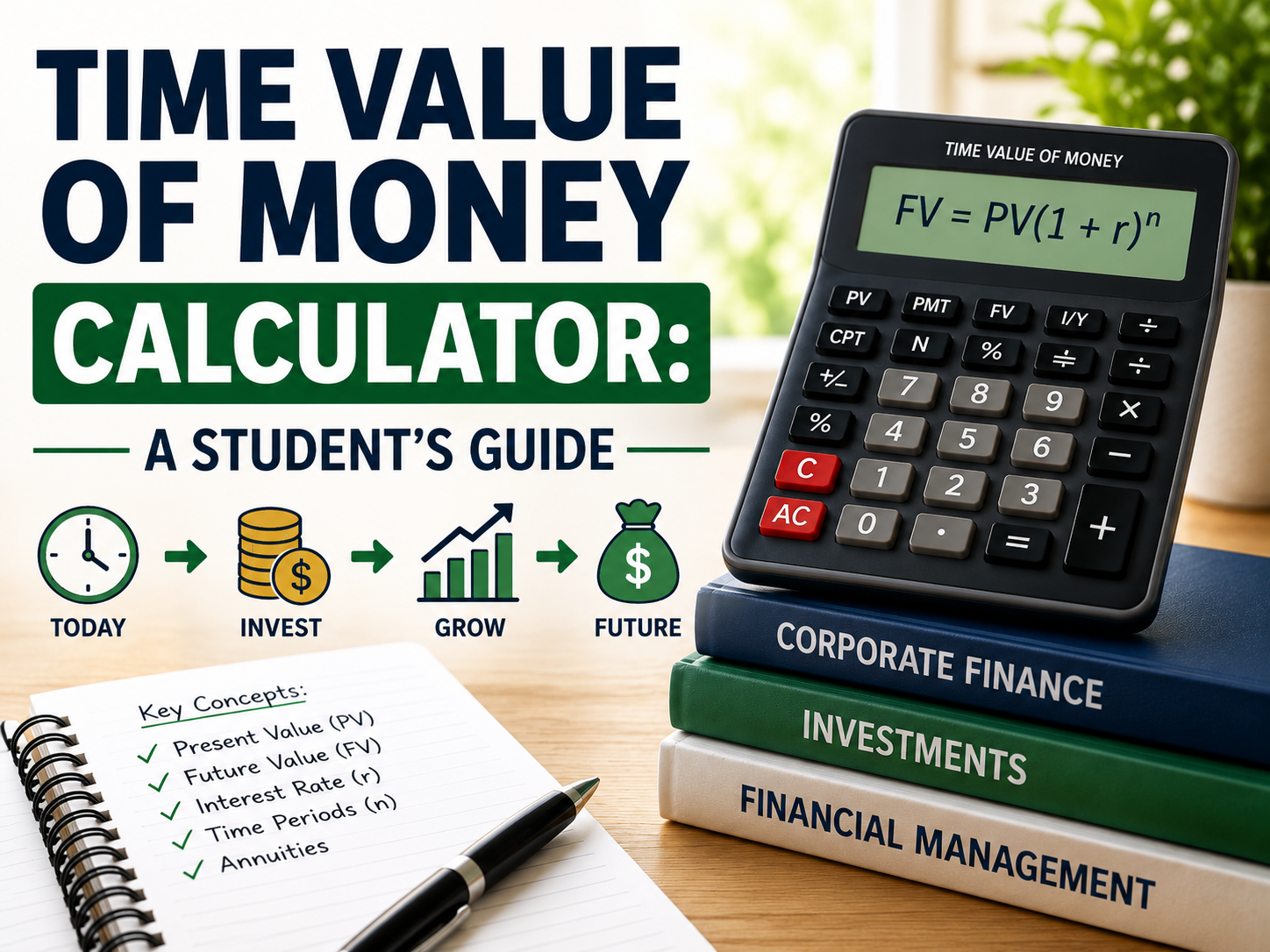
    Here is what the TVM calculator looks like — with every field labelled so you know exactly what you’re looking at before entering a single number:

    TVM Calculator

    Mode: End Beginning
    Label Value Compute
    Present Value: e.g. -200 PV
    Payments: e.g. -50 PMT
    Future Value: e.g. -1000 FV
    Annual Rate (%): e.g. 10 Rate
    Periods (years): e.g. 5 Periods
    Compounding:
    Annually
    Reset
    Build Wealth Retire Rich: Time Value of Money Calculator

    The logic is always the same: enter any four of the five variables, then click the Compute button for the fifth. The calculator solves for the unknown. The key is knowing what each variable means, what sign to give it, and which mode to use.

    The 5 Variables: PV, PMT, FV, Rate, Periods

    Every TVM problem involves five variables. You always know four of them and solve for the fifth. Here’s exactly what each one means in plain English — with real student contexts:

    PV

    Present Value

    The value of money today — either an amount you have right now, or the current worth of a future cash flow. In borrowing it’s the loan amount. In investing it’s your starting deposit.

    Student examples: $5,000 student loan taken out today $500 you deposit into a Roth IRA today Current value of a $1,000 bond maturing in 5 years
    PMT

    Payments (Annuity)

    A regular recurring payment made at equal intervals — either money going out (loan payments, regular savings contributions) or money coming in (income from an annuity). Enter 0 if there are no recurring payments.

    Student examples: $150/month loan repayment $50/month invested into an index fund $0 (lump-sum problems with no regular payments)
    FV

    Future Value

    The value of money at a specific point in the future, after growth or after a series of payments. This is what you’re solving for when asking “what will my investment be worth in 30 years?” or “how much will I owe at the end of this loan?”

    Student examples: What your Roth IRA will be worth at 65 The final payoff amount on a loan $0 (for a fully amortising loan that ends at zero)
    r

    Annual Rate (%)

    The annual interest rate — entered as a percentage, not a decimal (enter 7, not 0.07). For investments this is your expected annual return. For loans it’s the APR. The calculator adjusts for compounding frequency automatically.

    Student examples: 7 (for 7% average investment return) 6.5 (federal student loan rate) 24 (typical credit card APR)
    N

    Periods (Years)

    The total number of time periods — usually years, but can be months if your payment frequency is monthly. If you’re solving a 30-year mortgage with monthly payments, enter 30 years (the calculator accounts for compounding frequency). If your calculator uses periods in months directly, enter 360 (30 × 12).

    Student examples: 10 years of investing from age 20 to 30 45 years until retirement (age 20 to 65) 5 years on a car loan 4 years of college remaining

    The Sign Convention — Why Negative Numbers Matter

    This is where almost every beginner gets confused — and where most wrong answers come from. TVM calculators use a cash flow sign convention: money flowing out of your pocket is negative; money flowing into your pocket is positive.

    💡 The Sign Convention — Always Think From Your Perspective

    Negative (Money Out)

    Cash that leaves your hands. You invest it, pay it out, or deposit it somewhere. You no longer have this money in your pocket.

    Examples: loan payment you make, deposit into savings, money you invest today

    +
    Positive (Money In)

    Cash that arrives in your hands. You receive it, earn it, or withdraw it. This money is coming into your pocket.

    Examples: loan proceeds you receive, investment payout, cash you withdraw

    The most important rule: PV and FV must have opposite signs when money flows in one direction. If you enter a negative PV (money you invest today), FV will compute as positive (money you receive later). If you enter a positive PV (loan proceeds you receive), FV will compute as negative (amount you owe at the end).

    ⚠️ The Most Common Sign Mistake

    Entering PV and PMT with the same sign when they should have opposite signs is the single most common TVM error. If you’re making regular payments on a loan (PMT is negative — money leaving you), the loan you received (PV) must be positive — money that came to you. If you get an error or an absurd answer, check your signs first.

    End vs Beginning Mode

    The Mode selector at the top of the calculator — End or Beginning — determines when payments occur within each period. For most student problems, End mode is correct.

    End Mode (Ordinary Annuity)

    Payments at the End of Each Period

    The most common setting. Payments are made or received at the end of each period — after the interest for that period has been calculated.

    This is how most loans, mortgages, and regular savings plans work. Your monthly mortgage payment is due at the end of the month, after that month’s interest has accrued.

    ✓ Use for: student loan payments, car loans, monthly savings contributions, most investment problems
    Beginning Mode (Annuity Due)

    Payments at the Start of Each Period

    Less common. Payments occur at the beginning of each period — before interest is calculated for that period. This means each payment earns (or avoids) one extra period of interest.

    Beginning mode produces a slightly higher future value for investments and a slightly lower present value for loans, because money is working for one more period.

    ✓ Use for: rent paid at month start, lease payments, some annuities specified as “due”
    📐 How Much Does Mode Actually Change Your Answer?

    Switching from End to Beginning mode on a $200/month investment at 7% over 30 years changes the result from approximately $244,000 to approximately $245,000 — a difference of about $1,000. The effect grows with the rate and the number of periods. For most homework and real-life problems, End mode is correct unless the problem specifically states “annuity due” or “beginning of period.”

    Compounding Frequency Explained

    The Compounding dropdown controls how many times per year interest is applied to the balance. The more frequently interest compounds, the slightly more you earn (or owe). Here’s how the options compare on a $10,000 balance at 7% over 10 years:

    Compounding Option Times/Year Balance at 10 Years Interest Earned
    Annually $19,672 $9,672
    Semi-annually $19,898 $9,898
    Quarterly $20,016 $10,016
    Monthly Most Common 12× $20,097 $10,097
    Daily 365× $20,136 $10,136

    For most investment problems, select Monthly — this matches how most brokerages, savings accounts, and loan products compound. For problems where the question specifies a different frequency (e.g. “compounded quarterly”), match it exactly. The difference is small but matters for precise answers.

    Step-by-Step Examples for Students

    Here are four common student scenarios — each solved step by step using the TVM calculator.

    Example 1 · Investing

    “What will my $75/month investment be worth in 40 years?”

    You invest $75 every month into a Roth IRA starting at age 22. You expect a 7% average annual return. You want to know your balance at age 62.

    • 1

      PV = 0  — You’re starting with no lump sum today. Just monthly contributions.

    • 2

      PMT = −75  — $75 leaves your pocket each month. Negative because it’s money out.

    • 3

      FV = ?  — This is what you’re solving for. Leave it blank and click Compute FV.

    • 4

      Rate = 7  — Enter 7 for 7% annual return.

    • 5

      Periods = 40  — 40 years from age 22 to 62.

    • 6

      Mode = End  — Monthly contributions at end of each period. Compounding = Monthly.

    ✓ Result: FV ≈ $196,861 — Your $75/month grows to approximately $197,000 over 40 years. You contributed $36,000 — compound interest added ~$161,000.
    Example 2 · Loans

    “What are my monthly payments on a $15,000 car loan at 6% over 5 years?”

    You’re financing a used car. The loan is $15,000 at 6% APR over 5 years. You want to know your monthly payment.

    • 1

      PV = +15,000  — You receive $15,000 from the lender. Positive because money is coming to you.

    • 2

      PMT = ?  — This is what you’re solving for. Click Compute PMT.

    • 3

      FV = 0  — The loan fully pays off (ends at zero balance).

    • 4

      Rate = 6  — Enter 6 for 6% APR.

    • 5

      Periods = 5  — 5-year loan term. Compounding = Monthly.

    • 6

      Mode = End  — Standard loan payments at end of each period.

    ✓ Result: PMT ≈ −$289.99/month — The negative sign confirms money is leaving you each month. You’ll pay approximately $290/month, totalling ~$17,400 over 5 years. The extra $2,400 is interest.
    Example 3 · Savings Goal

    “How much do I need to save monthly to have $10,000 in 3 years?”

    You want $10,000 saved in 3 years for a down payment. You’ll earn 5% APY in a high-yield savings account. How much do you need to save each month?

    • 1

      PV = 0  — Starting from nothing today.

    • 2

      PMT = ?  — What you’re solving for. Click Compute PMT.

    • 3

      FV = +10,000  — The $10,000 you want to receive in 3 years. Positive because it’s money coming to you.

    • 4

      Rate = 5  — 5% APY savings account.

    • 5

      Periods = 3  — 3 years. Compounding = Monthly.

    • 6

      Mode = End  — Monthly deposits at end of each period.

    ✓ Result: PMT = −$258.04/month — You need to save approximately $258 per month to reach $10,000 in 3 years at 5% APY. Without interest you’d need $278/month — the HYSA saves you about $720 in required contributions.
    Example 4 · Interest Rate

    “What interest rate am I actually paying on this loan?”

    You borrowed $2,000 and agreed to pay $95/month for 24 months. What is the actual annual interest rate you’re being charged?

    • 1

      PV = +2,000  — You received $2,000. Positive.

    • 2

      PMT = −95  — You pay $95 per month. Negative.

    • 3

      FV = 0  — Loan fully paid off at end.

    • 4

      Rate = ?  — What you’re solving for. Click Compute Rate.

    • 5

      Periods = 2  — 2-year loan (24 months). Compounding = Monthly.

    • 6

      Mode = End.

    ✓ Result: Rate ≈ 12.9% APR — You’re paying 12.9% annually on this loan. If someone told you it was “only $95 a month,” that hides the true rate. Using the TVM calculator revealed what the actual cost of borrowing is — always check the rate before signing.

    Quick Reference — What to Enter for Common Problems

    Bookmark this. For each type of TVM problem, here’s exactly what to enter and what to solve for:

    PV PMT FV Rate N Solve for Use Case
    0 −monthly amt ? return % years FV Future value of regular investments (e.g. monthly Roth IRA)
    −lump sum 0 ? return % years FV Growth of a one-time deposit (e.g. $500 invested today)
    +loan amt ? 0 APR % years PMT Monthly loan or mortgage payment
    0 ? +goal amt return % years PMT Monthly savings needed to reach a goal
    +loan amt −payment 0 ? years Rate True interest rate on a loan
    0 −monthly amt +goal amt return % ? Periods How many years to reach a savings goal
    ? 0 +future amt rate % years PV Present value of a future amount (what is $50K in 10 years worth today?)
    ◆ ◆ ◆

    TVM Calculator — Common Mistakes to Avoid

    • Wrong signs: PV and FV should almost always have opposite signs. PMT direction matches whichever it flows with — money you pay is negative, money you receive is positive
    • Wrong mode: Default to End mode unless the problem specifically says “beginning of period,” “annuity due,” or “rent paid in advance”
    • Wrong compounding: Match the compounding frequency to the payment frequency or what the problem specifies — Monthly for most loan and savings problems
    • Entering rate as decimal: Enter 7, not 0.07. The field expects a percentage, not a decimal
    • Not clearing previous inputs: Always hit Reset before a new problem — leftover values from a previous calculation will corrupt your answer
    • Forgetting to enter FV = 0 for loans: A fully amortising loan ends at a zero balance — always enter FV = 0 unless the problem specifies a balloon payment

    Frequently Asked Questions

    What does the TVM calculator solve?
    The TVM (Time Value of Money) calculator solves for any one of five variables — PV (present value), PMT (regular payment), FV (future value), Rate (annual interest rate), or N (number of periods) — when you provide the other four. It applies the mathematical relationship between money today and money in the future, accounting for interest rates and compounding frequency.
    Why do I need to use negative numbers in a TVM calculator?
    TVM calculators use a cash flow sign convention: money leaving your pocket is negative, money entering your pocket is positive. This allows the calculator to correctly model the direction of cash flows. If you invest $500 today (money out = negative PV), the calculator knows to return a positive FV (money you’ll receive later). Entering both PV and FV as the same sign would produce an error or an incorrect result.
    What is the difference between End and Beginning mode?
    End mode (ordinary annuity) means payments occur at the end of each period — this is the default and covers most loans, mortgages, and regular investment contributions. Beginning mode (annuity due) means payments occur at the start of each period — used for rent paid in advance or leases. Beginning mode produces a slightly higher future value because each payment has one extra period to grow or save interest.
    Which compounding setting should I use for most problems?
    Use Monthly for most practical problems — it matches the payment frequency for most loans, savings accounts, and investment contributions. If a problem or financial product specifies a different compounding frequency (quarterly, annually, etc.), match it exactly. When comparing products, always make sure you’re using the same compounding setting for a fair comparison.
    How do I use the TVM calculator for student loan repayment?
    Enter: PV = your total loan balance (positive — you received this money), PMT = solve for this (click Compute PMT), FV = 0 (loan fully paid off), Rate = your loan’s annual interest rate, N = repayment period in years. Set Mode to End and Compounding to Monthly. The result will be a negative monthly payment — negative because it’s money leaving your pocket each month.

    The Campus Investor  ·  Financial Tools Guide  ·  TVM Calculator

    Written for students who want to graduate smart — and retire rich.

  • Why You Should Start Investing in Your 20s

    Why You Should Start Investing in Your 20s

    Why You Should Start Investing in Your 20s | The Campus Investor
    The Campus Investor
    Build Wealth from Day One
    📈 Issue No. 07  ·  Investing Series

    Why You Should Start Investing in Your 20s

    May 2026 | 7 min read | For College Students

    Here is a financial truth that nobody tells you loudly enough: your 20s are the single most powerful investing decade of your entire life. Not your 40s when you have more money. Not your 50s when you’re thinking seriously about retirement. Your 20s — right now — when time is working completely in your favor and every dollar you invest is worth more than any dollar you’ll invest later.

    Most people understand this in theory and do nothing about it. They’re waiting for more money, less debt, a better time, more certainty. Every year they wait costs them more than the entire amount they would have invested. This issue is about making that math so clear it becomes impossible to ignore.

    ~$323K
    What $100/month invested at 20 becomes by 65 at 6.5% return
    $160K
    What the same $100/month becomes if you start at 30 instead
    10 yrs
    The gap in start date that cuts your outcome nearly in half

    The Math That Makes Your 20s Irreplaceable

    Compound interest is the engine of wealth building — and it runs on one fuel: time. The longer money stays invested, the more aggressively it compounds. Each year of growth doesn’t just add to your balance — it multiplies it. And the multiplications in your 20s are the most powerful because they have the most future years to keep compounding.

    Here’s the simplest way to see it. A single $1,000 invested at age 20, never touched, grows at 7% average annual return:

    Age 20
    💰 $1,000 invested
    $1,000
    Age 30
    📈 First decade of growth
    ~$1,967
    Age 40
    📈 Two decades of growth
    ~$3,870
    Age 50
    📈 Three decades of growth
    ~$7,612
    Age 60
    📈 Four decades of growth
    ~$14,974
    Age 65
    🏆 45 years compounded
    ~$21,002
    Actively growing One $1,000 investment · 7% average annual return · no additional contributions

    A single $1,000 invested at 20 becomes over $21,000 by 65 — a 21x return — without a single additional dollar contributed. That same $1,000 invested at 40 becomes about $7,600. The money invested in your 20s earns returns for four decades. Money invested at 40 earns them for two and a half. The dollars are identical. The time is not.

    📐 The Rule of 72 — Applied to Your 20s

    At 7% annual return, money doubles every ~10 years. A dollar invested at 20 doubles four times before retirement — $1 → $2 → $4 → $8 → $16. A dollar invested at 40 doubles twice — $1 → $2 → $4. Same dollar. Same return. The difference is entirely when the clock started.

    Two Investors, One Number That Says Everything

    The most powerful way to understand early investing isn’t abstract math — it’s a direct comparison. Meet Alex and Jordan. Same age. Same investment return. Dramatically different outcomes.

    Early Investor
    Alex — Starts at 22
    Monthly contribution
    $100/month
    Investing period
    Age 22 to 65 (43 years)
    Total contributed
    $51,600
    Average annual return
    7%
    Balance at 65: ~$328,000
    Late Starter
    Jordan — Starts at 32
    Monthly contribution
    $300/month
    Investing period
    Age 32 to 65 (33 years)
    Total contributed
    $118,800
    Average annual return
    7%
    Balance at 65: ~$463,000
    Open TVM Calculator

    Jordan invested three times more money every month and contributed $67,200 more overall — yet ended with only about $135,000 more than Alex. Alex invested just $100 per month and still built a portfolio worth nearly $328,000 simply because he started 10 years earlier.

    This example highlights one of the most important lessons in investing: time matters more than the amount you invest early on. Starting sooner gives compound growth more years to work, allowing even smaller contributions to grow significantly over time.

    Now flip the scenario: what if Alex had also invested $300 per month starting at age 22 instead of $100? By age 65, the balance would grow to approximately $983,000. In comparison, Jordan’s balance would still be around $463,000.

    That means delaying investing by 10 years at the same contribution level could reduce potential wealth by more than $500,000. The biggest cost was not poor investing decisions — it was waiting to begin.

    “In investing, time does not just help. It is the primary variable. Everything else — the amount, the account type, the specific fund — is secondary to when you start.”

    6 Reasons Your 20s Are the Best Time to Start

    The math alone should be enough. But there are six additional reasons your 20s specifically are an extraordinary window for investing — reasons that go beyond just the numbers.

    01

    You Have the Longest Time Horizon of Your Life

    Time horizon is the number of years your investment has to grow before you need it. In your 20s, you have 40+ years of runway. This means you can invest almost entirely in growth assets like stock index funds, ride out every market crash, and benefit from the full power of long-term compounding. As you age, your time horizon shrinks and your portfolio needs to become more conservative. Right now, you have the luxury of maximum growth potential.

    02

    Your Tax Bracket Is Probably the Lowest It Will Ever Be

    Most college students and recent graduates are in the 10% or 12% federal tax bracket. A Roth IRA lets you pay tax on contributions now and withdraw everything — contributions and all growth — completely tax-free in retirement. Paying a low tax rate now to lock in decades of tax-free growth is one of the most effective legal tax strategies available. The older you get, the higher your income — and the worse this deal gets.

    03

    You Can Afford to Take More Risk — and Benefit From It

    Risk in investing largely means volatility — the market goes up and down. In your 20s, a market crash is not a disaster. It’s a buying opportunity. You have decades before you need the money, so short-term losses recover and your continued monthly contributions buy more shares at lower prices. Investors in their 20s who hold through market downturns consistently come out ahead. The same crash is devastating for someone who is 62 and about to retire.

    04

    You Build the Habit Before Life Gets Complicated

    Investing in your 20s isn’t just about the money — it’s about building the habit before the demands of adult life multiply. Before a mortgage, a family, aging parents, medical bills, and career pivots. The students who automate $50 a month at 21 tend to keep investing as their income grows — because it’s already part of how they operate. The ones who wait tend to find that life keeps providing new reasons to delay.

    05

    Mistakes Cost Less When Stakes Are Lower

    If you make an investing mistake in your 20s — buy a stock that drops, choose a slightly wrong fund, invest in the wrong account type — the dollar amounts are small and the recovery window is enormous. The same mistake at 55 with your entire life savings is catastrophic. Your 20s are the cheapest possible time to learn how investing works by actually doing it. Every lesson learned now is paid for with small dollars and long recovery time.

    06

    You Create Options — Not Just Money

    A growing investment portfolio in your 20s and 30s doesn’t just build retirement wealth. It creates options. The option to leave a job you hate. The option to take a pay cut to pursue meaningful work. The option to take a year off. The option to retire earlier than your peers. Financial independence isn’t about being rich — it’s about having enough invested that your choices are no longer controlled by your next paycheck. That freedom starts in your 20s or it starts much later.

    The Excuses vs The Reality

    Every reason not to invest in your 20s has a direct answer. Here are the most common ones — and what the math actually says:

    ❌ The Excuse ✓ The Reality
    “I don’t have enough money to invest.” Fidelity and Schwab have zero minimums. $25/month is enough to start. The amount is secondary to starting.
    “I need to pay off my student loans first.” Federal loans at 4–7% interest cost less than the historical 7–10% market return. You can do both. One doesn’t require waiting for the other.
    “I’ll start when I get my first real job.” The average first job starts at 22–23. Each year of delay at that stage costs $20,000–$30,000 in eventual retirement wealth at typical contribution levels.
    “The market is too volatile right now.” The market has always looked scary to someone. Every market high in history once looked like a terrifying new peak before going higher. Time in the market beats timing the market.
    “I don’t know enough about investing yet.” You need to know one thing: open a Roth IRA, buy a total market index fund, automate contributions. That is the entire strategy for most investors under 30.
    “I’ll invest seriously in my 30s when I earn more.” Jordan did this in the comparison above. Invested 3x as much per month starting at 32 — and barely matched Alex who invested $100/month from 22.

    The Real Cost of Waiting — Visualized

    Still not convinced? Here is what five years of waiting actually costs — not in missed contributions, but in the total wealth difference at retirement. These numbers assume $200/month invested at a 7% average annual return until age 65.

    The True Cost of Delaying $200/Month at 7% Return

    Start at Age 20
    Total contributed: $108,000
    Balance at 65: ~$758,000
    45 years of compounding
    Start at Age 25
    Total contributed: $96,000
    Balance at 65: ~$524,000
    Cost of 5-year delay: ~$234,000
    Start at Age 30
    Total contributed: $84,000
    Balance at 65: ~$360,000
    Cost of 10-year delay: ~$398,000
    Start at Age 35
    Total contributed: $72,000
    Balance at 65: ~$244,000
    Cost of 15-year delay: ~$514,000
    Open TVM Calculator

    A 15-year delay between starting at 20 vs 35 costs over $500,000 in retirement wealth — on just $200 a month. That is not the cost of bad investing decisions. It is the cost of doing nothing while life happened. The delay feels free. It isn’t.

    Mini-Case · The $12 a Day Decision

    Sam, Junior — Finance

    Sam was a finance major who understood investing theory perfectly — and still hadn’t opened a Roth IRA by junior year. His excuse was that he was “waiting until he understood it better.” He spent about $12 a day on food delivery and coffee shop runs without tracking it.

    One afternoon he did the math: $12 a day was $360 a month. He redirected $100 of that — cutting two delivery orders a week — into a Fidelity Roth IRA invested in FSKAX. He didn’t feel the difference in his daily life.

    At 7% average return, $100/month started at 21 projects to over $352,000 by age 65 — completely tax-free in his Roth IRA. He’d been walking past that number every day on his way to pick up a delivery order.

    The lesson: The money to start investing is almost always already there. It just isn’t labeled “investing” yet. Sam didn’t change his income — he changed where $100 of it went. The rest is compound interest’s job.

    What to Do This Week

    The gap between knowing this and acting on it is where most people lose. The information is not the barrier. The first step is. So here is the first step, made as small as possible:

    Your Action List — This Week, Not Next Month

    • Open a Roth IRA at Fidelity.com, Vanguard.com, or Schwab.com — free, takes 10 minutes, no minimum balance required
    • Make your first deposit — any amount. $25 is a real start. $50 is better. The number matters less than the account existing
    • Buy a total market index fund: FSKAX (Fidelity), VTI (Vanguard), or SWTSX (Schwab)
    • Set up automatic monthly contributions — even $50 — so it happens without you deciding each month
    • Identify one current spending habit worth $50–$100/month that doesn’t bring proportional value — redirect it
    • Do not check your balance more than once a month. Do not sell when the market drops. Do nothing except keep contributing

    “The best investors aren’t the ones who found the best stocks or timed the market perfectly. They’re the ones who started earliest, stayed consistent the longest, and never let fear or impatience interrupt the process.”

    ◆ ◆ ◆

    Frequently Asked Questions

    Why is investing in your 20s so much better than starting later?
    Because compound interest is exponential, not linear. Money invested in your 20s has 40+ years to double, redouble, and compound again. The same contribution at 35 has 20 fewer years — meaning it doubles only half as many times. A 10-year delay on a $100/month investment at 7% return reduces your retirement balance by approximately $160,000–$200,000 depending on exact timing.
    I have student loans. Should I still invest in my 20s?
    Yes, in most cases. If your federal student loan rate is below 7%, the expected market return outpaces your debt cost — meaning you come out ahead investing while making minimum loan payments. If you have high-interest credit card debt (20%+), pay that off first. For federal loans in the 4–7% range, doing both simultaneously is the mathematically sound approach. Don’t use student loans as a reason to delay investing entirely.
    What if I can only invest $25 or $50 a month as a student?
    Start with exactly that. At 7% return, $25/month started at 20 grows to over $94,000 by 65. $50/month grows to over $189,000. These numbers aren’t impressive in isolation — they’re extraordinary given that a student sacrificed less than the cost of a streaming subscription per week to create them. The habit and the account matter more than the initial amount. Increase contributions as your income grows.
    Is it safe to invest as a college student with limited income?
    As long as your emergency fund and essential expenses are covered first, yes. Only invest money you won’t need for at least 5 years — ideally decades. Never invest your emergency fund or money you might need for rent or tuition. Roth IRA contributions (not earnings) can be withdrawn penalty-free if absolutely necessary, making it safer than most people realize as a long-term vehicle.
    What is the best account for a student who wants to start investing in their 20s?
    A Roth IRA is almost always the best starting point. It offers tax-free growth and tax-free withdrawals in retirement — and since most students are in a low tax bracket now, paying tax on contributions today is cheap compared to the decades of tax-free compounding ahead. Open one at Fidelity, Vanguard, or Schwab. Contribute monthly into a total market index fund. That is the complete strategy for most people under 30.

    The Campus Investor  ·  Issue 07  ·  Investing Series

    Written for students who want to graduate smart — and retire rich.

  • Investing for Students: A Beginner’s Guide

    Investing for Students: A Beginner’s Guide

    Investing for Students: A Beginner’s Guide | The Campus Investor
    The Campus Investor
    Build Wealth from Day One
    📈 Issue No. 06  ·  Investing Series

    Investing for Students: A Beginner’s Guide

    May 2026 | 7 min read | For College Students

    Most college students think investing is something you do later — after the real job, after the debt is paid off, after life feels more settled. That thinking is understandable. It’s also one of the most expensive financial mistakes you can make, because investing is the one area of personal finance where time is the single most valuable ingredient — and you can never get it back.

    You don’t need thousands of dollars to start. You don’t need a finance degree or a brokerage account with a complicated interface. You need to understand four ideas, open one account, and invest one amount consistently. That’s it. This guide walks you through all of it.

    $379K
    What $100/month invested at 20 grows to by age 65 at 7% return
    $180K
    What the same $100/month grows to if you start at 30 instead
    $199K
    The cost of waiting just 10 years to start investing
    Open TVM Calculator

    Those numbers are the entire argument for investing in college. Not starting young doesn’t just cost you some growth — it cuts your outcome nearly in half. The decade between 20 and 30 is the most powerful investing decade of your entire life, and most people spend it doing nothing.

    Why Investing in College Matters More Than You Think

    Investing feels abstract when you’re living on a part-time salary and managing tuition bills. But here’s what most students don’t understand: the stock market doesn’t care how much you invest — it cares how long you invest. A small amount over a long time almost always beats a large amount over a short time.

    Priya invests $80 a month starting at age 20. Her roommate Jordan waits until 30 to start and invests $300 a month — nearly four times as much. At 65, who has more? Priya does. By a lot. Because the decade between 20 and 30 compounded her early dollars into something Jordan’s larger contributions can never fully catch up to.

    “The best time to start investing was when you got your first paycheck. The second best time is today — not after graduation, not after the raise, not when things settle down. Today.”

    The Power of Compound Interest — Explained Simply

    Compound interest means your money earns returns — and then those returns earn returns too. It sounds simple but the math over decades is staggering. Here’s what $50 a month looks like invested at a 7% average annual return across different starting ages:

    $50/Month Invested at 6.5% Average Annual Return — Balance at Age 65

    Start at 20
    $161,000+
    45 years invested
    Start at 25
    $114,000+
    40 years invested
    Start at 30
    $80,000+
    35 years invested
    Start at 35
    $55,000+
    30 years invested
    Start at 40
    $37,000+
    25 years invested

    Same $50 a month. Same 6.5% return. The only variable is when you start. Starting at 20 versus 40 produces more than four times the outcome. Compound interest doesn’t reward effort — it rewards time. College is where that time begins.

    📐 The Rule of 72

    Divide 72 by your expected annual return to find out how many years it takes your money to double. At 7% return: 72 ÷ 7 = approximately 10 years to double. So $1,000 invested at 20 becomes ~$2,000 at 30, ~$4,000 at 40, ~$8,000 at 50, and ~$16,000 at 60 — without adding a single dollar more.

    The Types of Investments Students Should Know About

    You don’t need to understand every investment product on the market. You need to understand four — and for most students, only one of them really matters right now.

    Investment Type 01

    Stocks — Ownership in a Company

    When you buy a stock, you own a tiny piece of a company. If the company grows and becomes more valuable, your shares are worth more. Stocks offer the highest long-term returns but also the most short-term volatility — prices go up and down constantly. Beginners should not pick individual stocks. Instead, use index funds (below) to own hundreds of stocks at once.

    Investment Type 02

    Index Funds — The Smart Beginner’s Choice

    An index fund holds a basket of stocks that mirrors a market index — like the S&P 500 (the 500 largest US companies). Instead of picking winners, you own a slice of everything. This instant diversification means one bad company can’t sink your investment. Index funds have low fees, require no expertise, and historically outperform most actively managed funds over the long run. This is where almost every beginner should start.

    Investment Type 03

    Bonds — Lower Risk, Lower Return

    Bonds are loans you make to governments or corporations in exchange for regular interest payments. They’re safer than stocks but grow much more slowly. At your age, bonds should be a very small part — or no part — of your portfolio. You have decades ahead of you, which means you can afford to ride out stock market dips and benefit from higher long-term growth.

    Investment Type 04

    ETFs — Index Funds You Can Trade Like Stocks

    Exchange-traded funds (ETFs) work like index funds but trade on stock exchanges throughout the day like individual stocks. Many popular index funds come in ETF form — like VTI (Vanguard Total Stock Market ETF) or VOO (Vanguard S&P 500 ETF). For beginners they’re functionally identical to index funds. Low cost, diversified, and simple.

    For most college students, the entire investing strategy is: open a Roth IRA → buy a total market index fund → contribute monthly → don’t touch it. Four steps. Zero complexity. Maximum time in the market.

    Why the Roth IRA Is the Best First Account for Students

    There are many types of investment accounts. For college students, one stands above everything else: the Roth IRA. Here’s why it’s extraordinary — and why starting one in college is one of the best financial decisions you can make.

    Feature Roth IRA Regular Brokerage Account Traditional IRA
    Tax on contributions After-tax (you pay tax now) After-tax Pre-tax (deducted now)
    Tax on growth Tax-Free Forever Taxed Each Year Taxed at Withdrawal
    Tax on withdrawals Zero Tax in Retirement Capital Gains Tax Taxed as Income
    Early withdrawal of contributions Allowed Penalty-Free Allowed Anytime Penalty Before 59½
    Best for students? Yes — Ideal After Roth is Maxed Less Ideal in College

    The Roth IRA’s superpower is tax-free growth. You pay income tax on the money before it goes in — but everything it earns over decades, and every dollar you take out in retirement, is completely tax-free. Since most college students are in a low tax bracket right now, the tax you pay going in is minimal. The tax-free compound growth over 40+ years is enormous.

    📋 Roth IRA Rules to Know

    Eligibility: You must have earned income (wages from a job). Investment returns don’t count.  |  Contribution limit: $7,500 per year (2026).  |  Income limit: Phases out above $150,000 single filer — not a concern for most students.  |  Withdrawal of contributions: Can be taken out penalty-free at any time — making it a flexible long-term savings vehicle, not just a retirement account.

    How to Start Investing in 4 Steps

    This is the practical part. Here are the four steps to go from zero to invested — most students complete all four in under 30 minutes.

    1

    Open a Roth IRA

    Go to Fidelity.com, Vanguard.com, or Schwab.com. Click “Open an Account,” select Roth IRA, and complete the application. You’ll need your Social Security number, bank account details, and about 10 minutes. All three platforms are free with no account minimums.

    2

    Fund It — Even $25

    Link your checking account and make an initial deposit. There is no minimum. $25, $50, $100 — whatever you can do right now. The amount matters less than starting. You can always increase contributions as your income grows.

    3

    Buy One Index Fund

    Search for a total US market index fund: FSKAX (Fidelity), VTSAX or VTI (Vanguard), or SWTSX (Schwab). These funds hold thousands of companies in one investment, have razor-thin fees (often under 0.05%), and require zero expertise to hold.

    4

    Automate Monthly Contributions

    Set up automatic monthly contributions from your checking account — whatever amount fits your budget. Automation means you never have to decide whether to invest. The money moves before you can spend it. Set it, forget it, and let compound interest do its work.

    Mini-Case · Starting Small, Thinking Long

    Keiko, Sophomore — Biology

    Keiko worked 10 hours a week at the campus bookstore — about $360 a month after taxes. After rent, groceries, and her phone bill, she had around $90 left over. She’d been spending it on miscellaneous things each month without tracking it.

    After reading about Roth IRAs, she opened a Fidelity account on a Sunday afternoon. She set up a $60 monthly contribution into FSKAX (Fidelity’s total market index fund) and adjusted her miscellaneous spending down by $60. The whole process took 25 minutes.

    She didn’t feel the difference in her daily life. But over 45 years at a 6.5% average return, that $60 a month started at 20 is projected to grow to over $193,000 — entirely tax-free in a Roth IRA.

    The lesson: $60 a month doesn’t change your lifestyle. It changes your retirement. Keiko didn’t wait until she had “enough” to invest — she started with what she had, and time did the rest.

    The Investing Mistakes Students Make Most

    Knowing what to do is half the battle. Knowing what to avoid is the other half. These are the four most common investing mistakes college students make:

    ⚠️ Mistake 1 — Waiting for the “Right Time”

    There is no right time. The market will always look scary, uncertain, or overpriced to someone. Students who wait for a perfect entry point almost always wait years — and those years are the most expensive thing they never bought. Time in the market beats timing the market. Always. Start now with whatever you have.

    ⚠️ Mistake 2 — Picking Individual Stocks

    Buying individual stocks feels exciting. It’s also how most beginners lose money. Picking stocks requires significant research, expertise, and tolerance for volatility. Even professional fund managers fail to beat the market index consistently over time. Skip the individual stocks entirely and use index funds instead — you’ll outperform most active investors by doing less.

    ⚠️ Mistake 3 — Panic-Selling During Market Dips

    The stock market drops regularly — by 10%, 20%, sometimes more. Every major dip in history has eventually recovered and gone on to new highs. Students who sell when the market drops lock in their losses permanently. Students who hold (or keep contributing) through downturns end up buying more shares at lower prices. Your job during a market dip is to do absolutely nothing.

    ⚠️ Mistake 4 — Not Investing Because of Student Loans

    If your federal student loan interest rate is below 7%, mathematically you are better off investing in the market (historically 7–10% average annual return) than aggressively paying down low-interest debt. This doesn’t mean ignore your loans — it means don’t sacrifice investing entirely for debt that costs you less than the market returns. Both can happen at once.

    ◆ ◆ ◆

    Investing doesn’t require confidence, a large income, or perfect market knowledge. It requires one account, one fund, one automated contribution, and the patience to leave it alone. Every week you wait is a week of compound growth you can’t get back. Every week you’re invested is a week that works for your future self.

    “You don’t build wealth by being the smartest investor in the room. You build it by being the most consistent one — starting earlier than everyone else, and never stopping.”

    Your Investing Action List — Do This This Weekend

    • Open a Roth IRA at Fidelity, Vanguard, or Schwab — free, takes 10 minutes
    • Make an initial deposit — any amount, no minimum required
    • Buy a total market index fund: FSKAX, VTI, or SWTSX
    • Set up an automatic monthly contribution — even $25 or $50
    • Do not check your balance more than once a month — avoid the temptation to react
    • Increase your contribution by $10–$25 every time your income increases

    Frequently Asked Questions

    How much money do I need to start investing as a college student?
    You don’t need a minimum amount. Fidelity, Vanguard, and Schwab all offer Roth IRAs with no account minimums and no fees. You can start with $25. The amount matters far less than starting — compound growth needs time, not a large initial deposit. Starting with $25 a month at 20 beats starting with $500 a month at 35.
    What is the best investment for a college student?
    A total market index fund inside a Roth IRA. The Roth IRA gives you tax-free growth for decades. A total market index fund (like FSKAX, VTI, or SWTSX) gives you instant diversification across thousands of companies with minimal fees. This single combination — available for free at any major brokerage — is the foundation of most successful long-term investment strategies.
    Should I pay off student loans or invest first?
    If your loan interest rate is below 7%, consider doing both — make your minimum loan payments and invest a small amount simultaneously. If your rate is above 7–8%, paying down debt first makes more mathematical sense since the guaranteed “return” of eliminating high-interest debt beats the uncertain market return. High-interest credit card debt (20%+ APR) should always be paid off before investing.
    Is investing risky for college students?
    All investing carries risk, but time dramatically reduces it. The stock market has always recovered from every historical downturn and gone on to new highs over long periods. As a college student investing for 40+ years, short-term volatility is largely irrelevant. The real risk is not investing at all — losing decades of compound growth is far more costly than riding out market fluctuations.
    Can I withdraw money from a Roth IRA if I need it in an emergency?
    Yes — you can withdraw your contributions (the money you put in, not the earnings) from a Roth IRA at any time, for any reason, with no taxes or penalties. This makes it more flexible than most people realize. However, it’s best to treat your Roth IRA as untouchable and build a separate emergency fund for unexpected expenses — so compound growth is never interrupted.

    The Campus Investor  ·  Issue 06  ·  Investing Series

    Written for students who want to graduate smart — and retire rich.