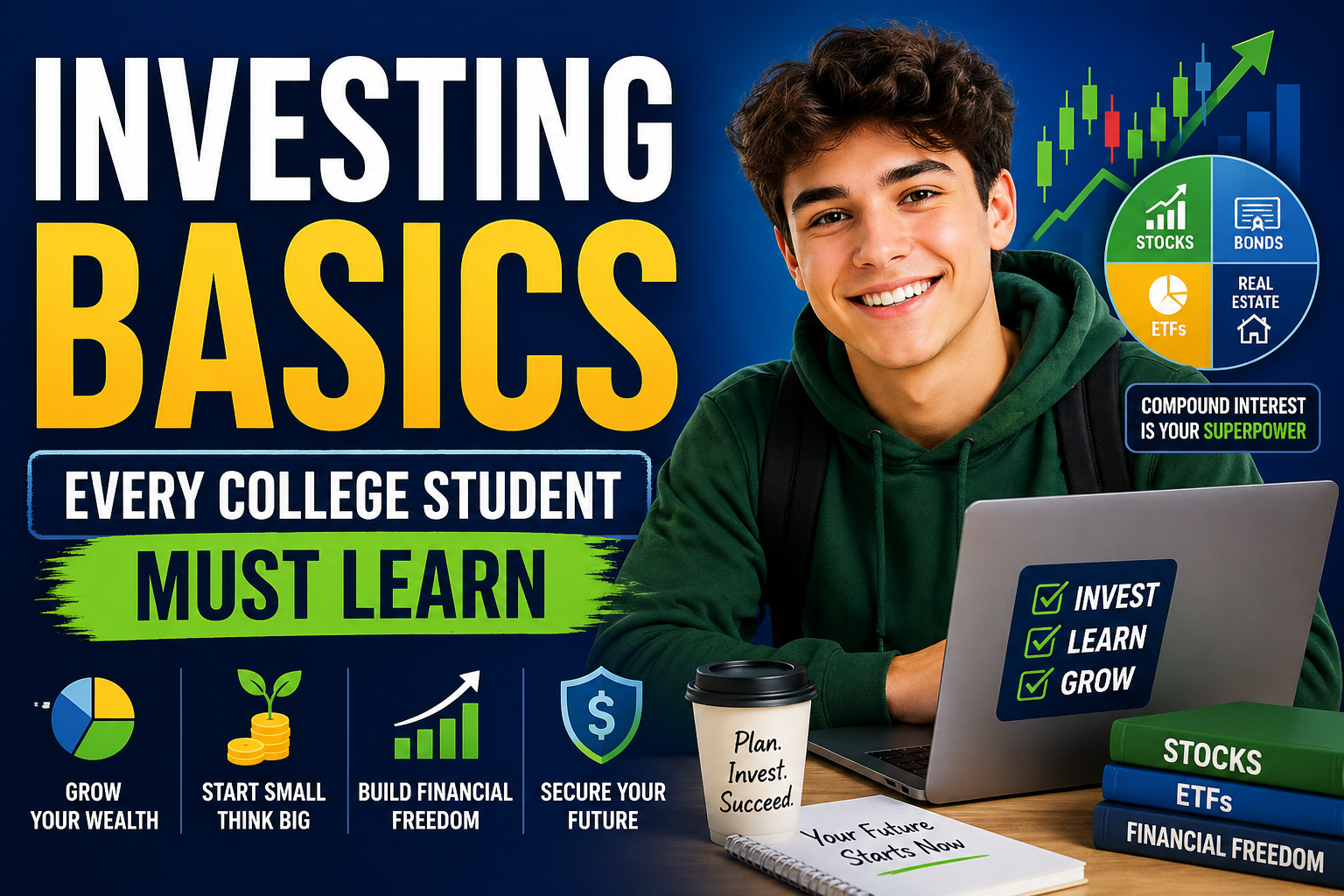
Investing Basics Every College Student Must Learn

Categories: Investing
Wishlist Share

About Course

If you’ve ever felt confused about investing or unsure where to start, this course is designed for you.

Investing Basics Every College Student Must Learn is a beginner-friendly course that breaks down complex financial concepts into simple, easy-to-understand lessons. 

You will learn the core principles that every successful investor understands—from how money grows over time to how risk, time horizon, and diversification impact your financial decisions. Instead of overwhelming you with jargon, this course focuses on practical understanding, real-life examples, and simple frameworks you can actually apply.

By the end of this course, you will:

  • Understand the difference between saving and investing

  • Learn how risk and return work together

  • See how time and compounding build wealth

  • Identify different asset classes like stocks, bonds, and cash

  • Understand key concepts like inflation, liquidity, and opportunity cost

  • Build a strong mindset to make smarter financial decisions

Each lesson is structured in a clear, step-by-step format and supported with visual, notebook-style explanations to make learning engaging and easy to remember.

This course is not about quick wins or market predictions. It is about building a strong foundation—so you can make informed decisions, avoid common mistakes, and confidently begin your investing journey.

Start where every successful investor starts—with the basics.

Show More

What Will You Learn?

  • Understand what investing really means and how it builds wealth
  • Differentiate between saving, investing, and speculation
  • Learn how risk and return are connected
  • Understand the impact of time horizon on investments
  • Recognize how inflation reduces purchasing power
  • Explore different asset classes like stocks, bonds, and cash
  • Learn the basics of capital appreciation and income investing
  • Understand liquidity and why it matters
  • Build smart investing habits and avoid emotional decisions
  • Learn the power of diversification
  • Develop long-term thinking for wealth creation
  • Start investing confidently with small amounts
  • Set clear financial goals for investing
  • Understand your personal risk tolerance
  • Create a simple beginner-friendly portfolio
  • Avoid common beginner investing mistakes
  • Follow a step-by-step checklist to make your first investment

Course Content

Module 1: Getting Started with Investing
This module builds the foundation for your entire investing journey. Before you choose stocks or think about returns, it’s important to understand what investing really means—and what it does not. You will start by learning the true definition of investing and how it differs from simply saving money. Many people believe they are investing when they are actually just holding cash or speculating, which can lead to poor financial decisions. This module helps you clearly distinguish between saving, investing, and speculation so you can avoid common beginner mistakes. You will also explore the concept of opportunity cost, which is one of the most powerful yet overlooked ideas in personal finance. Every financial decision has a trade-off, and understanding this will help you make smarter choices with your money. Finally, we bring everything together by answering one of the most important questions: Why does investing matter? You will see how investing helps you grow your wealth, beat inflation, and move closer to financial independence over time. By the end of this module, you will have a strong mental framework that sets the stage for everything that follows in the course.

  • Lesson1: What Is Investing?
  • Lesson 2: Why Investing Matters
  • Lesson 3: Saving vs Investing
  • Lesson 4: Speculation vs Investing
  • Lesson 5: Opportunity Cost

Module 2: Understanding Risk & Time
In this module, you will learn two of the most important forces that shape every investment decision: risk and time. Many beginners focus only on returns, but successful investors understand that every return comes with some level of risk. This module helps you understand the relationship between risk and return, so you can make smarter and more confident choices. You will also explore your time horizon, which is how long you plan to keep your money invested. Time plays a powerful role in investing—it can reduce risk, smooth out market ups and downs, and allow your money to grow through compounding. Another key focus of this module is inflation and purchasing power. You will see how rising prices quietly reduce the value of your money over time, and why investing is essential to stay ahead. Finally, you will learn about liquidity, or how quickly you can access your money when you need it. Balancing liquidity with long-term growth is a critical part of building a strong financial strategy. By the end of this module, you will understand how to think about risk, how time impacts your investments, and how to make decisions that align with your financial goals.

Module 3: Where You Can Invest
In this module, you will explore the different places where you can put your money to work. Understanding your investment options is a key step in building a strong and balanced portfolio. You will begin by learning about asset classes, which are the main categories of investments such as stocks, bonds, and cash. Each asset class behaves differently and plays a unique role in your financial plan. Next, you will compare stocks and bonds, two of the most common investment options. You will understand how they differ in terms of risk, return, and purpose, helping you decide where each fits in your strategy. You will also explore cash and cash equivalents, which provide safety and liquidity but lower returns. These are important for short-term needs and emergency funds. The module then introduces two key ways investments create value: capital appreciation and income investing. You will learn how some investments grow in value over time, while others generate regular income. By the end of this module, you will have a clear understanding of where to invest, how different options work, and how to choose investments that align with your financial goals.

Module 4: Building Smart Habits (Behavior + Discipline)
This module focuses on the most overlooked part of investing—your behavior. While knowledge is important, long-term success in investing comes from the habits and decisions you make consistently over time. You will learn how diversification helps reduce risk and protect your investments, and why thinking long-term is one of the biggest advantages an investor can have. Instead of reacting to short-term market movements, this module teaches you how to stay focused on your bigger financial goals. A key part of this module is understanding how emotions can impact your decisions. Fear, greed, and panic often lead to poor choices, and learning to avoid emotional decisions can significantly improve your outcomes. You will also discover why consistency matters more than perfection. Many people wait for the “perfect time” to invest, but successful investors focus on taking steady, disciplined action instead. Finally, this module emphasizes the importance of starting small. You do not need a large amount of money to begin—what matters most is getting started and building momentum over time. By the end of this module, you will understand that investing is not just about numbers—it is about mindset, discipline, and habits that lead to long-term success.

Module 5: Your First Investment Plan
This module brings everything together and helps you take your first real step into investing. Instead of just learning concepts, you will now apply them to build your own simple investment plan. You will begin by setting clear financial goals, because every investment decision should have a purpose. Whether it’s retirement, buying a home, or financial freedom, your goals will guide your strategy. Next, you will understand your risk level—how much uncertainty you are comfortable with. This helps you choose investments that match your personality and avoid unnecessary stress. You will then learn how to build a simple portfolio, combining different types of investments in a way that balances growth and stability. The focus is on keeping things easy, practical, and beginner-friendly. This module also highlights common beginner mistakes, so you can avoid costly errors and stay on the right path from the start. Finally, you will use a first investment checklist to put everything into action. This step-by-step guide ensures you are ready to begin with confidence. By the end of this module, you will not just understand investing—you will be ready to start.

Quiz

Student Ratings & Reviews

No Review Yet
No Review Yet