Title: What Is Simple Interest? — The Foundation of Financial Growth Meta Description: Learn how simple interest works, how to calculate it, and why it’s the first step toward understanding compound interest and long-term investing.
💡 Definition: What Is Simple Interest?
Simple interest is the most basic form of earning or paying interest. It’s calculated only on your original amount — the principal — not on the interest that builds up along the way.
When you deposit money in a savings account, a bank pays you interest for allowing them to use your funds. When you take a loan, you pay the lender interest for borrowing their money. In both cases, the simple interest formula stays the same:
🧮 Simple Interest = Principal × Rate × Time
This predictable structure makes simple interest a great starting point for understanding how money grows (or costs) over time.
📈 Example: How to Calculate Simple Interest
Let’s say you deposit $1,000 in a short-term savings product that pays 5% per year.
Year 1: 1,000 × 0.05 × 1 = $50
Year 2: Another $50
After 2 years: You’ve earned $100 total interest
Your final balance will be $1,100. Notice that the second year earns the same $50 because you’re not earning interest on the interest — only on the original $1,000.
Simple interest is straightforward: easy to calculate, easy to predict. That’s why it’s commonly used in short-term loans, car financing, and savings certificates.
🧠 Why Simple Interest Matters
Understanding simple interest gives you control and confidence over your money. It helps you:
Estimate returns on fixed-term deposits, CDs, and treasury bills.
Compare loans — to see how much total interest you’ll pay.
Build awareness for how your money grows (or your debt accumulates).
It also prepares you for the next step in wealth building: compound interest — where interest begins earning its own interest, creating exponential growth.
Knowing how simple interest works ensures you don’t get confused when comparing savings accounts or loan terms. It’s your first step in financial literacy.
🚀 How to Use Simple Interest in Real Life
For Saving: Choose short-term simple-interest products if you value predictability.
For Borrowing: Calculate total loan interest upfront — avoid surprises.
For Learning: Use simple interest examples to understand time, rate, and principal relationships before moving to compounding.
For Planning: If your goal is steady, guaranteed growth for a short period, simple interest is ideal.
💡 Money Tip: The more time your money is invested, the more important it becomes to switch from simple interest to compound interest to accelerate your growth.
🌱 Final Thought
Simple interest is the foundation of financial awareness. It teaches you how money grows in its most basic form — steady, transparent, and easy to calculate.
Once you master simple interest, the next step is learning how compound interest builds on it — turning simple growth into exponential wealth over time.
The Time Value of Money (TVM) is one of the most fundamental financial principles. It explains that money today is worth more than the same amount in the future due to its earning potential. Whether you’re saving for retirement, paying off a loan, or planning an investment, our TVM Calculator at Build Wealth Retire Rich makes complex financial calculations easy.
This guide walks you through how to use the calculator to make smarter financial decisions.
TVM Calculator
TVM Calculator
Key Features of the TVM Calculator
Our TVM Calculator is designed for ease of use and allows you to:
✔️ Select whether payments occur at the beginning or end of the period ✔️ Enter a Present Value (PV), Future Value (FV), or solve for either ✔️ Choose a payment frequency (weekly, monthly, annually, etc.) ✔️ Adjust for different compounding periods (annually, monthly, weekly, or daily) ✔️ Automatically compute results based on your inputs
Key Inputs
Present Value (PV): The starting amount of money (investment or loan).
Payment (PMT): The regular contribution or withdrawal per period.
Future Value (FV): The amount accumulated at the end of the given years.
Annual Interest Rate (%): The yearly rate of return or loan interest.
Periods (Number of Years): The total number of years for the investment or loan.
Compounding Frequency: Choose from annually, monthly, weekly, or daily.
Important:
If you deposit or invest money, enter PV and PMT as negative numbers because they represent cash outflows.
If you are taking out a loan, enter PV as a positive number since it represents borrowed money.
How to Use the TVM Calculator for Different Financial Goals
1. Calculate Future Value of an Investment
To find out how much your money will grow over time:
✔️ Enter Present Value (PV): Initial investment amount (negative value). ✔️ Enter Payment (PMT): Recurring contribution (negative value). ✔️ Enter Annual Interest Rate (%): Expected return. ✔️ Enter Periods (Number of Years): Duration of the investment. ✔️ Select Compounding Frequency: Choose how often interest compounds. ✔️ Click “Compute” next to FV to calculate your total future amount.
Example:
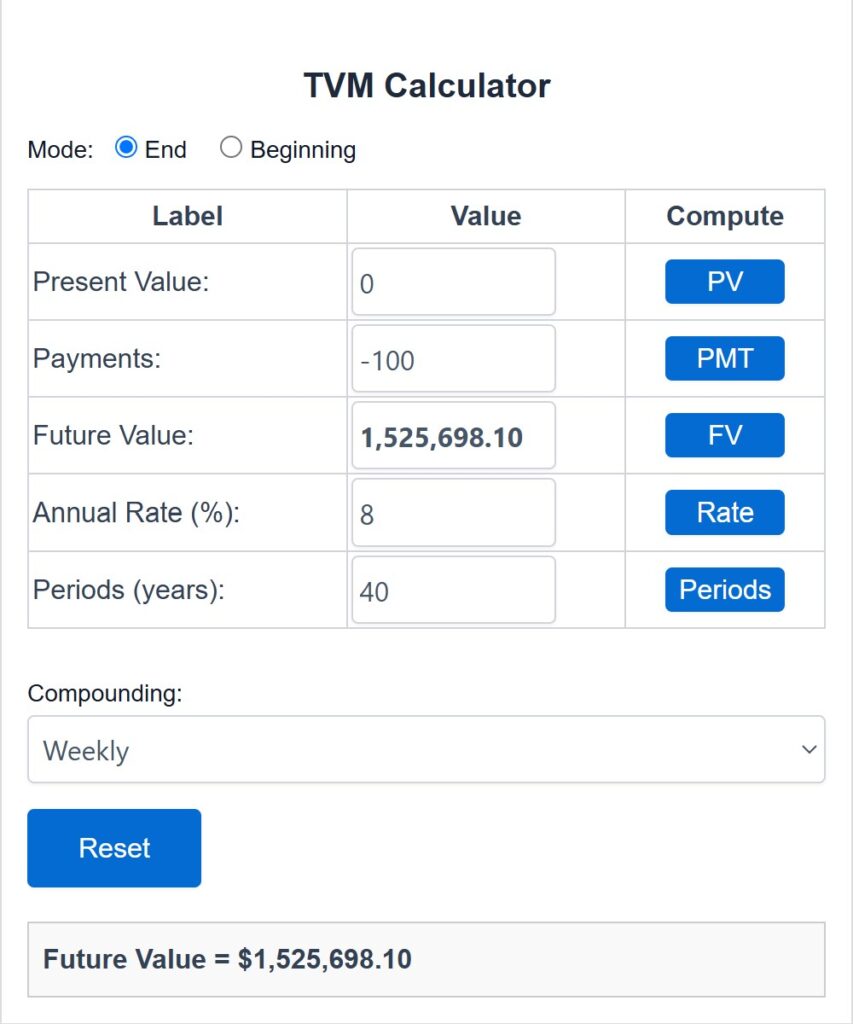
Investment: $100 a week
Annual Interest Rate: 8%
Years: 40
Compounded Weekly
Input:
PV: 0
Payments: -100 (if contributing $100 per week)
Annual Rate: 8
Period Years: 40
Compounding: Weekly
Output:Future Value (FV) = $1,525,698.10
2. Find Out How Much You Need to Save to Reach a Goal
✔️ Enter Future Value (FV): Your desired final amount. ✔️ Enter Present Value (PV): Any initial savings (negative value). ✔️ Enter Annual Interest Rate (I/Y): Expected return. ✔️ Enter Number of Years: Time until your goal. ✔️ Select Compounding Frequency: Choose compounding method. ✔️ Click “Compute” next to PMT to see how much you need to save per period.
Example:
Goal: $500,000
Annual Interest Rate: 7%
Periods (Years): 20
Compounded Monthly
Input:
Present Value: 0
Annual Rate (%): 7
Years: 20
Compounding: Monthly
Compute PMT
Output:
You need to save $959.83 per month
3. Calculate Loan or Mortgage Payments
✔️ Enter Present Value (PV): Loan amount (positive value). ✔️ Enter Annual Interest Rate (I/Y): Loan interest rate. ✔️ Enter Number of Years: Loan duration. ✔️ Select Compounding Frequency: Choose how often interest compounds. ✔️ Click “Compute” next to PMT to see required payment per period.
Example:
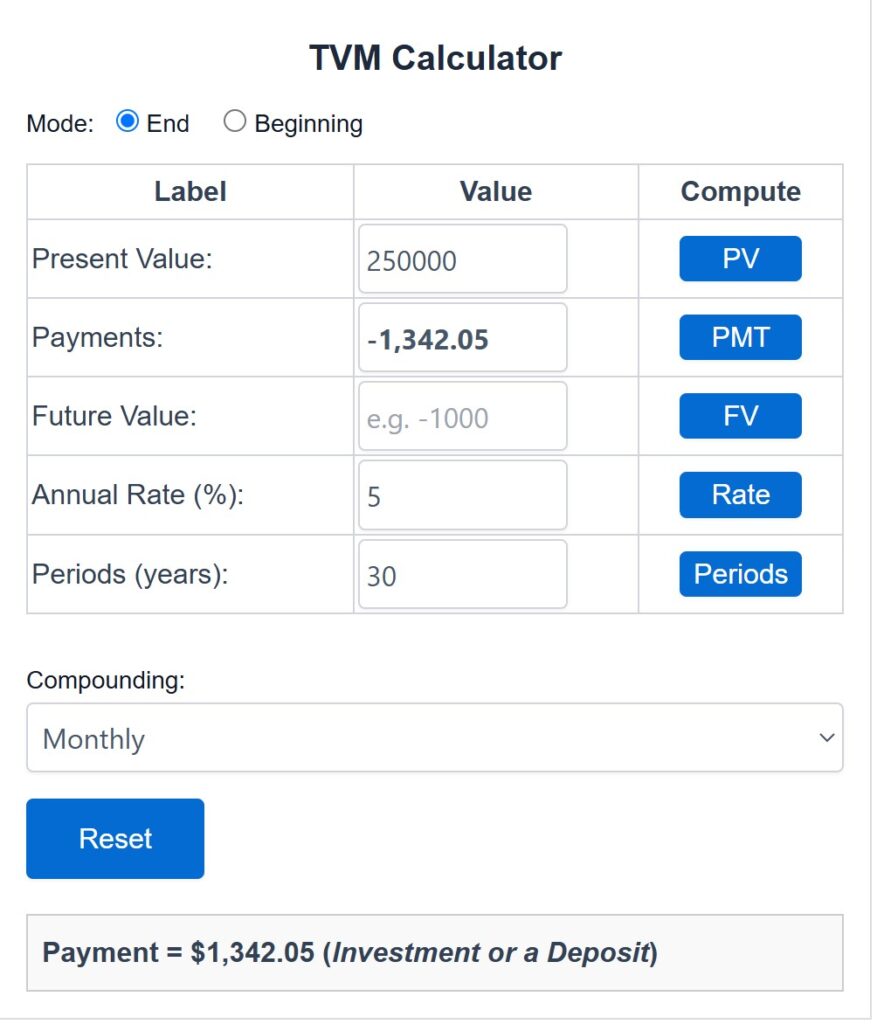
Loan Amount: $250,000
Annual Interest Rate: 5%
Years: 30
Compounded Monthly
Input:
Present Value: 250,000
Annual Rate (%): 5
Periods(Years: 30
Compounding: Monthly
Compute PMT
Output:
Monthly Payment (PMT) = $1,342.05 (Deposit)
Note: The negative sign means this is a payment (cash outflow).
Understanding Mode: End vs. Beginning Payments
The TVM Calculator allows you to choose whether payments occur at the beginning or end of each period.
✔️ End Mode: Most common setting, where payments are made at the end of each period. ✔️ Beginning Mode: Used for cases where payments are made at the start of each period (e.g., rent payments).
Example: If rent is due at the start of the month, use Beginning Mode; if payments are made after a service period, use End Mode.
Why Use This TVM Calculator?
✔️ Simple & Intuitive: Just enter values and hit “Compute”—no manual formulas required! ✔️ Multiple Payment & Compounding Options: Supports annual, monthly, weekly, and daily compounding. ✔️ Accurate Results: Ensures correct calculations without needing Excel or a financial calculator. ✔️ Works for Both Investments & Loans: Helps with retirement planning, wealth building, and debt management.
Start Planning Your Financial Future Today!
The TVM Calculator is an essential tool for financial success. Whether you’re investing, saving, or borrowing, mastering the Time Value of Money will help you maximize wealth and avoid costly financial mistakes.
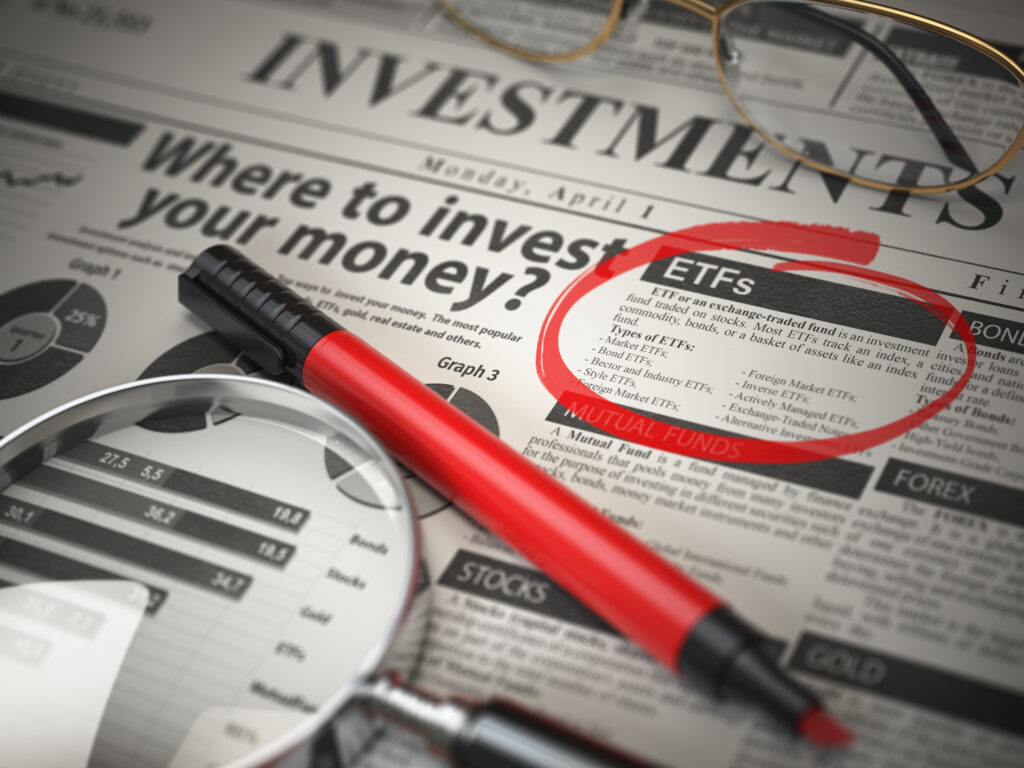
Exchange-Traded Funds (ETFs) have revolutionized the way individuals and institutions invest, providing a versatile, cost-effective, and accessible way to diversify portfolios. Whether you’re a seasoned investor or just starting your financial journey, understanding ETFs can unlock new opportunities for achieving your financial goals.
What Are ETFs?
An ETF is a type of investment fund that holds a collection of assets, such as stocks, bonds, commodities, or a mix of these. ETFs trade on stock exchanges, just like individual stocks, allowing investors to buy and sell shares throughout the trading day at market prices.
How ETFs Work
Underlying Assets: ETFs track the performance of an index, sector, or specific asset class. For example, the S&P 500 ETF tracks the S&P 500 index.
Creation and Redemption: ETFs are created or redeemed in large blocks (called creation units) by institutional investors. This ensures liquidity and helps keep the ETF’s price close to its net asset value (NAV).
Market Trading: Unlike mutual funds, which are priced only once at the end of the trading day, ETFs can be traded anytime the market is open.
Benefits of ETFs
Diversification: One ETF can provide exposure to hundreds of securities, reducing the risk associated with investing in individual stocks or bonds.
Example: Investing in an emerging markets ETF can give you exposure to multiple countries’ economies without needing to purchase individual international stocks.
Cost Efficiency: Most ETFs have low expense ratios compared to mutual funds, making them a cost-effective option for long-term investors.
Flexibility: Since ETFs trade like stocks, they offer features like limit orders, stop-loss orders, and the ability to short-sell.
Transparency: ETFs disclose their holdings daily, allowing investors to know exactly what they own.
Tax Efficiency: The structure of ETFs generally leads to fewer capital gains distributions compared to mutual funds.
Types of ETFs
Stock ETFs: Track a specific index or sector.
Bond ETFs: Provide exposure to fixed-income securities like government or corporate bonds.
Sector and Industry ETFs: Focus on specific sectors like healthcare or energy.
Thematic ETFs: Centered on trends like clean energy, artificial intelligence, or blockchain.
Commodity ETFs: Invest in physical commodities like gold or oil.
Inverse and Leveraged ETFs: Used for short-term trading to amplify returns or hedge against market downturns.
How to Invest in ETFs
Set Your Investment Goals: Define your financial objectives, whether they are growth, income, or diversification.
Research ETFs: Look at the ETF’s objective, underlying holdings, expense ratio, and performance history.
Choose a Brokerage: Most online brokerages offer commission-free ETF trading.
Start Small: You can invest in ETFs with as little as the price of one share or even fractional shares, depending on your brokerage.
Potential Risks
While ETFs offer many benefits, they are not without risks:
Market Risk: Like any investment, ETFs are subject to market fluctuations.
Tracking Errors: The ETF may not perfectly replicate the performance of its benchmark index.
Liquidity Issues: Some niche ETFs might have low trading volumes, leading to wider bid-ask spreads.
Real-Life Example of ETF Growth
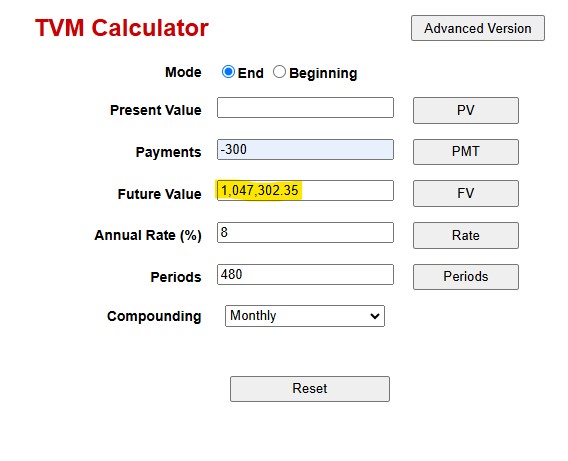
Consider an investor who consistently invests $300 per month in an ETF with an average annual return of 8%. After 40 years, their portfolio could grow to over $1,047,302.35, thanks to the power of compounding.
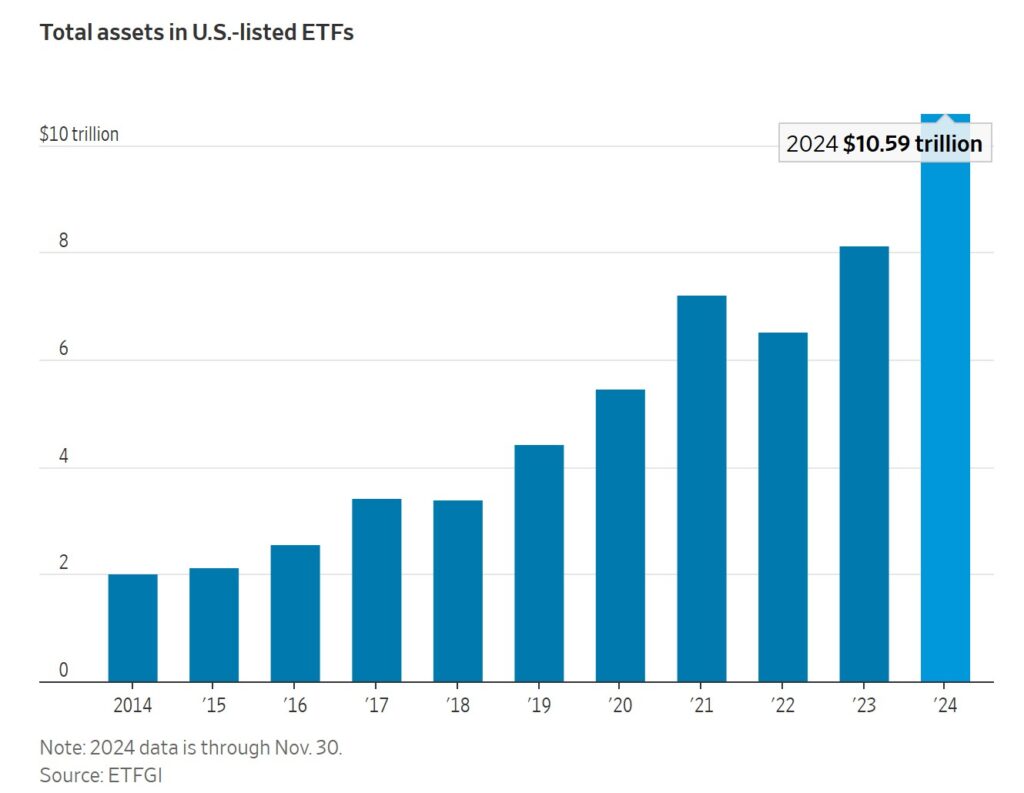
According to an article in the WSJ.com, ETFs witnessed record-breaking inflows in 2024, with over $1 trillion poured into U.S.-based ETFs, pushing total assets to an all-time high of $10.6 trillion by the end of November. This marked a 30% increase from the beginning of the year, driven by several factors:
Record Inflows: Investors poured over $1 trillion into U.S. exchange-traded funds (ETFs) in 2024, setting a new record and surpassing the previous peak by a significant margin.
Surge in ETF Assets: Total assets in U.S.-based ETFs reached $10.6 trillion by November 2024, reflecting a 30% increase from the start of the year, fueled by strong market performance and renewed investor confidence.
Shift from Mutual Funds: The long-term trend of investors moving from mutual funds to ETFs continued due to ETFs’ tax advantages and easier trading.
Key Drivers of Growth: The S&P 500’s 25% gain and growing interest in actively managed strategies contributed to significant inflows, with Invesco’s QQQ attracting over $27 billion by mid-December.
Diverse Investment Strategies: Active management strategies, bitcoin-focused ETFs, and fixed-income funds gained traction, with retirees favoring options-based strategies to manage risk.
Dominance of U.S. Stocks: U.S. equity funds dominated the market, capturing the majority of net inflows, reflecting strong investor optimism about U.S. economic growth and corporate performance.
These inflows highlight investors’ confidence and the growing appeal of ETFs as a cornerstone of modern investing.
Conclusion
ETFs are a cornerstone of modern investing, offering a mix of accessibility, cost efficiency, and diversification. Whether you’re saving for retirement, building wealth, or exploring new investment opportunities, ETFs can play a crucial role in achieving your financial objectives.
Start small, stay consistent, and always research before investing. With ETFs, you can build a robust portfolio tailored to your financial goals.
Your Mantra for Success: Save Consistently. Invest Smartly. Retire Richly.
Legal Disclaimer for Build Wealth Retire Rich Blog/Website
The information provided on the “Build Wealth Retire Rich” blog/website is for educational purposes only and should not be construed as financial, investment, or legal advice. While every effort is made to ensure the accuracy and reliability of the information presented, Build Wealth Retire Rich and its contributors, including AI tools used in the creation of some content, do not guarantee its completeness or timeliness. Users are encouraged to consult with a qualified financial advisor or legal professional to discuss their specific financial situation and to obtain advice tailored to their individual circumstances.
Build Wealth Retire Rich is not responsible for any decisions made based on the information provided on this website. All financial products, investment strategies, and other content discussed are presented for informational purposes only, and no guarantees are made regarding the performance or suitability of any particular investment or strategy.
The views and opinions expressed on “Build Wealth Retire Rich” are those of the authors and do not necessarily reflect the views of the website’s owner or any affiliated institutions. “Build Wealth Retire Rich” does not endorse or promote any particular investment, financial product, or institution unless explicitly stated.
Risk Disclosure: Investing involves risk, including the potential loss of principal. Past performance is not indicative of future results. Always do your own research and consider your financial goals and risk tolerance before making any financial decisions.
By using this website, you agree that Build Wealth Retire Rich and its affiliates are not liable for any losses or damages incurred as a result of using the information provided. Users are solely responsible for their financial decisions and should seek independent advice when necessary.