Why You Should Start Investing in Your 20s | The Campus Investor
The Campus Investor
Build Wealth from Day One
📈 Issue No. 07 · Investing Series
Why You Should Start Investing in Your 20s
May 2026 | 7 min read | For College Students
Here is a financial truth that nobody tells you loudly enough: your 20s are the single most powerful investing decade of your entire life. Not your 40s when you have more money. Not your 50s when you’re thinking seriously about retirement. Your 20s — right now — when time is working completely in your favor and every dollar you invest is worth more than any dollar you’ll invest later.
Most people understand this in theory and do nothing about it. They’re waiting for more money, less debt, a better time, more certainty. Every year they wait costs them more than the entire amount they would have invested. This issue is about making that math so clear it becomes impossible to ignore.
What $100/month invested at 20 becomes by 65 at 6.5% return
$160K
What the same $100/month becomes if you start at 30 instead
10 yrs
The gap in start date that cuts your outcome nearly in half
The Math That Makes Your 20s Irreplaceable
Compound interest is the engine of wealth building — and it runs on one fuel: time. The longer money stays invested, the more aggressively it compounds. Each year of growth doesn’t just add to your balance — it multiplies it. And the multiplications in your 20s are the most powerful because they have the most future years to keep compounding.
Here’s the simplest way to see it. A single $1,000 invested at age 20, never touched, grows at 7% average annual return:
Age 20
💰 $1,000 invested
$1,000
Age 30
📈 First decade of growth
~$1,967
Age 40
📈 Two decades of growth
~$3,870
Age 50
📈 Three decades of growth
~$7,612
Age 60
📈 Four decades of growth
~$14,974
Age 65
🏆 45 years compounded
~$21,002
Actively growingOne $1,000 investment · 7% average annual return · no additional contributions
A single $1,000 invested at 20 becomes over $21,000 by 65 — a 21x return — without a single additional dollar contributed. That same $1,000 invested at 40 becomes about $7,600. The money invested in your 20s earns returns for four decades. Money invested at 40 earns them for two and a half. The dollars are identical. The time is not.
📐 The Rule of 72 — Applied to Your 20s
At 7% annual return, money doubles every ~10 years. A dollar invested at 20 doubles four times before retirement — $1 → $2 → $4 → $8 → $16. A dollar invested at 40 doubles twice — $1 → $2 → $4. Same dollar. Same return. The difference is entirely when the clock started.
Two Investors, One Number That Says Everything
The most powerful way to understand early investing isn’t abstract math — it’s a direct comparison. Meet Alex and Jordan. Same age. Same investment return. Dramatically different outcomes.
Jordan invested three times more money every month and contributed $67,200 more overall — yet ended with only about $135,000 more than Alex. Alex invested just $100 per month and still built a portfolio worth nearly $328,000 simply because he started 10 years earlier.
This example highlights one of the most important lessons in investing: time matters more than the amount you invest early on. Starting sooner gives compound growth more years to work, allowing even smaller contributions to grow significantly over time.
Now flip the scenario: what if Alex had also invested $300 per month starting at age 22 instead of $100? By age 65, the balance would grow to approximately $983,000. In comparison, Jordan’s balance would still be around $463,000.
That means delaying investing by 10 years at the same contribution level could reduce potential wealth by more than $500,000. The biggest cost was not poor investing decisions — it was waiting to begin.
“In investing, time does not just help. It is the primary variable. Everything else — the amount, the account type, the specific fund — is secondary to when you start.”
✉ Free Newsletter — Join 5,000+ Students
Something went wrong. Please try again.
Your subscription has been successful.
6 Reasons Your 20s Are the Best Time to Start
The math alone should be enough. But there are six additional reasons your 20s specifically are an extraordinary window for investing — reasons that go beyond just the numbers.
01
You Have the Longest Time Horizon of Your Life
Time horizon is the number of years your investment has to grow before you need it. In your 20s, you have 40+ years of runway. This means you can invest almost entirely in growth assets like stock index funds, ride out every market crash, and benefit from the full power of long-term compounding. As you age, your time horizon shrinks and your portfolio needs to become more conservative. Right now, you have the luxury of maximum growth potential.
02
Your Tax Bracket Is Probably the Lowest It Will Ever Be
Most college students and recent graduates are in the 10% or 12% federal tax bracket. A Roth IRA lets you pay tax on contributions now and withdraw everything — contributions and all growth — completely tax-free in retirement. Paying a low tax rate now to lock in decades of tax-free growth is one of the most effective legal tax strategies available. The older you get, the higher your income — and the worse this deal gets.
03
You Can Afford to Take More Risk — and Benefit From It
Risk in investing largely means volatility — the market goes up and down. In your 20s, a market crash is not a disaster. It’s a buying opportunity. You have decades before you need the money, so short-term losses recover and your continued monthly contributions buy more shares at lower prices. Investors in their 20s who hold through market downturns consistently come out ahead. The same crash is devastating for someone who is 62 and about to retire.
04
You Build the Habit Before Life Gets Complicated
Investing in your 20s isn’t just about the money — it’s about building the habit before the demands of adult life multiply. Before a mortgage, a family, aging parents, medical bills, and career pivots. The students who automate $50 a month at 21 tend to keep investing as their income grows — because it’s already part of how they operate. The ones who wait tend to find that life keeps providing new reasons to delay.
05
Mistakes Cost Less When Stakes Are Lower
If you make an investing mistake in your 20s — buy a stock that drops, choose a slightly wrong fund, invest in the wrong account type — the dollar amounts are small and the recovery window is enormous. The same mistake at 55 with your entire life savings is catastrophic. Your 20s are the cheapest possible time to learn how investing works by actually doing it. Every lesson learned now is paid for with small dollars and long recovery time.
06
You Create Options — Not Just Money
A growing investment portfolio in your 20s and 30s doesn’t just build retirement wealth. It creates options. The option to leave a job you hate. The option to take a pay cut to pursue meaningful work. The option to take a year off. The option to retire earlier than your peers. Financial independence isn’t about being rich — it’s about having enough invested that your choices are no longer controlled by your next paycheck. That freedom starts in your 20s or it starts much later.
Every reason not to invest in your 20s has a direct answer. Here are the most common ones — and what the math actually says:
❌ The Excuse
✓ The Reality
“I don’t have enough money to invest.”
Fidelity and Schwab have zero minimums. $25/month is enough to start. The amount is secondary to starting.
“I need to pay off my student loans first.”
Federal loans at 4–7% interest cost less than the historical 7–10% market return. You can do both. One doesn’t require waiting for the other.
“I’ll start when I get my first real job.”
The average first job starts at 22–23. Each year of delay at that stage costs $20,000–$30,000 in eventual retirement wealth at typical contribution levels.
“The market is too volatile right now.”
The market has always looked scary to someone. Every market high in history once looked like a terrifying new peak before going higher. Time in the market beats timing the market.
“I don’t know enough about investing yet.”
You need to know one thing: open a Roth IRA, buy a total market index fund, automate contributions. That is the entire strategy for most investors under 30.
“I’ll invest seriously in my 30s when I earn more.”
Jordan did this in the comparison above. Invested 3x as much per month starting at 32 — and barely matched Alex who invested $100/month from 22.
The Real Cost of Waiting — Visualized
Still not convinced? Here is what five years of waiting actually costs — not in missed contributions, but in the total wealth difference at retirement. These numbers assume $200/month invested at a 7% average annual return until age 65.
A 15-year delay between starting at 20 vs 35 costs over $500,000 in retirement wealth — on just $200 a month. That is not the cost of bad investing decisions. It is the cost of doing nothing while life happened. The delay feels free. It isn’t.
Mini-Case · The $12 a Day Decision
Sam, Junior — Finance
Sam was a finance major who understood investing theory perfectly — and still hadn’t opened a Roth IRA by junior year. His excuse was that he was “waiting until he understood it better.” He spent about $12 a day on food delivery and coffee shop runs without tracking it.
One afternoon he did the math: $12 a day was $360 a month. He redirected $100 of that — cutting two delivery orders a week — into a Fidelity Roth IRA invested in FSKAX. He didn’t feel the difference in his daily life.
At 7% average return, $100/month started at 21 projects to over $352,000 by age 65 — completely tax-free in his Roth IRA. He’d been walking past that number every day on his way to pick up a delivery order.
The lesson: The money to start investing is almost always already there. It just isn’t labeled “investing” yet. Sam didn’t change his income — he changed where $100 of it went. The rest is compound interest’s job.
What to Do This Week
The gap between knowing this and acting on it is where most people lose. The information is not the barrier. The first step is. So here is the first step, made as small as possible:
Your Action List — This Week, Not Next Month
Open a Roth IRA at Fidelity.com, Vanguard.com, or Schwab.com — free, takes 10 minutes, no minimum balance required
Make your first deposit — any amount. $25 is a real start. $50 is better. The number matters less than the account existing
Buy a total market index fund: FSKAX (Fidelity), VTI (Vanguard), or SWTSX (Schwab)
Set up automatic monthly contributions — even $50 — so it happens without you deciding each month
Identify one current spending habit worth $50–$100/month that doesn’t bring proportional value — redirect it
Do not check your balance more than once a month. Do not sell when the market drops. Do nothing except keep contributing
“The best investors aren’t the ones who found the best stocks or timed the market perfectly. They’re the ones who started earliest, stayed consistent the longest, and never let fear or impatience interrupt the process.”
◆ ◆ ◆
Frequently Asked Questions
Why is investing in your 20s so much better than starting later?
Because compound interest is exponential, not linear. Money invested in your 20s has 40+ years to double, redouble, and compound again. The same contribution at 35 has 20 fewer years — meaning it doubles only half as many times. A 10-year delay on a $100/month investment at 7% return reduces your retirement balance by approximately $160,000–$200,000 depending on exact timing.
I have student loans. Should I still invest in my 20s?
Yes, in most cases. If your federal student loan rate is below 7%, the expected market return outpaces your debt cost — meaning you come out ahead investing while making minimum loan payments. If you have high-interest credit card debt (20%+), pay that off first. For federal loans in the 4–7% range, doing both simultaneously is the mathematically sound approach. Don’t use student loans as a reason to delay investing entirely.
What if I can only invest $25 or $50 a month as a student?
Start with exactly that. At 7% return, $25/month started at 20 grows to over $94,000 by 65. $50/month grows to over $189,000. These numbers aren’t impressive in isolation — they’re extraordinary given that a student sacrificed less than the cost of a streaming subscription per week to create them. The habit and the account matter more than the initial amount. Increase contributions as your income grows.
Is it safe to invest as a college student with limited income?
As long as your emergency fund and essential expenses are covered first, yes. Only invest money you won’t need for at least 5 years — ideally decades. Never invest your emergency fund or money you might need for rent or tuition. Roth IRA contributions (not earnings) can be withdrawn penalty-free if absolutely necessary, making it safer than most people realize as a long-term vehicle.
What is the best account for a student who wants to start investing in their 20s?
A Roth IRA is almost always the best starting point. It offers tax-free growth and tax-free withdrawals in retirement — and since most students are in a low tax bracket now, paying tax on contributions today is cheap compared to the decades of tax-free compounding ahead. Open one at Fidelity, Vanguard, or Schwab. Contribute monthly into a total market index fund. That is the complete strategy for most people under 30.
Personal Finance for Students: A Complete Beginner’s Guide | The Campus Investor
The Campus Investor
Money Smarts for Real Life
📖 Issue No. 02 · Financial Literacy Series
Personal Finance for Students: A Complete Beginner’s Guide
May 2026 | 7 min read | For College Students
Nobody hands you a money manual when you move into the dorms. You figure out your major, your schedule, your roommate situation — and somehow, managing your finances is just supposed to happen. For most students, it doesn’t. Not well, anyway.
This guide is your manual. No finance degree required. No confusing jargon. Just the five building blocks of personal finance — explained simply, with examples from student life — so you can start making smarter money decisions starting today.
of college students report significant financial stress
$3,280
Average credit card balance carried by college students
1 in 4
Students skip meals to save money
These numbers aren’t meant to scare you — they’re meant to show you that financial stress on campus is real, common, and largely preventable. The students who avoid it aren’t smarter or richer. They just learned a few fundamentals early.
Step 1 — Know Your Income
Before you can manage money, you need to know exactly how much money you actually have. This sounds obvious, but most students have a blurry picture — a mix of financial aid, a part-time job, family support, and the occasional birthday check from grandma.
List every income source you have and how often it comes in. Then convert everything to a monthly number. That single figure — your monthly income — is your starting point for everything else.
💡 Quick Action
Open your bank app right now. Add up all money that came in last month from every source. Write that number down. That’s your baseline. If it varies a lot month to month, average the last three months.
Mini-Case · Knowing the Number
Taylor, Sophomore — Nursing
Taylor thought she had “plenty of money” between her scholarship, a part-time shift at a coffee shop, and monthly transfers from her parents. She’d never added it all up until her intro econ professor made the class do a cash flow exercise.
The total: $1,340 per month. She’d been spending closer to $1,600. The gap — $260 every month — was quietly building up on her credit card without her realizing it.
The lesson: You can’t manage what you haven’t measured. Knowing your exact monthly income is step zero. Everything else is built on that number.
Budgeting has a reputation for being restrictive and boring. It’s not. A budget is just a plan for your money — one you write before the month starts, instead of wondering where everything went after it ends.
The simplest system for students is the 50/30/20 rule: allocate 50% of your income to needs, 30% to wants, and 20% to savings and debt payoff. Here’s what that looks like on a $1,200/month student budget:
Dining out, streaming, social events, clothes, hobbies
20% — Save & Pay Debt$240
Emergency fund, loan payments, Roth IRA contributions
The 50/30/20 split isn’t gospel — it’s a starting point. If your rent eats up 60% of your income, adjust the want category down. The important thing is that every dollar has a category before the month begins.
Mini-Case · The Budget That Changed Everything
Devon, Junior — Business Administration
Devon had tried budgeting three times and quit each time because it felt like too much work. His fourth attempt was different: he used a free app (YNAB — You Need A Budget) and spent 20 minutes on the first of every month assigning his income to categories.
Within two months he’d stopped overdrafting his account. Within four months he had $600 in savings — the first time he’d ever had a financial cushion in his adult life.
The lesson: The best budget isn’t the most detailed one. It’s the one you’ll actually stick to. Simple, consistent, and reviewed monthly beats perfect and abandoned.
✉ Free Newsletter — Join 5,000+ Students
Something went wrong. Please try again.
Your subscription has been successful.
Step 3 — Save Before You Spend
Most people save whatever’s left at the end of the month. Spoiler: there’s usually nothing left. The students who actually build savings do it differently — they save first, then spend what remains.
This is called “paying yourself first.” Even $25 or $50 a month matters. It builds the habit, grows an emergency fund, and stops you from starting adult life with zero financial buffer.
🎯 Your First Savings Goal
Start with a $500 emergency fund. Put it in a high-yield savings account (many online banks offer 4–5% APY). This single cushion will prevent you from reaching for a credit card the next time your car breaks down or your laptop dies.
Not all debt is the same. Understanding the difference between the debt working against you and the debt that’s manageable — is one of the most important financial skills you can develop in college.
⚠
Bad Debt — Avoid This
Credit card balances with 20–30% APR. Payday loans. Buy-now-pay-later plans you can’t afford. This debt compounds fast and eats your future income.
✓
Manageable Debt — Handle This
Federal student loans at fixed low rates. These have income-driven repayment options, deferment, and forgiveness programs. Know your balance and your options.
The single most important thing you can do with student loans right now: log into StudentAid.gov, find your exact balance, and understand your repayment options before graduation. Many students are shocked by the number — don’t be one of them.
Mini-Case · The Ignored Loan
Chris, Recent Graduate — Psychology
Chris borrowed “whatever the financial aid office offered” each year without tracking the total. He signed the promissory notes online each fall without reading them — it only took a minute. When he graduated, he finally logged in to StudentAid.gov for the first time.
The balance: $54,000. His monthly payment on the standard 10-year plan was $562. On his $36,000 starting salary, that was nearly 19% of his gross income — before taxes, rent, or food.
The lesson: Know your loan balance every single semester. And before you graduate, spend one hour researching income-driven repayment plans — they can cut your monthly payment dramatically.
Step 5 — Build Credit the Right Way
Your credit score follows you into every major life decision after college: renting an apartment, financing a car, getting a mortgage, and sometimes even job applications. Building it in college — the right way — gives you a massive head start.
The 5 Rules of Building Credit as a Student
Get one student credit card with a low limit — treat it like a debit card
Never spend more than 30% of your credit limit (this is your “utilization rate”)
Pay the full balance every single month — never carry a balance
Set up autopay for the minimum so you never miss a due date
Check your credit report for free every year at AnnualCreditReport.com
“A credit score isn’t about debt. It’s a track record that proves you can borrow and repay responsibly. Build it early and you’ll never have to beg for a good rate.”
If you have anything left after covering your budget and hitting your savings goals, it’s time to think about your first investment. And no — you don’t need hundreds of dollars or a brokerage account with a confusing interface.
The best first investment for most college students is a Roth IRA. You contribute after-tax dollars now, and the money grows completely tax-free for the rest of your life. The contribution limit is $7,500 per year (2026), but even $50 or $100 a month is an extraordinary start.
1
Open a Roth IRA
Fidelity, Vanguard, and Charles Schwab all offer free Roth IRAs with no minimums. It takes about 10 minutes online.
2
Buy One Index Fund
Search for a total market index fund (like FSKAX or VTSAX). One fund, low fees, instant diversification across thousands of companies.
3
Set It to Auto
Set up an automatic monthly contribution — even $25. Automation removes emotion and willpower from investing entirely.
4
Leave It Alone
Don’t check it every day. Don’t sell when markets drop. Time in the market beats timing the market — every time.
Personal finance is only overwhelming when you try to do everything at once. Take it one step at a time, in order. Here’s your starting point:
Do These 5 Things This Week
Add up your total monthly income from all sources — write the number down
Download a budgeting app (YNAB, Mint, or even a simple spreadsheet) and set up your 50/30/20 categories
Open a high-yield savings account and start a $500 emergency fund goal
Log into StudentAid.gov and check your exact loan balance and repayment options
Check your credit score for free — try Credit Karma, your bank app, or Experian
You don’t need to be wealthy to start. You don’t need a finance degree. You need about an hour this weekend and the willingness to take the first step. Every financially confident adult you admire started exactly where you are right now — they just started.
Personal finance isn’t about perfection. It’s about making slightly better decisions than last month — and doing that every single month for the rest of your life.
Frequently Asked Questions
What is the 50/30/20 rule and how does it work for students?
The 50/30/20 rule splits your monthly income into three categories: 50% for needs (rent, groceries, utilities, transportation), 30% for wants (dining out, entertainment, hobbies), and 20% for savings and debt repayment. On a $1,200/month student income that means $600 for needs, $360 for wants, and $240 toward savings or debt. It’s a starting framework — adjust the percentages to fit your situation.
Should college students open a Roth IRA?
Yes — if you have any earned income (from a part-time job or work-study), you’re eligible to open a Roth IRA. Contributions are made with after-tax money and grow completely tax-free. Even $25–$50 a month started in college can grow to hundreds of thousands by retirement due to compound growth. Fidelity, Vanguard, and Schwab all offer Roth IRAs with no minimums and no fees.
How much should a college student have in an emergency fund?
Start with a $500 goal — enough to cover a car repair, a medical co-pay, or a laptop issue without touching a credit card. Once you hit $500, build toward one full month of your essential expenses. Keep it in a separate high-yield savings account so it’s accessible but not mixed with your spending money.
What is a good credit score for a college student?
Any score above 670 is considered “good” by most lenders. For a college student just starting to build credit, a score between 650–720 by graduation is an excellent target. The keys are simple: get one student credit card, keep your utilization below 30%, and pay the full balance every month. Consistency over 12–24 months builds a strong credit history.
What’s the difference between good debt and bad debt for students?
Good debt is borrowed at low interest rates for something that builds future value — federal student loans are the classic example. Bad debt is borrowed at high interest rates for consumption — credit card balances at 20–30% APR are the most common student example. The key difference is the interest rate and what you’re financing. Avoid carrying a credit card balance. Understand but don’t fear federal student loans — just know your balance and repayment options.
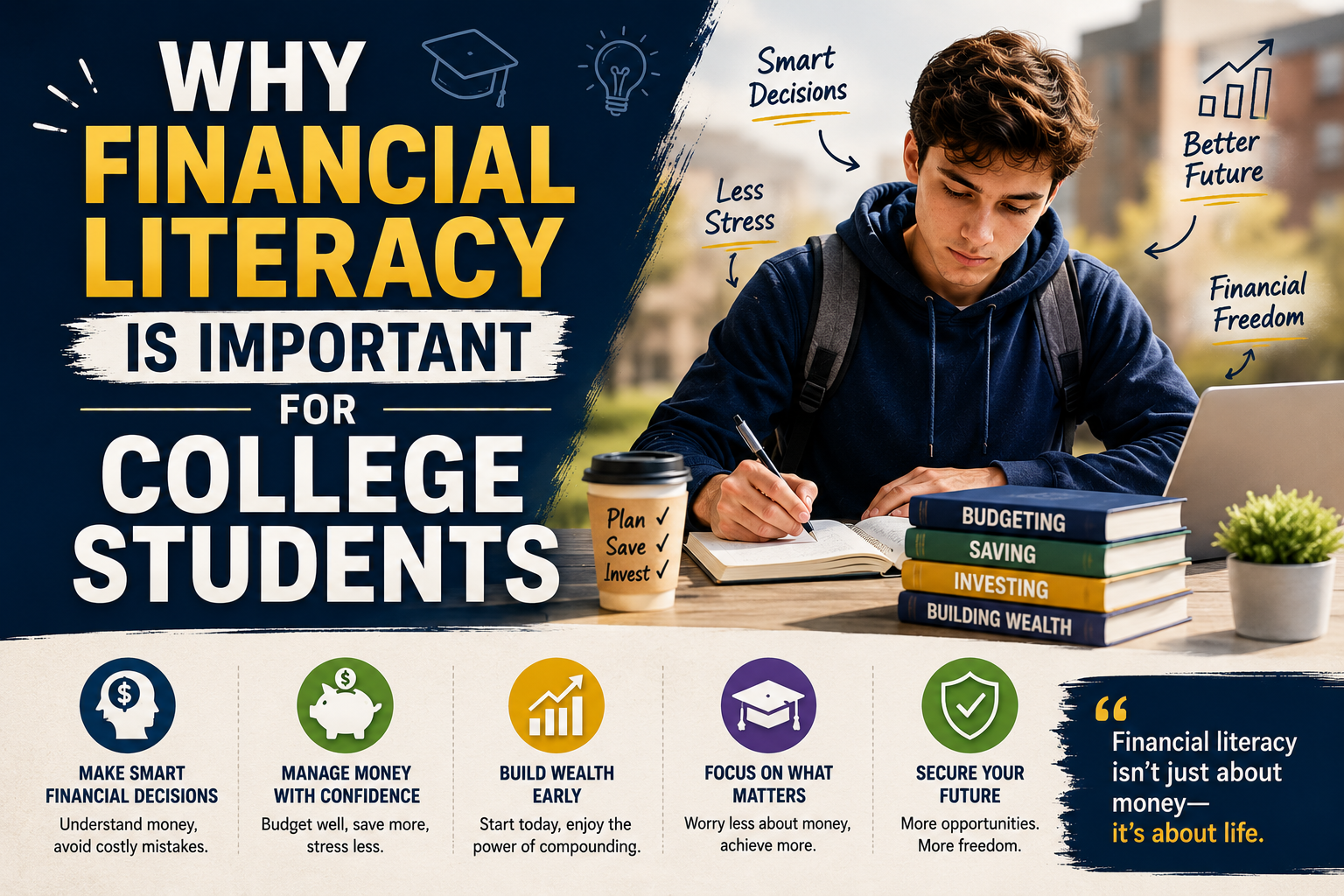
Why Financial Literacy is Important for College Students | The Campus Investor
The Campus Investor
Build Wealth from Day One
📚 Issue No. 01 · Financial Literacy Series
Why Financial Literacy is Important for College Students
May 2026 | 6 min read | For College Students
You can study four years at a university, earn a degree, and graduate with strong grades — and still have no idea how to manage a credit card, understand a student loan statement, or know the difference between a Roth IRA and a savings account. That’s not a personal failing. That’s a gap in the education system.
Financial literacy — the ability to understand and apply basic money concepts — is one of the most practical life skills available to you. Yet most college students enter the workforce without it. The result is predictable: debt they didn’t plan for, savings they never started, and financial decisions made by default rather than by design.
This guide explains exactly why financial literacy matters for college students, what it actually covers, and how you can start building it today — even on a student income.
Average student loan debt per borrower in the U.S.
65%
College students who feel financially unprepared after graduation
1 in 3
Gen Z adults with zero emergency savings
What Financial Literacy Actually Means
Financial literacy is not about being wealthy. It’s not about having a finance degree or reading the Wall Street Journal every morning. It’s simply the ability to understand how money works — and to use that understanding to make better decisions about the money you have.
A financially literate student knows how to build a monthly budget, understands what an interest rate means, knows the difference between good and bad debt, can read a bank statement, and has a basic grasp of how saving and investing work over time. None of this requires advanced knowledge. All of it requires learning things the school system rarely teaches.
💡 A Simple Definition
Financial literacy = the knowledge and skills to manage your money effectively. It’s not about how much you earn — it’s about how confidently and intentionally you handle what you do earn. A student earning $800 a month with financial literacy is better positioned than a graduate earning $60,000 without it.
Why Financial Literacy Matters Especially in College
College is the first time most people manage their own money independently. Financial aid arrives in a lump sum. Credit card companies target students aggressively. Student loans are signed with a click. Rent, groceries, textbooks, and social spending all compete for the same limited income. For many students, it’s overwhelming — and without financial literacy, the defaults are expensive.
Reason 01
You’re making real financial decisions for the first time
College is the stage where financial decisions begin to have lasting consequences. The credit habits you build now follow you for years. The student loans you sign without reading are real legal obligations. The savings habit you either develop or skip in college shapes your financial baseline going into your 30s and beyond.
Reason 02
Compound interest works for or against you — starting now
Every year you delay investing is a year of compound growth you can never get back. Every year you carry high-interest credit card debt is a year that compound interest works against you. Financial literacy helps you understand this dynamic early — when the difference between acting and waiting is still relatively small in dollars but enormous in decades.
Reason 03
Student loans are one of the largest financial decisions of your life
The average student borrower graduates with over $37,000 in federal loan debt. Many have significantly more. Yet most students sign their promissory notes each year without reading them, without tracking their running total, and without understanding how repayment works. Financial literacy doesn’t eliminate student loans — it ensures you make informed decisions about how much to borrow and how to manage what you owe.
Reason 04
Credit history starts in college — and follows you everywhere
Your credit score affects your ability to rent an apartment, finance a car, qualify for a mortgage, and sometimes even get a job. Building credit thoughtfully in college — with one card, low utilization, and on-time payments — can get you to a 700+ score by graduation. Ignoring credit, or misusing it, can set you back years. Financial literacy is what makes the difference.
Reason 05
The financial gap between your peers starts here
Two students can graduate from the same program, enter similar jobs, and end up in dramatically different financial positions ten years later — not because of salary differences, but because of the habits, knowledge, and systems they built (or didn’t build) in college. Financial literacy is not a guarantee of wealth. It is the foundation that makes wealth possible.
What Financial Literacy Covers
Financial literacy isn’t one skill — it’s a set of interconnected concepts that build on each other. You don’t need to master all of them at once. But knowing what’s included helps you prioritize where to start.
📋
Budgeting
Knowing your income, tracking your spending, and allocating money intentionally before the month begins.
💳
Credit & Credit Scores
Understanding how credit scores work, what affects them, and how to build credit responsibly from day one.
🏦
Saving & Emergency Funds
Building a financial cushion so unexpected expenses don’t become debt. Knowing where to keep savings.
🧾
Debt Management
Distinguishing good debt from bad, understanding interest rates, and knowing how repayment actually works.
📈
Investing Basics
Understanding compound interest, index funds, Roth IRAs, and why starting young changes everything.
🎯
Financial Goal Setting
Knowing how to set specific, measurable financial goals — and how to track and achieve them consistently.
Mini-Case · No One Told Marcus
Marcus, Junior — Computer Science
Marcus got his first credit card freshman year with a $2,000 limit. He used it for takeout, concert tickets, and a new laptop — paying only the $35 minimum each month. Nobody had ever explained how APR worked. Nobody told him that 24% annual interest compounds monthly.
By junior year his balance was $1,900. He was paying more in monthly interest than he was reducing the principal. The laptop had effectively cost him $1,700 and counting. He wasn’t irresponsible — he was uninformed.
The lesson: Marcus’s situation wasn’t caused by recklessness. It was caused by a gap in financial education that one afternoon of learning could have prevented. Financial literacy isn’t about being smarter — it’s about having information that changes how you act.
✉ Free Newsletter — Join 5,000+ Students
Something went wrong. Please try again.
Your subscription has been successful.
The Real Cost of Financial Illiteracy
Financial illiteracy isn’t just an abstract disadvantage. It has concrete, dollar-denominated consequences that compound over years — often without the person realizing what’s happening until the damage is done.
Mini-Case · High GPA, Empty Account
Jordan, Recent Graduate — Pre-Law
Jordan graduated with a strong GPA and $62,000 in student loan debt. His $58,000 starting salary felt like a victory — until he did the math. After taxes, rent, loan payments on the standard 10-year plan, and a car payment he hadn’t properly compared rates on, Jordan had less than $200 left each month.
He had never made a budget. He didn’t know income-driven repayment plans existed. His car loan carried a 17% interest rate — predatory, but he had signed without reading. His credit card had a $1,200 balance at 22% APR.
The lesson: A strong academic record and a decent salary don’t equal financial health. Financial literacy is what bridges the gap between earning money and actually keeping — and growing — it.
Mini-Case · Small Habit, Big Outcome
Priya, Senior — Communications
Priya worked 15 hours a week at the campus library — around $450 a month after taxes. After expenses she had $80 left over. Instead of spending it, she read about Roth IRAs one Sunday afternoon, opened a Fidelity account that same day, and set up an $80 monthly automatic contribution into a total market index fund.
She wasn’t wealthy. She didn’t have a finance degree. She had one afternoon of financial literacy and the discipline to act on it.
The lesson: At a 8% average annual return, Priya’s $80/month habit has the potential to grow to over $279,000 in 40 years — completely tax-free in her Roth IRA. Financial literacy didn’t require a high income. It required information and one decision.
Financial literacy isn’t built in a semester — it’s built in small steps over time. The good news is that the most impactful concepts take very little time to understand, and acting on them early creates disproportionately large results.
You don’t need to read every personal finance book or take a course. You need five actions, done in order, and one commitment to keep learning as your situation evolves.
Your 5 Starting Points — This Week
Know your number: Add up all your monthly income from every source. Write that number down. It’s your financial baseline — everything else is built on it.
Track your spending for one month: Don’t budget yet — just watch. Pull up your last 30 days of transactions and categorize them. You cannot improve what you haven’t measured.
Check your credit score: Use Credit Karma, Experian, or your bank app — most offer free access. Know where you stand and what’s affecting your score.
Log into StudentAid.gov: Find your exact loan balance, interest rate, and repayment options. Many students have never done this. It takes five minutes and changes how you think about every borrowing decision going forward.
Open a high-yield savings account: Move your savings from a traditional bank (0.01% APY) to an online bank offering 4–5% APY. Same money, automatically earning more. Takes 10 minutes.
“Financial literacy isn’t about knowing everything. It’s about knowing enough to make better decisions than you would have otherwise — and learning one more thing each month for the rest of your life.”
The students who graduate financially prepared aren’t necessarily the ones who studied finance. They’re the ones who took the time to understand how money works in their own life — and who started that process early enough for the information to actually shape their decisions.
This series exists to be that starting point. Each issue covers one topic — budgeting, credit, debt, saving, investing, financial goals — in plain language with real student examples. Start here. Keep going.
◆ ◆ ◆
Frequently Asked Questions
Why is financial literacy important for college students specifically?
College is when most people make their first independent financial decisions — managing income, signing student loans, opening credit cards, paying rent. These decisions have long-term consequences, yet financial literacy is rarely taught in school. Students who understand money basics in college build credit, avoid unnecessary debt, start saving early, and enter the workforce with a significant financial head start over peers who never learned.
What does financial literacy include for students?
Financial literacy for students covers six core areas: budgeting (knowing your income and controlling spending), credit scores (building and protecting your credit history), saving and emergency funds (creating a financial cushion), debt management (understanding student loans and avoiding high-interest traps), investing basics (compound interest, index funds, Roth IRAs), and financial goal setting (turning intentions into specific plans with deadlines and monthly actions).
How does financial literacy affect a student’s future?
The financial habits and decisions made in college compound significantly over time. A student who builds good credit, avoids carrying a credit card balance, starts a small Roth IRA, and manages their student loans wisely will have meaningfully different financial outcomes at 35 and 45 than a peer with the same salary who never learned these concepts. Financial literacy doesn’t change income — it changes what you do with income.
Can you be financially literate on a small student income?
Yes — and in some ways it’s easier. The core concepts of financial literacy are the same at $900/month as they are at $9,000/month: spend less than you earn, build an emergency fund, avoid high-interest debt, and start investing something consistently. A student earning $900 a month who does all four is more financially literate — and better positioned for the future — than a professional earning $8,000 who does none of them.
What is the easiest way to start building financial literacy as a student?
Start with your actual numbers: know your monthly income, look at your last 30 days of spending, and check your credit score and student loan balance. These four actions take under an hour and immediately change how you see your finances. From there, read one personal finance article or watch one explainer video per week — covering budgeting, credit, saving, investing, and debt in that order. Knowledge in use is what builds literacy, not knowledge in theory.
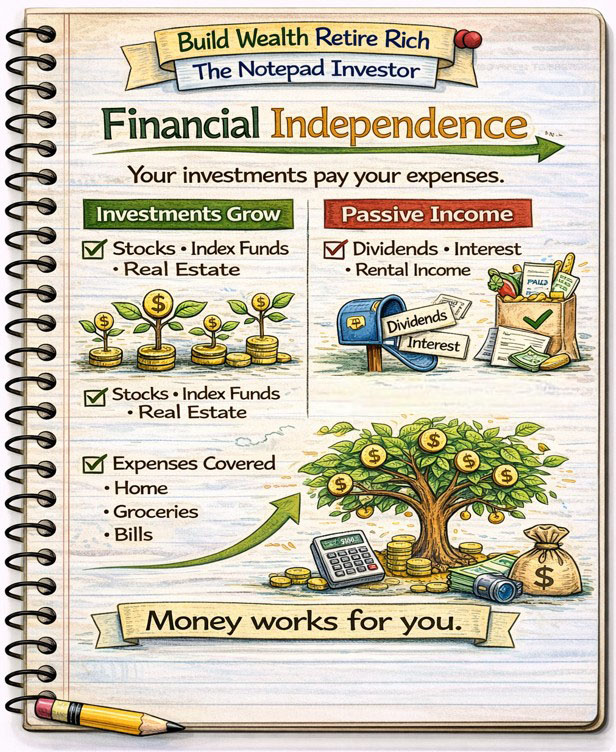
Financial independence is the state of having sufficient wealth and passive income to cover living expenses indefinitely without requiring active employment—achieved when investment returns, rental income, business profits, or other passive sources generate enough to fund desired lifestyle without trading time for money. Unlike retirement requiring reaching age 65 and depending on limited savings, financial independence means work becomes optional at any age, with typical targets ranging from $1-3 million in invested assets producing $40,000-$120,000+ annually through 4% withdrawal rule, though exact amounts vary dramatically based on lifestyle costs and income expectations.
This article is designed for anyone seeking work flexibility, individuals tired of mandatory employment, or those wanting to understand wealth building beyond traditional retirement. You do not need high incomes, inheritance, or business ownership to achieve financial independence—systematic saving (30-50%+ of income), strategic investing, and lifestyle optimization enable financial independence in 10-20 years for dedicated practitioners regardless of starting salary, though higher incomes and lower expenses dramatically accelerate timelines.
Understanding financial independence matters because most people work 40+ years trading time for money until age 65, financial independence enables career changes without income pressure, geographic flexibility, extended travel, entrepreneurship risk-taking, caregiving time, or early retirement impossible while dependent on paychecks—yet many people assume wealth building requires decades of slow accumulation when aggressive saving and investing can achieve financial independence in 10-15 years for those willing to optimize spending and maximize savings rates.
Educational disclaimer: This article provides general educational information about financial independence concepts. Individual circumstances, income levels, expenses, and timelines vary dramatically. Investment return assumptions use historical averages—actual returns vary and are not guaranteed. This is not financial, investment, or retirement advice. Consult qualified financial professionals for personalized guidance.
Understanding Financial Independence
What Is Financial Independence?
Core definition: Passive income covers all living expenses without requiring employment
Key characteristics:
Work becomes optional, not required
Investment income sustains desired lifestyle
Freedom from paycheck dependency
Time autonomy for pursuits beyond earning
Financial security through asset ownership
What financial independence is NOT:
Not necessarily retirement (can choose to work)
Not unlimited wealth (specific to your expenses)
Not passive—requires active management and discipline
Not guaranteed—markets fluctuate, plans adjust
Not one-size-fits-all (highly personalized to lifestyle)
Financial Independence vs Traditional Retirement
Traditional retirement:
Work until age 65-67
Rely on Social Security + modest savings
Often insufficient funds
40+ years of mandatory employment
Limited flexibility before retirement age
Financial independence:
Achievable at any age (30s, 40s, 50s possible)
Self-funded through investments
Sufficient assets for complete lifestyle funding
10-20 years possible with aggressive saving
Work flexibility at any point
The FIRE Movement
FIRE = Financial Independence, Retire Early
Core principles:
Aggressive saving (50-70% of income)
Frugal living and lifestyle optimization
Low-cost index fund investing
Early retirement (30s-50s typical)
Focus on time freedom over material consumption
FIRE variations:
Lean FIRE:
Minimal expenses ($25,000-$40,000 annually)
Target: $625,000-$1,000,000 invested
Extreme frugality, geographic optimization
Fastest path to independence
Regular FIRE:
Moderate expenses ($40,000-$60,000 annually)
Target: $1,000,000-$1,500,000 invested
Comfortable lifestyle, selective spending
Balanced approach
Fat FIRE:
Higher expenses ($75,000-$150,000+ annually)
Target: $2,000,000-$4,000,000+ invested
Luxury lifestyle maintained
Requires high income or longer timeline
Barista FIRE:
Partial financial independence
Part-time work covers expenses, investments preserve/grow
Reduced work stress, maintained engagement
Hybrid approach
Coast FIRE:
Retirement savings sufficient, no additional contributions needed
Current work covers only current expenses
Investments grow to retirement through compounding
Pressure-free working years
The 4% Rule
Safe withdrawal rate principle: Can withdraw 4% of portfolio annually with high confidence money lasts 30+ years
How it works:
$1,000,000 portfolio → $40,000 annual withdrawal
Adjust withdrawals annually for inflation
Portfolio continues growing despite withdrawals
Based on Trinity Study and historical market returns
Calculating FI number:
Annual expenses × 25 = FI target
$40,000 expenses × 25 = $1,000,000 needed
$60,000 expenses × 25 = $1,500,000 needed
$100,000 expenses × 25 = $2,500,000 needed
Why 25x expenses:
4% withdrawal rate = 1/25 of portfolio
Diversified portfolio historically returns 7%+ after inflation
Without understanding financial independence, people assume 40-year careers are inevitable accepting limited control over time and choices, miss opportunities for aggressive wealth building enabling work optionality within 10-20 years, and settle for traditional retirement timelines when strategic saving and investing could provide freedom decades earlier—while those pursuing FI systematically build wealth enabling life design impossible through conventional approaches.
Understanding financial independence enables individuals to:
Achieve work optionality at ages far younger than traditional retirement
Pursue careers and opportunities without financial pressure
Build substantial wealth through systematic high-savings strategies
Design lives around values and priorities rather than financial necessity
Create security through asset ownership and passive income
Gain time freedom for family, health, passions, and purposes beyond earning
Financial independence awareness transforms resignation to 40-year work sentences into strategic paths to freedom achievable within 10-20 years through disciplined execution.
Advertisement
Reserved space for in-content ad
Common Misunderstandings
Many people assume financial independence requires high six-figure incomes or inheritance. In reality, FI depends more on savings rate than absolute income—someone earning $60,000 saving 50% ($30,000 annually, living on $30,000) achieves FI faster than someone earning $150,000 saving 10% ($15,000 annually, living on $135,000) because lower expenses reduce FI target while higher savings accelerate accumulation, proving discipline trumps income level.
Another common misconception is that financial independence means never working again. In practice, FI means work becomes optional not forbidden—many FI achievers continue working in passion careers, part-time roles, entrepreneurship, or volunteering, but without financial pressure transforming work from necessity into choice, proving FI provides freedom to work meaningfully rather than mandatory retirement.
Some believe pursuing FI requires extreme sacrifice making present life miserable. However, successful FI practitioners optimize spending cutting low-value expenses while maintaining high-value spending aligned with personal values—strategic lifestyle design rather than deprivation, proving FI pursuit can increase present life satisfaction while building future freedom when approached thoughtfully versus rigidly.
How Financial Independence Fits Into Financial Success
Financial independence provides ultimate goal organizing all financial decisions—every spending choice evaluated against FI timeline impact, career moves assessed for FI acceleration potential, and investment strategies optimized for FI accumulation, creating comprehensive framework transforming reactive money management into systematic wealth building with clear purpose and measurable progress toward complete financial autonomy.
For example, two people earn $70,000 annually at age 30. Person A never considers FI—spends $65,000, saves $5,000 annually (7% savings rate), lives comfortably but paycheck to paycheck. After 30 years: $285,000 saved at 8% return, still working at 60, requiring continued employment into 70s. Person B discovers FI at 30—optimizes spending to $42,000 (cuts housing 30%, transportation 40%, eliminates unconscious spending), saves $28,000 annually (40% savings rate). After 17 years at 8% return: $850,000 saved, reaches FI at age 47 ($42,000 × 25 = $1,050,000 target nearly achieved). At 47: Person A still has 18 years until retirement, dependent on paycheck. Person B has work optionality—can retire, pursue passion work, travel extensively, or continue career by choice not necessity. Same starting income, different FI awareness and execution, one achieves freedom at 47 while other remains dependent at 60+.
Financial independence understanding separates those achieving time freedom in 40s-50s from those working into 60s-70s by necessity through strategic wealth building enabling optional work versus mandatory employment.
Recent Updates and Trends
In recent years, FIRE movement has exploded—blogs, podcasts, communities proliferating sharing strategies and accountability, though some criticism emerged about sustainability, flexibility, and life balance requiring thoughtful adaptation versus dogmatic following.
Remote work revolution has accelerated FI pursuit—geographic arbitrage easier (work in high-wage area remotely while living in low-cost area), reduced commuting expenses, and flexibility enabling side hustles, all accelerating savings and wealth accumulation.
Market volatility has reinforced importance of conservative FI numbers—3.5% or 3% rules gaining traction versus 4% as sequence of returns risk becomes more appreciated, especially for very early retirement (40+ year timeframes).
Healthcare costs have become major FI planning focus—ACA marketplace providing pre-Medicare coverage option, though costs significant ($500-$2,000+ monthly), making healthcare a major FI expense requiring careful planning especially for early retirees.
Fundamental FI principles remain timeless: aggressive saving (40-70% of income) dramatically accelerates wealth accumulation, expense optimization reduces both savings required and FI target simultaneously, index fund investing provides simple effective growth strategy, and living below means while investing difference enables financial freedom within 10-20 years for dedicated practitioners—regardless of market conditions, economic cycles, or income levels, systematic high-savings execution produces financial independence for those willing to optimize lifestyle and prioritize time freedom over consumption.
3 Things You Can Do Today
Ready to pursue financial independence? Here are three simple steps you can take right now:
1. Calculate your FI number and current progress – Track expenses for last 3 months, average monthly, multiply by 12 for annual. Multiply annual expenses by 25 (4% rule). Example: $45,000 annual expenses × 25 = $1,125,000 FI target. Calculate current net worth (assets minus debts). Divide net worth by FI number for % to FI. Example: $180,000 net worth ÷ $1,125,000 = 16% to FI. This creates concrete target and baseline measuring progress.
2. Calculate current savings rate and FI timeline – Formula: (Annual income – Annual expenses) ÷ Annual income × 100. Example: ($75,000 – $60,000) ÷ $75,000 = 20% savings rate. Use online FI calculator (search “FI calculator” or “time to FI calculator”) inputting savings rate, current net worth, FI target, expected returns (8%). Result shows estimated years to FI. This reveals whether current trajectory achieves FI and when, enabling informed decisions about acceleration strategies.
3. Identify three expense optimizations increasing savings rate 5-10% – Review last month’s spending. Find three areas with low value-to-cost ratio: expensive housing for rarely-used space, vehicle payments on depreciating assets, subscriptions barely used, dining out from convenience not enjoyment. Calculate savings if optimized. Example: Downsize apartment (-$300), sell financed car for paid-off used (-$250), cancel unused subscriptions (-$75), reduce dining out 50% (-$200) = $825 monthly = $9,900 annually. On $75,000 income with 20% savings ($15,000), this increases to 33% ($24,900), cutting FI timeline from 37 years to 25 years—12-year acceleration from expense optimization alone.
These actions create FI awareness with concrete numbers transforming vague retirement hopes into actionable wealth-building plans with measurable timelines and specific strategies.
Advertisement
Reserved space for in-content ad
Quick FAQ
How much money do I need to be financially independent?
Annual expenses × 25 using 4% rule. Example: $40,000 expenses = $1,000,000 needed. $60,000 expenses = $1,500,000. $100,000 expenses = $2,500,000. Conservative: Use 30-33x for 3-3.5% withdrawal rates if retiring very early (40+ year horizon). Amount depends entirely on YOUR spending—no universal number. Lower expenses = lower target = faster FI.
Can I achieve FI on a modest income?
Yes, but requires high savings rate. $50,000 income saving 50% ($25,000 annually, living on $25,000) needs $625,000 and can achieve in ~17 years at 8% returns. $100,000 income saving 20% ($20,000 annually, living on $80,000) needs $2,000,000 and requires ~35 years. Lower income with high savings rate beats high income with low savings rate. Savings rate matters most.
What if the 4% rule fails or markets crash?
Multiple safeguards: (1) Conservative 3-3.5% rule instead, (2) Flexible spending reducing withdrawals in down years, (3) 2-3 years expenses in bonds/cash weathering crashes, (4) Part-time work option if needed, (5) Social Security safety net eventually. 4% rule has 95%+ historical success rate—not guaranteed but highly probable. Diversification, flexibility, and buffers manage risk.
Do I have to retire if I reach FI?
No—FI means work becomes optional, not forbidden. Many continue careers they enjoy without financial pressure, pursue passion work, consult part-time, or start businesses. FI provides freedom to choose work for fulfillment rather than necessity. “Retire Early” in FIRE is option not requirement. Work on your terms when and how you want.
What about inflation eroding my FI number over time?
4% rule accounts for inflation—withdraw 4% year one, then adjust upward for inflation annually. $40,000 year 1 becomes $41,200 year 2 at 3% inflation. Portfolio continues growing despite withdrawals (historically 7%+ real returns after inflation). Real returns exceed withdrawals maintaining purchasing power. Inflation addressed in withdrawal strategy design.
Is pursuing FI selfish or irresponsible with family obligations?
Opposite—FI provides family security and time availability. Financial independence enables: being present for children, caregiving for aging parents, supporting spouse’s career flexibility, weathering job losses without crisis, pursuing meaningful family time versus mandatory overtime. FI pursuit through saving and investing demonstrates responsibility. Balance aggressive FI with present family needs, but FI and family obligations align more than conflict when approached thoughtfully.
This article is provided for educational purposes only and does not constitute financial, investment, retirement, or tax advice. Financial independence strategies involve significant lifestyle changes and investment risk. Investment return assumptions use historical averages—actual returns vary significantly and are not guaranteed. 4% rule and variations based on historical studies—past performance does not guarantee future results. Individual circumstances, income levels, expenses, risk tolerances, and timelines vary dramatically affecting appropriate strategies and achievable timelines. Healthcare costs, tax implications, and withdrawal strategies require personalized planning. Examples are illustrative using simplified assumptions—actual results depend on individual factors, market conditions, and execution quality. FI pursuit requires sustained discipline over many years—not suitable for everyone. Consult qualified financial planners, tax professionals, and investment advisors for personalized guidance considering specific situations. Advertisements or sponsored content may appear within or alongside this content. All information is presented independently.
Interactive Quiz: Financial Independence
Choose an answer and click Check Answer to learn why it is correct or incorrect.
1. What best describes financial independence?
2. What does the 4% rule suggest?
3. How is a financial independence target commonly calculated?
4. Which factor most strongly affects how quickly someone reaches financial independence?
5. Which is a common mistake when planning for financial independence?
Some expenses feel fixed simply because they repeat.
Phone and internet bills arrive every month, get paid automatically, and are rarely questioned. Over time, small inefficiencies can quietly add up without being noticed.
Day 22 is about visibility — not negotiation.
Today’s Focus
Review your phone and internet bills.
Read through the charges. Notice what you’re paying for. No calls or changes today.
Why This Step Matters
Recurring bills shape your cash flow more than occasional expenses.
When you understand these costs:
Awareness increases
Future decisions feel easier
Opportunities become visible
Clarity always comes before optimization.
This Is Not About Perfection
You’re not expected to reduce or cancel anything today.
Simply knowing what you pay creates control.
Reflection Question
What surprised you when you reviewed these bills?
What’s Next
Tomorrow, we’ll explore how your savings could quietly work harder for you.