Most people think they know where their money goes.
In reality, habits blur together — subscriptions, small purchases, and routine spending fade into the background. Over time, those patterns shape results more than one-time decisions.
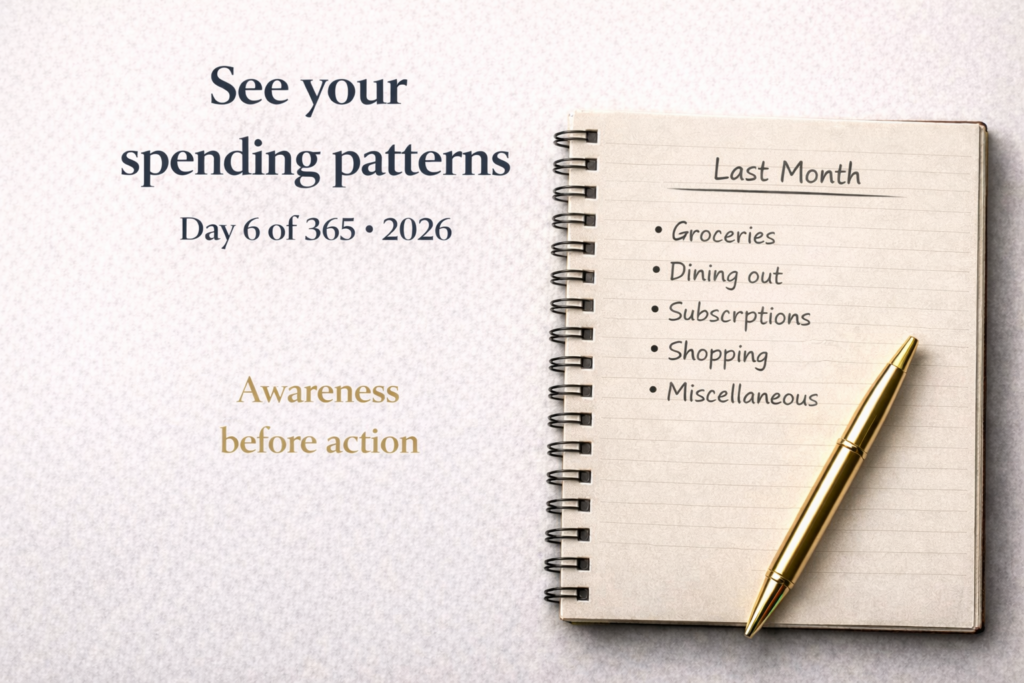
Day 6 is about seeing those patterns clearly.
Today’s Focus
Review last month’s spending.
You don’t need to categorize perfectly or make changes today. Simply notice where money showed up most often.
Why This Step Matters
Spending patterns explain financial stress better than income alone.
When you see patterns:
Awareness increases
Emotional spending decreases
Choices feel intentional
Clarity creates calm — even before any changes are made.
This Is Not a Judgment Exercise
Spending reflects life stages, priorities, and circumstances.
Today’s goal isn’t criticism. It’s understanding.
Reflection Question
Which category showed up more often than expected?
That answer often reveals the easiest future improvement.
What’s Next
Tomorrow, we’ll look at how consistency — not perfection — shapes financial outcomes.
Many people know they have credit cards, but few have ever written down all their balances in one place. When numbers remain scattered across apps and statements, uncertainty grows — even if nothing has changed financially.
That’s why Day 4 focuses on visibility.
Today’s Action
List every credit card you have and its current balance.
This includes:
Cards you use often
Cards you rarely use
Store or promotional cards
You are not paying anything today. You are not closing accounts. You are simply writing everything down.
Why This Step Matters
When balances are unclear, stress fills the gap.
When balances are visible:
Anxiety decreases
Decision-making improves
Planning becomes possible
Clarity does not fix debt instantly — but it removes fear and replaces it with facts.
A Gentle Reminder
This is not a judgment exercise.
Your balances reflect past decisions made with the information you had at the time. Awareness creates control, and control creates confidence.
Reflection Question
Which balance surprised you the most when you saw it written down?
What’s Next
Tomorrow, we’ll list all remaining debts so your full financial picture is clear.
Many people feel uneasy about their finances not because of debt or income, but because their money feels scattered.
Multiple checking accounts, savings accounts, old joint accounts, or rarely used online banks can quietly create mental clutter. When money is fragmented, clarity disappears.
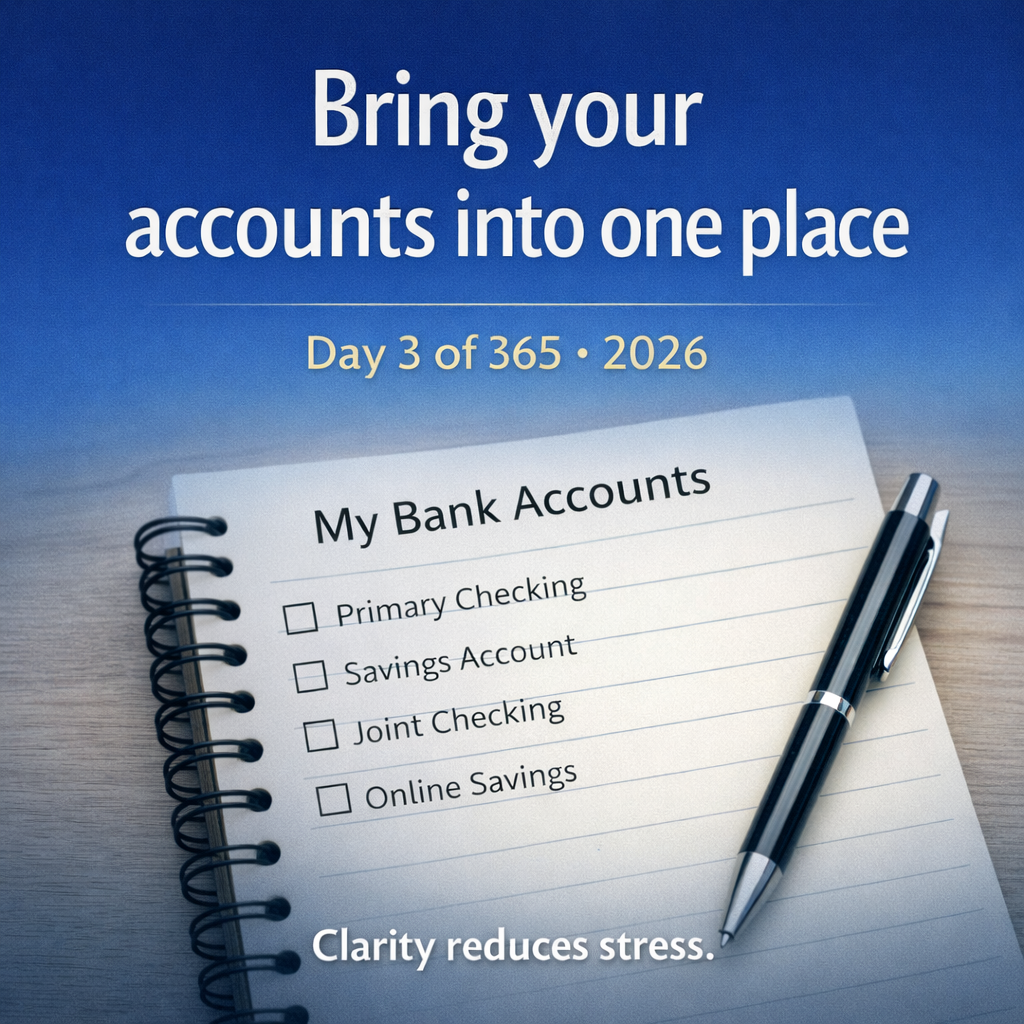
That’s why Day 3 focuses on visibility.
Today’s Action
List every bank account you currently have.
Include:
Checking accounts
Savings accounts
Joint accounts
Online-only accounts
You’re not closing anything. You’re not moving money. You’re simply bringing everything into one place.
Why This Step Matters
When accounts are spread out, it becomes harder to:
Track balances
Plan savings
Automate finances
Feel confident about decisions
Visibility creates calm. Once you see everything clearly, organizing and simplifying becomes much easier.
This Is About Awareness, Not Action
There’s no right or wrong number of accounts.
Some people need multiple accounts. Others benefit from fewer. Today isn’t about fixing — it’s about understanding what exists.
Reflection Question
Which account do you rarely think about, but still keep open?
That answer often points to future simplification.
What’s Next
Tomorrow, we’ll do the same exercise for credit cards to complete the visibility phase.
You’ve listed your income, written down your expenses, and tracked spending for 3 days. Now comes the moment of truth — add it all up.
This step isn’t about guilt; it’s about clarity. When you see your full week’s spending total, you finally understand your true cash flow — and where your money naturally goes.
🪙 Step 4 — Add Up Your Weekly Spending
Pull out your list from the past few days and do the math. ✅ Add every transaction, large or small. ✅ Include online orders, bills, subscriptions, and cash payments. ✅ Write down your total weekly spending number.
Now, compare that number to your weekly take-home income (monthly ÷ 4). Ask yourself: Is my spending aligned with what I earn?
If you’re spending more than you make, don’t panic — you’ve just found the first area to improve.
📊 Example
If your monthly take-home pay is $3,800, your weekly income is about $950. After adding your expenses, you discover you spent $1,040 this week — $90 over budget. That $90 doesn’t seem huge, but repeated every week equals $4,680 a year — money that could’ve built your emergency fund or started investing.
Awareness = power.
🌱 Why It Matters
Adding your spending gives you control:
You see where the leaks are.
You understand your real habits instead of your guesses.
You set the stage for next week’s plan — a working budget.
The truth might sting for a moment, but it frees you for life.
🔍 Challenge for Today
Spend 15 minutes adding up every expense from the past 7 days. Write your total at the bottom of your list. Then write this question underneath: “Am I okay with this number?”
Money clarity begins when numbers meet honesty. Adding your weekly total may feel uncomfortable — but it’s also empowering. You can’t steer what you won’t measure.
You’ve listed your income. You’ve listed your expenses.
Now it’s time to take the next step — track your spending for three days.
Listing showed what you spend on; tracking shows how you spend. It reveals habits, timing, and the emotional triggers behind your money moves.
🪙 Step 3 — Track Every Dollar for 3 Days
For the next three days, record every transaction the moment it happens. This isn’t a long-term budget — it’s a short-term money snapshot.
✅ Write down each purchase immediately (use Notes, Excel, or a tracking app). ✅ Record where and when you spent it. ✅ Include cash, card, online payments, and even tips.
The goal isn’t perfection — it’s honesty. In just three days, you’ll see patterns that were invisible before.
📊 Example: What Tracking Reveals
After three days, you might find:
Two morning coffees instead of one ☕
$25 in delivery fees 🚗
$18 impulse purchase while scrolling 🛒
Forgotten $10 app subscription 📱
Those small numbers tell a big story — where your cash really leaks away.
🌱 Why It Matters
Tracking connects your intentions to your actions.
You start noticing automatic habits — and that awareness creates choice.
You understand not only what you spend but when and why.
This sets the stage for tomorrow’s step: creating a simple 3-category spending plan.
Money clarity starts with observation, not restriction.
🔍 Challenge for Today
Commit to 3 days of real-time tracking. Keep your tracker open on your phone — update it the moment you buy something. At the end of Day 3, review your total and note one surprise you didn’t expect.
Before You Control Money, You Must See Where It Goes
Yesterday, you learned how to find your true monthly income. Today, you’re taking the next small — but powerful — step: list every expense.
Not track. Not judge. Not analyze. Just list.
This exercise builds awareness — the foundation of financial control. Most people underestimate how much they spend simply because they never see it all in one place.
Step 2 — Write Down Every Expense
Grab a notebook, open your Notes app, or start a blank spreadsheet. Now, begin writing every single thing you’ve spent money on this month.
✅ Rent or mortgage ✅ Groceries ✅ Gas or transportation ✅ Subscriptions (Netflix, Spotify, etc.) ✅ Eating out and coffee ✅ Utilities and phone ✅ Insurance, fees, or memberships ✅ Miscellaneous purchases
Don’t worry about sorting or labeling — that comes later. For now, your only goal is to get everything on paper.
Example: What a List Might Look Like
Rent – $1,200
Coffee – $4.50
Gas – $45
Netflix – $15
Grocery store – $110
Gym membership – $40
You’re not analyzing or tracking patterns yet — you’re collecting truth. Seeing it all together often surprises people — and that surprise is powerful.
Why It Matters
When you list your expenses, you stop guessing and start knowing.
Awareness is the first step to control.
You’ll see where your money goes without judgment.
Tomorrow, when you begin grouping and tracking, you’ll have accurate data — not estimates.
You can’t manage what you haven’t written down.
Challenge for Today
Set aside 20 minutes today to list every expense from the past week (or month if possible). Look through bank statements, receipts, and apps. Write each amount in one continuous list — no categories, no filters.
Wealth begins with awareness — and awareness begins with your list. Today, you’re not budgeting or cutting back; you’re opening your eyes. Tomorrow, you’ll turn that list into a powerful financial picture.
You Can’t Build Wealth If You Don’t Know What’s Coming In
Before you create a budget, set goals, or invest a single dollar, there’s one simple but powerful step: know your monthly income.
Sounds obvious, right? Yet most people can’t say — with confidence — how much they actually take home each month after taxes, insurance, and retirement deductions. That number — your net income — is the foundation of every financial decision you’ll ever make.
Step 1: Find Your Real Take-Home Pay
Start with your paycheck or salary. Look beyond the “gross income” — the total before taxes and deductions — and focus on your net pay:
✅ Subtract taxes (federal, state, and local) ✅ Subtract Social Security and Medicare (FICA) ✅ Subtract any benefits like health insurance or 401(k) contributions
Example: If your annual salary is $60,000, your gross monthly income is $5,000. But after deductions, your take-home pay might be closer to $3,800. That $3,800 is your real income — the number that determines how much you can save, invest, and spend without guilt.
Why It Matters
Knowing your income is like turning on the lights in a dark room. Suddenly, you can see where everything stands:
You’ll budget with confidence, not guesswork.
You’ll know how much to save for short-term and long-term goals.
You’ll understand your cash flow, making every financial choice intentional.
When you control awareness, you control outcomes.
Challenge for Today
Take 15 minutes today to calculate your true monthly income. Open your latest pay stub or check your online payroll portal. Write down your after-tax, after-deduction amount — that’s your real income.
This is Day 1 of your 365-Day Financial Wellness Journey. Every small step you take will move you closer to financial independence.