
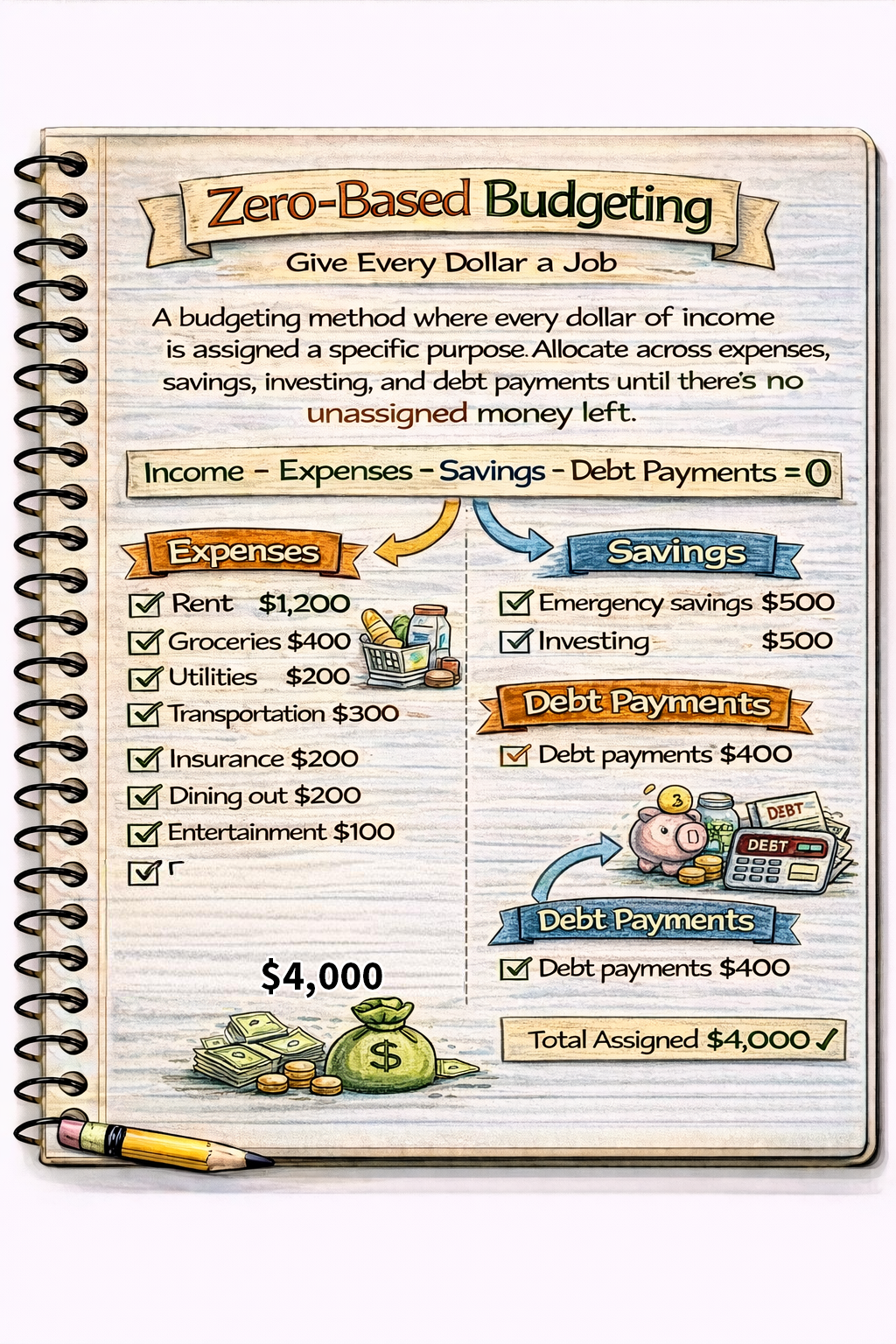
Zero-based budgeting is a budgeting method where every dollar of income is assigned a specific purpose—spending, saving, or debt repayment—until income minus all allocations equals exactly zero, ensuring no money remains unallocated at month’s end. Unlike traditional budgeting where leftover money sits in checking accounts getting spent unconsciously, zero-based budgeting gives every single dollar a job before the month begins, whether allocated to bills, groceries, savings, entertainment, or other categories, creating intentional complete allocation preventing unconscious spending leaks and maximizing money working toward priorities.
This article is designed for anyone seeking maximum budgeting control, individuals losing track of money despite budgeting efforts, or those wanting intentional allocation of every dollar earned. You do not need accounting expertise, complex software, or mathematical skills to implement zero-based budgeting—simple income-minus-expenses calculation until reaching exactly zero creates functional framework enabling complete money control regardless of income level, though method works best for detail-oriented individuals comfortable with active monthly planning.
Understanding zero-based budgeting matters because traditional budgets often leave money unallocated creating unconscious spending on forgotten items, people with “leftover” money frequently wonder where it went despite budgeting other categories, and lack of complete intentional allocation prevents maximizing money working toward goals—while zero-based budgeters maintain total control through every-dollar assignment, eliminate unconscious spending completely, and ensure maximum allocation toward priorities through comprehensive intentional planning impossible with partial budgeting approaches.
Educational disclaimer: This article provides general educational information about zero-based budgeting methodology. Individual circumstances, income levels, expenses, and budgeting preferences vary significantly. Zero-based budgeting requires time investment and detail orientation—not suitable for everyone. This is not financial planning or professional advice. Consult qualified financial professionals for personalized guidance.
Understanding Zero-Based Budgeting
What Is Zero-Based Budgeting?
Core definition: Budgeting method where income minus all allocations equals exactly zero
The fundamental equation:
- Income – (Expenses + Savings + Debt Payments) = $0
- Or rearranged: Income = Expenses + Savings + Debt Payments
- Every dollar gets assigned to a category until nothing remains
Key principle: Give every dollar a name and purpose before month begins
What “zero” means:
- NOT: Spend everything leaving zero in accounts
- INSTEAD: Allocate everything intentionally (including savings) leaving zero unassigned dollars
Example:
- Income: $4,500
- Rent: $1,200
- Utilities: $180
- Groceries: $450
- Gas: $120
- Dining out: $200
- Entertainment: $150
- Debt payments: $350
- Emergency fund: $500
- Retirement: $400
- Misc/buffer: $100
- Car insurance: $150
- Phone: $85
- Subscriptions: $65
- Clothing: $50
- Total allocated: $4,500
- Remaining: $0
Every dollar assigned a job—no money floating unallocated
Zero-Based Budgeting vs Traditional Budgeting
Traditional budgeting:
- Income: $4,500
- Major categories budgeted: $3,800
- Remaining “leftover”: $700
- Leftover money often spent unconsciously or sits vaguely designated
Zero-based budgeting:
- Income: $4,500
- ALL categories budgeted: $4,500
- Remaining: $0
- The $700 “leftover” explicitly assigned: $400 savings, $200 sinking funds, $100 miscellaneous buffer
Key difference: Complete intentional allocation vs partial budgeting with unassigned remainder
Origin and Philosophy
Business origins: Developed for corporate budgeting requiring departments to justify every dollar from zero each cycle rather than using previous budgets as baselines
Personal finance adaptation: Popularized by Dave Ramsey and YNAB (You Need A Budget) for individuals
Underlying philosophy:
- Every dollar represents potential—earning potential, savings potential, enjoyment potential
- Unconscious spending wastes potential through drift
- Intentional allocation maximizes every dollar’s impact
- Money sitting unallocated gets spent unconsciously
- Proactive planning beats reactive spending
Who Zero-Based Budgeting Works Best For
Ideal candidates:
- Detail-oriented individuals comfortable with planning
- People who wonder “where did my money go?” despite budgeting
- Those seeking maximum control and intentionality
- Aggressive savers wanting to maximize allocation toward goals
- Individuals with variable income requiring flexible allocation
- Couples wanting complete transparency and joint planning
Less suitable for:
- People overwhelmed by detailed planning (may prefer 50/30/20 simplicity)
- Individuals resistant to tracking and monitoring
- Those wanting “set and forget” automated budgets
- Very high earners with spending far below income (overkill for them)

Creating a Zero-Based Budget
Step 1: Determine Monthly Income
For regular income:
- Calculate monthly take-home pay (after taxes, retirement, insurance)
- Add any side income or other earnings
- This is your starting number to allocate to zero
Example:
- Job 1: $3,800 monthly (after-tax)
- Side hustle: $500 monthly (average)
- Total income to allocate: $4,300
For irregular income:
- Use conservative estimate (lowest typical month or 12-month average)
- Create priority-based spending plan
- Allocate additional income from high months when received
Step 2: List All Expenses and Allocations
Fixed expenses (same monthly):
- Rent or mortgage
- Car payment
- Insurance premiums
- Loan payments
- Subscriptions
- Phone, internet
Variable expenses (fluctuate monthly):
- Groceries
- Utilities
- Gas/transportation
- Dining out
- Entertainment
- Personal care
- Household items
Savings and goals:
- Emergency fund
- Retirement contributions
- Sinking funds (upcoming irregular expenses)
- Goal-specific savings
Debt repayment:
- Minimum payments (already covered above)
- Extra principal payments for accelerated payoff
Buffer/miscellaneous:
- Unexpected small expenses
- Category to prevent budget failure from minor deviations
Step 3: Assign Dollar Amount to Each Category
Use historical spending for estimates:
- Review last 2-3 months spending by category
- Calculate averages for variable categories
- Use actual amounts for fixed categories
- Adjust based on goals (reduce dining out, increase savings, etc.)
Example budget draft:
- Income: $4,300
- Rent: $1,200
- Utilities: $150
- Groceries: $400
- Dining out: $150
- Gas: $100
- Car payment: $300
- Auto insurance: $125
- Health insurance: $200
- Phone: $75
- Internet: $60
- Subscriptions: $45
- Student loan: $250
- Entertainment: $120
- Personal care: $80
- Clothing: $75
- Emergency fund: $400
- Retirement: $300
- Sinking funds: $150
- Miscellaneous: $120
Total allocated: $4,300 ✓
Remaining to allocate: $0 ✓
Step 4: Adjust Until Income Minus Allocations = $0
If total under income (money unallocated):
- Don’t leave it floating—assign it immediately
- Options: Increase savings, add to debt payoff, allocate to sinking fund, boost emergency fund
- Example: $200 unallocated → add $200 to emergency fund reaching zero
If total over income (overspending):
- Reduce variable expenses until balanced
- Cut discretionary categories first (dining, entertainment, shopping)
- Review needs for optimization opportunities
- Or increase income through side work if cuts insufficient
Balance achieved when: Every dollar assigned AND income exactly matches total allocations
Step 5: Track Spending Throughout Month
Daily or weekly tracking:
- Record expenses as they occur
- Deduct from allocated category amounts
- Monitor category balances remaining
- Adjust spending if approaching category limits
Example tracking (groceries category):
- Allocated: $400
- Week 1 shopping: -$95 (Remaining: $305)
- Week 2 shopping: -$110 (Remaining: $195)
- Week 3 shopping: -$88 (Remaining: $107)
- Week 4 shopping: -$98 (Remaining: $9)
- Month-end: $9 leftover reallocated or rolled to next month
Tools for tracking:
- YNAB (You Need A Budget) app—designed specifically for zero-based budgeting
- EveryDollar app—Dave Ramsey’s zero-based budget tool
- Spreadsheet with running balances per category
- Paper envelope system (physical cash in labeled envelopes)
Step 6: Handle Variations and Adjustments
Overspending in one category:
- Cover by reducing another category (budget adjustments mid-month)
- Example: Spent $50 extra on groceries → reduce dining out by $50
- Maintains zero-based principle—every dollar still accounted for
Underspending in one category:
- Reallocate surplus to another category needing funds
- Or roll forward to next month’s same category
- Or move to savings if all other categories satisfied
Unexpected expenses:
- Use miscellaneous/buffer category
- Or reallocate from discretionary categories
- Or pull from emergency fund if genuine emergency
Income changes:
- More income: Immediately allocate bonus/raise to categories until zero
- Less income: Reduce allocations across categories maintaining zero
Zero-Based Budgeting Example Scenarios
Scenario 1: Single Person, $3,500 Monthly Income
Income allocation:
- Income: $3,500
- Rent: $900
- Utilities: $120
- Groceries: $300
- Gas: $100
- Car payment: $250
- Auto insurance: $110
- Health insurance: $180
- Phone: $65
- Internet: $50
- Streaming: $30
- Gym: $45
- Student loans: $200
- Credit card payment: $150
- Dining out: $100
- Entertainment: $80
- Personal care: $60
- Clothing: $50
- Emergency fund: $400
- Retirement (Roth IRA): $200
- Miscellaneous: $110
- Total: $3,500
- Remaining: $0 ✓
Scenario 2: Family, $6,000 Monthly Income
Income allocation:
- Income: $6,000
- Mortgage: $1,500
- Property tax/insurance: $300
- Utilities: $200
- Groceries: $650
- Gas: $150
- Car payment: $350
- Auto insurance: $180
- Health insurance: $350
- Life insurance: $75
- Phone (2 lines): $120
- Internet: $70
- Childcare: $500
- Student loans: $300
- Dining out: $200
- Entertainment: $150
- Kids activities: $100
- Personal care: $100
- Clothing: $100
- Household items: $80
- Gifts/occasions: $75
- Emergency fund: $350
- Retirement (401k already contributed pre-tax): $400
- College savings (529): $150
- Sinking funds (car maintenance, holidays): $200
- Miscellaneous: $150
- Total: $6,000
- Remaining: $0 ✓
Scenario 3: Debt Payoff Focus, $4,800 Income
Aggressive debt elimination allocation:
- Income: $4,800
- Rent: $1,100
- Utilities: $130
- Groceries: $350 (reduced, meal planning)
- Gas: $90
- Car payment: $280
- Auto insurance: $115
- Health insurance: $200
- Phone: $60
- Internet: $55
- Minimum debt payments: $300
- Extra debt payoff: $1,500 (aggressive allocation)
- Starter emergency fund: $100 (maintaining $1,000 minimum)
- Dining out: $50 (minimal)
- Entertainment: $30 (minimal)
- Personal care: $40
- Miscellaneous: $100
- Subscriptions: $0 (temporarily canceled)
- Gym: $0 (using free exercise)
- Clothing: $0 (paused except essentials)
- Total: $4,800
- Remaining: $0 ✓
Strategy: Temporarily minimal discretionary spending, maximum debt payoff, maintained small emergency fund contribution
Advanced Zero-Based Budgeting Concepts
Sinking Funds in Zero-Based Budgets
What are sinking funds: Monthly savings for irregular predictable expenses
Common sinking fund categories:
- Car maintenance and repairs
- Car insurance (if paid annually or semi-annually)
- Holiday gifts
- Vacation
- Home maintenance
- Property taxes (if not escrowed)
- Annual subscriptions
- Medical deductible
How to calculate:
- Estimate annual cost for each category
- Divide by 12 for monthly allocation
- Include in zero-based budget as line item
Example sinking fund allocation:
- Car maintenance: $1,200 annual ÷ 12 = $100 monthly
- Holiday gifts: $600 annual ÷ 12 = $50 monthly
- Vacation: $2,400 annual ÷ 12 = $200 monthly
- Home repairs: $1,800 annual ÷ 12 = $150 monthly
- Total sinking funds: $500 monthly allocated in budget
Benefit: Large irregular expenses don’t destroy budget when they occur—money already saved
Handling Variable Income
Priority-based budgeting approach:
Tier 1 (Essential – fund first):
- Housing (rent/mortgage)
- Utilities (basic levels)
- Food (groceries)
- Transportation (essential for work)
- Insurance (health, required auto)
Tier 2 (Important – fund after essentials):
- Minimum debt payments
- Basic emergency fund contribution
- Childcare if applicable
Tier 3 (Discretionary – fund if income allows):
- Dining out
- Entertainment
- Upgraded versions of basics
Tier 4 (Goals – fund extra income):
- Extra debt payments
- Increased savings
- Sinking funds
Implementation:
- Low income month ($3,000): Fund Tier 1 + 2 only = $2,800, remaining $200 to Tier 3
- Average month ($4,500): Fund Tiers 1-3 = $3,800, remaining $700 to Tier 4
- High income month ($6,000): Fund all tiers fully plus extra to Tier 4 goals
Still zero-based: Every dollar allocated even when amounts vary—just allocated differently based on income level
Rolling With The Punches (Mid-Month Adjustments)
YNAB principle: Budget isn’t failed when reality differs from plan—adjust budget to match reality
Example scenario:
- Budgeted groceries: $400
- Actual spent week 1-2: $280
- Unexpected medical expense: $150
- Solution: Reduce remaining grocery budget to $120, reallocate $150 from dining out budget to medical
- Result: Still zero-based, categories adjusted to reality
Key mindset: Budget is plan, not prison—adjust as needed while maintaining every-dollar allocation
Age of Money Concept
Definition: Average age of dollars in your accounts (how long ago you earned the money you’re spending today)
Goals:
- New to budgeting: 0-10 days (spending money earned this pay period)
- Building stability: 20-30 days (spending last month’s money)
- Financial stability: 30+ days (living on previous month’s income)
- Strong position: 60+ days
Benefit: Higher age of money = less paycheck-to-paycheck stress, easier to handle irregular income and timing mismatches
Advantages of Zero-Based Budgeting
Maximum Intentionality
- Every single dollar assigned purpose before spending
- No unconscious drift or forgotten allocations
- Forces conscious trade-off decisions
- Maximizes money working toward priorities
Eliminates “Where Did My Money Go?” Syndrome
- Common problem: Budget major categories but lose track of $300-800 monthly
- Zero-based solution: Those amounts explicitly allocated preventing disappearance
- Complete account for every dollar
Flexibility Within Structure
- Can reallocate between categories as needed
- Adjustments maintain zero-based principle
- Adapts to irregular income through priority-based allocation
- Handles unexpected expenses through reallocation not budget failure
Proactive Planning
- Budget created before month begins, not reactively during month
- Anticipates upcoming expenses through sinking funds
- Enables strategic allocation toward goals
- Reduces stress through preparedness
Accelerated Goal Achievement
- Explicit allocation to savings, debt payoff, goals ensures progress
- Prevents “I’ll save what’s left” failure (nothing left)
- Pay yourself first integrated into every-dollar allocation
Disadvantages and Challenges
Time Investment
- Initial setup: 2-4 hours creating detailed budget
- Monthly planning: 1-2 hours before each month
- Weekly tracking: 15-30 minutes reviewing balances
- More intensive than 50/30/20 or automated approaches
Requires Detail Orientation
- Must track spending consistently
- Need comfort with numbers and categories
- Overwhelming for some personalities preferring simplicity
Learning Curve
- First 2-3 months require frequent adjustments
- Finding realistic category amounts takes trial and error
- Mindset shift from “leftover” to “every dollar assigned” takes practice
Potential for Obsessiveness
- Some people become overly rigid
- Can create stress if treated as inflexible law rather than flexible plan
- Balance needed between intentionality and flexibility
May Be Overkill for High Earners
- Someone earning $200,000 spending $80,000 may not need every-dollar precision
- General awareness and automated savings may suffice
- Time investment not worth marginal improvement for some
Why Zero-Based Budgeting Matters
Without complete intentional allocation, people budget major categories but lose track of hundreds monthly wondering where money went, leave “leftover” amounts floating unassigned getting spent unconsciously on forgotten items, and fail to maximize money working toward priorities through partial planning—while zero-based budgeters maintain total control through every-dollar assignment, eliminate all unconscious spending, and ensure maximum allocation toward goals through comprehensive intentional planning impossible with partial budgeting creating superior wealth-building outcomes.
Understanding and implementing zero-based budgeting enables individuals to:
- Maintain complete control through intentional allocation of every dollar
- Eliminate unconscious spending completely through comprehensive assignment
- Maximize money working toward priorities through deliberate planning
- Handle irregular income and expenses through flexible priority allocation
- Accelerate goal achievement through explicit savings and debt allocations
- Build wealth systematically through maximum intentional money management
Zero-based budgeting transforms partial budgeting into complete intentional allocation enabling maximum control and wealth building for dedicated practitioners.
Common Misunderstandings
Many people assume “zero-based budgeting” means spending all money leaving bank account at zero by month-end. In reality, zero refers to unallocated dollars not account balance—someone might allocate $2,000 to savings and $1,000 to emergency fund within their zero-based budget, maintaining substantial account balances while achieving zero unassigned dollars, proving method maximizes intentional saving not spending.
Another common misconception is that zero-based budgeting requires perfect accuracy with no mid-month adjustments allowed. In practice, budget serves as starting plan with regular adjustments expected as reality unfolds—overspending one category covered by reducing another maintaining every-dollar allocation, proving flexibility and adaptability are features not bugs when implemented properly.
Some believe zero-based budgeting only works for people with consistent predictable incomes making irregular earners unsuitable. However, zero-based budgeting adapts excellently to variable income through priority-based allocation—allocating dollars as they arrive toward tiered categories based on actual received amounts, proving method works across all income patterns when approached appropriately.
How Zero-Based Budgeting Fits Into Financial Success
Zero-based budgeting provides maximum intentional control enabling comprehensive allocation of every dollar toward priorities, eliminates unconscious spending completely through systematic assignment, and accelerates goal achievement through explicit savings and debt payoff allocations, creating financial management system producing superior wealth-building outcomes for dedicated practitioners willing to invest time in detailed planning and tracking.
For example, two people earn $4,500 monthly both attempting to save and pay down debt. Person A uses traditional budgeting—budgets major categories ($3,800), has vague plan for remaining $700 (“save some, pay extra on debt”), ends each month finding $200-300 disappeared to forgotten spending (coffee, impulse purchases, small items), saves $250-400 sporadically. After year: saved $3,600 inconsistently, paid extra $1,200 toward debt. Person B implements zero-based budgeting—allocates all $4,500 explicitly including $500 emergency fund, $250 extra debt payment, $150 sinking funds, $100 miscellaneous buffer, tracks spending weekly adjusting as needed. Every dollar assigned prevents unconscious leaks. After year: saved $6,000 emergency fund ($500 × 12), paid extra $3,000 debt ($250 × 12), built $1,800 sinking funds. Total: Person B achieved $10,800 in savings/debt progress versus Person A’s $4,800—125% better outcome through complete intentional allocation versus partial budgeting losing $300+ monthly to unconscious drift.
Zero-based budgeting separates maximum wealth builders from partial budgeters through every-dollar allocation eliminating unconscious leaks and maximizing goal progress impossible with incomplete planning.
Recent Updates and Trends
In recent years, YNAB (You Need A Budget) has popularized zero-based budgeting principles reaching millions through app and methodology emphasizing every-dollar assignment, though subscription cost ($99 annually) creates barrier for some versus free alternatives.
Envelope system evolution has modernized—traditional cash envelopes being replaced by digital envelope systems in apps maintaining zero-based allocation without physical cash inconvenience, making method accessible to cashless younger generations.
Subscription fatigue has highlighted zero-based budgeting value—explicit allocation reveals forgotten subscriptions totaling $100-300+ monthly for many people, enabling cancellation through visibility created by every-line-item assignment.
Irregular income prevalence has increased zero-based budgeting relevance—gig economy and freelance work creating variable income situations where priority-based zero-based allocation provides superior control versus fixed-amount budgets failing during low months.
Fundamental zero-based budgeting principles remain timeless: every dollar assigned specific purpose before month begins, complete intentional allocation prevents unconscious spending, flexibility within structure through mid-month reallocation, and proactive planning beats reactive hoping—regardless of app availability, payment method trends, or income patterns, systematic every-dollar assignment produces superior financial outcomes versus partial budgeting approaches leaving money unallocated and vulnerable to unconscious drift.
3 Things You Can Do Today
Ready to try zero-based budgeting? Here are three simple steps you can take right now:
1. Calculate your budgetable income and create starting number – Review last month’s income: all after-tax deposits to accounts. If you contribute to 401(k) pre-tax, add that back (it’s allocated to savings already). This total is your starting number to allocate to zero. Example: $3,800 take-home + $400 401(k) = $4,200 to allocate. Write this number at top of page—this is what you’re allocating to exactly zero. If income varies, use conservative estimate (lowest typical month or 6-month average). Takes 5 minutes establishing foundation.
2. List every expense category and assign dollar amount to each – Write comprehensive list: housing, utilities, groceries, gas, insurance, debt payments, dining out, entertainment, subscriptions, savings, emergency fund, sinking funds, clothing, personal care, miscellaneous—everything. Assign realistic dollar amount to each based on recent months. Include savings and debt payoff categories (not just spending). Add buffer/miscellaneous category ($50-150) for unexpected small items. Total all categories. Takes 30-45 minutes creating complete allocation.
3. Adjust allocations until total exactly matches income – Compare category total to income from step 1. Over income? Reduce variable categories (dining out, entertainment, shopping) until balanced. Under income? Don’t leave money unallocated—add to savings, emergency fund, debt payoff, or sinking funds until reaching exactly zero remaining. Final check: Income minus all allocations = $0. This is your zero-based budget. Takes 15-20 minutes achieving balance. Implementation next: track spending this month against allocations adjusting as reality unfolds.
These actions create functional zero-based budget within 60-90 minutes establishing every-dollar allocation framework enabling maximum intentional control starting immediately.
Quick FAQ
What does “zero” mean in zero-based budgeting?
Zero means zero dollars left unallocated, NOT zero dollars in bank account. Formula: Income – (All Expenses + Savings + Debt Payments) = $0. Every dollar gets assigned job (spending, saving, debt payoff) until none remain unallocated. Example: $4,000 income allocated $2,500 expenses + $800 savings + $700 debt = $0 unassigned (but $800 sitting in savings account). Zero-based maximizes intentional saving, not spending.
How is zero-based budgeting different from the 50/30/20 rule?
50/30/20 uses percentage allocations to three broad categories (needs, wants, savings). Zero-based budgeting uses detailed line-item categories allocating every specific dollar. 50/30/20 simpler (less tracking, broader categories). Zero-based more detailed (every expense its own line, complete allocation). Can combine: Use 50/30/20 percentages as guide, but allocate every dollar within those buckets zero-based style. Choose based on preference for simplicity (50/30/20) vs maximum control (zero-based).
What if I overspend in one category—does that ruin my zero-based budget?
No—adjust budget covering overspending by reducing another category. Example: Overspent groceries by $50, reduce dining out by $50. This maintains zero-based allocation—every dollar still assigned, just reassigned mid-month based on reality. “Rolling with the punches”—budget is plan not prison. Flexibility within structure is feature allowing real-life adjustment while maintaining every-dollar accountability. Only “fails” if you ignore overspending allowing unconscious drift.
Do I need YNAB or special software for zero-based budgeting?
No—zero-based budgeting is methodology, not software requirement. Can implement with: Spreadsheet (Google Sheets or Excel), EveryDollar app (free basic version), Paper and pen, YNAB ($99 annually, designed specifically for zero-based). Software makes tracking easier but isn’t required. Start with free spreadsheet, upgrade to paid app only if needed. Methodology matters more than tool.
How long does zero-based budgeting take each month?
Initial setup: 2-4 hours first month creating categories and establishing amounts. Ongoing monthly: 1-2 hours before month creating next month’s budget. Weekly tracking: 15-30 minutes reviewing balances and adjusting if needed. Total: 3-4 hours monthly after initial setup. More time than 50/30/20 but produces maximum control. Efficiency improves after 3-4 months as categories stabilize and process becomes routine. Worth time investment if “where did my money go?” is recurring problem.
Can zero-based budgeting work with irregular or variable income?
Yes—use priority-based allocation. Create tiered categories: Tier 1 essentials (housing, utilities, basic food), Tier 2 important (debt minimums, basic savings), Tier 3 discretionary (dining out, entertainment), Tier 4 goals (extra debt/savings). Low month: Allocate dollars as received to Tier 1 first, then 2, stop when money gone. High month: Allocate through all tiers plus extra to Tier 4. Every dollar still gets assigned—just allocated differently each month based on available amount. Maintains zero-based principle with flexible amounts.
Explore More in Money Basics
Disclosure
This article is provided for educational purposes only and does not constitute financial planning or budgeting advice. Zero-based budgeting methodology requires time investment and detail orientation—suitability varies by individual preferences and circumstances. App and software mentions (YNAB, EveryDollar, etc.) are informational—no endorsements implied, costs and features change. Examples are illustrative using simplified scenarios—actual budgets vary significantly. Success requires consistent implementation and tracking. Consult qualified financial planners and advisors for personalized guidance. Advertisements or sponsored content may appear within or alongside this content. All information is presented independently.