When financial documents are scattered, even simple tasks can feel heavier than they should. Organization doesn’t require perfection — it just needs a system you trust.
Day 16 is about creating order, not control.
Today’s Focus
Organize your financial documents digitally.
One folder is enough. You don’t need to organize everything. Progress matters more than completeness.
Why This Step Matters
When information is easy to find:
Decisions feel lighter
Tasks take less time
Stress decreases
Order creates confidence before action begins.
This Is Not About Perfection
You’re not building a perfect filing system.
You’re creating a starting point that makes future steps easier.
Reflection Question
What feels easier once your documents are in one place?
What’s Next
Tomorrow, we’ll remove one small source of financial friction. For today, organization is enough.
Taxes often feel stressful because they stay in the background.
Money comes in, deductions happen, and most people never pause to ask whether everything is aligned. That quiet uncertainty can turn into frustration later, even when nothing is technically “wrong.”
Day 15 is about awareness — understanding what’s currently happening before any changes are considered.
Today’s Focus
Check the tax withholding on your paycheck.
This is a review only. No adjustments today. No action required beyond looking.
You’re simply becoming familiar with how taxes are handled right now.
Why This Step Matters
Tax surprises usually don’t come from mistakes. They come from lack of visibility.
When you understand withholding:
Uncertainty decreases
Confidence increases
Future planning becomes easier
Awareness today prevents stress later.
This Is Not About Perfection
You don’t need to understand every detail immediately.
Today is just about noticing what’s there so nothing feels hidden or confusing.
Reflection Question
How does knowing this information change how you feel about your paycheck?
What’s Next
Tomorrow, we’ll organize the information you already have so it’s easier to access when you need it.
Title: What Is Simple Interest? — The Foundation of Financial Growth Meta Description: Learn how simple interest works, how to calculate it, and why it’s the first step toward understanding compound interest and long-term investing.
💡 Definition: What Is Simple Interest?
Simple interest is the most basic form of earning or paying interest. It’s calculated only on your original amount — the principal — not on the interest that builds up along the way.
When you deposit money in a savings account, a bank pays you interest for allowing them to use your funds. When you take a loan, you pay the lender interest for borrowing their money. In both cases, the simple interest formula stays the same:
🧮 Simple Interest = Principal × Rate × Time
This predictable structure makes simple interest a great starting point for understanding how money grows (or costs) over time.
📈 Example: How to Calculate Simple Interest
Let’s say you deposit $1,000 in a short-term savings product that pays 5% per year.
Year 1: 1,000 × 0.05 × 1 = $50
Year 2: Another $50
After 2 years: You’ve earned $100 total interest
Your final balance will be $1,100. Notice that the second year earns the same $50 because you’re not earning interest on the interest — only on the original $1,000.
Simple interest is straightforward: easy to calculate, easy to predict. That’s why it’s commonly used in short-term loans, car financing, and savings certificates.
🧠 Why Simple Interest Matters
Understanding simple interest gives you control and confidence over your money. It helps you:
Estimate returns on fixed-term deposits, CDs, and treasury bills.
Compare loans — to see how much total interest you’ll pay.
Build awareness for how your money grows (or your debt accumulates).
It also prepares you for the next step in wealth building: compound interest — where interest begins earning its own interest, creating exponential growth.
Knowing how simple interest works ensures you don’t get confused when comparing savings accounts or loan terms. It’s your first step in financial literacy.
🚀 How to Use Simple Interest in Real Life
For Saving: Choose short-term simple-interest products if you value predictability.
For Borrowing: Calculate total loan interest upfront — avoid surprises.
For Learning: Use simple interest examples to understand time, rate, and principal relationships before moving to compounding.
For Planning: If your goal is steady, guaranteed growth for a short period, simple interest is ideal.
💡 Money Tip: The more time your money is invested, the more important it becomes to switch from simple interest to compound interest to accelerate your growth.
🌱 Final Thought
Simple interest is the foundation of financial awareness. It teaches you how money grows in its most basic form — steady, transparent, and easy to calculate.
Once you master simple interest, the next step is learning how compound interest builds on it — turning simple growth into exponential wealth over time.
Investing in the stock market can be overwhelming, especially with the wide range of choices available. Index funds have emerged as one of the simplest yet most effective investment strategies for building long-term wealth. These funds offer a low-cost, diversified, and hassle-free way to participate in market growth. In this guide, we’ll explore what index funds are, why they’re popular among investors, and how they can fit into your financial strategy.
What Are Index Funds?
An index fund is a type of mutual fund or exchange-traded fund (ETF) that aims to replicate the performance of a specific stock market index, such as:
S&P 500 Index (SPY, VOO, IVV) – Tracks the 500 largest U.S. companies.
Dow Jones Industrial Average (DIA) – Follows 30 blue-chip U.S. stocks.
NASDAQ 100 (QQQ) – Focuses on the largest non-financial companies listed on NASDAQ.
Total Stock Market Index (VTI, FZROX) – Invests in the entire U.S. stock market.
Unlike actively managed funds, index funds do not attempt to outperform the market; instead, they simply mirror its performance.
Why Choose Index Funds?
Index funds have gained massive popularity for several reasons:
Low fees: Index funds have lower expense ratios than actively managed funds.
Diversification: They spread investments across hundreds or thousands of stocks, reducing risk compared to picking individual stocks.
Market performance over time: Historically, index funds outperform most actively managed funds.
Simplicity and passive growth: No need to monitor the market daily, making them ideal for investors who prefer a “set-it-and-forget-it” approach.
Index Funds vs. Actively Managed Funds
Feature
Index Funds
Actively Managed Funds
Goal
Match market performance
Beat the market
Management Style
Passive
Active
Expense Ratios
Low (0.03%–0.20%)
Higher (0.50%–2.00%)
Tax Efficiency
High (low turnover)
Lower (frequent buying/selling)
Performance
Often exceeds active funds over time
Inconsistent returns
How to Invest in Index Funds
Step 1: Choose Your Investment Account
401(k) or IRA: Great for retirement tax benefits.
Taxable Brokerage Account: Ideal for general investing.
Step 2: Pick an Index Fund
Look for funds with low expense ratios (e.g., Vanguard, Fidelity, Schwab).
Consider what index you want to track (S&P 500, Total Stock Market, International, etc.).
Step 3: Decide on a Contribution Plan
Invest consistently using dollar-cost averaging (DCA).
Automate contributions to grow your portfolio over time.
Step 4: Hold for the Long Term
Avoid market timing and short-term trading.
Let compounding work in your favor.
Latest Trends in ETFs and Index Funds
As of 2024, assets under management (AUM) in ETFs worldwide have surpassed $10 trillion, with the U.S. market accounting for the majority of these assets. Some of the largest index ETFs by AUM include:
SPDR S&P 500 ETF (SPY) – Over $500 billion in assets
Vanguard Total Stock Market ETF (VTI) – Over $300 billion in assets
iShares Core S&P 500 ETF (IVV) – Over $400 billion in assets
The popularity of ETFs continues to grow, driven by increasing demand for low-cost, passive investing options. Investors are shifting away from high-fee active management in favor of index funds that provide diversified exposure with minimal costs.
Common Myths About Index Funds
“Index funds are boring.” True wealth-building is about long-term growth, not excitement.
“I can beat the market by picking stocks.” Studies show that most investors underperform the market over time.
“They’re only for beginners.” Even professional investors allocate significant portions of their portfolios to index funds.
Real-World Example: The Power of Passive Investing
If you invested $10,000 in an S&P 500 index fund in 1980, it would be worth over $1.3 million today, assuming dividends were reinvested. This demonstrates the power of long-term investing and compounding growth.
Who Should Invest in Index Funds?
Beginners: Ideal for those new to investing.
Busy professionals: Great for those who don’t have time to research stocks.
Long-term investors: Perfect for retirement and wealth-building.
Anyone who wants low-cost, market-tracking returns.
Conclusion: A Simple Yet Powerful Strategy
Index funds are one of the easiest and most effective ways to build wealth over time. With low costs, diversification, and market-beating performance, they are a go-to investment for both beginners and experienced investors.
Key Takeaways:
Index funds track market performance and outperform most actively managed funds.
They offer low fees, diversification, and tax efficiency.
The best approach is to invest consistently and hold for the long term.
Your Mantra for Success: “Keep it simple. Invest passively. Build long-term wealth.”
Legal Disclaimer for Build Wealth Retire Rich Blog/Website
The information provided on the “Build Wealth Retire Rich” blog/website is for educational purposes only and should not be construed as financial, investment, or legal advice. While every effort is made to ensure the accuracy and reliability of the information presented, Build Wealth Retire Rich and its contributors, including AI tools used in the creation of some content, do not guarantee its completeness or timeliness. Users are encouraged to consult with a qualified financial advisor or legal professional to discuss their specific financial situation and to obtain advice tailored to their individual circumstances.
Build Wealth Retire Rich is not responsible for any decisions made based on the information provided on this website. All financial products, investment strategies, and other content discussed are presented for informational purposes only, and no guarantees are made regarding the performance or suitability of any particular investment or strategy.
The views and opinions expressed on “Build Wealth Retire Rich” are those of the authors and do not necessarily reflect the views of the website’s owner or any affiliated institutions. “Build Wealth Retire Rich” does not endorse or promote any particular investment, financial product, or institution unless explicitly stated.
Risk Disclosure: Investing involves risk, including the potential loss of principal. Past performance is not indicative of future results. Always do your own research and consider your financial goals and risk tolerance before making any financial decisions.
By using this website, you agree that Build Wealth Retire Rich and its affiliates are not liable for any losses or damages incurred as a result of using the information provided. Users are solely responsible for their financial decisions and should seek independent advice when necessary.
Here’s a more detailed guide, enriched with practical examples, to help you take charge of your retirement planning.
Key Survey Insights:
1. Overestimating the Role of Personal Savings
• Expectation: 48% of workers expect personal savings, such as 401(k) or IRA accounts, to be a major source of retirement income.
• Reality: Only 36% actively contribute to these accounts. Without regular contributions and strategic investing, personal savings may fall short of expectations.
2. Misjudging Employment Income
• Expectation: 19% of workers anticipate part-time work to provide significant retirement income.
• Reality: Only 7% of retirees depend on part-time work. Health issues, caregiving responsibilities, or limited opportunities often make this difficult.
3. Confidence Gap
• Over half of Americans doubt their ability to retire comfortably. This lack of confidence is especially evident among workers aged 45–54, who are nearing retirement but may not feel financially prepared.
Actionable Steps to Strengthen Your Retirement Readiness
1. Maximize Employer Contributions
Employer-sponsored retirement plans are a powerful tool to build retirement wealth. One key advantage is that contributions are deducted from your paycheck before you even see it, ensuring you “pay yourself first.” Additionally, these plans often offer significant tax benefits, reducing your taxable income and allowing your investments to grow tax-deferred.
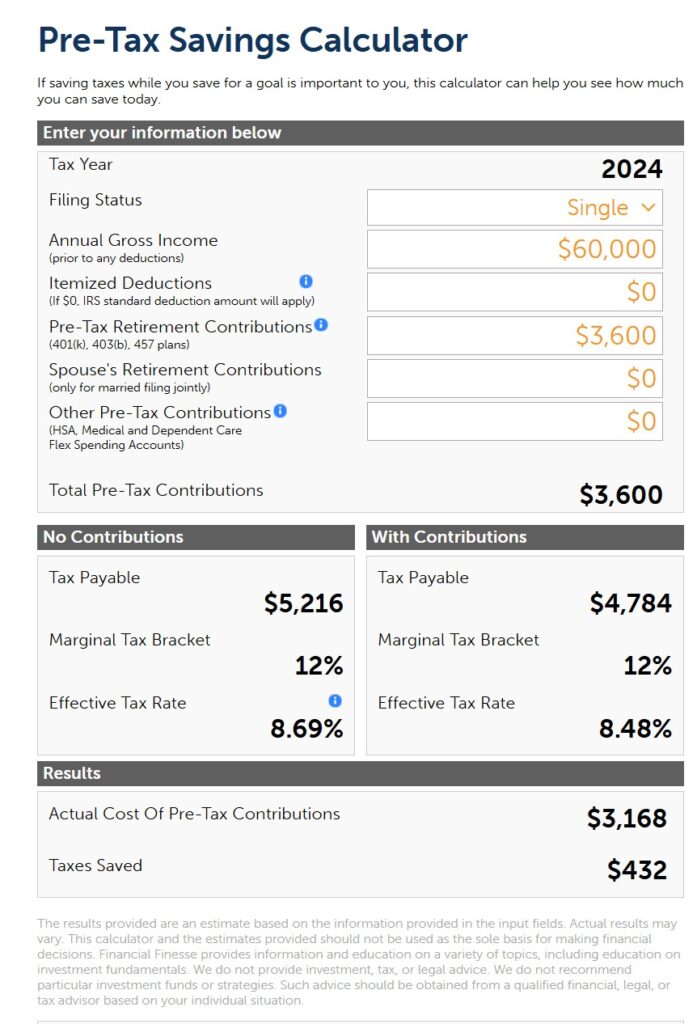
Contributing to a 401(k) using pre-tax dollars significantly lowers the actual cost of your contributions due to tax savings. For example, if you earn $60,000 annually and contribute $3,600 to your 401(k), your taxable income is reduced to $56,400, lowering the amount of federal taxes you owe. This reduction in taxable income results in immediate tax savings—$432 in this case—effectively reducing the real cost of your $3,600 contribution to just $3,168. By taking advantage of these pre-tax contributions, you can save for retirement while minimizing the impact on your take-home pay.
By contributing enough to receive the full employer match, you can effectively double a portion of your savings instantly, making it one of the smartest financial moves you can make early on.
Example: Sarah earns $60,000 annually, and her employer offers a 50% match on contributions up to 6% of her salary. If Sarah contributes $3,600 (6%), her employer adds $1,800, giving her $5,400 in total annual contributions.
• Takeaway: Not contributing enough to receive the full match is like leaving part of your salary behind.
2. Contributions in an Individual Retirement Account (IRA)
In addition to contributing consistently to your employer-sponsored retirement plan, opening a Roth IRA can provide significant benefits, especially when it comes to diversifying the tax impact in retirement. Unlike 401(k) contributions, which are pre-tax, Roth IRA contributions are made with after-tax dollars, allowing your investments to grow tax-free and enabling tax-free withdrawals in retirement. This tax diversification can be a game-changer, as it provides flexibility to manage your tax liability in retirement. Furthermore, Roth IRAs often offer a wider range of investment options compared to employer-sponsored plans, giving you more control over how your money is invested. By consistently contributing to both a 401(k) and a Roth IRA, you can maximize your retirement savings while balancing your current tax savings and future tax-free income.
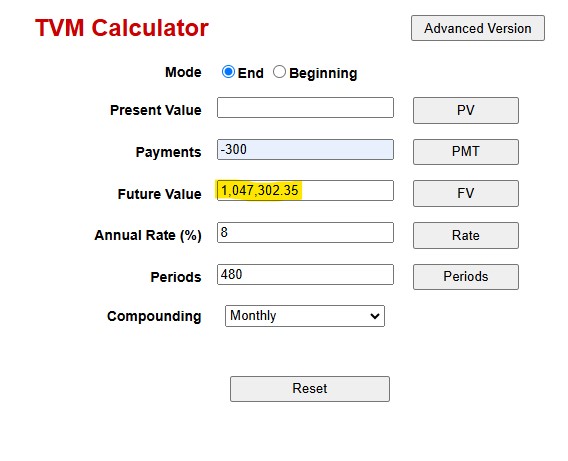
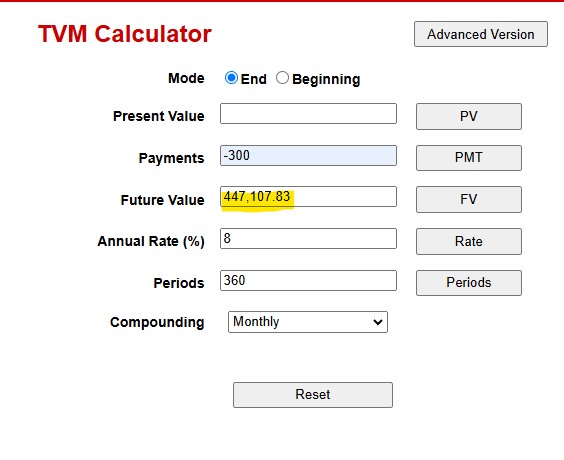
Example: John starts investing $300 in an IRA account per month at age 25 in a retirement account earning an average 8% annual return. By age 65, he has nearly $1,000,000. If he starts at 35, the same monthly contribution only grows to about $445,000.
• Takeaway: Consistency and starting early harness the power of compounding to grow wealth exponentially.
4. Reinvest Dividends for Compounding Growth
Dividend reinvestment is a powerful strategy that allows investors to use dividends earned from stocks or funds to purchase additional shares, instead of taking the cash. This approach enables the investor to benefit from compounding growth over time, as reinvested dividends generate their own returns.
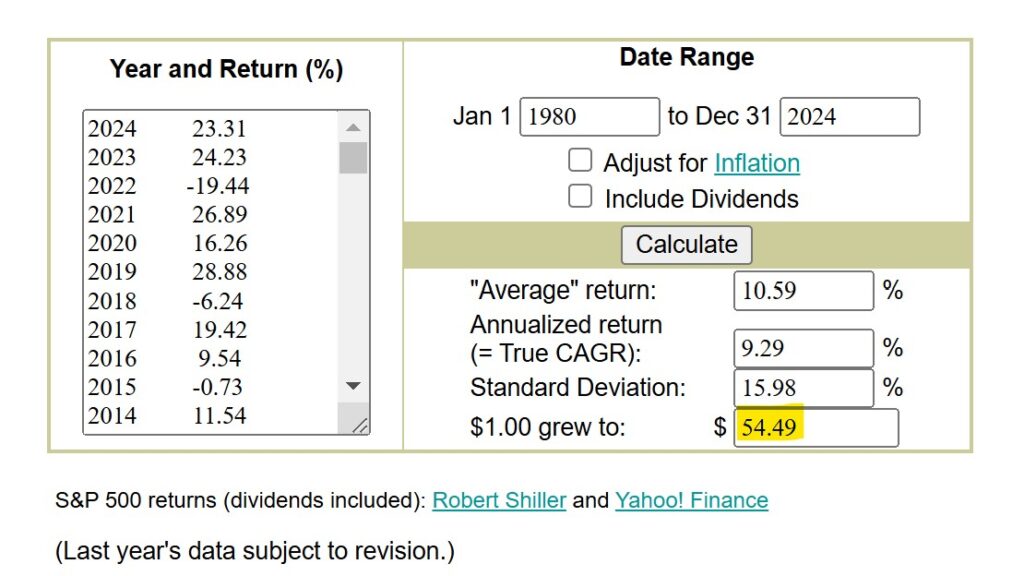
Example: Growth of $1 in S&P 500 Index with and without dividend reinvestment
Over the period from 1980 to 2024, the growth of $1 invested in the S&P 500 demonstrates the significant impact of dividends on long-term returns. Without reinvesting dividends, $1 grew to $54.49, reflecting the price appreciation of the index alone. However, when dividends were reinvested, the same $1 grew to an impressive $174.09, highlighting the power of compounding returns through dividend reinvestment. This stark difference underscores the critical role dividends play in maximizing investment growth over time.
• Takeaway: Reinvesting dividends accelerates growth over the long term.
5. Stay Invested for the Long Term
Remaining invested through market fluctuations is essential for maximizing long-term growth. Market timing—trying to predict and capitalize on short-term market movements—can significantly reduce returns and increase risk. By staying invested, you allow your portfolio to recover from downturns and benefit from periods of strong growth, ensuring steady progress toward your financial goals. Patience and consistency are key to leveraging the full potential of the market over time.
• Takeaway: Market timing is risky. Staying invested through market ups and downs ensures you benefit from long-term growth.
6. Rebalance Your Portfolio Regularly
Example: David’s portfolio was initially 60% stocks and 40% bonds. After a strong year for stocks, his allocation shifted to 70% stocks and 30% bonds. Rebalancing back to 60/40 protects David from taking on more risk than he intended.
• Takeaway: Rebalancing helps maintain your desired risk-reward profile and ensures diversification.
Additional Strategies for a Secure Retirement
1. Automate Savings
• Set up automatic contributions to your retirement account to ensure you’re consistently saving without the temptation to spend.
2. Diversify Investments
• A well-diversified portfolio, including stocks, bonds, and other assets, reduces risk and improves the likelihood of steady returns over time.
• Example: A portfolio with 70% stocks and 30% bonds might be ideal for someone in their 30s, but a retiree might shift to 50% stocks and 50% bonds to reduce risk.
3. Plan for Healthcare Costs
• According to Fidelity, a 65-year-old couple retiring today can expect to spend over $300,000 on healthcare costs in retirement. Investing in an HSA (Health Savings Account) can help.
• Example: With an HSA, you can save tax-free for medical expenses. If you contribute $8,550 annually (family limit in 2025) and invest the funds, you could have a significant tax-free healthcare fund by retirement.
The Power of Starting Now
It’s easy to feel overwhelmed by retirement planning, but small steps today make a big difference tomorrow.
• Start Small but Stay Consistent: Even $50 or $100 per month adds up over time.
• Review Your Plan Annually: Check your contributions, portfolio, and retirement goals to stay on track.
• Seek Professional Guidance: A financial advisor can provide tailored advice and help optimize your plan.
The Importance of Financial Education
Understanding the principles of investing and personal finance is a crucial step toward building long-term wealth. Financial education empowers individuals to make informed decisions, avoid common pitfalls, and develop strategies aligned with their goals. Whether it’s learning about the benefits of staying invested, the power of dividend reinvestment, or the risks of market timing, financial literacy provides the confidence and knowledge needed to navigate the complexities of the financial world. By prioritizing financial education, individuals can create a solid foundation for achieving financial security and independence.
By taking these steps, you can bridge the gap between retirement expectations and reality. Whether you’re 25, 45, or 55, it’s never too early—or too late—to start building a secure financial future.
Remember, retirement isn’t just a dream—it’s a goal you can achieve with intentional planning and action.
Your Mantra for Success: Save Consistently. Invest Smartly. Retire Richly.
Legal Disclaimer for Build Wealth Retire Rich Blog/Website
The information provided on the “Build Wealth Retire Rich” blog/website is for educational purposes only and should not be construed as financial, investment, or legal advice. While every effort is made to ensure the accuracy and reliability of the information presented, Build Wealth Retire Rich and its contributors, including AI tools used in the creation of some content, do not guarantee its completeness or timeliness. Users are encouraged to consult with a qualified financial advisor or legal professional to discuss their specific financial situation and to obtain advice tailored to their individual circumstances.
Build Wealth Retire Rich is not responsible for any decisions made based on the information provided on this website. All financial products, investment strategies, and other content discussed are presented for informational purposes only, and no guarantees are made regarding the performance or suitability of any particular investment or strategy.
The views and opinions expressed on “Build Wealth Retire Rich” are those of the authors and do not necessarily reflect the views of the website’s owner or any affiliated institutions. “Build Wealth Retire Rich” does not endorse or promote any particular investment, financial product, or institution unless explicitly stated.
Risk Disclosure: Investing involves risk, including the potential loss of principal. Past performance is not indicative of future results. Always do your own research and consider your financial goals and risk tolerance before making any financial decisions.
By using this website, you agree that Build Wealth Retire Rich and its affiliates are not liable for any losses or damages incurred as a result of using the information provided. Users are solely responsible for their financial decisions and should seek independent advice when necessary.
Investing is more than just a financial activity—it’s a gateway to achieving long-term financial goals, building wealth, and ensuring a secure future. While saving provides a foundation, investing takes your money to the next level by putting it to work and allowing it to grow.
Why Is Investing Important?
Wealth Accumulation Through Growth Investing allows your money to grow significantly over time, thanks to the magic of compounding. When you earn returns on your investments, those returns are reinvested, creating a snowball effect. For example:
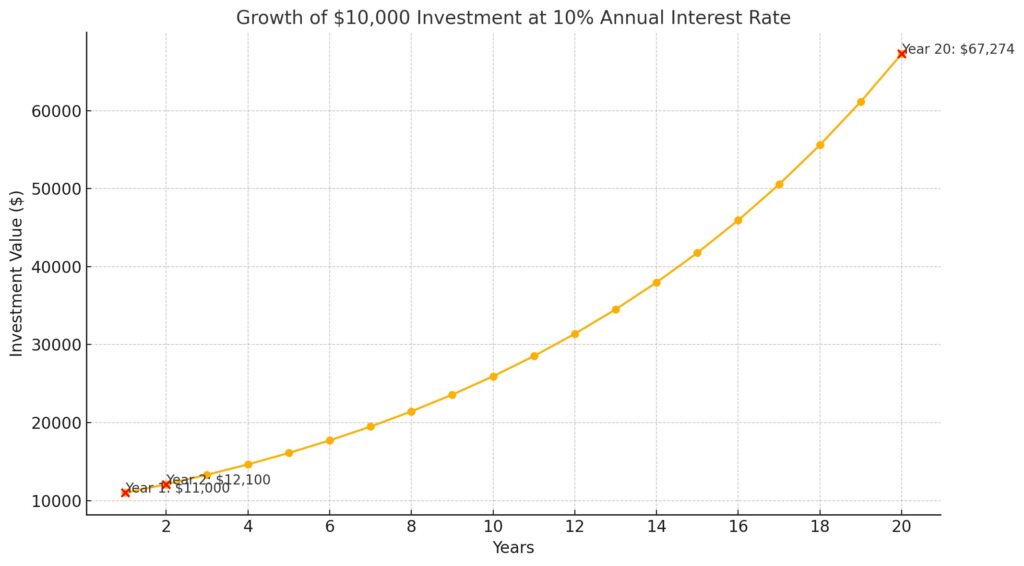
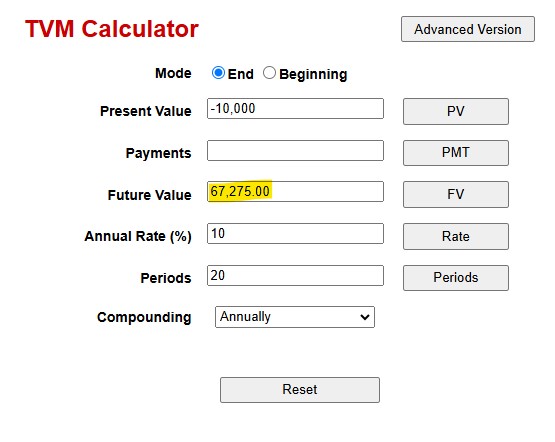
If you invest $10,000 at an average annual return of 10%, it can grow to over $67,000 in 20 years. This growth far exceeds what a regular savings account would offer.
2. Protecting Against Inflation Inflation gradually decreases the purchasing power of money. By investing in assets with higher returns than inflation, you preserve and increase your real wealth. For instance:
If inflation averages 3% annually, a $100 item today will cost approximately $180 in 20 years. Investments in stocks or real estate can help your money keep pace with or surpass inflation.
3. Achieving Financial Goals Investing is a strategic way to reach significant milestones like:
Set Clear Goals Define what you’re investing for—retirement, education, or wealth building—and tailor your strategy accordingly.
Determine Your Risk Tolerance Understand your comfort level with risk. Stocks are riskier but offer higher returns, while bonds and savings accounts are safer but yield lower returns.
Start Small and Be Consistent
Begin with what you can afford. Many brokerage firms allow you to start with as little as $1.
Spread your investments across different asset classes to reduce risk.
The saying, “Don’t put all your eggs in one basket,” applies strongly in investing.
Consult a Financial Advisor If you’re unsure where to start, seek professional advice to create a personalized investment plan.
Overcoming Common Misconceptions
“I need a lot of money to start.” Many brokerage firms allow you to begin investing with minimal amounts.
“Investing is too risky.” Risk varies by asset class. Balancing high-risk investments (stocks) with safer options (bonds) can align with your comfort level.
“I don’t know enough.” Financial literacy tools, seminar/courses, and advisors are available to help you gain confidence.
Key Takeaways
Investing is not just for the wealthy or financially savvy—it’s for anyone with a desire to grow their wealth and secure their future. Here’s why you should start now:
Time is your greatest ally in investing.
Small, consistent contributions lead to significant long-term gains.
Diversifying and understanding your goals reduce risks and improve results.
Remember, investing is like planting a tree: the sooner you plant it, the sooner it bears fruit. Start today and take control of your financial future.
Your Mantra for Success: Save Consistently. Invest Smartly. Retire Richly.
Legal Disclaimer for Build Wealth Retire Rich Blog/Website
The information provided on the “Build Wealth Retire Rich” blog/website is for educational purposes only and should not be construed as financial, investment, or legal advice. While every effort is made to ensure the accuracy and reliability of the information presented, Build Wealth Retire Rich and its contributors, including AI tools used in the creation of some content, do not guarantee its completeness or timeliness. Users are encouraged to consult with a qualified financial advisor or legal professional to discuss their specific financial situation and to obtain advice tailored to their individual circumstances.
Build Wealth Retire Rich is not responsible for any decisions made based on the information provided on this website. All financial products, investment strategies, and other content discussed are presented for informational purposes only, and no guarantees are made regarding the performance or suitability of any particular investment or strategy.
The views and opinions expressed on “Build Wealth Retire Rich” are those of the authors and do not necessarily reflect the views of the website’s owner or any affiliated institutions. “Build Wealth Retire Rich” does not endorse or promote any particular investment, financial product, or institution unless explicitly stated.
Risk Disclosure: Investing involves risk, including the potential loss of principal. Past performance is not indicative of future results. Always do your own research and consider your financial goals and risk tolerance before making any financial decisions.
By using this website, you agree that Build Wealth Retire Rich and its affiliates are not liable for any losses or damages incurred as a result of using the information provided. Users are solely responsible for their financial decisions and should seek independent advice when necessary.
Exchange-Traded Funds (ETFs) have revolutionized the way individuals and institutions invest, providing a versatile, cost-effective, and accessible way to diversify portfolios. Whether you’re a seasoned investor or just starting your financial journey, understanding ETFs can unlock new opportunities for achieving your financial goals.
What Are ETFs?
An ETF is a type of investment fund that holds a collection of assets, such as stocks, bonds, commodities, or a mix of these. ETFs trade on stock exchanges, just like individual stocks, allowing investors to buy and sell shares throughout the trading day at market prices.
How ETFs Work
Underlying Assets: ETFs track the performance of an index, sector, or specific asset class. For example, the S&P 500 ETF tracks the S&P 500 index.
Creation and Redemption: ETFs are created or redeemed in large blocks (called creation units) by institutional investors. This ensures liquidity and helps keep the ETF’s price close to its net asset value (NAV).
Market Trading: Unlike mutual funds, which are priced only once at the end of the trading day, ETFs can be traded anytime the market is open.
Benefits of ETFs
Diversification: One ETF can provide exposure to hundreds of securities, reducing the risk associated with investing in individual stocks or bonds.
Example: Investing in an emerging markets ETF can give you exposure to multiple countries’ economies without needing to purchase individual international stocks.
Cost Efficiency: Most ETFs have low expense ratios compared to mutual funds, making them a cost-effective option for long-term investors.
Flexibility: Since ETFs trade like stocks, they offer features like limit orders, stop-loss orders, and the ability to short-sell.
Transparency: ETFs disclose their holdings daily, allowing investors to know exactly what they own.
Tax Efficiency: The structure of ETFs generally leads to fewer capital gains distributions compared to mutual funds.
Types of ETFs
Stock ETFs: Track a specific index or sector.
Bond ETFs: Provide exposure to fixed-income securities like government or corporate bonds.
Sector and Industry ETFs: Focus on specific sectors like healthcare or energy.
Thematic ETFs: Centered on trends like clean energy, artificial intelligence, or blockchain.
Commodity ETFs: Invest in physical commodities like gold or oil.
Inverse and Leveraged ETFs: Used for short-term trading to amplify returns or hedge against market downturns.
How to Invest in ETFs
Set Your Investment Goals: Define your financial objectives, whether they are growth, income, or diversification.
Research ETFs: Look at the ETF’s objective, underlying holdings, expense ratio, and performance history.
Choose a Brokerage: Most online brokerages offer commission-free ETF trading.
Start Small: You can invest in ETFs with as little as the price of one share or even fractional shares, depending on your brokerage.
Potential Risks
While ETFs offer many benefits, they are not without risks:
Market Risk: Like any investment, ETFs are subject to market fluctuations.
Tracking Errors: The ETF may not perfectly replicate the performance of its benchmark index.
Liquidity Issues: Some niche ETFs might have low trading volumes, leading to wider bid-ask spreads.
Real-Life Example of ETF Growth
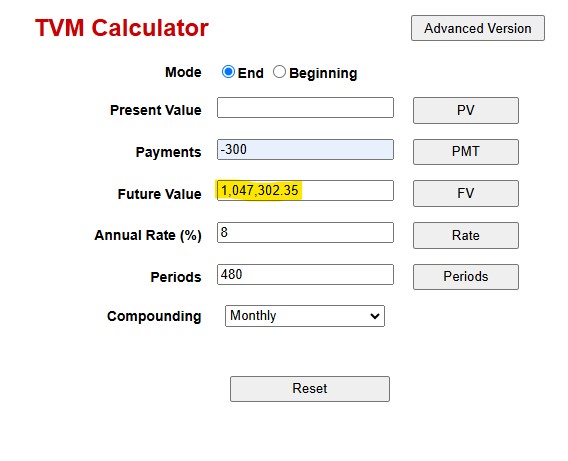
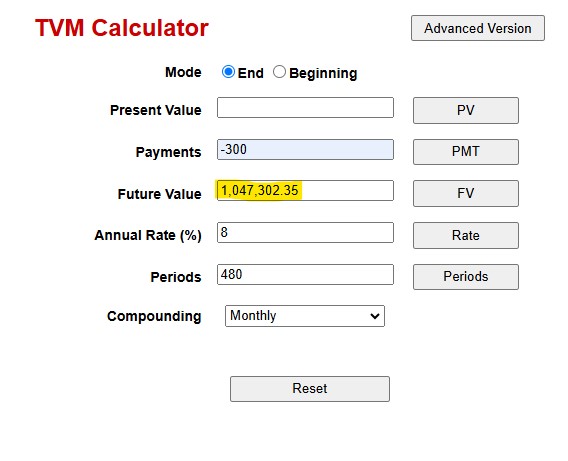
Consider an investor who consistently invests $300 per month in an ETF with an average annual return of 8%. After 40 years, their portfolio could grow to over $1,047,302.35, thanks to the power of compounding.
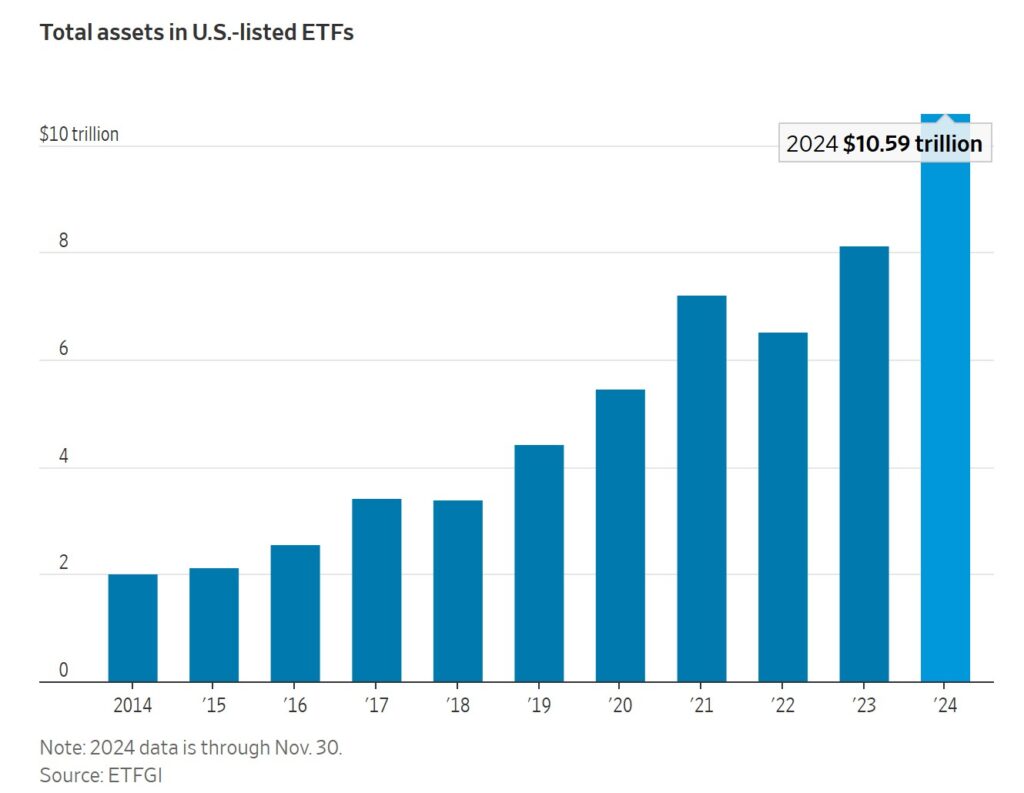
According to an article in the WSJ.com, ETFs witnessed record-breaking inflows in 2024, with over $1 trillion poured into U.S.-based ETFs, pushing total assets to an all-time high of $10.6 trillion by the end of November. This marked a 30% increase from the beginning of the year, driven by several factors:
Record Inflows: Investors poured over $1 trillion into U.S. exchange-traded funds (ETFs) in 2024, setting a new record and surpassing the previous peak by a significant margin.
Surge in ETF Assets: Total assets in U.S.-based ETFs reached $10.6 trillion by November 2024, reflecting a 30% increase from the start of the year, fueled by strong market performance and renewed investor confidence.
Shift from Mutual Funds: The long-term trend of investors moving from mutual funds to ETFs continued due to ETFs’ tax advantages and easier trading.
Key Drivers of Growth: The S&P 500’s 25% gain and growing interest in actively managed strategies contributed to significant inflows, with Invesco’s QQQ attracting over $27 billion by mid-December.
Diverse Investment Strategies: Active management strategies, bitcoin-focused ETFs, and fixed-income funds gained traction, with retirees favoring options-based strategies to manage risk.
Dominance of U.S. Stocks: U.S. equity funds dominated the market, capturing the majority of net inflows, reflecting strong investor optimism about U.S. economic growth and corporate performance.
These inflows highlight investors’ confidence and the growing appeal of ETFs as a cornerstone of modern investing.
Conclusion
ETFs are a cornerstone of modern investing, offering a mix of accessibility, cost efficiency, and diversification. Whether you’re saving for retirement, building wealth, or exploring new investment opportunities, ETFs can play a crucial role in achieving your financial objectives.
Start small, stay consistent, and always research before investing. With ETFs, you can build a robust portfolio tailored to your financial goals.
Your Mantra for Success: Save Consistently. Invest Smartly. Retire Richly.
Legal Disclaimer for Build Wealth Retire Rich Blog/Website
The information provided on the “Build Wealth Retire Rich” blog/website is for educational purposes only and should not be construed as financial, investment, or legal advice. While every effort is made to ensure the accuracy and reliability of the information presented, Build Wealth Retire Rich and its contributors, including AI tools used in the creation of some content, do not guarantee its completeness or timeliness. Users are encouraged to consult with a qualified financial advisor or legal professional to discuss their specific financial situation and to obtain advice tailored to their individual circumstances.
Build Wealth Retire Rich is not responsible for any decisions made based on the information provided on this website. All financial products, investment strategies, and other content discussed are presented for informational purposes only, and no guarantees are made regarding the performance or suitability of any particular investment or strategy.
The views and opinions expressed on “Build Wealth Retire Rich” are those of the authors and do not necessarily reflect the views of the website’s owner or any affiliated institutions. “Build Wealth Retire Rich” does not endorse or promote any particular investment, financial product, or institution unless explicitly stated.
Risk Disclosure: Investing involves risk, including the potential loss of principal. Past performance is not indicative of future results. Always do your own research and consider your financial goals and risk tolerance before making any financial decisions.
By using this website, you agree that Build Wealth Retire Rich and its affiliates are not liable for any losses or damages incurred as a result of using the information provided. Users are solely responsible for their financial decisions and should seek independent advice when necessary.
Investing can often seem like a daunting task, especially with fluctuating markets and an overwhelming number of investment choices. The good news? Building wealth doesn’t require timing the market or having expert knowledge. The cornerstone of a successful investing strategy lies in consistency, discipline, and simplicity.
A recurring investment plan, particularly one focused on a diversified index fund, provides a clear path to financial security. It automates your investments, builds long-term wealth, and minimizes the stress of managing your portfolio. Here’s why this approach works and how you can implement it to secure your financial future.
1. The Power of Recurring Investments
Recurring investment plans are about regularly putting money into your investment accounts, like a 401(k), IRA, or brokerage account. Many brokers now allow you to set up recurring investments in tax-advantaged accounts, such as IRAs, with minimum amounts as low as $1.
These plans are flexible and let you decide how often to invest—daily, weekly, or monthly—making it easy to start even with a small budget. For example, if you set up a recurring plan to invest $5 daily, you could build a significant portfolio over time with very little effort.
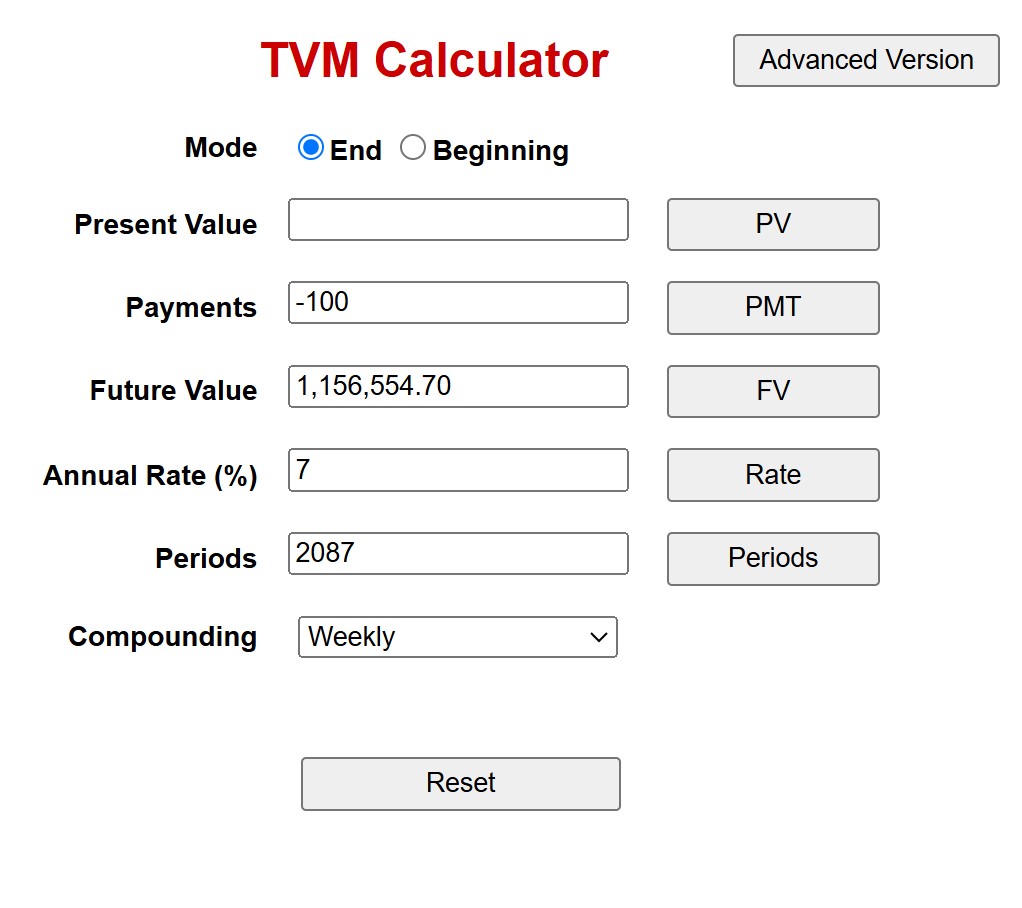
For instance, Sarah, a 20-year-old professional, invests $100 every week in her Roth IRA account. Over 40 years, she contributes a total of $208,700. However, with an average return of 7% per year, her account grows to an impressive $1,156,554.70 by the time she’s 60.
Automation also helps you avoid procrastination or skipping investments when things feel uncertain. Once you set it up, your money works for you without any extra effort.
2. Fractional Shares and Zero Commissions: Making Recurring Investments Accessible
Thanks to advancements in modern investing platforms, fractional shares and zero-commission trading have made recurring investment plans more accessible than ever. Fractional shares allow you to buy a portion of a stock or fund, meaning you don’t need thousands of dollars to invest in expensive funds like those tracking the S&P 500 or companies like Amazon and Alphabet. For example, even with just $10, you can start building a position in high-value investments, making it easier for anyone to get started with investing.
Zero-commission trading has further reduced barriers by eliminating transaction fees, allowing you to invest small amounts frequently without worrying about costs eating into your returns. Together, these innovations enable you to set up recurring investment plans with minimal amounts, automating contributions to funds that align with your goals. Whether it’s $5 a day or $50 a week, fractional shares and commission-free platforms empower you to steadily grow your wealth, even with a modest budget.
This accessibility ensures that anyone, regardless of income level, can begin their investment journey and benefit from consistent contributions over time.
3. Diversification Makes Investing Safer
Choosing the right investments can feel overwhelming, but diversification makes it easier to build a portfolio that balances growth and stability. Diversification means spreading your investments across different asset classes—such as stocks, bonds, and cash—to reduce the overall risk of your portfolio. By not putting all your eggs in one basket, you minimize the impact of any single investment performing poorly.
For example, many people invest in a diversified index fund, like one tracking the S&P 500, which gives exposure to 500 of the largest U.S. companies. However, diversification can go a step further by including bonds alongside stocks. Bonds tend to be more stable than stocks and provide a buffer during market downturns, making them a great choice for those seeking to lower overall risk.
Investing in a fund that blends stocks and bonds—such as a balanced fund or target-date fund—can help align your portfolio with your financial goals and risk tolerance. A younger investor saving for retirement might choose a fund with a higher proportion of stocks for growth, while someone nearing retirement might prefer a fund with more bonds for stability.
A recurring investment plan can also be set up with a desired fund that matches your goals and risk preferences. This means you can automate your contributions to a specific diversified fund, ensuring consistency and eliminating the need for manual adjustments. Whether you aim for aggressive growth, steady income, or a mix of both, choosing the right fund for your recurring investment plan allows your portfolio to grow while staying aligned with your objectives.
By combining diversification with the automation of recurring investments, you create a strategy that’s both effective and easy to maintain, helping you achieve long-term financial success.
4. Rebalancing Your Recurring Investment Plan
As life changes, so do your financial goals and circumstances. It’s important to periodically review and rebalance your recurring investment plan to ensure it aligns with your current life situation. Rebalancing involves adjusting the allocation of your investments to maintain the right mix of assets, such as stocks, bonds, and cash. For example, a young professional might prioritize higher-growth investments like stocks, while someone nearing retirement might shift to more stable assets like bonds to preserve wealth.
Additionally, major life events—such as getting married, having children, or receiving a promotion—may require increasing or modifying your contributions. For instance, if your income rises, you can increase your weekly or monthly investment amount to accelerate your wealth-building goals. Conversely, during challenging times, you might reduce contributions temporarily but should aim to stay consistent when possible.
Rebalancing ensures your investment strategy evolves with your needs, helping you stay on track toward long-term financial security.
Simple Steps to Start a Recurring Investment Plan
Getting started is easy:
Pick the Right Account: Decide whether a brokerage account, IRA, or 401(k) aligns with your goals. Many brokers now let you start with as little as $1, making it easy to take the first step.
Choose a Diversified Fund: Look for low-cost index funds or ETFs. They’re simple and effective.
Set Up Automation: Schedule automatic transfers from your bank account or paycheck into your investment account. Decide if you want to invest daily, weekly, or monthly.
Stick to the Plan: Focus on your long-term goals and avoid reacting to short-term market changes.
Bonus Tips to Grow Your Wealth
Reinvest Dividends: Instead of taking dividends as cash, use them to buy more shares. This speeds up growth through compounding.
Use Fractional Shares: Invest small amounts in big companies by buying fractions of shares. For example, even with $50, you can own a piece of companies like Amazon.
Take Advantage of Zero Fees: Many platforms now offer commission-free trades, so you can invest without extra costs.
Why Simple Strategies Work
Investing doesn’t have to be overwhelming. A recurring investment plan reduces the complexity of wealth building, focusing on steady contributions, diversification, and compounding. By removing the stress of market timing and stock picking, you create a sustainable strategy for financial freedom.
Whether you’re starting with $50, $100, or $1,000 a month, what matters is getting started and staying consistent. Over time, your efforts will pay off, and you’ll be on the path to financial freedom.
Your Mantra for Success: Save Consistently. Invest Smartly. Retire Richly.
Legal Disclaimer for Build Wealth Retire Rich Blog/Website
The information provided on the “Build Wealth Retire Rich” blog/website is for educational purposes only and should not be construed as financial, investment, or legal advice. While every effort is made to ensure the accuracy and reliability of the information presented, Build Wealth Retire Rich and its contributors, including AI tools used in the creation of some content, do not guarantee its completeness or timeliness. Users are encouraged to consult with a qualified financial advisor or legal professional to discuss their specific financial situation and to obtain advice tailored to their individual circumstances.
Build Wealth Retire Rich is not responsible for any decisions made based on the information provided on this website. All financial products, investment strategies, and other content discussed are presented for informational purposes only, and no guarantees are made regarding the performance or suitability of any particular investment or strategy.
The views and opinions expressed on “Build Wealth Retire Rich” are those of the authors and do not necessarily reflect the views of the website’s owner or any affiliated institutions. “Build Wealth Retire Rich” does not endorse or promote any particular investment, financial product, or institution unless explicitly stated.
Risk Disclosure: Investing involves risk, including the potential loss of principal. Past performance is not indicative of future results. Always do your own research and consider your financial goals and risk tolerance before making any financial decisions.
By using this website, you agree that Build Wealth Retire Rich and its affiliates are not liable for any losses or damages incurred as a result of using the information provided. Users are solely responsible for their financial decisions and should seek independent advice when necessary.
It’s easy to think you need a high salary or a glamorous career to retire with a million dollars. But the story of Ronald Read, a Vermont janitor and gas station attendant, proves otherwise. Read quietly amassed an $8 million fortune through disciplined saving, frugal living, and smart investing, surprising even his family and friends upon his death at age 92.
Read’s story is a testament to the idea that anyone, regardless of income, can achieve financial independence with the right approach. By following simple principles like starting early, saving consistently, and investing wisely, you can also build a seven-figure nest egg for retirement.
Here’s how to make it happen.
Start Early: The Magic of Compound Interest
Compound interest is the most powerful force in wealth building. Starting early allows your money to grow exponentially because you’re earning interest not just on your savings but also on the interest already earned.
Example 1: Imagine Sarah, a 25-year-old who invests $300 per month in a retirement account with an average annual return of 8%. By age 65, Sarah will have over $1,000,000.
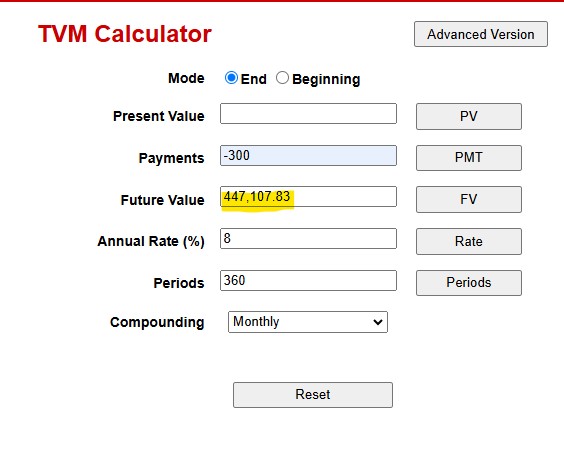
Now consider Jake, who waits until he’s 35 to start saving the same $300 per month. By 65, Jake will only have $447,000, less than half of Sarah’s total—just because he started later.
The takeaway? Starting early is like giving your money extra years to work for you.
Consistency is Key: Automate Your Savings
It’s not about saving big chunks at once—it’s about saving regularly. Automating contributions to your retirement accounts ensures that you’re consistently building wealth without needing to think about it.
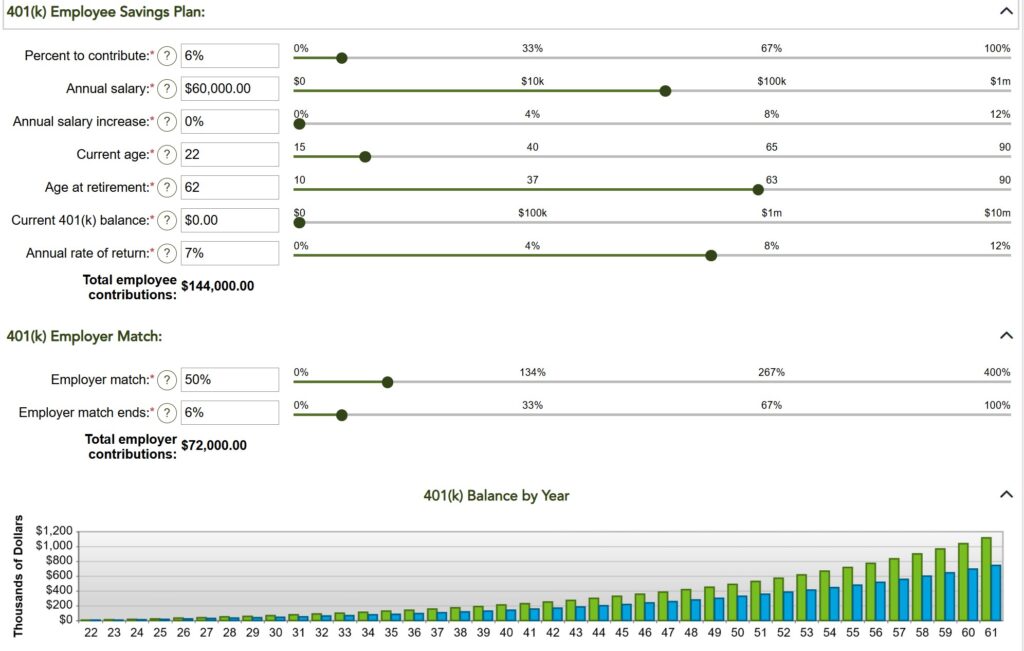
Example 2: David earns $60,000 annually and chooses to save 6% of his salary in his 401(k). Over 40 years, with an assumed annual return of 7%, his retirement savings would grow to $1,118,482.41 if his employer matches 50% of his contributions. Without the employer match, his total savings would be $745,654.94.
Automating his savings made it easier for David to stick to his plan and take advantage of free money through employer matches.
Invest Wisely: Keep Costs Low and Diversify
Choosing the right investments is crucial. Low-cost index funds and ETFs are excellent options because they provide diversification and minimize fees, which can erode your returns.
Avoid the Debt Trap
Debt is a significant barrier to wealth. High-interest debt, such as credit card balances, can overshadow even the best investment returns. Paying off debt early frees up more money for savings.
Example 4: Maria has $10,000 in credit card debt with a 20% interest rate. If she only makes the minimum payments, calculated as 3% of the balance, it will take her over 20 years to pay off the debt and cost her more than $12,000 in interest. However, by aggressively paying off the debt, she can save thousands in interest and redirect those savings into her retirement fund.
The “4% rule” is a popular guideline for retirement planning. It suggests you can withdraw 4% of your retirement savings annually without running out of money.
Example 5: If John has $1 million saved, he can withdraw $40,000 annually to cover living expenses. Combined with Social Security benefits, this amount could provide a comfortable lifestyle.
Save More as You Earn More
As your income grows, increase your savings rate. Bonuses, raises, or additional income can help accelerate your journey to $1 million.
Example 6: Emma earns $50,000 and starts saving 10% of her income. After 5 years, her salary increases to $70,000. Instead of sticking to her original contribution of $5,000 per year, Emma raises it to 15%, or $10,500 annually. This simple adjustment significantly boosts her retirement savings over time.
Balance Today and Tomorrow
Saving for the future doesn’t mean sacrificing your quality of life today. The key is prioritizing what brings you joy while minimizing unnecessary expenses.
Example 7: Ryan loves traveling and spends $3,000 a year on trips. To afford this while saving for retirement, he cuts back on dining out, saving $200 per month. This way, Ryan enjoys his travels while still contributing $500 a month to his IRA.
Real-Life Stories of Millionaire Retirees
Recent data from Fidelity shows there are now over 497,000 401(k) millionaires and 418,111 IRA millionaires as of September 30, 2024. These individuals weren’t all earning massive salaries—they simply followed consistent savings habits and invested wisely.
Take Action Today
Here’s a step-by-step roadmap to retiring a millionaire:
Start Saving Now: The earlier, the better. Even small contributions grow significantly over time.
Use Tax-Advantaged Accounts: Maximize your 401(k), IRA, or Roth IRA contributions.
Take Advantage of Matches: Always contribute enough to get your employer’s full match.
Invest Strategically: Opt for low-cost index funds or ETFs for diversification and lower fees.
Increase Contributions Over Time: Save more as you earn more.
Avoid High-Interest Debt: Focus on paying off debt to free up cash for investing.
Find Balance: Save consistently while enjoying life.
Becoming a millionaire isn’t about earning a massive salary; it’s about building wealth one step at a time. Whether you’re earning $40,000 or $400,000, the principles remain the same: save early, save often, and invest smartly. With patience and discipline, your dream of a $1 million retirement fund can become a reality.
Your future self will thank you.
Our Newsletter Can Help You Build Wealth and Retire Rich!
Sign up for our free newsletter!
Want actionable tips and expert advice to grow your wealth, save smarter, and retire comfortably? Sign up for the Build Wealth Retire Rich newsletter to receive weekly updates packed with personal finance strategies and insights—delivered straight to your inbox!Please accept terms and conditions.
By submitting your information, you`re giving us permission to email you. You may unsubscribe at any time.
Thank you for subscribing to our newsletter. You are one step away from financial freedom.
Legal Disclaimer for Build Wealth Retire Rich Blog/Website
The information provided on the “Build Wealth Retire Rich” blog/website is for educational purposes only and should not be construed as financial, investment, or legal advice. While every effort is made to ensure the accuracy and reliability of the information presented, Build Wealth Retire Rich and its contributors, including AI tools used in the creation of some content, do not guarantee its completeness or timeliness. Users are encouraged to consult with a qualified financial advisor or legal professional to discuss their specific financial situation and to obtain advice tailored to their individual circumstances.
Build Wealth Retire Rich is not responsible for any decisions made based on the information provided on this website. All financial products, investment strategies, and other content discussed are presented for informational purposes only, and no guarantees are made regarding the performance or suitability of any particular investment or strategy.
The views and opinions expressed on “Build Wealth Retire Rich” are those of the authors and do not necessarily reflect the views of the website’s owner or any affiliated institutions. “Build Wealth Retire Rich” does not endorse or promote any particular investment, financial product, or institution unless explicitly stated.
Risk Disclosure: Investing involves risk, including the potential loss of principal. Past performance is not indicative of future results. Always do your own research and consider your financial goals and risk tolerance before making any financial decisions.
By using this website, you agree that Build Wealth Retire Rich and its affiliates are not liable for any losses or damages incurred as a result of using the information provided. Users are solely responsible for their financial decisions and should seek independent advice when necessary.