Tag: investing

  • Time Value of Money Calculator: A Student’s Guide

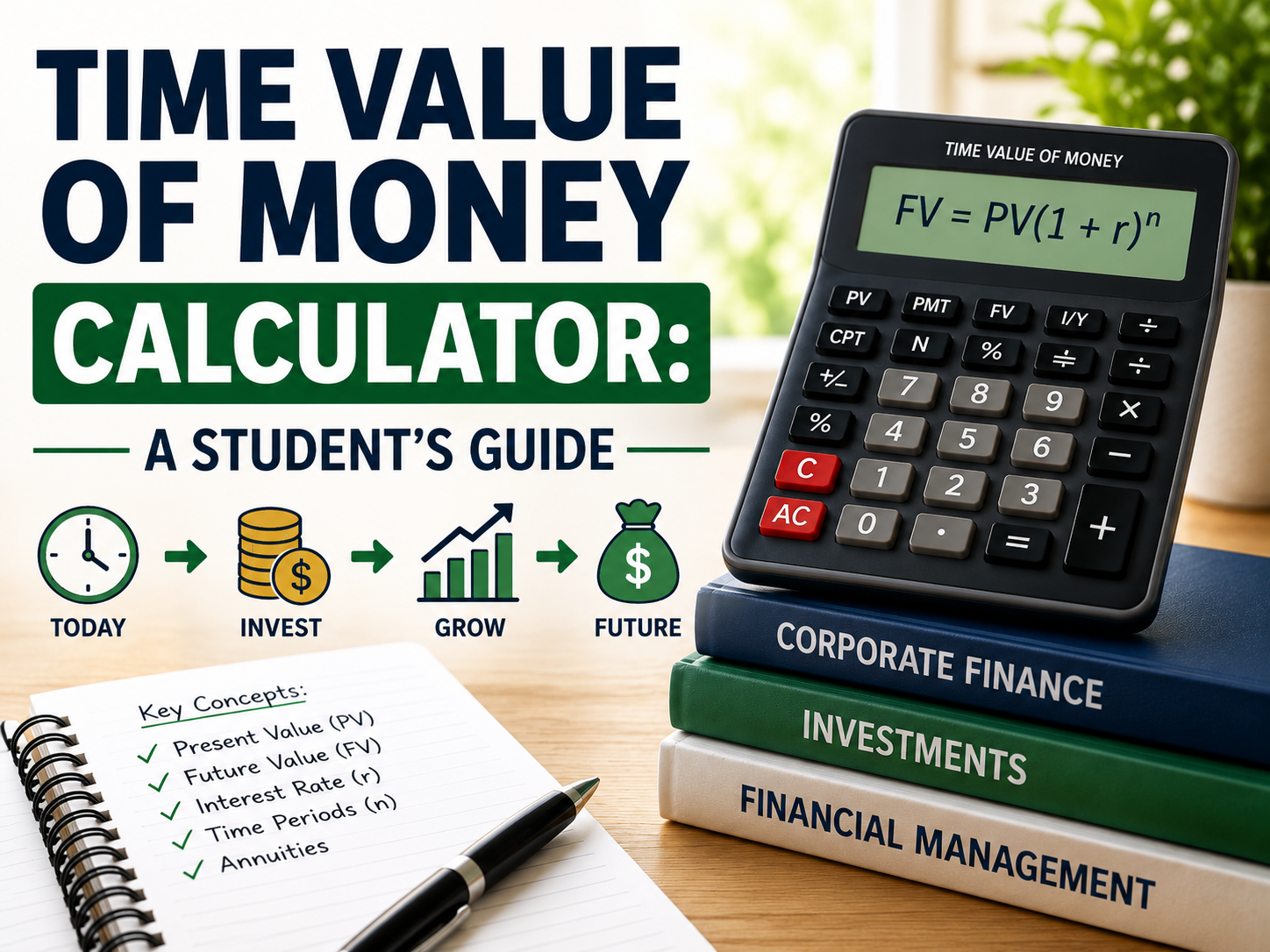
    Time Value of Money Calculator: A Student’s Guide

    Time Value of Money Calculator: A Student’s Guide | The Campus Investor
    The Campus Investor
    Build Wealth from Day One
    🧮 Financial Tools  ·  Calculator Guide

    Time Value of Money Calculator: A Student’s Guide

    May 2026 | 8 min read | For College Students

    The Time Value of Money (TVM) Calculator is one of the most powerful financial tools a student can learn to use — and one of the most confusing at first glance. Five variables, a sign convention that trips everyone up, two modes that change your answer, and a compounding dropdown that most people ignore.

    This guide breaks every part of the calculator down — plainly, with real student examples — so you can use it confidently to solve any TVM problem: investment growth, loan payments, savings goals, and more.

    What is the Time Value of Money?

    The core idea behind every TVM calculation is simple: a dollar today is worth more than a dollar tomorrow. Why? Because a dollar you have right now can be invested and grow. A dollar promised to you in the future can’t be invested yet — so it’s worth less in today’s terms.

    This principle underpins almost every financial decision: how much a loan will cost you, how much you need to save to reach a goal, what your investments will be worth at retirement, and whether a lump sum payment or an annuity is the better deal.

    “Time value of money is not just a finance concept. It’s the reason investing early beats investing more — and the reason carrying debt costs you more than the interest rate suggests.”

    The Calculator — Every Field Explained

    Here is what the TVM calculator looks like — with every field labelled so you know exactly what you’re looking at before entering a single number:

    TVM Calculator

    Mode: End Beginning
    Label Value Compute
    Present Value: e.g. -200 PV
    Payments: e.g. -50 PMT
    Future Value: e.g. -1000 FV
    Annual Rate (%): e.g. 10 Rate
    Periods (years): e.g. 5 Periods
    Compounding:
    Annually
    Reset
    Build Wealth Retire Rich: Time Value of Money Calculator

    The logic is always the same: enter any four of the five variables, then click the Compute button for the fifth. The calculator solves for the unknown. The key is knowing what each variable means, what sign to give it, and which mode to use.

    The 5 Variables: PV, PMT, FV, Rate, Periods

    Every TVM problem involves five variables. You always know four of them and solve for the fifth. Here’s exactly what each one means in plain English — with real student contexts:

    PV

    Present Value

    The value of money today — either an amount you have right now, or the current worth of a future cash flow. In borrowing it’s the loan amount. In investing it’s your starting deposit.

    Student examples: $5,000 student loan taken out today $500 you deposit into a Roth IRA today Current value of a $1,000 bond maturing in 5 years
    PMT

    Payments (Annuity)

    A regular recurring payment made at equal intervals — either money going out (loan payments, regular savings contributions) or money coming in (income from an annuity). Enter 0 if there are no recurring payments.

    Student examples: $150/month loan repayment $50/month invested into an index fund $0 (lump-sum problems with no regular payments)
    FV

    Future Value

    The value of money at a specific point in the future, after growth or after a series of payments. This is what you’re solving for when asking “what will my investment be worth in 30 years?” or “how much will I owe at the end of this loan?”

    Student examples: What your Roth IRA will be worth at 65 The final payoff amount on a loan $0 (for a fully amortising loan that ends at zero)
    r

    Annual Rate (%)

    The annual interest rate — entered as a percentage, not a decimal (enter 7, not 0.07). For investments this is your expected annual return. For loans it’s the APR. The calculator adjusts for compounding frequency automatically.

    Student examples: 7 (for 7% average investment return) 6.5 (federal student loan rate) 24 (typical credit card APR)
    N

    Periods (Years)

    The total number of time periods — usually years, but can be months if your payment frequency is monthly. If you’re solving a 30-year mortgage with monthly payments, enter 30 years (the calculator accounts for compounding frequency). If your calculator uses periods in months directly, enter 360 (30 × 12).

    Student examples: 10 years of investing from age 20 to 30 45 years until retirement (age 20 to 65) 5 years on a car loan 4 years of college remaining

    The Sign Convention — Why Negative Numbers Matter

    This is where almost every beginner gets confused — and where most wrong answers come from. TVM calculators use a cash flow sign convention: money flowing out of your pocket is negative; money flowing into your pocket is positive.

    💡 The Sign Convention — Always Think From Your Perspective

    Negative (Money Out)

    Cash that leaves your hands. You invest it, pay it out, or deposit it somewhere. You no longer have this money in your pocket.

    Examples: loan payment you make, deposit into savings, money you invest today

    +
    Positive (Money In)

    Cash that arrives in your hands. You receive it, earn it, or withdraw it. This money is coming into your pocket.

    Examples: loan proceeds you receive, investment payout, cash you withdraw

    The most important rule: PV and FV must have opposite signs when money flows in one direction. If you enter a negative PV (money you invest today), FV will compute as positive (money you receive later). If you enter a positive PV (loan proceeds you receive), FV will compute as negative (amount you owe at the end).

    ⚠️ The Most Common Sign Mistake

    Entering PV and PMT with the same sign when they should have opposite signs is the single most common TVM error. If you’re making regular payments on a loan (PMT is negative — money leaving you), the loan you received (PV) must be positive — money that came to you. If you get an error or an absurd answer, check your signs first.

    End vs Beginning Mode

    The Mode selector at the top of the calculator — End or Beginning — determines when payments occur within each period. For most student problems, End mode is correct.

    End Mode (Ordinary Annuity)

    Payments at the End of Each Period

    The most common setting. Payments are made or received at the end of each period — after the interest for that period has been calculated.

    This is how most loans, mortgages, and regular savings plans work. Your monthly mortgage payment is due at the end of the month, after that month’s interest has accrued.

    ✓ Use for: student loan payments, car loans, monthly savings contributions, most investment problems
    Beginning Mode (Annuity Due)

    Payments at the Start of Each Period

    Less common. Payments occur at the beginning of each period — before interest is calculated for that period. This means each payment earns (or avoids) one extra period of interest.

    Beginning mode produces a slightly higher future value for investments and a slightly lower present value for loans, because money is working for one more period.

    ✓ Use for: rent paid at month start, lease payments, some annuities specified as “due”
    📐 How Much Does Mode Actually Change Your Answer?

    Switching from End to Beginning mode on a $200/month investment at 7% over 30 years changes the result from approximately $244,000 to approximately $245,000 — a difference of about $1,000. The effect grows with the rate and the number of periods. For most homework and real-life problems, End mode is correct unless the problem specifically states “annuity due” or “beginning of period.”

    Compounding Frequency Explained

    The Compounding dropdown controls how many times per year interest is applied to the balance. The more frequently interest compounds, the slightly more you earn (or owe). Here’s how the options compare on a $10,000 balance at 7% over 10 years:

    Compounding Option Times/Year Balance at 10 Years Interest Earned
    Annually $19,672 $9,672
    Semi-annually $19,898 $9,898
    Quarterly $20,016 $10,016
    Monthly Most Common 12× $20,097 $10,097
    Daily 365× $20,136 $10,136

    For most investment problems, select Monthly — this matches how most brokerages, savings accounts, and loan products compound. For problems where the question specifies a different frequency (e.g. “compounded quarterly”), match it exactly. The difference is small but matters for precise answers.

    Step-by-Step Examples for Students

    Here are four common student scenarios — each solved step by step using the TVM calculator.

    Example 1 · Investing

    “What will my $75/month investment be worth in 40 years?”

    You invest $75 every month into a Roth IRA starting at age 22. You expect a 7% average annual return. You want to know your balance at age 62.

    • 1

      PV = 0  — You’re starting with no lump sum today. Just monthly contributions.

    • 2

      PMT = −75  — $75 leaves your pocket each month. Negative because it’s money out.

    • 3

      FV = ?  — This is what you’re solving for. Leave it blank and click Compute FV.

    • 4

      Rate = 7  — Enter 7 for 7% annual return.

    • 5

      Periods = 40  — 40 years from age 22 to 62.

    • 6

      Mode = End  — Monthly contributions at end of each period. Compounding = Monthly.

    ✓ Result: FV ≈ $196,861 — Your $75/month grows to approximately $197,000 over 40 years. You contributed $36,000 — compound interest added ~$161,000.
    Example 2 · Loans

    “What are my monthly payments on a $15,000 car loan at 6% over 5 years?”

    You’re financing a used car. The loan is $15,000 at 6% APR over 5 years. You want to know your monthly payment.

    • 1

      PV = +15,000  — You receive $15,000 from the lender. Positive because money is coming to you.

    • 2

      PMT = ?  — This is what you’re solving for. Click Compute PMT.

    • 3

      FV = 0  — The loan fully pays off (ends at zero balance).

    • 4

      Rate = 6  — Enter 6 for 6% APR.

    • 5

      Periods = 5  — 5-year loan term. Compounding = Monthly.

    • 6

      Mode = End  — Standard loan payments at end of each period.

    ✓ Result: PMT ≈ −$289.99/month — The negative sign confirms money is leaving you each month. You’ll pay approximately $290/month, totalling ~$17,400 over 5 years. The extra $2,400 is interest.
    Example 3 · Savings Goal

    “How much do I need to save monthly to have $10,000 in 3 years?”

    You want $10,000 saved in 3 years for a down payment. You’ll earn 5% APY in a high-yield savings account. How much do you need to save each month?

    • 1

      PV = 0  — Starting from nothing today.

    • 2

      PMT = ?  — What you’re solving for. Click Compute PMT.

    • 3

      FV = +10,000  — The $10,000 you want to receive in 3 years. Positive because it’s money coming to you.

    • 4

      Rate = 5  — 5% APY savings account.

    • 5

      Periods = 3  — 3 years. Compounding = Monthly.

    • 6

      Mode = End  — Monthly deposits at end of each period.

    ✓ Result: PMT = −$258.04/month — You need to save approximately $258 per month to reach $10,000 in 3 years at 5% APY. Without interest you’d need $278/month — the HYSA saves you about $720 in required contributions.
    Example 4 · Interest Rate

    “What interest rate am I actually paying on this loan?”

    You borrowed $2,000 and agreed to pay $95/month for 24 months. What is the actual annual interest rate you’re being charged?

    • 1

      PV = +2,000  — You received $2,000. Positive.

    • 2

      PMT = −95  — You pay $95 per month. Negative.

    • 3

      FV = 0  — Loan fully paid off at end.

    • 4

      Rate = ?  — What you’re solving for. Click Compute Rate.

    • 5

      Periods = 2  — 2-year loan (24 months). Compounding = Monthly.

    • 6

      Mode = End.

    ✓ Result: Rate ≈ 12.9% APR — You’re paying 12.9% annually on this loan. If someone told you it was “only $95 a month,” that hides the true rate. Using the TVM calculator revealed what the actual cost of borrowing is — always check the rate before signing.

    Quick Reference — What to Enter for Common Problems

    Bookmark this. For each type of TVM problem, here’s exactly what to enter and what to solve for:

    PV PMT FV Rate N Solve for Use Case
    0 −monthly amt ? return % years FV Future value of regular investments (e.g. monthly Roth IRA)
    −lump sum 0 ? return % years FV Growth of a one-time deposit (e.g. $500 invested today)
    +loan amt ? 0 APR % years PMT Monthly loan or mortgage payment
    0 ? +goal amt return % years PMT Monthly savings needed to reach a goal
    +loan amt −payment 0 ? years Rate True interest rate on a loan
    0 −monthly amt +goal amt return % ? Periods How many years to reach a savings goal
    ? 0 +future amt rate % years PV Present value of a future amount (what is $50K in 10 years worth today?)
    ◆ ◆ ◆

    TVM Calculator — Common Mistakes to Avoid

    • Wrong signs: PV and FV should almost always have opposite signs. PMT direction matches whichever it flows with — money you pay is negative, money you receive is positive
    • Wrong mode: Default to End mode unless the problem specifically says “beginning of period,” “annuity due,” or “rent paid in advance”
    • Wrong compounding: Match the compounding frequency to the payment frequency or what the problem specifies — Monthly for most loan and savings problems
    • Entering rate as decimal: Enter 7, not 0.07. The field expects a percentage, not a decimal
    • Not clearing previous inputs: Always hit Reset before a new problem — leftover values from a previous calculation will corrupt your answer
    • Forgetting to enter FV = 0 for loans: A fully amortising loan ends at a zero balance — always enter FV = 0 unless the problem specifies a balloon payment

    Frequently Asked Questions

    What does the TVM calculator solve?
    The TVM (Time Value of Money) calculator solves for any one of five variables — PV (present value), PMT (regular payment), FV (future value), Rate (annual interest rate), or N (number of periods) — when you provide the other four. It applies the mathematical relationship between money today and money in the future, accounting for interest rates and compounding frequency.
    Why do I need to use negative numbers in a TVM calculator?
    TVM calculators use a cash flow sign convention: money leaving your pocket is negative, money entering your pocket is positive. This allows the calculator to correctly model the direction of cash flows. If you invest $500 today (money out = negative PV), the calculator knows to return a positive FV (money you’ll receive later). Entering both PV and FV as the same sign would produce an error or an incorrect result.
    What is the difference between End and Beginning mode?
    End mode (ordinary annuity) means payments occur at the end of each period — this is the default and covers most loans, mortgages, and regular investment contributions. Beginning mode (annuity due) means payments occur at the start of each period — used for rent paid in advance or leases. Beginning mode produces a slightly higher future value because each payment has one extra period to grow or save interest.
    Which compounding setting should I use for most problems?
    Use Monthly for most practical problems — it matches the payment frequency for most loans, savings accounts, and investment contributions. If a problem or financial product specifies a different compounding frequency (quarterly, annually, etc.), match it exactly. When comparing products, always make sure you’re using the same compounding setting for a fair comparison.
    How do I use the TVM calculator for student loan repayment?
    Enter: PV = your total loan balance (positive — you received this money), PMT = solve for this (click Compute PMT), FV = 0 (loan fully paid off), Rate = your loan’s annual interest rate, N = repayment period in years. Set Mode to End and Compounding to Monthly. The result will be a negative monthly payment — negative because it’s money leaving your pocket each month.

    The Campus Investor  ·  Financial Tools Guide  ·  TVM Calculator

    Written for students who want to graduate smart — and retire rich.

  • Top 10 Money Mistakes Students Make (And How to Avoid Them)

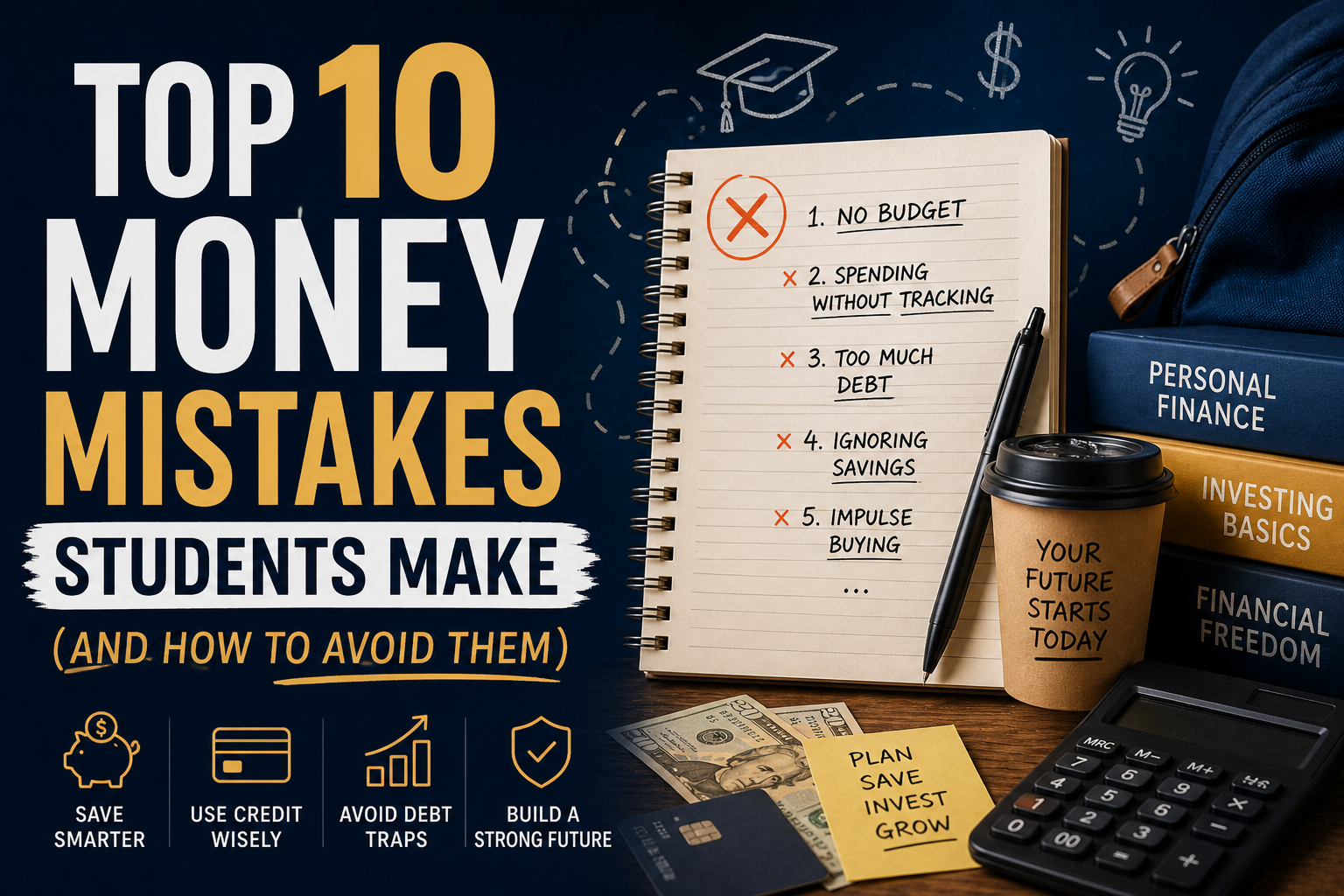
    Top 10 Money Mistakes Students Make (And How to Avoid Them)

    Top 10 Money Mistakes Students Make (And How to Avoid Them) | The Campus Investor
    The Campus Investor
    Money Smarts for Real Life
    ⚠️ Issue No. 03  ·  Financial Literacy Series

    Top 10 Money Mistakes Students Make (And How to Avoid Them)

    May 2026 | 7 min read | For College Students

    Most financial mistakes college students make aren’t caused by carelessness or bad intentions. They’re caused by nobody ever explaining how money actually works. You didn’t get a personal finance class. Neither did most of your classmates. So you figured it out as you went — and “figuring it out” usually means making the same expensive mistakes everyone else does.

    Here are the 10 most common ones — and more importantly, exactly what to do instead.

    73%
    of students have no monthly budget in place
    $1,600
    Average amount students overspend per semester without realizing it
    40%
    of students don’t know the interest rate on their student loans
    01
    Mistake #1
    Having No Budget At All

    This is the most common and most costly mistake on the list. Without a budget, spending decisions happen by feel — and feelings are notoriously bad at math. You think you have money because your bank account isn’t empty. Then it is.

    Aisha, a junior studying education, went three semesters without a budget. She wasn’t reckless — just untracked. When she finally added everything up, she found she’d been spending $340 a month on food and dining out, not the $150 she estimated. That $190 gap added up to nearly $1,200 in unexpected spending over a semester.

    ✅ The Fix

    Spend 20 minutes on the first day of each month writing down your income and assigning every dollar to a category. Use the 50/30/20 rule as your starting framework. Free apps like YNAB, Copilot, or even a Google Sheet get the job done. Need a full walkthrough? See our beginner’s guide to personal finance for students.

    02
    Mistake #2
    Misusing Credit Cards

    A credit card is a powerful financial tool — until it isn’t. The mistake most students make isn’t getting a credit card. It’s treating it like bonus money instead of a payment method for money they already have.

    When you carry a balance on a card with 24% APR, every $100 you don’t pay off costs you $24 in interest per year — and that compounds monthly. A $500 balance you carry for two years can quietly turn into over $750 owed.

    ✅ The Fix

    Use your credit card for regular purchases you’d make anyway — groceries, gas, subscriptions. Set up autopay for the full balance every month, not the minimum. Never charge what you can’t already afford to pay off from your checking account.

    03
    Mistake #3
    Ignoring Student Loans While In School

    Out of sight, out of mind — until graduation hits and a repayment notice lands in your inbox for an amount that takes your breath away. Many students borrow year after year without ever logging into StudentAid.gov to check their running total.

    On unsubsidized federal loans, interest accrues from day one — even while you’re still in school. If you borrow $8,000 in freshman year at 6.5%, by the time you graduate four years later you already owe roughly $10,200 before you’ve made a single payment.

    ✅ The Fix

    Log into StudentAid.gov today and find your exact balance. If your loans are unsubsidized, consider making small interest-only payments while in school — even $25 to $50 a month prevents interest from capitalizing and inflating your principal.

    04
    Mistake #4
    Having Zero Emergency Fund

    Life doesn’t wait for a convenient time to break down. Your car needs a new tire. Your laptop dies the night before finals. Your hours get cut at work. Without a financial cushion, any small crisis immediately becomes a credit card charge — and debt you’ll spend months paying off.

    An emergency fund isn’t about having a lot of money saved. It’s about having a buffer between normal life and financial disaster. Even $300 to $500 changes the equation entirely.

    ✅ The Fix

    Open a separate high-yield savings account and label it “Emergency Fund.” Transfer a fixed amount each month — even $20 or $30 — until you hit $500. Once you’re there, aim for one month of expenses. This account is not for sales, trips, or concert tickets. Emergencies only.

    05
    Mistake #5
    Lifestyle Creep After Every Raise

    You get a pay raise, a bigger financial aid package, or start a higher-paying job — and almost immediately your spending rises to match it. New apartment, nicer restaurants, upgraded phone. This is lifestyle creep, and it’s one of the quietest wealth-killers there is.

    Students who earn more tend to feel financially ahead — until they realize they’re saving the same zero dollars they were before the raise. The extra income evaporated into a slightly more expensive version of the same life.

    ✅ The Fix

    Every time your income increases, direct at least 50% of the increase to savings or debt payoff before adjusting your lifestyle. Give yourself a small upgrade as a reward — but make the majority work for your future self, not your current comfort.

    06
    Mistake #6
    Paying Only the Minimum on Debt

    The minimum payment on a credit card is designed to keep you in debt as long as possible — not to help you pay it off. On a $1,500 balance at 22% APR, paying only the minimum of around $35/month means you’ll be paying for over five years and will have paid nearly $800 in interest alone.

    This is one of the most expensive financial habits a student can form — and it’s completely invisible on a monthly basis because the minimum payment always feels affordable.

    ✅ The Fix

    Always pay more than the minimum — even an extra $20 or $30 a month makes a significant difference. Use the avalanche method: list all debts by interest rate and put every extra dollar toward the highest rate first, while paying minimums on the rest.

    07
    Mistake #7
    Not Tracking Subscriptions

    Streaming services, gym memberships, app subscriptions, meal kit trials that converted to paid plans — they’re each small, they auto-renew quietly, and together they add up to a number most students would be genuinely shocked by.

    The average college student has 4 to 6 active subscriptions at any given time, often including at least one they completely forgot about. At $10 to $15 each, that’s easily $50 to $80 a month — over $900 a year — disappearing before they even check their balance.

    ✅ The Fix

    Do a subscription audit right now: pull up your bank or credit card statement and highlight every recurring charge. Cancel anything you haven’t used in the last 30 days. Tools like Rocket Money or your bank’s subscription tracker can automate this going forward.

    08
    Mistake #8
    Skipping Renter’s Insurance

    This is the most overlooked financial mistake on the list — and it can be the most catastrophic. Your landlord’s insurance covers the building. It does not cover your laptop, your bike, your furniture, or any of your belongings if there’s a fire, flood, theft, or break-in.

    Renter’s insurance costs between $10 and $20 per month and covers your personal property for losses up to $20,000 or more. Most students skip it because they think they “don’t have enough stuff” to insure — until they do the math on what it would cost to replace everything.

    ✅ The Fix

    Get renter’s insurance. Today. Lemonade, State Farm, and most major insurers offer policies for students starting around $8 to $12 per month. It takes about 5 minutes to set up online and it’s one of the best dollars-per-protection purchases available.

    09
    Mistake #9
    Waiting to Start Investing

    “I’ll start investing when I have a real job.” This is the single most expensive sentence in personal finance. Every year you wait to start investing costs you far more than the amount you would have invested — because of compound growth.

    A student who invests $50 a month starting at 20 will have significantly more at retirement than someone who invests $200 a month starting at 35. The math is brutal and it’s irreversible — time you don’t invest can never be bought back. We break this down in detail in Why Financial Literacy Matters More Than Your GPA.

    ✅ The Fix

    Open a Roth IRA at Fidelity, Vanguard, or Schwab — all free, no minimums. Invest as little as $25 to $50 a month in a total market index fund. Set it to auto-invest so you never have to think about it. Start this month, not next year.

    10
    Mistake #10
    Comparing Your Finances to Everyone Else’s

    Social media shows you the vacation, the new car, the apartment upgrade, the dinner out — not the credit card bill that funded it. Comparing your financial situation to curated highlight reels is a fast path to bad spending decisions made for the wrong reasons.

    Some of the most financially healthy students on any campus are also some of the least visibly “balling.” They drive older cars, pack lunch, and say no to expensive weekend trips. Their future selves will have the receipts — in the form of a paid-off loan and a growing investment account.

    ✅ The Fix

    Compare yourself to your own previous month, not to other people’s social media. Set one financial goal per month — pay off $100 extra debt, add $50 to savings, cancel one subscription — and measure progress against that. Your financial story is the only one that matters.

    ◆ ◆ ◆

    “Financial mistakes aren’t a sign of failure. They’re a sign of never being taught. Now you know — and knowing is the only thing that separates a mistake you make once from one you keep making forever.”

    The good news about all ten of these mistakes? Every single one is fixable. Most take less than an hour to address. You don’t need a perfect financial past to build a strong financial future — you just need to start making slightly better decisions than you made last month.

    Your 10-Point Action Checklist

    • Set up a monthly budget using the 50/30/20 rule
    • Set credit card autopay to full balance every month
    • Log into StudentAid.gov and check your exact loan balance
    • Open a separate high-yield savings account for emergencies
    • Save at least 50% of any future income increases before lifestyle adjustments
    • Pay more than the minimum on any debt you’re carrying
    • Audit your subscriptions and cancel anything unused
    • Get renter’s insurance — takes 5 minutes, costs less than a pizza
    • Open a Roth IRA and start with as little as $25/month
    • Stop comparing your finances to social media — build your own scorecard
    📚 Continue the Series

    This is Issue 03 of The Campus Investor Financial Literacy Series. Missed the earlier issues? Read Issue 01: Why Financial Literacy Matters More Than Your GPA and Issue 02: Personal Finance for Students — A Complete Beginner’s Guide on our site.

    Frequently Asked Questions

    What is the biggest financial mistake college students make?
    The single most impactful mistake is having no budget at all. Without a budget, spending happens by feeling rather than by plan — and feelings are terrible at math. The second most costly mistake is ignoring student loan balances while in school, allowing interest to capitalize unchecked. Both are completely fixable with about one hour of attention.
    Why do so many college students end up in credit card debt?
    Most students treat a credit card as extra money rather than a payment tool for money they already have. Combined with high APRs (often 22–28%) and a habit of paying only the minimum, balances grow quickly. A $500 balance paid at minimum payments can take years to clear and cost hundreds in interest. The fix is simple: never charge more than you can pay off in full at the end of the month.
    Is renter’s insurance really necessary for college students?
    Yes — and it’s one of the most overlooked protections available. Your landlord’s insurance covers the building, not your belongings. If your laptop, bike, or furniture is stolen or damaged in a fire, you’re on your own without renter’s insurance. Policies start at around $8–$12 per month and typically cover $15,000–$20,000 in personal property. It takes five minutes to set up and costs less than a pizza per month.
    What is lifestyle creep and how does it hurt college students?
    Lifestyle creep happens when your spending rises to match every increase in your income — leaving your savings rate unchanged no matter how much more you earn. For students, it often follows a new job, a bigger financial aid package, or a scholarship. The fix is to direct at least 50% of any income increase to savings or debt before adjusting your lifestyle. Enjoy a portion of the increase — but make the majority work for your future first.
    When should college students start investing?
    As soon as you have any earned income — which for most students means the moment you get a part-time job. Even $25–$50 a month into a Roth IRA invested in a total market index fund is a powerful start. The math of compound growth is ruthless about time: every year you delay investing costs you far more than the amount you would have invested. “I’ll start when I have a real job” is the most expensive sentence in personal finance.

    The Campus Investor  ·  Issue 03  ·  Financial Literacy Series

    Written for students who want to graduate smart — in every sense of the word.

  • The Power of Investing: A Path to Financial Independence

    Investing is more than just a financial activity—it’s a gateway to achieving long-term financial goals, building wealth, and ensuring a secure future. While saving provides a foundation, investing takes your money to the next level by putting it to work and allowing it to grow.


    Why Is Investing Important?

    1. Wealth Accumulation Through Growth
      Investing allows your money to grow significantly over time, thanks to the magic of compounding. When you earn returns on your investments, those returns are reinvested, creating a snowball effect. For example:
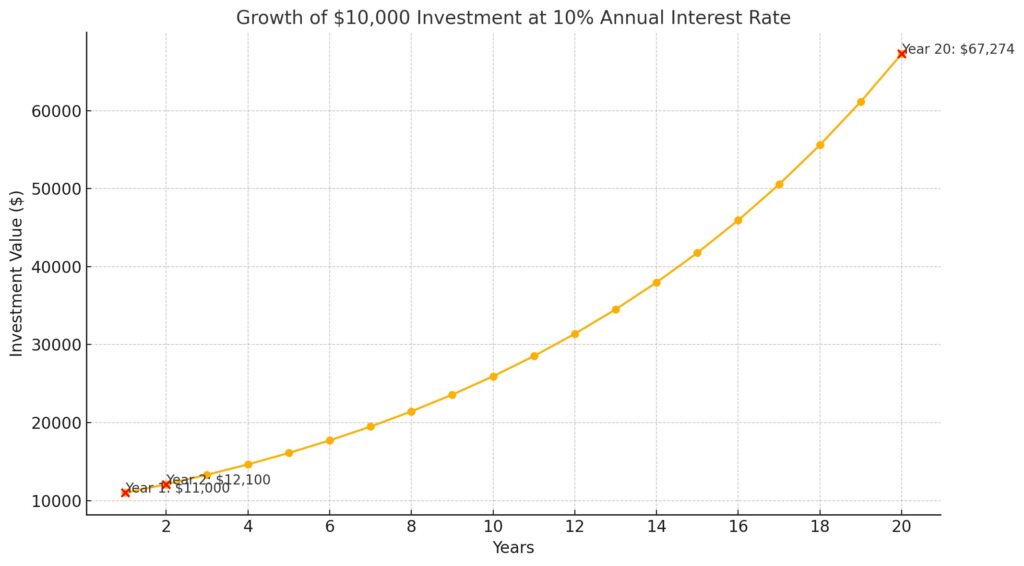
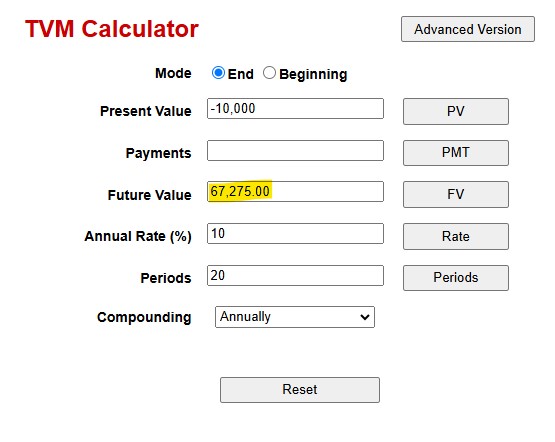
    • If you invest $10,000 at an average annual return of 10%, it can grow to over $67,000 in 20 years.
      This growth far exceeds what a regular savings account would offer.

    https://www.fncalculator.com/financialcalculator?type=tvmCalculator

    2. Protecting Against Inflation
    Inflation gradually decreases the purchasing power of money. By investing in assets with higher returns than inflation, you preserve and increase your real wealth. For instance:

    • If inflation averages 3% annually, a $100 item today will cost approximately $180 in 20 years. Investments in stocks or real estate can help your money keep pace with or surpass inflation.

    3. Achieving Financial Goals
    Investing is a strategic way to reach significant milestones like:

    • Buying a home.
    • Funding your child’s education through 529 college savings plan.
    • Launching a business.
    • Building generational wealth for your family.

    4. Planning for Retirement
    Retirement planning often requires more than just saving in a bank account.

    • Investment vehicles like 401(k)s, IRAs, or even personal portfolios provide opportunities for market growth.
    • Investing through HSA account ensures you have the funds to maintain your desired lifestyle and cover healthcare costs during retirement.

    5. Diversifying Income Streams
    Investments generate income through:

    • Dividends from stocks.
    • Interest from bonds.
    • Real Estate Investment Trust (REIT) funds.

    This reduces dependency on a single source of income, offering financial stability


    Benefits of Investing Early

    Starting early provides a massive advantage due to time and compounding returns. Consider two investors:

    • Investor A starts at age 25, investing $300 monthly
    • Investor B starts at age 35, investing $300 monthly

    At age 65, assuming a 8% annual return:

    • Investor A’s portfolio grows to over $1,000,000.
    • Investor B’s portfolio grows to about $447,000.

    Investor A can retire as a millionaire by taking benefits of investing early.

    https://www.fncalculator.com/financialcalculator?type=tvmCalculator


    Common Investment Options

    1. Stocks
      • High-risk, high-reward investments.
      • Suitable for long-term goals due to potential for substantial growth.
    2. Bonds
      • Lower risk compared to stocks.
      • Provide regular income through interest payments.
    3. Mutual Funds and ETFs
      • Offer diversification by pooling money to invest in multiple assets.
      • Managed by professionals, making them beginner-friendly.
    4. Real Estate Investment Trusts (REIT)
      • Provide rental income
    5. Retirement Accounts (401(k), IRA)
      • Offer tax advantages to boost your savings for retirement.
      • Employer-sponsored accounts often include matching contributions.

    How to Start Investing

    1. Educate Yourself
      Learn the basics of asset classes, risk management, and market behavior. Resources include:
    2. Set Clear Goals
      Define what you’re investing for—retirement, education, or wealth building—and tailor your strategy accordingly.
    3. Determine Your Risk Tolerance
      Understand your comfort level with risk. Stocks are riskier but offer higher returns, while bonds and savings accounts are safer but yield lower returns.
    4. Start Small and Be Consistent
      • Begin with what you can afford. Many brokerage firms allow you to start with as little as $1.
      • Consistency matters more than large investments—set up automatic contributions.
    5. Diversify Your Portfolio
      • Spread your investments across different asset classes to reduce risk.
      • The saying, “Don’t put all your eggs in one basket,” applies strongly in investing.
    6. Consult a Financial Advisor
      If you’re unsure where to start, seek professional advice to create a personalized investment plan.

    Overcoming Common Misconceptions

    1. “I need a lot of money to start.”
      Many brokerage firms allow you to begin investing with minimal amounts.
    2. “Investing is too risky.”
      Risk varies by asset class. Balancing high-risk investments (stocks) with safer options (bonds) can align with your comfort level.
    3. “I don’t know enough.”
      Financial literacy tools, seminar/courses, and advisors are available to help you gain confidence.

    Key Takeaways

    Investing is not just for the wealthy or financially savvy—it’s for anyone with a desire to grow their wealth and secure their future. Here’s why you should start now:

    • Time is your greatest ally in investing.
    • Small, consistent contributions lead to significant long-term gains.
    • Diversifying and understanding your goals reduce risks and improve results.

    Remember, investing is like planting a tree: the sooner you plant it, the sooner it bears fruit. Start today and take control of your financial future.

    Your Mantra for Success: Save Consistently. Invest Smartly. Retire Richly.

    Legal Disclaimer for Build Wealth Retire Rich Blog/Website

    The information provided on the “Build Wealth Retire Rich” blog/website is for educational purposes only and should not be construed as financial, investment, or legal advice. While every effort is made to ensure the accuracy and reliability of the information presented, Build Wealth Retire Rich and its contributors, including AI tools used in the creation of some content, do not guarantee its completeness or timeliness. Users are encouraged to consult with a qualified financial advisor or legal professional to discuss their specific financial situation and to obtain advice tailored to their individual circumstances.

    Build Wealth Retire Rich is not responsible for any decisions made based on the information provided on this website. All financial products, investment strategies, and other content discussed are presented for informational purposes only, and no guarantees are made regarding the performance or suitability of any particular investment or strategy.

    The views and opinions expressed on “Build Wealth Retire Rich” are those of the authors and do not necessarily reflect the views of the website’s owner or any affiliated institutions. “Build Wealth Retire Rich” does not endorse or promote any particular investment, financial product, or institution unless explicitly stated.

    Risk Disclosure: Investing involves risk, including the potential loss of principal. Past performance is not indicative of future results. Always do your own research and consider your financial goals and risk tolerance before making any financial decisions.

    By using this website, you agree that Build Wealth Retire Rich and its affiliates are not liable for any losses or damages incurred as a result of using the information provided. Users are solely responsible for their financial decisions and should seek independent advice when necessary.