Needs vs Wants: A Simple Guide for College Students | The Campus Investor
The Campus Investor
Money Smarts for Real Life
🛒 Issue No. 05 · Financial Literacy Series
Needs vs Wants: A Simple Guide for College Students
May 2026 | 6 min read | For College Students
You get paid. You pay your bills. Then somehow, by the end of the month, there’s almost nothing left — and you can’t quite explain where it went. Sound familiar? The answer almost always comes down to one blurry line: the difference between what you actually need and what you simply want.
This distinction sounds obvious until you’re standing in line at a coffee shop, talking yourself into a $7 latte because “I need caffeine to study.” Or justifying a new pair of shoes because “I needed something to wear to the interview.” The line between needs and wants isn’t always clean — and that’s exactly the problem.
This guide gives you a clear framework for telling them apart, a practical way to audit your own spending, and the tools to make smarter decisions every single month.
of student spending goes to non-essential “want” categories each month
$220
Average monthly amount students spend on dining out beyond meal plans
60%
of impulse purchases are regretted within 48 hours
What Needs and Wants Actually Mean
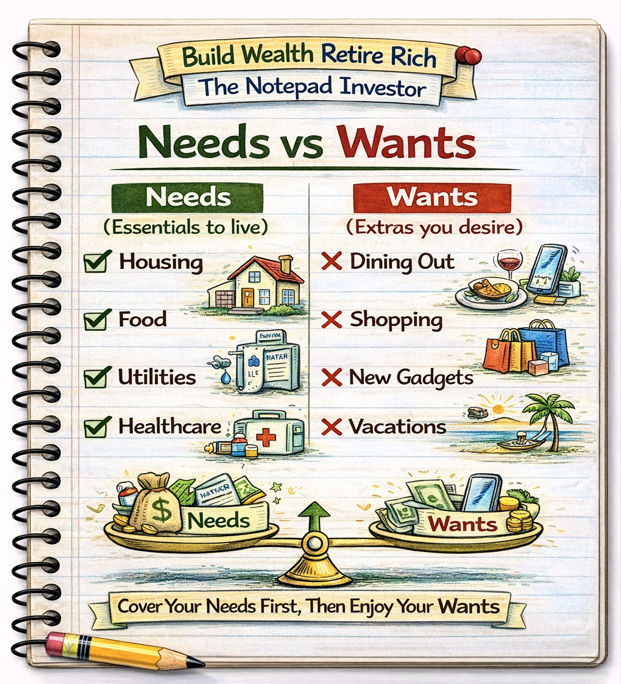
The classic definition: a need is something you must have to survive and function. A want is something that improves your life or brings enjoyment but isn’t essential. Simple in theory. Messy in practice — especially for a college student whose entire context is different from a working adult.
🏠
NEED
Essential to function
Things you genuinely cannot function without — your safety, health, ability to attend class, and basic daily living.
Rent or on-campus housing
Groceries and basic food
Utilities — electricity, water, heat
Required textbooks and course materials
Transportation to class or work
Health insurance and medications
Basic clothing appropriate for weather
Phone (for safety and class communication)
Internet for coursework
Minimum debt payments
🛍️
WANT
Nice to have, not essential
Things that add comfort, entertainment, or enjoyment — but that you could live and study without.
Daily coffee shop runs
Dining out beyond your meal plan
Streaming subscriptions
New clothes beyond basic needs
Concerts, events, nights out
Gaming or hobby purchases
Upgraded phone or laptop
Gym membership (if campus gym exists)
Brand-name vs generic products
Convenience food and delivery apps
Notice that some of these feel debatable. A phone is listed as a need — but a brand-new iPhone is a want. Internet is a need — but a $100/month premium plan when a $40 plan works just as well is a want. The category matters less than your honest answer to: “Could I manage without this specific version of it?”
The most expensive financial mistakes students make live in the grey zone — the space between a clear need and a clear want. These are purchases that start as legitimate needs but get upgraded into wants without anyone noticing.
Item
The Need Version
The Want Version
Verdict
Food
Groceries, meal plan, cooking at home
DoorDash 4x a week, restaurant meals, daily Starbucks
Depends
Phone
A working phone on a reasonable plan
Latest iPhone, $90/month unlimited premium plan
Depends
Laptop
A functional laptop for coursework
Upgrading a working laptop “because it’s slow”
Depends
Transportation
Bus pass, bike, carpool to class
Uber everywhere because “it’s faster”
Depends
Clothing
Weather-appropriate, interview-ready basics
New outfit every month, brand loyalty shopping
Depends
Textbooks
Required course materials, library copies, PDFs
Buying new when rentals or PDFs exist
Depends
Internet
Reliable connection for classes and work
$110/month gigabit plan for a single user
Depends
Social spending
Occasional meals or events with friends
Saying yes to every outing out of FOMO
Depends
“The grey zone is where budgets break down. The need is real — but the version of it you’re buying is a want in disguise.”
Mini-Case · The Food Budget Illusion
Sofia, Junior — Nursing
Sofia told herself she spent around $200 a month on food. She had a partial meal plan, cooked sometimes, and grabbed coffee a few times a week. When she actually pulled her bank statements, the real number was $410 — nearly double her estimate.
The gap was all grey zone: $80 in delivery apps she’d forgotten about, $55 in coffee shop runs she counted as “study expenses,” and $75 in spontaneous dining out she never tracked. None of it felt like overspending in the moment. Together it was $210 she hadn’t planned for.
The lesson: Food is absolutely a need. Daily delivery, premium coffee, and spontaneous restaurant meals are wants wearing a need’s clothing. The category is legitimate — the version matters enormously.
✉ Free Newsletter — Join 5,000+ Students
Something went wrong. Please try again.
Your subscription has been successful.
A 4-Question Framework to Decide in Real Time
The best time to classify a purchase isn’t when you’re budgeting — it’s at the moment of decision, standing in the store or about to hit “place order.” Here are four questions to run through before any non-routine purchase:
1
Can I physically function without this today?
If you’d miss a class, compromise your health, or be unable to complete required work without it — it’s a need. If life goes on normally without it — it’s a want. This is the most honest filter first.
2
Is there a cheaper version that serves the same purpose?
If yes, the need is real but the specific purchase may be a want. You need food — the $14 delivery fee is a want. You need a textbook — the $180 new copy when a $20 rental exists is a want. Always check for the “need version” of the purchase first.
3
Am I buying this because I want it, or because I feel like I should?
Social pressure and FOMO are the hidden drivers behind most student overspending. “Everyone’s going” or “I’d feel left out” are want-based motivations, not need-based ones. Recognizing the difference takes practice — but it’s worth developing.
4
Is this in my budget this month?
Even legitimate wants are fine — if they’re budgeted for. A concert ticket isn’t inherently bad spending. A concert ticket that pushes your grocery budget into a credit card charge is. The question isn’t just need or want — it’s need or want and is it planned for?
⏱ The 24-Hour Rule
For any unplanned purchase over $30, wait 24 hours before buying. If you still want it the next day and it fits your budget — buy it guilt-free. Most impulse purchases disappear in that window. For purchases over $100, make it 48 hours. This one habit alone can save students hundreds of dollars a semester.
How to Audit Your Own Spending
Theory is useful. Seeing your own actual numbers is better. A spending audit takes about 20 minutes and will show you more about your financial habits than any quiz or framework ever could.
Pull up your last 30 days of bank and credit card transactions. Go through each one and sort it into one of three buckets:
✅
Keep
Essential needs and planned wants that fit your budget. These stay as-is.
✂️
Trim
Real needs being met in an expensive way. Find a cheaper version — same result, less cost.
❌
Cut
Wants you didn’t plan for, don’t use, or that don’t bring enough value. Eliminate these first.
Mini-Case · The Audit That Paid Off
Marcus, Senior — Engineering
Marcus did his first-ever spending audit during finals week — not the ideal timing, but the results were eye-opening. In 30 minutes he found: two streaming services he’d forgotten about ($28/month), a gym membership he hadn’t used since September ($35/month), daily energy drinks from the campus store ($55/month), and $120 in Uber rides he could have replaced with the free campus shuttle.
Total identified: $238/month he wasn’t conscious of spending. He cut the gym and one streaming service immediately, switched to making coffee in his dorm, and started using the shuttle. The following month he had $180 more — without changing anything about his actual lifestyle.
The lesson: The spending audit doesn’t tell you to stop enjoying life. It tells you where your money went without your permission — and gives it back.
Once you understand needs vs wants, they slot directly into the 50/30/20 budget rule covered in Issue 02 of this series. Needs live in the 50% category. Wants live in the 30% category. Savings and debt payoff take the remaining 20%.
The power of knowing your needs vs wants is that it helps you defend your budget categories under pressure. When you’re tempted to dip into your savings for a want, you know what you’re doing. When a surprise expense hits your needs category, you know where to pull from — your wants budget, not your savings.
📊 A Rule Worth Remembering
Wants aren’t the enemy. A budget that has zero room for enjoyment won’t last two weeks. The goal is to make your wants intentional and planned — not to eliminate them. Give yourself a monthly “wants allowance,” spend it freely, and don’t feel guilty about it. The guilt comes from unplanned want spending, not from spending on wants itself.
The Mindset Shift That Makes It All Easier
The biggest obstacle to distinguishing needs from wants isn’t knowledge — it’s the story we tell ourselves in the moment. “I deserve this.” “I’ve been stressed.” “Everyone else has one.” “It’s on sale.” These narratives are powerful and they arrive instantly. The framework above gives you a pause — a moment between the impulse and the action where a better decision can live.
But the deeper shift is this: stop thinking about money as something that runs out and start thinking of it as something you direct. Every dollar you spend on a want you didn’t plan for is a dollar that could have been directed toward a goal you actually care about. The latte isn’t just $7 — it’s $7 that wasn’t going toward your emergency fund, your loan balance, or your first investment.
That framing isn’t meant to make you feel guilty. It’s meant to give you agency. You’re not deprived when you skip the $7 latte. You’re choosing your goal over your impulse — and that’s a different kind of power entirely.
“Every want you choose intentionally makes you richer. Every want that sneaks past your budget makes you poorer. The difference is awareness.”
◆ ◆ ◆
Your Needs vs Wants Action List — This Week
Pull up your last 30 days of transactions and sort each into Need, Want, or Grey Zone
Identify your top three unplanned want categories — these are your budget leaks
Find one “grey zone” item you’re spending on the want version of — switch to the need version
Set a monthly wants allowance in your budget and stick to it guilt-free
Apply the 24-hour rule to every unplanned purchase over $30 this month
Review your subscriptions — cancel anything you haven’t used in 30 days
What is the difference between needs and wants for college students?
A need is something essential to your health, safety, and ability to function as a student — rent, basic food, utilities, required course materials, transportation to class. A want is anything that improves your comfort or enjoyment but isn’t essential — dining out, streaming services, new clothes beyond basics, daily coffee shop runs. The blurry part is the grey zone: items that are genuine needs being fulfilled in a want-level way, like food via delivery apps instead of cooking.
How do I stop impulse spending as a college student?
The single most effective tool is the 24-hour rule: for any unplanned purchase over $30, wait 24 hours before buying. Most impulse purchases disappear in that window. For purchases over $100, wait 48 hours. Combined with a monthly “wants allowance” — a fixed amount you can spend on anything guilt-free — you get both discipline and freedom without feeling deprived.
Is daily coffee a need or a want for students?
Coffee itself could be argued as a need for focus and studying — but daily coffee shop runs at $5–$7 each are a want. The need version is making coffee at your dorm or apartment. The want version is the experience, convenience, and specific brand of the coffee shop. At $6 a day, five days a week, that’s $120 a month — $960 over an 8-month academic year — on the want version of a need.
How do needs and wants fit into a student budget?
Using the 50/30/20 rule: needs should consume no more than 50% of your monthly income, wants up to 30%, and the remaining 20% goes to savings and debt payoff. The key is giving yourself a planned wants allowance each month — a fixed amount you can spend freely on whatever brings you joy. Guilt comes from unplanned want spending, not from spending on wants itself.
How do I do a spending audit as a student?
Pull up your last 30 days of bank and credit card transactions. Go through each one and label it Keep (essential or planned), Trim (real need being met expensively — find a cheaper version), or Cut (unplanned want or unused subscription). Most students find $100–$250 per month in Trim and Cut categories in their first audit — money they were spending without noticing or intending to.
Needs vs wants represents the critical distinction between essential expenses required for basic survival and well-being versus discretionary desires enhancing comfort or lifestyle but remaining non-essential—needs include shelter, food, basic clothing, healthcare, and transportation enabling work, while wants encompass dining out, entertainment, premium versions of necessities, luxury items, and lifestyle upgrades. Unlike treating all expenses equally, distinguishing needs from wants enables strategic spending decisions, emergency budget creation, debt elimination planning, and wealth building through conscious prioritization of essential over discretionary spending.
This article is designed for anyone struggling with spending decisions, individuals living paycheck to paycheck despite adequate incomes, or those seeking to reduce expenses and increase savings. You do not need financial expertise, restrictive diets, or extreme frugality to benefit from needs versus wants clarity—understanding this fundamental distinction transforms spending from unconscious reaction to intentional choice aligned with priorities and financial goals.
Understanding needs vs wants matters because conflating wants with needs leads to overspending on non-essentials preventing wealth building, unclear priorities during financial stress force poor crisis decisions, and inability to distinguish essential from discretionary spending creates perpetual cash flow problems and debt accumulation regardless of income level, leaving people financially vulnerable despite spending on items they believed necessary.
Educational disclaimer: This article provides general educational information about distinguishing needs from wants. Individual circumstances vary—what’s essential for one person may be discretionary for another based on health, location, work requirements, and family situations. This is not financial or budgeting advice. Consult qualified financial professionals for personalized guidance.
Defining Needs
What Are Needs?
Definition: Expenses required for basic survival, health, safety, and ability to earn income
Core characteristics of needs:
Essential for physical survival or safety
Required to maintain employment (income generation)
Necessary for legal or health compliance
Cannot be eliminated without serious consequences
Would cause harm if absent
The Hierarchy of Needs (Maslow Applied to Finance)
Social connection: Some social spending maintaining relationships
Work effectiveness: Tools or environment enabling productivity
Family harmony: Activities preventing constant conflict
Balance required: Recognize these as important but budget for them consciously as “quality of life” category rather than justifying all discretionary spending as necessity.
Practical Application: Using Needs vs Wants
Creating a Needs-Only Budget
Purpose: Understand bare minimum living costs for emergency situations or debt payoff
Process:
List all current expenses
Mark each as “need” or “want”
For mixed items, separate need portion from want portion
Insight: If income $3,500 and total spending $2,955 ($2,390 needs + $565 wants), survival possible on $2,390 freeing $1,110 monthly for emergency debt payoff or wealth building.
The 50/30/20 Budget Framework
Rule:
50% of net income = Needs
30% of net income = Wants
20% of net income = Savings and debt payoff
Example with $4,000 monthly net income:
Needs budget: $2,000 (50%)
Wants budget: $1,200 (30%)
Savings/debt: $800 (20%)
Flexibility:
High cost-of-living areas: May need 60/20/20
Aggressive savers: 50/10/40 or better
Debt payoff mode: 50/0/50 temporarily
Decision Framework for Purchases
Before any purchase, ask:
Is this a need or want? Be honest, no rationalization
If a need, what’s the minimum viable version? Avoid upgrading needs unnecessarily
If a want, does it fit in my wants budget? Check remaining discretionary funds
What am I trading for this want? Every dollar spent on wants delays financial goals
Will I remember/value this in 6 months? Avoid regret purchases
The 24-hour rule for wants:
Wait 24 hours before purchasing any non-essential item over $50
If still want it after waiting, evaluate against wants budget
Prevents impulse purchases disguised as needs
Reduces regret and wasted money
Advertisement
Reserved space for in-content ad
Common Needs vs Wants Mistakes
Lifestyle Creep (Needs Inflation)
Pattern: Yesterday’s wants become today’s “needs” as income increases
First apartment: $600 studio = need
After raise: $1,200 one-bedroom = “need bigger space”
After promotion: $1,800 two-bedroom = “need home office”
Pattern: Defining needs based on peers rather than actual requirements
“Everyone has Netflix/Hulu/Disney+ so I need them”
“My coworkers drive nice cars so I need one too”
“My friends take vacations so I need to travel”
Solution: Define needs based on YOUR life requirements, not others’ choices. Their wants aren’t your needs.
Emergency Justification
Pattern: Claiming wants as needs during specific situations
“I need this vacation—I’m so stressed” (want: relief, need: stress management has free options)
“I need new clothes for this event” (want: new outfit, need: wear existing clothing)
“I need to order food, too tired to cook” (want: convenience, need: nutrition has home options)
Solution: Acknowledge wants honestly. Budget for them if possible, but don’t pretend they’re needs.
Kids’ Wants Become Parents’ “Needs”
Pattern: Children’s desires reframed as necessities
“They need the latest phone for school” (want: status, need: basic communication)
“They need brand-name shoes” (want: peer acceptance, need: functional footwear)
“They need this experience/activity” (want: enrichment, need: free alternatives exist)
Solution: Distinguish actual needs (education, safety, health) from wants (status items, premium experiences). Budget for some wants but be honest about categorization.
Confusion Between Habits and Needs
Pattern: Long-standing habits mistaken for requirements
“I need my morning Starbucks” (habit, not need—home coffee works)
“I need to eat out for lunch” (habit, not need—packing lunch possible)
“I need cable TV” (habit, not need—streaming or antenna alternatives)
Solution: Examine regular expenses. Habits feel like needs but remain wants if alternatives exist.
Why Needs vs Wants Understanding Matters
Without distinguishing needs from wants, people overspend on discretionary items believing them essential preventing savings accumulation, financial emergencies become catastrophic because basic survival costs unclear, and debt accumulation occurs through unconscious want spending rationalized as necessary rather than discretionary choices enabling financial fragility regardless of income level.
Understanding needs vs wants enables individuals to:
Create realistic budgets distinguishing essential from discretionary
Survive financial emergencies by cutting to needs-only spending
Accelerate debt payoff through temporary want elimination
Make conscious spending choices aligned with priorities
Reduce financial stress through clarity about true requirements
Build wealth faster by controlling want spending strategically
Needs versus wants clarity transforms spending from emotional reaction to intentional choice supporting financial goals and security.
Advertisement
Reserved space for in-content ad
Common Misunderstandings
Many people assume needs versus wants distinction requires extreme deprivation or elimination of all enjoyment. In reality, understanding the difference enables strategic allocation of discretionary spending to highest-value wants rather than unconscious spending on low-value items—knowing what’s truly needed creates freedom to spend on wants deliberately and guilt-free within budget constraints.
Another common misconception is that wants are bad or wasteful. In practice, wants enhance life quality and happiness when budgeted appropriately—problem arises when wants consume resources needed for financial security or when wants are rationalized as needs preventing honest budget management and conscious choice-making.
Some believe their personal needs are objectively higher than average requiring more spending. However, most people’s true survival needs are similar—differences lie in quality preferences, location choices, and lifestyle standards representing wants added to basic needs, not genuinely higher baseline requirements for survival and functioning.
How Needs vs Wants Fits Into Financial Health
Needs versus wants distinction provides framework for all financial decisions—emergency budgets cut to needs only, debt payoff prioritizes needs funding wants elimination, and wealth building requires conscious want control directing surplus toward savings and investment rather than lifestyle inflation consuming income increases.
For example, person earning $4,000 monthly treats all spending as needs—$3,900 total expenses seem necessary, leaving only $100 monthly for savings. Financial emergency occurs requiring budget cuts but person believes they “can’t cut anything because everything is a need.” Result: Credit card debt accumulation at 20% interest. Contrast: Similar person honestly categorizes $2,200 as true needs, $1,700 as wants. Emergency occurs—immediately cuts wants to zero, maintains $2,200 needs, uses $1,800 monthly surplus to handle emergency without debt. After emergency passes, gradually adds back highest-value wants while maintaining $800+ monthly savings. Needs versus wants clarity enabled emergency navigation without debt spiral plus sustainable wealth building.
Needs versus wants distinction creates financial flexibility and resilience impossible when all spending treated as equally necessary.
Recent Updates and Trends
In recent years, subscription creep has blurred needs-wants lines—multiple streaming services, apps, memberships accumulating creating perception of necessity when all are wants requiring conscious evaluation and elimination.
Minimalism movement has popularized needs-wants distinction—deliberate living emphasizing need satisfaction while questioning want accumulation, though some interpretations become extreme rather than balanced.
Influencer culture has intensified wants-as-needs confusion—social media showcasing lifestyles creating artificial needs through comparison and FOMO (fear of missing out) driving discretionary spending rationalized as necessary.
Economic uncertainty has renewed interest in needs-only budgeting—more people creating survival budgets understanding bare minimum costs as financial fragility protection.
Fundamental needs versus wants principles remain timeless: distinguish essential survival requirements from discretionary enhancements, budget for both honestly rather than rationalizing wants as needs, maintain ability to cut to needs-only during emergencies, and consciously allocate discretionary spending to highest-value wants rather than unconscious accumulation of low-satisfaction purchases.
3 Things You Can Do Today
Ready to clarify needs vs wants? Here are three simple steps you can take right now:
1. Categorize last month’s expenses as needs vs wants – Pull last month’s bank and credit card statements. List every expense. Mark each honestly as “need” or “want” (no rationalization allowed). For mixed items, separate need portion from want portion. Total each category. Calculate percentages. This reveals actual spending patterns versus assumptions. Most people discover 40-60% of spending is wants they believed were needs.
2. Create your needs-only survival budget – List minimum expenses for basic survival if emergency required drastic cuts: shelter, basic utilities, minimum groceries, essential transportation, legally required insurance and payments, critical healthcare. Total these. This number = emergency baseline. Knowing this amount reduces financial anxiety—you know exact minimum required for survival. Typical needs-only budget: 50-60% of current spending.
3. Implement the 24-hour want delay rule – Starting today: Before purchasing any non-essential item over $50, wait 24 hours. Write down the item and date. If still want it tomorrow, evaluate against monthly wants budget. If fits budget and still desired, purchase. This single rule prevents impulse want purchases saving $100-$500+ monthly for most people—those savings compound to $50,000-$250,000+ over 20 years invested.
These actions create needs versus wants clarity enabling conscious spending choices rather than unconscious rationalization and impulse purchases.
Advertisement
Reserved space for in-content ad
Quick FAQ
How do I know if something is really a need?
Ask: “What happens if I don’t have this?” If answer includes: physical harm, homelessness, inability to work, legal consequences, health deterioration—it’s likely a need. If answer is: disappointment, inconvenience, missing out, looking less successful—it’s a want. Most honest self-assessment reveals 70%+ of “needs” are actually wants we strongly prefer.
Are any wants actually okay to have?
Absolutely! Wants are not evil or wasteful—they enhance life quality and happiness. Problem arises when: (1) wants consume resources needed for financial security, (2) wants are rationalized as needs preventing honest budgeting, (3) want spending is unconscious rather than intentional. Budget consciously for wants within your discretionary income after covering needs and savings goals.
What percentage of my budget should be needs vs wants?
General guideline: 50% needs, 30% wants, 20% savings (50/30/20 rule). High cost-of-living areas might be 60/20/20. Aggressive savers: 50/10/40. During debt payoff: 50/0/50 temporarily. Adapt to your situation but maintain clear separation and honest categorization. Most people claim 80-90% needs when actually 50-60%.
Is a car a need or want?
Depends entirely on circumstances. Need: Rural area, no public transit, required for work commute with no alternatives. Want: Urban area with robust public transportation, walkable neighborhood, or remote work. Even when car is need, luxury model vs. reliable used vehicle represents want portion. Context matters—examine your specific situation honestly.
How can I afford wants on a tight budget?
After covering needs and minimum savings (even $50-100 monthly), allocate specific wants budget from remaining income. Choose highest-value wants that bring most joy per dollar. Example: $100 monthly wants budget might go to one streaming service ($15), one nice dinner ($40), hobby supplies ($30), social activity ($15). Strategic want spending beats unconscious want accumulation exceeding budget.
What if my needs exceed my income?
Two options: (1) Reduce needs through major changes (cheaper housing, eliminate car via public transit, roommates, move to lower-cost area), (2) Increase income urgently (second job, higher-paying work, government assistance if eligible). Unsustainable long-term—requires immediate action. Examine “needs” critically—often contain want elements that can be reduced (cheaper housing location, basic food vs premium groceries, etc.).
This article is provided for educational purposes only and does not constitute financial or budgeting advice. What constitutes a “need” versus “want” varies by individual circumstances including health conditions, location, work requirements, family situations, and personal values. Information presented represents general frameworks—specific categorizations depend on individual contexts. Examples are illustrative—actual spending patterns and appropriate needs-wants balances vary significantly. No judgment intended for any spending choices—article aims to provide clarity for informed decision-making, not prescribe specific lifestyles. Consult qualified financial professionals for personalized guidance. Advertisements or sponsored content may appear within or alongside this content. All information is presented independently.
Interactive Quiz: Needs vs Wants
Choose an answer for each question and click Check Answer to learn why it is right or wrong.
1. Which statement best describes a need?
2. Which of the following is most clearly a want according to the article?
3. What is the purpose of a needs-only budget?
4. According to the article, what is the “wants disguised as needs” trap?
5. What does the 24-hour rule for wants help prevent?