Taxes often feel stressful because they stay in the background.
Money comes in, deductions happen, and most people never pause to ask whether everything is aligned. That quiet uncertainty can turn into frustration later, even when nothing is technically “wrong.”
Day 15 is about awareness — understanding what’s currently happening before any changes are considered.
Today’s Focus
Check the tax withholding on your paycheck.
This is a review only. No adjustments today. No action required beyond looking.
You’re simply becoming familiar with how taxes are handled right now.
Why This Step Matters
Tax surprises usually don’t come from mistakes. They come from lack of visibility.
When you understand withholding:
Uncertainty decreases
Confidence increases
Future planning becomes easier
Awareness today prevents stress later.
This Is Not About Perfection
You don’t need to understand every detail immediately.
Today is just about noticing what’s there so nothing feels hidden or confusing.
Reflection Question
How does knowing this information change how you feel about your paycheck?
What’s Next
Tomorrow, we’ll organize the information you already have so it’s easier to access when you need it.
Title: What Is Simple Interest? — The Foundation of Financial Growth Meta Description: Learn how simple interest works, how to calculate it, and why it’s the first step toward understanding compound interest and long-term investing.
💡 Definition: What Is Simple Interest?
Simple interest is the most basic form of earning or paying interest. It’s calculated only on your original amount — the principal — not on the interest that builds up along the way.
When you deposit money in a savings account, a bank pays you interest for allowing them to use your funds. When you take a loan, you pay the lender interest for borrowing their money. In both cases, the simple interest formula stays the same:
🧮 Simple Interest = Principal × Rate × Time
This predictable structure makes simple interest a great starting point for understanding how money grows (or costs) over time.
📈 Example: How to Calculate Simple Interest
Let’s say you deposit $1,000 in a short-term savings product that pays 5% per year.
Year 1: 1,000 × 0.05 × 1 = $50
Year 2: Another $50
After 2 years: You’ve earned $100 total interest
Your final balance will be $1,100. Notice that the second year earns the same $50 because you’re not earning interest on the interest — only on the original $1,000.
Simple interest is straightforward: easy to calculate, easy to predict. That’s why it’s commonly used in short-term loans, car financing, and savings certificates.
🧠 Why Simple Interest Matters
Understanding simple interest gives you control and confidence over your money. It helps you:
Estimate returns on fixed-term deposits, CDs, and treasury bills.
Compare loans — to see how much total interest you’ll pay.
Build awareness for how your money grows (or your debt accumulates).
It also prepares you for the next step in wealth building: compound interest — where interest begins earning its own interest, creating exponential growth.
Knowing how simple interest works ensures you don’t get confused when comparing savings accounts or loan terms. It’s your first step in financial literacy.
🚀 How to Use Simple Interest in Real Life
For Saving: Choose short-term simple-interest products if you value predictability.
For Borrowing: Calculate total loan interest upfront — avoid surprises.
For Learning: Use simple interest examples to understand time, rate, and principal relationships before moving to compounding.
For Planning: If your goal is steady, guaranteed growth for a short period, simple interest is ideal.
💡 Money Tip: The more time your money is invested, the more important it becomes to switch from simple interest to compound interest to accelerate your growth.
🌱 Final Thought
Simple interest is the foundation of financial awareness. It teaches you how money grows in its most basic form — steady, transparent, and easy to calculate.
Once you master simple interest, the next step is learning how compound interest builds on it — turning simple growth into exponential wealth over time.
When changing jobs or optimizing your retirement strategy, one crucial decision is how to move your retirement savings. Choosing the right rollover method can help you avoid tax penalties, maximize your investments, and keep your retirement funds growing.
But not all rollovers are created equal. Some methods trigger taxes, while others ensure a seamless transition. Let’s break down the three primary options:
Types of Retirement Account Rollovers
1️⃣ Indirect Rollover: Temporary Control but High Risk
An indirect rollover means the money from your retirement account is sent to you first before you redeposit it into another account. You have 60 days to complete the process—or you could face tax consequences and penalties.
⚠️ Important Considerations:
20% withholding: The IRS requires 20% of your withdrawal to be withheld for taxes (on pre-tax accounts).
You must replace the withheld amount: To roll over the full balance, you need to contribute the withheld portion from your own funds.
Taxable event if not completed: If you don’t deposit the full amount within 60 days, the IRS considers it a withdrawal, subject to income tax + a 10% early withdrawal penalty (if under age 59½).
One-per-year rule: The IRS limits indirect rollovers to one per 12-month period across all IRAs.
Example: If you withdraw $50,000, your plan withholds $10,000 (20%) for taxes. To complete the rollover, you must deposit the full $50,000 (including the missing $10,000) into a new account within 60 days. Otherwise, the IRS considers the $10,000 taxable income.
✅ Pros:
Provides temporary access to funds.
Offers flexibility to move funds between different retirement accounts.
❌ Cons:
Mandatory 20% tax withholding on pre-tax accounts.
Risk of penalties if the rollover isn’t completed within 60 days.
Limited to one indirect rollover per 12 months across all IRAs.
📌Best for: Those who need temporary access to funds, though it comes with significant risks.
2️⃣ Direct Rollover: The Smart & Safe Choice
A direct rollover is when funds move directly from your employer’s retirement plan (401(k), 403(b), 457) to another retirement plan or an IRA. The money never touches your hands, avoiding withholding and penalties.
✅ Why it’s a great choice: ✔️ No tax withholding or penalties ✔️ No risk of missing deadlines ✔️ No annual rollover limits
💡 How to do it: Contact your old plan administrator and request a direct rollover to your new retirement plan or IRA. You may receive a check, but it will be payable to the new plan—not you.
✅ Pros:
No tax withholding, keeping 100% of your funds invested.
No risk of penalties, since the money never passes through your hands.
No annual rollover limit, unlike indirect rollovers.
❌ Cons:
Less flexibility—you must ensure the new plan accepts rollovers.
Some employer plans may have restrictions on where you can roll over funds
📌 Best for: Employees rolling over a 401(k) to an IRA after leaving a job.
3️⃣ Trustee-to-Trustee Transfer: The Best for IRAs
A trustee-to-trustee transfer is the safest way to move funds between IRAs. Unlike rollovers, this method does not count toward the one-rollover-per-year rule.
✅ Why it’s the best method for IRA transfers: ✔️ No tax withholding or penalties ✔️ No 60-day deadline ✔️ No annual limits on transfers
💡 How to do it: Simply request your IRA provider to transfer your funds directly to your new IRA custodian. The money moves institution to institution without you handling it.
✅ Pros:
No tax withholding or penalties.
Unlimited transfers allowed (unlike rollovers).
Simple and fast—ideal for IRA-to-IRA movements.
❌ Cons:
Requires coordination between financial institutions.
Some institutions may charge transfer fees.
📌 Best for: Moving an IRA to another IRA for better investment options or lower fees.
Comparison: Which Rollover Method is Right for You?
Rollover Type
Best For
Tax Withholding?
Risk of Penalty?
Annual Limits?
Indirect Rollover
Temporary access to cash
✅ Yes (20%)
✅ Yes, if not redeposited in 60 days
✅ Yes (once per year)
Direct Rollover
Moving a 401(k) to an IRA
❌ No
❌ No
❌ No limits
Trustee-to-Trustee Transfer
Moving between IRAs
❌ No
❌ No
❌ No limits
Key Takeaways
✔️ For 401(k) rollovers, a direct rollover is the safest and most tax-efficient method. ✔️ For IRA transfers, opt for a trustee-to-trustee transfer to avoid unnecessary restrictions. ✔️ Indirect rollovers can be risky—use them only if you absolutely need short-term access to funds.
🚀 Take control of your retirement savings today! Before making a move, consult a financial advisor to ensure your rollover strategy aligns with your long-term goals.
Your Mantra for Success: Save Consistently. Invest Smartly. Retire Richly.
Legal Disclaimer for Build Wealth Retire Rich Blog/Website
The information provided on the “Build Wealth Retire Rich” blog/website is for educational purposes only and should not be construed as financial, investment, or legal advice. While every effort is made to ensure the accuracy and reliability of the information presented, Build Wealth Retire Rich and its contributors, including AI tools used in the creation of some content, do not guarantee its completeness or timeliness. Users are encouraged to consult with a qualified financial advisor or legal professional to discuss their specific financial situation and to obtain advice tailored to their individual circumstances.
Build Wealth Retire Rich is not responsible for any decisions made based on the information provided on this website. All financial products, investment strategies, and other content discussed are presented for informational purposes only, and no guarantees are made regarding the performance or suitability of any particular investment or strategy.
The views and opinions expressed on “Build Wealth Retire Rich” are those of the authors and do not necessarily reflect the views of the website’s owner or any affiliated institutions. “Build Wealth Retire Rich” does not endorse or promote any particular investment, financial product, or institution unless explicitly stated.
Risk Disclosure: Investing involves risk, including the potential loss of principal. Past performance is not indicative of future results. Always do your own research and consider your financial goals and risk tolerance before making any financial decisions.
By using this website, you agree that Build Wealth Retire Rich and its affiliates are not liable for any losses or damages incurred as a result of using the information provided. Users are solely responsible for their financial decisions and should seek independent advice when necessary.
Investing in the stock market can be overwhelming, especially with the wide range of choices available. Index funds have emerged as one of the simplest yet most effective investment strategies for building long-term wealth. These funds offer a low-cost, diversified, and hassle-free way to participate in market growth. In this guide, we’ll explore what index funds are, why they’re popular among investors, and how they can fit into your financial strategy.
What Are Index Funds?
An index fund is a type of mutual fund or exchange-traded fund (ETF) that aims to replicate the performance of a specific stock market index, such as:
S&P 500 Index (SPY, VOO, IVV) – Tracks the 500 largest U.S. companies.
Dow Jones Industrial Average (DIA) – Follows 30 blue-chip U.S. stocks.
NASDAQ 100 (QQQ) – Focuses on the largest non-financial companies listed on NASDAQ.
Total Stock Market Index (VTI, FZROX) – Invests in the entire U.S. stock market.
Unlike actively managed funds, index funds do not attempt to outperform the market; instead, they simply mirror its performance.
Why Choose Index Funds?
Index funds have gained massive popularity for several reasons:
Low fees: Index funds have lower expense ratios than actively managed funds.
Diversification: They spread investments across hundreds or thousands of stocks, reducing risk compared to picking individual stocks.
Market performance over time: Historically, index funds outperform most actively managed funds.
Simplicity and passive growth: No need to monitor the market daily, making them ideal for investors who prefer a “set-it-and-forget-it” approach.
Index Funds vs. Actively Managed Funds
Feature
Index Funds
Actively Managed Funds
Goal
Match market performance
Beat the market
Management Style
Passive
Active
Expense Ratios
Low (0.03%–0.20%)
Higher (0.50%–2.00%)
Tax Efficiency
High (low turnover)
Lower (frequent buying/selling)
Performance
Often exceeds active funds over time
Inconsistent returns
How to Invest in Index Funds
Step 1: Choose Your Investment Account
401(k) or IRA: Great for retirement tax benefits.
Taxable Brokerage Account: Ideal for general investing.
Step 2: Pick an Index Fund
Look for funds with low expense ratios (e.g., Vanguard, Fidelity, Schwab).
Consider what index you want to track (S&P 500, Total Stock Market, International, etc.).
Step 3: Decide on a Contribution Plan
Invest consistently using dollar-cost averaging (DCA).
Automate contributions to grow your portfolio over time.
Step 4: Hold for the Long Term
Avoid market timing and short-term trading.
Let compounding work in your favor.
Latest Trends in ETFs and Index Funds
As of 2024, assets under management (AUM) in ETFs worldwide have surpassed $10 trillion, with the U.S. market accounting for the majority of these assets. Some of the largest index ETFs by AUM include:
SPDR S&P 500 ETF (SPY) – Over $500 billion in assets
Vanguard Total Stock Market ETF (VTI) – Over $300 billion in assets
iShares Core S&P 500 ETF (IVV) – Over $400 billion in assets
The popularity of ETFs continues to grow, driven by increasing demand for low-cost, passive investing options. Investors are shifting away from high-fee active management in favor of index funds that provide diversified exposure with minimal costs.
Common Myths About Index Funds
“Index funds are boring.” True wealth-building is about long-term growth, not excitement.
“I can beat the market by picking stocks.” Studies show that most investors underperform the market over time.
“They’re only for beginners.” Even professional investors allocate significant portions of their portfolios to index funds.
Real-World Example: The Power of Passive Investing
If you invested $10,000 in an S&P 500 index fund in 1980, it would be worth over $1.3 million today, assuming dividends were reinvested. This demonstrates the power of long-term investing and compounding growth.
Who Should Invest in Index Funds?
Beginners: Ideal for those new to investing.
Busy professionals: Great for those who don’t have time to research stocks.
Long-term investors: Perfect for retirement and wealth-building.
Anyone who wants low-cost, market-tracking returns.
Conclusion: A Simple Yet Powerful Strategy
Index funds are one of the easiest and most effective ways to build wealth over time. With low costs, diversification, and market-beating performance, they are a go-to investment for both beginners and experienced investors.
Key Takeaways:
Index funds track market performance and outperform most actively managed funds.
They offer low fees, diversification, and tax efficiency.
The best approach is to invest consistently and hold for the long term.
Your Mantra for Success: “Keep it simple. Invest passively. Build long-term wealth.”
Legal Disclaimer for Build Wealth Retire Rich Blog/Website
The information provided on the “Build Wealth Retire Rich” blog/website is for educational purposes only and should not be construed as financial, investment, or legal advice. While every effort is made to ensure the accuracy and reliability of the information presented, Build Wealth Retire Rich and its contributors, including AI tools used in the creation of some content, do not guarantee its completeness or timeliness. Users are encouraged to consult with a qualified financial advisor or legal professional to discuss their specific financial situation and to obtain advice tailored to their individual circumstances.
Build Wealth Retire Rich is not responsible for any decisions made based on the information provided on this website. All financial products, investment strategies, and other content discussed are presented for informational purposes only, and no guarantees are made regarding the performance or suitability of any particular investment or strategy.
The views and opinions expressed on “Build Wealth Retire Rich” are those of the authors and do not necessarily reflect the views of the website’s owner or any affiliated institutions. “Build Wealth Retire Rich” does not endorse or promote any particular investment, financial product, or institution unless explicitly stated.
Risk Disclosure: Investing involves risk, including the potential loss of principal. Past performance is not indicative of future results. Always do your own research and consider your financial goals and risk tolerance before making any financial decisions.
By using this website, you agree that Build Wealth Retire Rich and its affiliates are not liable for any losses or damages incurred as a result of using the information provided. Users are solely responsible for their financial decisions and should seek independent advice when necessary.
Investing is more than just a financial activity—it’s a gateway to achieving long-term financial goals, building wealth, and ensuring a secure future. While saving provides a foundation, investing takes your money to the next level by putting it to work and allowing it to grow.
Why Is Investing Important?
Wealth Accumulation Through Growth Investing allows your money to grow significantly over time, thanks to the magic of compounding. When you earn returns on your investments, those returns are reinvested, creating a snowball effect. For example:
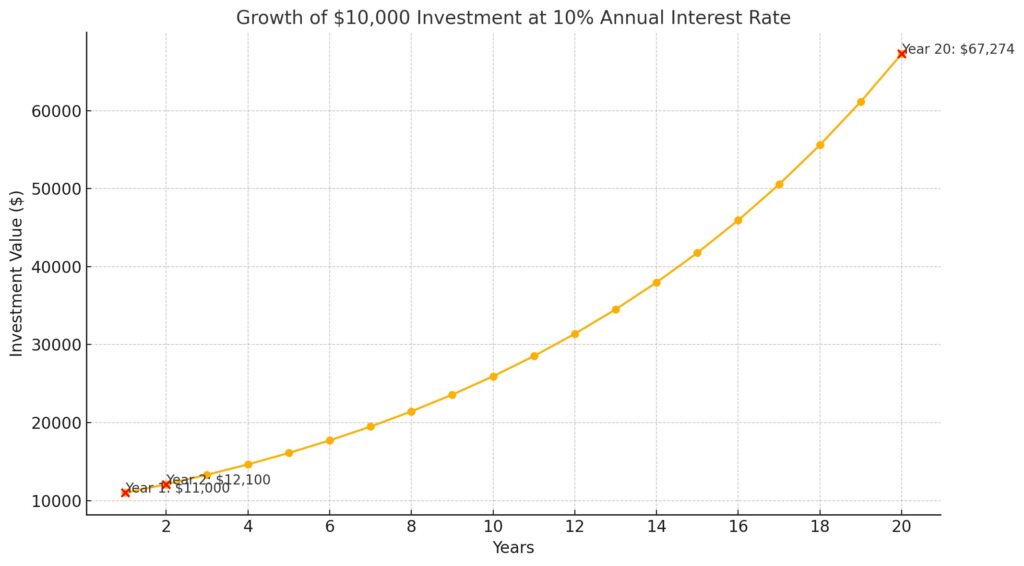
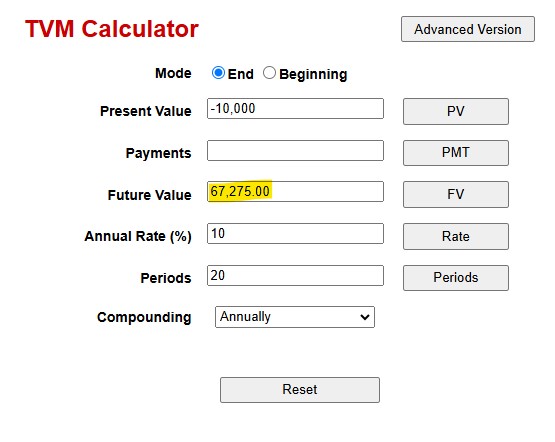
If you invest $10,000 at an average annual return of 10%, it can grow to over $67,000 in 20 years. This growth far exceeds what a regular savings account would offer.
2. Protecting Against Inflation Inflation gradually decreases the purchasing power of money. By investing in assets with higher returns than inflation, you preserve and increase your real wealth. For instance:
If inflation averages 3% annually, a $100 item today will cost approximately $180 in 20 years. Investments in stocks or real estate can help your money keep pace with or surpass inflation.
3. Achieving Financial Goals Investing is a strategic way to reach significant milestones like:
Set Clear Goals Define what you’re investing for—retirement, education, or wealth building—and tailor your strategy accordingly.
Determine Your Risk Tolerance Understand your comfort level with risk. Stocks are riskier but offer higher returns, while bonds and savings accounts are safer but yield lower returns.
Start Small and Be Consistent
Begin with what you can afford. Many brokerage firms allow you to start with as little as $1.
Spread your investments across different asset classes to reduce risk.
The saying, “Don’t put all your eggs in one basket,” applies strongly in investing.
Consult a Financial Advisor If you’re unsure where to start, seek professional advice to create a personalized investment plan.
Overcoming Common Misconceptions
“I need a lot of money to start.” Many brokerage firms allow you to begin investing with minimal amounts.
“Investing is too risky.” Risk varies by asset class. Balancing high-risk investments (stocks) with safer options (bonds) can align with your comfort level.
“I don’t know enough.” Financial literacy tools, seminar/courses, and advisors are available to help you gain confidence.
Key Takeaways
Investing is not just for the wealthy or financially savvy—it’s for anyone with a desire to grow their wealth and secure their future. Here’s why you should start now:
Time is your greatest ally in investing.
Small, consistent contributions lead to significant long-term gains.
Diversifying and understanding your goals reduce risks and improve results.
Remember, investing is like planting a tree: the sooner you plant it, the sooner it bears fruit. Start today and take control of your financial future.
Your Mantra for Success: Save Consistently. Invest Smartly. Retire Richly.
Legal Disclaimer for Build Wealth Retire Rich Blog/Website
The information provided on the “Build Wealth Retire Rich” blog/website is for educational purposes only and should not be construed as financial, investment, or legal advice. While every effort is made to ensure the accuracy and reliability of the information presented, Build Wealth Retire Rich and its contributors, including AI tools used in the creation of some content, do not guarantee its completeness or timeliness. Users are encouraged to consult with a qualified financial advisor or legal professional to discuss their specific financial situation and to obtain advice tailored to their individual circumstances.
Build Wealth Retire Rich is not responsible for any decisions made based on the information provided on this website. All financial products, investment strategies, and other content discussed are presented for informational purposes only, and no guarantees are made regarding the performance or suitability of any particular investment or strategy.
The views and opinions expressed on “Build Wealth Retire Rich” are those of the authors and do not necessarily reflect the views of the website’s owner or any affiliated institutions. “Build Wealth Retire Rich” does not endorse or promote any particular investment, financial product, or institution unless explicitly stated.
Risk Disclosure: Investing involves risk, including the potential loss of principal. Past performance is not indicative of future results. Always do your own research and consider your financial goals and risk tolerance before making any financial decisions.
By using this website, you agree that Build Wealth Retire Rich and its affiliates are not liable for any losses or damages incurred as a result of using the information provided. Users are solely responsible for their financial decisions and should seek independent advice when necessary.
A Health Savings Account (HSA) is a tax-advantaged savings account designed to help individuals with high-deductible health plans (HDHPs) save for qualified medical expenses. HSAs provide a unique combination of flexibility, growth potential, and tax benefits that make them one of the most powerful tools in personal finance. Here are the three primary tax advantages HSAs offer:
Tax-Deductible Contributions: Contributions to an HSA are either made pre-tax through payroll deductions or can be deducted from your taxable income when filing your tax return.
Tax-Free Growth: The funds in an HSA can grow tax-free if invested in options like mutual funds or ETFs, depending on the provider.
Tax-Free Withdrawals: Withdrawals from an HSA are tax-free when used for qualified medical expenses, such as doctor visits, prescriptions, and certain over-the-counter items.
Key Features of HSAs
Portability: Your HSA is yours to keep, even if you change jobs, switch health plans, or retire. This makes it a flexible savings vehicle.
Rollovers: Unlike Flexible Spending Accounts (FSAs), unused HSA funds roll over year after year, allowing you to build a substantial balance over time.
No Use-It-or-Lose-It Rule: You can save your HSA funds indefinitely for future medical expenses or use them as supplemental retirement savings.
Investment Options: Many HSA providers offer investment opportunities, such as stocks, bonds, and mutual funds, which can help your savings grow over time.
Eligibility Requirements
To open and contribute to an HSA, you must meet the following criteria:
Enrollment in an HDHP: You must be covered under a high-deductible health plan.
No Other Health Coverage: You cannot be covered by another health plan that isn’t an HDHP.
Not Enrolled in Medicare: Once you enroll in Medicare, you can no longer contribute to an HSA, but you can still use the funds.
No Dependents on Another’s Tax Return: You cannot be claimed as a dependent on someone else’s tax return.
Maximize Your Health Savings Account (HSA): Don’t Let Your Cash Sit Idle
Health Savings Accounts (HSAs) are one of the most underutilized tools for building financial security, yet they hold incredible potential. Designed to help individuals with high-deductible health plans (HDHPs), HSAs offer a triple tax advantage: tax-deductible contributions, tax-free growth, and tax-free withdrawals for qualified medical expenses. However, many people miss out on maximizing these benefits.
The Problem: Cash-Heavy HSAs
Despite the perks, 87% of HSA account holders keep their balances in cash, according to data from the Employee Benefit Research Institute. This means that only 13% of account holders are taking advantage of investment options available through HSAs. While holding cash provides safety and immediate liquidity, it also means missing out on the power of compound growth, which could significantly enhance your financial health over time.
Why Do People Leave Cash in Their HSAs?
There are several reasons why people choose not to invest their HSA funds:
Lack of Awareness: Many account holders don’t realize that their HSA can function like an investment account.
Fear of Market Volatility: Concerns about losing money in the stock market lead some to stick with cash.
Immediate Medical Expenses: Some prefer cash for quick access to pay for current healthcare costs.
Provider Restrictions: Some HSA providers require account holders to maintain a minimum cash balance—typically $1,000 to $2,000—before investing.
Why Investing Your HSA Matters
Investing your HSA funds can help you leverage the account’s tax advantages to build a significant nest egg for future healthcare expenses and even retirement. Here’s why investing makes sense:
Tax-Free Growth: When you invest your HSA funds, any earnings, such as dividends and capital gains, grow tax-free.
Long-Term Healthcare Costs: Healthcare expenses tend to increase with age, and having a larger HSA balance can provide peace of mind.
Retirement Benefits: At age 65, HSA funds can be withdrawn for any purpose without penalty (though non-medical withdrawals will be taxed as ordinary income). This makes it a valuable supplemental retirement savings tool.
How to Start Investing Your HSA Funds
Check Your Provider’s Investment Options: Many HSA providers offer mutual funds, ETFs, or other investment options. Review what’s available.
Meet the Minimum Cash Balance: Ensure you maintain any required minimum balance in cash.
Choose a Diversified Portfolio: Select investments based on your risk tolerance and long-term goals.
Contribute Regularly: Maximize your annual HSA contributions to take full advantage of the tax benefits.
Pay Out-of-Pocket for Current Expenses: If possible, pay for current medical expenses with other funds to allow your HSA investments to grow.
Practical Example: The Power of Investing
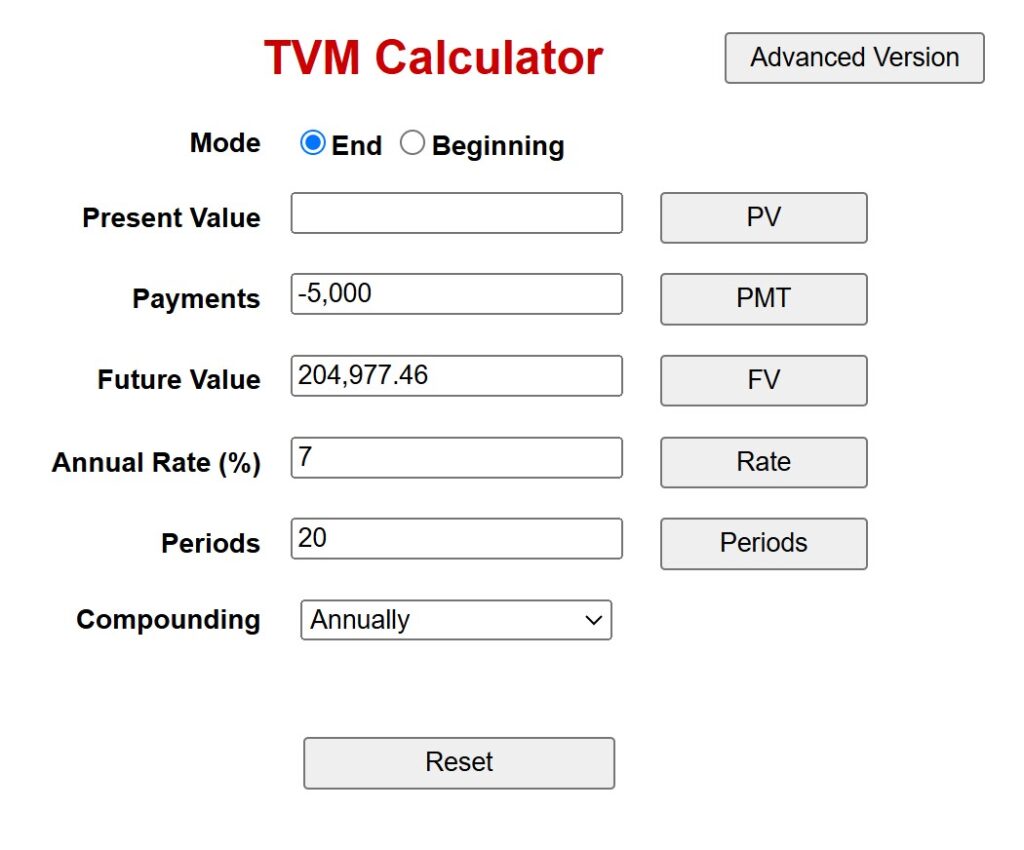
Consider this scenario: You contribute $5,000 annually to your HSA and invest the funds in a diversified portfolio earning an average of 7% annually. After 20 years, your HSA balance could grow to about $205,000, assuming no withdrawals. In contrast, if you keep the funds in cash with no growth, your balance would be limited to the total contributions of $100,000.
Don’t let your HSA’s potential go untapped. While it’s important to keep some funds liquid for immediate needs, investing the excess can transform your HSA into a powerful wealth-building tool. Consult with a financial advisor to create a strategy that aligns with your healthcare and retirement goals.
By taking a proactive approach, you can turn your HSA into more than just a savings account—it can become a cornerstone of your long-term financial security.
Your Mantra for Success: Save Consistently. Invest Smartly. Retire Richly.
Legal Disclaimer for Build Wealth Retire Rich Blog/Website
The information provided on the “Build Wealth Retire Rich” blog/website is for educational purposes only and should not be construed as financial, investment, or legal advice. While every effort is made to ensure the accuracy and reliability of the information presented, Build Wealth Retire Rich and its contributors, including AI tools used in the creation of some content, do not guarantee its completeness or timeliness. Users are encouraged to consult with a qualified financial advisor or legal professional to discuss their specific financial situation and to obtain advice tailored to their individual circumstances.
Build Wealth Retire Rich is not responsible for any decisions made based on the information provided on this website. All financial products, investment strategies, and other content discussed are presented for informational purposes only, and no guarantees are made regarding the performance or suitability of any particular investment or strategy.
The views and opinions expressed on “Build Wealth Retire Rich” are those of the authors and do not necessarily reflect the views of the website’s owner or any affiliated institutions. “Build Wealth Retire Rich” does not endorse or promote any particular investment, financial product, or institution unless explicitly stated.
Risk Disclosure: Investing involves risk, including the potential loss of principal. Past performance is not indicative of future results. Always do your own research and consider your financial goals and risk tolerance before making any financial decisions.
By using this website, you agree that Build Wealth Retire Rich and its affiliates are not liable for any losses or damages incurred as a result of using the information provided. Users are solely responsible for their financial decisions and should seek independent advice when necessary.
A 529 college savings plan is one of the most effective tools available to families planning for the ever-increasing costs of education. This tax-advantaged plan not only helps you save but also provides multiple strategies to make your funds work smarter for you. Let’s explore the full potential of 529 plans, from harnessing compound interest to mitigating overfunding concerns through SECURE 2.0 provisions.
What Is a 529 College Savings Plan?
A 529 college savings plan is a state-sponsored investment account designed to encourage saving for educational expenses. It comes with these key advantages:
Tax-Free Growth: Your investments grow tax-free, and withdrawals for qualified expenses are tax-exempt.
Qualified Expenses: Funds can be used for tuition, fees, books, supplies, room and board, and even certain tech tools like laptops.
State Tax Benefits: Many states offer tax deductions or credits for contributions, boosting your savings further.
Ownership and Control: Unlike custodial accounts, the account owner retains control of the funds, even if the beneficiary decides not to attend college.
The account’s flexibility and tax advantages make it a cornerstone of education funding for millions of families.
The Magic of Compound Interest
Starting early is the secret weapon in education savings. Compound interest—the process of earning returns on both your initial investment and the returns it generates—can make a significant difference over time.
Stocks have historically outperformed bonds in terms of returns, making them a strong choice for long-term growth. However, managing risk is essential. The S&P 500 has delivered an average annual return of approximately 7% to 8% after adjusting for inflation.
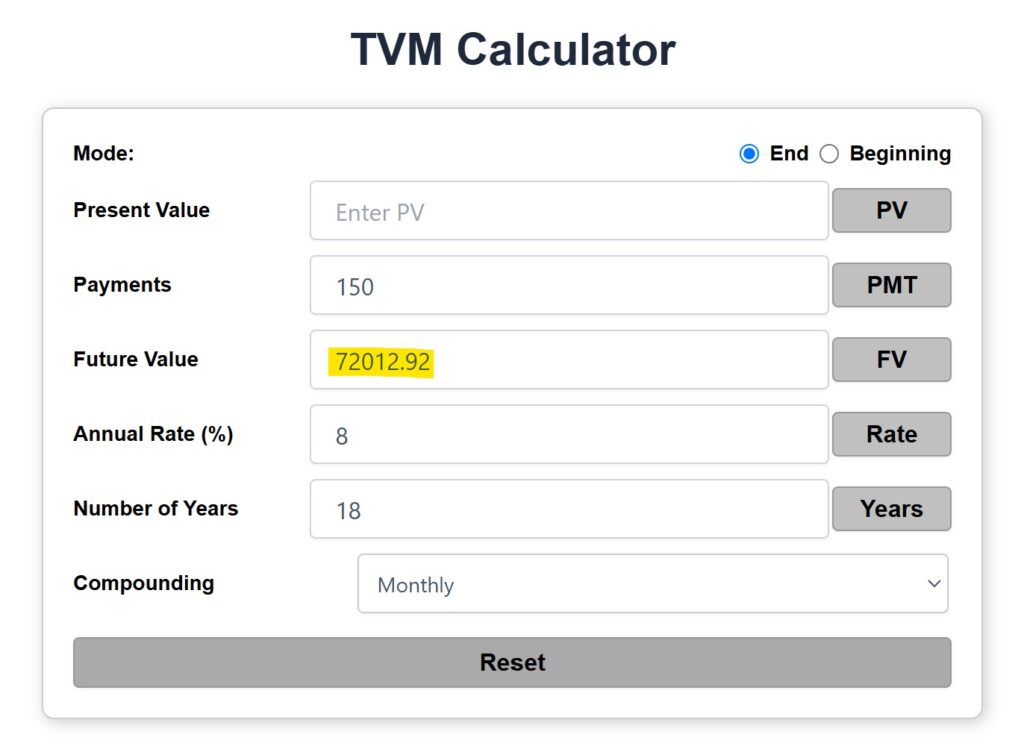
Example: Imagine you start investing $150 a month into a 529 plan when your child is born. Assuming a 8% average annual return:
At age 18, the account reaches approximately $72,000, with approximately $40,000 in earnings.
This example illustrates how small, consistent contributions, combined with time, can lead to substantial savings.
SECURE 2.0 Act: Addressing Overfunding Concerns
One common question parents ask is: What if I save too much? Previously, overfunding a 529 plan could lead to taxes and penalties on unused funds. However, the SECURE 2.0 Act introduced a groundbreaking provision to ease this worry.
529 to Roth IRA Rollovers Starting in 2024, parents can roll over unused 529 funds into a Roth IRA for the beneficiary under these conditions:
15-Year Rule: The 529 account must have been open for at least 15 years.
Recent Contributions Ineligible: Contributions made in the past five years (and their earnings) cannot be rolled over.
Lifetime Cap: A maximum of $35,000 can be rolled over per beneficiary.
Annual Contribution Limits Apply: Rollovers count toward the annual Roth IRA contribution limit (The IRA contribution limits for 2024 are $7,000 for those under 50 and $8,000 for those 50 or older.)
Beneficiary Must Have Income: The beneficiary must have earned income during the rollover year.
No Roth Income Limits: Income restrictions for regular Roth contributions don’t apply to these rollovers.
These rollovers provide an excellent safety net, ensuring excess funds can still contribute to the beneficiary’s long-term financial well-being without penalties.
Example: Transferring Funds from a 529 Plan to a Roth IRA Under SECURE 2.0
Let’s take a practical example to understand how the SECURE 2.0 provisions work for rolling over unused 529 funds into a Roth IRA.
Scenario
Sarah and John started a 529 plan for their daughter, Emily, when she was born. Over the years, they contributed regularly, and the account now has $45,000. Emily received a full scholarship to college, leaving $20,000 unused in the 529 plan after covering all education expenses. Sarah and John want to avoid penalties and taxes on the unused funds.
Step-by-Step Application of SECURE 2.0
Account Age Verification:
The 529 plan has been open for 18 years, meeting the 15-year requirement.
Eligible Funds:
Sarah and John contributed $3,000 in the past five years. Assuming these contributions generated $500 in earnings, this $3,500 (contributions + earnings) is excluded from the rollover.
Eligible Amount:
$20,000 (total unused funds) – $3,500 (ineligible recent contributions and their earnings) = $16,500 potentially eligible for rollover.
Lifetime Cap:
The maximum lifetime amount that can be rolled over to a Roth IRA is $35,000. Since Emily’s eligible funds are below this cap, the entire $16,500 can be considered.
Annual Contribution Limit:
Roth IRA contributions are subject to the annual limit ($7,000 in 2024 for those under age 50).
Sarah and John decide to roll over $7,000 in the first year and plan to roll over the remaining $9,500 in subsequent years, subject to the annual limits.
Earned Income Requirement:
Emily has a part-time job earning $12,000 per year, satisfying the earned income requirement.
Roth IRA Income Limits:
Roth income limits do not apply to this rollover, so Emily qualifies regardless of her income level.
Outcome
In Year 1, Sarah and John roll over $7,000 to Emily’s Roth IRA. The remaining $9,500 will be rolled over in future years until the entire eligible amount is transferred.
Emily now has a jumpstart on her retirement savings, with the funds benefiting from decades of tax-free growth.
No penalties or taxes are incurred, and the 529 funds are repurposed effectively.
Key Benefits
The unused 529 funds support Emily’s retirement, turning what could have been a financial penalty into a long-term wealth-building opportunity.
By starting early, Emily gains the advantage of compound interest in her Roth IRA. Example: If the $16,500 grows at an average annual return of 7% for 40 years, it could grow to over $247,000, entirely tax-free!
This example illustrates how the SECURE 2.0 provisions make 529 plans even more flexible, ensuring that every dollar saved can be utilized meaningfully.
Flexibility for Families
529 plans offer unparalleled flexibility, allowing families to adapt to changing circumstances:
Multiple Beneficiaries: Funds can be transferred to siblings, cousins, or other eligible family members if one child doesn’t use the money.
K-12 Education: Some states allow 529 funds to be used for private K-12 tuition (up to $10,000 per year).
Student Loan Repayment: Up to $10,000 can be used to repay student loans for the beneficiary or their siblings.
Apprenticeship Programs: Funds can also cover expenses for qualified apprenticeship programs, making 529 plans viable for non-college career paths.
Maximizing Your 529 Savings
To get the most out of your 529 plan:
Start Early: Time is your ally. The earlier you begin, the more you benefit from compound interest.
Make Consistent Contributions: Even modest amounts can add up significantly over 18 years.
Take Advantage of State Tax Benefits: Research whether your state offers tax incentives for contributions.
Reassess Investment Options: As your child nears college age, consider shifting to more conservative investments to protect your savings.
Monitor Costs: Understand the costs associated with your 529 plan, such as management fees, which can affect long-term growth.
Considerations Beyond Education
While 529 plans are tailored for education savings, their versatility can also complement long-term financial goals:
Retirement Savings: With SECURE 2.0, unused funds can support retirement through Roth IRA rollovers.
Generational Wealth: These plans can be passed down, ensuring future generations benefit from your savings.
The Bottom Line
A 529 college savings plan is a smart, tax-efficient way to save for education while leveraging the power of compound interest. The SECURE 2.0 Act further enhances the appeal of these plans, providing a safety net for unused funds. Whether you’re starting early or catching up, a 529 plan can be a cornerstone of your family’s financial strategy.
Start today to secure your child’s future and take advantage of the peace of mind these plans offer. If you’re unsure how to get started, consult a financial advisor to develop a plan tailored to your needs.
Your Mantra for Success: Save Consistently. Invest Smartly. Retire Richly.
Legal Disclaimer for Build Wealth Retire Rich Blog/Website
The information provided on the “Build Wealth Retire Rich” blog/website is for educational purposes only and should not be construed as financial, investment, or legal advice. While every effort is made to ensure the accuracy and reliability of the information presented, Build Wealth Retire Rich and its contributors, including AI tools used in the creation of some content, do not guarantee its completeness or timeliness. Users are encouraged to consult with a qualified financial advisor or legal professional to discuss their specific financial situation and to obtain advice tailored to their individual circumstances.
Build Wealth Retire Rich is not responsible for any decisions made based on the information provided on this website. All financial products, investment strategies, and other content discussed are presented for informational purposes only, and no guarantees are made regarding the performance or suitability of any particular investment or strategy.
The views and opinions expressed on “Build Wealth Retire Rich” are those of the authors and do not necessarily reflect the views of the website’s owner or any affiliated institutions. “Build Wealth Retire Rich” does not endorse or promote any particular investment, financial product, or institution unless explicitly stated.
Risk Disclosure: Investing involves risk, including the potential loss of principal. Past performance is not indicative of future results. Always do your own research and consider your financial goals and risk tolerance before making any financial decisions.
By using this website, you agree that Build Wealth Retire Rich and its affiliates are not liable for any losses or damages incurred as a result of using the information provided. Users are solely responsible for their financial decisions and should seek independent advice when necessary.
Planning for retirement is one of the most critical steps in achieving long-term financial security. With so many options available, finding the right retirement plan can feel overwhelming. At Build Wealth, Retire Rich, we believe that understanding your choices is the first step toward a prosperous future. Here, we break down the most common retirement plans and accounts to help you make informed decisions.
Understanding Retirement Plans
Retirement plans fall into two primary categories: employer-sponsored plans and individual accounts. Depending on your employment status and financial goals, certain plans might be better suited for you. Let’s explore the key options.
Employer-Sponsored Retirement Plans
1. 401(k) Plans
A 401(k) is the most common employer-sponsored retirement plan.
Tax Advantages: Contributions are pre-tax, lowering your current taxable income. Your savings grow tax-deferred until withdrawal.
Employer Matching: Many employers offer matching contributions—essentially free money for your retirement.
High Contribution Limits: In 2024, you can contribute up to $23,000, with an additional $7,500 if you’re 50 or older.
Ease of Use: Automatic payroll deductions make saving effortless.
Example of Tax Savings in a 401(k)
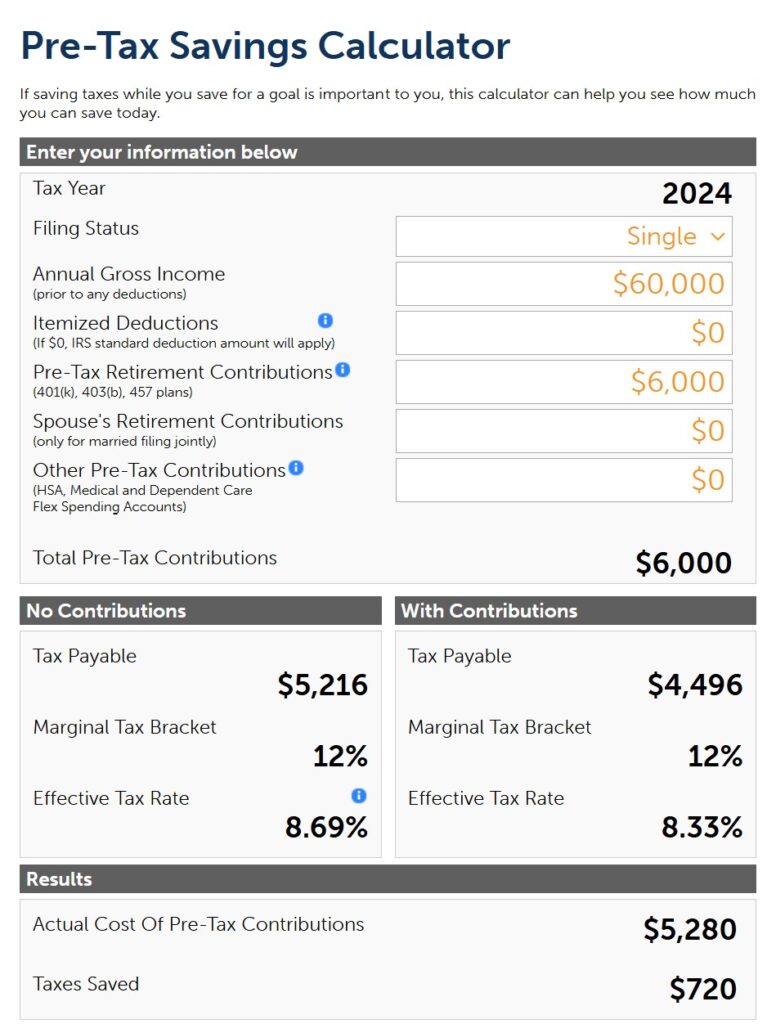
Let’s say you are single and your annual salary is $60,000, and you contribute 10% of your salary ($6,000) to your 401(k). Here’s how it affects your taxes:
Before Contribution: Your taxable income is $60,000.
After Contribution: Your taxable income is reduced to $54,000 ($60,000 – $6,000).
Tax Savings: In 2024, you will save $720 in federal taxes.
By contributing to a 401(k), you’re not only saving for retirement but also reducing your current tax liability—a win-win situation!
Example of Employer Matching
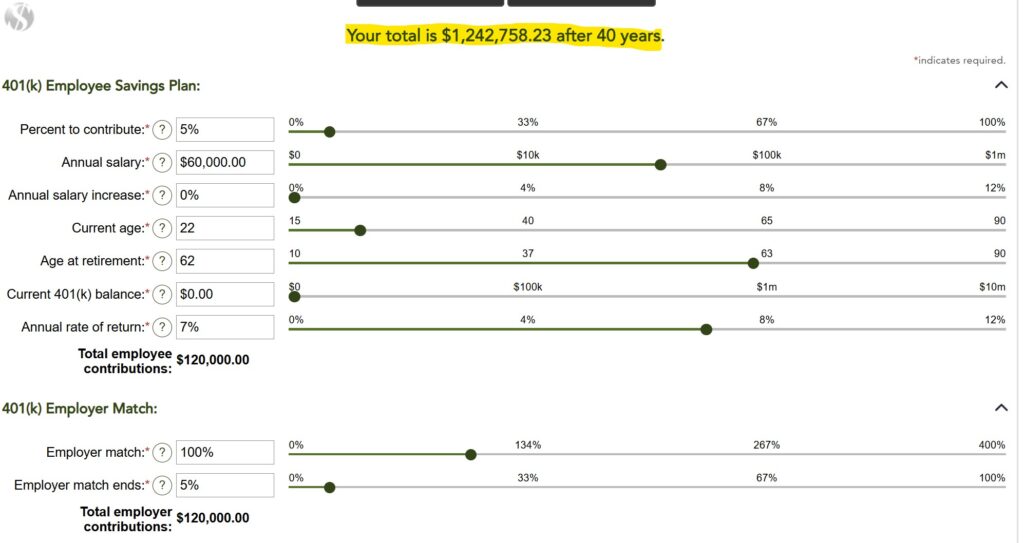
Imagine you earn $60,000 annually and your employer offers a 100% match on the first 5% of your salary you contribute to the 401(k). Here’s what happens:
Imagine you earn $60,000 annually and your employer offers a 100% match on the first 5% of your salary you contribute to the 401(k). Over 40 years, with an assumed annual return of 7%, your retirement savings would grow to over $1,200,000 if his employer matches 100% of his contributions. Without the employer match, his total savings would be $621,379.12
With the employer match, your contribution is effectively doubled. Over time, this additional contribution can significantly boost your retirement savings, especially when combined with compound growth.
2. 403(b) Plans
Designed for nonprofit and public sector employees, 403(b) plans share many similarities with 401(k)s.
Unique Perks: Some plans offer a 15-year service catch-up provision for long-term employees.
Flexibility: You can often contribute to both a 403(b) and a 457(b) plan simultaneously, boosting your savings potential.
3. Thrift Savings Plan (TSP)
Available to federal employees and military personnel, the TSP is one of the most cost-effective retirement plans.
Employer Matching: Federal employees receive a 5% match on their contributions.
Low Fees: The TSP is known for its low administrative costs, leaving more money in your account.
4. 457(b) Plans
Ideal for state and local government employees, 457(b) plans offer unique benefits.
No Early Withdrawal Penalty: You can withdraw funds without penalties before age 59½ if you separate from service.
Additional Savings: Contributions can be made alongside a 403(b) or 401(k) plan.
Plans for Small Businesses and Self-Employed Individuals
5. SIMPLE IRA
Perfect for small businesses with 100 or fewer employees.
Tax Advantages: Contributions reduce taxable income and grow tax-deferred.
Employer Contributions: Employers can match up to 3% of employee compensation or provide a 2% non-elective contribution.
Contribution Limits: $16,000 for 2024, with a $3,500 catch-up contribution for those 50+.
6. SEP IRA
A Simplified Employee Pension (SEP) IRA is ideal for self-employed individuals and small businesses.
Flexible Contributions: Employers can decide how much to contribute each year.
High Limits: Contributions can reach up to $69,000 in 2024, depending on income.
7. Solo 401(k)
Tailored for self-employed individuals, Solo 401(k)s offer high contribution limits.
Dual Contributions: You can contribute as both employee and employer, maximizing your retirement savings.
Limits: Up to $69,000 in 2024, or $76,500 if you’re 50 or older.
Individual Retirement Accounts (IRAs)
Traditional IRA
Tax Deductibility: Contributions may be tax-deductible, depending on your income.
Growth: Funds grow tax-deferred until withdrawal.
Roth IRA
Tax-Free Withdrawals: Contributions are post-tax, but withdrawals in retirement are tax-free.
Flexibility: Contributions can be withdrawn anytime without penalties.
Other Savings Tools
Health Savings Accounts (HSAs)
Triple Tax Advantage: Contributions are pre-tax, growth is tax-deferred, and withdrawals for qualified expenses are tax-free.
Brokerage Accounts
Unlimited Contributions: Invest as much as you want with no income restrictions.
Tax Efficiency: Long-term gains are taxed at lower rates than regular income.
Tips for Choosing the Right Plan
Leverage Employer Matching: Always contribute enough to receive your employer’s full match.
Start Early: Time is your greatest asset. The earlier you save, the more your money can grow.
Diversify: Consider using multiple accounts, such as a 401(k) and an IRA, to maximize tax benefits.
Plan for Taxes: Roth accounts offer tax-free withdrawals, providing flexibility in retirement.
Final Thoughts
Retirement planning is a journey, not a sprint. By understanding your options and taking advantage of the right tools, you can build wealth and retire rich. At Build Wealth, Retire Rich, we’re here to guide you every step of the way. Start today—your future self will thank you!
Legal Disclaimer for Build Wealth Retire Rich Blog/Website
The information provided on the “Build Wealth Retire Rich” blog/website is for educational purposes only and should not be construed as financial, investment, or legal advice. While every effort is made to ensure the accuracy and reliability of the information presented, Build Wealth Retire Rich and its contributors, including AI tools used in the creation of some content, do not guarantee its completeness or timeliness. Users are encouraged to consult with a qualified financial advisor or legal professional to discuss their specific financial situation and to obtain advice tailored to their individual circumstances.
Build Wealth Retire Rich is not responsible for any decisions made based on the information provided on this website. All financial products, investment strategies, and other content discussed are presented for informational purposes only, and no guarantees are made regarding the performance or suitability of any particular investment or strategy.
The views and opinions expressed on “Build Wealth Retire Rich” are those of the authors and do not necessarily reflect the views of the website’s owner or any affiliated institutions. “Build Wealth Retire Rich” does not endorse or promote any particular investment, financial product, or institution unless explicitly stated.
Risk Disclosure: Investing involves risk, including the potential loss of principal. Past performance is not indicative of future results. Always do your own research and consider your financial goals and risk tolerance before making any financial decisions.
By using this website, you agree that Build Wealth Retire Rich and its affiliates are not liable for any losses or damages incurred as a result of using the information provided. Users are solely responsible for their financial decisions and should seek independent advice when necessary.
Social Security is one of the most critical safety nets in the United States, providing financial assistance to millions of Americans. While it is often associated with retirement, it offers a broad range of benefits, including disability, survivor, and dependent benefits. This blog will walk you through the essential aspects of Social Security, from eligibility requirements to various benefit types. By the end, you’ll have a solid understanding of how Social Security works and what it means for you and your family.
What is Social Security?
Social Security is a federal program designed to provide financial assistance to retirees, disabled individuals, and families of deceased workers. Funded by payroll taxes, the program ensures a basic level of income for individuals who meet specific work and earning requirements.
Social Security benefits are typically categorized into the following:
Retirement Benefits
Disability Benefits
Survivor Benefits
Dependent Benefits
Who Qualifies for Social Security?
Eligibility for Social Security depends on a worker’s employment history and earnings. Workers earn Social Security credits based on their annual income. In 2024, a worker receives 1 credit for every $1,730 earned, up to a maximum of 4 credits per year. A worker is fully insured for life once they accumulate 40 credits. However, different benefits have additional requirements, particularly for younger workers or those who become disabled.
Understanding the Benefits:
Retirement Benefits:Social Security retirement benefits are the most well-known type of benefit. A fully insured worker can start receiving these benefits as early as age 62. However, opting for early retirement will result in reduced benefits. Full retirement age (FRA) varies depending on your birth year, typically ranging between 66 and 67. Waiting until the full retirement age, or even delaying benefits until age 70, results in a higher monthly payment.
Example: John, a 67-year-old retiree, worked consistently throughout his life and accumulated 40 credits by the time he turned 40. He is now eligible for full Social Security retirement benefits based on his average indexed monthly earnings.
Spousal Benefits:Spousal benefits provide support to spouses who may not have earned enough credits on their own. The spousal benefit can be up to 50% of the primary worker’s benefit amount if the spouse claims it at full retirement age. Spouses can also be eligible for benefits if they care for a minor or disabled child.
Example: Sarah, John’s wife, never worked outside the home. When John claims his retirement benefits, Sarah is eligible for 50% of his benefit amount, provided she waits until her FRA.
Survivor Benefits:Survivor benefits support the family members of deceased workers who were fully or currently insured. These benefits can be paid to the deceased worker’s spouse, minor children, or even dependent parents.
Widow/Widower Benefit: A surviving spouse aged 60 or older can receive survivor benefits based on the deceased worker’s earnings.
Widow/Widower Caring for a Minor Child: A spouse caring for a dependent child under age 16 is eligible for benefits regardless of age.
Example: Mark passed away at age 58. His wife, Julie, who is now 62, can claim survivor benefits. If she had been caring for their 12-year-old son when Mark passed, she could have started receiving benefits immediately.
Disability Benefits:Disability benefits are designed to assist workers who are severely impaired and unable to perform any substantial gainful activity. To qualify, the worker must have accumulated sufficient credits based on their age and must meet the recent work test. For workers over age 31, at least 20 of the most recent 40 credits (10 years) must have been earned prior to becoming disabled.
Example: Anna, a 42-year-old nurse, became disabled due to a severe car accident. Since she worked consistently for the past 10 years and earned more than 20 credits, she qualifies for Social Security Disability Insurance (SSDI).
Dependent Child Benefits:If a fully insured worker has dependent children, those children may be eligible for benefits. The dependent benefit is typically up to 50% of the parent’s full retirement or disability benefit and continues until the child turns 18 or 19 (if still in high school).
Example: David, a retired engineer, receives Social Security benefits. His 15-year-old daughter, Emily, is eligible for a monthly dependent benefit until she graduates high school.
Dependent Parent Benefit:A less commonly known benefit, the dependent parent benefit is available when a fully insured worker has passed away, leaving a parent who was financially dependent. To qualify, the parent must be 62 or older and must have received at least half of their support from the deceased worker.
Example: Nancy passed away at age 55, leaving behind her 65-year-old mother, Carol. Because Carol was financially dependent on Nancy, she qualifies for the dependent parent benefit.
Lump-Sum Death Benefit:When a fully insured worker dies, a one-time lump-sum death benefit of $255 may be paid to the surviving spouse or child. While this amount is relatively small, it can help with immediate expenses following the worker’s death.
Example: Tom, who was fully insured, passed away at age 64. His wife, Susan, received a one-time death benefit of $255 to help cover immediate expenses.
Key Takeaways:
Understanding Your Insured Status: Being fully insured means you have earned at least 40 credits. This status qualifies you for a range of benefits, including retirement, spousal, and dependent benefits.
Recent Work Test for Disability: If you become disabled, having 40 credits alone is not enough. You must also have recent work credits, especially if you are between ages 31 and 42.
Planning for Survivor Benefits: Survivor benefits can provide crucial support to family members after a worker’s death. Make sure your spouse and children understand what they are entitled to.
Maximizing Spousal Benefits: Spousal benefits can significantly increase a family’s retirement income. Understanding how to coordinate benefits can result in higher monthly payments.
Dependent Child and Parent Benefits: These lesser-known benefits can provide additional financial support for families with dependent children or elderly parents.
Social Security is a complex program, but understanding its key features and benefits can help you make informed decisions for yourself and your family. Whether you are planning for retirement, considering disability options, or thinking about how your family would fare in your absence, knowing your eligibility and options is crucial. Always consult with a financial professional or Social Security representative for personalized advice based on your specific situation.
Final Thought:
Understanding Social Security is not just about knowing when to claim retirement benefits. It’s about ensuring financial security for yourself and your loved ones throughout life’s many stages. Take time to review your Social Security Statement and speak with a financial planner to align your benefits with your overall financial goals.
Our Newsletter Can Help You Build Wealth and Retire Rich!
Sign up for our free newsletter!
Want actionable tips and expert advice to grow your wealth, save smarter, and retire comfortably? Sign up for the Build Wealth Retire Rich newsletter to receive weekly updates packed with personal finance strategies and insights—delivered straight to your inbox!
Thank you for subscribing to our newsletter. You are one step away from financial freedom.
By submitting your information, you`re giving us permission to email you. You may unsubscribe at any time.
Legal Disclaimer for Build Wealth Retire Rich Blog/Website
The information provided on the “Build Wealth Retire Rich” blog/website is for educational purposes only and should not be construed as financial, investment, or legal advice. While every effort is made to ensure the accuracy and reliability of the information presented, Build Wealth Retire Rich and its contributors, including AI tools used in the creation of some content, do not guarantee its completeness or timeliness. Users are encouraged to consult with a qualified financial advisor or legal professional to discuss their specific financial situation and to obtain advice tailored to their individual circumstances.
Build Wealth Retire Rich is not responsible for any decisions made based on the information provided on this website. All financial products, investment strategies, and other content discussed are presented for informational purposes only, and no guarantees are made regarding the performance or suitability of any particular investment or strategy.
The views and opinions expressed on “Build Wealth Retire Rich” are those of the authors and do not necessarily reflect the views of the website’s owner or any affiliated institutions. “Build Wealth Retire Rich” does not endorse or promote any particular investment, financial product, or institution unless explicitly stated.
Risk Disclosure: Investing involves risk, including the potential loss of principal. Past performance is not indicative of future results. Always do your own research and consider your financial goals and risk tolerance before making any financial decisions.
By using this website, you agree that Build Wealth Retire Rich and its affiliates are not liable for any losses or damages incurred as a result of using the information provided. Users are solely responsible for their financial decisions and should seek independent advice when necessary.