Title: What Is Simple Interest? — The Foundation of Financial Growth Meta Description: Learn how simple interest works, how to calculate it, and why it’s the first step toward understanding compound interest and long-term investing.
💡 Definition: What Is Simple Interest?
Simple interest is the most basic form of earning or paying interest. It’s calculated only on your original amount — the principal — not on the interest that builds up along the way.
When you deposit money in a savings account, a bank pays you interest for allowing them to use your funds. When you take a loan, you pay the lender interest for borrowing their money. In both cases, the simple interest formula stays the same:
🧮 Simple Interest = Principal × Rate × Time
This predictable structure makes simple interest a great starting point for understanding how money grows (or costs) over time.
📈 Example: How to Calculate Simple Interest
Let’s say you deposit $1,000 in a short-term savings product that pays 5% per year.
Year 1: 1,000 × 0.05 × 1 = $50
Year 2: Another $50
After 2 years: You’ve earned $100 total interest
Your final balance will be $1,100. Notice that the second year earns the same $50 because you’re not earning interest on the interest — only on the original $1,000.
Simple interest is straightforward: easy to calculate, easy to predict. That’s why it’s commonly used in short-term loans, car financing, and savings certificates.
🧠 Why Simple Interest Matters
Understanding simple interest gives you control and confidence over your money. It helps you:
Estimate returns on fixed-term deposits, CDs, and treasury bills.
Compare loans — to see how much total interest you’ll pay.
Build awareness for how your money grows (or your debt accumulates).
It also prepares you for the next step in wealth building: compound interest — where interest begins earning its own interest, creating exponential growth.
Knowing how simple interest works ensures you don’t get confused when comparing savings accounts or loan terms. It’s your first step in financial literacy.
🚀 How to Use Simple Interest in Real Life
For Saving: Choose short-term simple-interest products if you value predictability.
For Borrowing: Calculate total loan interest upfront — avoid surprises.
For Learning: Use simple interest examples to understand time, rate, and principal relationships before moving to compounding.
For Planning: If your goal is steady, guaranteed growth for a short period, simple interest is ideal.
💡 Money Tip: The more time your money is invested, the more important it becomes to switch from simple interest to compound interest to accelerate your growth.
🌱 Final Thought
Simple interest is the foundation of financial awareness. It teaches you how money grows in its most basic form — steady, transparent, and easy to calculate.
Once you master simple interest, the next step is learning how compound interest builds on it — turning simple growth into exponential wealth over time.
The Time Value of Money (TVM) is one of the most fundamental financial principles. It explains that money today is worth more than the same amount in the future due to its earning potential. Whether you’re saving for retirement, paying off a loan, or planning an investment, our TVM Calculator at Build Wealth Retire Rich makes complex financial calculations easy.
This guide walks you through how to use the calculator to make smarter financial decisions.
TVM Calculator
TVM Calculator
Key Features of the TVM Calculator
Our TVM Calculator is designed for ease of use and allows you to:
✔️ Select whether payments occur at the beginning or end of the period ✔️ Enter a Present Value (PV), Future Value (FV), or solve for either ✔️ Choose a payment frequency (weekly, monthly, annually, etc.) ✔️ Adjust for different compounding periods (annually, monthly, weekly, or daily) ✔️ Automatically compute results based on your inputs
Key Inputs
Present Value (PV): The starting amount of money (investment or loan).
Payment (PMT): The regular contribution or withdrawal per period.
Future Value (FV): The amount accumulated at the end of the given years.
Annual Interest Rate (%): The yearly rate of return or loan interest.
Periods (Number of Years): The total number of years for the investment or loan.
Compounding Frequency: Choose from annually, monthly, weekly, or daily.
Important:
If you deposit or invest money, enter PV and PMT as negative numbers because they represent cash outflows.
If you are taking out a loan, enter PV as a positive number since it represents borrowed money.
How to Use the TVM Calculator for Different Financial Goals
1. Calculate Future Value of an Investment
To find out how much your money will grow over time:
✔️ Enter Present Value (PV): Initial investment amount (negative value). ✔️ Enter Payment (PMT): Recurring contribution (negative value). ✔️ Enter Annual Interest Rate (%): Expected return. ✔️ Enter Periods (Number of Years): Duration of the investment. ✔️ Select Compounding Frequency: Choose how often interest compounds. ✔️ Click “Compute” next to FV to calculate your total future amount.
Example:
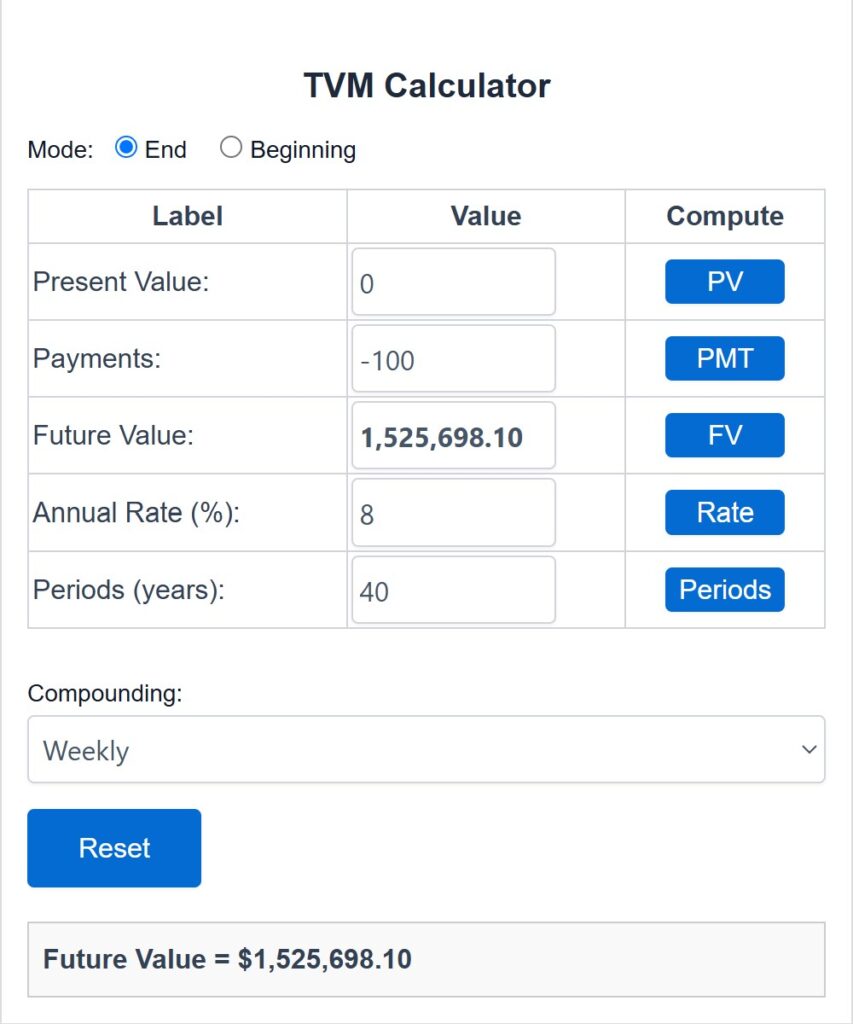
Investment: $100 a week
Annual Interest Rate: 8%
Years: 40
Compounded Weekly
Input:
PV: 0
Payments: -100 (if contributing $100 per week)
Annual Rate: 8
Period Years: 40
Compounding: Weekly
Output:Future Value (FV) = $1,525,698.10
2. Find Out How Much You Need to Save to Reach a Goal
✔️ Enter Future Value (FV): Your desired final amount. ✔️ Enter Present Value (PV): Any initial savings (negative value). ✔️ Enter Annual Interest Rate (I/Y): Expected return. ✔️ Enter Number of Years: Time until your goal. ✔️ Select Compounding Frequency: Choose compounding method. ✔️ Click “Compute” next to PMT to see how much you need to save per period.
Example:
Goal: $500,000
Annual Interest Rate: 7%
Periods (Years): 20
Compounded Monthly
Input:
Present Value: 0
Annual Rate (%): 7
Years: 20
Compounding: Monthly
Compute PMT
Output:
You need to save $959.83 per month
3. Calculate Loan or Mortgage Payments
✔️ Enter Present Value (PV): Loan amount (positive value). ✔️ Enter Annual Interest Rate (I/Y): Loan interest rate. ✔️ Enter Number of Years: Loan duration. ✔️ Select Compounding Frequency: Choose how often interest compounds. ✔️ Click “Compute” next to PMT to see required payment per period.
Example:
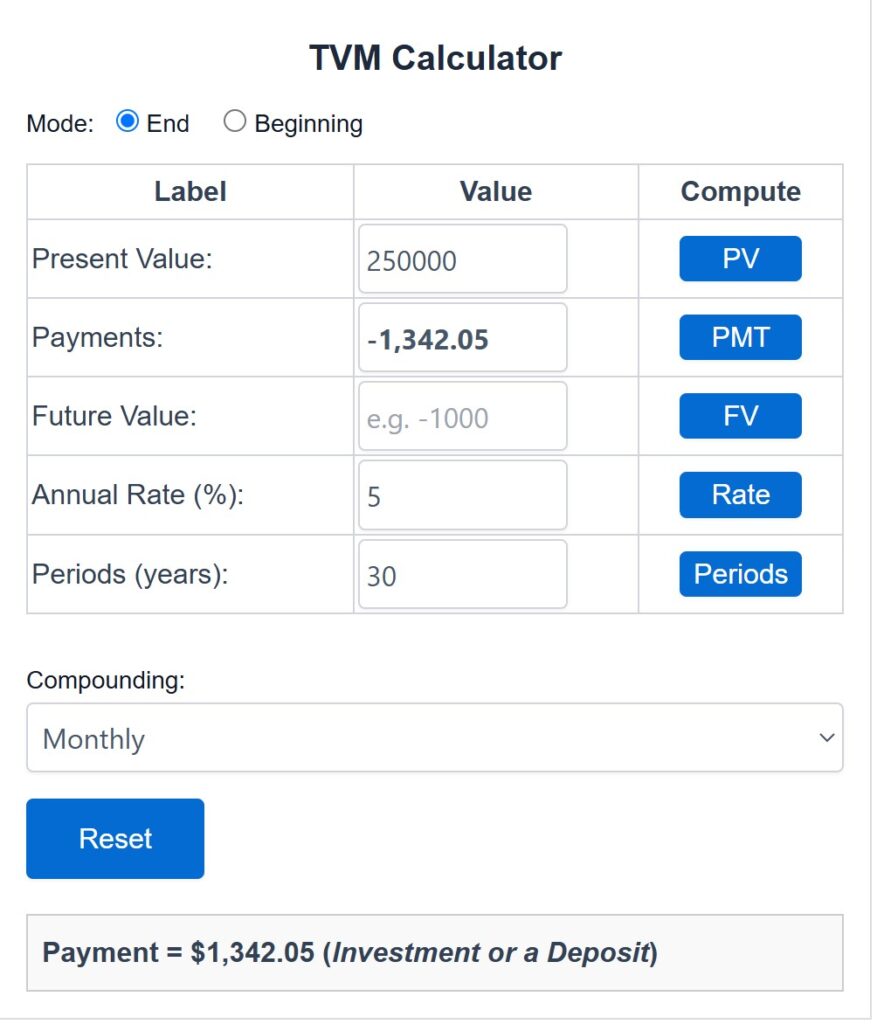
Loan Amount: $250,000
Annual Interest Rate: 5%
Years: 30
Compounded Monthly
Input:
Present Value: 250,000
Annual Rate (%): 5
Periods(Years: 30
Compounding: Monthly
Compute PMT
Output:
Monthly Payment (PMT) = $1,342.05 (Deposit)
Note: The negative sign means this is a payment (cash outflow).
Understanding Mode: End vs. Beginning Payments
The TVM Calculator allows you to choose whether payments occur at the beginning or end of each period.
✔️ End Mode: Most common setting, where payments are made at the end of each period. ✔️ Beginning Mode: Used for cases where payments are made at the start of each period (e.g., rent payments).
Example: If rent is due at the start of the month, use Beginning Mode; if payments are made after a service period, use End Mode.
Why Use This TVM Calculator?
✔️ Simple & Intuitive: Just enter values and hit “Compute”—no manual formulas required! ✔️ Multiple Payment & Compounding Options: Supports annual, monthly, weekly, and daily compounding. ✔️ Accurate Results: Ensures correct calculations without needing Excel or a financial calculator. ✔️ Works for Both Investments & Loans: Helps with retirement planning, wealth building, and debt management.
Start Planning Your Financial Future Today!
The TVM Calculator is an essential tool for financial success. Whether you’re investing, saving, or borrowing, mastering the Time Value of Money will help you maximize wealth and avoid costly financial mistakes.
When changing jobs or optimizing your retirement strategy, one crucial decision is how to move your retirement savings. Choosing the right rollover method can help you avoid tax penalties, maximize your investments, and keep your retirement funds growing.
But not all rollovers are created equal. Some methods trigger taxes, while others ensure a seamless transition. Let’s break down the three primary options:
Types of Retirement Account Rollovers
1️⃣ Indirect Rollover: Temporary Control but High Risk
An indirect rollover means the money from your retirement account is sent to you first before you redeposit it into another account. You have 60 days to complete the process—or you could face tax consequences and penalties.
⚠️ Important Considerations:
20% withholding: The IRS requires 20% of your withdrawal to be withheld for taxes (on pre-tax accounts).
You must replace the withheld amount: To roll over the full balance, you need to contribute the withheld portion from your own funds.
Taxable event if not completed: If you don’t deposit the full amount within 60 days, the IRS considers it a withdrawal, subject to income tax + a 10% early withdrawal penalty (if under age 59½).
One-per-year rule: The IRS limits indirect rollovers to one per 12-month period across all IRAs.
Example: If you withdraw $50,000, your plan withholds $10,000 (20%) for taxes. To complete the rollover, you must deposit the full $50,000 (including the missing $10,000) into a new account within 60 days. Otherwise, the IRS considers the $10,000 taxable income.
✅ Pros:
Provides temporary access to funds.
Offers flexibility to move funds between different retirement accounts.
❌ Cons:
Mandatory 20% tax withholding on pre-tax accounts.
Risk of penalties if the rollover isn’t completed within 60 days.
Limited to one indirect rollover per 12 months across all IRAs.
📌Best for: Those who need temporary access to funds, though it comes with significant risks.
2️⃣ Direct Rollover: The Smart & Safe Choice
A direct rollover is when funds move directly from your employer’s retirement plan (401(k), 403(b), 457) to another retirement plan or an IRA. The money never touches your hands, avoiding withholding and penalties.
✅ Why it’s a great choice: ✔️ No tax withholding or penalties ✔️ No risk of missing deadlines ✔️ No annual rollover limits
💡 How to do it: Contact your old plan administrator and request a direct rollover to your new retirement plan or IRA. You may receive a check, but it will be payable to the new plan—not you.
✅ Pros:
No tax withholding, keeping 100% of your funds invested.
No risk of penalties, since the money never passes through your hands.
No annual rollover limit, unlike indirect rollovers.
❌ Cons:
Less flexibility—you must ensure the new plan accepts rollovers.
Some employer plans may have restrictions on where you can roll over funds
📌 Best for: Employees rolling over a 401(k) to an IRA after leaving a job.
3️⃣ Trustee-to-Trustee Transfer: The Best for IRAs
A trustee-to-trustee transfer is the safest way to move funds between IRAs. Unlike rollovers, this method does not count toward the one-rollover-per-year rule.
✅ Why it’s the best method for IRA transfers: ✔️ No tax withholding or penalties ✔️ No 60-day deadline ✔️ No annual limits on transfers
💡 How to do it: Simply request your IRA provider to transfer your funds directly to your new IRA custodian. The money moves institution to institution without you handling it.
✅ Pros:
No tax withholding or penalties.
Unlimited transfers allowed (unlike rollovers).
Simple and fast—ideal for IRA-to-IRA movements.
❌ Cons:
Requires coordination between financial institutions.
Some institutions may charge transfer fees.
📌 Best for: Moving an IRA to another IRA for better investment options or lower fees.
Comparison: Which Rollover Method is Right for You?
Rollover Type
Best For
Tax Withholding?
Risk of Penalty?
Annual Limits?
Indirect Rollover
Temporary access to cash
✅ Yes (20%)
✅ Yes, if not redeposited in 60 days
✅ Yes (once per year)
Direct Rollover
Moving a 401(k) to an IRA
❌ No
❌ No
❌ No limits
Trustee-to-Trustee Transfer
Moving between IRAs
❌ No
❌ No
❌ No limits
Key Takeaways
✔️ For 401(k) rollovers, a direct rollover is the safest and most tax-efficient method. ✔️ For IRA transfers, opt for a trustee-to-trustee transfer to avoid unnecessary restrictions. ✔️ Indirect rollovers can be risky—use them only if you absolutely need short-term access to funds.
🚀 Take control of your retirement savings today! Before making a move, consult a financial advisor to ensure your rollover strategy aligns with your long-term goals.
Your Mantra for Success: Save Consistently. Invest Smartly. Retire Richly.
Legal Disclaimer for Build Wealth Retire Rich Blog/Website
The information provided on the “Build Wealth Retire Rich” blog/website is for educational purposes only and should not be construed as financial, investment, or legal advice. While every effort is made to ensure the accuracy and reliability of the information presented, Build Wealth Retire Rich and its contributors, including AI tools used in the creation of some content, do not guarantee its completeness or timeliness. Users are encouraged to consult with a qualified financial advisor or legal professional to discuss their specific financial situation and to obtain advice tailored to their individual circumstances.
Build Wealth Retire Rich is not responsible for any decisions made based on the information provided on this website. All financial products, investment strategies, and other content discussed are presented for informational purposes only, and no guarantees are made regarding the performance or suitability of any particular investment or strategy.
The views and opinions expressed on “Build Wealth Retire Rich” are those of the authors and do not necessarily reflect the views of the website’s owner or any affiliated institutions. “Build Wealth Retire Rich” does not endorse or promote any particular investment, financial product, or institution unless explicitly stated.
Risk Disclosure: Investing involves risk, including the potential loss of principal. Past performance is not indicative of future results. Always do your own research and consider your financial goals and risk tolerance before making any financial decisions.
By using this website, you agree that Build Wealth Retire Rich and its affiliates are not liable for any losses or damages incurred as a result of using the information provided. Users are solely responsible for their financial decisions and should seek independent advice when necessary.
When it comes to building wealth, compound interest is one of the most powerful tools available. Albert Einstein once called it the “eighth wonder of the world,” and for good reason—it can turn small, steady investments into a large amount of money over time. In this post, we’ll explain what compound interest is, how it works, and how you can use it to grow your wealth and secure your financial future.
What is Compound Interest?
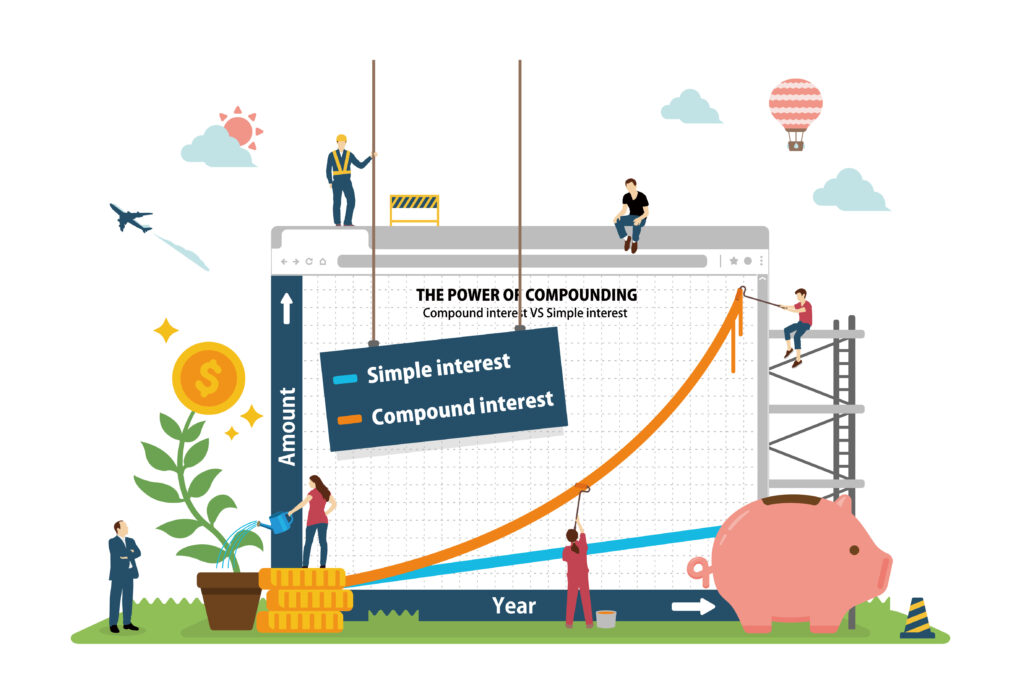
Compound interest means earning interest on your money and then earning interest on that interest. It’s different from simple interest, which only grows based on your original amount (called the principal).
How It Works
Imagine you put $1,000 in a savings account that earns 5% interest per year. At the end of the first year, you earn $50 in interest, so you now have $1,050. In the second year, you earn 5% on $1,050—not just $1,000—so your interest grows to $52.50. Over time, this snowball effect gets bigger and bigger.
Why Compound Interest is So Powerful
1. The Time Factor
Time is the single most important element in maximizing the effects of compound interest. The earlier you start saving or investing, the longer your money has to grow exponentially. Even modest contributions can turn into substantial sums over decades.
Example:
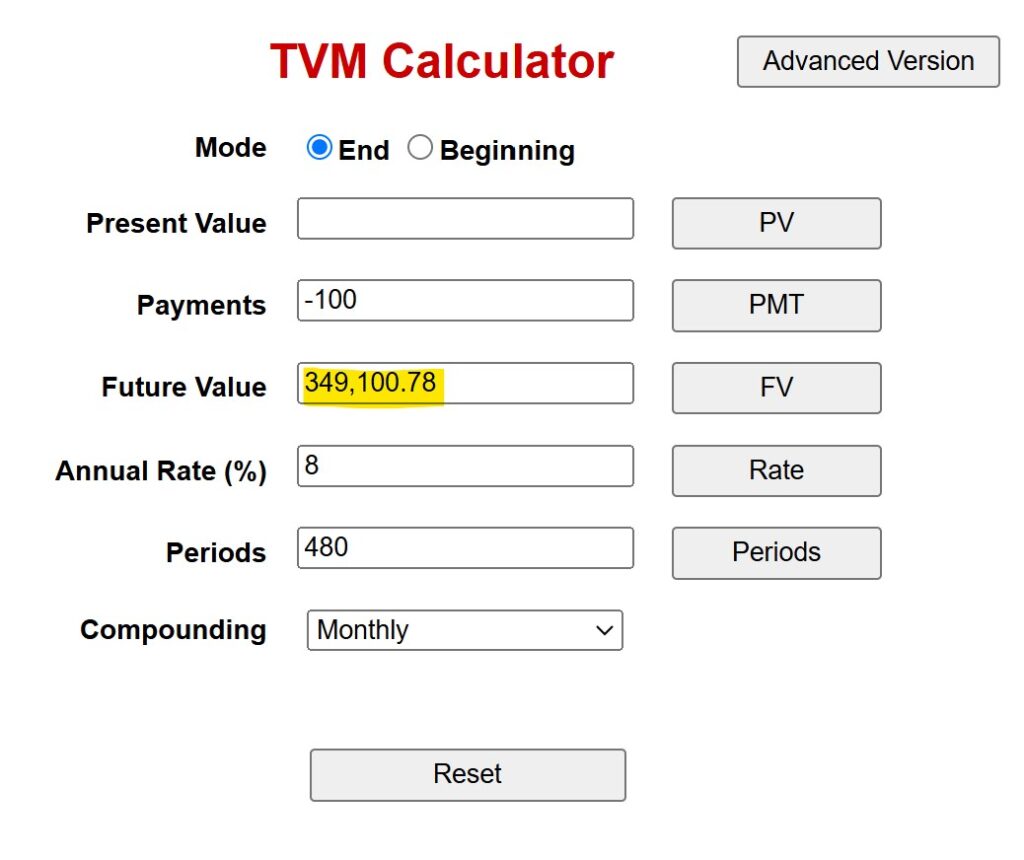
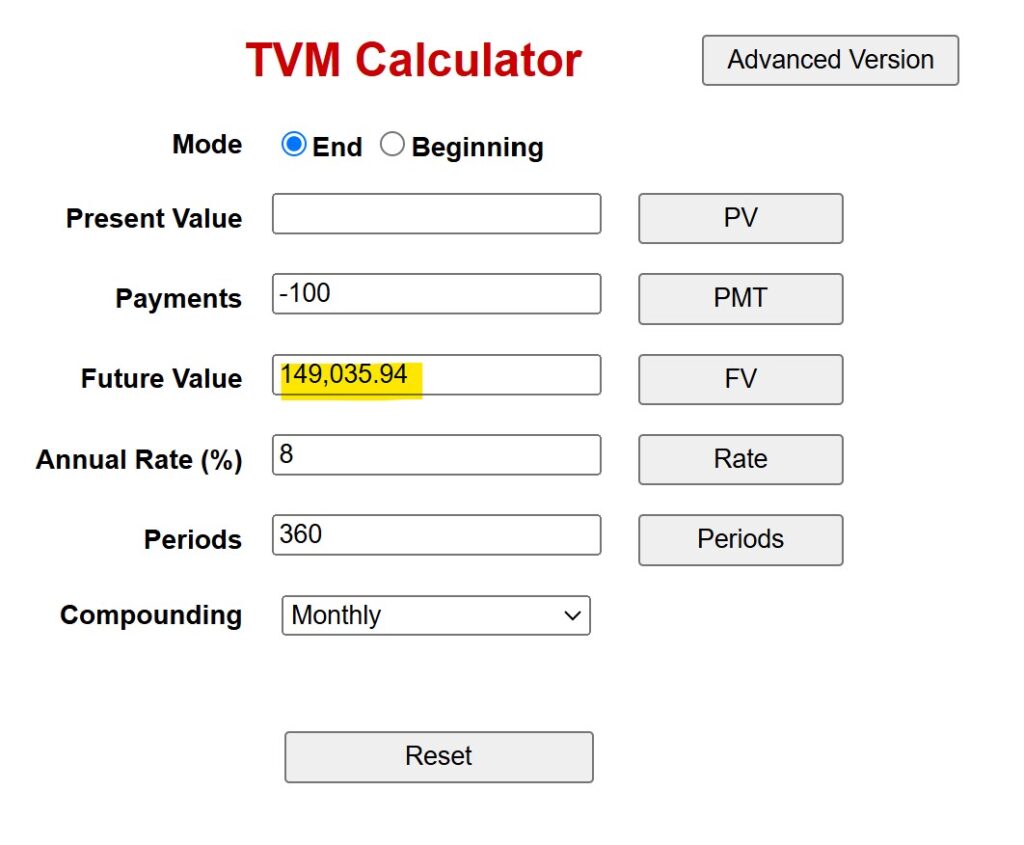
Scenario 1: Sarah starts saving $100 a month at age 25, earning 8% annually. By age 65, she’ll have accumulated nearly $349,000.
Starting early gives Sarah an extra decade for compounding to work its magic, which makes a massive difference.
2. Exponential Growth Over Time
The compounding effect becomes more significant as time passes. In the early years, your growth might seem slow, but over time, the growth accelerates. This is why compound interest is often referred to as “interest on interest.”
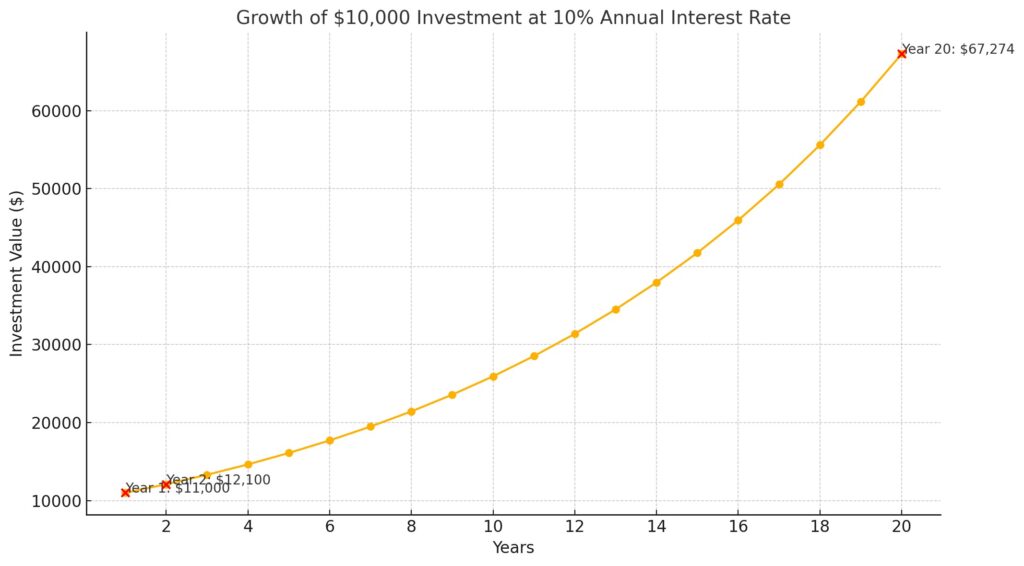
Example: Let’s say you invest $10,000 at a 10% annual interest rate:
Year 1: $11,000
Year 2: $12,100
Year 20: Over $67,000
This demonstrates the power of compound interest over time
Here’s a chart showing the growth of a $10,000 investment at a 10% annual interest rate over 20 years. It highlights key points:
How to Leverage Compound Interest to Build Wealth
1. Start Saving or Investing Early
The earlier you start, the more powerful the compounding effect becomes. Even if you start small, the impact of compounding over decades can be monumental.
Pro Tip: Encourage young adults to save early—even a few years of delay can have a significant impact on long-term growth.
2. Make Regular Contributions
Consistency is key to maximizing the benefits of compounding. Setting up automatic contributions to your savings or investment accounts ensures you’re continuously adding to your principal.
Example:
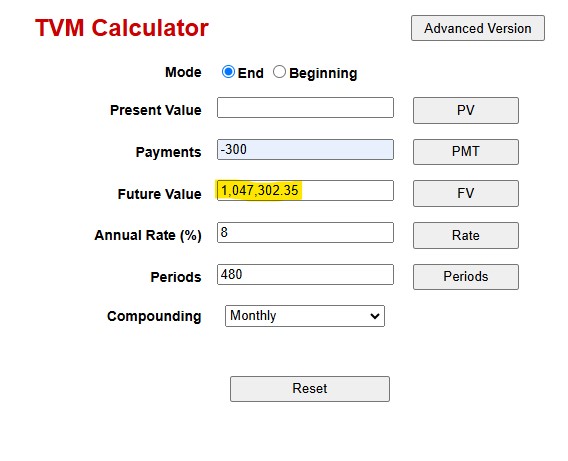
Investing $300 per month at an 8% annual return will grow to $1,047,302.35 in 40 years.
Whether you’re earning dividends from stocks or interest from bonds, reinvesting those earnings allows them to generate additional returns. This reinvestment is crucial to achieving exponential growth.
The stock market can be volatile in the short term, but historically, it has delivered solid long-term returns. By staying invested and avoiding the temptation to withdraw during market downturns, you allow compounding to work uninterrupted.
6. Take Advantage of Employer Contributions
Many employers offer matching contributions for retirement accounts like 401(k)s. This is essentially free money that grows with compound interest. Always contribute enough to maximize your employer match.
7. Be Patient
Compounding takes time, and the biggest rewards come later in the journey. Avoid withdrawing your funds prematurely or chasing short-term gains. Staying disciplined and patient is key to unlocking the full potential of compound interest.
Common Pitfalls to Avoid
Delaying Your Start: Waiting just a few years can drastically reduce your wealth-building potential.
Not Reinvesting Earnings: Spending your earnings prevents them from contributing to future growth.
Ignoring Inflation: Ensure your investments outpace inflation to maintain purchasing power.
High Fees: Investment fees can erode returns over time. Opt for low-cost index funds or ETFs when possible.
Final Thoughts
Compound interest is a true game-changer for building wealth, but it requires three key ingredients: time, consistency, and patience. Whether you’re saving for retirement, your child’s education, or financial independence, starting early and staying consistent can help you achieve your goals.
Remember, building wealth isn’t about overnight success—it’s about leveraging the tools at your disposal to create sustainable, long-term growth. By understanding and using compound interest, you’re setting yourself on the path to financial security and freedom.
Your Mantra for Success: Save Consistently. Invest Smartly. Retire Richly.
Legal Disclaimer for Build Wealth Retire Rich Blog/Website
The information provided on the “Build Wealth Retire Rich” blog/website is for educational purposes only and should not be construed as financial, investment, or legal advice. While every effort is made to ensure the accuracy and reliability of the information presented, Build Wealth Retire Rich and its contributors, including AI tools used in the creation of some content, do not guarantee its completeness or timeliness. Users are encouraged to consult with a qualified financial advisor or legal professional to discuss their specific financial situation and to obtain advice tailored to their individual circumstances.
Build Wealth Retire Rich is not responsible for any decisions made based on the information provided on this website. All financial products, investment strategies, and other content discussed are presented for informational purposes only, and no guarantees are made regarding the performance or suitability of any particular investment or strategy.
The views and opinions expressed on “Build Wealth Retire Rich” are those of the authors and do not necessarily reflect the views of the website’s owner or any affiliated institutions. “Build Wealth Retire Rich” does not endorse or promote any particular investment, financial product, or institution unless explicitly stated.
Risk Disclosure: Investing involves risk, including the potential loss of principal. Past performance is not indicative of future results. Always do your own research and consider your financial goals and risk tolerance before making any financial decisions.
By using this website, you agree that Build Wealth Retire Rich and its affiliates are not liable for any losses or damages incurred as a result of using the information provided. Users are solely responsible for their financial decisions and should seek independent advice when necessary.
Building wealth requires intentional habits and thoughtful financial decisions. Sometimes, behaviors that seem harmless can significantly hinder progress toward financial freedom. Let’s explore these habits and how to replace them with wealth-building strategies, along with real-world examples.
Focusing on Income Instead of Net Worth
It’s easy to assume that earning a higher salary guarantees financial security. However, research reveals that even households with six-figure incomes often find themselves living paycheck to paycheck. According to a Bank of America analysis, nearly 20% of U.S. households earning over $150,000 dedicate more than 95% of their income to necessities like housing, child care, and utilities. This highlights how high incomes alone don’t translate to wealth.
Example: Consider a household earning $160,000 annually but living in an expensive city with a high mortgage, significant child care costs, and rising utility bills. Despite their income, they have little room for savings or investments because their spending is stretched across necessities and lifestyle inflation.
The Problem with Overspending: Higher earners often purchase larger homes with higher property taxes and utility bills, taking on bigger mortgages with the expectation of future promotions or raises. Inflation further exacerbates this issue by increasing the cost of essentials, leaving many households financially strained despite their income levels.
What to Do Instead: Shift your focus from earning more to saving and growing your net worth. For instance:
Downsize Lifestyle Choices: Instead of a luxury home, choose a property that meets your needs without overextending your budget.
Prioritize Savings: Allocate a percentage of your income to savings and investments first, treating them as non-negotiable expenses.
Reassess Necessities: Evaluate if your spending on essentials, such as private child care or high-end internet packages, can be optimized for savings.
By adopting these strategies, you can ensure that your income contributes to long-term financial growth instead of just covering immediate needs.
2. Keeping Money Idle
Allowing your money to sit in a low-interest savings account can cost you opportunities for growth, especially in the face of inflation. Even a modest improvement in interest rates can make a significant difference over time.
High-Yield Savings Account vs. Regular Savings Account Example: Imagine you have $10,000 in a traditional savings account earning 0.05% interest. After one year, you’ll earn just $5. But if you move the same amount to a high-yield savings account earning 4%, you’ll earn $400 in the same period.
Real-Life Example: John switched his emergency fund from a regular savings account at a big bank to a high-yield savings account offered by an online bank. Over three years, he earned $1,200 in interest instead of the $15 he would have received otherwise.
What to Do Instead: Look for high-yield savings accounts to store your emergency fund. Ensure these accounts are FDIC-insured for security and aim for institutions offering competitive rates. Use savings comparison websites to find the best option.
3. Overlooking Small, Daily Expenses
Small, recurring expenses can add up to a significant drain on your finances over time. Many people underestimate the impact of their daily spending habits.
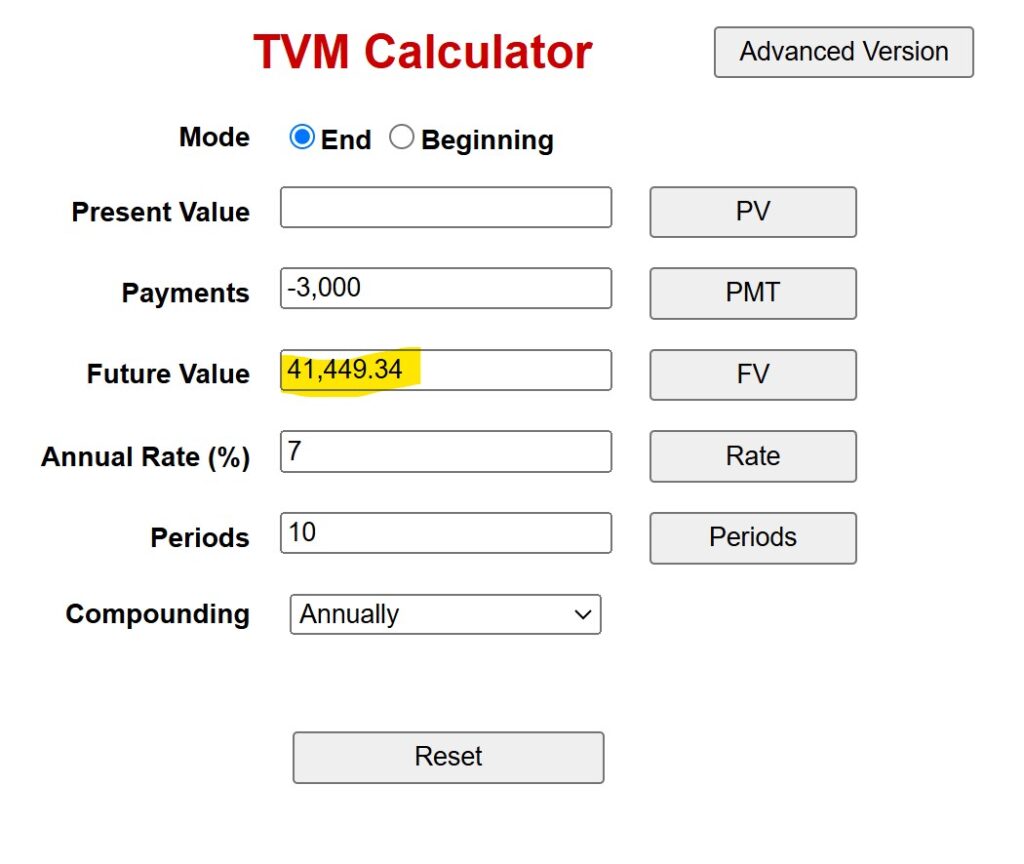
Example: Emma spends $5 on coffee every weekday and $15 on lunch. Over a year, this adds up to $5,200. By making coffee at home and bringing lunch a few times a week, she saves $3,000 annually, which she invests in a diversified index fund. After 10 years, her savings grow to $41,449, assuming a 7% annual return.
What to Do Instead: Conduct a spending audit to identify areas where you can cut back. Budgeting Apps can help track expenses and find savings opportunities. Redirect these savings into investments or a high-yield savings account.
4. Procrastinating on Financial Goals
Delaying financial decisions can lead to missed opportunities. Whether it’s starting an investment account, creating a budget, or paying off debt, waiting often results in smaller returns or higher costs.
Example: Let’s compare two individuals: Sam and Chris. Both plan to retire at age 65 and invest in an account that earns 7% annual interest.
Sam starts saving $100 per month at age 25 and saves for 40 years.
Chris starts saving $100 per month at age 35 and saves for 30 years.
Growth with Compound Interest:
Using a 7% annual return:
Sam’s savings at age 65: After saving $100 per month for 40 years at a 7% annual interest rate, Sam’s total savings grow to approximately $262,481.
Sam contributed only $12,000 more than Chris but ended up with twice as much due to starting earlier.
The extra 10 years of saving and compounding significantly boosted Sam’s final savings.
Starting early allows your money more time to grow, even with smaller contributions.
The earlier you start, the easier it becomes to achieve your financial goals!
What to Do Instead: Set clear financial goals with specific deadlines. Use tools like financial calculators to understand the impact of starting early, and automate contributions to savings or investment accounts to ensure consistent progress.
5. Avoiding Conversations About Money
Many people avoid discussing finances due to discomfort or lack of knowledge. However, avoiding these conversations can lead to missed opportunities, misunderstandings, or financial mistakes.
Example: Tom never discussed salary negotiation with his peers, assuming his offer was standard. When he finally asked around, he discovered that others in similar roles were earning 20% more. Armed with this knowledge, he negotiated a raise that significantly boosted his income and savings potential.
What to Do Instead: Engage in open conversations about money with trusted friends, family, or professionals. Seek advice on investments, budgeting, or salary negotiations. Join communities or forums where people share financial insights to expand your knowledge and perspective.
The Path to Financial Freedom
Building wealth isn’t about perfection—it’s about consistent, intentional actions. By addressing these everyday habits, you can take control of your financial future and achieve long-term success.
Which habit are you ready to tackle today? Let us know in the comments below!
Our Newsletter Can Help You Build Wealth and Retire Rich!
Want actionable tips and expert advice to grow your wealth, save smarter, and retire comfortably? Sign up for the Build Wealth Retire Rich newsletter to receive weekly updates packed with personal finance strategies and insights that are delivered straight to your inbox!
Sign up for our free newsletter!
Thank you for subscribing to our newsletter. You are one step away from financial freedom.
By submitting your information, you`re giving us permission to email you. You may unsubscribe at any time.
In a world where financial decisions shape our futures, adopting the right habits early on can be the key to long-term security and prosperity. At “Build Wealth Retire Rich“, we believe in simplifying financial wisdom into actionable principles that anyone can follow.
Our guiding mantra is clear and concise: “Spend Wisely, Invest Early.”
1. Spend Wisely
The foundation of financial success begins with smart spending. This mantra emphasizes the importance of mindful consumption and prioritizing needs over wants. Here’s how you can adopt this principle in your daily life:
• Create a Budget: Track your income and expenses to identify where your money is going. Tools like spreadsheets or budgeting apps can help you stay organized.
• Distinguish Needs from Wants: Before making a purchase, ask yourself if it’s a necessity or a luxury.
• Avoid Impulse Buying: Give yourself a cooling-off period for major purchases to ensure they align with your financial goals.
• Seek Value, Not Just Price: Opt for quality over quantity when it comes to products and services. Spending on durable items can save money in the long run.
• Eliminate Debt: High-interest debts like credit cards can erode your wealth. Pay them off systematically and avoid accumulating new ones.
Spending wisely doesn’t mean living a life of deprivation—it’s about making informed choices that bring long-term benefits.
2. Invest Early
If spending wisely is the foundation, investing early is the accelerator of financial success. Time is the most valuable asset in investing, thanks to the power of compounding. Here’s why starting early matters:
• Harness the Power of Compounding: When you invest, your returns generate further returns over time. Starting early gives your money decades to grow exponentially.
• Build Wealth Gradually: Even small contributions add up. A monthly investment of $200 starting at age 25 can grow significantly compared to starting at age 40.
• Reduce Financial Stress: Early investments create a safety net for emergencies, retirement, and life goals, reducing financial anxiety.
• Take More Risks: Younger investors have the luxury of time to recover from market fluctuations, allowing them to take calculated risks for higher returns.
Simple Steps to Start Investing Early
1. Set Financial Goals: Define what you’re saving for—retirement, a home, education, or financial independence.
2. Start Small: Begin with an amount you’re comfortable with, even if it’s just $50 a month.
3. Leverage Tax-Advantaged Accounts: Use accounts like IRAs, 401(k)s, or ABLE accounts (for special needs planning) to maximize tax benefits.
4. Diversify Your Portfolio: Spread your investments across various assets like stocks, bonds, and mutual funds to reduce risk.
5. Automate Contributions: Set up automatic transfers to your investment accounts to ensure consistency.
Why These Mantras Work Together
The beauty of “Spend Wisely” and “Invest Early” lies in their interdependence. Wise spending creates the surplus necessary to invest, while early investments multiply your savings. Together, they form a powerful strategy to achieve financial independence.
For instance:
• By cutting unnecessary expenses (spend wisely), you can contribute more to your retirement accounts or save for a dream vacation.
• Starting investments in your 20s instead of your 30s could potentially double or triple your wealth at retirement age.
Conclusion
The “Build Wealth Retire Rich” mantra—“Spend Wisely, Invest Early”—is more than just advice; it’s a way of life that empowers you to take control of your finances. By adopting these principles today, you’re setting yourself up for a future of financial freedom and security.
Take the first step toward financial success. Evaluate your spending habits, set aside an investment fund, and let the journey begin. Remember, the sooner you start, the better your results will be.