Tag: student debt

  • How to Set Financial Goals as a Student (Step-by-Step)

    How to Set Financial Goals as a Student (Step-by-Step)

    How to Set Financial Goals as a Student (Step-by-Step) | The Campus Investor
    The Campus Investor
    Money Smarts for Real Life
    🎯 Issue No. 04  ·  Financial Literacy Series

    How to Set Financial Goals as a Student (Step-by-Step)

    May 2026 | 6 min read | For College Students

    Most students don’t lack motivation when it comes to money. They lack direction. They want to save more, spend less, get out of debt — but without a concrete goal attached to a concrete plan, “wanting” never becomes “doing.”

    Financial goals are the bridge between where you are and where you want to be. Set them well and money suddenly has purpose. Skip them and you’ll spend four years reacting to your bank account instead of directing it.

    This guide walks you through exactly how to set financial goals that are realistic, motivating, and built for a student life — step by step.

    78%
    of students have no written financial goals
    2x
    more likely to achieve goals when written down vs. kept in your head
    $0
    average savings of students with no savings goal

    Why Most Students Skip Financial Goals — And Pay For It

    Setting financial goals sounds like something responsible adults do — not something relevant to a student living on dining hall food and a part-time barista salary. That’s the first misconception. Goals aren’t about how much money you have. They’re about telling the money you do have where to go.

    Without a goal, every financial decision gets made in the moment — based on mood, peer pressure, or whatever sale just hit your inbox. That’s how students end up $800 into a semester with no memory of where it went.

    Mini-Case · No Goal, No Direction

    Ryan, Sophomore — Marketing

    Ryan worked 12 hours a week at a campus coffee shop, bringing in around $480 a month after taxes. He wasn’t spending recklessly — a dinner here, a concert ticket there, some new clothes in October. By November he had $14 in his account and no idea what happened.

    When his car needed a $380 repair, he had no choice but to call his parents. The embarrassment led him to finally sit down and write out three specific goals. Within six months he had a $600 emergency fund and was making progress on his credit card balance for the first time.

    The lesson: Ryan didn’t have an income problem. He had a direction problem. Three written goals changed everything — not because he earned more, but because he finally told his money where to go.

    The Three Types of Financial Goals Every Student Needs

    Not all goals are created equal. A strong personal finance plan includes goals across three time horizons — short, mid, and long-term. Each serves a different purpose and keeps you motivated at different stages of your financial journey.

    Short-Term

    1–12 Months

    • Build a $500 emergency fund
    • Pay off one credit card
    • Set up a monthly budget
    • Save $50/month consistently
    • Cancel unused subscriptions
    Mid-Term

    1–4 Years

    • Graduate with under $X in debt
    • Build a 700+ credit score
    • Save 3 months of expenses
    • Open and fund a Roth IRA
    • Pay off all credit card debt
    Long-Term

    5+ Years

    • Be debt-free by age 30
    • Save first home down payment
    • Reach $50K invested by 28
    • Build a 6-month emergency fund
    • Achieve financial independence

    You don’t need goals in all three categories right now. But having at least one goal from each tier gives you something to work toward today, something to build toward this year, and something to stay motivated about for the long haul.

    “A goal without a deadline is just a wish. A goal without a number is just a dream. A real financial goal has both — and a plan attached.”

    Money Management Basics Book Cover
    Explore the Easy Learning Series

    Money Management Basics

    Simple steps to take control of your finances — learn how to track spending, build savings, and reduce debt with clear, practical guidance.

    View on Amazon →

    How to Make Your Goals SMART

    You’ve probably heard of SMART goals in an academic context. The framework works just as well — actually better — for personal finance. Vague goals produce vague results. SMART goals produce specific ones.

    Here’s how it breaks down for a financial goal:

    Letter What It Means Financial Example
    S Specific — Exactly what do you want to achieve? “Save $600 in an emergency fund” not “save more money”
    M Measurable — How will you know you’ve hit it? A dollar amount, a balance, a date — something you can check
    A Achievable — Is this realistic for your income? Saving $75/month is achievable on $900/month income
    R Relevant — Does this goal matter to your life? An emergency fund matters if your car is your only transport
    T Time-bound — When will you reach this goal? “By December 31” beats “eventually” every single time
    💡 Before vs. After SMART

    Before: “I want to save money this semester.”  |  After: “I will save $75 per month for 8 months to build a $600 emergency fund by December 31.” The second version is a goal. The first is a wish.

    The 5-Step Process for Setting Your Goals

    Here is the exact process — five steps, done once at the start of each semester, reviewed once a month. It takes about 45 minutes the first time and 10 minutes each month after that.

    1
    Step One
    Know Your Current Financial Position

    You can’t set a destination if you don’t know where you’re starting. Before writing a single goal, spend 15 minutes getting a clear snapshot of your finances: total monthly income from all sources, total monthly fixed expenses, current bank balance, total debt owed (loans, credit cards), and current savings balance.

    Write these numbers down. Don’t estimate — look them up. This is your financial baseline, and every goal you set will be built on it.

    2
    Step Two
    Identify What Matters Most to You Right Now

    Not every financial goal is equally urgent. A freshman with $1,200 in credit card debt should prioritize paying that off before thinking about long-term investing. A senior with no emergency fund and graduation three months away has a different priority than a sophomore who’s debt-free.

    Ask yourself: what financial problem is causing me the most stress right now? That’s usually where your first goal should live. Solving your biggest pain point first creates momentum for everything else.

    3
    Step Three
    Write One Goal Per Category Using the SMART Framework

    Pick one goal from the short-term, mid-term, and long-term categories. Write each one as a complete SMART goal — specific, measurable, achievable, relevant, and time-bound. Resist the urge to write ten goals. One per category means three total. Three focused goals beat ten vague ones every time.

    Keep them somewhere visible — your phone notes, a sticky note on your laptop, a whiteboard. Out of sight means out of mind.

    4
    Step Four
    Break Each Goal Into Monthly Actions

    A goal without a monthly action is just a wish with a deadline. Once you’ve written your goals, work backward: if you want to save $600 by December and it’s May, that’s 7 months — you need to save $86 a month. Put that $86 in your budget as a fixed line item, not an afterthought.

    This step turns your goals from aspirational to operational. Every goal becomes a monthly number. Every monthly number goes into your budget. Your budget runs on autopilot from there.

    5
    Step Five
    Schedule a Monthly 10-Minute Review

    Set a recurring calendar reminder — first Sunday of every month, 10 minutes. Pull up your goals, check your progress, and adjust if needed. Did you hit your savings target? Did an unexpected expense knock you off course? What needs to change next month?

    The review is what separates students who achieve goals from students who set them and forget them. Ten minutes a month is the entire maintenance cost of a working financial plan.

    How to Track Progress and Stay on Course

    Tracking doesn’t need to be complicated. The simplest system that works is better than the perfect system you abandon after two weeks. Here’s a fill-in template you can copy into your notes app or a notebook right now:

    📋 My Financial Goal Template

    e.g. Short-term / Mid-term / Long-term
    e.g. Save $600 emergency fund
    e.g. $600
    e.g. December 31, 2026
    e.g. Transfer $86 to savings on the 1st
    e.g. $172 saved (Month 2 of 7)
    🔁 Monthly Review Prompt

    Every first Sunday of the month, ask yourself three questions: (1) Did I hit my monthly action this month? (2) What got in the way? (3) What’s one thing I’ll do differently next month? That’s the entire review. Three questions, ten minutes, consistent momentum.

    Real Goal Examples by Year in College

    Not sure where to start? Here are realistic financial goals matched to where you likely are in your college journey:

    Freshman Year

    Just Getting Started

    Short-term: Build a $300 emergency fund by end of first semester. Mid-term: Graduate with a credit score above 680. Long-term: Understand how your student loans work and what you’ll owe at graduation.

    Focus: Build the habit of tracking your money, open a student credit card and use it responsibly, and never borrow more in loans than you’ve looked up and acknowledged.
    Sophomore Year

    Building Momentum

    Short-term: Save $50/month consistently for 6 months. Mid-term: Pay off any credit card balance — zero balance by end of year. Long-term: Open a Roth IRA even if you only contribute $25/month.

    Focus: Lock in the savings habit, get debt-free on revolving credit, and plant the first seed of long-term investing. Small numbers right now, massive impact later.
    Junior Year

    Picking Up Speed

    Short-term: Build a full $1,000 emergency fund. Mid-term: Increase Roth IRA contributions to $50–$100/month. Long-term: Research income-driven repayment options for your student loans.

    Focus: Strengthen your financial cushion, accelerate investing, and get ahead of the student loan reality so graduation doesn’t catch you off guard.
    Senior Year

    Preparing for Launch

    Short-term: Know your exact total loan balance and monthly payment before you graduate. Mid-term: Have 1 month of post-graduation living expenses saved before your last day. Long-term: Draft a post-graduation budget based on your starting salary before you accept a job offer.

    Focus: Transition planning. The students who thrive financially after graduation are the ones who treated the last semester as a financial prep period, not just a finish line.
    ◆ ◆ ◆

    Financial goals aren’t about being perfect with money. They’re about being intentional. One well-written goal, reviewed monthly, acted on consistently, will do more for your financial future than ten vague intentions that never left your head.

    “You don’t need a perfect financial situation to set financial goals. You need a piece of paper, a number, and a date. Everything else follows from that.”

    Your Goal-Setting Action List — Do This Today

    • Write down your current income, expenses, savings balance, and total debt — your financial baseline
    • Identify your single biggest financial stress right now — that’s your first goal
    • Write one SMART goal for short-term, mid-term, and long-term
    • Break each goal into a monthly dollar action and add it to your budget
    • Set a recurring calendar reminder for a 10-minute monthly review
    • Tell one person your most important goal — accountability doubles your chances of success

    Frequently Asked Questions

    What financial goals should a college student set first?
    Start with your biggest pain point — usually the financial stress causing you the most anxiety right now. For most students that’s either building a $500 emergency fund, paying off a credit card balance, or understanding their student loan total. Solve that first. Once you have one win, momentum builds naturally toward mid and long-term goals.
    What are SMART financial goals for students?
    A SMART financial goal is Specific, Measurable, Achievable, Relevant, and Time-bound. Instead of “save more money,” a SMART version is “save $75 per month for 8 months to build a $600 emergency fund by December 31.” The difference is a clear number, a clear deadline, and a monthly action that turns the goal from aspirational to operational.
    How many financial goals should a student have at once?
    Three is the ideal number — one short-term (1–12 months), one mid-term (1–4 years), and one long-term (5+ years). More than three goals at once usually means none get the focused attention they need. Write them down, break each into a monthly dollar action, and review all three once a month. Simple, consistent, and visible beats complex and forgotten every time.
    What is a realistic financial goal for a college freshman?
    Three realistic freshman goals: build a $300–$500 emergency fund by end of the first semester, open a student credit card and pay it in full every month, and log into StudentAid.gov to know your loan balance. These three actions take minimal income and minimal time, but they set you up for every financial decision you’ll make over the next four years.
    How do you stay on track with financial goals in college?
    Schedule a 10-minute monthly review — first Sunday of every month. Check your progress on each goal, ask what worked and what didn’t, and adjust next month’s actions accordingly. Automate whatever you can — automatic savings transfers, automatic credit card payments, automatic investment contributions. Automation removes willpower from the equation entirely, which is the single most effective habit in personal finance.

    The Campus Investor  ·  Issue 04  ·  Financial Literacy Series

    Written for students who want to graduate smart — in every sense of the word.

  • Top 10 Money Mistakes Students Make (And How to Avoid Them)

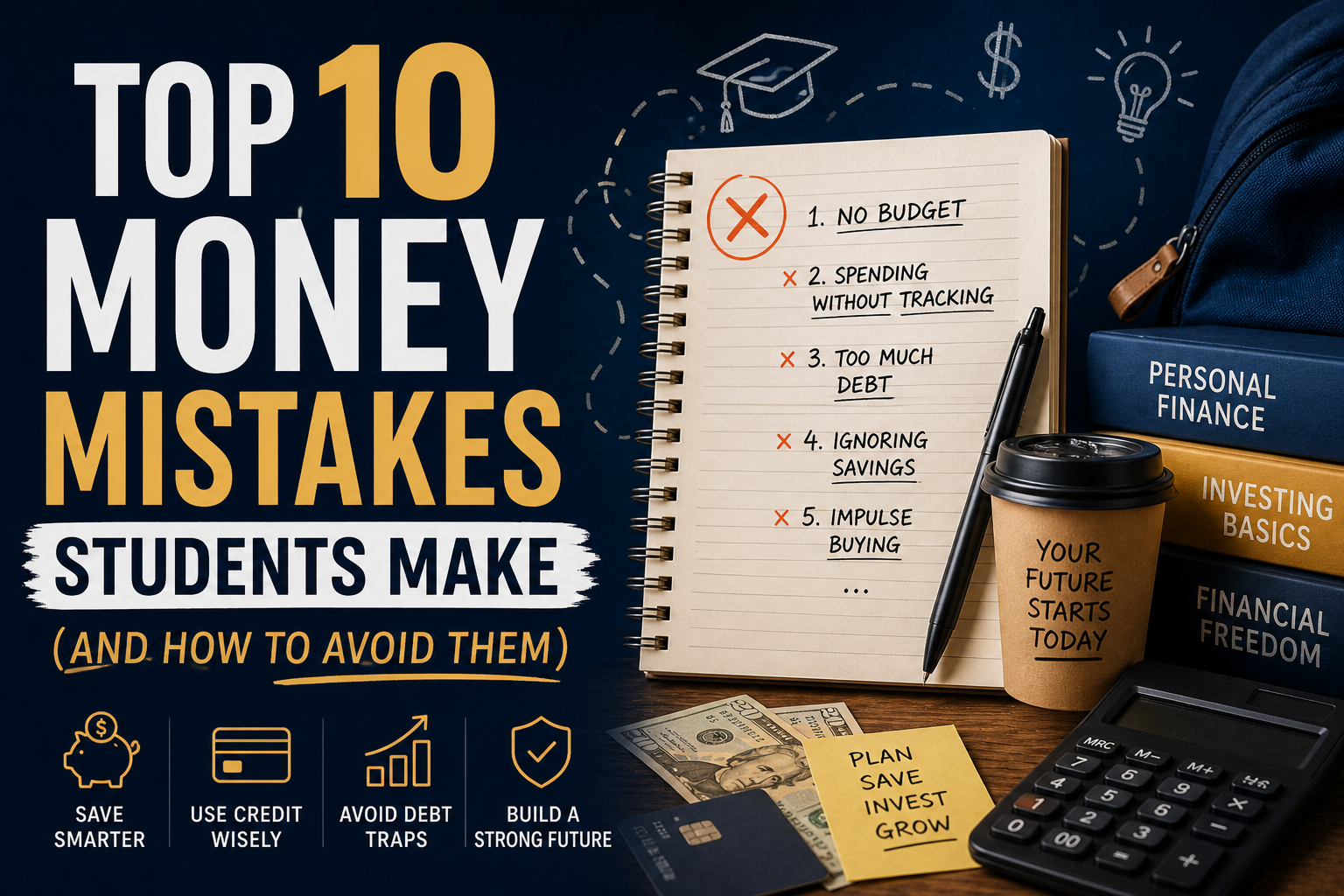
    Top 10 Money Mistakes Students Make (And How to Avoid Them)

    Top 10 Money Mistakes Students Make (And How to Avoid Them) | The Campus Investor
    The Campus Investor
    Money Smarts for Real Life
    ⚠️ Issue No. 03  ·  Financial Literacy Series

    Top 10 Money Mistakes Students Make (And How to Avoid Them)

    May 2026 | 7 min read | For College Students

    Most financial mistakes college students make aren’t caused by carelessness or bad intentions. They’re caused by nobody ever explaining how money actually works. You didn’t get a personal finance class. Neither did most of your classmates. So you figured it out as you went — and “figuring it out” usually means making the same expensive mistakes everyone else does.

    Here are the 10 most common ones — and more importantly, exactly what to do instead.

    73%
    of students have no monthly budget in place
    $1,600
    Average amount students overspend per semester without realizing it
    40%
    of students don’t know the interest rate on their student loans
    01
    Mistake #1
    Having No Budget At All

    This is the most common and most costly mistake on the list. Without a budget, spending decisions happen by feel — and feelings are notoriously bad at math. You think you have money because your bank account isn’t empty. Then it is.

    Aisha, a junior studying education, went three semesters without a budget. She wasn’t reckless — just untracked. When she finally added everything up, she found she’d been spending $340 a month on food and dining out, not the $150 she estimated. That $190 gap added up to nearly $1,200 in unexpected spending over a semester.

    ✅ The Fix

    Spend 20 minutes on the first day of each month writing down your income and assigning every dollar to a category. Use the 50/30/20 rule as your starting framework. Free apps like YNAB, Copilot, or even a Google Sheet get the job done. Need a full walkthrough? See our beginner’s guide to personal finance for students.

    02
    Mistake #2
    Misusing Credit Cards

    A credit card is a powerful financial tool — until it isn’t. The mistake most students make isn’t getting a credit card. It’s treating it like bonus money instead of a payment method for money they already have.

    When you carry a balance on a card with 24% APR, every $100 you don’t pay off costs you $24 in interest per year — and that compounds monthly. A $500 balance you carry for two years can quietly turn into over $750 owed.

    ✅ The Fix

    Use your credit card for regular purchases you’d make anyway — groceries, gas, subscriptions. Set up autopay for the full balance every month, not the minimum. Never charge what you can’t already afford to pay off from your checking account.

    03
    Mistake #3
    Ignoring Student Loans While In School

    Out of sight, out of mind — until graduation hits and a repayment notice lands in your inbox for an amount that takes your breath away. Many students borrow year after year without ever logging into StudentAid.gov to check their running total.

    On unsubsidized federal loans, interest accrues from day one — even while you’re still in school. If you borrow $8,000 in freshman year at 6.5%, by the time you graduate four years later you already owe roughly $10,200 before you’ve made a single payment.

    ✅ The Fix

    Log into StudentAid.gov today and find your exact balance. If your loans are unsubsidized, consider making small interest-only payments while in school — even $25 to $50 a month prevents interest from capitalizing and inflating your principal.

    04
    Mistake #4
    Having Zero Emergency Fund

    Life doesn’t wait for a convenient time to break down. Your car needs a new tire. Your laptop dies the night before finals. Your hours get cut at work. Without a financial cushion, any small crisis immediately becomes a credit card charge — and debt you’ll spend months paying off.

    An emergency fund isn’t about having a lot of money saved. It’s about having a buffer between normal life and financial disaster. Even $300 to $500 changes the equation entirely.

    ✅ The Fix

    Open a separate high-yield savings account and label it “Emergency Fund.” Transfer a fixed amount each month — even $20 or $30 — until you hit $500. Once you’re there, aim for one month of expenses. This account is not for sales, trips, or concert tickets. Emergencies only.

    05
    Mistake #5
    Lifestyle Creep After Every Raise

    You get a pay raise, a bigger financial aid package, or start a higher-paying job — and almost immediately your spending rises to match it. New apartment, nicer restaurants, upgraded phone. This is lifestyle creep, and it’s one of the quietest wealth-killers there is.

    Students who earn more tend to feel financially ahead — until they realize they’re saving the same zero dollars they were before the raise. The extra income evaporated into a slightly more expensive version of the same life.

    ✅ The Fix

    Every time your income increases, direct at least 50% of the increase to savings or debt payoff before adjusting your lifestyle. Give yourself a small upgrade as a reward — but make the majority work for your future self, not your current comfort.

    06
    Mistake #6
    Paying Only the Minimum on Debt

    The minimum payment on a credit card is designed to keep you in debt as long as possible — not to help you pay it off. On a $1,500 balance at 22% APR, paying only the minimum of around $35/month means you’ll be paying for over five years and will have paid nearly $800 in interest alone.

    This is one of the most expensive financial habits a student can form — and it’s completely invisible on a monthly basis because the minimum payment always feels affordable.

    ✅ The Fix

    Always pay more than the minimum — even an extra $20 or $30 a month makes a significant difference. Use the avalanche method: list all debts by interest rate and put every extra dollar toward the highest rate first, while paying minimums on the rest.

    07
    Mistake #7
    Not Tracking Subscriptions

    Streaming services, gym memberships, app subscriptions, meal kit trials that converted to paid plans — they’re each small, they auto-renew quietly, and together they add up to a number most students would be genuinely shocked by.

    The average college student has 4 to 6 active subscriptions at any given time, often including at least one they completely forgot about. At $10 to $15 each, that’s easily $50 to $80 a month — over $900 a year — disappearing before they even check their balance.

    ✅ The Fix

    Do a subscription audit right now: pull up your bank or credit card statement and highlight every recurring charge. Cancel anything you haven’t used in the last 30 days. Tools like Rocket Money or your bank’s subscription tracker can automate this going forward.

    08
    Mistake #8
    Skipping Renter’s Insurance

    This is the most overlooked financial mistake on the list — and it can be the most catastrophic. Your landlord’s insurance covers the building. It does not cover your laptop, your bike, your furniture, or any of your belongings if there’s a fire, flood, theft, or break-in.

    Renter’s insurance costs between $10 and $20 per month and covers your personal property for losses up to $20,000 or more. Most students skip it because they think they “don’t have enough stuff” to insure — until they do the math on what it would cost to replace everything.

    ✅ The Fix

    Get renter’s insurance. Today. Lemonade, State Farm, and most major insurers offer policies for students starting around $8 to $12 per month. It takes about 5 minutes to set up online and it’s one of the best dollars-per-protection purchases available.

    09
    Mistake #9
    Waiting to Start Investing

    “I’ll start investing when I have a real job.” This is the single most expensive sentence in personal finance. Every year you wait to start investing costs you far more than the amount you would have invested — because of compound growth.

    A student who invests $50 a month starting at 20 will have significantly more at retirement than someone who invests $200 a month starting at 35. The math is brutal and it’s irreversible — time you don’t invest can never be bought back. We break this down in detail in Why Financial Literacy Matters More Than Your GPA.

    ✅ The Fix

    Open a Roth IRA at Fidelity, Vanguard, or Schwab — all free, no minimums. Invest as little as $25 to $50 a month in a total market index fund. Set it to auto-invest so you never have to think about it. Start this month, not next year.

    10
    Mistake #10
    Comparing Your Finances to Everyone Else’s

    Social media shows you the vacation, the new car, the apartment upgrade, the dinner out — not the credit card bill that funded it. Comparing your financial situation to curated highlight reels is a fast path to bad spending decisions made for the wrong reasons.

    Some of the most financially healthy students on any campus are also some of the least visibly “balling.” They drive older cars, pack lunch, and say no to expensive weekend trips. Their future selves will have the receipts — in the form of a paid-off loan and a growing investment account.

    ✅ The Fix

    Compare yourself to your own previous month, not to other people’s social media. Set one financial goal per month — pay off $100 extra debt, add $50 to savings, cancel one subscription — and measure progress against that. Your financial story is the only one that matters.

    ◆ ◆ ◆

    “Financial mistakes aren’t a sign of failure. They’re a sign of never being taught. Now you know — and knowing is the only thing that separates a mistake you make once from one you keep making forever.”

    The good news about all ten of these mistakes? Every single one is fixable. Most take less than an hour to address. You don’t need a perfect financial past to build a strong financial future — you just need to start making slightly better decisions than you made last month.

    Your 10-Point Action Checklist

    • Set up a monthly budget using the 50/30/20 rule
    • Set credit card autopay to full balance every month
    • Log into StudentAid.gov and check your exact loan balance
    • Open a separate high-yield savings account for emergencies
    • Save at least 50% of any future income increases before lifestyle adjustments
    • Pay more than the minimum on any debt you’re carrying
    • Audit your subscriptions and cancel anything unused
    • Get renter’s insurance — takes 5 minutes, costs less than a pizza
    • Open a Roth IRA and start with as little as $25/month
    • Stop comparing your finances to social media — build your own scorecard
    📚 Continue the Series

    This is Issue 03 of The Campus Investor Financial Literacy Series. Missed the earlier issues? Read Issue 01: Why Financial Literacy Matters More Than Your GPA and Issue 02: Personal Finance for Students — A Complete Beginner’s Guide on our site.

    Frequently Asked Questions

    What is the biggest financial mistake college students make?
    The single most impactful mistake is having no budget at all. Without a budget, spending happens by feeling rather than by plan — and feelings are terrible at math. The second most costly mistake is ignoring student loan balances while in school, allowing interest to capitalize unchecked. Both are completely fixable with about one hour of attention.
    Why do so many college students end up in credit card debt?
    Most students treat a credit card as extra money rather than a payment tool for money they already have. Combined with high APRs (often 22–28%) and a habit of paying only the minimum, balances grow quickly. A $500 balance paid at minimum payments can take years to clear and cost hundreds in interest. The fix is simple: never charge more than you can pay off in full at the end of the month.
    Is renter’s insurance really necessary for college students?
    Yes — and it’s one of the most overlooked protections available. Your landlord’s insurance covers the building, not your belongings. If your laptop, bike, or furniture is stolen or damaged in a fire, you’re on your own without renter’s insurance. Policies start at around $8–$12 per month and typically cover $15,000–$20,000 in personal property. It takes five minutes to set up and costs less than a pizza per month.
    What is lifestyle creep and how does it hurt college students?
    Lifestyle creep happens when your spending rises to match every increase in your income — leaving your savings rate unchanged no matter how much more you earn. For students, it often follows a new job, a bigger financial aid package, or a scholarship. The fix is to direct at least 50% of any income increase to savings or debt before adjusting your lifestyle. Enjoy a portion of the increase — but make the majority work for your future first.
    When should college students start investing?
    As soon as you have any earned income — which for most students means the moment you get a part-time job. Even $25–$50 a month into a Roth IRA invested in a total market index fund is a powerful start. The math of compound growth is ruthless about time: every year you delay investing costs you far more than the amount you would have invested. “I’ll start when I have a real job” is the most expensive sentence in personal finance.

    The Campus Investor  ·  Issue 03  ·  Financial Literacy Series

    Written for students who want to graduate smart — in every sense of the word.

  • Why Financial Literacy is Important for College Students

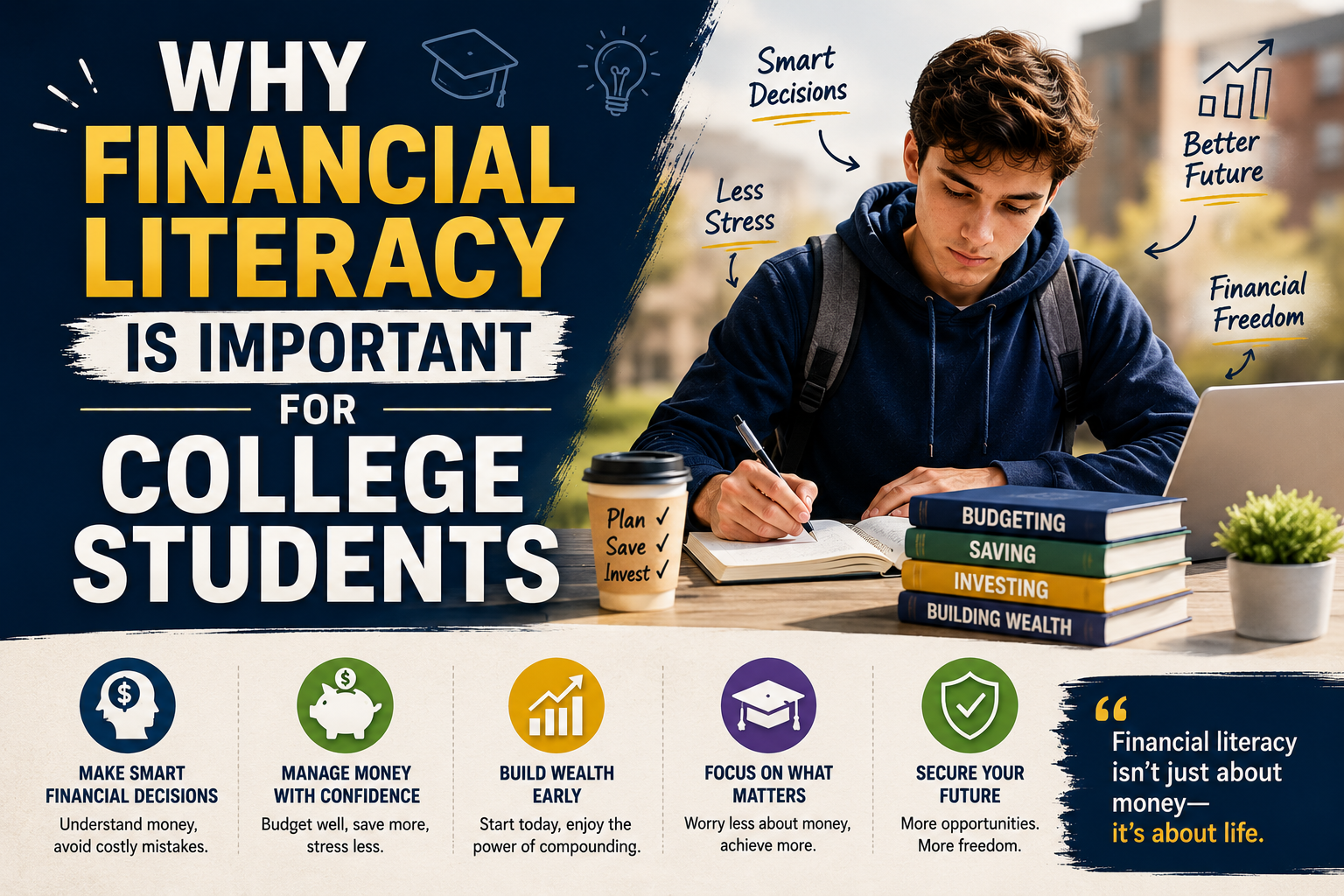
    Why Financial Literacy is Important for College Students

    Why Financial Literacy is Important for College Students | The Campus Investor
    The Campus Investor
    Build Wealth from Day One
    📚 Issue No. 01  ·  Financial Literacy Series

    Why Financial Literacy is Important for College Students

    May 2026 | 6 min read | For College Students

    You can study four years at a university, earn a degree, and graduate with strong grades — and still have no idea how to manage a credit card, understand a student loan statement, or know the difference between a Roth IRA and a savings account. That’s not a personal failing. That’s a gap in the education system.

    Financial literacy — the ability to understand and apply basic money concepts — is one of the most practical life skills available to you. Yet most college students enter the workforce without it. The result is predictable: debt they didn’t plan for, savings they never started, and financial decisions made by default rather than by design.

    This guide explains exactly why financial literacy matters for college students, what it actually covers, and how you can start building it today — even on a student income.

    $37K
    Average student loan debt per borrower in the U.S.
    65%
    College students who feel financially unprepared after graduation
    1 in 3
    Gen Z adults with zero emergency savings

    What Financial Literacy Actually Means

    Financial literacy is not about being wealthy. It’s not about having a finance degree or reading the Wall Street Journal every morning. It’s simply the ability to understand how money works — and to use that understanding to make better decisions about the money you have.

    A financially literate student knows how to build a monthly budget, understands what an interest rate means, knows the difference between good and bad debt, can read a bank statement, and has a basic grasp of how saving and investing work over time. None of this requires advanced knowledge. All of it requires learning things the school system rarely teaches.

    💡 A Simple Definition

    Financial literacy = the knowledge and skills to manage your money effectively. It’s not about how much you earn — it’s about how confidently and intentionally you handle what you do earn. A student earning $800 a month with financial literacy is better positioned than a graduate earning $60,000 without it.

    Why Financial Literacy Matters Especially in College

    College is the first time most people manage their own money independently. Financial aid arrives in a lump sum. Credit card companies target students aggressively. Student loans are signed with a click. Rent, groceries, textbooks, and social spending all compete for the same limited income. For many students, it’s overwhelming — and without financial literacy, the defaults are expensive.

    Reason 01

    You’re making real financial decisions for the first time

    College is the stage where financial decisions begin to have lasting consequences. The credit habits you build now follow you for years. The student loans you sign without reading are real legal obligations. The savings habit you either develop or skip in college shapes your financial baseline going into your 30s and beyond.

    Reason 02

    Compound interest works for or against you — starting now

    Every year you delay investing is a year of compound growth you can never get back. Every year you carry high-interest credit card debt is a year that compound interest works against you. Financial literacy helps you understand this dynamic early — when the difference between acting and waiting is still relatively small in dollars but enormous in decades.

    Reason 03

    Student loans are one of the largest financial decisions of your life

    The average student borrower graduates with over $37,000 in federal loan debt. Many have significantly more. Yet most students sign their promissory notes each year without reading them, without tracking their running total, and without understanding how repayment works. Financial literacy doesn’t eliminate student loans — it ensures you make informed decisions about how much to borrow and how to manage what you owe.

    Reason 04

    Credit history starts in college — and follows you everywhere

    Your credit score affects your ability to rent an apartment, finance a car, qualify for a mortgage, and sometimes even get a job. Building credit thoughtfully in college — with one card, low utilization, and on-time payments — can get you to a 700+ score by graduation. Ignoring credit, or misusing it, can set you back years. Financial literacy is what makes the difference.

    Reason 05

    The financial gap between your peers starts here

    Two students can graduate from the same program, enter similar jobs, and end up in dramatically different financial positions ten years later — not because of salary differences, but because of the habits, knowledge, and systems they built (or didn’t build) in college. Financial literacy is not a guarantee of wealth. It is the foundation that makes wealth possible.

    What Financial Literacy Covers

    Financial literacy isn’t one skill — it’s a set of interconnected concepts that build on each other. You don’t need to master all of them at once. But knowing what’s included helps you prioritize where to start.

    📋

    Budgeting

    Knowing your income, tracking your spending, and allocating money intentionally before the month begins.

    💳

    Credit & Credit Scores

    Understanding how credit scores work, what affects them, and how to build credit responsibly from day one.

    🏦

    Saving & Emergency Funds

    Building a financial cushion so unexpected expenses don’t become debt. Knowing where to keep savings.

    🧾

    Debt Management

    Distinguishing good debt from bad, understanding interest rates, and knowing how repayment actually works.

    📈

    Investing Basics

    Understanding compound interest, index funds, Roth IRAs, and why starting young changes everything.

    🎯

    Financial Goal Setting

    Knowing how to set specific, measurable financial goals — and how to track and achieve them consistently.

    Mini-Case · No One Told Marcus

    Marcus, Junior — Computer Science

    Marcus got his first credit card freshman year with a $2,000 limit. He used it for takeout, concert tickets, and a new laptop — paying only the $35 minimum each month. Nobody had ever explained how APR worked. Nobody told him that 24% annual interest compounds monthly.

    By junior year his balance was $1,900. He was paying more in monthly interest than he was reducing the principal. The laptop had effectively cost him $1,700 and counting. He wasn’t irresponsible — he was uninformed.

    The lesson: Marcus’s situation wasn’t caused by recklessness. It was caused by a gap in financial education that one afternoon of learning could have prevented. Financial literacy isn’t about being smarter — it’s about having information that changes how you act.

    The Real Cost of Financial Illiteracy

    Financial illiteracy isn’t just an abstract disadvantage. It has concrete, dollar-denominated consequences that compound over years — often without the person realizing what’s happening until the damage is done.

    Mini-Case · High GPA, Empty Account

    Jordan, Recent Graduate — Pre-Law

    Jordan graduated with a strong GPA and $62,000 in student loan debt. His $58,000 starting salary felt like a victory — until he did the math. After taxes, rent, loan payments on the standard 10-year plan, and a car payment he hadn’t properly compared rates on, Jordan had less than $200 left each month.

    He had never made a budget. He didn’t know income-driven repayment plans existed. His car loan carried a 17% interest rate — predatory, but he had signed without reading. His credit card had a $1,200 balance at 22% APR.

    The lesson: A strong academic record and a decent salary don’t equal financial health. Financial literacy is what bridges the gap between earning money and actually keeping — and growing — it.
    Mini-Case · Small Habit, Big Outcome

    Priya, Senior — Communications

    Priya worked 15 hours a week at the campus library — around $450 a month after taxes. After expenses she had $80 left over. Instead of spending it, she read about Roth IRAs one Sunday afternoon, opened a Fidelity account that same day, and set up an $80 monthly automatic contribution into a total market index fund.

    She wasn’t wealthy. She didn’t have a finance degree. She had one afternoon of financial literacy and the discipline to act on it.

    The lesson: At a 8% average annual return, Priya’s $80/month habit has the potential to grow to over $279,000 in 40 years — completely tax-free in her Roth IRA. Financial literacy didn’t require a high income. It required information and one decision.
    Money Management Basics Book Cover
    Explore the Easy Learning Series

    Money Management Basics

    Simple steps to take control of your finances — learn how to track spending, build savings, and reduce debt with clear, practical guidance.

    View on Amazon →
    >

    How to Start Building Financial Literacy Today

    Financial literacy isn’t built in a semester — it’s built in small steps over time. The good news is that the most impactful concepts take very little time to understand, and acting on them early creates disproportionately large results.

    You don’t need to read every personal finance book or take a course. You need five actions, done in order, and one commitment to keep learning as your situation evolves.

    Your 5 Starting Points — This Week

    • Know your number: Add up all your monthly income from every source. Write that number down. It’s your financial baseline — everything else is built on it.
    • Track your spending for one month: Don’t budget yet — just watch. Pull up your last 30 days of transactions and categorize them. You cannot improve what you haven’t measured.
    • Check your credit score: Use Credit Karma, Experian, or your bank app — most offer free access. Know where you stand and what’s affecting your score.
    • Log into StudentAid.gov: Find your exact loan balance, interest rate, and repayment options. Many students have never done this. It takes five minutes and changes how you think about every borrowing decision going forward.
    • Open a high-yield savings account: Move your savings from a traditional bank (0.01% APY) to an online bank offering 4–5% APY. Same money, automatically earning more. Takes 10 minutes.

    “Financial literacy isn’t about knowing everything. It’s about knowing enough to make better decisions than you would have otherwise — and learning one more thing each month for the rest of your life.”

    The students who graduate financially prepared aren’t necessarily the ones who studied finance. They’re the ones who took the time to understand how money works in their own life — and who started that process early enough for the information to actually shape their decisions.

    This series exists to be that starting point. Each issue covers one topic — budgeting, credit, debt, saving, investing, financial goals — in plain language with real student examples. Start here. Keep going.

    ◆ ◆ ◆

    Frequently Asked Questions

    Why is financial literacy important for college students specifically?
    College is when most people make their first independent financial decisions — managing income, signing student loans, opening credit cards, paying rent. These decisions have long-term consequences, yet financial literacy is rarely taught in school. Students who understand money basics in college build credit, avoid unnecessary debt, start saving early, and enter the workforce with a significant financial head start over peers who never learned.
    What does financial literacy include for students?
    Financial literacy for students covers six core areas: budgeting (knowing your income and controlling spending), credit scores (building and protecting your credit history), saving and emergency funds (creating a financial cushion), debt management (understanding student loans and avoiding high-interest traps), investing basics (compound interest, index funds, Roth IRAs), and financial goal setting (turning intentions into specific plans with deadlines and monthly actions).
    How does financial literacy affect a student’s future?
    The financial habits and decisions made in college compound significantly over time. A student who builds good credit, avoids carrying a credit card balance, starts a small Roth IRA, and manages their student loans wisely will have meaningfully different financial outcomes at 35 and 45 than a peer with the same salary who never learned these concepts. Financial literacy doesn’t change income — it changes what you do with income.
    Can you be financially literate on a small student income?
    Yes — and in some ways it’s easier. The core concepts of financial literacy are the same at $900/month as they are at $9,000/month: spend less than you earn, build an emergency fund, avoid high-interest debt, and start investing something consistently. A student earning $900 a month who does all four is more financially literate — and better positioned for the future — than a professional earning $8,000 who does none of them.
    What is the easiest way to start building financial literacy as a student?
    Start with your actual numbers: know your monthly income, look at your last 30 days of spending, and check your credit score and student loan balance. These four actions take under an hour and immediately change how you see your finances. From there, read one personal finance article or watch one explainer video per week — covering budgeting, credit, saving, investing, and debt in that order. Knowledge in use is what builds literacy, not knowledge in theory.

    The Campus Investor  ·  Issue 01  ·  Financial Literacy Series

    Written for students who want to graduate smart — and retire rich.