Tag: student loans

  • Time Value of Money Calculator: A Student’s Guide

    Time Value of Money Calculator: A Student’s Guide

    Time Value of Money Calculator: A Student’s Guide | The Campus Investor
    The Campus Investor
    Build Wealth from Day One
    🧮 Financial Tools  ·  Calculator Guide

    Time Value of Money Calculator: A Student’s Guide

    May 2026 | 8 min read | For College Students

    The Time Value of Money (TVM) Calculator is one of the most powerful financial tools a student can learn to use — and one of the most confusing at first glance. Five variables, a sign convention that trips everyone up, two modes that change your answer, and a compounding dropdown that most people ignore.

    This guide breaks every part of the calculator down — plainly, with real student examples — so you can use it confidently to solve any TVM problem: investment growth, loan payments, savings goals, and more.

    What is the Time Value of Money?

    The core idea behind every TVM calculation is simple: a dollar today is worth more than a dollar tomorrow. Why? Because a dollar you have right now can be invested and grow. A dollar promised to you in the future can’t be invested yet — so it’s worth less in today’s terms.

    This principle underpins almost every financial decision: how much a loan will cost you, how much you need to save to reach a goal, what your investments will be worth at retirement, and whether a lump sum payment or an annuity is the better deal.

    “Time value of money is not just a finance concept. It’s the reason investing early beats investing more — and the reason carrying debt costs you more than the interest rate suggests.”

    The Calculator — Every Field Explained

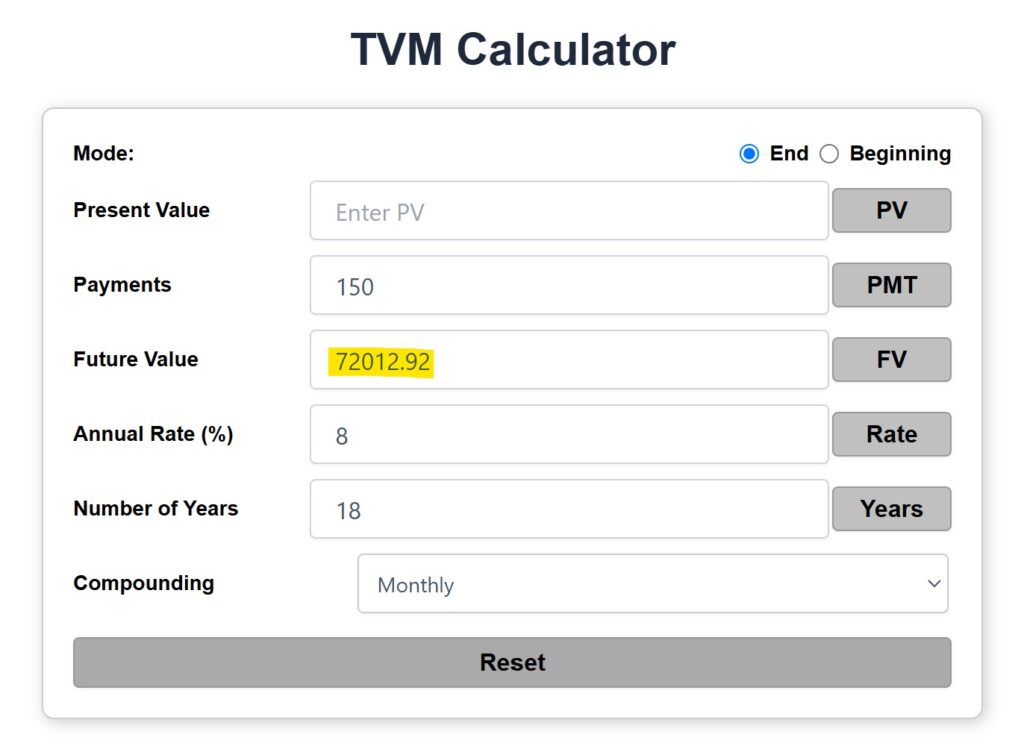
    Here is what the TVM calculator looks like — with every field labelled so you know exactly what you’re looking at before entering a single number:

    TVM Calculator

    Mode: End Beginning
    Label Value Compute
    Present Value: e.g. -200 PV
    Payments: e.g. -50 PMT
    Future Value: e.g. -1000 FV
    Annual Rate (%): e.g. 10 Rate
    Periods (years): e.g. 5 Periods
    Compounding:
    Annually
    Reset
    Build Wealth Retire Rich: Time Value of Money Calculator

    The logic is always the same: enter any four of the five variables, then click the Compute button for the fifth. The calculator solves for the unknown. The key is knowing what each variable means, what sign to give it, and which mode to use.

    The 5 Variables: PV, PMT, FV, Rate, Periods

    Every TVM problem involves five variables. You always know four of them and solve for the fifth. Here’s exactly what each one means in plain English — with real student contexts:

    PV

    Present Value

    The value of money today — either an amount you have right now, or the current worth of a future cash flow. In borrowing it’s the loan amount. In investing it’s your starting deposit.

    Student examples: $5,000 student loan taken out today $500 you deposit into a Roth IRA today Current value of a $1,000 bond maturing in 5 years
    PMT

    Payments (Annuity)

    A regular recurring payment made at equal intervals — either money going out (loan payments, regular savings contributions) or money coming in (income from an annuity). Enter 0 if there are no recurring payments.

    Student examples: $150/month loan repayment $50/month invested into an index fund $0 (lump-sum problems with no regular payments)
    FV

    Future Value

    The value of money at a specific point in the future, after growth or after a series of payments. This is what you’re solving for when asking “what will my investment be worth in 30 years?” or “how much will I owe at the end of this loan?”

    Student examples: What your Roth IRA will be worth at 65 The final payoff amount on a loan $0 (for a fully amortising loan that ends at zero)
    r

    Annual Rate (%)

    The annual interest rate — entered as a percentage, not a decimal (enter 7, not 0.07). For investments this is your expected annual return. For loans it’s the APR. The calculator adjusts for compounding frequency automatically.

    Student examples: 7 (for 7% average investment return) 6.5 (federal student loan rate) 24 (typical credit card APR)
    N

    Periods (Years)

    The total number of time periods — usually years, but can be months if your payment frequency is monthly. If you’re solving a 30-year mortgage with monthly payments, enter 30 years (the calculator accounts for compounding frequency). If your calculator uses periods in months directly, enter 360 (30 × 12).

    Student examples: 10 years of investing from age 20 to 30 45 years until retirement (age 20 to 65) 5 years on a car loan 4 years of college remaining

    The Sign Convention — Why Negative Numbers Matter

    This is where almost every beginner gets confused — and where most wrong answers come from. TVM calculators use a cash flow sign convention: money flowing out of your pocket is negative; money flowing into your pocket is positive.

    💡 The Sign Convention — Always Think From Your Perspective

    Negative (Money Out)

    Cash that leaves your hands. You invest it, pay it out, or deposit it somewhere. You no longer have this money in your pocket.

    Examples: loan payment you make, deposit into savings, money you invest today

    +
    Positive (Money In)

    Cash that arrives in your hands. You receive it, earn it, or withdraw it. This money is coming into your pocket.

    Examples: loan proceeds you receive, investment payout, cash you withdraw

    The most important rule: PV and FV must have opposite signs when money flows in one direction. If you enter a negative PV (money you invest today), FV will compute as positive (money you receive later). If you enter a positive PV (loan proceeds you receive), FV will compute as negative (amount you owe at the end).

    ⚠️ The Most Common Sign Mistake

    Entering PV and PMT with the same sign when they should have opposite signs is the single most common TVM error. If you’re making regular payments on a loan (PMT is negative — money leaving you), the loan you received (PV) must be positive — money that came to you. If you get an error or an absurd answer, check your signs first.

    End vs Beginning Mode

    The Mode selector at the top of the calculator — End or Beginning — determines when payments occur within each period. For most student problems, End mode is correct.

    End Mode (Ordinary Annuity)

    Payments at the End of Each Period

    The most common setting. Payments are made or received at the end of each period — after the interest for that period has been calculated.

    This is how most loans, mortgages, and regular savings plans work. Your monthly mortgage payment is due at the end of the month, after that month’s interest has accrued.

    ✓ Use for: student loan payments, car loans, monthly savings contributions, most investment problems
    Beginning Mode (Annuity Due)

    Payments at the Start of Each Period

    Less common. Payments occur at the beginning of each period — before interest is calculated for that period. This means each payment earns (or avoids) one extra period of interest.

    Beginning mode produces a slightly higher future value for investments and a slightly lower present value for loans, because money is working for one more period.

    ✓ Use for: rent paid at month start, lease payments, some annuities specified as “due”
    📐 How Much Does Mode Actually Change Your Answer?

    Switching from End to Beginning mode on a $200/month investment at 7% over 30 years changes the result from approximately $244,000 to approximately $245,000 — a difference of about $1,000. The effect grows with the rate and the number of periods. For most homework and real-life problems, End mode is correct unless the problem specifically states “annuity due” or “beginning of period.”

    Compounding Frequency Explained

    The Compounding dropdown controls how many times per year interest is applied to the balance. The more frequently interest compounds, the slightly more you earn (or owe). Here’s how the options compare on a $10,000 balance at 7% over 10 years:

    Compounding Option Times/Year Balance at 10 Years Interest Earned
    Annually $19,672 $9,672
    Semi-annually $19,898 $9,898
    Quarterly $20,016 $10,016
    Monthly Most Common 12× $20,097 $10,097
    Daily 365× $20,136 $10,136

    For most investment problems, select Monthly — this matches how most brokerages, savings accounts, and loan products compound. For problems where the question specifies a different frequency (e.g. “compounded quarterly”), match it exactly. The difference is small but matters for precise answers.

    Step-by-Step Examples for Students

    Here are four common student scenarios — each solved step by step using the TVM calculator.

    Example 1 · Investing

    “What will my $75/month investment be worth in 40 years?”

    You invest $75 every month into a Roth IRA starting at age 22. You expect a 7% average annual return. You want to know your balance at age 62.

    • 1

      PV = 0  — You’re starting with no lump sum today. Just monthly contributions.

    • 2

      PMT = −75  — $75 leaves your pocket each month. Negative because it’s money out.

    • 3

      FV = ?  — This is what you’re solving for. Leave it blank and click Compute FV.

    • 4

      Rate = 7  — Enter 7 for 7% annual return.

    • 5

      Periods = 40  — 40 years from age 22 to 62.

    • 6

      Mode = End  — Monthly contributions at end of each period. Compounding = Monthly.

    ✓ Result: FV ≈ $196,861 — Your $75/month grows to approximately $197,000 over 40 years. You contributed $36,000 — compound interest added ~$161,000.
    Example 2 · Loans

    “What are my monthly payments on a $15,000 car loan at 6% over 5 years?”

    You’re financing a used car. The loan is $15,000 at 6% APR over 5 years. You want to know your monthly payment.

    • 1

      PV = +15,000  — You receive $15,000 from the lender. Positive because money is coming to you.

    • 2

      PMT = ?  — This is what you’re solving for. Click Compute PMT.

    • 3

      FV = 0  — The loan fully pays off (ends at zero balance).

    • 4

      Rate = 6  — Enter 6 for 6% APR.

    • 5

      Periods = 5  — 5-year loan term. Compounding = Monthly.

    • 6

      Mode = End  — Standard loan payments at end of each period.

    ✓ Result: PMT ≈ −$289.99/month — The negative sign confirms money is leaving you each month. You’ll pay approximately $290/month, totalling ~$17,400 over 5 years. The extra $2,400 is interest.
    Example 3 · Savings Goal

    “How much do I need to save monthly to have $10,000 in 3 years?”

    You want $10,000 saved in 3 years for a down payment. You’ll earn 5% APY in a high-yield savings account. How much do you need to save each month?

    • 1

      PV = 0  — Starting from nothing today.

    • 2

      PMT = ?  — What you’re solving for. Click Compute PMT.

    • 3

      FV = +10,000  — The $10,000 you want to receive in 3 years. Positive because it’s money coming to you.

    • 4

      Rate = 5  — 5% APY savings account.

    • 5

      Periods = 3  — 3 years. Compounding = Monthly.

    • 6

      Mode = End  — Monthly deposits at end of each period.

    ✓ Result: PMT = −$258.04/month — You need to save approximately $258 per month to reach $10,000 in 3 years at 5% APY. Without interest you’d need $278/month — the HYSA saves you about $720 in required contributions.
    Example 4 · Interest Rate

    “What interest rate am I actually paying on this loan?”

    You borrowed $2,000 and agreed to pay $95/month for 24 months. What is the actual annual interest rate you’re being charged?

    • 1

      PV = +2,000  — You received $2,000. Positive.

    • 2

      PMT = −95  — You pay $95 per month. Negative.

    • 3

      FV = 0  — Loan fully paid off at end.

    • 4

      Rate = ?  — What you’re solving for. Click Compute Rate.

    • 5

      Periods = 2  — 2-year loan (24 months). Compounding = Monthly.

    • 6

      Mode = End.

    ✓ Result: Rate ≈ 12.9% APR — You’re paying 12.9% annually on this loan. If someone told you it was “only $95 a month,” that hides the true rate. Using the TVM calculator revealed what the actual cost of borrowing is — always check the rate before signing.

    Quick Reference — What to Enter for Common Problems

    Bookmark this. For each type of TVM problem, here’s exactly what to enter and what to solve for:

    PV PMT FV Rate N Solve for Use Case
    0 −monthly amt ? return % years FV Future value of regular investments (e.g. monthly Roth IRA)
    −lump sum 0 ? return % years FV Growth of a one-time deposit (e.g. $500 invested today)
    +loan amt ? 0 APR % years PMT Monthly loan or mortgage payment
    0 ? +goal amt return % years PMT Monthly savings needed to reach a goal
    +loan amt −payment 0 ? years Rate True interest rate on a loan
    0 −monthly amt +goal amt return % ? Periods How many years to reach a savings goal
    ? 0 +future amt rate % years PV Present value of a future amount (what is $50K in 10 years worth today?)
    ◆ ◆ ◆

    TVM Calculator — Common Mistakes to Avoid

    • Wrong signs: PV and FV should almost always have opposite signs. PMT direction matches whichever it flows with — money you pay is negative, money you receive is positive
    • Wrong mode: Default to End mode unless the problem specifically says “beginning of period,” “annuity due,” or “rent paid in advance”
    • Wrong compounding: Match the compounding frequency to the payment frequency or what the problem specifies — Monthly for most loan and savings problems
    • Entering rate as decimal: Enter 7, not 0.07. The field expects a percentage, not a decimal
    • Not clearing previous inputs: Always hit Reset before a new problem — leftover values from a previous calculation will corrupt your answer
    • Forgetting to enter FV = 0 for loans: A fully amortising loan ends at a zero balance — always enter FV = 0 unless the problem specifies a balloon payment

    Frequently Asked Questions

    What does the TVM calculator solve?
    The TVM (Time Value of Money) calculator solves for any one of five variables — PV (present value), PMT (regular payment), FV (future value), Rate (annual interest rate), or N (number of periods) — when you provide the other four. It applies the mathematical relationship between money today and money in the future, accounting for interest rates and compounding frequency.
    Why do I need to use negative numbers in a TVM calculator?
    TVM calculators use a cash flow sign convention: money leaving your pocket is negative, money entering your pocket is positive. This allows the calculator to correctly model the direction of cash flows. If you invest $500 today (money out = negative PV), the calculator knows to return a positive FV (money you’ll receive later). Entering both PV and FV as the same sign would produce an error or an incorrect result.
    What is the difference between End and Beginning mode?
    End mode (ordinary annuity) means payments occur at the end of each period — this is the default and covers most loans, mortgages, and regular investment contributions. Beginning mode (annuity due) means payments occur at the start of each period — used for rent paid in advance or leases. Beginning mode produces a slightly higher future value because each payment has one extra period to grow or save interest.
    Which compounding setting should I use for most problems?
    Use Monthly for most practical problems — it matches the payment frequency for most loans, savings accounts, and investment contributions. If a problem or financial product specifies a different compounding frequency (quarterly, annually, etc.), match it exactly. When comparing products, always make sure you’re using the same compounding setting for a fair comparison.
    How do I use the TVM calculator for student loan repayment?
    Enter: PV = your total loan balance (positive — you received this money), PMT = solve for this (click Compute PMT), FV = 0 (loan fully paid off), Rate = your loan’s annual interest rate, N = repayment period in years. Set Mode to End and Compounding to Monthly. The result will be a negative monthly payment — negative because it’s money leaving your pocket each month.

    The Campus Investor  ·  Financial Tools Guide  ·  TVM Calculator

    Written for students who want to graduate smart — and retire rich.

  • Top 10 Money Mistakes Students Make (And How to Avoid Them)

    Top 10 Money Mistakes Students Make (And How to Avoid Them)

    Top 10 Money Mistakes Students Make (And How to Avoid Them) | The Campus Investor
    The Campus Investor
    Money Smarts for Real Life
    ⚠️ Issue No. 03  ·  Financial Literacy Series

    Top 10 Money Mistakes Students Make (And How to Avoid Them)

    May 2026 | 7 min read | For College Students

    Most financial mistakes college students make aren’t caused by carelessness or bad intentions. They’re caused by nobody ever explaining how money actually works. You didn’t get a personal finance class. Neither did most of your classmates. So you figured it out as you went — and “figuring it out” usually means making the same expensive mistakes everyone else does.

    Here are the 10 most common ones — and more importantly, exactly what to do instead.

    73%
    of students have no monthly budget in place
    $1,600
    Average amount students overspend per semester without realizing it
    40%
    of students don’t know the interest rate on their student loans
    01
    Mistake #1
    Having No Budget At All

    This is the most common and most costly mistake on the list. Without a budget, spending decisions happen by feel — and feelings are notoriously bad at math. You think you have money because your bank account isn’t empty. Then it is.

    Aisha, a junior studying education, went three semesters without a budget. She wasn’t reckless — just untracked. When she finally added everything up, she found she’d been spending $340 a month on food and dining out, not the $150 she estimated. That $190 gap added up to nearly $1,200 in unexpected spending over a semester.

    ✅ The Fix

    Spend 20 minutes on the first day of each month writing down your income and assigning every dollar to a category. Use the 50/30/20 rule as your starting framework. Free apps like YNAB, Copilot, or even a Google Sheet get the job done. Need a full walkthrough? See our beginner’s guide to personal finance for students.

    02
    Mistake #2
    Misusing Credit Cards

    A credit card is a powerful financial tool — until it isn’t. The mistake most students make isn’t getting a credit card. It’s treating it like bonus money instead of a payment method for money they already have.

    When you carry a balance on a card with 24% APR, every $100 you don’t pay off costs you $24 in interest per year — and that compounds monthly. A $500 balance you carry for two years can quietly turn into over $750 owed.

    ✅ The Fix

    Use your credit card for regular purchases you’d make anyway — groceries, gas, subscriptions. Set up autopay for the full balance every month, not the minimum. Never charge what you can’t already afford to pay off from your checking account.

    03
    Mistake #3
    Ignoring Student Loans While In School

    Out of sight, out of mind — until graduation hits and a repayment notice lands in your inbox for an amount that takes your breath away. Many students borrow year after year without ever logging into StudentAid.gov to check their running total.

    On unsubsidized federal loans, interest accrues from day one — even while you’re still in school. If you borrow $8,000 in freshman year at 6.5%, by the time you graduate four years later you already owe roughly $10,200 before you’ve made a single payment.

    ✅ The Fix

    Log into StudentAid.gov today and find your exact balance. If your loans are unsubsidized, consider making small interest-only payments while in school — even $25 to $50 a month prevents interest from capitalizing and inflating your principal.

    04
    Mistake #4
    Having Zero Emergency Fund

    Life doesn’t wait for a convenient time to break down. Your car needs a new tire. Your laptop dies the night before finals. Your hours get cut at work. Without a financial cushion, any small crisis immediately becomes a credit card charge — and debt you’ll spend months paying off.

    An emergency fund isn’t about having a lot of money saved. It’s about having a buffer between normal life and financial disaster. Even $300 to $500 changes the equation entirely.

    ✅ The Fix

    Open a separate high-yield savings account and label it “Emergency Fund.” Transfer a fixed amount each month — even $20 or $30 — until you hit $500. Once you’re there, aim for one month of expenses. This account is not for sales, trips, or concert tickets. Emergencies only.

    05
    Mistake #5
    Lifestyle Creep After Every Raise

    You get a pay raise, a bigger financial aid package, or start a higher-paying job — and almost immediately your spending rises to match it. New apartment, nicer restaurants, upgraded phone. This is lifestyle creep, and it’s one of the quietest wealth-killers there is.

    Students who earn more tend to feel financially ahead — until they realize they’re saving the same zero dollars they were before the raise. The extra income evaporated into a slightly more expensive version of the same life.

    ✅ The Fix

    Every time your income increases, direct at least 50% of the increase to savings or debt payoff before adjusting your lifestyle. Give yourself a small upgrade as a reward — but make the majority work for your future self, not your current comfort.

    06
    Mistake #6
    Paying Only the Minimum on Debt

    The minimum payment on a credit card is designed to keep you in debt as long as possible — not to help you pay it off. On a $1,500 balance at 22% APR, paying only the minimum of around $35/month means you’ll be paying for over five years and will have paid nearly $800 in interest alone.

    This is one of the most expensive financial habits a student can form — and it’s completely invisible on a monthly basis because the minimum payment always feels affordable.

    ✅ The Fix

    Always pay more than the minimum — even an extra $20 or $30 a month makes a significant difference. Use the avalanche method: list all debts by interest rate and put every extra dollar toward the highest rate first, while paying minimums on the rest.

    07
    Mistake #7
    Not Tracking Subscriptions

    Streaming services, gym memberships, app subscriptions, meal kit trials that converted to paid plans — they’re each small, they auto-renew quietly, and together they add up to a number most students would be genuinely shocked by.

    The average college student has 4 to 6 active subscriptions at any given time, often including at least one they completely forgot about. At $10 to $15 each, that’s easily $50 to $80 a month — over $900 a year — disappearing before they even check their balance.

    ✅ The Fix

    Do a subscription audit right now: pull up your bank or credit card statement and highlight every recurring charge. Cancel anything you haven’t used in the last 30 days. Tools like Rocket Money or your bank’s subscription tracker can automate this going forward.

    08
    Mistake #8
    Skipping Renter’s Insurance

    This is the most overlooked financial mistake on the list — and it can be the most catastrophic. Your landlord’s insurance covers the building. It does not cover your laptop, your bike, your furniture, or any of your belongings if there’s a fire, flood, theft, or break-in.

    Renter’s insurance costs between $10 and $20 per month and covers your personal property for losses up to $20,000 or more. Most students skip it because they think they “don’t have enough stuff” to insure — until they do the math on what it would cost to replace everything.

    ✅ The Fix

    Get renter’s insurance. Today. Lemonade, State Farm, and most major insurers offer policies for students starting around $8 to $12 per month. It takes about 5 minutes to set up online and it’s one of the best dollars-per-protection purchases available.

    09
    Mistake #9
    Waiting to Start Investing

    “I’ll start investing when I have a real job.” This is the single most expensive sentence in personal finance. Every year you wait to start investing costs you far more than the amount you would have invested — because of compound growth.

    A student who invests $50 a month starting at 20 will have significantly more at retirement than someone who invests $200 a month starting at 35. The math is brutal and it’s irreversible — time you don’t invest can never be bought back. We break this down in detail in Why Financial Literacy Matters More Than Your GPA.

    ✅ The Fix

    Open a Roth IRA at Fidelity, Vanguard, or Schwab — all free, no minimums. Invest as little as $25 to $50 a month in a total market index fund. Set it to auto-invest so you never have to think about it. Start this month, not next year.

    10
    Mistake #10
    Comparing Your Finances to Everyone Else’s

    Social media shows you the vacation, the new car, the apartment upgrade, the dinner out — not the credit card bill that funded it. Comparing your financial situation to curated highlight reels is a fast path to bad spending decisions made for the wrong reasons.

    Some of the most financially healthy students on any campus are also some of the least visibly “balling.” They drive older cars, pack lunch, and say no to expensive weekend trips. Their future selves will have the receipts — in the form of a paid-off loan and a growing investment account.

    ✅ The Fix

    Compare yourself to your own previous month, not to other people’s social media. Set one financial goal per month — pay off $100 extra debt, add $50 to savings, cancel one subscription — and measure progress against that. Your financial story is the only one that matters.

    ◆ ◆ ◆

    “Financial mistakes aren’t a sign of failure. They’re a sign of never being taught. Now you know — and knowing is the only thing that separates a mistake you make once from one you keep making forever.”

    The good news about all ten of these mistakes? Every single one is fixable. Most take less than an hour to address. You don’t need a perfect financial past to build a strong financial future — you just need to start making slightly better decisions than you made last month.

    Your 10-Point Action Checklist

    • Set up a monthly budget using the 50/30/20 rule
    • Set credit card autopay to full balance every month
    • Log into StudentAid.gov and check your exact loan balance
    • Open a separate high-yield savings account for emergencies
    • Save at least 50% of any future income increases before lifestyle adjustments
    • Pay more than the minimum on any debt you’re carrying
    • Audit your subscriptions and cancel anything unused
    • Get renter’s insurance — takes 5 minutes, costs less than a pizza
    • Open a Roth IRA and start with as little as $25/month
    • Stop comparing your finances to social media — build your own scorecard
    📚 Continue the Series

    This is Issue 03 of The Campus Investor Financial Literacy Series. Missed the earlier issues? Read Issue 01: Why Financial Literacy Matters More Than Your GPA and Issue 02: Personal Finance for Students — A Complete Beginner’s Guide on our site.

    Frequently Asked Questions

    What is the biggest financial mistake college students make?
    The single most impactful mistake is having no budget at all. Without a budget, spending happens by feeling rather than by plan — and feelings are terrible at math. The second most costly mistake is ignoring student loan balances while in school, allowing interest to capitalize unchecked. Both are completely fixable with about one hour of attention.
    Why do so many college students end up in credit card debt?
    Most students treat a credit card as extra money rather than a payment tool for money they already have. Combined with high APRs (often 22–28%) and a habit of paying only the minimum, balances grow quickly. A $500 balance paid at minimum payments can take years to clear and cost hundreds in interest. The fix is simple: never charge more than you can pay off in full at the end of the month.
    Is renter’s insurance really necessary for college students?
    Yes — and it’s one of the most overlooked protections available. Your landlord’s insurance covers the building, not your belongings. If your laptop, bike, or furniture is stolen or damaged in a fire, you’re on your own without renter’s insurance. Policies start at around $8–$12 per month and typically cover $15,000–$20,000 in personal property. It takes five minutes to set up and costs less than a pizza per month.
    What is lifestyle creep and how does it hurt college students?
    Lifestyle creep happens when your spending rises to match every increase in your income — leaving your savings rate unchanged no matter how much more you earn. For students, it often follows a new job, a bigger financial aid package, or a scholarship. The fix is to direct at least 50% of any income increase to savings or debt before adjusting your lifestyle. Enjoy a portion of the increase — but make the majority work for your future first.
    When should college students start investing?
    As soon as you have any earned income — which for most students means the moment you get a part-time job. Even $25–$50 a month into a Roth IRA invested in a total market index fund is a powerful start. The math of compound growth is ruthless about time: every year you delay investing costs you far more than the amount you would have invested. “I’ll start when I have a real job” is the most expensive sentence in personal finance.

    The Campus Investor  ·  Issue 03  ·  Financial Literacy Series

    Written for students who want to graduate smart — in every sense of the word.

  • Why Financial Literacy is Important for College Students

    Why Financial Literacy is Important for College Students

    Why Financial Literacy is Important for College Students | The Campus Investor
    The Campus Investor
    Build Wealth from Day One
    📚 Issue No. 01  ·  Financial Literacy Series

    Why Financial Literacy is Important for College Students

    May 2026 | 6 min read | For College Students

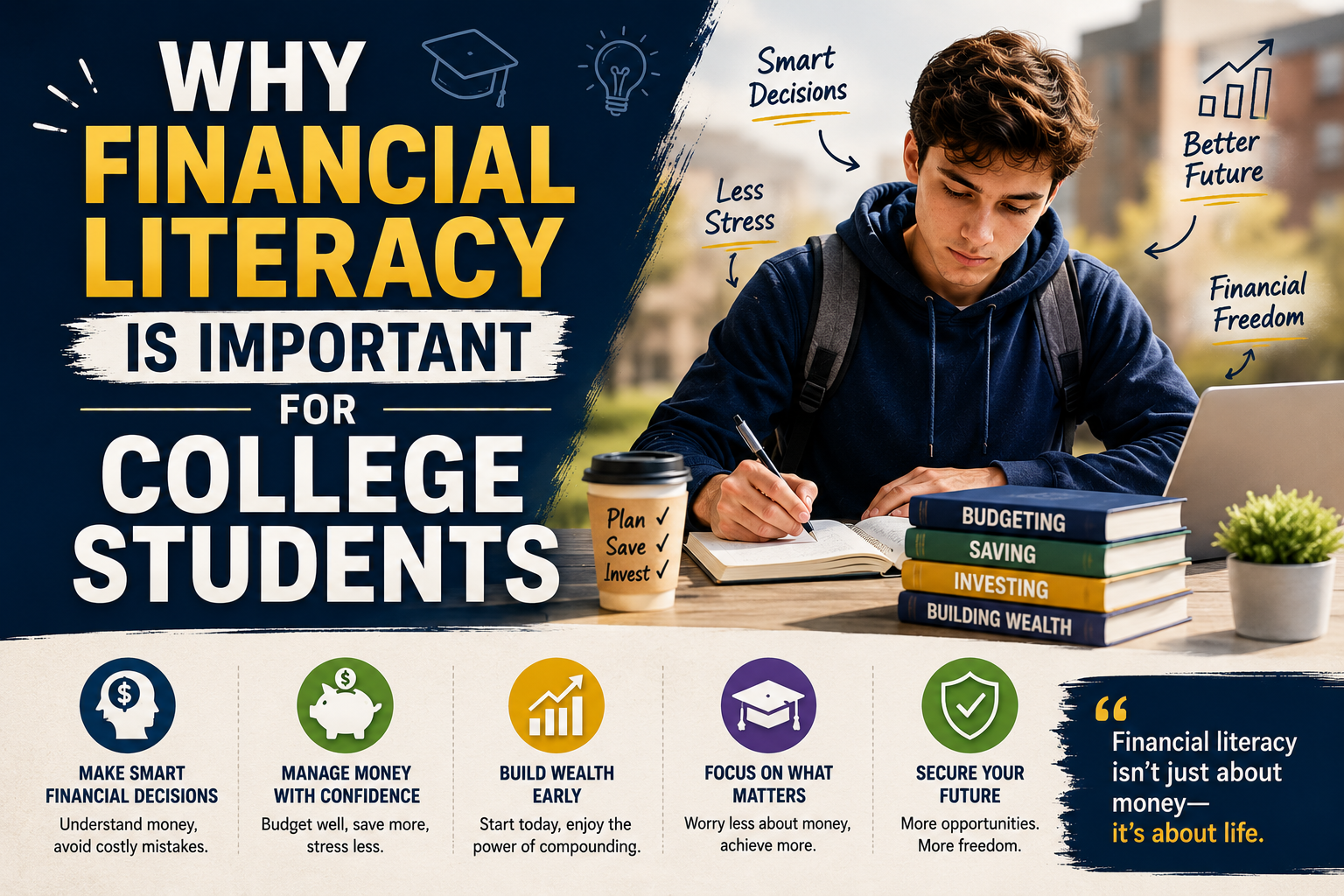
    You can study four years at a university, earn a degree, and graduate with strong grades — and still have no idea how to manage a credit card, understand a student loan statement, or know the difference between a Roth IRA and a savings account. That’s not a personal failing. That’s a gap in the education system.

    Financial literacy — the ability to understand and apply basic money concepts — is one of the most practical life skills available to you. Yet most college students enter the workforce without it. The result is predictable: debt they didn’t plan for, savings they never started, and financial decisions made by default rather than by design.

    This guide explains exactly why financial literacy matters for college students, what it actually covers, and how you can start building it today — even on a student income.

    $37K
    Average student loan debt per borrower in the U.S.
    65%
    College students who feel financially unprepared after graduation
    1 in 3
    Gen Z adults with zero emergency savings

    What Financial Literacy Actually Means

    Financial literacy is not about being wealthy. It’s not about having a finance degree or reading the Wall Street Journal every morning. It’s simply the ability to understand how money works — and to use that understanding to make better decisions about the money you have.

    A financially literate student knows how to build a monthly budget, understands what an interest rate means, knows the difference between good and bad debt, can read a bank statement, and has a basic grasp of how saving and investing work over time. None of this requires advanced knowledge. All of it requires learning things the school system rarely teaches.

    💡 A Simple Definition

    Financial literacy = the knowledge and skills to manage your money effectively. It’s not about how much you earn — it’s about how confidently and intentionally you handle what you do earn. A student earning $800 a month with financial literacy is better positioned than a graduate earning $60,000 without it.

    Why Financial Literacy Matters Especially in College

    College is the first time most people manage their own money independently. Financial aid arrives in a lump sum. Credit card companies target students aggressively. Student loans are signed with a click. Rent, groceries, textbooks, and social spending all compete for the same limited income. For many students, it’s overwhelming — and without financial literacy, the defaults are expensive.

    Reason 01

    You’re making real financial decisions for the first time

    College is the stage where financial decisions begin to have lasting consequences. The credit habits you build now follow you for years. The student loans you sign without reading are real legal obligations. The savings habit you either develop or skip in college shapes your financial baseline going into your 30s and beyond.

    Reason 02

    Compound interest works for or against you — starting now

    Every year you delay investing is a year of compound growth you can never get back. Every year you carry high-interest credit card debt is a year that compound interest works against you. Financial literacy helps you understand this dynamic early — when the difference between acting and waiting is still relatively small in dollars but enormous in decades.

    Reason 03

    Student loans are one of the largest financial decisions of your life

    The average student borrower graduates with over $37,000 in federal loan debt. Many have significantly more. Yet most students sign their promissory notes each year without reading them, without tracking their running total, and without understanding how repayment works. Financial literacy doesn’t eliminate student loans — it ensures you make informed decisions about how much to borrow and how to manage what you owe.

    Reason 04

    Credit history starts in college — and follows you everywhere

    Your credit score affects your ability to rent an apartment, finance a car, qualify for a mortgage, and sometimes even get a job. Building credit thoughtfully in college — with one card, low utilization, and on-time payments — can get you to a 700+ score by graduation. Ignoring credit, or misusing it, can set you back years. Financial literacy is what makes the difference.

    Reason 05

    The financial gap between your peers starts here

    Two students can graduate from the same program, enter similar jobs, and end up in dramatically different financial positions ten years later — not because of salary differences, but because of the habits, knowledge, and systems they built (or didn’t build) in college. Financial literacy is not a guarantee of wealth. It is the foundation that makes wealth possible.

    What Financial Literacy Covers

    Financial literacy isn’t one skill — it’s a set of interconnected concepts that build on each other. You don’t need to master all of them at once. But knowing what’s included helps you prioritize where to start.

    📋

    Budgeting

    Knowing your income, tracking your spending, and allocating money intentionally before the month begins.

    💳

    Credit & Credit Scores

    Understanding how credit scores work, what affects them, and how to build credit responsibly from day one.

    🏦

    Saving & Emergency Funds

    Building a financial cushion so unexpected expenses don’t become debt. Knowing where to keep savings.

    🧾

    Debt Management

    Distinguishing good debt from bad, understanding interest rates, and knowing how repayment actually works.

    📈

    Investing Basics

    Understanding compound interest, index funds, Roth IRAs, and why starting young changes everything.

    🎯

    Financial Goal Setting

    Knowing how to set specific, measurable financial goals — and how to track and achieve them consistently.

    Mini-Case · No One Told Marcus

    Marcus, Junior — Computer Science

    Marcus got his first credit card freshman year with a $2,000 limit. He used it for takeout, concert tickets, and a new laptop — paying only the $35 minimum each month. Nobody had ever explained how APR worked. Nobody told him that 24% annual interest compounds monthly.

    By junior year his balance was $1,900. He was paying more in monthly interest than he was reducing the principal. The laptop had effectively cost him $1,700 and counting. He wasn’t irresponsible — he was uninformed.

    The lesson: Marcus’s situation wasn’t caused by recklessness. It was caused by a gap in financial education that one afternoon of learning could have prevented. Financial literacy isn’t about being smarter — it’s about having information that changes how you act.

    The Real Cost of Financial Illiteracy

    Financial illiteracy isn’t just an abstract disadvantage. It has concrete, dollar-denominated consequences that compound over years — often without the person realizing what’s happening until the damage is done.

    Mini-Case · High GPA, Empty Account

    Jordan, Recent Graduate — Pre-Law

    Jordan graduated with a strong GPA and $62,000 in student loan debt. His $58,000 starting salary felt like a victory — until he did the math. After taxes, rent, loan payments on the standard 10-year plan, and a car payment he hadn’t properly compared rates on, Jordan had less than $200 left each month.

    He had never made a budget. He didn’t know income-driven repayment plans existed. His car loan carried a 17% interest rate — predatory, but he had signed without reading. His credit card had a $1,200 balance at 22% APR.

    The lesson: A strong academic record and a decent salary don’t equal financial health. Financial literacy is what bridges the gap between earning money and actually keeping — and growing — it.
    Mini-Case · Small Habit, Big Outcome

    Priya, Senior — Communications

    Priya worked 15 hours a week at the campus library — around $450 a month after taxes. After expenses she had $80 left over. Instead of spending it, she read about Roth IRAs one Sunday afternoon, opened a Fidelity account that same day, and set up an $80 monthly automatic contribution into a total market index fund.

    She wasn’t wealthy. She didn’t have a finance degree. She had one afternoon of financial literacy and the discipline to act on it.

    The lesson: At a 8% average annual return, Priya’s $80/month habit has the potential to grow to over $279,000 in 40 years — completely tax-free in her Roth IRA. Financial literacy didn’t require a high income. It required information and one decision.
    Money Management Basics Book Cover
    Explore the Easy Learning Series

    Money Management Basics

    Simple steps to take control of your finances — learn how to track spending, build savings, and reduce debt with clear, practical guidance.

    View on Amazon →
    >

    How to Start Building Financial Literacy Today

    Financial literacy isn’t built in a semester — it’s built in small steps over time. The good news is that the most impactful concepts take very little time to understand, and acting on them early creates disproportionately large results.

    You don’t need to read every personal finance book or take a course. You need five actions, done in order, and one commitment to keep learning as your situation evolves.

    Your 5 Starting Points — This Week

    • Know your number: Add up all your monthly income from every source. Write that number down. It’s your financial baseline — everything else is built on it.
    • Track your spending for one month: Don’t budget yet — just watch. Pull up your last 30 days of transactions and categorize them. You cannot improve what you haven’t measured.
    • Check your credit score: Use Credit Karma, Experian, or your bank app — most offer free access. Know where you stand and what’s affecting your score.
    • Log into StudentAid.gov: Find your exact loan balance, interest rate, and repayment options. Many students have never done this. It takes five minutes and changes how you think about every borrowing decision going forward.
    • Open a high-yield savings account: Move your savings from a traditional bank (0.01% APY) to an online bank offering 4–5% APY. Same money, automatically earning more. Takes 10 minutes.

    “Financial literacy isn’t about knowing everything. It’s about knowing enough to make better decisions than you would have otherwise — and learning one more thing each month for the rest of your life.”

    The students who graduate financially prepared aren’t necessarily the ones who studied finance. They’re the ones who took the time to understand how money works in their own life — and who started that process early enough for the information to actually shape their decisions.

    This series exists to be that starting point. Each issue covers one topic — budgeting, credit, debt, saving, investing, financial goals — in plain language with real student examples. Start here. Keep going.

    ◆ ◆ ◆

    Frequently Asked Questions

    Why is financial literacy important for college students specifically?
    College is when most people make their first independent financial decisions — managing income, signing student loans, opening credit cards, paying rent. These decisions have long-term consequences, yet financial literacy is rarely taught in school. Students who understand money basics in college build credit, avoid unnecessary debt, start saving early, and enter the workforce with a significant financial head start over peers who never learned.
    What does financial literacy include for students?
    Financial literacy for students covers six core areas: budgeting (knowing your income and controlling spending), credit scores (building and protecting your credit history), saving and emergency funds (creating a financial cushion), debt management (understanding student loans and avoiding high-interest traps), investing basics (compound interest, index funds, Roth IRAs), and financial goal setting (turning intentions into specific plans with deadlines and monthly actions).
    How does financial literacy affect a student’s future?
    The financial habits and decisions made in college compound significantly over time. A student who builds good credit, avoids carrying a credit card balance, starts a small Roth IRA, and manages their student loans wisely will have meaningfully different financial outcomes at 35 and 45 than a peer with the same salary who never learned these concepts. Financial literacy doesn’t change income — it changes what you do with income.
    Can you be financially literate on a small student income?
    Yes — and in some ways it’s easier. The core concepts of financial literacy are the same at $900/month as they are at $9,000/month: spend less than you earn, build an emergency fund, avoid high-interest debt, and start investing something consistently. A student earning $900 a month who does all four is more financially literate — and better positioned for the future — than a professional earning $8,000 who does none of them.
    What is the easiest way to start building financial literacy as a student?
    Start with your actual numbers: know your monthly income, look at your last 30 days of spending, and check your credit score and student loan balance. These four actions take under an hour and immediately change how you see your finances. From there, read one personal finance article or watch one explainer video per week — covering budgeting, credit, saving, investing, and debt in that order. Knowledge in use is what builds literacy, not knowledge in theory.

    The Campus Investor  ·  Issue 01  ·  Financial Literacy Series

    Written for students who want to graduate smart — and retire rich.

  • 5.3 Student Loans Explained: What Every Borrower Must Know

    5.3 Student Loans Explained: What Every Borrower Must Know

    Student loans are borrowed funds specifically designated for education expenses including tuition, fees, books, housing, and living costs during college or graduate school—creating obligation to repay principal plus interest after graduation or leaving school, with repayment terms, interest rates, and borrower protections varying significantly between federal loans offering fixed rates (4-7% typical), income-driven repayment options, and potential forgiveness programs versus private loans through banks requiring credit checks, offering variable rates (7-14% typical), and providing fewer protections making federal borrowing generally preferable despite lower borrowing limits. Representing $1.7+ trillion national debt burden affecting 43+ million Americans, student loans enable education access impossible for most through cash payment alone—bachelor’s degree costing $40,000-$100,000+ at public universities and $120,000-$200,000+ at private institutions requires borrowing for majority of students, with appropriate loan usage financing high-ROI degrees generating $500,000-$2,000,000 additional lifetime earnings justifying debt costs while excessive borrowing for low-earning majors creates financial burdens consuming 20-40% of post-graduation income for decades making strategic borrowing decisions, realistic earning potential evaluation, and loan type understanding essential for education financing aligned with career goals rather than emotional college choice creating impossible repayment situations destroying financial futures through student debt exceeding earning capacity.

    Notebook sketch explaining personal finance

    This article is designed for anyone considering student loans for self or dependents, current borrowers wanting repayment optimization, or those confused by federal versus private options and repayment strategies. You do not need financial expertise to understand student loans—fundamental concepts accessible through clear explanations of loan types, application processes, repayment options, and strategic considerations, though requires honest degree ROI evaluation distinguishing between passion pursuits and practical earning potential, realistic cost assessment comparing schools and financing options, and disciplined borrowing limiting debt to amounts sustainable on expected post-graduation income preventing common trap of following dreams to expensive institutions for low-earning degrees creating six-figure debt with five-figure salaries making repayment mathematically impossible without parent support or income-driven forgiveness relying on taxpayers subsidizing poor borrowing decisions.

    Understanding student loans matters because single education financing decision determines whether degree investment produces positive or negative lifetime financial return, federal versus private loan choice creates $20,000-50,000+ difference in total repayment costs through interest rates and repayment flexibility, and strategic borrowing enables career advancement through education while irresponsible borrowing destroys financial futures through impossible debt burdens—while student-loan-literate individuals maximize federal borrowing before private, limit debt to 1x first-year salary maintaining affordable payments, and choose degrees with clear employment paths yielding incomes justifying debt costs, creating dramatically different outcomes where strategic borrowers achieve 10-40x ROI through increased lifetime earnings versus irresponsible borrowers struggling with payments consuming 30%+ of income for decades preventing wealth accumulation, homeownership, and financial security through education debt exceeding benefits received.

    Educational disclaimer: This article provides general educational information about student loans. Individual loan terms, eligibility, interest rates, and appropriate borrowing amounts vary based on circumstances including credit, income, school choice, and degree pursued. Federal student loan programs and repayment options subject to legislative changes. This is not financial advice or recommendation of specific borrowing amounts or schools. Consult qualified financial aid advisors and education professionals for personalized guidance. Student loan debt carries serious long-term financial implications requiring careful consideration before borrowing.

    Federal vs Private Student Loans

    Federal Student Loans (Preferred Option)

    Key characteristics:

    • Funded by U.S. Department of Education
    • Fixed interest rates set by Congress annually
    • No credit check required (except PLUS loans)
    • Income-driven repayment plans available
    • Potential loan forgiveness programs
    • Deferment and forbearance options during hardship
    • Death and disability discharge provisions

    Federal loan types:

    Direct Subsidized Loans (undergraduates with financial need):

    • Government pays interest while in school (minimum half-time enrollment)
    • Annual limits: $3,500-$5,500 depending on year in school
    • Interest rate: 5.50% for 2024-2025 academic year (fixed)
    • Best federal option due to subsidized interest

    Direct Unsubsidized Loans (all students regardless of need):

    • Interest accrues from disbursement (even during school)
    • Annual limits: $5,500-$7,500 undergrad, $20,500 graduate
    • Interest rate: 5.50% undergrad, 7.05% graduate (2024-2025)
    • Most common federal loan type

    Direct PLUS Loans (parents and graduate students):

    • Parent PLUS: Parents borrow for dependent undergraduates
    • Grad PLUS: Graduate students borrow additional funds
    • Credit check required (adverse credit disqualifies)
    • Interest rate: 8.05% (2024-2025)
    • Origination fee: 4.228%
    • No aggregate limit (borrow up to cost of attendance)

    Annual federal borrowing limits (dependent undergraduates):

    • Freshman: $5,500 ($3,500 subsidized, $2,000 unsubsidized)
    • Sophomore: $6,500 ($4,500 subsidized, $2,000 unsubsidized)
    • Junior/Senior: $7,500 ($5,500 subsidized, $2,000 unsubsidized)
    • Aggregate limit: $31,000 total ($23,000 subsidized)

    Private Student Loans (Last Resort)

    Key characteristics:

    • Issued by banks, credit unions, online lenders
    • Variable or fixed interest rates based on creditworthiness
    • Credit check required (cosigner often needed for students)
    • No income-driven repayment or forgiveness options
    • Limited deferment/forbearance (lender discretion)
    • No death or disability discharge typically

    Private loan interest rates:

    • Excellent credit (750+): 4-7% variable, 5-8% fixed
    • Good credit (700-749): 7-10% variable, 8-11% fixed
    • Fair credit (650-699): 10-12% variable, 11-13% fixed
    • Poor credit: Often requires cosigner or denied
    • Rates adjust with market (variable) creating payment uncertainty

    Federal vs Private Comparison

    $30,000 borrowed over 4 years, 10-year repayment:

    Federal unsubsidized at 6.5% fixed:

    • Monthly payment: $341
    • Total paid: $40,920
    • Total interest: $10,920
    • Income-driven option if needed: Yes
    • Forgiveness eligible: Yes (Public Service after 120 payments)

    Private at 9% variable (starts, could increase):

    • Monthly payment: $380
    • Total paid: $45,600 (if rate stays 9%, increases if rates rise)
    • Total interest: $15,600
    • Income-driven option: No
    • Forgiveness eligible: No
    • Rate increase risk: Yes (could reach 12%+ = $430 monthly)

    Cost difference: $4,680 more expensive for private loan, plus flexibility loss

    Strategic Borrowing Priority

    Recommended borrowing sequence:

    • 1. Federal Direct Subsidized Loans (if eligible) – Best option, government pays interest during school
    • 2. Federal Direct Unsubsidized Loans – Fixed rates, repayment flexibility, forgiveness options
    • 3. Scholarships and grants (free money, prioritize aggressive searching)
    • 4. Work-study and part-time employment (earn while learning)
    • 5. Parent PLUS Loans (if parents willing and able, higher rates but federal protections)
    • 6. Private student loans – ONLY after exhausting all federal options
    Advertisement

    Financial Wellness Planner

    How Much to Borrow: The ROI Calculation

    The Critical Question: Debt vs Expected Income

    Golden rule of student loan borrowing:

    • Total student loan debt should not exceed first-year expected salary
    • Example: Expect $50,000 starting salary → Borrow maximum $50,000 total
    • Ensures manageable 10% of gross income payment on standard 10-year plan
    • Exceeding this ratio creates unsustainable burden requiring income-driven plans

    Calculation example:

    • Degree: Bachelor’s in Computer Science
    • Expected starting salary: $75,000 (research median for field)
    • Maximum recommended debt: $75,000
    • Payment on standard 10-year plan at 6%: $832 monthly
    • Payment as percentage of gross income: 13% ($832 ÷ $6,250 monthly gross)
    • Manageable within typical budget (under 15% threshold)

    Degree ROI by Field

    High-ROI degrees (debt-to-income under 1x easily achievable):

    Engineering:

    • Median starting salary: $70,000-$80,000
    • Recommended maximum debt: $70,000-$80,000
    • Lifetime earnings premium: $1.5-$2M vs high school diploma
    • ROI: 20:1+ (borrow $60,000, earn $1.2M extra over career)

    Nursing (BSN):

    • Median starting salary: $60,000-$70,000
    • Recommended maximum debt: $60,000
    • Lifetime earnings premium: $1M+
    • ROI: 15:1+ plus job security and advancement

    Computer Science:

    • Median starting salary: $75,000-$85,000
    • Recommended maximum debt: $75,000
    • Lifetime earnings premium: $1.5-$2.5M
    • ROI: 20-30:1

    Accounting/Finance:

    • Median starting salary: $55,000-$65,000
    • Recommended maximum debt: $55,000
    • Lifetime earnings premium: $900,000-$1.2M
    • ROI: 15-20:1

    Low-ROI degrees (difficult to maintain debt-to-income under 1x):

    Psychology (BA):

    • Median starting salary: $35,000-$40,000
    • Recommended maximum debt: $35,000 (difficult to achieve at many schools)
    • Lifetime earnings premium: Limited without graduate degree
    • Warning: $60,000 debt common but creates 60%+ debt-to-income ratio

    Liberal Arts/Humanities:

    • Median starting salary: $32,000-$38,000
    • Recommended maximum debt: $32,000
    • Reality: Private school costs create $80,000-$120,000 debt typical
    • Outcome: 2.5-3.5x debt-to-income ratio creating financial crisis

    Fine Arts:

    • Median starting salary: $30,000-$35,000
    • Recommended maximum debt: $30,000 maximum
    • Challenge: Often requires expensive schools creating $100,000+ debt
    • Outcome: 3-4x debt-to-income ratio, likely default or forbearance

    Real-World ROI Examples

    Positive ROI example:

    • Degree: Bachelor’s in Mechanical Engineering from state university
    • Total cost: $80,000 (tuition, fees, books over 4 years)
    • Scholarships/grants: $20,000
    • Family contribution: $15,000
    • Work earnings: $10,000
    • Student loans: $35,000 (stayed under starting salary expectation)
    • Starting salary: $72,000
    • Loan payment: $398 monthly (10-year plan at 5%)
    • Payment as % of income: 6.6% (very manageable)
    • Salary without degree: $35,000 (high school diploma manufacturing work)
    • Income differential: $37,000 annually
    • Lifetime benefit: $1.48M additional earnings over 40-year career
    • ROI: 42:1 ($1.48M benefit vs $35,000 debt)

    Negative ROI example:

    • Degree: Bachelor’s in Art History from private university
    • Total cost: $200,000 (expensive private school)
    • Scholarships/grants: $40,000
    • Family contribution: $30,000
    • Work earnings: $8,000
    • Student loans: $122,000 (3.5x starting salary expectation)
    • Starting salary: $35,000 (museum assistant, retail management)
    • Standard 10-year payment: $1,390 monthly (unaffordable = 47% of gross)
    • Actual plan: Income-driven repayment $200 monthly (balance growing through insufficient payment)
    • 25-year timeline: Balance grows to $180,000, forgiven with tax bomb, paid $60,000 over 25 years
    • Salary without degree: $32,000 (similar retail work possible without degree)
    • Income differential: $3,000 annually (minimal benefit)
    • Lifetime “benefit”: $120,000 additional earnings over 40 years
    • Cost: $60,000 paid + $50,000 forgiveness tax burden = $110,000
    • Net result: Paid $110,000 for $120,000 benefit = Minimal ROI, 25 years financial stress

    Repayment Plans and Options

    Standard Repayment Plan

    How it works:

    • Fixed monthly payment over 10 years
    • Automatic plan if no alternative selected
    • Minimizes total interest paid
    • Highest monthly payment but shortest timeline

    Example:

    • Debt: $40,000 at 6% APR
    • Monthly payment: $444
    • Total paid: $53,280
    • Total interest: $13,280

    Graduated Repayment Plan

    How it works:

    • Payments start lower, increase every 2 years
    • 10-year term total
    • Designed for borrowers expecting income growth
    • Higher total interest than standard plan

    Example (same $40,000):

    • Years 1-2: $250 monthly
    • Years 3-4: $350 monthly
    • Years 5-6: $450 monthly
    • Years 7-8: $600 monthly
    • Years 9-10: $750 monthly
    • Total paid: $57,000
    • Total interest: $17,000 (vs $13,280 standard)
    • Extra cost: $3,720 for payment flexibility

    Income-Driven Repayment Plans

    Four main types:

    1. SAVE Plan (Saving on a Valuable Education, newest):

    • Payment: 10% of discretionary income (income above 225% poverty line)
    • Forgiveness: 20 years undergraduate, 25 years graduate
    • Interest subsidy: Government covers unpaid interest preventing balance growth
    • Best income-driven option for most borrowers

    2. PAYE (Pay As You Earn):

    • Payment: 10% of discretionary income
    • Forgiveness: 20 years
    • Eligibility: New borrowers after Oct 1, 2007

    3. IBR (Income-Based Repayment):

    • Payment: 10-15% of discretionary income depending on loan date
    • Forgiveness: 20-25 years
    • Available to most federal borrowers

    4. ICR (Income-Contingent Repayment):

    • Payment: Lesser of 20% of discretionary income or fixed 12-year plan amount
    • Forgiveness: 25 years
    • Least favorable income-driven option

    Income-driven example:

    • Debt: $60,000 at 6%
    • Income: $40,000
    • Poverty line (single): $15,000 (approximate)
    • 225% poverty line: $33,750
    • Discretionary income: $40,000 – $33,750 = $6,250
    • SAVE payment: $6,250 × 10% ÷ 12 months = $52 monthly
    • Standard payment would be: $666 monthly (unaffordable)
    • Benefit: Manageable payment during low-earning years
    • Drawback: Balance grows from insufficient payment, 20-year timeline

    Public Service Loan Forgiveness (PSLF)

    Eligibility requirements:

    • Work full-time for qualifying employer (government, 501(c)(3) nonprofit)
    • Make 120 qualifying payments (10 years) under income-driven plan
    • Federal Direct Loans only (consolidate if needed)
    • Remaining balance forgiven tax-free after 120 payments

    PSLF strategic example:

    • Degree: Master’s in Social Work, $80,000 debt
    • Job: Nonprofit mental health center, $48,000 salary
    • Plan: SAVE income-driven, $200 monthly payment
    • 10 years: Paid $24,000 total ($200 × 120 months)
    • Balance after 10 years: $85,000 (grew through insufficient payments)
    • Forgiven: $85,000 tax-free through PSLF
    • Total cost: $24,000 for $80,000 education (effective 70% discount)
    • Alternative without PSLF: $90,000+ paid over 20-25 years
    • Savings: $66,000 through strategic PSLF qualification
    Advertisement
    Reserved space for in-content ad

    Strategic Student Loan Management

    While In School

    Minimize borrowing strategies:

    • Choose in-state public university (60-70% less expensive than private)
    • Live at home or off-campus (saves $10,000-$15,000 annually vs dorms)
    • Work part-time 10-20 hours weekly ($5,000-$10,000 annually)
    • Apply aggressively for scholarships (thousands available, most unclaimed)
    • Complete degree in 4 years maximum (extra year = $20,000-$30,000+ additional debt)
    • Take AP/CLEP credits reducing required courses
    • Start at community college transferring junior year (save $20,000-$40,000)

    Interest minimization for unsubsidized loans:

    • Pay interest while in school preventing capitalization
    • Example: $20,000 unsubsidized at 6% over 4 years
    • Interest accrual: $100 monthly
    • If unpaid: $4,800 interest capitalizes (adds to principal) = $24,800 balance at graduation
    • If paid monthly: $20,000 balance at graduation, saved $4,800 future interest
    • Even partial payments help: $50 monthly reduces capitalization by $2,400

    After Graduation

    Aggressive payoff strategy (when affordable):

    • Pay more than minimum attacking principal
    • Specify “apply to principal” not future payments when sending extra
    • Target highest interest rate loans first (avalanche method)
    • Refinance if excellent credit and stable income (lose federal protections, weigh carefully)

    Payoff acceleration example:

    • Debt: $35,000 at 6%
    • Standard payment: $389 monthly, 10 years, $11,680 interest
    • Aggressive $600 monthly: 6.5 years, $7,000 interest
    • Savings: $4,680 interest plus 3.5 years faster

    Income-driven strategy (when necessary):

    • Enroll in SAVE or PAYE during low-earning years
    • Recertify income annually (required for plan continuation)
    • Track PSLF qualifying payments if eligible
    • Understand forgiveness creates taxable income (except PSLF)

    Refinancing Considerations

    When refinancing makes sense:

    • Excellent credit score (740+)
    • Stable high income (debt-to-income under 20%)
    • Current federal rate over 7% and can refinance to under 5%
    • No intention to use income-driven plans or PSLF
    • Emergency fund established (6+ months expenses)

    Refinancing example:

    • Current: $50,000 federal at 7%, $581 monthly, 10 years remaining
    • Refinance: $50,000 private at 4.5%, $519 monthly, 10 years
    • Monthly savings: $62
    • Total savings: $7,440 over 10 years
    • Trade-off: Lose income-driven repayment, forbearance flexibility, forgiveness eligibility

    When refinancing risky:

    • Job instability or income uncertainty
    • Planning PSLF pursuit
    • May need income-driven plans future
    • Federal protections valuable (deferment, forbearance)
    • Interest savings minimal (under 1.5% reduction)

    Avoiding Default

    Default consequences:

    • Entire balance becomes immediately due
    • Wages garnished up to 15% without court order
    • Tax refunds seized
    • Social Security benefits garnished (if receiving)
    • Credit score destroyed (drops 100+ points)
    • Collection costs added to balance (up to 25%)
    • Federal employment ineligible
    • Professional licenses jeopardized in some states

    Prevention strategies if struggling:

    • Contact servicer IMMEDIATELY when payment difficulty arises
    • Switch to income-driven repayment (payment as low as $0 if very low income)
    • Request deferment or forbearance (temporary payment pause, interest accrues)
    • Consolidate defaulted loans into new Direct Consolidation Loan
    • Rehabilitation program (9 on-time payments restores good standing)

    Making the College Decision

    Cost vs Value Analysis

    Compare total 4-year costs:

    In-state public university:

    • Tuition: $10,000 annually
    • Room/board: $12,000 annually
    • Books/fees: $2,000 annually
    • Total annual: $24,000
    • 4-year total: $96,000

    Private university:

    • Tuition: $50,000 annually
    • Room/board: $15,000 annually
    • Books/fees: $2,000 annually
    • Total annual: $67,000
    • 4-year total: $268,000

    Cost difference: $172,000

    The critical question: Does private school create $172,000 additional lifetime value?

    Same degree earning potential:

    • Computer Science degree: $80,000 starting salary from either school
    • Employers care about degree, skills, experience—rarely care about specific school for most majors
    • ROI comparison: Public $96,000 investment = 1.2:1 cost-to-income. Private $268,000 = 3.4:1 cost-to-income
    • Verdict: Public university superior financial choice for same career outcome

    Different earning potential (rare exception):

    • Ivy League or elite school opening doors to investment banking ($150,000+ starting)
    • Top law school enabling BigLaw ($200,000+ starting)
    • Elite connections network creating opportunity premium
    • May justify higher cost IF pursuing these specific high-paying career paths

    Alternative Education Paths

    Community college → 4-year transfer:

    • 2 years community college: $6,000 tuition ($3,000 annually)
    • 2 years state university: $40,000 ($20,000 annually including room/board)
    • Total: $46,000 for bachelor’s degree
    • Same diploma as 4-year attendee
    • Savings: $50,000 versus 4 years at state school

    Trade schools and certificates:

    • Electrician, plumber, HVAC: $5,000-$15,000 training
    • Earning potential: $50,000-$80,000 with experience
    • No student debt burden
    • Start earning 18-24 months vs 4+ years

    Employer-sponsored education:

    • Major companies (Starbucks, Amazon, Walmart, UPS) offer tuition assistance
    • Work part-time while attending school debt-free
    • Takes longer but zero debt
    Advertisement
    Reserved space for in-content ad

    Why Understanding Student Loans Matters

    Without understanding student loans, individuals borrow blindly following emotional college choices creating six-figure debt for degrees yielding five-figure salaries making repayment impossible, choose private loans losing federal protections and paying $20,000-50,000 extra in interest, and miss strategic repayment options like PSLF potentially forgiving $50,000-100,000+ debt—while student-loan-literate individuals limit borrowing to 1x expected first-year salary ensuring manageable payments, maximize federal loans before private capturing lower rates and protections, and strategically pursue high-ROI degrees in engineering, nursing, computer science generating $1-2 million additional lifetime earnings justifying education costs, creating dramatically different outcomes where strategic borrowers achieve positive 10-40x ROI through education enabling career advancement versus irresponsible borrowers struggling with payments consuming 30-40% of income for decades preventing homeownership, retirement savings, and financial security through education debt exceeding benefits impossible to escape without default, forbearance, or 20-25 year forgiveness programs subsidizing poor borrowing decisions.

    Understanding student loans enables individuals to:

    • Calculate appropriate borrowing limits through debt-to-income ROI analysis
    • Distinguish between federal and private loans maximizing favorable terms
    • Evaluate degree earning potential determining sustainable debt levels
    • Navigate repayment options matching income and career paths strategically
    • Pursue PSLF when eligible potentially saving $50,000-100,000+
    • Make informed school choices weighing costs versus career outcomes
    • Avoid default consequences through proactive servicer communication and plan changes

    Student loan knowledge transforms education financing from emotional college dreams into strategic career investment evaluating costs, expected returns, and repayment sustainability enabling wealth-building through appropriate education debt versus financial destruction through excessive borrowing for low-earning degrees impossible without understanding loan types, repayment mechanics, and degree ROI analysis.

    Common Misunderstandings

    Many people assume all college degrees equally valuable justifying any borrowing amount. In reality, degree ROI varies dramatically—engineering generating $1.5-2M lifetime earnings premium versus psychology BA creating $200,000-300,000 differential, making $60,000 debt excellent investment for engineering (paid back in 3-4 years from income differential) versus potentially devastating burden for psychology requiring 15-20 years repayment on lower income, proving degree field fundamentally determines whether student debt strategic investment or destructive burden requiring honest earning potential evaluation not assumption that any bachelor’s degree justifies unlimited borrowing based on generic “college graduates earn more” statistics obscuring massive variation by major.

    Another common misconception is private student loans offer better rates than federal. In practice, federal rates (currently 5.50-8.05%) compare favorably to private loans requiring excellent credit (4-7% variable best-case, 8-13% typical), plus federal loans provide income-driven repayment, forbearance flexibility, potential PSLF forgiveness, and death/disability discharge worth $10,000-50,000+ in option value making federal loans superior even at slightly higher interest rates through protections impossible to replicate with private loans lacking safety nets creating default risk when income disrupted, proving federal borrowing should always be maximized before considering private loans despite marketing suggesting private loans competitive.

    Some believe student loan debt dischargeable through bankruptcy like credit cards. However, student loans nearly impossible to discharge requiring “undue hardship” standard met only in extreme circumstances (permanent disability, decades of unsuccessful repayment attempts, zero prospect of future income) with under 1% of bankruptcy filers achieving student loan discharge, proving student debt follows borrowers for life unlike dischargeable consumer debt making student loan decisions permanent requiring careful consideration before borrowing versus false security believing bankruptcy provides escape route from excessive education debt.

    How Student Loan Understanding Fits Into Financial Success

    Student loan understanding enables strategic education financing creating 10-40x ROI through increased lifetime earnings, prevents financial destruction through excessive borrowing for low-earning degrees, and maximizes federal loan benefits through appropriate repayment plan selection—making student debt literacy essential component of career development requiring realistic degree ROI evaluation, disciplined borrowing limits maintaining debt under 1x first-year salary, and strategic repayment approach matching income trajectory, transforming student loans from feared burden or reckless spending into calculated investment enabling career advancement when borrowed appropriately for high-earning degrees versus creating impossible repayment situations when excessive debt finances passion majors yielding insufficient income justifying costs impossible without understanding degree earning potential, loan type differences, and repayment mechanics enabling informed education financing decisions.

    For example, two high school seniors both age 18 considering college. Student A passionate about art history, emotionally attached to prestigious private university costing $60,000 annually ($240,000 total). Receives $10,000 annual scholarship, parents contribute $10,000 annually, borrows $40,000 annually in student loans (federal maxed, remainder private) totaling $160,000 debt upon graduation. Graduates age 22 with Bachelor’s in Art History, finds museum assistant position paying $34,000 annually. Student loan payment on standard 10-year plan: $1,845 monthly (unaffordable, 65% of gross income). Switches to income-driven repayment: $150 monthly but balance grows through insufficient payment. After 10 years age 32: Paid $18,000 total, balance grown to $195,000, still 15 years remaining on 25-year forgiveness timeline, career advanced to $42,000 (minimal growth), cannot afford home purchase (student debt prevents mortgage approval despite $30,000 saved), cannot save for retirement (payments plus living expenses consume income). After 25 years age 47: Paid $45,000 total ($150 × 300 months), $200,000 forgiven creating $70,000 tax liability (forgiveness treated as income), total education cost $115,000 for degree enabling $34,000-$48,000 career versus $30,000-$35,000 without degree, marginal lifetime benefit $200,000-$300,000 consumed by education costs and opportunity costs making net financial outcome negative. Student B researches degree earning potential, discovers engineering median starting salary $75,000, chooses in-state public university $25,000 annually total cost ($100,000 over 4 years). Receives $8,000 annual scholarship, parents contribute $10,000 annually, works part-time earning $5,000 annually, borrows $7,000 annually federal loans totaling $28,000 debt upon graduation (staying well under 1x starting salary guideline). Graduates age 22 with Bachelor’s in Mechanical Engineering, accepts position paying $74,000. Student loan payment standard 10-year: $318 monthly (comfortable, 5.2% of gross income). Aggressively pays $600 monthly eliminating debt by age 27 (5 years), total paid $32,600 ($28,000 + $4,600 interest). Age 32: Debt-free, salary advanced to $95,000, purchased home age 28 (excellent credit, manageable debt-to-income enabled mortgage), building equity $60,000, retirement accounts $85,000. Age 47: Home equity $250,000, retirement savings $780,000, total net worth $1.2M+ from strategic degree choice enabling high income. Difference: Student A’s poor student loan understanding through excessive borrowing for low-earning degree created $115,000 education cost for minimal career benefit requiring 25 years repayment preventing wealth building, Student B’s student debt literacy through limited borrowing for high-ROI degree created $32,600 education investment yielding $1.2M+ net worth by age 47 ($1.5M additional lifetime earnings from engineering vs art history path) demonstrating $1.3M+ wealth difference from understanding degree ROI, appropriate borrowing limits, and loan type optimization enabling career advancement through strategic education debt versus financial destruction through passion-based borrowing exceeding earning potential.

    Student loan understanding separates strategic education investors achieving dramatic ROI through high-earning degrees from financially-burdened passion pursuers struggling with debt exceeding career earning potential, requiring honest degree evaluation, disciplined borrowing limits, and federal loan maximization creating measurable wealth differences impossible without student debt literacy.

    Recent Updates and Trends

    In recent years, SAVE plan introduced (2023) replacing REPAYE offering improved terms including interest subsidy preventing balance growth and income-driven payments based on 225% poverty line versus 150% creating lower payments for most borrowers, though plans subject to legal challenges and political changes requiring monitoring of program availability and terms before relying on long-term forgiveness expectations.

    Student loan forgiveness debates have intensified with proposed broad cancellation programs facing legal challenges, though actual forgiveness remains limited to existing programs (PSLF, income-driven forgiveness after 20-25 years, disability discharge) making responsible borrowing essential rather than assuming future cancellation will eliminate debt through political action creating false security encouraging irresponsible borrowing.

    Income-driven repayment enrollment has surged with 40%+ of federal borrowers now using IDR plans versus 10-year standard repayment, indicating borrowers struggling with debt burdens exceeding original affordability expectations though creating concerns about program costs and sustainability as balances grow through insufficient payments requiring eventual forgiveness subsidized by taxpayers.

    College costs have continued rising faster than inflation with average tuition increasing 3-5% annually outpacing wage growth, making strategic school choice and borrowing discipline increasingly critical as even public universities approach $30,000-35,000 annual total costs creating $120,000-140,000 debt exposure for students borrowing full amounts without family contribution or scholarships.

    Fundamental student loan principles remain timeless: borrow only for high-ROI degrees justifying debt through increased earnings, limit total debt to 1x first-year expected salary ensuring manageable payments, maximize federal loans before private capturing protections and repayment flexibility, and pursue PSLF when eligible potentially saving $50,000-100,000+—regardless of forgiveness debates, plan changes, cost increases, or enrollment trends, understanding degree earning potential, appropriate borrowing limits, and strategic loan type selection produces superior outcomes through informed education financing enabling career advancement without financial destruction impossible without student debt literacy evaluating ROI before borrowing.

    3 Things You Can Do Today

    Ready to optimize student loan strategy? Here are three simple steps you can take right now:

    1. Research median starting salaries for degree being pursued calculating maximum recommended borrowing using 1x income rule – Specific degree consideration: Note exact major (Computer Science, Nursing, Psychology, Business, etc.). Research median starting salary: Visit Bureau of Labor Statistics (BLS.gov), PayScale.com, or university career services, find median NOT average (median more representative eliminating outliers). Example research: Bachelor’s in Accounting median starting salary $58,000, Bachelor’s in English median $38,000, Bachelor’s in Engineering median $75,000. Calculate maximum recommended debt: 1x first-year salary rule ensuring payments stay under 10-13% gross income on standard 10-year plan. Example calculations: Accounting degree → Maximum $58,000 total debt (payment $660 monthly = 11% of $58,000 income, manageable). English degree → Maximum $38,000 total debt (payment $432 monthly = 11% of $38,000 income, manageable but lower borrowing limit). Engineering degree → Maximum $75,000 total debt (payment $853 monthly = 11% of $75,000 income, manageable). Compare to actual borrowing needed: Calculate 4-year total cost (tuition, room/board, fees), subtract scholarships/grants, subtract family contribution, subtract expected work earnings = needed student loans. Example: Engineering at state school $100,000 total cost, $15,000 scholarships, $20,000 family, $10,000 work = $55,000 needed loans (under $75,000 maximum, APPROVED). Art History at private school $240,000 cost, $40,000 scholarships, $30,000 family, $8,000 work = $162,000 needed loans for degree with $35,000 median salary (4.6x income ratio, DANGER – unaffordable, requires school change or major change). Takes 30 minutes research creating concrete borrowing limit preventing excessive debt impossible to repay on realistic post-graduation income.

    2. If currently borrowing or planning to borrow, commit to maximizing federal loans before any private loans creating $20,000-50,000 savings through protections – Current or upcoming borrowing: List all needed educational funding. Federal loan priority sequence: (1) Complete FAFSA application annually (required for all federal aid), (2) Accept all Direct Subsidized Loans offered (government pays interest during school, best option), (3) Accept necessary Direct Unsubsidized Loans (interest accrues but federal protections valuable), (4) Consider federal Parent PLUS if parents willing (8% rate but federal safety nets), (5) Private loans ONLY after exhausting federal options. Annual federal limits review: Dependent undergrad maxes at $7,500 annually junior/senior year, $31,000 aggregate—if need exceeds, evaluate if school choice affordable or requires lower-cost alternative. Example federal maximization: Year 1 need $15,000, federal offers $5,500 → Accept $5,500 federal, reduce need to $9,500 through work/family before considering private. Year 2 need $18,000, federal offers $6,500 → Accept $6,500 federal, reduce need to $11,500. Year 3-4 need $20,000 each, federal offers $7,500 each → Accept $7,500 federal annually, total $27,000 federal over 4 years, remaining $23,000 need ($11,500 + $12,500 + $12,500) filled through work/family/small private if absolutely necessary. Benefits of federal maximization: $27,000 at fixed 6% with income-driven options versus private at 9-12% variable without protections, saves $8,000-15,000 in interest plus option value of federal repayment flexibility worth $10,000-30,000 if income disrupted. Critical commitment: Never accept private loans until federal completely exhausted, contact financial aid office requesting maximum federal eligibility before shopping private lenders. Takes 1 hour annually (FAFSA completion plus federal loan acceptance) creating $20,000-50,000 value through optimal loan type selection.

    3. If currently in repayment, evaluate current plan versus alternatives calculating potential interest savings or payment relief through plan optimization – Current repayment status: Note total balance, interest rate(s), current monthly payment, current plan type (standard, graduated, income-driven). Calculate current path: Use studentaid.gov loan simulator entering balance and rate, shows total paid on current plan, years to payoff, total interest. Example current situation: $45,000 balance at 6%, standard 10-year plan, $500 monthly, total paid $60,000, interest $15,000. Evaluate alternatives: Aggressive payoff—If income allows, what if pay $750 monthly? Payoff in 6.7 years, total paid $55,800, saves $4,200 interest. Income-driven—If payment straining budget, what if switch to SAVE plan? $150 monthly based on $40,000 income, balance grows initially but manageable during low-earning years, switch back to standard when income increases. PSLF pursuit—If employed by government or nonprofit, enroll in income-driven plan certifying employment annually, track toward 120 qualifying payments potentially forgiving $30,000-60,000 remaining balance. Refinancing evaluation—If excellent credit (740+), stable high income, current rate over 7%, can refinance to under 5% saving thousands BUT lose federal protections (only refinance if certain won’t need income-driven plans or forbearance). Example refinance: $45,000 at 7% refinance to 4.5% = Save $3,600 over remaining term but lose safety nets. Action decision tree: Comfortable payment + stable income = Aggressive payoff OR refinance if rate gap 2%+. Struggling with payment = Immediate switch to income-driven plan preventing default. Public service career = Enroll in PSLF-qualifying plan immediately, certify employment annually. Contact servicer: Call or log in online, can change repayment plans anytime, takes 10-20 minutes application, effective next month. Takes 20 minutes evaluation creating $3,000-60,000 potential savings through plan optimization or payment relief preventing default impossible when continuing unsuitable repayment plan without exploring alternatives.

    These actions create student loan mastery within 90 minutes—researched degree earning potential establishing appropriate borrowing limit preventing excessive debt ($50,000-100,000 potential savings avoiding unaffordable major/school combinations), committed to federal loan maximization creating $20,000-50,000 value through optimal loan type selection, and evaluated repayment plan optimization potentially saving $3,000-60,000 or preventing default—transforming student loans from feared burden or reckless tool into strategic education financing enabling career advancement through informed borrowing decisions aligned with earning potential impossible without understanding degree ROI, loan type differences, and repayment mechanics.

    Quick FAQ

    How much student loan debt is too much?
    Rule of thumb: Total student debt should not exceed first-year expected salary in chosen career field ensuring manageable 10-13% of gross income payment on standard 10-year repayment plan. Example appropriate: $55,000 debt for nursing degree with $60,000 starting salary (0.92:1 ratio), payment $626 monthly = 12.5% of $60,000 income (manageable within typical budget). Example excessive: $80,000 debt for psychology degree with $38,000 starting salary (2.1:1 ratio), payment $910 monthly = 29% of $38,000 income (unsustainable, requires income-driven plans with balance growth). Calculation: Research median starting salary for specific degree (not generic “college graduate” statistics obscuring major differences), use as maximum borrowing limit, compare to needed loans after scholarships/family/work, if exceeds limit choose different school or reconsider major. Warning signs of too much debt: Ratio exceeds 1.5x starting salary, standard payment would exceed 15% gross income, considering low-earning major at expensive school, total debt approaching $100,000 for bachelor’s degree. Reality: Under $30,000 total debt generally manageable regardless of major, $30,000-60,000 manageable for moderate-to-high earning degrees, $60,000-80,000 requires high-earning degree justification, over $80,000 bachelor’s debt red flag requiring exceptional degree ROI or school reconsideration.

    Should I use federal or private student loans?
    ALWAYS maximize federal loans before considering private due to superior protections worth $10,000-50,000+ in option value: Federal advantages—Fixed interest rates (5.50-8.05% current), income-driven repayment plans reducing payments to $0-10% of discretionary income during low-earning years, PSLF eligibility potentially forgiving $50,000-100,000+ for public service careers, deferment/forbearance during hardship, death and disability discharge protecting family from debt, no credit check required (except PLUS loans). Private disadvantages—Variable rates (can increase dramatically, 7-14% typical), credit check required often needing cosigner for students, no income-driven plans (payment fixed regardless of income hardship), no forgiveness programs, limited deferment/forbearance at lender discretion, cosigner remains liable if borrower dies. Cost comparison: $30,000 federal at 6% = $333 monthly 10 years, income-driven safety net if needed. $30,000 private at 9% variable = $380 monthly minimum, no safety net if income drops. Strategy: Accept all offered federal loans first, exhaust $31,000 dependent undergrad limit and $57,500 independent limit before considering private, evaluate if additional private borrowing signals unaffordable school requiring less expensive alternative. Exception: Refinancing existing federal loans to private AFTER graduation if excellent credit, stable high income, certain won’t need federal protections—but this converts federal to private permanently losing safety nets. Never bypass federal loans for private during school regardless of seemingly lower private rates advertised—federal protections worth more than interest rate differential.

    What is Public Service Loan Forgiveness and how do I qualify?
    PSLF forgives remaining federal Direct Loan balance tax-free after 120 qualifying monthly payments (10 years) while working full-time for qualifying employer: Qualifying employers—Federal, state, local, tribal government (any position), 501(c)(3) nonprofit organizations, other nonprofits providing public services (healthcare, education, public safety, law, early childhood education, public interest law, public service for individuals with disabilities/elderly, library, school-based services). NON-qualifying: For-profit companies (even if public-facing), labor unions, partisan political organizations, most 501(c)(4) organizations. Qualifying payments—Must be under income-driven repayment plan (SAVE, PAYE, IBR, ICR) or 10-year standard plan, full payment amount for that plan, made within 15 days of due date, while employed full-time at qualifying employer. Process: Enroll in income-driven plan, submit Employment Certification Form annually confirming employer qualifies and payments count toward 120, after 120 payments submit PSLF application for forgiveness. Strategic example: $75,000 law school debt, nonprofit legal aid attorney $52,000 salary, SAVE plan $300 monthly, after 10 years paid $36,000, balance grown to $85,000, forgiven tax-free saving $49,000. Requirements: Federal Direct Loans only (consolidate FFEL or Perkins loans if needed), must remain in qualifying employment full-time entire 10 years, must recertify income annually for income-driven plan, must submit employment certification to track progress. Common mistakes: Wrong loan type (FFEL or Perkins don’t qualify without consolidation), wrong repayment plan (extended, graduated don’t qualify), wrong employer (thinking any nonprofit qualifies when only certain types do), not certifying employment annually (cannot retroactively verify). Takes initial 20 minutes enrollment plus 10 minutes annually certification creating potential $40,000-120,000 forgiveness for public service careers making PSLF highly valuable for qualifying borrowers.

    Can I discharge student loans in bankruptcy?
    Extremely difficult, requiring “undue hardship” standard met in under 1% of bankruptcy cases making student loans effectively non-dischargeable unlike credit cards or medical debt: Undue hardship test (varies by jurisdiction but generally requires all three)—(1) Cannot maintain minimal standard of living for self and dependents if forced to repay loans, (2) Additional circumstances indicating hardship will persist for significant portion of repayment period, (3) Made good faith efforts to repay loans before seeking discharge. Examples rarely meeting standard: Temporary unemployment (not permanent hardship), moderate income insufficient to pay loans comfortably (courts expect sacrifice), choosing low-paying career after expensive education (self-imposed hardship). Examples sometimes meeting standard: Permanent total disability preventing any employment, severe chronic illness preventing work with no prospect of improvement, elderly borrower with no income or assets and no prospect of future income. Reality: Courts view education as conferring lasting benefit justifying repayment regardless of hardship, bankruptcy judges extremely reluctant to discharge absent catastrophic permanent circumstances. Successful discharge rate: Under 1% of bankruptcy filers even attempt adversary proceeding required for student loan discharge, under 20% of those attempting succeed, total discharge rate under 0.1% of borrowers. Better alternatives than bankruptcy: Income-driven repayment plans reducing payments to $0 if income very low, PSLF forgiveness for public service, disability discharge for total and permanent disability, negotiating settlement if in default (sometimes accept 40-60% of balance). Key insight: Student loans follow borrowers for life making borrowing decisions permanent unlike dischargeable consumer debt—requires careful degree and amount evaluation before borrowing rather than assuming bankruptcy provides escape route from excessive education debt.

    Should I pay off student loans early or invest the money?
    Depends on interest rate versus investment return expectations plus consideration of federal loan protections: GENERALLY pay student loans early when—Interest rate exceeds 7% (guaranteed savings likely beats market risk-adjusted returns), private loans without income-driven safety nets (eliminate risk), approaching major purchase requiring clean debt-to-income (mortgage application), loans create significant stress regardless of math (psychological value). GENERALLY invest instead when—Interest rate under 5% (market returns likely exceed guaranteed savings), federal loans with income-driven/PSLF options (protections valuable), decades until retirement (time for compounding), comfortable debt-to-income for goals (loans not blocking homeownership), emergency fund established (investing beyond safety net). Example comparison: $30,000 student loans at 4.5% versus invest at 8% expected. Pay loans: Save $5,400 interest over 10 years (guaranteed). Invest: Grow to $65,000 in 10 years at 8% = $35,000 net gain versus loan payoff. Math favors investing by $30,000. Alternative: $30,000 loans at 8% versus invest. Pay loans: Save $9,600 interest (guaranteed high return). Invest: Might grow to $65,000 but paying 8% interest meanwhile negating returns. Math favors debt payoff. Federal loan special consideration: If pursuing PSLF, minimum payments optimal maximizing forgiveness (paying extra reduces eventual forgiveness). If using income-driven plan, extra payments reduce total cost but forfeiting forgiveness option. Balance approach: Split extra cash 50/50 between debt payoff and investing if interest rate 5-7% range providing guaranteed returns plus market exposure. Rule of thumb: Aggressively pay loans over 7%, invest if loans under 5%, case-by-case 5-7% range based on circumstances. Always maintain 3-6 month emergency fund before aggressive payoff or investing—liquidity prevents forced borrowing in crisis.

    Explore More in Money Basics

    Disclosure

    This article provides general educational information about student loans and education financing. Individual loan terms, eligibility requirements, interest rates, repayment options, and appropriate borrowing amounts vary significantly based on circumstances including credit, income, school choice, degree pursued, and lender. Federal student loan programs, interest rates, borrowing limits, and repayment plans subject to legislative changes and administrative modifications. This is not financial advice, recommendation of specific borrowing amounts, guarantee of loan approval, or endorsement of particular schools or degree programs. Salary expectations and ROI projections represent median data and hypothetical scenarios—actual earnings vary substantially based on individual performance, job market conditions, location, and economic factors. PSLF and income-driven forgiveness programs have specific eligibility requirements and are subject to program changes, legal challenges, and potential elimination. Loan forgiveness may create taxable income (except PSLF). Refinancing federal loans to private permanently eliminates federal protections and repayment flexibility. Default consequences serious including wage garnishment, tax refund seizure, credit damage, and collection costs. Bankruptcy discharge of student loans extremely rare requiring undue hardship standard rarely met. Consult qualified financial aid advisors, student loan counselors, and education professionals for personalized guidance matching individual circumstances and goals. Focus on realistic degree earning potential evaluation and disciplined borrowing limits rather than assuming any college degree justifies unlimited debt or future forgiveness will eliminate obligations. Advertisements or sponsored content may appear within or alongside this content. All information presented independently for educational purposes only.
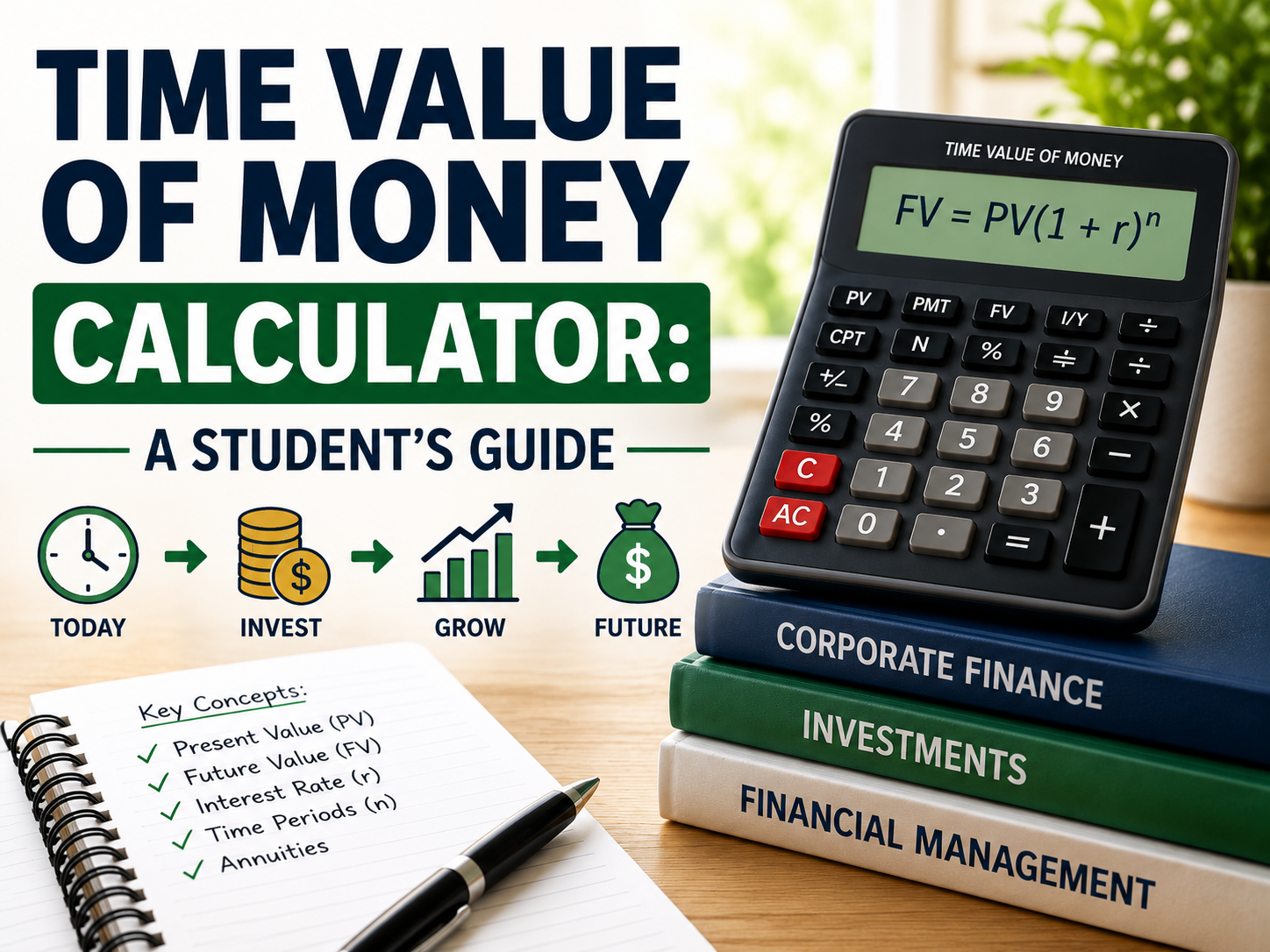
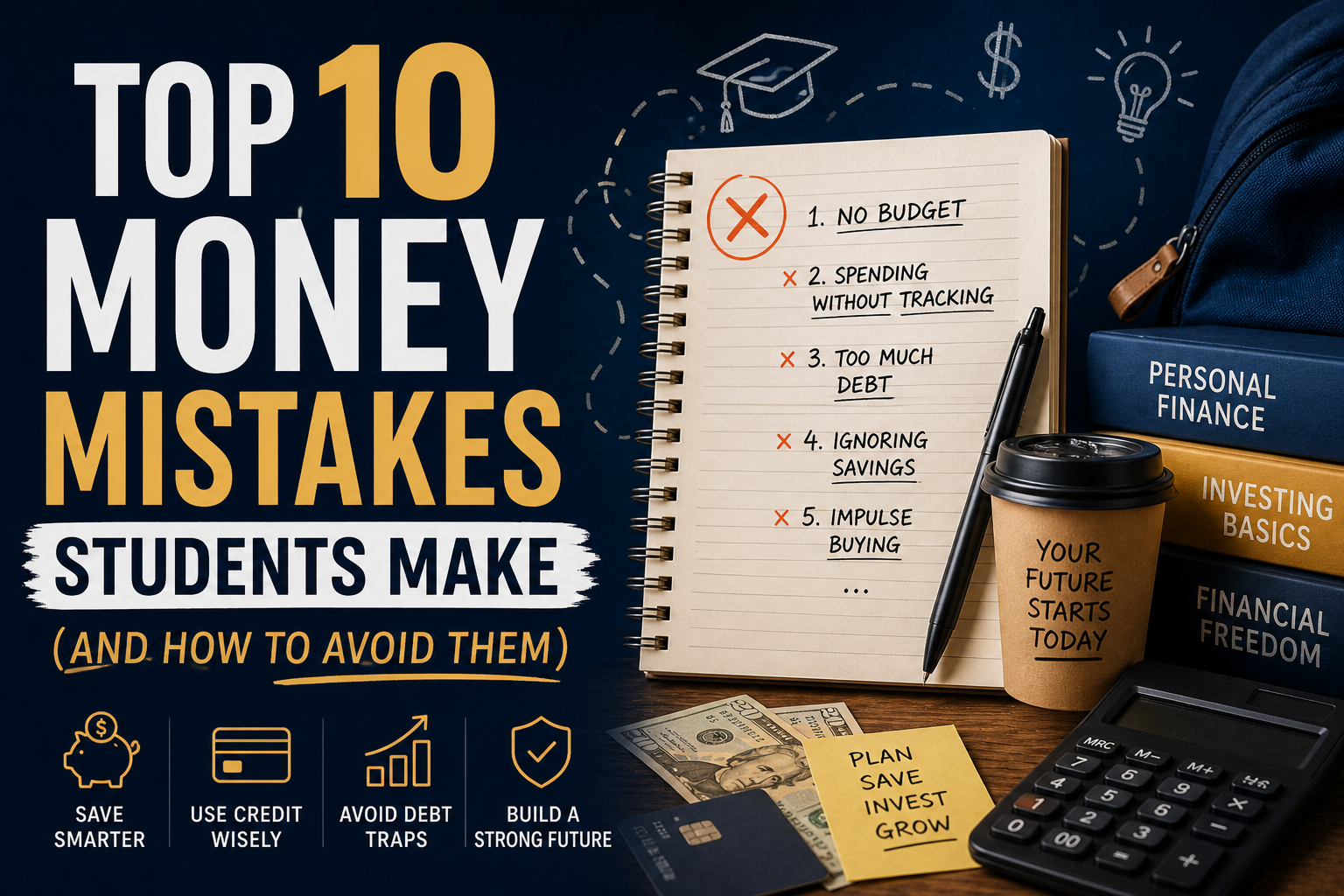
  • 529 College Savings Plans: Building Wealth for Education and Retirement

    SECURE 2.0 Act: Addressing Overfunding Concerns

    A 529 college savings plan is one of the most effective tools available to families planning for the ever-increasing costs of education. This tax-advantaged plan not only helps you save but also provides multiple strategies to make your funds work smarter for you. Let’s explore the full potential of 529 plans, from harnessing compound interest to mitigating overfunding concerns through SECURE 2.0 provisions.


    What Is a 529 College Savings Plan?

    A 529 college savings plan is a state-sponsored investment account designed to encourage saving for educational expenses. It comes with these key advantages:

    • Tax-Free Growth: Your investments grow tax-free, and withdrawals for qualified expenses are tax-exempt.
    • Qualified Expenses: Funds can be used for tuition, fees, books, supplies, room and board, and even certain tech tools like laptops.
    • State Tax Benefits: Many states offer tax deductions or credits for contributions, boosting your savings further.
    • Ownership and Control: Unlike custodial accounts, the account owner retains control of the funds, even if the beneficiary decides not to attend college.

    The account’s flexibility and tax advantages make it a cornerstone of education funding for millions of families.


    The Magic of Compound Interest

    Starting early is the secret weapon in education savings. Compound interest—the process of earning returns on both your initial investment and the returns it generates—can make a significant difference over time.

    Stocks have historically outperformed bonds in terms of returns, making them a strong choice for long-term growth. However, managing risk is essential. The S&P 500 has delivered an average annual return of approximately 7% to 8% after adjusting for inflation.

    Example:
    Imagine you start investing $150 a month into a 529 plan when your child is born. Assuming a 8% average annual return:

    • At age 18, the account reaches approximately $72,000, with approximately $40,000 in earnings.

    https://wallstreetsim.com/tvm/

    This example illustrates how small, consistent contributions, combined with time, can lead to substantial savings.


    SECURE 2.0 Act: Addressing Overfunding Concerns

    One common question parents ask is: What if I save too much? Previously, overfunding a 529 plan could lead to taxes and penalties on unused funds. However, the SECURE 2.0 Act introduced a groundbreaking provision to ease this worry.

    529 to Roth IRA Rollovers
    Starting in 2024, parents can roll over unused 529 funds into a Roth IRA for the beneficiary under these conditions:

    • 15-Year Rule: The 529 account must have been open for at least 15 years.
    • Recent Contributions Ineligible: Contributions made in the past five years (and their earnings) cannot be rolled over.
    • Lifetime Cap: A maximum of $35,000 can be rolled over per beneficiary.
    • Annual Contribution Limits Apply: Rollovers count toward the annual Roth IRA contribution limit (The IRA contribution limits for 2024 are $7,000 for those under 50 and $8,000 for those 50 or older.)
    • Beneficiary Must Have Income: The beneficiary must have earned income during the rollover year.
    • No Roth Income Limits: Income restrictions for regular Roth contributions don’t apply to these rollovers.

    These rollovers provide an excellent safety net, ensuring excess funds can still contribute to the beneficiary’s long-term financial well-being without penalties.

    Example: Transferring Funds from a 529 Plan to a Roth IRA Under SECURE 2.0

    Let’s take a practical example to understand how the SECURE 2.0 provisions work for rolling over unused 529 funds into a Roth IRA.


    Scenario

    Sarah and John started a 529 plan for their daughter, Emily, when she was born. Over the years, they contributed regularly, and the account now has $45,000. Emily received a full scholarship to college, leaving $20,000 unused in the 529 plan after covering all education expenses. Sarah and John want to avoid penalties and taxes on the unused funds.


    Step-by-Step Application of SECURE 2.0

    1. Account Age Verification:
      • The 529 plan has been open for 18 years, meeting the 15-year requirement.
    2. Eligible Funds:
      • Sarah and John contributed $3,000 in the past five years. Assuming these contributions generated $500 in earnings, this $3,500 (contributions + earnings) is excluded from the rollover.
      • Eligible Amount:
      • $20,000 (total unused funds) – $3,500 (ineligible recent contributions and their earnings) = $16,500 potentially eligible for rollover.
    3. Lifetime Cap:
      • The maximum lifetime amount that can be rolled over to a Roth IRA is $35,000. Since Emily’s eligible funds are below this cap, the entire $16,500 can be considered.
    4. Annual Contribution Limit:
      • Roth IRA contributions are subject to the annual limit ($7,000 in 2024 for those under age 50).
      • Sarah and John decide to roll over $7,000 in the first year and plan to roll over the remaining $9,500 in subsequent years, subject to the annual limits.
    5. Earned Income Requirement:
      • Emily has a part-time job earning $12,000 per year, satisfying the earned income requirement.
    6. Roth IRA Income Limits:
      • Roth income limits do not apply to this rollover, so Emily qualifies regardless of her income level.

    Outcome

    • In Year 1, Sarah and John roll over $7,000 to Emily’s Roth IRA. The remaining $9,500 will be rolled over in future years until the entire eligible amount is transferred.
    • Emily now has a jumpstart on her retirement savings, with the funds benefiting from decades of tax-free growth.
    • No penalties or taxes are incurred, and the 529 funds are repurposed effectively.

    Key Benefits

    • The unused 529 funds support Emily’s retirement, turning what could have been a financial penalty into a long-term wealth-building opportunity.
    • By starting early, Emily gains the advantage of compound interest in her Roth IRA.
      Example: If the $16,500 grows at an average annual return of 7% for 40 years, it could grow to over $247,000, entirely tax-free!

    This example illustrates how the SECURE 2.0 provisions make 529 plans even more flexible, ensuring that every dollar saved can be utilized meaningfully.


    Flexibility for Families

    529 plans offer unparalleled flexibility, allowing families to adapt to changing circumstances:

    • Multiple Beneficiaries: Funds can be transferred to siblings, cousins, or other eligible family members if one child doesn’t use the money.
    • K-12 Education: Some states allow 529 funds to be used for private K-12 tuition (up to $10,000 per year).
    • Student Loan Repayment: Up to $10,000 can be used to repay student loans for the beneficiary or their siblings.
    • Apprenticeship Programs: Funds can also cover expenses for qualified apprenticeship programs, making 529 plans viable for non-college career paths.

    Maximizing Your 529 Savings

    To get the most out of your 529 plan:

    1. Start Early: Time is your ally. The earlier you begin, the more you benefit from compound interest.
    2. Make Consistent Contributions: Even modest amounts can add up significantly over 18 years.
    3. Take Advantage of State Tax Benefits: Research whether your state offers tax incentives for contributions.
    4. Reassess Investment Options: As your child nears college age, consider shifting to more conservative investments to protect your savings.
    5. Monitor Costs: Understand the costs associated with your 529 plan, such as management fees, which can affect long-term growth.

    Considerations Beyond Education

    While 529 plans are tailored for education savings, their versatility can also complement long-term financial goals:

    • Retirement Savings: With SECURE 2.0, unused funds can support retirement through Roth IRA rollovers.
    • Generational Wealth: These plans can be passed down, ensuring future generations benefit from your savings.

    The Bottom Line

    A 529 college savings plan is a smart, tax-efficient way to save for education while leveraging the power of compound interest. The SECURE 2.0 Act further enhances the appeal of these plans, providing a safety net for unused funds. Whether you’re starting early or catching up, a 529 plan can be a cornerstone of your family’s financial strategy.

    Start today to secure your child’s future and take advantage of the peace of mind these plans offer. If you’re unsure how to get started, consult a financial advisor to develop a plan tailored to your needs.

    Your Mantra for Success: Save Consistently. Invest Smartly. Retire Richly.

    Legal Disclaimer for Build Wealth Retire Rich Blog/Website

    The information provided on the “Build Wealth Retire Rich” blog/website is for educational purposes only and should not be construed as financial, investment, or legal advice. While every effort is made to ensure the accuracy and reliability of the information presented, Build Wealth Retire Rich and its contributors, including AI tools used in the creation of some content, do not guarantee its completeness or timeliness. Users are encouraged to consult with a qualified financial advisor or legal professional to discuss their specific financial situation and to obtain advice tailored to their individual circumstances.

    Build Wealth Retire Rich is not responsible for any decisions made based on the information provided on this website. All financial products, investment strategies, and other content discussed are presented for informational purposes only, and no guarantees are made regarding the performance or suitability of any particular investment or strategy.

    The views and opinions expressed on “Build Wealth Retire Rich” are those of the authors and do not necessarily reflect the views of the website’s owner or any affiliated institutions. “Build Wealth Retire Rich” does not endorse or promote any particular investment, financial product, or institution unless explicitly stated.

    Risk Disclosure: Investing involves risk, including the potential loss of principal. Past performance is not indicative of future results. Always do your own research and consider your financial goals and risk tolerance before making any financial decisions.

    By using this website, you agree that Build Wealth Retire Rich and its affiliates are not liable for any losses or damages incurred as a result of using the information provided. Users are solely responsible for their financial decisions and should seek independent advice when necessary.