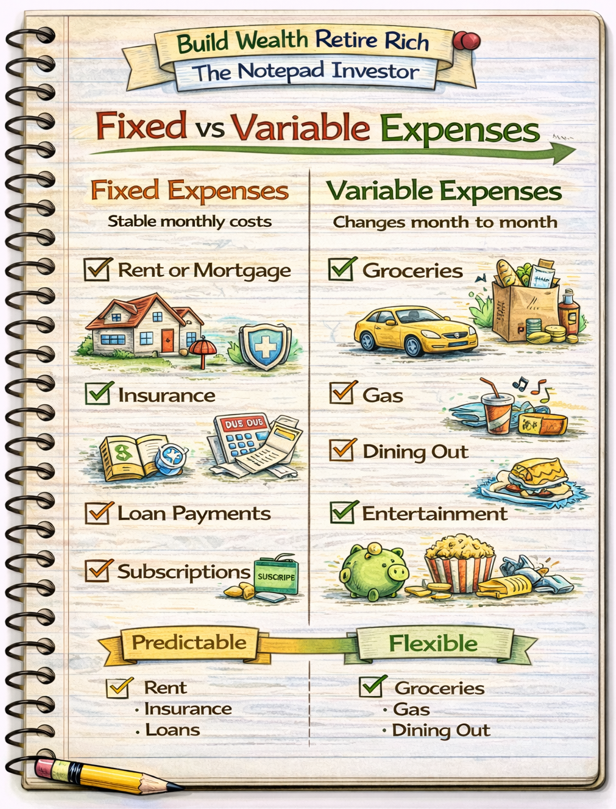
Fixed vs variable expenses distinguish between costs that remain constant month to month (rent, insurance, loan payments) versus expenses that fluctuate based on usage or behavior (groceries, utilities, gas, entertainment)—with fixed expenses providing predictable stability enabling straightforward budgeting while variable expenses offer control and optimization opportunities through conscious consumption choices. Unlike treating all expenses identically creating inflexible budgets and missed optimization chances, understanding this distinction enables accurate forecasting of baseline costs, identifies discretionary spending categories offering reduction opportunities, and facilitates emergency budget creation knowing which expenses are negotiable versus non-negotiable during financial stress.
This article is designed for anyone creating budgets, individuals seeking expense reduction strategies, or those planning for income changes or financial emergencies. You do not need accounting expertise, financial backgrounds, or complex analysis to distinguish fixed from variable expenses—simple classification of existing spending reveals baseline obligations versus flexible categories enabling informed budget decisions and optimization priorities regardless of income level or financial complexity.
Understanding fixed versus variable expenses matters because confusing expense types leads to unrealistic budgets failing when “fixed” amounts fluctuate unexpectedly, focusing reduction efforts on truly fixed expenses wastes energy better directed toward variable categories, and lacking clear baseline cost knowledge prevents realistic emergency planning—while those distinguishing expense types create accurate budgets accommodating fluctuations, optimize efficiently targeting controllable spending, and plan confidently knowing minimum survival costs during crises.
Educational disclaimer: This article provides general educational information about expense classification. Individual expenses may blur lines between fixed and variable depending on circumstances. Examples are generalizations—specific situations vary. This is not financial planning or budgeting advice. Consult qualified financial professionals for personalized guidance.
Understanding Fixed vs Variable Expenses
What Are Fixed Expenses?
Core definition: Costs that remain constant monthly regardless of behavior or usage
Key characteristics:
- Same amount every month (or billing period)
- Paid on consistent schedule
- Often contractual obligations
- Predictable and easy to budget
- Difficult to change short-term
- Not directly influenced by daily choices
Common examples:
- Rent or mortgage payment
- Car payment or lease
- Insurance premiums (auto, health, life, homeowners)
- Loan payments (student loans, personal loans)
- Subscriptions (streaming services, software, gym)
- HOA fees
- Property taxes (if not escrowed)
- Childcare or tuition
Budget advantage: Once identified, fixed expenses require minimal monthly attention—allocate amount, verify payment, done
What Are Variable Expenses?
Core definition: Costs that fluctuate month to month based on usage, consumption, or behavioral choices
Key characteristics:
- Different amounts monthly
- Influenced by behavior and choices
- Often no contractual minimums
- Require estimation and monitoring
- Directly controllable through decisions
- Optimization opportunities through awareness
Common examples:
- Groceries
- Utilities (electricity, gas, water)
- Gasoline and transportation costs
- Dining out and takeout
- Entertainment and recreation
- Clothing and personal care
- Household supplies
- Medical expenses (copays, medications)
- Gifts and miscellaneous
Budget challenge: Variable expenses require monthly estimation, tracking, and adjustment based on actual spending patterns
Why the Distinction Matters
Budget accuracy:
- Fixed expenses: Budget exact amount with confidence
- Variable expenses: Budget estimate based on historical average plus buffer
Optimization focus:
- Fixed expenses: Require strategic negotiation, contract changes, major decisions (long-term impact)
- Variable expenses: Controllable through daily choices (immediate impact)
Emergency planning:
- Fixed expenses: Baseline survival costs, must be covered or renegotiated
- Variable expenses: Reduction opportunities during financial stress
Cash flow management:
- Fixed expenses: Predictable obligations enabling forward planning
- Variable expenses: Require reserves for high-usage months

Detailed Expense Classification
Clear Fixed Expenses
Housing costs (fixed portion):
- Rent: Same amount monthly per lease
- Mortgage: Principal and interest payment constant (fixed-rate mortgages)
- HOA fees: Set monthly amount
- Property tax: Annual amount divided into monthly payments
- Homeowners/renters insurance: Monthly premium
Transportation (fixed portion):
- Car payment: Set monthly installment
- Car lease: Fixed monthly lease payment
- Auto insurance: Monthly or annual premium
- Monthly parking permit: Consistent fee
- Public transit pass: Monthly subscription
Debt obligations:
- Student loans: Minimum monthly payment
- Personal loans: Fixed installment
- Credit card minimum payments: Required amount (though paying only minimum problematic)
Insurance premiums:
- Health insurance: Monthly premium
- Life insurance: Set premium
- Disability insurance: Fixed monthly cost
Subscriptions and memberships:
- Streaming services: Fixed monthly fees
- Gym memberships: Set monthly dues
- Software subscriptions: Consistent charges
- Phone plan: Base monthly cost
- Internet service: Monthly fee
Childcare and education:
- Daycare: Set monthly tuition
- School tuition: Fixed costs
- After-school programs: Consistent fees
Clear Variable Expenses
Food:
- Groceries: Depends on shopping frequency, choices, household size
- Dining out: Completely discretionary and variable
- Coffee shops: Usage-based
- Takeout and delivery: Optional and fluctuating
Utilities (usage-based):
- Electricity: Varies by usage, season, temperature
- Natural gas: Heating/cooling dependent
- Water and sewer: Usage-based (though often minimal variation)
Transportation (variable portion):
- Gasoline: Miles driven, gas prices
- Car maintenance: Timing and extent unpredictable
- Parking meters and tolls: Usage-dependent
- Rideshare (Uber, Lyft): Completely variable
Personal and household:
- Clothing: Timing and amount discretionary
- Personal care items: Replenishment needs vary
- Household supplies: Usage-based
- Home maintenance: Unpredictable needs
Entertainment and discretionary:
- Entertainment activities: Completely discretionary
- Hobbies and recreation: Optional spending
- Shopping: Discretionary timing and amounts
- Travel: Irregular and variable
Healthcare (variable portion):
- Doctor visits and copays: Need-based
- Prescriptions: Refill timing varies
- Over-the-counter medications: As needed
- Medical procedures: Unpredictable timing
Hybrid Expenses (Fixed Base + Variable Usage)
Phone service:
- Fixed: Base monthly plan cost
- Variable: Overage charges, international calls, app purchases
Internet:
- Fixed: Base monthly service
- Variable: Equipment rentals, overage fees (some plans)
Gym membership:
- Fixed: Monthly membership fee
- Variable: Personal training, classes, additional services
Water/sewer (some locations):
- Fixed: Base service charge
- Variable: Usage-based charges
Classification approach: Budget hybrid expenses as fixed for base amount, separate variable portion if significant
Context-Dependent Classification
Groceries:
- Generally variable: Amount changes based on shopping choices
- But semi-predictable: Most families spend similar amounts monthly
- Budget approach: Treat as variable but estimate closely based on history
Utilities:
- Technically variable: Usage influences cost
- But somewhat predictable: Patterns emerge (higher summer/winter, lower spring/fall)
- Budget approach: Average last 12 months for baseline, adjust seasonally
Medications:
- Chronic conditions: Effectively fixed (same prescriptions monthly)
- As-needed medications: Variable
- Classification: Depends on health situation
Budgeting Fixed vs Variable Expenses
Fixed Expense Budgeting
Simple approach:
- List all fixed expenses with exact amounts
- Note due dates for cash flow planning
- Total for monthly baseline obligation
- Allocate funds before month begins
- Automate payments when possible
Example fixed expense budget:
- Rent: $1,200
- Car payment: $350
- Auto insurance: $125
- Health insurance: $280
- Student loan: $220
- Internet: $70
- Phone: $85
- Gym: $50
- Streaming services: $45
- Total fixed: $2,425
Budget once, monitor minimally: After initial setup, fixed expenses require only verification of payment, not monthly recalculation
Variable Expense Budgeting
Estimation approach:
- Track variable expenses 2-3 months establishing baseline
- Calculate average per category
- Add 10-20% buffer for variation
- Monitor actual spending monthly
- Adjust future allocations based on patterns
Example variable expense budget (based on 3-month average):
- Groceries: $450 (average $420, +$30 buffer)
- Utilities: $180 (average $165, seasonal adjustment)
- Gas: $120 (average $110, +$10 buffer)
- Dining out: $200 (historical average, reduction target)
- Entertainment: $100 (discretionary allocation)
- Clothing: $75 (averaged from sporadic purchases)
- Personal care: $60 (toiletries, haircuts)
- Household supplies: $50 (cleaning, misc)
- Medical copays: $40 (estimated)
- Miscellaneous: $100 (buffer category)
- Total variable: $1,375
- Fixed expenses: $2,425 (54% of income)
- Variable expenses: $1,375 (31% of income)
- Savings and goals: $700 (15% of income)
- Total: $4,500 (100% allocated)
- Fixed baseline: $2,425 must be covered monthly
- Variable flexibility: $1,375 adjustable if income drops
- Savings cushion: $700 optional (though important for long-term goals)
- Emergency survival cost: $2,425 minimum (fixed only)
- Utilities: Higher summer (AC) and winter (heating), lower spring/fall
- Gas: Higher during vacation months, winter heating (some areas)
- Gifts: Higher November-December (holidays), sporadic birthdays
- Clothing: Higher back-to-school (August-September), seasonal changes
- Calculate annual total for seasonal expenses
- Divide by 12 for monthly sinking fund
- Save consistent amount monthly, spend from reserves during high months
- Example: Annual gifts $1,200 ÷ 12 = $100 monthly savings, spend $500+ December
Requires active management: Variable expenses need weekly monitoring and course-correction to stay within allocations
Combined Budget Example
Monthly income: $4,500 (net take-home)
Budget stability analysis:
Seasonal Adjustments
Variable expenses with predictable patterns:
Budget strategy:
Optimization Strategies
Reducing Fixed Expenses (Strategic, Long-Term)
Housing:
- Move to cheaper location or smaller space (largest impact, major decision)
- Refinance mortgage if rates dropped
- Negotiate rent renewal (some landlords reduce to avoid vacancy)
- Take roommate reducing per-person cost
- Challenge property tax assessment
Insurance:
- Shop and compare annually (save $200-800+ yearly)
- Bundle policies (auto + home = discount)
- Increase deductibles if emergency fund adequate
- Remove unnecessary coverage
- Ask about discounts (good driver, safety features, loyalty)
Debt payments:
- Refinance high-interest debt to lower rates
- Consolidate multiple debts
- Accelerate payoff eliminating payment entirely
Subscriptions:
- Cancel unused or rarely-used services (easy, immediate savings)
- Rotate subscriptions (one streaming service at a time)
- Negotiate retention deals when canceling
- Switch to annual billing (often 15-20% cheaper than monthly)
Phone and internet:
- Call providers negotiating lower rates (retention departments offer deals)
- Switch to lower-cost providers (MVNOs for phone, alternative ISPs)
- Downgrade to cheaper plans if sufficient
Expected savings: $200-600+ monthly through strategic fixed expense reduction
Reducing Variable Expenses (Tactical, Immediate)
Groceries:
- Meal planning and shopping lists (reduce impulse buys)
- Store brands vs name brands (20-40% savings)
- Cook at home more consistently
- Reduce food waste through better planning
- Buy in bulk for non-perishables
- Potential: Save $100-300 monthly
Dining out:
- Cut frequency by 50% (immediate major savings)
- Choose cheaper restaurants
- Share entrees, skip drinks/apps
- Use for special occasions only
- Potential: Save $100-400 monthly
Utilities:
- Adjust thermostat (2-3 degrees saves 10-20%)
- LED bulbs and energy-efficient appliances
- Unplug devices, use power strips
- Shorter showers, full dishwasher/laundry loads
- Weatherize home (seal drafts)
- Potential: Save $30-100 monthly
Transportation:
- Combine errands reducing trips
- Carpool or public transit
- Maintain vehicle properly (better MPG)
- Shop for gas prices (apps show cheapest nearby)
- Potential: Save $40-150 monthly
Entertainment and discretionary:
- Free or low-cost activities (libraries, parks, free events)
- Wait for sales, use coupons
- Borrow instead of buying
- DIY when possible
- Potential: Save $50-200+ monthly
Expected savings: $300-1,000+ monthly through variable expense optimization
Strategy Comparison
Fixed expense reduction:
- Pros: Large per-item savings, permanent reduction
- Cons: Requires major decisions, time to implement, limited opportunities
- Best for: Annual financial reviews, major life changes
Variable expense reduction:
- Pros: Immediate impact, many opportunities, complete control
- Cons: Requires ongoing discipline, behavioral change, smaller per-item savings
- Best for: Monthly budget optimization, emergency cuts
Optimal approach: Address both—strategic fixed expense reduction annually, tactical variable expense optimization ongoing
Emergency Budget Planning
Needs-Only Budget (Survival Mode)
Scenario: Job loss, medical emergency, major income reduction requiring drastic spending cuts
Step 1: Identify truly fixed essential expenses
- Housing: Rent/mortgage (non-negotiable short-term)
- Utilities: Basic amounts only
- Essential transportation: Car payment if needed for job searching, minimum gas
- Insurance: Health (critical), auto if required by law
- Minimum debt payments: Avoid default
- Basic groceries: Food only
Step 2: Eliminate or minimize variable expenses
- Cancel: Dining out, entertainment, subscriptions, discretionary spending
- Minimize: Groceries (basic nutrition only), utilities (survival settings)
- Pause: Savings contributions (temporarily), extra debt payments
Example emergency budget:
- Rent: $1,200 (fixed, essential)
- Basic utilities: $120 (reduced from $180)
- Car payment: $350 (fixed, essential for work)
- Auto insurance: $125 (fixed, legally required)
- Health insurance: $280 (fixed, critical)
- Minimum debt payments: $220 (fixed, avoid default)
- Basic groceries: $300 (reduced from $450)
- Minimal gas: $80 (reduced from $120)
- Emergency total: $2,675 (vs normal $3,800)
- Reduction: $1,125 monthly (30% cut)
Insight: Knowing baseline survival cost ($2,675) informs emergency fund needs and provides action plan if crisis occurs
Graduated Reduction Plan
Tier 1 (10% income reduction):
- Cut variable discretionary: Dining out, entertainment, shopping
- Maintain fixed expenses and essential variables
- Reduce savings slightly
Tier 2 (25% income reduction):
- Eliminate all discretionary variable expenses
- Minimize essential variables (basic groceries, minimal utilities)
- Review fixed expenses for reduction opportunities
- Pause non-emergency savings
Tier 3 (50%+ income reduction):
- Needs-only budget (survival mode)
- Negotiate fixed expense reductions
- Consider major changes (moving, selling car, etc.)
- Use emergency fund for gap
Why Understanding Fixed vs Variable Expenses Matters
Without distinguishing fixed from variable expenses, people create inflexible budgets treating all costs as unchangeable preventing necessary adjustments, waste energy attempting to reduce truly fixed expenses while ignoring controllable variables, and lack emergency planning baseline making crisis management reactive chaos—while those understanding expense types build realistic flexible budgets accommodating fluctuations, optimize efficiently targeting controllable spending, and plan confidently knowing baseline survival costs and reduction options during financial stress.
Understanding fixed versus variable expenses enables individuals to:
- Create accurate budgets accommodating predictable fixed costs and variable fluctuations
- Optimize spending efficiently targeting controllable variable expenses first
- Plan emergency budgets knowing baseline survival costs and reduction strategies
- Manage cash flow confidently understanding payment timing and amounts
- Make informed financial decisions recognizing long-term fixed versus immediate variable impacts
- Build resilience through clear understanding of obligations versus discretionary spending
Fixed versus variable expense awareness transforms budgeting from rigid uniformity to strategic flexibility enabling both stability and optimization.
Common Misunderstandings
Many people assume fixed expenses are completely unchangeable requiring permanent acceptance. In reality, most fixed expenses are modifiable through strategic actions like negotiation, provider switching, refinancing, or major life changes—they’re “fixed” month-to-month but adjustable over time through deliberate intervention, proving distinction refers to monthly stability not permanent immutability.
Another common misconception is that variable expenses are inherently discretionary and unimportant. In practice, many variable expenses are essential (groceries, utilities, medical care) while some fixed expenses are discretionary (gym memberships, premium subscriptions)—variable versus fixed describes fluctuation pattern not necessity level, proving these dimensions are independent requiring separate analysis.
Some believe optimizing variable expenses is insufficient for meaningful savings requiring fixed expense reduction. However, variable expense optimization often produces larger total savings than fixed reductions—cutting dining out $200 monthly, groceries $100, utilities $50, gas $40, entertainment $100 totals $490 monthly versus typical fixed expense reduction of $200-300, proving variable optimization is high-impact not trivial despite smaller per-category amounts.
How Fixed vs Variable Understanding Fits Into Financial Success
Fixed versus variable expense distinction provides essential framework for all budget management—enables accurate forecasting combining predictable baselines with estimated fluctuations, guides optimization efforts toward highest-impact opportunities, facilitates emergency planning through clear baseline costs and reduction strategies, and supports cash flow management matching payment timing to income schedules creating systematic control impossible through undifferentiated expense treatment.
For example, two people each earn $4,500 monthly spending $4,200 with minimal savings. Person A treats all expenses identically—budgets everything at last month’s actual amounts, surprised when groceries, utilities, gas vary creating overruns, attempts fixed expense reductions negotiating rent (impossible mid-lease) and insurance (saves $30 after hours of effort), frustrated by minimal progress. Person B distinguishes fixed versus variable—identifies $2,400 fixed (unchangeable short-term), $1,800 variable (controllable immediately). Focuses optimization on variables: reduces dining 40% saving $150, cuts groceries 15% saving $75, adjusts utilities saving $40, eliminates discretionary subscriptions saving $45. Total monthly reduction: $310 versus Person A’s $30. Annual difference: $3,360 savings through targeted optimization versus $360 through misdirected effort. Understanding expense types enabled 10x better results through strategic focus.
Fixed versus variable expense awareness separates efficient optimizers from frustrated ineffective reducers through strategic targeting of controllable spending producing dramatic results impossible through undifferentiated approaches.
Recent Updates and Trends
In recent years, subscription proliferation has increased fixed expense burden—average household now carries 10-15+ subscriptions adding $200-500 monthly in “small” fixed costs that accumulate substantially, making subscription audit increasingly critical fixed expense optimization.
Inflation has made variable expenses more volatile—grocery and utility costs fluctuating 20-30%+ year-over-year rather than historical 2-3%, requiring larger budgeting buffers and more active management of previously predictable variables.
Remote work has shifted expense patterns—reduced gas and dining (variables) while increasing home utilities and internet (semi-fixed), changing typical expense distributions requiring budget category adjustments for work-from-home situations.
Payment app prevalence has made variable tracking easier—automatic categorization and real-time alerts help manage fluctuating expenses previously requiring manual tracking, though also enabling unconscious spending through transaction ease.
Fundamental fixed versus variable principles remain timeless: fixed expenses provide predictable baseline enabling budget stability, variable expenses offer control and optimization through behavioral choices, emergency planning requires understanding both baseline obligations and reduction options, and effective budgeting combines fixed certainty with variable estimation and monitoring—regardless of subscription trends, inflation volatility, work arrangements, or payment technologies, distinguishing expense types produces superior budget accuracy and optimization results versus undifferentiated treatment.
3 Things You Can Do Today
Ready to distinguish and optimize expenses? Here are three simple steps you can take right now:
1. Classify all expenses as fixed or variable – Review last month’s bank and credit card statements. List every expense. Mark each “Fixed” (same amount monthly) or “Variable” (fluctuates). For each category total separately. Calculate percentages of income. Example result: Fixed $2,400 (53%), Variable $1,600 (36%), Savings $500 (11%). This 30-minute exercise reveals budget structure—high fixed percentage limits flexibility, high variable percentage offers optimization opportunities. Typical healthy distribution: 40-60% fixed, 25-40% variable, 15-20%+ savings.
2. Calculate your emergency survival budget (fixed + essential variables only) – From classification in step 1, list only: fixed expenses required to avoid default/eviction (rent, minimum debt payments, essential insurance) plus minimum essential variables (basic groceries, minimal utilities, necessary gas). Total this. Example: Fixed essentials $2,000 + minimal variables $600 = $2,600 survival baseline. This is minimum income needed avoiding crisis or amount to cover with emergency fund during job loss. Knowing this number reduces anxiety and guides emergency fund target.
3. Identify three high-impact variable expense reductions – Review variable expenses from step 1. Find three categories: (1) highest absolute amount (likely biggest savings potential), (2) easiest to reduce (quick wins maintaining motivation), (3) lowest value-to-cost ratio (spending not providing proportional satisfaction). For each, set 20-40% reduction target and specific action. Example: Dining out $300 → reduce to $180 (meal prep 3x weekly), Groceries $450 → reduce to $360 (store brands, meal planning), Subscriptions $75 → reduce to $30 (cancel unused). Total potential: $345 monthly = $4,140 annually. Implement starting this week.
These actions create fixed versus variable awareness enabling strategic optimization targeting controllable spending producing meaningful savings impossible through undifferentiated approaches.
Quick FAQ
What percentage of my budget should be fixed vs variable expenses?
Typical healthy distribution: Fixed 40-60%, Variable 25-40%, Savings 15-20%+. High fixed percentage (over 65%) limits financial flexibility—consider reducing fixed obligations through strategic changes. High variable percentage (over 45%) suggests opportunity for behavioral optimization. Very low variable (under 20%) may indicate unrealistic fixed expense burden leaving insufficient for daily needs. Balance enables both stability (through fixed) and flexibility (through variable controllability).
Should I prioritize reducing fixed or variable expenses?
Both matter—pursue simultaneously. Quick wins: Variable expense reduction (immediate impact, full control, multiple opportunities). Long-term: Strategic fixed expense reduction (larger per-item savings, permanent impact). Start with variable (dining out, entertainment, optimization) achieving fast visible progress while working strategic fixed reductions (insurance shopping, subscription cancellation, refinancing). Variable changes produce 60-70% of typical savings despite smaller per-item amounts through cumulative effect across categories.
Are subscription services fixed or variable expenses?
Fixed—they charge same amount monthly regardless of usage. However, they’re “voluntarily fixed”—you chose to subscribe and can cancel anytime versus mortgage or loan contractual obligations. Budgeting: Treat as fixed (predictable amount). Optimization: Excellent reduction targets (easy cancellation, immediate savings, often forgotten). Many households save $50-200 monthly eliminating unused or low-value subscriptions.
How do I budget for variable expenses that change significantly month to month?
Three approaches: (1) Average method: Calculate 3-6 month average plus 10-20% buffer, (2) High-water mark: Budget highest recent month amount, (3) Sinking fund: Annualize irregular variable (gifts, maintenance), divide by 12, save monthly. Recommendation: Average method for most variables, sinking fund for very irregular predictable expenses (holiday gifts, annual maintenance). Monitor actual spending weekly adjusting behavior to stay within allocation.
Can variable expenses become fixed through behavioral consistency?
Classification remains variable (amount still fluctuates based on choices) but spending patterns can stabilize making budgeting easier. Example: Groceries technically variable but families often spend similar amounts monthly creating predictability. Utilities vary by season but patterns emerge. Budgeting benefit: Historical data enables accurate estimation despite technical variability. Don’t reclassify as truly fixed—maintain awareness of control and optimization potential through behavioral adjustments.
What if my fixed expenses exceed recommended percentage?
Over 60-65% fixed leaves little room for variables and savings—vulnerable position. Actions: (1) Immediate: Aggressive variable expense optimization freeing maximum for savings, (2) Short-term (3-6 months): Shop fixed expenses for reductions (insurance, subscriptions, phone), (3) Medium-term (6-12 months): Consider major changes reducing primary fixed costs (cheaper housing, eliminating car payment, refinancing). Very high fixed (75%+) requires urgent action—unsustainable lacking flexibility for needs and emergencies.
Explore More in Money Basics
Disclosure
This article is provided for educational purposes only and does not constitute financial planning or budgeting advice. Fixed and variable expense classifications are generalizations—specific expenses may blur categories depending on individual circumstances. Recommended percentage distributions are general guidelines—appropriate allocations vary by location, life stage, income level, and personal priorities. Optimization strategies and expected savings are estimates—actual results depend on individual situations and implementation consistency. Examples are illustrative using simplified scenarios—actual expenses and budgets vary significantly. Consult qualified financial planners and advisors for personalized guidance. Advertisements or sponsored content may appear within or alongside this content. All information is presented independently.