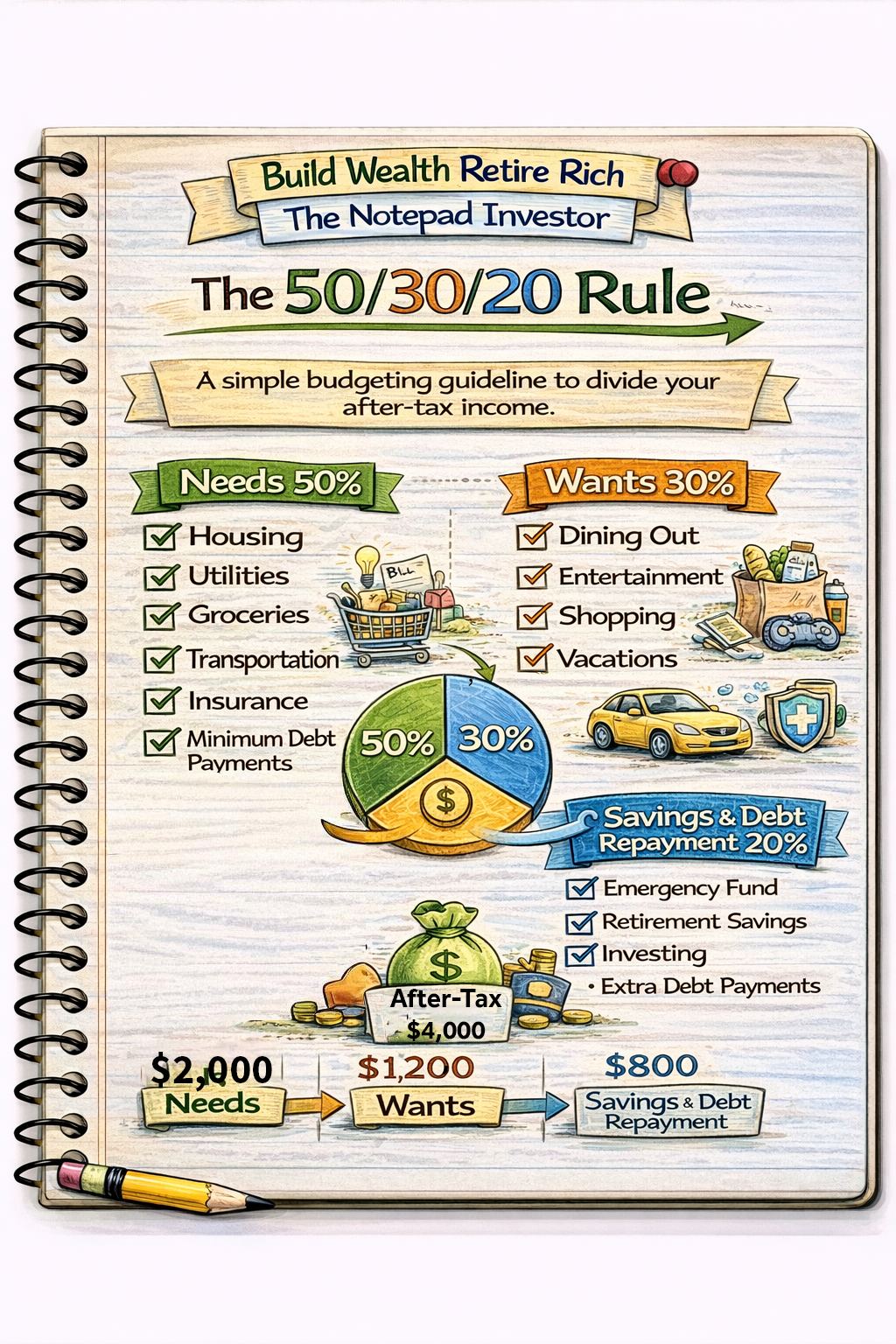
The 50/30/20 rule is a simple budgeting framework allocating after-tax income into three categories: 50% to needs (essential expenses like housing, utilities, groceries, transportation, insurance), 30% to wants (discretionary spending like dining out, entertainment, hobbies, non-essential purchases), and 20% to savings and debt repayment (emergency fund, retirement, investments, extra debt payments beyond minimums). Unlike complex line-item budgets requiring detailed tracking of dozens of categories, this straightforward percentage-based approach provides accessible structure for budget beginners while ensuring balanced allocation across necessities, enjoyment, and financial goals through simple three-category division.
This article is designed for budgeting beginners, individuals overwhelmed by detailed budgeting, or those seeking simple sustainable spending frameworks. You do not need financial expertise, accounting knowledge, or complex software to implement the 50/30/20 rule—basic income calculation and three-category expense classification create functional budgets within hours enabling immediate financial control regardless of income level or previous budgeting experience.
Understanding the 50/30/20 rule matters because many people avoid budgeting perceiving it as restrictive and complicated, others create overly detailed budgets abandoning them within weeks due to tracking burden, and lack of spending structure leads to unconscious allocation favoring immediate gratification over long-term security—while 50/30/20 followers maintain simple sustainable budgets balancing essential coverage, quality of life, and wealth building through accessible framework preventing both deprivation and financial recklessness.
Educational disclaimer: This article provides general educational information about the 50/30/20 budgeting framework. Individual circumstances, income levels, expenses, and priorities vary significantly. The 50/30/20 percentages are guidelines—not rigid rules requiring exact adherence. This is not financial planning or professional advice. Consult qualified financial professionals for personalized guidance.
Understanding the 50/30/20 Rule
What Is the 50/30/20 Rule?
Core framework: Divide after-tax income into three buckets based on spending purpose
The three categories:
- 50% Needs: Essential expenses required for basic living
- 30% Wants: Discretionary spending enhancing quality of life
- 20% Savings and Debt: Financial goals and debt elimination beyond minimums
Origin: Popularized by Senator Elizabeth Warren and her daughter Amelia Warren Tyagi in book “All Your Worth: The Ultimate Lifetime Money Plan” (2005)
Philosophy: Balanced approach covering essentials, allowing enjoyment, and building financial security without requiring detailed tracking
50% Needs (Essential Expenses)
Definition: Expenses necessary for survival and basic functioning
What qualifies as needs:
- Housing: Rent or mortgage payment, property taxes, HOA fees
- Utilities: Electricity, gas, water, sewer, trash (basic levels)
- Groceries: Food for home preparation (not dining out)
- Transportation: Car payment, gas, auto insurance, public transit (for work commute)
- Insurance: Health insurance, minimum required auto insurance, life insurance (if dependents)
- Minimum debt payments: Required minimums on credit cards, loans (extra payments go in 20% category)
- Healthcare: Health insurance premiums, necessary prescriptions, essential medical care
- Childcare: If required for work
- Basic phone and internet: Essential for work and modern life (basic plans, not premium)
What does NOT qualify as needs:
- Dining out and takeout (want, not need)
- Premium cable or multiple streaming services (basic internet is need, entertainment upgrades are wants)
- New clothing beyond basic replacement (fashion and shopping are wants)
- Gym memberships (want, not need—exercise is free)
- Extra debt payments beyond minimums (goes in 20% savings category)
Key principle: Needs are expenses that would create significant hardship if eliminated—housing, basic food, essential transportation, health coverage
30% Wants (Discretionary Spending)
Definition: Non-essential expenses that enhance lifestyle and provide enjoyment
What qualifies as wants:
- Dining out, takeout, and food delivery
- Entertainment: Movies, concerts, sporting events, hobbies
- Streaming services and premium cable
- Gym memberships and fitness classes
- Shopping and non-essential clothing
- Vacations and travel
- Personal care: Salon services, spa treatments, cosmetics beyond basics
- Upgraded versions of needs: Fancy coffee, organic groceries, premium phone plans
- Subscription boxes and memberships
- Gifts beyond obligatory occasions
Gray area items (context-dependent):
- Internet: Basic service is need, high-speed gaming plan is want
- Phone: Basic smartphone is need, latest iPhone is want
- Car: Reliable used car is need, luxury vehicle is want
- Clothing: Work wardrobe replacement is need, fashion shopping is want
Key principle: Wants are expenses that could be eliminated or reduced without affecting basic survival—lifestyle enhancements and entertainment
20% Savings and Debt Repayment
Definition: Money allocated to financial goals and debt elimination beyond required minimums
What qualifies in this category:
- Emergency fund contributions
- Retirement savings: 401(k), IRA, other retirement accounts
- Investment account contributions
- Extra debt payments: Amounts beyond required minimums for faster payoff
- Savings for specific goals: Down payment, vacation, car replacement
- College savings: 529 plans for children
- Any savings or investing activity
Priority order within the 20%:
- Employer 401(k) match (free money, get full match first)
- Starter emergency fund ($1,000-$2,000)
- High-interest debt extra payments (credit cards over 15% APR)
- Full emergency fund (3-6 months expenses)
- Retirement contributions (15% of income total including match)
- Other savings goals
- Low-interest debt extra payments (mortgages, student loans under 6%)
Clarification: Minimum debt payments are “needs” (50% category), extra payments beyond minimums are “savings/debt” (20% category)

Implementing the 50/30/20 Rule
Step 1: Calculate After-Tax Monthly Income
For salaried employees:
- Look at monthly take-home pay (after taxes, retirement, insurance deducted)
- Add any consistent side income or other earnings
- This is your budgetable monthly income
Example:
- Gross salary: $75,000 annually = $6,250 monthly
- Deductions: Federal/state taxes, Social Security, Medicare = $1,500
- Pre-tax deductions: 401(k) contributions, health insurance = $625
- Take-home pay: $4,125 monthly
Important note: If you already contribute to 401(k) pre-tax, count that as part of your income for 50/30/20 purposes (it’s savings, part of the 20%)
Adjusted calculation:
- Take-home pay: $4,125
- Plus 401(k) contribution: $500
- Total monthly income for budgeting: $4,625
For irregular income:
- Calculate average monthly income last 6-12 months
- Or use lowest earning month (conservative approach)
- Budget conservatively, save excess from high months
Step 2: Calculate Category Allocations
Using example income of $4,625 monthly:
- Needs (50%): $4,625 × 0.50 = $2,313
- Wants (30%): $4,625 × 0.30 = $1,388
- Savings (20%): $4,625 × 0.20 = $925
These are your target maximums for each category
Step 3: Track Current Spending by Category
Review last 2-3 months expenses:
- Go through bank and credit card statements
- Categorize each expense: Need, Want, or Savings/Debt
- Total each category
- Calculate actual percentages
Example current spending analysis:
- Needs: $2,650 (57% of income—over 50% target)
- Wants: $1,575 (34% of income—over 30% target)
- Savings: $400 (9% of income—under 20% target)
Diagnosis: Overspending on needs and wants, undersaving for future
Step 4: Adjust Spending to Meet Targets
Needs category adjustments (reduce from $2,650 to $2,313):
- Review housing (32% of income—high but common in expensive areas)
- Shop auto insurance (potential $20-50 monthly savings)
- Switch to cheaper phone plan (save $15-30)
- Optimize utilities through conservation (save $20-40)
- Generic groceries vs brands (save $30-60)
- Target reduction: $337 monthly through strategic shopping and optimization
Wants category adjustments (reduce from $1,575 to $1,388):
- Reduce dining out 30% (save $100-150)
- Cancel unused subscriptions (save $20-40)
- Reduce entertainment spending (save $30-50)
- Target reduction: $187 monthly through conscious discretionary cuts
Savings increase (from $400 to $925):
- $337 saved from needs optimization
- $187 saved from wants reduction
- Total available: $524 additional for savings
- New savings: $400 + $524 = $924 (hitting 20% target)
Step 5: Monitor and Adjust Monthly
Monthly check-in process:
- Week 1: Review needs spending, on track vs target?
- Week 2: Check wants spending, adjust if nearing limit
- Week 3: Verify savings transfers occurring
- Week 4: Month-end review, calculate actual percentages
Quarterly adjustments:
- Income changes: Recalculate dollar targets
- Consistent overspending: Re-evaluate need vs want classifications
- Consistent undershooting: Can increase savings or allow more wants
50/30/20 Rule Examples
Example 1: $3,000 Monthly Income
Allocations:
- Needs (50%): $1,500
- Wants (30%): $900
- Savings (20%): $600
Sample budget breakdown:
Needs ($1,500):
- Rent: $800
- Utilities: $100
- Groceries: $250
- Car insurance + gas: $150
- Health insurance: $100
- Phone: $50
- Minimum debt payments: $50
Wants ($900):
- Dining out: $200
- Entertainment: $150
- Streaming services: $35
- Gym: $40
- Clothing/shopping: $150
- Personal care: $80
- Hobbies: $100
- Miscellaneous: $145
Savings ($600):
- Emergency fund: $300
- Retirement (Roth IRA): $200
- Extra debt payment: $100
Example 2: $6,000 Monthly Income
Allocations:
- Needs (50%): $3,000
- Wants (30%): $1,800
- Savings (20%): $1,200
Sample budget breakdown:
Needs ($3,000):
- Mortgage: $1,400
- Property tax/insurance: $300
- Utilities: $150
- Groceries: $500
- Car payment: $250
- Auto insurance + gas: $200
- Health insurance: $150
- Childcare: $50 (partial, subsidized)
Wants ($1,800):
- Dining out: $400
- Entertainment: $250
- Vacations (monthly savings): $300
- Hobbies: $200
- Shopping: $300
- Personal care: $150
- Subscriptions: $75
- Gifts: $125
Savings ($1,200):
- 401(k): $600 (including employer match)
- Roth IRA: $400
- Emergency fund: $200
Example 3: High Cost-of-Living Area ($5,000 income)
Reality check: 50% to needs challenging in expensive cities
Actual distribution:
- Needs: 60% ($3,000)—housing eats larger share
- Wants: 20% ($1,000)—reduced from 30% target
- Savings: 20% ($1,000)—maintained as priority
Modified approach: 60/20/20 rule maintaining 20% savings while accepting higher housing costs, reducing wants temporarily
Common Challenges and Solutions
Challenge 1: Needs Exceed 50%
Common causes:
- High housing costs (rent/mortgage over 30% of income)
- Car payments on depreciating assets
- High debt minimum payments
- Large family with high grocery/childcare costs
- Expensive location
Short-term solutions:
- Reduce wants from 30% to 20% temporarily
- Maintain 20% savings (critical for long-term success)
- Modified ratio: 60/20/20 or 55/25/20
Long-term solutions:
- Strategic housing reduction (cheaper location, smaller space, roommate)
- Eliminate car payment (drive paid-off vehicle)
- Aggressive debt payoff reducing minimum payments
- Increase income through raises, job changes, side hustles
- Relocate to lower cost-of-living area
Reality: Many people in expensive cities run 60/20/20 temporarily while working toward income increases or relocation
Challenge 2: Difficulty Saving 20%
Common causes:
- Low income relative to basic needs
- High debt payments
- Lifestyle inflation eating discretionary income
Solutions:
- Start smaller (10-15%) and increase gradually
- Automate savings first (pay yourself first approach)
- Aggressive wants reduction freeing savings capacity
- Increase income specifically allocating raises to savings
- Eliminate high-interest debt creating room for savings
Minimum acceptable: 15% savings maintains long-term viability, under 10% creates future problems
Challenge 3: Need vs Want Classification Disagreements
Gray area examples:
Gym membership:
- Want perspective: Exercise is free (running, bodyweight workouts)
- Need perspective: Essential for health, mental wellbeing, chronic condition management
- Resolution: Classify based on genuine necessity vs preference—most people classify as want
Internet speed:
- Basic internet: Need (required for modern life, work)
- Gigabit speed: Want (nice-to-have for gaming, streaming)
- Resolution: Basic tier in needs, upgrades in wants
Organic groceries:
- Want perspective: Regular groceries meet nutritional needs
- Need perspective: Health condition requiring dietary restrictions
- Resolution: Premium above standard groceries goes in wants
Guiding principle: If removing it would create genuine hardship affecting survival or basic functioning = need. If removing it would be disappointing but manageable = want.
Challenge 4: Irregular Income
Challenges:
- Can’t predict exact 50/30/20 dollar amounts monthly
- Some months exceed targets, others fall short
Solutions:
- Use percentage approach regardless of income level
- Low income month: 50/30/20 of $3,000 = $1,500/$900/$600
- High income month: 50/30/20 of $7,000 = $3,500/$2,100/$1,400
- Build buffer from high months for low months
- Or use conservative baseline (lowest month) + save all excess
Modifications and Variations
70/20/10 Rule (Debt Focus)
When to use: Aggressive debt payoff mode, temporarily sacrificing wants
- 70% Needs and minimum living expenses
- 20% Debt payoff (all extra payments)
- 10% Minimal wants (sustainable lifestyle)
Duration: Temporary (12-36 months) until high-interest debt eliminated
50/10/40 Rule (Aggressive Savings)
When to use: FIRE pursuit, financial independence acceleration
- 50% Needs
- 10% Wants (minimal discretionary)
- 40% Savings and investments
Goal: Reach financial independence in 10-15 years through extreme savings
40/30/30 Rule (Lower Housing Markets)
When to use: Low cost-of-living areas where needs naturally under 50%
- 40% Needs
- 30% Wants
- 30% Savings (increased from standard 20%)
Advantage: Accelerated wealth building without sacrifice
60/20/20 Rule (High-Cost Areas)
When to use: Expensive cities (NYC, SF, etc.) where housing unavoidably high
- 60% Needs (accepting housing reality)
- 20% Wants (reduced but present)
- 20% Savings (maintained as priority)
Goal: Maintain 20% savings while acknowledging location costs
Customization Principles
- Never reduce savings below 15% (future financial health requires minimum)
- Adjust needs/wants split based on location and life stage
- Temporary modifications acceptable (debt payoff, crisis)
- Return to balanced 50/30/20 for long-term sustainability
Why the 50/30/20 Rule Matters
Without simple budgeting frameworks, people avoid budgeting perceiving excessive complexity and tracking burden, create unsustainable all-restriction or all-indulgence approaches lacking balance, and fail to systematically allocate toward essential categories causing unconscious drift toward immediate gratification—while 50/30/20 followers maintain accessible structure covering needs, allowing enjoyment, and building financial security through straightforward three-category division requiring minimal tracking yet producing balanced allocation impossible through unstructured approaches.
Understanding and implementing the 50/30/20 rule enables individuals to:
- Create functional budgets within hours without complex tracking systems
- Balance essential expenses, quality of life, and financial goals systematically
- Identify spending imbalances through simple percentage calculations
- Make informed trade-off decisions within category boundaries
- Build sustainable long-term financial habits through accessible framework
- Achieve financial security without deprivation or restrictive accounting
The 50/30/20 rule transforms budgeting from overwhelming complexity into accessible simplicity enabling sustainable financial control for millions avoiding traditional detailed approaches.
Common Misunderstandings
Many people assume the 50/30/20 rule requires exact adherence to percentages with budgets failing if ratios deviate by even few points. In reality, framework provides guidelines not rigid requirements—48/32/20 or 52/28/20 perfectly acceptable, with percentages representing targets guiding allocation not pass/fail thresholds, proving flexibility and direction matter more than precision.
Another common misconception is that 50/30/20 rule too simplistic for complex financial situations requiring detailed tracking. In practice, framework provides high-level structure while allowing detailed tracking within categories if desired—someone can use 50/30/20 for overall allocation while maintaining detailed line-item budget within each bucket, proving simplicity and complexity compatible through layered approach.
Some believe classifying expenses as needs versus wants creates judgment and shame around discretionary spending. However, framework explicitly allocates 30% to wants validating discretionary spending importance—labeling something “want” doesn’t condemn it but rather acknowledges it as lifestyle enhancement versus survival requirement, proving classification enables informed trade-offs not moral judgments.
How the 50/30/20 Rule Fits Into Financial Success
The 50/30/20 rule provides accessible entry point to budgeting enabling structure without overwhelming complexity, creates balanced allocation ensuring essential coverage while funding quality of life and financial goals, and establishes sustainable framework scalable across income levels and life stages through percentage-based approach adapting automatically to changing circumstances.
For example, two people earn $4,500 monthly struggling with savings. Person A attempts detailed line-item budget tracking 40 categories—overwhelmed within three weeks, abandons budget, returns to unconscious spending averaging 70% needs/wants, 5% savings, $225 monthly. Person B implements 50/30/20—calculates targets ($2,250 needs, $1,350 wants, $900 savings), roughly tracks three categories weekly, adjusts spending to maintain ratios. After year: Person A saved $2,700 sporadically through abandoned budgets and good intentions, accumulated additional debt during budget-free months. Person B saved $10,800 consistently ($900 × 12 months) through sustainable simple framework, eliminated $3,000 credit card debt, built emergency fund. Same income, different approach—simple sustainable framework produced $11,000+ better outcome ($10,800 vs $2,700 savings plus $3,000 debt elimination vs $0) through accessible structure versus overwhelming complexity causing abandonment.
The 50/30/20 rule separates sustainable budgeters from overwhelmed abandoners through simple accessible framework producing consistent results impossible through complex systems requiring unsustainable tracking burden.
Recent Updates and Trends
In recent years, housing cost inflation has challenged 50% needs target—many locations seeing rents and housing costs requiring 35-45% of income alone making 50% total needs increasingly difficult without strategic housing decisions or income increases.
Subscription proliferation has blurred needs/wants lines—services like streaming, software, and apps previously considered clear wants now sometimes defended as essential for work or modern life requiring thoughtful classification.
FIRE movement has popularized aggressive modifications—50/10/40 and even 30/10/60 ratios gaining traction among those pursuing financial independence through extreme savings rates, though sustainability questions remain for most people.
Inflation volatility has required more frequent ratio adjustments—grocery and utility costs fluctuating 10-30%+ year-over-year versus historical 2-3% requiring more active needs category monitoring and rebalancing.
Fundamental 50/30/20 principles remain timeless: balanced approach covering essentials without deprivation, explicit allocation to quality-of-life wants preventing restriction burnout, systematic savings ensuring future security, and simple accessible framework enabling sustainable budgeting for millions avoiding detailed approaches—regardless of housing inflation, subscription trends, or savings extremes, moderate balanced allocation through straightforward framework produces superior long-term outcomes versus extremes or unstructured chaos.
3 Things You Can Do Today
Ready to implement the 50/30/20 rule? Here are three simple steps you can take right now:
1. Calculate your 50/30/20 dollar targets based on monthly income – Determine monthly after-tax take-home pay from last month’s paystub. If already contributing to 401(k) pre-tax, add that back (it’s part of savings). Multiply by 50% for needs target, 30% for wants target, 20% for savings target. Example: $5,000 income × 50% = $2,500 needs maximum, × 30% = $1,500 wants maximum, × 20% = $1,000 savings minimum. Write these three numbers down—these are your category boundaries. Takes 5 minutes creating concrete targets.
2. Review last month’s spending and calculate your actual percentages – Pull last month’s bank and credit card statements. Go through every expense classifying as Need (housing, basic groceries, required transportation, insurance, minimum debt payments), Want (dining out, entertainment, shopping, subscriptions, discretionary), or Savings/Debt (emergency fund contributions, retirement, extra debt payments). Total each category. Divide by monthly income calculating percentages. Example: $2,800 needs = 56%, $1,700 wants = 34%, $500 savings = 10%. This reveals actual allocation versus targets identifying imbalances. Takes 30-45 minutes providing diagnostic clarity.
3. Identify one adjustment per category moving toward 50/30/20 targets – Based on step 2 analysis, find: One needs reduction (shop auto insurance saving $30, switch phone plan saving $20, optimize utilities saving $40), One wants cut (reduce dining out 30% saving $150, cancel unused subscriptions saving $35, cut entertainment 25% saving $60), One savings increase (automate transfer for amount saved from needs and wants reductions). Total these adjustments—often $200-400 monthly moving significantly toward balanced 50/30/20. Implement starting this week through specific actions not vague intentions.
These actions create 50/30/20 awareness with concrete targets, diagnostic baseline, and specific adjustments transforming abstract framework into personal actionable budget within one hour total effort.
Quick FAQ
Is the 50/30/20 rule right for everyone?
Not everyone but most people as starting framework. Works well for: Budgeting beginners needing simple structure, individuals overwhelmed by detailed budgets, moderate-income earners in average cost areas. May need modification for: High cost-of-living areas (60/20/20), aggressive savers pursuing FIRE (50/10/40), very low income (needs may exceed 50% requiring assistance). Even if modifying percentages, framework’s need/want/savings division provides valuable structure. Start with 50/30/20, adjust based on reality.
Do I include mortgage/rent in the 50% needs category?
Yes—housing is quintessential need. Mortgage or rent payment, property taxes, HOA fees, and homeowners/renters insurance all belong in 50% needs category. However, if housing alone exceeds 35-40% of income, overall needs likely over 50% requiring wants reduction or income increase. Housing should ideally be 25-30% of income leaving room for other needs within 50% target.
How do I handle minimum debt payments in the 50/30/20 rule?
Minimum required debt payments go in 50% needs category (contractual obligations you must pay). Extra payments beyond minimums go in 20% savings/debt category (optional accelerated payoff). Example: $250 student loan minimum = needs, $100 extra principal payment = savings/debt. This ensures debt obligations covered while categorizing aggressive payoff as financial goal alongside other savings.
What if I can’t get my needs below 50%?
Common challenge especially expensive cities. Short-term: Accept 60/20/20 or 55/25/20 maintaining 20% savings as non-negotiable. Long-term: Strategic needs reduction through cheaper housing, eliminating car payment, debt payoff reducing minimums, or income increases. Priority order: Keep savings at 20% minimum (future security), reduce wants to 15-25% (not eliminating entirely causes burnout), accept needs at 55-65% temporarily while working toward structural changes bringing below 50%.
Can I use the 50/30/20 rule with irregular income?
Yes, use percentage approach adapting to actual income each month. Low month earning $3,500: Allocate $1,750 needs/$1,050 wants/$700 savings. High month earning $6,500: Allocate $3,250 needs/$1,950 wants/$1,300 savings. Or conservative approach: Budget using lowest typical month (50/30/20 of $3,500), save 100% of excess from high months. Percentages work better than fixed dollar amounts for variable income.
Should I include 401(k) contributions in the 20% savings?
Yes—retirement contributions count toward 20% savings category whether made pre-tax (401k) or post-tax (Roth IRA). When calculating income for 50/30/20, ADD BACK any pre-tax retirement contributions since they’re savings even though not hitting checking account. Example: $5,000 take-home + $500 401(k) = $5,500 income for budgeting. The $500 401(k) already fulfills part of 20% savings ($1,100 target), need $600 more in emergency fund/investments/debt to hit 20%.
Explore More in Money Basics
Disclosure
This article is provided for educational purposes only and does not constitute financial planning or budgeting advice. The 50/30/20 percentages are general guidelines—individual circumstances vary by location, income level, family size, and personal priorities requiring customization. Need versus want classifications are generalizations—specific items may be context-dependent. Examples are illustrative using simplified scenarios—actual budgets vary significantly. Information about rule origin and history is for educational context. Modifications and variations should be adapted to personal circumstances. Consult qualified financial planners and advisors for personalized guidance. Advertisements or sponsored content may appear within or alongside this content. All information is presented independently.