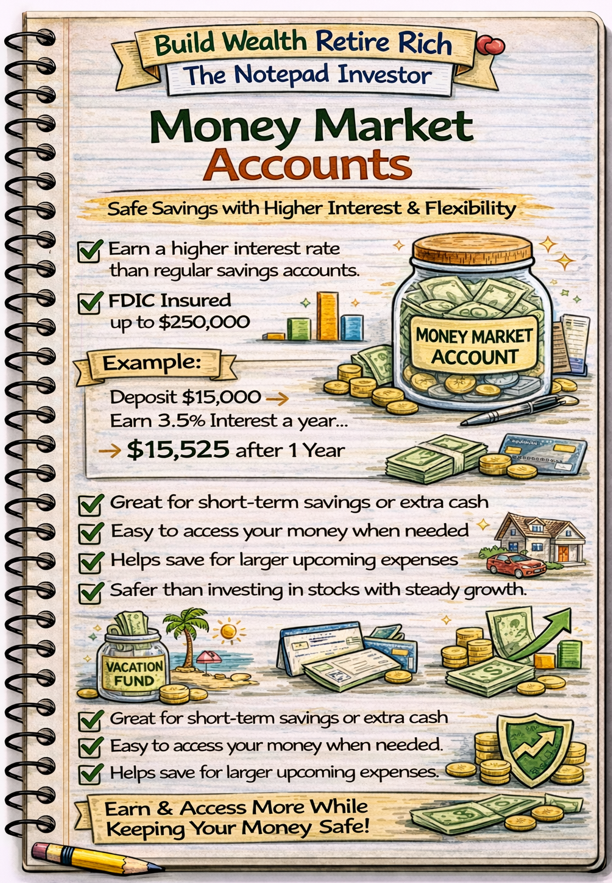
A money market account (MMA) is a federally insured deposit account combining features of savings and checking accounts—offering competitive interest rates similar to high-yield savings (typically 3-5% APY) while providing check-writing privileges and debit card access creating greater liquidity than traditional savings. Unlike regular savings accounts restricting transactions or checking accounts earning minimal interest, money market accounts bridge both worlds through higher returns on deposits plus convenient access for occasional larger payments, making them versatile option for emergency funds, short-term savings goals, and operating cash requiring both growth and periodic accessibility without sacrificing FDIC protection or principal safety.
This article is designed for anyone comparing savings vehicles, individuals wanting higher returns with checking-like features, or those seeking optimal cash account selection. You do not need financial expertise, high balances, or technical knowledge to understand and use money market accounts—straightforward deposit account accessible to most people providing competitive returns with added flexibility, though typically requires higher minimum balances ($1,000-10,000) than high-yield savings creating accessibility barrier for those building initial emergency funds from zero.
Understanding money market accounts matters because appropriate vehicle selection optimizes cash allocation matching account features to specific needs, money market accounts fill specific niche between pure savings and checking creating useful option for certain situations, and knowing differences between savings vehicles prevents suboptimal choices leaving money in wrong account type—while informed account users strategically select checking for spending, high-yield savings for pure accumulation, money market accounts for hybrid needs, and investments for long-term growth, creating comprehensive optimized structure impossible through single-account approach or uninformed default selections failing to match vehicles to purposes.
Educational disclaimer: This article provides general educational information about money market accounts. Interest rates, account features, minimum balance requirements, and fees vary significantly by institution. Money market accounts described are FDIC-insured bank accounts, distinct from money market mutual funds which lack FDIC insurance. This is not financial advice or recommendation of specific institutions. Consult qualified financial professionals for personalized guidance.
Understanding Money Market Accounts
What Is a Money Market Account?
Core definition: FDIC-insured deposit account offering higher interest rates than checking accounts plus limited check-writing and debit card access
Key characteristics:
- FDIC insured: Up to $250,000 per depositor per institution
- Competitive rates: Currently 3-5% APY at competitive institutions
- Check-writing: Typically allowed with some limitations (number of checks monthly)
- Debit card access: Some MMAs include debit card for ATM/purchases
- Higher minimums: Often $1,000-10,000 minimum balance required
- Tiered interest: Higher balances may earn higher rates
Money Market Account vs High-Yield Savings
Similarities:
- Both FDIC insured to $250,000
- Both offer competitive interest rates (typically 3-5% APY range)
- Both suitable for emergency funds and short-term savings
- Both variable-rate accounts following market conditions
- Both safe, liquid options for cash reserves
Key differences:
Money Market Accounts:
- Access: Check-writing and often debit card
- Minimums: Higher minimum balances ($1,000-10,000 typical)
- Rates: May have tiered rates (higher balances = higher APY)
- Fees: More likely to have monthly fees if below minimum
- Availability: Offered by traditional and online banks
High-Yield Savings Accounts:
- Access: Transfer-only (no checks or debit card typically)
- Minimums: Often $0 or very low ($25-100)
- Rates: Usually flat rate regardless of balance
- Fees: Typically $0 monthly fees
- Availability: Primarily online banks
Bottom line comparison:
- Similar interest rates (within 0.1-0.5% typically)
- MMA offers more access features (checks, debit)
- High-yield savings has lower barriers to entry (minimums, fees)
- Choice depends on need for access features vs simplicity/accessibility
Money Market Account vs Regular Checking
Interest earnings comparison:
- Regular checking: 0-0.1% APY typical
- Money market account: 3-5% APY typical
- On $5,000 balance: Checking earns $0-5 annually, MMA earns $150-250 annually
Access and features:
- Regular checking: Unlimited transactions, checks, debit card, often no minimums
- Money market: Limited transactions, some check/debit access, higher minimums
Use case distinction:
- Checking: Daily transactions, bill payments, frequent spending
- Money market: Cash reserves earning interest with occasional large payments
Money Market Accounts vs Money Market Funds (Critical Distinction)
Money Market Account (Bank MMA):
- FDIC-insured bank deposit account
- Principal guaranteed up to $250,000
- Fixed interest rate (variable over time but guaranteed return on balance)
- Subject: This article
Money Market Mutual Fund (Investment):
- NOT FDIC insured—investment product
- Principal not guaranteed (can theoretically lose value, though rare)
- Variable return based on fund performance
- Offered by investment firms, not banks
- Different product entirely despite similar name
Critical: This article discusses money market ACCOUNTS (bank deposit), not money market FUNDS (investments)

Money Market Account Features
Interest Rates and Tiers
Current rate environment (2024-2026):
- Competitive MMAs: 3.5-5.0% APY
- Average MMAs: 2.5-3.5% APY
- Low-tier MMAs: 0.5-1.5% APY
Tiered rate structure example:
- $0-$9,999: 2.5% APY
- $10,000-$24,999: 3.5% APY
- $25,000-$49,999: 4.0% APY
- $50,000+: 4.5% APY
Impact:
- $5,000 balance: Earns $125 annually at 2.5%
- $15,000 balance: Earns $525 annually at 3.5%
- $30,000 balance: Earns $1,200 annually at 4.0%
- Higher balances rewarded with better returns
Versus flat-rate high-yield savings:
- High-yield savings: 4.5% on all balances (no tiers)
- $5,000: Earns $225 annually—better than low-tier MMA
- $30,000: Earns $1,350 annually—better than or competitive with MMA
- Tiered rates favor higher balances but flat rates often competitive
Minimum Balance Requirements
Common structures:
- Opening minimum: $1,000-$2,500 to open account
- Ongoing minimum: $1,000-$10,000 to avoid monthly fees
- Minimum for top rate: Often $25,000-$50,000 for highest APY tier
Example institution requirements:
- Bank A: $2,500 opening, $2,500 minimum to avoid $12 monthly fee
- Bank B: $10,000 opening, $10,000 minimum to avoid $15 monthly fee
- Bank C: $100 opening, $1,000 minimum to avoid $10 monthly fee, $25,000 for top rate
Implication:
- MMAs less accessible for those building savings from zero
- Better suited for established emergency funds ($10,000+)
- High-yield savings better for initial accumulation phase due to lower minimums
Transaction Limitations
Historical regulation (Regulation D):
- Federal rule previously limited certain withdrawals to 6 per month
- Suspended in 2020 but some banks maintain limitation
Current typical limits:
- Check writing: 3-6 checks monthly
- Debit card transactions: May be limited or unlimited depending on bank
- Electronic transfers: May have limits (6 per month common)
- ATM withdrawals: Often unlimited
Exceeding limits:
- Fees per excess transaction ($10-25 typical)
- Account conversion to checking (losing interest rate)
- Account closure (if repeatedly exceeding)
Practical impact:
- Fine for occasional large payments (rent, major purchase)
- Not suitable for frequent daily transactions
- Complements checking account for specific uses
Check-Writing and Debit Access
Check-writing privileges:
- Typically provided with MMAs
- Limited number monthly (3-6 common)
- Useful for large payments: Rent, contractors, major purchases
- Earns interest until check clears
Debit card availability:
- Some MMAs include debit card
- ATM access for cash withdrawals
- Point-of-sale purchases (if allowed)
- Not all MMAs offer debit—check before opening if important
Strategic use:
- Write check for major expense from high-interest account
- Avoid transferring to checking first (saves time, earns interest longer)
- Example: Pay $2,500 contractor directly from MMA earning 4% vs 0% checking
When to Use Money Market Accounts
Ideal Use Cases
1. Large emergency fund with occasional direct payment needs:
- $25,000 emergency fund
- Earning competitive interest (4% = $1,000 annually)
- Occasionally pay large emergency expense directly via check
- Example: Write $3,000 check to auto repair shop from emergency fund MMA
2. Business operating reserves:
- Business maintains $50,000 cash reserves
- Earns interest on operating cash (4% = $2,000 annually)
- Writes checks for large vendor payments directly
- Better than business checking earning 0%
3. High-balance cash management:
- Someone with $100,000 liquid savings
- Tiered rates favor large balance (4.5% = $4,500 annually)
- Occasional large payments (property tax, major purchase)
- MMA provides both growth and access
4. Hybrid checking-savings for low transaction users:
- Someone with simple finances, few monthly bills
- Uses MMA as primary account
- Pays bills via check/debit (within transaction limits)
- Earns interest on full balance versus 0% checking
When High-Yield Savings Better Choice
Situations favoring HYSA over MMA:
Building emergency fund from zero:
- HYSA: $0 minimum, immediately start earning 4.5%
- MMA: Need $1,000-$10,000 to open or avoid fees
- HYSA accessible during accumulation phase
Multiple separate savings goals:
- HYSA: Can open unlimited free sub-accounts at many banks
- MMA: Each account needs minimum balance, potentially costly
- HYSA better for goal-based savings organization
Never need check-writing or debit access:
- If pure savings never requiring direct payment
- MMA features unused, paying for unnecessary access
- HYSA simpler and often higher rate without minimums
Rate-chasing focus:
- HYSA rates often 0.1-0.3% higher than MMA at same institution
- If maximizing every basis point matters
- No minimum balance barriers when switching banks
When Regular Checking Better Choice
Situations favoring checking over MMA:
Frequent transactions needed:
- Daily or weekly spending, bill payments
- MMA transaction limits problematic
- Checking offers unlimited transactions
Low balance maintained:
- $500-2,000 typical checking balance for bills
- Below MMA minimums, would incur fees
- Better in free checking even at 0% than MMA with fees
Need for extensive check writing:
- Write 10+ checks monthly
- Exceeds MMA limits
- Checking designed for extensive use
Optimizing Money Market Account Use
Three-Account Strategy
Comprehensive cash management structure:
Account 1: Checking (daily spending)
- Purpose: Bills, daily transactions, frequent spending
- Balance: 1-2 weeks expenses ($1,000-2,500 typical)
- Features: Unlimited transactions, debit card, bill pay
- Interest: 0-0.1% (irrelevant for small short-term balance)
Account 2: Money market (emergency fund or large reserves)
- Purpose: Emergency fund, cash reserves, occasional large payments
- Balance: $10,000-50,000 (emergency fund or operating reserves)
- Features: Competitive interest (4%+), check-writing for large payments
- Interest: Meaningful on large balance ($400-2,000 annually)
Account 3: High-yield savings (goal-based savings)
- Purpose: Short-term savings goals (vacation, down payment, etc.)
- Balance: Variable, accumulating toward goals
- Features: High interest (4.5%), no minimums, multiple sub-accounts
- Interest: Maximized rate, organized by goals
Money flow:
- Paycheck → Checking
- Automatic transfers → MMA (emergency fund), HYSA (goals)
- Checking maintained at minimum for spending
- Bulk of cash earning interest in MMA and HYSA
Choosing the Right Money Market Account
Evaluation criteria:
1. Interest rate:
- Compare APY across institutions
- Check tiered structure matching your balance
- Target: 4-5% range for competitive account
2. Minimum balance requirements:
- Can you meet opening minimum?
- Can you maintain ongoing minimum avoiding fees?
- Monthly fee amount if below minimum?
3. Monthly fees:
- Ideally $0 with minimum balance met
- Fee amount if minimum not met
- Compare fee vs potential interest earnings
4. Access features needed:
- Check-writing important? How many checks monthly?
- Debit card access needed?
- ATM network size and fees
5. Institution reputation:
- Established bank vs newer institution
- Customer service quality
- Online/mobile app functionality
- FDIC membership confirmed
Top-tier money market account characteristics:
- 4-5% APY competitive rate
- Reasonable minimums ($1,000-$2,500, not $10,000+)
- $0 monthly fee with minimum met
- Check-writing and debit access
- Strong customer service and mobile app
- FDIC insured
Tax Considerations
Interest taxation:
- MMA interest is taxable income
- Reported on 1099-INT (if earned $10+ annually)
- Taxed at ordinary income rates
- No capital gains treatment
Example tax impact:
- $25,000 MMA balance at 4% = $1,000 interest
- 22% tax bracket: $220 tax owed
- After-tax return: $780 or 3.12% after-tax yield
Still far superior to traditional savings:
- $25,000 at 0.05% traditional = $12.50 interest, $2.75 tax, $9.75 after-tax
- MMA after-tax: $780 vs traditional after-tax: $9.75
- MMA 78x better even after taxes
Tax-deferred alternatives:
- Emergency funds and short-term savings can’t go in IRA/401k
- Need liquid accessible cash outside retirement accounts
- Accept tax on interest as cost of liquidity and safety
Why Money Market Accounts Matter
Without understanding money market accounts as option within savings vehicle spectrum, people miss hybrid solution combining high interest rates with check-writing flexibility serving specific needs traditional savings and checking cannot address simultaneously, inappropriate vehicle selection leaves substantial interest earnings on table or creates access friction when features mismatched to purposes, and complete cash management optimization requires knowing all available tools selecting best fit for each specific use case—while informed users strategically deploy checking for daily spending, high-yield savings for pure accumulation, money market accounts for large reserves needing occasional direct access, and investments for long-term growth, creating comprehensive structure maximizing returns while maintaining appropriate liquidity impossible through single-vehicle approach or uninformed default account selections.
Understanding money market accounts enables individuals to:
- Earn competitive interest on large cash reserves (3-5% vs 0%)
- Access funds directly via checks or debit when needed
- Maintain FDIC insurance protection up to $250,000
- Optimize emergency funds or business reserves earning meaningful returns
- Select appropriate vehicle matching specific liquidity and access needs
- Create comprehensive multi-account structure maximizing overall returns
- Make informed trade-offs between features, minimums, and rates
Money market accounts provide valuable hybrid option between pure savings and checking serving specific situations where both competitive returns and direct payment access required simultaneously creating optimized solution impossible through either extreme alone.
Common Misunderstandings
Many people confuse money market accounts (FDIC-insured bank deposits) with money market mutual funds (investment products without FDIC insurance). In reality, these are completely different products despite similar names—money market accounts are bank deposit accounts with guaranteed principal up to $250,000 FDIC coverage, while money market funds are investments sold by brokerages with no principal guarantee though historically very stable, proving critical importance of confirming account type when opening to ensure receiving expected FDIC protection versus investment product exposure.
Another common misconception is that money market accounts always offer better rates than high-yield savings accounts. In practice, rates are typically competitive within 0.1-0.5% of each other with high-yield savings sometimes offering higher APY especially for lower balances below tiering thresholds, making rate alone insufficient reason to choose MMA—decision should incorporate minimum requirements, fees, and whether check-writing features provide actual value versus unused bells and whistles paying for through higher minimums or lower rates.
Some believe money market accounts provide truly unlimited access like checking accounts. However, transaction limits typically apply (often 3-6 checks monthly, possible electronic transfer limits) with fees or restrictions for exceeding limits, proving MMAs designed for occasional large payments not daily frequent transactions, making them complement to checking account rather than replacement requiring understanding of appropriate use cases avoiding violation of transaction limitations triggering fees or account conversion.
How Money Market Accounts Fit Into Financial Success
Money market accounts provide specialized tool within comprehensive cash management strategy serving hybrid needs between pure savings and transactional checking, enable large cash reserves earning competitive interest while maintaining direct payment access impossible with transfer-only savings accounts, and represent sophisticated optimization for specific situations though not universally superior to alternatives requiring informed situational assessment, making MMA knowledge essential component of complete financial vehicle literacy enabling optimal account selection matching specific needs rather than one-size-fits-all default approach leaving opportunities for optimization unrealized.
For example, two small business owners both maintain $40,000 operating cash reserves for slow periods and large vendor payments. Owner A keeps reserves in business checking earning 0% interest—easy access for payments but zero return on substantial idle cash. After 10 years: Principal $40,000 (unchanged), interest earned $0, opportunity cost massive. Owner B opens business money market account earning 4% average with check-writing privileges—maintains same payment access while earning interest on reserves. After 10 years: Principal $40,000, interest earned $19,200 with compounding, ending balance $59,200. Difference: $19,200 additional wealth from identical starting point and identical access features—pure gain from strategic account selection requiring 30-minute initial setup creating ongoing passive returns. Both could write checks for large vendor payments. Both maintained liquidity for business needs. Owner B simply used appropriate vehicle capturing returns Owner A unnecessarily forfeited through checking account inertia despite substantial balance justifying optimization. Single account choice decision (MMA vs checking for reserves) created five-figure wealth difference over decade requiring no additional contributions, time, or reduced access beyond initial thoughtful vehicle selection.
Money market accounts separate optimized cash managers understanding complete vehicle spectrum from single-account users leaving substantial returns on table through inappropriate vehicle selection for specific use cases requiring informed assessment matching features to actual needs.
Recent Updates and Trends
In recent years, interest rate environment normalization has revitalized money market accounts—rates rising from 0.1-0.5% (2020-2021) to 3-5% (2024-2026) making competitive returns available while maintaining FDIC protection and access features, dramatically increasing value proposition versus checking accounts earning nothing.
Online banks expanding MMA offerings—previously domain of traditional banks, online institutions increasingly offering competitive money market accounts with lower minimums and higher rates than brick-and-mortar alternatives, though often lacking check-writing reducing hybrid appeal creating interesting trade-offs between rates and features.
Regulation D suspension has reduced transaction limit enforcement—federal limitation on certain withdrawals suspended 2020 giving banks discretion whether maintaining restrictions, some removing limits entirely making MMAs more flexible while others retaining traditional 6-transaction monthly caps creating need for verification before opening.
High-yield savings narrowing distinction—as online HYSAs offer increasingly competitive rates often matching or exceeding MMAs while maintaining zero minimums and fees, money market accounts’ value proposition increasingly dependent on check-writing feature rather than rate advantage, making assessment of whether that feature justifies higher minimums critical decision factor.
Fundamental money market account principles remain timeless: hybrid vehicle combining competitive interest with direct payment access serves specific needs neither pure savings nor checking address simultaneously, higher minimum requirements and potential fees require cost-benefit analysis versus high-yield savings alternatives, appropriate use cases include large reserves requiring occasional large payments, and informed vehicle selection matching features to actual needs rather than assumptions produces optimal comprehensive cash management—regardless of specific rate levels, minimum requirements, regulatory environment, or competitive dynamics, money market accounts fill valuable niche within complete savings vehicle spectrum for situations where both returns and payment access required simultaneously justifying potential trade-offs versus simpler alternatives.
3 Things You Can Do Today
Ready to evaluate money market accounts? Here are three simple steps you can take right now:
1. Assess whether money market account fits your specific needs – Review your situation asking: Do I have $10,000+ cash reserves (emergency fund, business reserves, large savings)? Do I occasionally need to write large checks or make large payments directly from reserves? Would I benefit from earning interest on these reserves? If yes to all three, MMA potentially valuable. If no to any: High-yield savings likely better choice (no minimums, often higher rates, simpler). Calculate potential earnings: Your reserve balance × 4% = annual interest. Example: $25,000 × 4% = $1,000 annually. Compare to current earnings if in checking (likely $0). Takes 10 minutes determining if MMA addresses actual need versus theoretical feature set.
2. Compare 3 money market accounts if MMA appropriate for your situation – If step 1 indicates MMA fits needs, research options: Check current banks’ MMA offerings, compare online banks (Ally, Marcus, Capital One), review credit unions. For each note: APY (overall and for your balance tier), minimum balance requirements, monthly fees and fee-avoidance minimums, check-writing limits, debit card availability, customer reviews. Create comparison chart showing trade-offs. Target: 4%+ APY, reasonable minimums you can meet, $0 fees with minimums maintained, check-writing included. Takes 20 minutes identifying best options. Don’t need MMA? Skip this step—high-yield savings better default for most people.
3. If MMA appropriate, open account and transfer large reserves OR confirm high-yield savings better choice – Based on steps 1-2: If MMA clearly beneficial (large reserves, need check access, competitive rate), complete online application at chosen institution, transfer reserves from checking or traditional savings, set up any needed bill payments via check. If assessment reveals high-yield savings better fits needs (no check-writing needed, want zero minimums, prefer simplicity), open HYSA instead at Marcus/Ally/AmEx Personal Savings transferring reserves there. Either way, move large cash reserves from 0% checking/traditional savings to competitive vehicle earning 50-500x more interest. Takes 20-30 minutes creating immediate optimization. Key insight: Either MMA or HYSA dramatically better than checking/traditional savings—choice between them less critical than escaping zero-interest inertia entirely.
These actions create informed decision about money market accounts within 60 minutes—assessed whether hybrid features match actual needs, compared options if appropriate, executed optimal choice whether MMA or HYSA—resulting in cash reserves earning competitive returns while maintaining needed access creating comprehensive optimization impossible through single checking account holding all funds at zero interest.
Quick FAQ
What’s the difference between a money market account and money market fund?
Money market ACCOUNT = FDIC-insured bank deposit (subject of this article), principal guaranteed up to $250,000, offered by banks, checking-like features often included. Money market FUND = investment mutual fund (NOT FDIC insured), principal not guaranteed though historically very stable, offered by investment firms, no check-writing. Critical distinction: Accounts have federal deposit insurance protecting principal, funds are investments without guarantee. Always verify which product you’re opening—ask explicitly about FDIC insurance confirming bank deposit account not investment fund.
Should I use money market account instead of high-yield savings for emergency fund?
Depends on balance and need for check-writing. Large emergency fund ($25,000+) where you might occasionally write check for major emergency expense: MMA potentially useful. Smaller emergency fund (<$10,000) or never need direct payment: High-yield savings better (no minimums, often slightly higher rate, simpler). Both equally safe (FDIC insured), both competitive rates (4-5%), choice depends on check-writing value and meeting minimums. Many people: HYSA better default unless specific need for MMA hybrid features justifies higher minimums and potential complexity.
Can I use money market account as primary checking account?
Possible but not ideal for most people. Works if: Very few monthly transactions (within MMA limits typically 3-6 checks/transfers), comfortable with transaction limits, maintain high minimum balance avoiding fees, primarily pay bills via few large checks monthly. Problematic if: Frequent daily spending, many small transactions, fluctuating balance potentially dropping below minimums. Better approach: Checking for daily transactions (unlimited access, no minimums), MMA for reserves earning interest with occasional large payments. Most people need both not MMA replacing checking entirely.
Are money market accounts safe or is the higher interest indicating risk?
Completely safe—FDIC insured identical to checking and savings accounts ($250,000 per depositor per institution). Higher interest results from competitive market for deposits not elevated risk. Principal cannot decrease—guaranteed by FDIC. Only risk: Interest rates variable, can decline if Federal Reserve lowers rates, but balance never goes down. Equally safe as traditional savings just better return through competitive institution versus legacy bank complacency. Zero additional risk for higher earnings—pure benefit from shopping around.
What are typical minimum balance requirements and fees for money market accounts?
Varies widely by institution: Opening minimum: $100-$10,000 (typical $1,000-$2,500). Ongoing minimum: $1,000-$10,000 to avoid monthly fee. Monthly fee if below minimum: $10-$25 typical. Top-tier rate minimum: Often $25,000-$50,000 for highest APY tier. Example: $2,500 to open, $2,500 minimum avoiding $12 monthly fee, 3.5% APY on $2,500-$24,999, 4.5% on $25,000+. Compare to HYSA: Often $0 minimum, $0 fees, flat 4.5% all balances. Minimums are why MMAs better for established larger reserves ($10,000+) not building savings from zero.
How do money market account interest rates compare to high-yield savings?
Currently (2024-2026) very similar: Money market accounts: 3-5% APY typical, often tiered (higher balances = higher rates). High-yield savings: 4-5% APY typical, usually flat rate all balances. Difference: Within 0.1-0.5% typically at competitive institutions. On $25,000: MMA at 4% = $1,000 annually, HYSA at 4.5% = $1,125 annually, difference $125—minimal. Choice should emphasize features needed (check-writing, minimums, fees) not tiny rate differences. Both dramatically better than traditional savings (0.01-0.5%) or checking (0%)—optimizing to either captures vast majority of benefit versus legacy account inertia.
Explore More in Money Basics
Disclosure
This article is provided for educational purposes only and does not constitute financial advice or recommendation of specific institutions. Money market accounts described are FDIC-insured bank deposit accounts—distinct from money market mutual funds which are investment products lacking FDIC insurance. Interest rates, minimum balance requirements, fees, and account features vary significantly by institution and change frequently. Rate information represents recent typical ranges—verify current rates before opening accounts. FDIC insurance limits and rules apply—coverage details at fdic.gov. Individual circumstances and needs differ significantly requiring personalized assessment. Examples use simplified scenarios—actual outcomes vary. Institutions mentioned for illustrative purposes only—not comprehensive or recommendations. Transaction limits, check-writing privileges, and debit access vary by bank. Tax implications vary by individual situation—consult tax professionals. Advertisements or sponsored content may appear within or alongside this content. All information presented independently for educational purposes only.