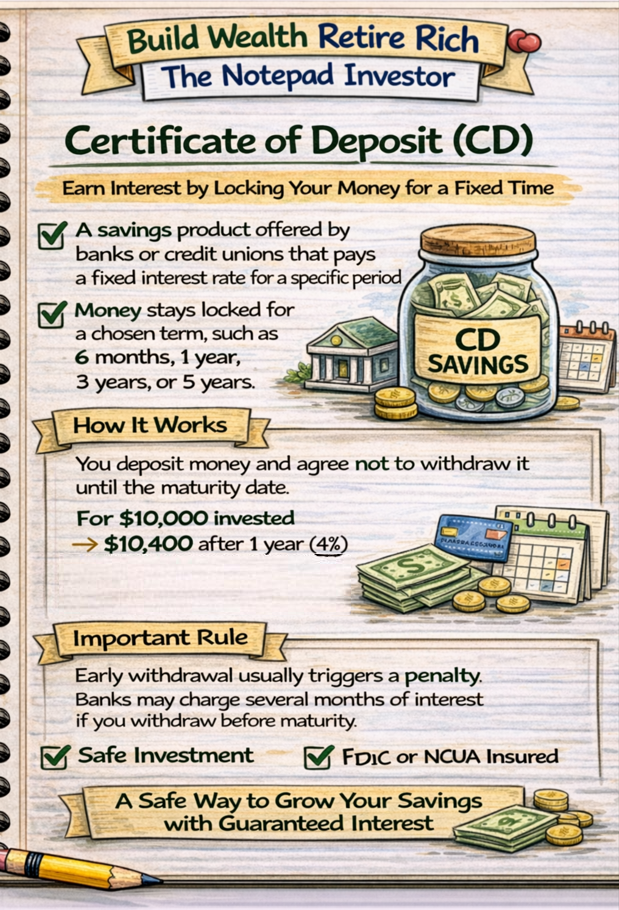
A certificate of deposit (CD) is a federally insured savings product requiring funds locked for fixed term (3 months to 5+ years) in exchange for guaranteed interest rate typically higher than regular savings accounts—offering 4-6% APY depending on term length with FDIC insurance protecting principal up to $250,000 but imposing penalties for early withdrawal before maturity date. Unlike liquid savings accounts or money market accounts allowing anytime access, CDs sacrifice flexibility for certainty and often higher returns through contractual commitment to leave money untouched for specific duration, making them optimal vehicle for funds definitely not needed within known timeframe—down payment savings with 2-year purchase timeline, sinking funds for scheduled major purchase, or conservative portion of investment portfolio requiring absolute safety with predictable returns regardless of market conditions.
This article is designed for anyone with savings sitting idle earning minimal interest despite no need for immediate access, individuals seeking guaranteed returns without market risk, or those wanting comprehensive understanding of all savings vehicle options. You do not need financial expertise, high balances, or technical knowledge to understand and use CDs—straightforward deposit product accessible to virtually everyone offering simple guaranteed return in exchange for time commitment, though requires careful term selection matching actual fund availability timeline to avoid costly early withdrawal penalties negating rate advantages.
Understanding certificates of deposit matters because funds genuinely not needed for 6 months to 5 years earn higher guaranteed returns in CDs versus liquid savings sitting unnecessarily accessible, appropriate vehicle selection matching known timeframes prevents leaving money in suboptimal accounts earning less than available alternatives, and complete savings vehicle literacy requires knowing fixed-term options alongside liquid choices enabling strategic allocation across spectrum—while informed savers deploy checking for spending, high-yield savings for emergency funds requiring liquidity, money market accounts for reserves needing occasional access, CDs for scheduled future needs with certain timelines, and investments for long-term growth, creating comprehensive optimized structure impossible through single-vehicle approach or limited awareness of available options.
Educational disclaimer: This article provides general educational information about certificates of deposit. Interest rates, terms, penalties, and features vary significantly by institution. Early withdrawal penalties can eliminate interest earnings and potentially reduce principal in extreme cases. FDIC insurance limits and rules apply. This is not financial advice or recommendation of specific institutions or CD products. Consult qualified financial professionals for personalized guidance.
Understanding Certificates of Deposit
What Is a Certificate of Deposit?
Core definition: Time deposit account offering fixed interest rate for fixed term with FDIC insurance but imposing penalties for early withdrawal
Key characteristics:
- Fixed term: Money locked for specific duration (3 months to 10 years typical)
- Fixed rate: Interest rate guaranteed not changing during term
- FDIC insured: Principal protected up to $250,000 per depositor per institution
- Early withdrawal penalty: Accessing funds before maturity costs months of interest
- Guaranteed return: Known exact earnings at maturity regardless of market fluctuations
- Minimum deposit: Often $500-$1,000 minimum though some offer lower or $0
How CDs Work
Opening process:
- Choose CD term matching when you’ll need money (6 months, 1 year, 3 years, etc.)
- Deposit funds meeting minimum requirement ($500-$1,000 typical)
- Funds locked earning guaranteed rate for full term
- At maturity: Receive principal + all accrued interest
Example CD:
- Deposit: $10,000
- Term: 18 months
- Rate: 5.0% APY
- At maturity: $10,764 (principal + $764 interest)
- Guaranteed return known upfront
Interest payment options:
- Most common: Interest compounds and paid at maturity
- Alternative: Some CDs pay interest monthly or quarterly to external account
- Typical: Interest compounds within CD maximizing return
CD Terms Available
Short-term CDs (3-12 months):
- 3-month, 6-month, 9-month, 12-month common
- Rates: Typically 4.0-5.5% APY currently
- Use: Near-term known expenses, parking cash briefly
Medium-term CDs (1-3 years):
- 18-month, 24-month, 36-month popular
- Rates: Typically 4.5-6.0% APY currently
- Use: Down payment savings, scheduled major purchase
Long-term CDs (3-10 years):
- 48-month (4-year), 60-month (5-year), some up to 10 years
- Rates: Variable, sometimes lower than medium-term (inverted yield curve)
- Use: Ultra-conservative investment portion, specific future expense
Current Rate Environment (2024-2026)
Typical CD rates by term:
- 3-month: 4.5-5.0% APY
- 6-month: 4.75-5.25% APY
- 12-month: 5.0-5.5% APY
- 18-month: 5.0-5.75% APY
- 24-month: 4.75-5.5% APY
- 36-month: 4.5-5.25% APY
- 60-month: 4.25-5.0% APY
Note: Rates fluctuate with Federal Reserve policy—verify current rates when opening
Rate comparison to liquid accounts:
- High-yield savings: 4.0-5.0% APY (liquid, anytime access)
- Money market accounts: 3.5-5.0% APY (limited access)
- 1-year CD: 5.0-5.5% APY (locked one year)
- Premium for illiquidity: 0.25-1.0% typically

CD Advantages and Disadvantages
Advantages of CDs
1. Guaranteed fixed return:
- Know exact earnings at opening
- No market volatility affecting returns
- Rate locked regardless of future changes
- Peace of mind through certainty
2. Higher rates than liquid savings (typically):
- 0.25-1.0% premium over high-yield savings common
- Example: 5.5% CD vs 4.5% HYSA = 22% more interest annually
- Meaningful difference on larger balances
3. FDIC insurance protection:
- Principal guaranteed up to $250,000
- Same safety as checking/savings
- Zero risk of loss within insurance limits
4. Forced savings discipline:
- Early withdrawal penalty creates barrier to spending
- Locks money away from temptation
- Ensures funds available when needed for planned purpose
5. Rate lock protection:
- If interest rates fall, CD maintains original rate
- Example: Open 3-year CD at 5.5%, rates drop to 3%—you keep 5.5%
- Protection against declining rate environment
Disadvantages of CDs
1. Illiquidity and penalties:
- Funds locked for full term
- Early withdrawal penalty (typically 3-12 months interest)
- Emergency access requires sacrificing earnings
- Inflexibility compared to savings accounts
2. Opportunity cost if rates rise:
- If interest rates increase, CD stuck at lower rate
- Example: Open 5-year CD at 4.5%, rates rise to 6%—locked at 4.5% for duration
- Miss higher earnings available in new CDs or savings
3. Lower returns than investments long-term:
- Stock market historical average: ~10% annually
- CDs: 4-6% currently
- For long-term money (10+ years), investments likely superior despite volatility
4. Minimum deposit requirements:
- Many CDs require $500-$1,000 minimum
- Some “jumbo CDs” require $25,000-$100,000
- Less accessible than $0 minimum high-yield savings
5. Tax on interest (no tax advantage):
- CD interest taxed as ordinary income annually
- No special treatment like capital gains
- Can’t defer taxes like retirement accounts
Early Withdrawal Penalties
Typical Penalty Structures
Common penalty formulas:
- Short-term CDs (3-12 months): 3 months interest penalty
- Medium-term CDs (1-3 years): 6 months interest penalty
- Long-term CDs (3+ years): 12 months interest penalty
How penalties calculated:
- Penalty deducted from earned interest first
- If insufficient interest earned, deducted from principal
- Example: Withdraw after 2 months from 12-month CD with 6-month penalty—you’ve only earned 2 months interest, so 4 months penalty comes from principal
Example early withdrawal scenario:
- $10,000 deposited in 24-month CD at 5% APY
- Penalty: 6 months interest
- Withdraw after 18 months:
- Interest earned: $761 (18 months at 5%)
- Penalty: $253 (6 months interest)
- Net interest received: $508
- Total received: $10,508 (principal + net interest)
Worst case (very early withdrawal):
- Same CD, withdraw after 3 months
- Interest earned: $125 (3 months)
- Penalty: $253 (6 months interest)
- Penalty exceeds earned interest by $128
- Total received: $9,872 (principal minus $128)
- Lost principal through early withdrawal
Avoiding Penalties
Strategies:
1. Match term to actual timeline:
- Only use CD for money genuinely not needed until maturity
- Uncertain timeline? Use liquid savings instead
- Conservative estimate: If might need in 18 months, use 12-month CD
2. Maintain separate emergency fund:
- Never put emergency fund in CD
- Keep 3-6 months expenses in liquid savings
- Only put “above emergency fund” money in CDs
3. Use CD ladder (described below):
- Spreads maturities across time
- Regular access to portions without penalty
- Combines higher rates with periodic liquidity
4. Check for no-penalty CD options:
- Some banks offer “no-penalty CDs” or “liquid CDs”
- Allow early withdrawal without penalty
- Typically lower rates than traditional CDs (trade-off for flexibility)
- Bridge between CD and high-yield savings
CD Strategies
CD Laddering
Concept: Divide total CD allocation across multiple CDs with staggered maturity dates creating regular access while maintaining higher rates
Basic ladder example:
- Total available: $25,000 for CDs
- Divide into 5 parts: $5,000 each
- CD 1: $5,000 in 1-year CD
- CD 2: $5,000 in 2-year CD
- CD 3: $5,000 in 3-year CD
- CD 4: $5,000 in 4-year CD
- CD 5: $5,000 in 5-year CD
Benefits:
- After year 1: $5,000 matures, can access or reinvest
- Every year thereafter: $5,000 available
- Regular liquidity without penalties
- Average rate higher than keeping all in 1-year CDs
- Flexibility to adjust as rates change
Maintenance:
- When CD matures, reinvest in new longest-term CD
- Example: 1-year matures, reinvest in new 5-year CD
- Eventually all CDs at maximum term but one maturing annually
- Or take matured funds if needed (liquidity access)
Barbell Strategy
Concept: Split funds between very short-term and long-term CDs, avoiding middle terms
Example allocation:
- 50% in 3-6 month CDs (liquidity, frequent reinvestment opportunities)
- 50% in 5-year CDs (maximum rates)
- Nothing in 1-3 year range
Rationale:
- Short-term provides flexibility and rate adjustment opportunity
- Long-term captures highest rates
- Skip middle terms that don’t optimize either goal
Bullet Strategy
Concept: All CDs mature at same specific future date when funds needed
Example:
- Need $30,000 in 3 years for home down payment
- Currently have $10,000 saved
- Year 1: Put $10,000 in 3-year CD
- Year 2: Save another $10,000, put in 2-year CD
- Year 3: Save final $10,000, put in 1-year CD
- All three CDs mature in Year 4 when down payment needed
Purpose:
- Coordinate maturities with known expense date
- Maximize returns on scheduled savings
- All funds available exactly when needed
Rate Shopping and Timing
Finding best rates:
- Compare online: Bankrate.com, DepositAccounts.com, NerdWallet
- Check online banks (often highest rates): Marcus, Ally, Discover, Capital One
- Check credit unions (competitive rates for members)
- Traditional banks typically lowest rates (avoid unless relationship premium)
Rate difference impact:
- $20,000 in 2-year CD
- Bank A: 4.5% APY → Earns $1,845
- Bank B: 5.5% APY → Earns $2,271
- Difference: $426 from 10 minutes rate shopping
Timing considerations:
- Rising rate environment: Favor shorter terms, can reinvest at higher rates sooner
- Falling rate environment: Lock in longer terms before rates drop
- Uncertain environment: CD ladder balances both scenarios
When to Use CDs
Ideal Use Cases
1. Scheduled major purchase with known timeline:
- Saving $25,000 for home down payment in 2 years
- Put in 24-month CD earning 5.25% guaranteed
- At maturity: Have exactly $27,700 (guaranteed) for down payment
- No market risk, know exact amount available
2. Sinking funds for large future expenses:
- Know you’ll replace car in 3 years
- Saving $600 monthly = $7,200 annually
- Put year 1 savings ($7,200) in 3-year CD
- Put year 2 savings in 2-year CD, year 3 in 1-year
- All mature when car replacement needed
3. Conservative investment allocation:
- Retiree wanting zero stock market risk on portion of portfolio
- CD ladder providing safe predictable income
- Example: $200,000 in 5-rung ladder, $40,000 maturing annually
- Spending from maturing CDs each year
4. Parking cash during decision period:
- Sold house, have $100,000 waiting to invest
- Not ready to invest immediately (researching options)
- 6-12 month CDs earn guaranteed return while deciding
- Better than savings while maintaining safety
When NOT to Use CDs
Emergency fund (use liquid savings instead):
- Emergencies unpredictable by definition
- Early withdrawal penalties defeat purpose
- High-yield savings better: Liquid + competitive rate
Uncertain timeline (liquidity needed):
- Might need money in 6 months or 2 years (unknown)
- Risk of early withdrawal penalty
- Savings account provides flexibility without cost
Long-term investing (10+ years):
- Stocks historically outperform CDs significantly long-term
- 5% CD vs 10% average stock returns = massive opportunity cost over decades
- Accept volatility for growth when timeline long
When building initial savings (low balances):
- Need emergency fund accessibility first
- Minimums and penalties problematic when still accumulating
- High-yield savings better until emergency fund established
Why Certificates of Deposit Matter
Without understanding certificates of deposit as option within savings vehicle spectrum, people miss guaranteed higher returns available for funds genuinely not needed within known timeframes leaving money unnecessarily in liquid accounts earning less, appropriate fixed-term vehicle selection prevents opportunity cost when certainty exists about fund availability timeline, and complete savings optimization requires matching each dollar to optimal vehicle based on when needed—while informed savers strategically deploy liquid savings for uncertain needs, CDs for scheduled future expenses, and investments for long-term growth, creating comprehensive allocation impossible through single-vehicle approach or limited awareness of fixed-term alternatives providing superior returns when flexibility unnecessary.
Understanding certificates of deposit enables individuals to:
- Earn guaranteed higher returns on scheduled savings (0.5-1.0% premium typical)
- Lock in rates protecting against declining interest environment
- Maintain FDIC insurance while exceeding liquid savings returns
- Create forced savings discipline through penalty barrier
- Build CD ladders providing regular access with enhanced rates
- Coordinate maturity dates with planned major expenses
- Optimize complete savings allocation across liquidity spectrum
Certificates of deposit provide valuable fixed-term option completing savings vehicle spectrum enabling strategic allocation matching known timelines to guaranteed returns impossible through liquid-only approaches leaving returns on table unnecessarily.
Common Misunderstandings
Many people assume CDs always offer significantly better rates than high-yield savings accounts making them universally superior. In reality, rate premiums vary with market conditions—currently CDs offer 0.25-1.0% higher rates than HYSA typical, sometimes negligible difference especially for short terms, making trade-off between flexibility and minimal rate advantage not always worth illiquidity cost, proving CD superiority depends on specific rates available and genuine timeline certainty not automatic assumption requiring verification before locking funds.
Another common misconception is that early withdrawal from CD means losing all interest earned. In practice, early withdrawal penalty typically equals specific months of interest (3-12 months common) deducted from earned interest, often still leaving positive return if held substantial portion of term—example: withdraw 18-month CD after 15 months with 6-month penalty still leaves 9 months net interest earned, proving early withdrawal costly but not necessarily catastrophic total loss of earnings though should still be avoided when possible.
Some believe CDs are appropriate emergency fund vehicles due to higher rates and FDIC insurance. However, emergency fund requires immediate penalty-free access making illiquidity fatal flaw—early withdrawal penalties defeat emergency protection purpose, and rate premium (often 0.5-1.0%) insufficient compensation for access sacrifice, proving CDs fundamentally incompatible with emergency fund requirements regardless of safety and returns making liquid high-yield savings correct vehicle despite slightly lower rate.
How Certificates of Deposit Fit Into Financial Success
Certificates of deposit provide specialized fixed-term tool completing comprehensive savings vehicle toolkit, enable optimization of scheduled savings earning guaranteed premium returns when timeline certainty exists eliminating unnecessary liquidity premium cost, and represent sophisticated allocation strategy for portion of portfolio requiring absolute safety with known timeframe though inappropriate for emergency reserves or uncertain needs, making CD knowledge essential component of complete savings vehicle literacy enabling strategic deployment across liquidity spectrum rather than one-size-fits-all liquid-only approach leaving returns on table when flexibility unnecessary.
For example, two people both saving $20,000 for home down payment in exactly 24 months—certain timeline, scheduled expense, absolute safety required. Person A keeps savings in high-yield savings account at 4.5% APY (liquid, no penalties). After 24 months: Principal $20,000, interest $1,894, ending balance $21,894. Safe, liquid, reasonable approach. Person B shops for best 24-month CD finding 5.5% APY, locks in rate for full term. After 24 months: Principal $20,000, interest $2,307, ending balance $22,307. Difference: $413 additional wealth ($22,307 vs $21,894) from identical starting point, identical safety (FDIC insured), identical timeline—pure gain from strategic vehicle selection. Both have exactly $20,000+ available for down payment at planned purchase date. Both maintained absolute safety. Person B simply captured 1.0% rate premium available for accepting illiquidity irrelevant given certain two-year timeline. That $413 represents pizza, groceries, furnishings Person A unnecessarily forfeited through suboptimal vehicle choice despite certain timeline making flexibility premium unjustified. If unexpected need arose forcing early withdrawal? Person B would pay penalty losing perhaps $200-300 of $413 premium—still risk worth taking given high probability of following plan. Over financial lifetime, repeatedly choosing optimal vehicle for each specific situation compounds into substantial wealth differences through nothing more than sophisticated allocation matching vehicle features to actual requirements.
Certificates of deposit separate optimized savers understanding complete vehicle spectrum from liquid-only defaulters leaving guaranteed returns on table when certainty exists enabling strategic allocation impossible through limited awareness or reflexive avoidance of fixed-term options based on emergency fund logic inappropriately applied to all savings categories.
Recent Updates and Trends
In recent years, CD rate competitiveness has improved dramatically—rising from 0.5-1.5% (2020-2021) to 4.5-6.0% (2024-2026) making fixed-term vehicles attractive again after decade of near-zero returns, substantially increasing value proposition versus liquid savings which also rose but often with smaller premiums maintaining CD advantage for certain timelines.
No-penalty CD offerings have expanded—more institutions offering liquid CDs or no-penalty CDs allowing early withdrawal without traditional penalties though typically 0.5-1.0% lower rates than standard CDs, creating interesting middle ground between pure liquidity and traditional fixed-term trade-offs appealing to flexibility-seeking savers willing to accept slightly reduced returns.
Online banks dominating CD rates—internet-only institutions consistently offering 0.5-1.5% higher CD rates than traditional brick-and-mortar banks making physical branch loyalty increasingly expensive, though credit unions remaining competitive especially for members with established relationships creating local alternatives to online-only options.
Inverted yield curves periodically occurring—situations where short-term CDs paying higher rates than long-term CDs (example: 1-year at 5.5%, 5-year at 4.5%) creating counterintuitive scenarios favoring short terms when historically long-term commanded premium, requiring active rate monitoring rather than assumptions about term-to-rate relationships.
Fundamental certificate of deposit principles remain timeless: fixed-term commitment enables higher guaranteed returns compensating for illiquidity, appropriate use requires genuine timeline certainty avoiding costly early withdrawal penalties, CD laddering provides sophisticated strategy combining rate premiums with regular access, and strategic allocation of scheduled savings to fixed-term vehicles captures returns impossible through universal liquidity maintenance—regardless of absolute rate levels, yield curve shapes, no-penalty innovations, or online versus traditional dynamics, matching known timelines to guaranteed fixed returns produces superior outcomes versus keeping all funds liquid when certainty exists making flexibility premium unjustified opportunity cost.
3 Things You Can Do Today
Ready to evaluate certificates of deposit? Here are three simple steps you can take right now:
1. Identify savings with certain timelines suitable for CDs – Review your savings asking: What funds do I KNOW I won’t need for 6+ months? Examples: Down payment savings for house purchase in 18 months, car replacement fund for vehicle in 2 years, sinking funds for scheduled major purchase, portion of emergency fund above minimum (if have $25,000 emergency fund but only need $15,000, could CD the extra $10,000). Critical: Only consider money genuinely not needed with high certainty—uncertain timeline means stay in liquid savings. Calculate amount available for CDs. Example: “$15,000 savings for down payment in 24 months = CD-appropriate. $10,000 emergency fund = liquid savings only.” Takes 10 minutes identifying suitable funds avoiding inappropriate CD use for emergency reserves or uncertain needs.
2. Compare CD rates across terms matching your timeline – Visit rate comparison sites (Bankrate.com, DepositAccounts.com) or check directly: Marcus by Goldman Sachs, Ally Bank, Discover Bank, Capital One, local credit unions. For your timeline from step 1, note: Rates for matching term (18-month savings needs 18-month CD rates), Minimum deposits required, Early withdrawal penalties, Institution reputation. Compare to current high-yield savings rate (likely 4-5%). Calculate difference: CD rate minus HYSA rate = premium for illiquidity. Example: 5.5% CD vs 4.5% HYSA = 1.0% premium, on $15,000 over 18 months = $150 extra earnings. Worth it? Usually yes if timeline certain. Takes 15 minutes finding best rates and calculating benefit.
3. Open CD for appropriate funds if rate premium justifies OR confirm HYSA better choice – Decision point: If CD rate premium meaningful (0.5%+ over HYSA) AND timeline genuinely certain, open CD at highest-rate institution from step 2. Application takes 15 minutes online. If rate premium minimal (<0.25%) OR timeline has any uncertainty, keep in high-yield savings maintaining flexibility. Either way, move funds from traditional savings/checking earning nothing to competitive vehicle. Example outcomes: "$15,000 in 24-month CD at 5.5%" OR "Keep $15,000 in HYSA at 4.5% due to flexibility value"—both dramatically better than traditional savings at 0.05%. Takes 20 minutes executing decision.
These actions create informed CD decision within 45 minutes—identified appropriate funds with certain timelines, compared rates calculating premium benefit, executed optimal choice whether CD or maintaining liquidity—resulting in scheduled savings earning maximum returns appropriate for timeline certainty while avoiding inappropriate fixed-term commitment for emergency reserves or uncertain needs.
Quick FAQ
What happens if I withdraw CD money early before maturity?
Early withdrawal penalty typically equals 3-12 months interest depending on CD term (longer terms = larger penalties). Penalty deducted from earned interest; if insufficient interest earned, comes from principal. Example: Withdraw 18-month CD after 12 months with 6-month penalty—you earned 12 months interest, pay 6 months penalty, keep net 6 months interest plus full principal. Avoid early withdrawal when possible through careful term selection matching actual timeline—only use CDs for money genuinely not needed until maturity.
Are CDs better than high-yield savings accounts?
“Better” depends on need for liquidity. CDs typically offer 0.25-1.0% higher rates than HYSA (currently 5.0-5.5% vs 4.5% example) but lock money for fixed term with penalties. Use CDs when: Timeline certain (know you won’t need funds for CD term), rate premium meaningful (0.5%+ difference worth illiquidity), amount sufficient justifying optimization. Use HYSA when: Emergency fund (needs liquidity), uncertain timeline, rate premium minimal. Both FDIC insured and safe—choice depends on timeline certainty and flexibility value. Many people: HYSA for emergency fund, CDs for scheduled savings.
Should I put my emergency fund in a CD to get higher interest rate?
No—emergency fund requires immediate penalty-free access making CDs inappropriate despite higher rates. Emergencies unpredictable by definition—early withdrawal penalties (typically 3-12 months interest) defeat emergency protection purpose. Keep emergency fund in high-yield savings account earning competitive rate (4-5%) with full liquidity. Only use CDs for money above emergency fund with known future need dates. Example: $20,000 emergency fund = HYSA, $10,000 down payment savings for house in 2 years = 24-month CD. Don’t sacrifice access for 0.5-1.0% rate premium when accessibility is core requirement.
What is a CD ladder and how does it work?
CD ladder spreads total allocation across multiple CDs with staggered maturity dates providing regular access while maintaining higher rates. Example: $25,000 total, divide into five $5,000 CDs maturing in 1, 2, 3, 4, 5 years. After year 1: First CD matures providing access to $5,000—reinvest in new 5-year CD or use funds. Every year thereafter: One CD matures. Benefits: Regular liquidity without penalties, average rate higher than keeping all in short-term CDs, flexibility adjusting to rate changes at each maturity. Eventually all CDs at maximum term but one maturing annually combining highest rates with yearly access.
How do CD rates compare to stock market returns?
CDs: Currently 4-6% guaranteed, zero volatility, FDIC insured. Stock market: Historical average ~10% annually but with significant volatility (can lose 20-40% in bad years). For short/medium-term money (1-5 years) or absolute safety requirement: CDs appropriate despite lower returns. For long-term investing (10+ years): Stocks likely superior despite volatility—time smooths fluctuations, compound growth dramatically outperforms. Use CDs for: Scheduled savings with certain timelines, conservative portfolio portion requiring zero risk. Use stocks for: Retirement savings, long-term wealth building. Different purposes, different vehicles. Stocks not “better”—just appropriate for different time horizons and risk tolerances.
Can I lose money in a certificate of deposit?
No under normal circumstances—FDIC insured to $250,000 guaranteeing principal. Only scenarios losing principal: (1) Withdrawing very early when penalty exceeds earned interest (rare, requires withdrawal shortly after opening with long-term penalty), (2) Bank failure with deposits exceeding FDIC limits, (3) CD from non-FDIC institution (always verify FDIC membership). Barring these unusual situations: Principal absolutely safe, guaranteed to receive initial deposit plus interest at maturity. CDs among safest financial products available—government-backed safety, zero market risk, guaranteed returns. Inflation risk exists (if CD earning 5% but inflation 6%, losing purchasing power) but nominal principal never decreases.
Explore More in Money Basics
Disclosure
This article is provided for educational purposes only and does not constitute financial advice or recommendation of specific institutions or CD products. Certificate of deposit rates, terms, penalties, minimums, and features vary significantly by institution and change frequently with market conditions. Rate information represents recent typical ranges—verify current rates before opening CDs. Early withdrawal penalties can eliminate interest earnings and potentially reduce principal in extreme cases. FDIC insurance limits and rules apply—coverage details at fdic.gov. Individual circumstances, timelines, and liquidity needs differ significantly requiring personalized assessment. Examples use simplified scenarios—actual outcomes vary based on specific rates, terms, and circumstances. CDs described are bank deposit products—verify FDIC insurance before opening. Tax implications vary by individual situation—consult tax professionals. Comparisons to investments (stocks) based on historical averages—actual future returns unknown and not guaranteed. Institutions mentioned for illustrative purposes only—not comprehensive or recommendations. Advertisements or sponsored content may appear within or alongside this content. All information presented independently for educational purposes only.