Debt traps are cyclical borrowing patterns where repayment becomes nearly impossible despite regular payments—characterized by high-interest rates, minimum payment structures favoring lender profits over principal reduction, and compounding mechanisms creating debt growth exceeding payment capacity making escape increasingly difficult over time. Common debt traps include credit card balances maintained through minimum-only payments taking 15+ years costing double original debt in interest, payday loans with 400% APRs requiring repeated borrowing creating perpetual debt cycles, buy-now-pay-later services stacking multiple payments creating cash flow crises, and predatory personal loans targeting desperate borrowers with 36% APRs plus origination fees compounding financial distress. Avoiding debt traps requires recognizing warning signs before borrowing (APRs over 20%, minimum payment options encouraging long repayment, fees exceeding 5% of borrowed amount, aggressive marketing to financially stressed populations), understanding true total costs through calculation revealing how $2,000 borrowed becomes $5,000 paid over years, and implementing alternative strategies addressing root causes of borrowing needs through emergency funds, budgeting, income increases, or strategic low-interest borrowing when absolutely necessary replacing high-cost predatory options destroying wealth through interest and fees.
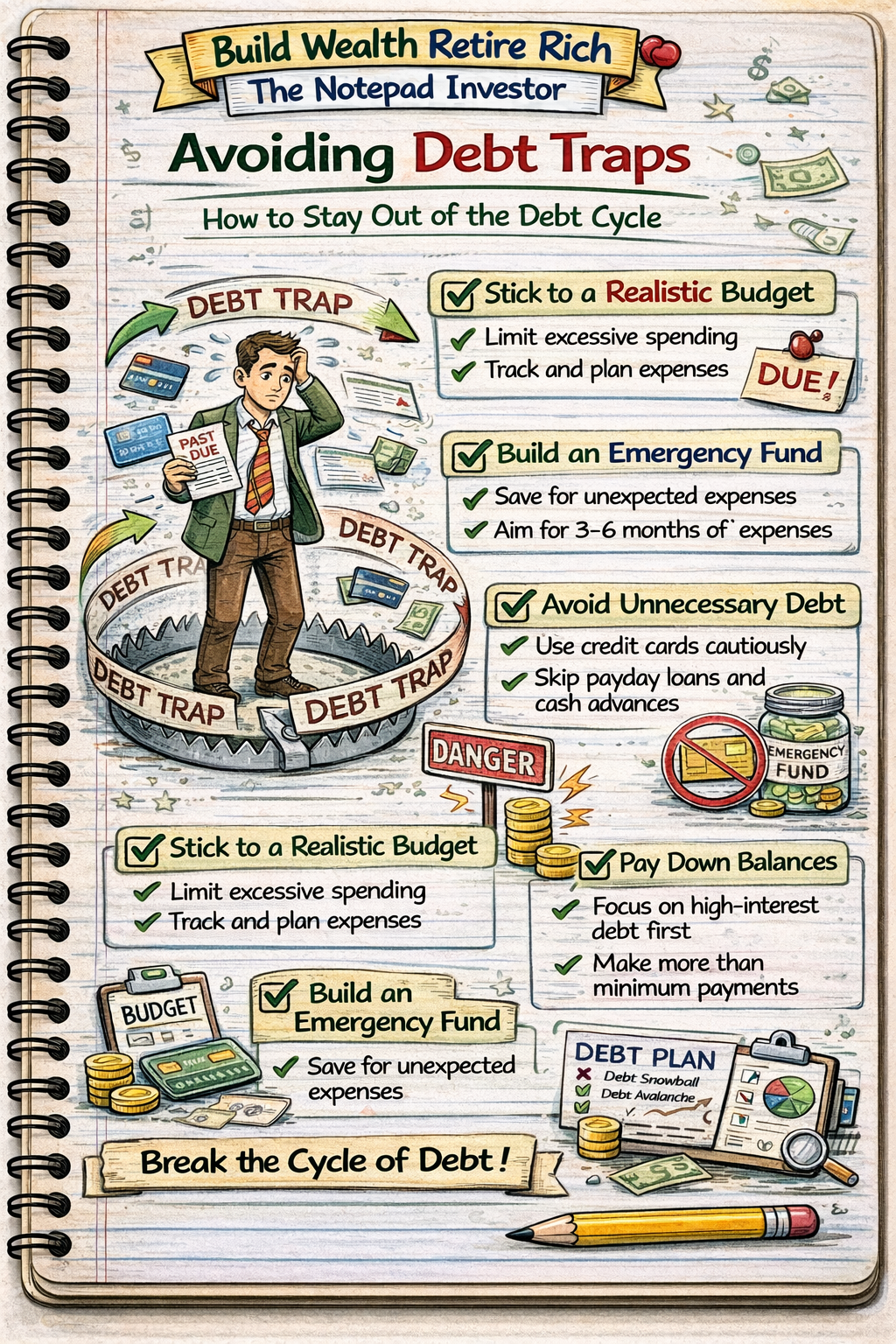
This article is designed for anyone considering high-interest borrowing, individuals currently trapped in debt cycles seeking escape strategies, or those wanting comprehensive understanding of predatory lending tactics enabling avoidance. You do not need financial expertise to recognize debt traps—fundamental warning signs accessible through clear identification of high costs, impossible repayment structures, and predatory targeting, though requires willingness to examine borrowing decisions critically rejecting convenient high-cost options favoring delayed gratification and alternative solutions addressing underlying financial gaps through income increases, expense reductions, or emergency fund building preventing desperate borrowing creating long-term damage exceeding short-term relief provided by predatory debt products.
Understanding debt trap avoidance matters because single payday loan often cascades into years of perpetual reborrowing costing thousands unnecessarily, credit card minimum payments create illusion of affordability while enriching issuers through compounding interest vastly exceeding purchases, and predatory personal loans target financial distress multiplying problems through fees and rates making repayment nearly impossible—while debt-trap-literate individuals recognize warning signs rejecting high-cost borrowing, implement emergency fund buffers preventing desperate borrowing decisions, and address root causes of financial gaps through sustainable solutions rather than temporary high-interest band-aids creating larger problems requiring additional borrowing perpetuating destructive cycles impossible to break without addressing underlying income-versus-expenses mismatches or lack of emergency reserves forcing crisis borrowing at predatory rates.
Educational disclaimer: This article provides general educational information about predatory lending and debt trap avoidance. Individual borrowing situations, alternatives, and appropriate solutions vary significantly. This is not financial advice, debt counseling, or recommendation of specific actions. Consult qualified financial professionals for personalized guidance. Some borrowing situations may require professional intervention including credit counseling or bankruptcy consultation. Focus on addressing root causes of financial stress through sustainable solutions rather than symptom treatment through high-cost borrowing creating additional problems.
Common Debt Traps Explained
Credit Card Minimum Payment Trap
How it works:
- Minimum payment typically 1-3% of balance or $25-35 minimum
- Appears affordable ($50 monthly on $2,000 debt seems manageable)
- Majority of payment goes to interest not principal early in repayment
- Compounding interest creates perpetual debt lasting decades
Real cost example:
- $5,000 credit card balance at 18% APR
- Minimum payment: $125 monthly (2.5% of balance, decreasing over time)
- Payoff timeline: 15 years, 3 months
- Total interest paid: $6,068
- Total amount paid: $11,068 (debt more than doubled)
- Month 1 breakdown: $125 payment, $75 goes to interest, only $50 reduces principal
Why it’s a trap:
- Minimum payment deliberately designed to maximize issuer profits
- Creates illusion of responsible debt management
- Prevents meaningful principal reduction
- Encourages continued spending while carrying balances
- Escape requires aggressive payments 3-5x minimum amount
Payday Loan Cycle
How it works:
- Short-term loan ($300-$500 typical) due next payday (2 weeks)
- Flat fee structure: $15-30 per $100 borrowed
- Appears small: “Just $45 fee to borrow $300”
- Due in full on next payday including principal plus fee
- Borrowers unable to repay renew loan paying fee again
True cost calculation:
- Borrow $300, fee $45 (15% for 2 weeks)
- APR equivalent: 391% (15% × 26 two-week periods)
- Next payday: Owe $345, can only afford to pay $45 fee and renew
- Second renewal: Another $45 fee, still owe $300 principal
- After 6 months (12 renewals): Paid $540 in fees, still owe $300 principal
- Total cost to borrow $300 for 6 months: $840 ($300 + $540 fees)
Why it’s a trap:
- Average borrower takes 8-10 loans per year (repeat borrowing)
- 73% of payday loan revenue from repeat borrowers
- Borrowers physically unable to repay in 2 weeks (need money persists)
- Creates cash flow crisis: Next paycheck minus loan payment leaves shortage forcing reborrow
- Escape requires breaking cycle with alternative income or expense reduction
Buy-Now-Pay-Later (BNPL) Stacking
How it works:
- Point-of-sale financing splitting purchases into 4 installments
- Appears interest-free: “Pay $50 every 2 weeks for 8 weeks”
- No credit check or minimal check encouraging usage
- Easy to stack multiple BNPL across different merchants
Stacking trap example:
- Week 1: Buy $200 clothes (Afterpay), owe $50 every 2 weeks
- Week 2: Buy $400 electronics (Klarna), owe $100 every 2 weeks
- Week 3: Buy $300 furniture (Affirm), owe $75 every 2 weeks
- Total biweekly obligation: $225 every 2 weeks for 8 weeks
- Monthly cash flow impact: $450-500 from $900 total purchases
- Income insufficient: Miss payment triggering $25-35 late fees per service
Why it’s a trap:
- Psychology: “Only $50” seems affordable ignoring cumulative effect
- No centralized tracking across multiple BNPL providers
- Autopay from checking creates overdraft risk when stacked
- Late fees and potential credit reporting when payments missed
- Encourages overspending beyond actual payment capacity
Predatory Personal Loans
Characteristics:
- Target borrowers with poor credit unable to access traditional loans
- APRs 24-36% (vs 8-18% for prime borrowers)
- Origination fees 5-12% of loan amount deducted upfront
- Short repayment periods (12-36 months) creating high monthly payments
- Prepayment penalties discouraging early payoff
Cost example:
- Borrow $5,000 at 36% APR, 24-month term
- Origination fee: $500 (10%), receive only $4,500
- Monthly payment: $278
- Total paid: $6,672 ($278 × 24 months)
- Total cost: $6,672 paid minus $4,500 received = $2,172 in interest and fees
- Effective cost: 48% of amount received
Why it’s a trap:
- High payments strain already stressed budgets
- Borrowers often unable to complete repayment leading to default
- Default triggers collections, credit damage, potential lawsuits
- Marketing targets desperate financial situations
- Creates additional financial stress rather than solving problems
Auto Title Loans
How it works:
- Borrow against vehicle value (25-50% of value typical)
- Surrender vehicle title as collateral
- APRs 200-300% annualized
- 30-day terms requiring full repayment or renewal
- Failure to repay results in vehicle repossession
Cost and risk example:
- Vehicle worth $8,000, borrow $2,500
- Monthly interest: 25% = $625
- APR: 300%
- Month 1: Owe $3,125, can only pay $625 interest and renew
- After 6 months: Paid $3,750 in interest, still owe $2,500 principal
- Miss payment: Vehicle repossessed, lose $8,000 asset to satisfy $2,500 debt
Why it’s a trap:
- Threatens essential asset (transportation for work)
- Renewal cycle similar to payday loans
- One in five borrowers loses vehicle to repossession
- Creates transportation crisis compounding financial problems
- Extremely high cost for small loan amounts

Warning Signs of Debt Traps
Red Flag: Extremely High APR (Over 36%)
APR benchmarks:
- Reasonable rates: Mortgages 6-8%, auto loans 4-12%, personal loans 8-18%, credit cards 15-25%
- Concerning rates: Credit cards 25-30%, personal loans 24-36%
- Predatory rates: Payday loans 200-400%, title loans 200-300%, some installment loans 100%+
Why high APRs signal traps:
- Rates over 36% typically target desperate borrowers
- Interest accumulation exceeds typical payment capacity
- Designed for profit maximization not borrower success
- Legal in many states despite consumer protection concerns
Red Flag: Minimum Payment Structure
Warning signs:
- Emphasis on “low monthly payment” over total cost
- Minimum payment under 5% of balance
- Payment decreases as balance decreases (credit cards)
- Long payoff timelines (10+ years) at minimum payments
Why this signals trap:
- Minimum payments deliberately maximize interest revenue
- Creates affordable-appearing perpetual debt
- Prevents meaningful principal reduction early
- Benefits lender not borrower
Red Flag: Excessive Fees
Fee warning thresholds:
- Reasonable: Origination fees 1-3%, no prepayment penalties, late fees $25-35
- Concerning: Origination fees 5-8%, minimal prepayment penalties, late fees $35-50
- Predatory: Origination fees 10%+, substantial prepayment penalties, late fees compounding, multiple fee types stacking
Example fee stacking:
- Payday loan: $300 borrowed, $45 fee (15%), $25 late fee if missed, $35 NSF fee if payment bounces
- Single missed payment: $300 loan becomes $405 owed ($300 + $45 + $25 + $35)
- Fees alone equal 35% of original loan in single incident
Red Flag: Short Repayment Periods Creating Cash Flow Stress
Dangerous repayment structures:
- Full repayment due in 2-4 weeks (payday loans)
- Balloon payments (small payments then large final payment)
- Biweekly payments creating 26 payments annually vs 24
- High monthly payments relative to income (over 15-20% of take-home)
Why short terms create traps:
- Borrower circumstances unlikely to change in weeks
- Creates cash flow crisis next period forcing reborrow
- Prevents gradual repayment allowing financial adjustment
- Designed for renewal fees not successful repayment
Red Flag: Aggressive Marketing to Financial Distress
Predatory marketing tactics:
- “Bad credit OK” or “No credit check required”
- “Get cash today” or “Instant approval”
- “No income verification” or “Guaranteed approval”
- Located in low-income neighborhoods
- Advertising during daytime TV, late night programming
Why marketing signals predatory intent:
- Targets financially vulnerable populations
- Emphasizes speed and convenience over cost
- Downplays or obscures true costs
- Exploits desperation rather than providing sustainable solutions
Calculating True Cost of Borrowing
Total Cost Calculation Formula
Complete cost analysis includes:
- Principal amount borrowed (what you actually receive)
- Total interest paid over full term
- All fees (origination, late fees, renewal fees, prepayment penalties)
- Opportunity cost (what else could money have been used for)
Example comprehensive calculation:
Predatory personal loan:
- Loan amount: $3,000
- Origination fee: $300 (10%)
- Amount received: $2,700
- APR: 36%, term: 24 months
- Monthly payment: $167
- Total payments: $4,008 ($167 × 24)
- One late payment fee: $50
- Total cost: $4,058 paid minus $2,700 received = $1,358 in interest and fees
- Effective cost: 50% of amount actually received
Alternative lower-cost option comparison:
- Credit union personal loan: $3,000 at 12% APR, 24 months
- No origination fee, receive full $3,000
- Monthly payment: $141
- Total paid: $3,384
- Total interest: $384
- Savings vs predatory loan: $974 ($1,358 – $384)
Comparing Payment to Income
Debt-to-income ratio guidelines:
- Safe: Total debt payments under 36% of gross income
- Manageable: 36-43% of gross income
- Stressed: 43-50% of gross income
- Dangerous: Over 50% of gross income
Example debt-to-income assessment:
- Gross monthly income: $3,000
- Current debt payments: $900 (existing car loan, student loan)
- Current ratio: 30% (manageable)
- Considering additional $400 monthly payment (predatory loan)
- New ratio: 43% ($1,300 ÷ $3,000)
- Creates financial stress, minimal buffer for emergencies
- Red flag: Taking loan would push into stressed category
Breakeven Analysis
When is borrowing worth the cost?
Acceptable scenarios:
- Emergency medical expense (health vs cost trade-off)
- Vehicle repair essential for employment (income vs cost)
- Investment in education increasing earning capacity (ROI positive)
- Home repair preventing larger damage (prevention vs cure)
Unacceptable scenarios:
- Discretionary purchases (vacation, entertainment, non-essentials)
- Covering routine expenses indicating budget mismatch
- Paying other debt (robbing Peter to pay Paul)
- Purchases affordable through delayed gratification and saving
Decision framework:
- Is expense truly unavoidable emergency or discretionary want?
- What happens if don’t borrow? (Job loss, health crisis, or mere inconvenience?)
- Can expense be reduced, delayed, or eliminated entirely?
- Are there lower-cost alternatives (family loan, payment plan, community assistance)?
- Will borrowing create larger problem than solves?
Alternatives to High-Cost Borrowing
Emergency Fund (Best Prevention)
Emergency fund framework:
- Starter fund: $500-1,000 (covers minor emergencies)
- Intermediate fund: 1 month expenses (prevents most debt needs)
- Full fund: 3-6 months expenses (comprehensive protection)
Building emergency fund:
- Start small: $25-50 per paycheck
- Automate transfers to savings
- Dedicate windfalls (tax refunds, bonuses)
- Temporary spending cuts until $1,000 reached
Impact:
- $1,000 emergency fund eliminates 80% of payday loan need
- Prevents desperate borrowing at predatory rates
- Breaks crisis borrowing cycle
Credit Union Loans and Payday Alternative Loans (PALs)
Payday Alternative Loan characteristics:
- $200-2,000 loan amounts
- 28% APR maximum (vs 300-400% payday loans)
- 1-12 month repayment terms
- $20 maximum application fee
- Available to credit union members (membership requirements vary)
Cost comparison:
- Borrow $500 for 3 months
- Payday loan: $45 fee every 2 weeks × 6 renewals = $270 fees + $500 principal = $770 total
- Credit union PAL: 28% APR = $22 interest + $20 fee + $500 principal = $542 total
- Savings: $228 (30% less expensive)
Payment Plans with Creditors
Negotiation approach:
- Contact creditor before payment due explaining hardship
- Request payment plan splitting amount over 2-6 months
- Many creditors prefer payment plan over non-payment
- Often no interest or fees if arranged proactively
Example successful negotiation:
- $1,200 unexpected medical bill due in 30 days
- Call provider requesting payment plan
- Agree to $200 monthly for 6 months
- Total cost: $1,200 (no interest or fees)
- Alternative payday loan: $180 fees over 6 months plus $1,200 = $1,380
- Savings: $180 from one phone call
Side Income for Temporary Cash Needs
Quick income options:
- Gig economy: Uber, DoorDash, TaskRabbit ($100-300 weekly possible)
- Sell unused items: Clothing, electronics, furniture ($200-1,000 one-time)
- Freelance skills: Writing, design, tutoring ($20-100+ per hour)
- Overtime at current job (time and a half)
Comparison:
- Need $500 for emergency
- Payday loan option: $75 fee immediately, perpetual cycle risk
- Side income option: 20 hours DoorDash at $15/hour = $300, 10 hours overtime at $30/hour = $300, total $600 in 2 weeks, no debt created
- Benefit: Earn more than needed, avoid debt trap entirely
Community Resources and Assistance
Available resources:
- Utility assistance programs (LIHEAP for energy bills)
- Food banks and SNAP benefits (reduces grocery expenses)
- Rent assistance programs (prevents eviction)
- Medical bill charity care and sliding scale clinics
- 211 helpline (connects to local resources)
Strategic use:
- Reduces essential expense burden
- Frees cash for emergency needs
- Prevents borrowing for basic necessities
- Available regardless of employment status
0% APR Credit Card Balance Transfers
For existing debt consolidation:
- Transfer high-interest balances to 0% promotional card
- 12-21 month promotional periods typical
- Balance transfer fee 3-5% (much less than high APR)
- Aggressive payoff during 0% period
Example debt escape:
- $4,000 debt at 24% APR paying $200 monthly
- Current path: 26 months payoff, $1,240 interest
- Transfer to 0% card (18 months), 4% fee = $160
- Pay $240 monthly = paid off in 17 months
- Total cost: $4,160 ($4,000 + $160 fee)
- Savings: $1,080 in avoided interest
Escaping Existing Debt Traps
Breaking the Payday Loan Cycle
Step-by-step escape plan:
Step 1: Stop new borrowing immediately
- Refuse renewal on next payment date
- Accept payment may bounce initially (one-time NSF fee vs perpetual cycle)
- Commit to breaking cycle regardless of short-term pain
Step 2: Request extended payment plan
- Many states require lenders offer extended plans
- Typically 60-90 days to repay without additional fees
- Must request before renewal date
Step 3: Find alternative income for final payment
- Overtime, side gig, sell items
- One-time effort breaking perpetual cycle
- Family loan with repayment plan
Step 4: Address underlying cash shortage
- Budget analysis: Income vs expenses
- Expense reduction or income increase required
- Build $500 buffer preventing future crisis borrowing
Accelerating Credit Card Payoff
Debt avalanche method:
- List all cards by APR highest to lowest
- Pay minimums on all, extra payment to highest APR
- When highest paid off, attack next highest
- Mathematically optimal for interest minimization
Increasing payment capacity:
- Temporary spending freeze (delay all discretionary)
- Side income directed entirely to debt
- Sell assets (second vehicle, unused items)
- Redirect raises/bonuses to debt vs lifestyle inflation
When to Consider Professional Help
Credit counseling (nonprofit):
- Free or low-cost budget analysis and debt management
- Debt management plans: Negotiate lower rates with creditors
- Typical DMP: Consolidate payments, reduce rates to 8-12%
- Find counselor: National Foundation for Credit Counseling (NFCC.org)
When counseling appropriate:
- Debt exceeds 50% of gross income
- Juggling payments, robbing Peter to pay Paul
- Considering bankruptcy but want alternatives
- Underwater despite consistent payments
Bankruptcy consideration:
- Last resort for truly unmanageable debt
- Chapter 7: Discharge unsecured debt, asset liquidation
- Chapter 13: Repayment plan over 3-5 years
- Consult bankruptcy attorney for evaluation
- Major credit impact but may be best option for fresh start
Why Understanding Debt Trap Avoidance Matters
Without understanding debt traps, individuals fall into predatory borrowing cycles costing thousands unnecessarily through compound interest and fees, mistake minimum payments for responsible debt management enriching lenders while creating perpetual obligations, and miss alternative solutions addressing root causes through emergency funds or income increases—while debt-trap-literate individuals recognize warning signs rejecting high-cost borrowing exceeding 36% APRs, calculate true total costs revealing how $2,000 borrowed becomes $5,000 paid, and implement sustainable alternatives building emergency buffers preventing desperate borrowing or addressing underlying income-expense gaps, creating financial stability impossible when repeatedly trapped in high-interest debt cycles destroying wealth through fees and compounding interest benefiting predatory lenders not borrowers seeking temporary relief creating larger long-term problems.
Understanding debt trap avoidance enables individuals to:
- Recognize predatory lending warning signs before borrowing preventing trap entry
- Calculate true borrowing costs revealing total amounts paid vs received
- Identify alternative solutions addressing needs without high-interest borrowing
- Escape existing debt traps through strategic payoff and cycle-breaking
- Build emergency funds preventing future desperate borrowing
- Understand minimum payment mathematics revealing perpetual debt design
- Save thousands in avoided interest and fees through trap prevention
Debt trap knowledge transforms borrowing from desperate crisis response into informed decision-making evaluating true costs, alternatives, and long-term impacts preventing wealth destruction through predatory interest rates and fee structures designed for lender profit not borrower success.
Common Misunderstandings
Many people assume payday loans provide necessary emergency access for those without alternatives. In reality, 73% of payday loan revenue comes from repeat borrowers trapped in cycles not one-time emergency users, average borrower takes 8-10 loans annually demonstrating dependency not occasional use, and alternatives including credit union PALs, payment plans, community resources, and side income provide superior solutions without 400% APRs, proving payday loans create perpetual debt not solve emergencies despite marketing emphasizing quick access and convenience obscuring true costs and cycle risks.
Another common misconception is credit card minimum payments represent responsible debt management. In practice, minimum payments deliberately designed to maximize issuer profits through interest accumulation keeping balances persistent for decades—$5,000 balance takes 15+ years and $6,000+ interest with minimums versus 11 months and $500 interest with aggressive payments, proving minimums create illusion of affordability while enriching issuers through compounding interest vastly exceeding principal reduction early in payoff timeline making minimum-only approach responsible-appearing trap not sound financial strategy.
Some believe debt consolidation loans always improve financial situations. However, consolidation loans replacing multiple debts with single payment at lower rate only help if root spending addressed—without budget changes consolidation frees credit limits enabling additional borrowing creating larger total debt, proving consolidation tool requiring discipline addressing underlying income-expense mismatches not automatic solution when old credit lines reused perpetuating cycle versus using consolidation as final borrowing paired with spending control preventing additional debt accumulation.
How Debt Trap Avoidance Fits Into Financial Success
Debt trap avoidance prevents wealth destruction through high-interest borrowing exceeding 36% APRs creating costs vastly exceeding original needs, enables building emergency fund buffers preventing desperate borrowing decisions, and creates sustainable financial patterns addressing root causes through income increases or expense management—making trap literacy essential component of financial stability impossible when repeatedly entering predatory borrowing cycles, understanding true total costs revealing how seemingly small fees accumulate to thousands, and implementing alternative solutions building long-term resilience versus short-term band-aids creating larger problems, transforming crisis management from reactive high-cost borrowing into proactive planning preventing emergency borrowing needs through preparation and strategic decision-making.
For example, two individuals both age 25 facing unexpected $800 car repair essential for work. Person A lacks emergency fund and debt trap knowledge, walks into payday loan store borrowing $800, pays $120 fee (15% for 2 weeks). Next payday unable to repay $920 due to ongoing expenses, renews loan paying another $120 fee. Cycle continues: Every 2 weeks pays $120 renewal fee, still owes $800 principal. After 6 months (12 renewals): Paid $1,440 in fees, still owes $800 principal. Desperate, takes second payday loan $500 to help repay first, now owes $1,300 total with $195 biweekly fees ($120 + $75). After 12 months total paid in fees: $3,120 across both loans, still owes principals totaling $1,300. Finally escapes through tax refund paying off both loans. Total cost: $800 original need became $4,420 paid ($800 + $3,120 fees + $500 second loan) over 12 months of cycle. Person B faces identical $800 repair, understands debt trap risks, explores alternatives: Negotiates payment plan with mechanic ($200 monthly for 4 months, no interest), picks up weekend DoorDash earning $400 over 2 weeks, sells unused exercise equipment $200, borrows $200 from family with repayment plan. Total alternative income: $600, payment plan handles remaining $200 monthly. After 4 months: Paid $800 total for $800 repair (no fees, no interest), built side income habit continuing earning extra $200 monthly, establishes $500 emergency fund preventing future crisis. After 12 months: $800 repair handled, $500 emergency fund built, side income generated $2,400 additional (continuing beyond initial need), total financial position improved $2,900 versus Person A. Difference from identical starting emergency: Person A’s lack of trap knowledge cost $3,620 ($4,420 paid vs $800 actual need) plus 12 months stress and perpetual borrowing cycle, Person B’s trap literacy enabled $800 cost matching actual need plus $2,400 income gain and $500 buffer built creating $6,020 different financial outcome ($3,620 saved + $2,400 earned) from knowledge enabling alternative solutions versus default high-cost predatory borrowing.
Debt trap understanding separates strategic problem-solvers finding sustainable alternatives from crisis borrowers repeatedly entering predatory cycles costing thousands through lack of knowledge about true costs, alternative solutions, and compound interest mathematics designed to enrich lenders while trapping borrowers in perpetual debt.
Recent Updates and Trends
In recent years, buy-now-pay-later services have proliferated offering point-of-sale financing as convenient credit card alternative, though creating similar debt trap risks through payment stacking across multiple providers without centralized tracking enabling overspending beyond payment capacity despite 0% interest marketing emphasizing convenience obscuring cumulative cash flow impacts.
State-level payday loan regulations have tightened in some jurisdictions with 18 states plus DC prohibiting or severely restricting payday lending through 36% APR caps, though lenders adapt through online operations based in permissive states creating enforcement challenges and continued access despite local restrictions.
Credit card minimum payment disclosure requirements now mandate statements showing “if you make only the minimum payment each month, you will pay off the balance shown in about X years” plus total interest cost, improving transparency though many consumers continue minimum payments despite stark warnings demonstrating information availability insufficient without financial literacy enabling comprehension.
Earned wage access products have emerged allowing early access to earned wages before payday as payday loan alternative, though creating similar dependency risks when used repeatedly for routine expenses indicating underlying budget imbalances requiring income increases or expense reductions not timing shifts of existing income.
Fundamental debt trap principles remain timeless: high interest rates exceeding 36% signal predatory intent, minimum payment structures deliberately maximize lender profits through perpetual debt, fees stacking creates costs vastly exceeding principal borrowed, and alternatives including emergency funds, payment plans, community resources, and side income provide superior solutions—regardless of product innovation, regulatory evolution, disclosure requirements, or earned wage access proliferation, understanding true costs, recognizing warning signs, and implementing sustainable alternatives produces superior outcomes through trap avoidance or escape impossible without literacy enabling informed decision-making rejecting predatory options despite aggressive marketing targeting financial desperation.
3 Things You Can Do Today
Ready to avoid or escape debt traps? Here are three simple steps you can take right now:
1. Calculate the true total cost of any current high-interest debt revealing perpetual payment trap – For each payday loan, high-interest credit card, or predatory personal loan: Note amount owed, APR or fee structure, current payment amount. Use online debt payoff calculator inputting balance, APR, and payment. Review shocking results: Payoff timeline (often 10-20+ years for minimum payments), total interest paid (frequently 100-150% of principal), total amount paid (2-3x original debt typical). Example eye-opener: $3,000 credit card at 24% APR paying $75 minimums = 7 years payoff, $2,800 interest, $5,800 total paid (nearly doubled debt). Write down totals making invisible costs visible: “Current path: X years, $Y total interest, $Z total paid.” Calculate aggressive alternative: How much can actually pay monthly? Example: $200 monthly instead of $75 minimums = 19 months payoff, $580 interest, $3,580 total paid (saves $2,220 and 5+ years). Payday loan analysis: $500 loan with $75 biweekly fee if renewed 12 times over 6 months = $900 fees paid still owing $500 principal = $1,400 total for $500 borrowed (180% effective cost). Creates concrete understanding: Seeing “$2,800 wasted interest” or “$900 in fees for $500 loan” provides compelling motivation for aggressive payoff or cycle-breaking impossible without quantifying actual costs making abstract interest concrete. Takes 15 minutes per debt revealing true costs creating urgency for strategic action versus continuing unconscious perpetual payments.
2. Start emergency fund with $25-50 per paycheck preventing future desperate borrowing at predatory rates – Open separate savings account designated “Emergency Fund Only” (prevents mixing with regular savings enabling spending), set up automatic transfer $25-50 per paycheck (biweekly = $50-100 monthly, semi-monthly = $50-100 monthly), commit to never touching except true emergencies. Timeline: $50 biweekly reaches $1,000 in 20 paychecks (10 months), $1,000 prevents 80%+ of payday loan scenarios. Define emergency beforehand preventing rationalization: True emergencies = job loss, medical crisis, essential vehicle repair, housing emergency. NOT emergencies = vacation, dining out, shopping, entertainment, routine predictable expenses. Boost progress: Direct all windfalls (tax refunds, bonuses, gift money) to emergency fund until $1,000 reached, temporary spending freeze on discretionary purchases accelerating timeline. Example acceleration: $50 biweekly + $600 tax refund + $200 birthday money + 3-month dining-out freeze saving $300 = $1,100 emergency fund in 5 months instead of 10. Impact: $1,000 buffer breaks payday loan cycle completely—instead of $800 emergency triggering $120 fee payday loan perpetual cycle costing $1,440+ in fees over 6 months, $1,000 fund covers emergency directly, replenish fund over 3-4 months through same $50 biweekly savings, total cost equals actual emergency not 180% markup. Takes 10 minutes setup creating permanent protection against predatory borrowing necessity saving thousands in avoided fees over lifetime through prevention versus repeated crisis borrowing.
3. If currently in payday loan cycle, commit to breaking cycle next renewal refusing extension regardless of short-term pain – Current payday loan debt: Note amount owed including fees (example: $500 principal + $75 fee = $575 total due). Next renewal date: Mark calendar, commit to breaking cycle this date refusing renewal. Gather escape payment: Pick up side gig earning $300-400 over 2 weeks (DoorDash, overtime, TaskRabbit), sell unused items $100-200 (Facebook Marketplace, Pawn shop), request extended payment plan from lender (many states require 60-90 day option), borrow from family/friend with written repayment agreement ($50-100 monthly for 6 months better than $75 biweekly perpetual fees). Accept short-term consequences: One NSF fee if payment bounces ($35) vs $75 fee every 2 weeks indefinitely, temporary budget strain from lump payment vs permanent payment every 2 weeks, potential family conversation vs perpetual predatory cycle. Example escape: $575 owed, earn $400 DoorDash over 2 weeks, sell old furniture $150, pay off completely, total effort 20 hours side work + one selling task = freedom from cycle. Savings: $75 biweekly fee × 26 renewals (1 year) = $1,950 saved through one-time effort breaking cycle. Critical: Address underlying cash shortage after escape—budget analysis showing income vs expenses, spending cuts or income increases required preventing future crisis borrowing, build $500 buffer from continued side income or spending cuts. Takes 2 weeks concentrated effort creating permanent escape from perpetual cycle saving $1,950+ annually through breaking deliberate trap designed for renewal fees not successful repayment.
These actions create debt trap avoidance and escape within 30 days—calculated true costs revealing perpetual payment traps motivating aggressive action ($2,000+ typical savings from acceleration), started emergency fund preventing future predatory borrowing ($1,000+ in avoided fees annually), and committed to payday loan cycle break saving $1,950+ annually through one-time escape effort—transforming debt from perpetual trap enriching predatory lenders into managed obligation eliminated through strategic action or prevented entirely through emergency preparation impossible without understanding true costs, alternative solutions, and cycle-breaking commitment.
Quick FAQ
Are payday loans ever a good option?
Rarely justified given 300-400% APRs and perpetual cycle risks: Theoretical acceptable use = true one-time emergency (car repair for work, medical crisis) when no alternatives exist and borrower certain of repayment ability in 2 weeks without reborrow. Reality: 73% of payday revenue from repeat borrowers trapped in cycles not one-time users, average borrower takes 8-10 loans annually demonstrating dependency not emergency relief. Better alternatives nearly always available: Credit union payday alternative loans (28% APR max vs 400%), payment plans with creditors (often zero interest), side income (DoorDash, selling items), community assistance programs, family loans with repayment plans. Exception proving rule: Absolute emergency preventing work (vehicle repair) when paycheck guaranteed in 2 weeks, certain of full repayment including fee without financial strain, explored all alternatives unsuccessfully—represents under 10% of actual payday loan usage. Recommendation: Avoid payday loans entirely, build $1,000 emergency fund preventing 80%+ of scenarios creating payday loan consideration, use credit union PALs or payment plans for remaining emergency needs.
How do I escape the payday loan cycle once trapped?
Breaking cycle requires deliberate action accepting short-term discomfort for long-term freedom: Step 1—Stop renewing next payment date regardless of consequences (one NSF fee better than perpetual $75 biweekly fees). Step 2—Request extended payment plan from lender (many states require 60-90 day plans, ask specifically, put in writing). Step 3—Generate one-time income covering final payment through side gig (DoorDash, Uber, TaskRabbit 20-30 hours earning $300-500), sell unused items ($100-500 typical), overtime at current job, borrow from family with repayment plan better than perpetual predatory fees. Step 4—Address root cause preventing cycle restart through budget analysis showing income vs expenses, temporary spending freeze building $500-1,000 buffer, permanent spending reduction or income increase fixing underlying gap. Timeline: 2-4 weeks intensive effort generating escape payment, 3-6 months rebuilding buffer and addressing root cause. Critical success factors: Commitment refusing renewal despite short-term strain, willingness to hustle temporarily for escape, addressing underlying budget imbalance not just paying current debt. Alternative: Nonprofit credit counseling can negotiate extended plans and provide budget assistance (NFCC.org for counselor finder).
Is it better to pay minimums on multiple debts or focus on one at a time?
Focus on one debt while paying minimums on others (debt avalanche or snowball method) mathematically superior to equal payments across all: Debt avalanche (optimal)—Pay minimums on all debts, apply all extra payment to highest APR debt, when eliminated attack next highest APR, minimizes total interest paid. Debt snowball (psychological)—Pay minimums on all, attack smallest balance first regardless of APR, creates quick wins and motivation, slightly more total interest but better adherence for some. Example comparison: $10,000 total debt across 3 cards, $500 monthly payment available. Equal payment approach ($167 each card): 28-30 months payoff, $2,800 total interest. Avalanche approach (attack 24% card first, then 18%, then 12%): 24-26 months payoff, $2,200 total interest, saves $600 and 4 months. Snowball approach (attack smallest balance first): 25-27 months payoff, $2,400 total interest, saves $400, provides psychological wins. Both avalanche and snowball superior to equal payments—choose based on personality: analytical types prefer avalanche (maximum savings), motivation-driven types prefer snowball (quicker victories). Never continue minimum-only approach across all debts—guarantees maximum interest and longest timeline enriching lenders.
Should I use a debt consolidation loan to pay off credit cards?
Only if three conditions met: (1) Consolidation loan APR significantly lower than current debt (example: 12% consolidation vs 24% credit cards), (2) Committed to not reusing paid-off credit cards preventing additional debt accumulation, (3) Total cost including consolidation fees less than current path. Calculation example: $15,000 credit card debt at average 22% APR paying $500 monthly = 42 months, $5,800 interest. Consolidation loan $15,000 at 12% APR, 36 months, $500 monthly, 5% origination fee ($750) = $3,100 interest + $750 fee = $3,850 total cost (saves $1,950 vs credit cards). Red flags indicating consolidation harmful: Origination fees exceeding 8% (eat into savings), APR barely lower than current debt (minimal benefit), inability to commit to zero new credit card charges (will create larger total debt freeing credit limits). Success requirements: Close or freeze paid-off credit cards preventing reuse, address underlying spending habits through budget, treat consolidation as FINAL borrowing not intermediate step, automatic payments preventing default. Alternative if can’t meet conditions: Balance transfer to 0% promotional credit card (3-5% fee but zero interest 12-21 months) with aggressive payoff plan, nonprofit credit counseling debt management plan negotiating lower rates.
How can I avoid falling into debt traps in the future?
Prevention requires three-layer defense: Layer 1 (Emergency Fund)—Build $1,000 starter fund preventing 80% of crisis borrowing scenarios, eventually 3-6 months expenses for comprehensive protection, automate $50-100 monthly until target reached. Layer 2 (Budget Alignment)—Monthly budget showing income vs expenses honestly, spending not exceeding income creating debt need, identify and fix income-expense gaps through spending cuts or income increases before crisis forces borrowing, track spending ensuring alignment with plan. Layer 3 (Warning Sign Recognition)—Reject borrowing over 36% APR automatically (payday loans, title loans, predatory personal loans), calculate total cost before any borrowing (total paid vs amount received), avoid minimum payment traps paying credit cards in full monthly, recognize aggressive marketing targeting desperation (“bad credit OK,” “instant approval”). Additional protection: Establish borrowing decision framework (is this emergency vs want? what are alternatives? can I truly repay without reborrow?), build support network (family/friends for temporary help vs predatory lenders), maintain good credit enabling access to reasonable-rate options (credit union loans, 0% balance transfers) if emergency borrowing necessary. Mindset shift: View high-interest debt as permanent wealth destroyer not temporary problem solver, understand short-term relief creating long-term damage, commit to prevention through preparation not reaction through desperation borrowing. Implementation: Start today with first $25-50 toward emergency fund regardless of current debt situation, begin budget tomorrow tracking income and expenses, commit to rejecting any borrowing over 36% APR from this point forward.
Explore More in Money Basics
Disclosure
This article provides general educational information about predatory lending practices and debt trap avoidance strategies. Individual debt situations, borrowing alternatives, and appropriate solutions vary significantly based on circumstances. APR ranges, fee examples, and cost calculations represent typical scenarios—actual terms vary by lender, location, and borrower qualifications. This is not financial advice, debt counseling, legal advice, or recommendation of specific actions. State regulations regarding payday loans, title loans, and other high-interest lending vary—check local laws. Alternative solutions presented (credit unions, payment plans, community resources) availability varies by location and individual eligibility. Debt consolidation effectiveness depends on specific circumstances and discipline avoiding new debt accumulation. Credit counseling agencies quality varies—verify nonprofit status and accreditation (NFCC.org or FCAA.org). Bankruptcy has serious long-term consequences—consult qualified bankruptcy attorney for evaluation. Escape timelines represent best-case scenarios with consistent behavior—actual results vary. Consult qualified financial professionals, credit counselors, or legal advisors for personalized guidance matching individual circumstances. Some situations may benefit from professional intervention including debt management plans or bankruptcy consultation. Focus on sustainable solutions addressing root causes rather than symptom treatment through additional borrowing. Product examples and company references presented for educational illustration only. Advertisements or sponsored content may appear within or alongside this content. All information presented independently for educational purposes only.