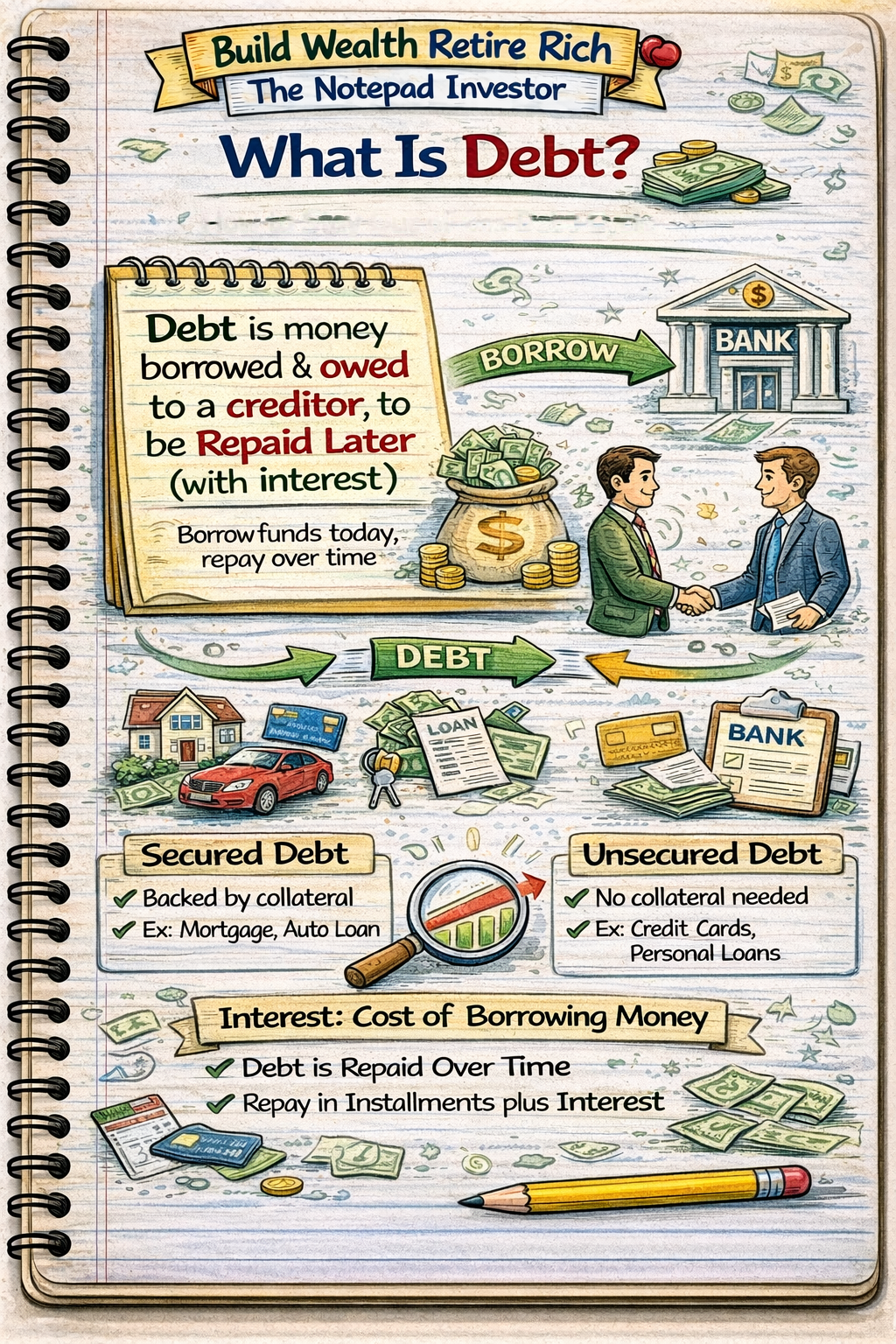
Debt is money owed to another party—typically a lender, creditor, or service provider—creating legal obligation to repay borrowed funds plus interest or fees within specified timeframes according to agreed-upon terms establishing payment schedules, interest rates, collateral requirements, and consequences for non-payment. Ranging from mortgages enabling homeownership through 30-year loans to credit card balances accumulated through everyday purchases, debt represents temporary access to purchasing power beyond current cash resources enabling major acquisitions impossible through savings alone while creating future financial obligations reducing available income through required payments. Understanding debt requires distinguishing between productive debt financing appreciating assets or income-generating investments (mortgages, student loans for high-earning degrees, business loans) versus destructive debt funding consumption or depreciating purchases through high-interest borrowing (credit card balances for vacations, payday loans for routine expenses), recognizing that debt itself is neutral tool—neither inherently good nor bad—with outcomes determined by interest rates, repayment terms, borrower discipline, and whether borrowed funds create value exceeding borrowing costs making strategic debt use wealth-building while irresponsible borrowing creates financial destruction through interest accumulation and payment burdens exceeding benefits received.
This article is designed for anyone wanting comprehensive debt understanding, individuals deciding whether to borrow for major purchases, or those confused by debt terminology and implications. You do not need financial expertise to understand debt fundamentals—basic concepts accessible through clear explanations of borrowing mechanics, types, costs, and strategic considerations, though requires honest assessment of borrowing motivations distinguishing between needs and wants, genuine inability to save versus impatience for immediate gratification, and productive investments versus consumption spending creating obligations without corresponding value, enabling informed borrowing decisions aligned with long-term financial goals rather than reactive emotional borrowing creating regret and financial stress when repayment obligations strain budgets unexpectedly.
Understanding what debt is matters because modern financial life frequently requires borrowing for homeownership, education, and reliable transportation making debt literacy essential for successful major purchases, high-interest consumer debt represents single largest obstacle to wealth building for most Americans through compound interest and opportunity costs, and strategic debt usage enables leveraging appreciating assets while avoiding wealth destruction through consumption borrowing—while debt-literate individuals distinguish between productive and destructive borrowing making informed decisions aligned with wealth building, understand true costs through total interest calculation revealing lifetime borrowing expenses, and maintain discipline ensuring debt serves financial goals rather than creating perpetual payment obligations preventing wealth accumulation through interest costs exceeding investment returns or salary growth.
Educational disclaimer: This article provides general educational information about debt concepts and types. Individual debt situations, appropriate borrowing decisions, and optimal strategies vary significantly based on circumstances including income, assets, goals, and risk tolerance. This is not financial advice or recommendation of specific borrowing actions. Debt carries risks including potential loss of collateral, credit damage, and financial stress from payment obligations. Consult qualified financial professionals for personalized guidance matching individual situations and goals.
Debt Fundamentals
Core Definition and Mechanics
What debt represents:
- Legal obligation to repay borrowed money
- Contract between borrower (debtor) and lender (creditor)
- Access to resources now in exchange for future repayment
- Transfer of purchasing power from future to present
Basic debt transaction:
- Step 1: Borrower requests loan (example: $20,000 auto loan)
- Step 2: Lender evaluates creditworthiness and approves terms
- Step 3: Funds disbursed to borrower or directly to seller
- Step 4: Borrower makes scheduled payments (principal + interest)
- Step 5: Debt satisfied when full amount plus interest repaid
Key components of any debt:
- Principal: Original amount borrowed ($20,000 in auto loan example)
- Interest: Cost of borrowing expressed as APR (6% typical for good credit)
- Term: Repayment timeframe (60 months = 5 years common for autos)
- Payment: Regular installment amount ($387 monthly example)
- Total cost: Principal + all interest ($23,200 total = $20,000 + $3,200 interest)
Why Debt Exists
Borrower benefits:
- Access to major purchases before saving full amount (homes, education)
- Emergency funding when cash reserves insufficient
- Investment in appreciating assets or income generation
- Cash flow smoothing during income fluctuations
- Leverage for wealth building through strategic borrowing
Lender benefits:
- Interest income on deployed capital
- Risk-adjusted returns based on borrower creditworthiness
- Economic growth facilitation through credit availability
Economic benefits broadly:
- Enables home ownership democratization
- Facilitates higher education access
- Supports business creation and expansion
- Drives consumption and economic activity
Secured vs Unsecured Debt
Secured debt (collateral-backed):
- Definition: Asset pledged guaranteeing repayment
- Examples: Mortgages (home collateral), auto loans (vehicle collateral), home equity loans
- Lender rights: Can seize collateral if borrower defaults
- Interest rates: Lower (less lender risk through collateral)
- Typical APRs: Mortgages 6-8%, auto loans 4-12%
Unsecured debt (no collateral):
- Definition: Based solely on borrower creditworthiness and promise to repay
- Examples: Credit cards, personal loans, student loans, medical debt
- Lender rights: No specific asset claim but can pursue collections and legal action
- Interest rates: Higher (greater lender risk without collateral)
- Typical APRs: Credit cards 15-25%, personal loans 8-18%
Risk and cost relationship:
- Secured debt less risky for lenders = lower rates for borrowers
- Unsecured debt riskier for lenders = higher rates compensating risk
- Borrower with collateral accesses cheaper borrowing
- Default consequences differ: Collateral loss vs credit damage and collections

Types of Debt
Revolving Debt
Definition and characteristics:
- Reusable credit line up to maximum limit
- Borrow, repay, borrow again without reapplying
- Variable payment based on balance (minimum payment structure)
- Ongoing access as long as account open and in good standing
Common revolving debt types:
Credit cards:
- Credit limit: $500-$50,000+ depending on creditworthiness
- APR: 15-25% typical, up to 29.99% for poor credit
- Grace period: 21-25 days if paid in full (no interest)
- Minimum payment: 1-3% of balance
Home Equity Lines of Credit (HELOCs):
- Secured by home equity
- Credit limit: Up to 85% of home equity typically
- APR: 7-11% typical (lower than credit cards, secured)
- Draw period: 10 years typically, then repayment period
Personal lines of credit:
- Unsecured revolving access
- Limits: $1,000-$50,000
- APR: 10-20% typical
- Less common than credit cards or HELOCs
Installment Debt
Definition and characteristics:
- Fixed loan amount borrowed once
- Regular payments over set term until fully repaid
- Closed-end (cannot reborrow after paying down)
- Predictable payment schedule
Common installment debt types:
Mortgages:
- Purpose: Home purchase or refinance
- Amount: $100,000-$1,000,000+ depending on home value and income
- Term: 15 or 30 years standard
- APR: 6-8% currently (varies with credit and market)
- Secured: Home as collateral
- Example: $300,000, 30 years, 6.5% = $1,896 monthly, $682,632 total paid
Auto loans:
- Purpose: Vehicle purchase
- Amount: $15,000-$50,000 typical
- Term: 36-72 months common
- APR: 4-12% depending on credit
- Secured: Vehicle as collateral
- Example: $25,000, 60 months, 6% = $483 monthly, $28,980 total paid
Student loans:
- Purpose: Education expenses
- Amount: Varies by education cost ($30,000-$100,000+ total)
- Term: 10-25 years
- APR: Federal 4-7%, private 7-14%
- Unsecured: No collateral but difficult to discharge in bankruptcy
Personal loans:
- Purpose: Debt consolidation, major purchases, emergencies
- Amount: $1,000-$50,000 typical
- Term: 12-60 months
- APR: 8-36% depending on credit
- Unsecured typically
Open-End Debt
Definition:
- Balance must be paid in full each period
- No option to carry balance (or limited)
- Examples: Charge cards (American Express traditional), utility bills, cell phone service
Productive vs Destructive Debt
Productive Debt Characteristics
Productive debt finances:
- Appreciating assets: Real estate typically increasing in value over time
- Income generation: Education increasing earning capacity, business investments
- Essential needs: Reliable transportation enabling employment
- Value exceeding cost: Benefits outweigh interest and fees paid
Examples of productive debt:
Mortgage for primary residence:
- Home appreciates: $300,000 purchase becomes $450,000 in 15 years typical
- Builds equity: $150,000+ equity from payments plus appreciation
- Tax benefits: Mortgage interest deduction (for some taxpayers)
- Alternative cost: Rent payments building landlord’s equity not yours
- Net result: Wealth building through homeownership despite interest costs
Student loans for high-ROI education:
- Investment: $40,000 in student loans for engineering degree
- Income increase: $35,000 without degree → $75,000 with degree
- Differential: $40,000 extra annually
- Payback: Debt paid in 2-3 years from income differential
- Lifetime value: $1.5 million+ additional earnings over career
- ROI: 37:1 return on education investment
Business loan for expansion:
- Borrow: $50,000 to purchase equipment enabling new product line
- Revenue increase: $30,000 annually from new capabilities
- Loan cost: $8,000 interest over 3-year term
- Net benefit: $90,000 revenue over 3 years minus $8,000 interest = $82,000 net gain
Destructive Debt Characteristics
Destructive debt finances:
- Consumption: Purchases consumed without lasting value (vacations, dining, entertainment)
- Depreciating assets: Items losing value rapidly (vehicles financed at high rates, electronics)
- Routine expenses: Using debt to cover regular living costs indicating budget mismatch
- Cost exceeding value: Interest and fees outweigh benefits received
Examples of destructive debt:
Credit card debt for lifestyle spending:
- Charges: $5,000 vacation, dining, shopping over 6 months
- Minimum payments: $125 monthly at 18% APR
- Payoff: 15+ years if minimum-only payments
- Total cost: $11,000+ paid for $5,000 of consumed purchases
- Net result: $6,000+ wasted in interest for items long-forgotten
Payday loan for routine expenses:
- Borrow: $300 for groceries (budget gap)
- Fee: $45 (15% for 2 weeks = 391% APR)
- Renewal cycle: Cannot repay, renews 10 times over 5 months
- Total cost: $450 in fees plus $300 principal = $750 for $300 groceries
- Net result: 150% markup on routine expenses perpetuating crisis
High-rate auto loan for depreciating vehicle:
- Purchase: $30,000 vehicle at 18% APR (subprime), 72 months
- Payment: $621 monthly
- Total paid: $44,712
- Vehicle value after 6 years: $8,000 (rapid depreciation)
- Net result: Paid $44,712 for asset worth $8,000, lost $36,712
Gray Area: Context-Dependent Debt
Debt that can be productive OR destructive depending on terms and usage:
Auto loan (can be either):
- Productive: Reliable $20,000 vehicle at 5% enabling $45,000 job (transportation essential)
- Destructive: Luxury $60,000 vehicle at 12% for status when $20,000 vehicle adequate
Home equity borrowing (can be either):
- Productive: HELOC funding necessary home repairs preventing larger damage or home addition increasing property value
- Destructive: HELOC funding vacation or luxury purchases risking foreclosure for consumption
Credit cards (can be either):
- Productive: Emergency car repair on credit, paid off within 3 months enabling job continuation
- Destructive: Routine spending accumulating balances paid over years at 20% APR
True Cost of Debt
Beyond the Sticker Price
Total cost calculation:
- Purchase price (principal borrowed)
- Plus all interest over full term
- Plus all fees (origination, late fees, prepayment penalties)
- Equals total amount paid
Example comprehensive calculation:
$250,000 home purchase:
- Down payment: $50,000 (20%)
- Mortgage: $200,000 at 6.5%, 30 years
- Monthly payment: $1,264
- Total payments: $455,040 ($1,264 × 360 months)
- Total interest: $255,040 ($455,040 – $200,000 principal)
- True cost of $250,000 home: $305,040 ($50,000 down + $255,040 interest)
- Interest represents 127% of principal borrowed
Opportunity Cost
What else could the money have done?
Example opportunity cost analysis:
- $400 monthly car payment over 5 years = $24,000 total
- Alternative: Invest $400 monthly in index fund at 8% annual return
- After 5 years investment value: $29,500
- After 30 years (continuing same $400): $545,000
- Opportunity cost of car payment: $545,000 potential retirement wealth forfeited
Debt payment vs investment trade-off:
- Every dollar to debt payment cannot be invested
- High-interest debt (over 7-8%) typically worth paying aggressively
- Low-interest debt (under 4-5%) may be worth carrying while investing
- Break-even point: Debt APR vs investment return comparison
Impact on Financial Flexibility
Debt obligations reduce options:
- Required monthly payments reduce discretionary income
- Job changes complicated by debt obligations
- Emergency response limited by existing payment burdens
- Debt-to-income ratio affects future borrowing capacity
Example flexibility impact:
- Income: $5,000 monthly
- Debt payments: $2,500 (mortgage, car, student loans, credit cards)
- Remaining: $2,500 for all other expenses and savings (50% of income consumed by debt)
- Job opportunity: Lower-stress position at $4,500 monthly
- Cannot accept: $2,500 debt payments on $4,500 income leaves only $2,000 (insufficient)
- High debt burden reduces career flexibility and emergency resilience
Debt and Credit Scores
How Debt Affects Credit
Credit score factors related to debt:
Payment history (35% of FICO score):
- On-time debt payments build credit
- Late payments damage scores severely (60-110 point drop)
- Missed payments, collections, charge-offs create major damage
Amounts owed (30% of score):
- Credit utilization on revolving debt (credit cards)
- Total debt amounts relative to limits
- High balances damage scores even with on-time payments
Length of credit history (15%):
- Older debt accounts (if managed well) help scores
- Average account age calculation
Credit mix (10%):
- Variety of debt types (revolving and installment) beneficial
- Shows diverse credit management capability
Strategic Debt for Credit Building
Using debt to build credit:
- Small credit card balance paid in full monthly (builds history without interest)
- Installment loan (auto, small personal loan) creating payment history
- Credit builder loan specifically designed for credit establishment
Credit building vs wealth building trade-off:
- Can build credit without paying interest (strategic card use, paid in full)
- Paying interest solely for credit building generally inadvisable
- Exception: Small credit builder loan ($300-1,000) with minimal interest acceptable for credit establishment
When to Borrow vs When to Save
Appropriate Borrowing Scenarios
When debt makes sense:
- Home purchase: Appreciation potential and rent alternative make mortgage worthwhile despite interest
- High-ROI education: Earning capacity increase justifies student loan costs
- Reliable transportation: Essential vehicle enabling employment when saving delays job access
- Business investment: Revenue generation exceeding borrowing costs
- True emergencies: Medical crisis, essential home repairs preventing larger damage
Decision framework:
- Is purchase truly necessary or discretionary want?
- Does asset appreciate or generate income exceeding interest costs?
- What happens if don’t borrow? (Job loss, health crisis, or mere inconvenience?)
- Are interest rates reasonable (under 8-10% generally)?
- Can I comfortably afford payments within budget?
When Saving Preferable to Borrowing
Save instead of borrow when:
- Discretionary purchases: Vacations, entertainment, luxury items
- Rapidly depreciating items: Electronics, furniture, vehicles (unless necessity)
- Timeline permits: Can delay purchase to save without significant consequences
- High interest rates: Borrowing costs exceeding 15-20% APR
- Uncertain repayment: Income instability making payments risky
Delayed gratification benefits:
- Zero interest costs (saves hundreds to thousands)
- Appreciation during saving period (investment returns)
- Better purchase decisions (time reduces impulse buying)
- Negotiating power (cash buyers command discounts)
Example comparison:
- Purchase: $3,000 furniture set
- Borrow option: Store financing 24% APR, 12 months = $3,425 total cost
- Save option: Save $250 monthly for 12 months, invest at 5% = $3,078 saved, buy cash, $347 cheaper than financing
Why Understanding Debt Matters
Without understanding what debt is, individuals borrow reactively without calculating true costs revealing interest often doubling purchase prices, fail to distinguish between productive debt enabling wealth building and destructive debt destroying it through consumption borrowing, and miss strategic opportunities using leverage appropriately while avoiding predatory high-interest traps—while debt-literate individuals make informed borrowing decisions aligned with long-term wealth building, understand total cost calculations revealing lifetime interest expenses, and maintain discipline ensuring debt serves financial goals rather than creating perpetual payment obligations preventing wealth accumulation through interest costs exceeding benefits received, enabling strategic debt usage maximizing leverage benefits while avoiding destructive borrowing patterns creating financial stress and opportunity costs impossible to recover from without behavior changes addressing root spending versus income mismatches.
Understanding what debt is enables individuals to:
- Distinguish between productive and destructive borrowing making strategic decisions
- Calculate true costs including total interest revealing lifetime expenses
- Recognize when borrowing appropriate versus when saving preferable
- Understand secured versus unsecured debt implications for rates and risks
- Identify revolving versus installment debt managing each type appropriately
- Evaluate opportunity costs of debt payments versus investment alternatives
- Make informed decisions about debt timing, amounts, and terms aligned with goals
Debt knowledge transforms borrowing from reactive emotional decisions into strategic informed choices evaluating costs, benefits, alternatives, and long-term implications enabling wealth building through appropriate leverage while avoiding wealth destruction through consumption borrowing impossible without understanding debt fundamentals, types, costs, and strategic usage principles.
Common Misunderstandings
Many people assume all debt inherently bad requiring complete avoidance. In reality, strategic debt enables major purchases impossible through cash-only approaches (homeownership building wealth through equity, education increasing lifetime earnings), appropriate leverage accelerates wealth building when borrowing costs lower than investment returns, and modern financial life frequently requires debt for housing, transportation, and education, proving debt itself neutral tool with outcomes determined by interest rates, repayment terms, and whether borrowed funds create value exceeding costs rather than all debt representing financial irresponsibility requiring avoidance.
Another common misconception is minimum payments represent responsible debt management. In practice, minimum payments deliberately designed to maximize lender profits through interest accumulation keeping balances persistent for decades—$5,000 credit card at 18% APR with minimums takes 15+ years and $6,000+ interest versus aggressive $300 monthly eliminating debt in 19 months with $580 interest, proving minimum payments create illusion of affordability while enriching issuers through compounding interest vastly exceeding principal reduction early in timeline making minimum-only approach responsible-appearing trap not sound strategy.
Some believe carrying debt helps credit scores by “showing active credit use.” However, credit scores improve through on-time payments and low utilization regardless of whether balances paid in full or carried—carrying balances costs substantial interest ($1,000+ annually on $5,000 balance at 20% APR) with zero additional score benefit, proving strategic credit card use paying in full monthly builds credit identically to carrying balances but without interest waste based on misunderstanding of scoring factors rewarding payment history and utilization percentage not interest payment to creditors.
How Debt Understanding Fits Into Financial Success
Debt understanding enables strategic leverage distinguishing between wealth-building borrowing and wealth-destroying consumption, provides framework for calculating true costs revealing lifetime interest expenses, and creates discipline ensuring debt serves financial goals rather than creating perpetual obligations—making debt literacy essential component of comprehensive financial success requiring informed borrowing decisions evaluating costs versus benefits, realistic repayment planning ensuring payments sustainable within budget, and strategic usage maximizing productive debt while minimizing or eliminating destructive borrowing, transforming debt from feared topic or misused tool into understood instrument enabling major purchases and wealth building when used appropriately versus creating financial destruction through high-interest consumption borrowing exceeding repayment capacity.
For example, two high school graduates both age 18 entering adult financial life. Person A views all debt as evil requiring complete avoidance, uses only cash and debit cards refusing any borrowing. Saves diligently, accumulates $15,000 by age 22. Wants to buy home but denied mortgage despite $15,000 saved—no credit history makes them “credit invisible” regardless of cash reserves and stable employment. Continues renting $1,200 monthly, age 35 still renting despite $60,000 saved (insufficient for home purchase in area, denied mortgage repeatedly). Meanwhile Person A drives $4,000 unreliable car purchased cash age 22, spends $3,000+ annually on repairs, eventually needs replacement age 28 paying $8,000 cash for another used vehicle. Zero credit card rewards earned over 17 years on same $30,000 annual spending Person B has. After 17 years age 35: Still renting ($244,800 paid in rent over 17 years building landlord’s equity), owns aging vehicle, $60,000 saved (disciplined) but no home equity wealth, never qualified for mortgage due to absent credit history. Person B understands debt as tool requiring strategic usage, opens secured credit card age 18 using for routine spending paying full balance monthly (builds credit, zero interest, earns 2% cash back = $600 annually). Age 22: Excellent 750+ credit score, approved for $20,000 auto loan at 5% buying reliable vehicle, $387 monthly for 60 months. Age 25: Approved for mortgage 6.5% rate buying $250,000 home with $15,000 down (identical savings as Person A), payment $1,485 monthly. Over 17 years: Built $100,000+ home equity ($50,000 principal payments + $50,000 appreciation), earned $10,200 credit card rewards ($600 × 17 years), owned reliable vehicles through strategic financing. Age 35: Home worth $400,000 with $150,000 equity, total paid $302,220 mortgage payments ($1,485 × 204 months) but owns asset worth $400,000, vehicles financed strategically saving repair costs versus Person A’s unreliable vehicles. Difference: Person B’s debt literacy created $250,000+ wealth difference ($150,000 home equity Person A lacks + $100,000 avoided rent versus mortgage principal comparison + $10,200 rewards) from strategic debt usage enabling homeownership, reliable transportation, and rewards capture versus Person A’s debt avoidance preventing wealth building despite equal savings discipline and spending levels—entire difference from understanding debt as neutral tool requiring strategic usage not inherent evil requiring complete avoidance.
Debt understanding separates strategic leveragers building wealth through appropriate borrowing from either avoiders preventing wealth building through credit invisibility or misusers destroying wealth through high-interest consumption debt lacking framework for distinguishing productive from destructive borrowing or calculating true costs enabling informed decisions.
Recent Updates and Trends
In recent years, buy-now-pay-later services have proliferated offering point-of-sale installment debt as convenient financing alternative, though creating similar risks to traditional consumer debt through payment stacking and potential overspending beyond capacity despite 0% interest marketing obscuring cash flow impacts and late fee risks.
Student loan debt has reached $1.7+ trillion nationally creating debt burden discussions around forgiveness programs and income-driven repayment plans, though fundamental education ROI principles remain unchanged requiring evaluation of degree earning potential versus debt incurred making strategic education borrowing wealth-building while excessive debt for low-earning majors creates financial burden exceeding benefits.
Mortgage rates have fluctuated significantly with Federal Reserve policy changes affecting homeownership affordability, though fundamental home equity building principles persist making strategic mortgage debt wealth-building despite interest cost variations requiring appropriate price points and realistic repayment planning regardless of current rate environment.
Credit card APRs have increased following Federal Reserve rate adjustments with average rates rising from 15-17% to 20-22%, though fundamental minimum payment mathematics unchanged requiring aggressive payoff regardless of specific APR making high balances increasingly expensive but not altering strategic approach of full monthly payments or aggressive payoff when balances carried.
Fundamental debt principles remain timeless: productive debt finances appreciating assets or income generation justifying interest costs, destructive debt funds consumption creating obligations without corresponding value, total cost including interest vastly exceeds purchase price requiring calculation before borrowing, and strategic debt usage enables wealth building while irresponsible borrowing destroys it—regardless of product innovation, rate environment changes, debt burden discussions, or buy-now-pay-later proliferation, understanding debt fundamentals, calculating true costs, and distinguishing productive from destructive borrowing produces superior outcomes through informed strategic decisions impossible without debt literacy enabling appropriate leverage maximizing benefits while avoiding wealth destruction through consumption borrowing.
3 Things You Can Do Today
Ready to understand and optimize debt usage? Here are three simple steps you can take right now:
1. Calculate total cost of every current debt revealing lifetime interest expenses beyond purchase prices – List all current debts: Credit cards (balances, APRs), auto loans (balance, APR, months remaining), student loans, personal loans, mortgage if applicable. Use online loan calculator for each entering: Balance, APR, current payment or term. Record shocking results: Total interest to be paid (often 50-150% of principal for credit cards), total amount will pay (principal + interest), years to payoff at current payment. Example revelations: $8,000 credit card at 20% APR paying $200 monthly = $2,400 interest over 5 years, $10,400 total paid. $25,000 auto loan at 8% = $4,200 interest over 60 months, $29,200 total paid. $200,000 mortgage at 6.5% = $255,000 interest over 30 years, $455,000 total paid for $200,000 borrowed. Sum total interest across all debts creating lifetime interest number (often $100,000-300,000 for typical household). Write totals making invisible costs visible: “Current debt path: $X total interest over Y years.” Creates awareness: Seeing “$150,000 lifetime interest” provides context for aggressive payoff decisions and future borrowing caution impossible without calculating true costs beyond minimum payment affordability. Takes 20 minutes per debt revealing actual costs driving strategic debt decisions.
2. Categorize each debt as productive or destructive creating action priority and strategic framework – Review each debt evaluating: What did borrowed money purchase? (Asset, education, consumption). Does asset appreciate or generate income? (Home appreciates, education increases earnings, vacation consumed). What’s the interest rate? (Under 8% potentially productive, over 15% likely destructive). Create two lists: PRODUCTIVE DEBT (mortgages on primary residence, student loans for degree increasing income, business loans generating revenue, low-rate auto loans for reliable essential transportation). DESTRUCTIVE DEBT (credit card balances for vacations/dining/shopping, payday loans, high-rate personal loans for consumption, auto loans over 12% APR for luxury vehicles). Action plan: Productive debt—continue scheduled payments, consider accelerating highest-rate items but prioritize investing if rates under 5-6%. Destructive debt—aggressive elimination prioritizing highest APR, temporary spending freeze, debt avalanche method, consider balance transfers to 0% promotional rates. Example categorization and action: Mortgage $200,000 at 6.5% = PRODUCTIVE (building equity, continue normal payments). Credit cards $8,000 at 20% = DESTRUCTIVE (consumption, attack aggressively paying $500 monthly eliminating in 18 months). Auto $15,000 at 12% = BORDERLINE DESTRUCTIVE (high rate, accelerate to $400 monthly eliminating in 45 months instead of 60). Takes 15 minutes creating strategic framework distinguishing wealth-building from wealth-destroying debt enabling appropriate action.
3. If considering new borrowing, calculate full cost and evaluate whether saving preferable to borrowing – Upcoming purchase or borrowing consideration: Note item cost, loan terms being considered (APR, term). Calculate total cost: Use loan calculator showing total interest plus principal. Example: $5,000 furniture, store financing 24% APR 24 months = $6,423 total ($1,423 interest). Compare saving alternative: Monthly payment would be $268, save $268 monthly instead for 18 months = $4,824 saved, buy cash, saves $1,599 versus financing plus 6-month delay. Decision framework questions: Is purchase essential or discretionary? (Furniture = want not need). What happens if delay 6-18 months saving? (Nothing terrible, temporary inconvenience only). Does asset appreciate or depreciate? (Furniture depreciates, worth $1,000 in 5 years). Can I comfortably afford payments or stretching budget? (Honest assessment). If answers = discretionary want + can delay + depreciates + stretching budget = SAVE instead of borrow. If answers = essential need + cannot delay + appreciates or generates income + comfortable payment = BORROW may be appropriate. Example appropriate borrowing: $20,000 vehicle essential for new job, cannot delay, reliable transportation generating $45,000 annual income, can afford $387 monthly at 6% = borrow makes sense (income enabled exceeds interest cost). Example inappropriate borrowing: $5,000 vacation, discretionary want, can delay saving, consumed experience, stretching budget at 18% APR = save instead (delaying 10 months saving $500 monthly costs zero interest versus $900+ financing). Takes 15 minutes evaluating each borrowing decision preventing thousands in unnecessary interest through strategic save-versus-borrow framework.
These actions create debt literacy foundation within 60 minutes—calculated true lifetime costs revealing total interest expenses ($100,000+ typical awareness shock), categorized debts as productive or destructive creating strategic action framework distinguishing wealth building from destruction, and established save-versus-borrow decision framework preventing future high-interest consumption borrowing—transforming debt from mysterious feared topic or misused tool into understood strategic instrument enabling informed borrowing decisions maximizing productive leverage while minimizing or eliminating destructive consumption debt impossible without fundamental understanding of debt types, costs, and strategic usage principles.
Quick FAQ
Is all debt bad?
No—debt neutral tool with outcomes determined by usage: Productive debt finances appreciating assets (homes building equity), income generation (education increasing earnings, business investments), or essential needs (reliable transportation enabling employment) creating value exceeding interest costs making strategic wealth-building. Destructive debt funds consumption (vacations, dining, entertainment), depreciating purchases (electronics, furniture through high-interest financing), or routine expenses indicating budget mismatch, creating obligations without corresponding value making wealth-destroying through interest waste. Critical factors: Interest rate (under 8% potentially productive, over 15% usually destructive), asset characteristics (appreciating vs depreciating), necessity (essential vs discretionary), repayment capacity (comfortable vs stretching budget). Examples: $200,000 mortgage at 6.5% for home appreciating to $400,000 building $150,000+ equity = GOOD debt despite $255,000 interest (equity gain exceeds cost). $5,000 credit card at 20% for vacation paid over 5 years costing $6,200+ total = BAD debt (consumed experience worth zero after trip, paid $1,200+ interest for memories). Context matters enormously—same debt type can be productive or destructive depending on terms, usage, and outcomes.
What’s the difference between secured and unsecured debt?
Secured debt backed by collateral (asset lender can seize if default), unsecured debt based solely on promise to repay creating different rates and risks: Secured characteristics—Requires pledging asset (home for mortgage, vehicle for auto loan), lender can repossess/foreclose if borrower defaults, lower interest rates (4-12% typical) due to reduced lender risk, larger loan amounts possible, easier qualification. Unsecured characteristics—No collateral required, based on creditworthiness only, higher interest rates (15-25% typical) compensating lender risk, collections and credit damage if default but no specific asset seizure, harder qualification typically. Examples secured: Mortgages (home collateral), auto loans (vehicle), HELOCs (home equity). Examples unsecured: Credit cards, personal loans, student loans, medical debt. Key difference: Default consequences—secured debt lose pledged asset (foreclosure, repossession), unsecured debt credit damage and potential lawsuits but no automatic asset loss. Strategic implication: Secured debt cheaper borrowing if comfortable risking collateral, unsecured more expensive but doesn’t risk losing home/car making appropriate for smaller amounts where asset risk unacceptable. Rate comparison example: $20,000 home equity loan (secured) at 7% versus $20,000 personal loan (unsecured) at 15%, total interest over 5 years: $3,761 secured versus $8,538 unsecured = $4,777 savings from collateralization but risking home if cannot repay versus higher cost but no home risk.
How does debt affect my credit score?
Debt affects 65% of FICO credit score through payment history (35%) and amounts owed (30%): Payment history impact—On-time debt payments build credit showing reliability, single 30-day late payment drops score 60-110 points, collections and charge-offs create major damage (100-150 point drops), payment history most important factor making perfect payments essential. Amounts owed impact—Credit utilization on revolving debt (credit cards) matters most, keeping balances under 30% of limits prevents score damage, under 10% optimal for maximum scores, high balances damage scores even with perfect payments (maxing cards drops scores 80-120 points). Credit age impact—Older debt accounts help average age calculation (15% of score), closing old accounts reduces history length damaging scores. Credit mix impact—Having both revolving (cards) and installment (loans) debt shows diverse management (10% of score). Strategic usage: Small credit card balance paid in full monthly builds excellent credit (perfect payment history, low utilization) without interest costs, installment loans like auto or personal loans add to credit mix, keeping old accounts open preserves history length. Example: $5,000 credit limit, keep balance under $500 (10% utilization), pay in full monthly = builds credit without cost. Total debt amount matters less than utilization percentage and payment history—someone with $200,000 mortgage paid on time has excellent credit, someone with $2,000 credit card maxed has poor credit despite lower total debt. Key: Use debt strategically for credit building (pay in full, low utilization, perfect payments) versus allowing debt to damage credit through high balances or late payments.
Should I pay off debt or invest?
Depends on debt interest rate versus investment return expectations creating mathematical decision: GENERALLY pay off debt early when—Interest rate exceeds 7-8% (guaranteed return through interest savings typically beats market risk-adjusted returns), debt creates emotional stress regardless of math (psychological benefit valuable), approaching retirement wanting debt-free status (risk reduction priority), variable rate debt in rising rate environment. GENERALLY invest instead when—Interest rate under 5% (market returns likely exceed guaranteed savings), mortgage under 4% especially (inflation partially offsets, tax deduction further reduces effective cost), decades until retirement (time for compounding), comfortable with debt psychologically, emergency fund established (investing beyond safety net not instead of). Example comparison: $20,000 extra available, $20,000 mortgage balance at 4% versus invest at 8% expected. Pay mortgage: Save $4,000 interest over remaining term (guaranteed). Invest: Grow to $43,000 in 20 years at 8% = $23,000 net gain versus mortgage payoff. Math favors investing by $19,000. Alternative: $20,000 credit card debt at 18% versus invest. Pay credit card: Save $18,000+ interest (guaranteed, high return). Invest: Might grow to $43,000 but paying 18% debt interest meanwhile (math favors debt payoff). Rule of thumb: Pay off debt over 7-8% aggressively, invest if debt under 5%, case-by-case evaluation 5-7% range based on risk tolerance and psychological factors. Always maintain emergency fund before aggressive debt payoff or investing—liquidity prevents forced borrowing in crisis.
What’s the best way to get out of debt?
Debt avalanche method (mathematical optimal) or debt snowball method (psychological optimal) combined with aggressive payment increase and spending discipline: Avalanche approach—List all debts from highest to lowest APR, pay minimums on all except highest APR, apply all extra payment to highest APR debt, when paid off attack next highest, minimizes total interest mathematically. Snowball approach—List debts smallest to largest balance (ignore APR), pay minimums on all except smallest, attack smallest balance aggressively, when eliminated roll payment to next smallest, creates quick wins and momentum. Example: $3,000 at 24%, $5,000 at 18%, $2,000 at 15%, available $600 monthly. Avalanche: Attack 24% first (minimums on others), mathematically optimal saving maximum interest. Snowball: Attack $2,000 first, quick win in 4 months, motivation boost, slightly more total interest but better psychological adherence for some. Implementation: Calculate minimum payments all debts, determine total available for debt payments (example: $600), allocate minimums to all, apply remainder to target debt chosen by method, increase payment amount through spending cuts or income increases creating faster progress. Acceleration strategies: Temporary spending freeze redirecting 100% discretionary income to debt, side income (DoorDash, overtime, selling items) applying entirely to debt, windfall capture (tax refunds, bonuses to principal), biweekly payments (26 half-payments = 13 full payments yearly). Timeline realistic expectations: $15,000 total debt, $600 monthly = 24-30 months debt-free depending on APRs and method, requires consistency and discipline. Critical: Address root cause (spending exceeds income) through budget or both methods perpetuate cycle versus treating symptom through aggressive payoff while continuing overspending creating new debt replacing old.
Explore More in Money Basics
Disclosure
This article provides general educational information about debt concepts and types. Individual debt situations, appropriate borrowing decisions, and optimal strategies vary significantly based on circumstances including income, assets, credit, goals, and risk tolerance. “Good debt” and “productive debt” terminology represents conceptual frameworks not guarantees of outcomes—all debt carries risks including potential default, credit damage, financial stress, and asset loss. This is not financial advice, recommendation of specific borrowing actions, or guarantee that any debt will produce positive outcomes. Interest rate thresholds and debt classifications represent general guidelines not absolute rules—individual situations may warrant different evaluations. Home appreciation, investment returns, and income increases are not guaranteed and depend on numerous factors including market conditions, individual performance, and economic environment. Opportunity cost calculations contain assumptions about investment returns that may not materialize. Debt-to-income ratios and affordability calculations represent general guidelines—individual budgets vary. Some “productive debt” examples like mortgages involve significant risks including market downturns and potential foreclosure. Student loan outcomes depend on degree completion, field selection, and employment success. Consult qualified financial professionals, credit counselors, or debt advisors for personalized guidance matching individual circumstances. Focus on conservative borrowing within proven repayment capacity rather than maximizing debt amounts. Minimum payment dangers and debt avalanche/snowball methods represent general strategies—individual optimization depends on complete financial picture. Advertisements or sponsored content may appear within or alongside this content. All information presented independently for educational purposes only.