Category: Foundations of Personal Finance

  • 1.10 The Ultimate Personal Finance Roadmap: From Broke to Financially Free

    1.10 The Ultimate Personal Finance Roadmap: From Broke to Financially Free

    The personal finance roadmap is a sequential framework outlining essential financial steps from foundational stability through wealth building to financial independence—progressing systematically from emergency fund establishment ($1,000-$2,000 starter), high-interest debt elimination, full emergency fund (3-6 months expenses), retirement savings (15%+ of income), goal funding, debt payoff, and wealth accumulation. Unlike approaching finances chaotically or pursuing everything simultaneously, following a structured roadmap ensures foundation before growth, eliminates wasteful debt interest while building assets, and creates sustainable path from financial fragility to security to independence through prioritized sequential actions rather than overwhelming parallel efforts.
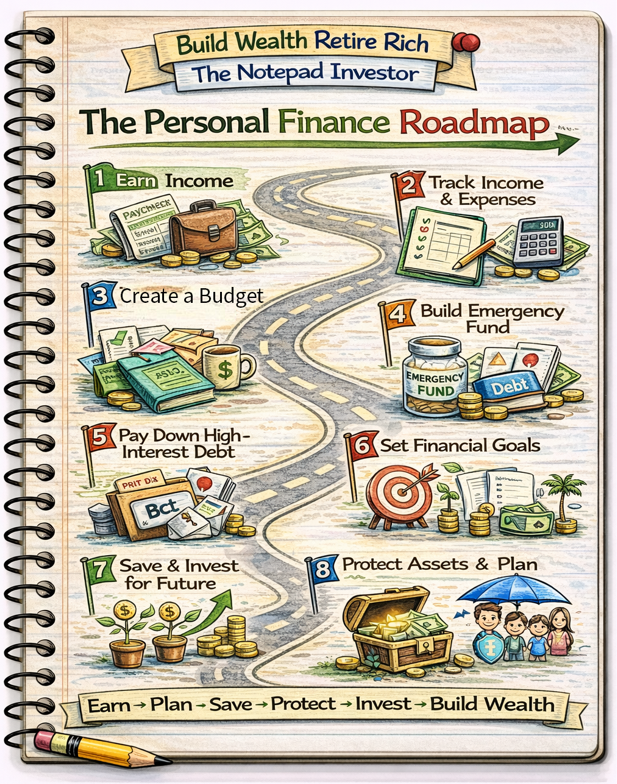
    Notebook sketch explaining personal finance

    This article is designed for anyone seeking financial clarity, individuals overwhelmed by competing priorities, or those wanting systematic improvement plans. You do not need financial expertise, high incomes, or perfect situations to follow the roadmap—principles apply at all income levels and starting points, providing clear next steps regardless of current position from deep debt through comfortable wealth, transforming financial confusion into actionable direction.

    Understanding the personal finance roadmap matters because pursuing goals in wrong order wastes resources (investing while carrying 20% APR credit card debt loses 15%+ annually), skipping foundation creates fragility (no emergency fund means job loss triggers catastrophic debt spiral), and paralysis from competing priorities prevents all progress—while roadmap followers systematically build financial security achieving milestones impossible through chaotic approaches, with each step strengthening foundation for subsequent advancement.

    Educational disclaimer: This article provides general educational framework for financial planning. Individual circumstances, priorities, incomes, and timelines vary significantly. Roadmap represents common optimized sequence—personal situations may warrant modifications. This is not financial, investment, or planning advice. Consult qualified financial professionals for personalized guidance.

    Understanding the Roadmap Concept

    Why Sequential Steps Matter

    Foundation before growth principle:

    • Can’t build wealth without financial stability
    • Can’t optimize without covering basics
    • Each step enables and protects subsequent steps
    • Skipping foundation creates collapse risk

    Common wrong-order mistakes:

    • Investing aggressively while carrying credit card debt (paying 20% to earn 8%)
    • Buying investment property without emergency fund (forced to sell during crisis)
    • Saving for home down payment while minimum-paying 18% credit cards (losing thousands in interest)
    • Maxing retirement accounts while living paycheck to paycheck (no flexibility for emergencies)

    Why roadmap sequence works:

    • Emergency fund prevents debt accumulation during setbacks
    • Debt elimination frees cash flow for wealth building
    • Foundation creates stability enabling aggressive growth
    • Each achievement builds momentum and confidence
    • Clear priorities eliminate decision paralysis

    Roadmap Flexibility

    The roadmap is guide, not rigid law:

    • Core sequence optimizes for most people most situations
    • Personal circumstances may warrant modifications
    • Life changes require roadmap adjustments
    • Some steps can run simultaneously (retirement + goals)
    • Understand principles to make informed adjustments

    When to modify:

    • Employer match: Always capture even during debt payoff (free money trumps optimization)
    • Extremely low-interest debt: May invest simultaneously with payoff (mortgage 3% vs 8% expected returns)
    • Time-sensitive opportunities: House purchase, education deadlines may justify temporary priority shifts
    • Health/family emergencies: Pause wealth building, address crisis, resume roadmap
    Advertisement
    Reserved space for in-content ad

    The Complete Personal Finance Roadmap

    Step 1: Create Budget and Track Spending

    Why this comes first: Can’t manage what you don’t measure

    Actions:

    • Track all spending for 1-3 months (apps, spreadsheet, or manual)
    • Categorize expenses: housing, transportation, food, insurance, debt, discretionary, savings
    • Calculate total monthly income (after-tax take-home)
    • Create budget: Income = Expenses + Savings (prioritize savings, adjust expenses to fit)
    • Identify spending leaks and optimization opportunities

    Target outcome:

    • Know exactly where money goes each month
    • Positive cash flow (income exceeds expenses)
    • Written budget allocating every dollar
    • Foundation for all subsequent steps

    Resources needed: Free budgeting app (Mint, YNAB, EveryDollar) or spreadsheet, 2-3 hours initial setup, 30 minutes monthly maintenance

    Step 2: Build $1,000-$2,000 Starter Emergency Fund

    Why this comes second: Prevents small emergencies from becoming debt crises

    Actions:

    • Save $1,000-$2,000 in high-yield savings account
    • Keep separate from regular checking (reduce spending temptation)
    • Use only for true emergencies (car repair, medical, unexpected essential expense)
    • Replenish immediately if used

    Typical timeline: 2-6 months saving $200-500 monthly

    Why not invest starter emergency fund: Need immediate access without market risk—stocks too volatile for short-term emergency money

    Step 3: Employer 401(k) Match (If Available)

    Why this comes third: Free money—100% instant return beats debt payoff math

    Actions:

    • Contribute minimum percentage capturing full employer match
    • Typical match: 50% or 100% of contributions up to 3-6% of salary
    • Example: $60,000 salary, 50% match on 6% = Contribute $3,600, receive $1,800 match = $5,400 annual retirement savings
    • Select low-cost target-date fund or total market index fund

    Target outcome: Capture all free employer money while building retirement habit

    Exception: If no employer match available, skip to Step 4

    Step 4: Eliminate High-Interest Debt

    Why this comes fourth: High-interest debt (15%+ APR) destroys wealth faster than investments build it

    Target debts:

    • Credit cards (typically 15-25% APR)
    • Payday loans (400%+ APR—eliminate immediately)
    • Personal loans over 10% APR
    • Any debt above 8-10% interest rate

    Payoff methods:

    Debt avalanche (mathematically optimal):

    • List debts highest to lowest interest rate
    • Minimum payments on all debts
    • Extra money to highest interest debt
    • When paid off, move to next highest
    • Saves most interest, fastest payoff

    Debt snowball (psychological wins):

    • List debts smallest to largest balance
    • Minimum payments on all debts
    • Extra money to smallest debt
    • Quick wins create momentum and motivation
    • Costs slightly more interest but higher completion rate

    Intensity matters:

    • Find extra $300-$1,000+ monthly through expense cuts and income increases
    • Pause non-essential spending temporarily
    • Aggressive focus: $15,000 debt paid in 12-18 months beats 5+ years of minimum payments

    Typical timeline: 12-36 months depending on debt amount and payment intensity

    Step 5: Build Full Emergency Fund (3-6 Months Expenses)

    Why this comes fifth: With high-interest debt eliminated, build complete financial protection

    Target amount:

    • Single income household: 6 months expenses
    • Dual income household: 3-4 months expenses
    • Self-employed or unstable income: 6-12 months expenses
    • Stable government job: 3 months expenses sufficient

    Calculation example:

    • Monthly expenses: $3,500
    • Target: 6 months = $21,000
    • Already have: $2,000 starter fund
    • Need to save: $19,000
    • At $500/month: 38 months
    • At $1,000/month: 19 months

    Where to keep emergency fund:

    • High-yield savings account (4-5% currently)
    • Money market account
    • Liquid and safe, never invested in stocks
    • Separate from checking to reduce spending temptation

    Typical timeline: 12-24 months

    Milestone achievement: Completing full emergency fund = financial stability achieved, foundation complete

    Step 6: Retirement Savings (15% of Income)

    Why this comes sixth: With stability secured, aggressively build long-term wealth

    Target contribution: 15% of gross income minimum

    Account priority order:

    1. 401(k) to employer match (already doing from Step 3)
    2. Max Roth IRA ($7,000 for 2024, $8,000 if 50+)
    3. Return to 401(k) increasing to 15% total
    4. If 15% maxes accounts, add to taxable brokerage

    Example: $75,000 salary

    • 15% target = $11,250 annually = $938 monthly
    • $4,500 to 401(k) capturing full match (6% of salary)
    • $7,000 to Roth IRA (max contribution)
    • If available funds exceed $11,250, increase 401(k) contributions

    Investment allocation:

    • 10+ years to retirement: 80-100% stocks (total market index funds)
    • Target-date funds appropriate for hands-off approach
    • Low-cost index funds (expense ratios under 0.20%)

    Why 15% minimum: Ensures comfortable retirement replacing 70-80% of pre-retirement income over 30-40 year career

    Step 7: Save for Medium-Term Goals

    Why this comes seventh: Foundation and retirement secured, fund 3-10 year objectives

    Common medium-term goals:

    • Home down payment (20% to avoid PMI)
    • Vehicle replacement fund
    • Major home renovations
    • Children’s college savings (529 plans)
    • Wedding or major life events
    • Sabbatical or extended travel

    Allocation by timeline:

    • 3-5 years: 30% stocks, 70% bonds or high-yield savings
    • 5-7 years: 50% stocks, 50% bonds
    • 7-10 years: 60-70% stocks, 30-40% bonds

    Parallel with retirement: Can pursue medium-term goals while maintaining 15% retirement contributions—both run simultaneously

    Step 8: Pay Off Low-Interest Debt

    Why this comes eighth: Eliminate remaining debt achieving complete debt freedom

    Target debts:

    • Mortgage (accelerated payoff optional)
    • Student loans (especially higher than 4-5%)
    • Auto loans remaining
    • Any debt under 8% not yet eliminated

    Acceleration strategies:

    • Extra principal payments (specify “principal only”)
    • Bi-weekly payments (26 half-payments = 13 full payments annually)
    • Lump sum payments from bonuses, raises, windfalls

    Mortgage payoff consideration:

    • Guaranteed return = interest rate saved (3-5% typical)
    • Vs investing: Expected 8%+ stock returns
    • Math favors investing over low-rate mortgage payoff
    • Emotional peace of debt-freedom has value beyond math
    • Personal preference—both approaches valid

    Typical timeline: 5-15 years depending on debt amounts and intensity

    Step 9: Build Wealth and Additional Savings

    Why this comes ninth: Debt-free with strong retirement savings, maximize wealth building

    Actions:

    • Increase retirement savings beyond 15% (20-30%+ of income)
    • Taxable investment accounts for additional wealth
    • Real estate investment if desired
    • Business ownership or side income development
    • 529 maximization for children’s education

    Investment allocation:

    • Diversified portfolio: US stocks, international stocks, bonds
    • Asset allocation matching risk tolerance
    • Regular rebalancing maintaining target allocation
    • Tax optimization: Strategic asset location, tax-loss harvesting

    Step 10: Financial Independence and Legacy Planning

    Why this comes tenth: Ultimate financial goals and generational wealth

    Financial independence:

    • Calculate FI number: Annual expenses × 25-33
    • Build investment portfolio supporting 3-4% withdrawal rate
    • Achieve work optionality at any age
    • Pursue FI through continued aggressive saving and investing

    Estate planning:

    • Will specifying asset distribution
    • Beneficiary designations on all accounts
    • Power of attorney (financial and medical)
    • Healthcare directive/living will
    • Trusts if estate over $13+ million (estate tax threshold)

    Legacy goals:

    • Generational wealth transfer
    • Charitable giving strategies
    • Family financial education
    • Values-based wealth management
    Advertisement
    Reserved space for in-content ad

    Roadmap Timeline Examples

    Aggressive Path (High Income, Low Expenses)

    Starting point: Age 25, $80,000 income, $45,000 expenses, $10,000 debt, $5,000 net worth

    Step 1-2: Budget + Starter Emergency Fund (Months 1-4)

    • Save $2,000 emergency fund
    • Net worth: $7,000

    Step 3: Employer Match (Month 5+)

    • Begin 6% 401(k) contributions ($400/month)
    • Employer adds $200/month match

    Step 4: Eliminate Debt (Months 5-16)

    • $10,000 debt paid off in 12 months ($833/month)
    • Net worth: $15,000 (includes 401k growth)

    Step 5: Full Emergency Fund (Months 17-28)

    • Build $22,500 emergency fund (6 months × $3,750)
    • Net worth: $40,000

    Step 6: Increase Retirement to 15% (Month 29+)

    • Add Roth IRA $583/month ($7,000 annually)
    • Increase 401k to $417/month ($5,000 annually)
    • Total retirement: $1,000/month ($12,000 annually = 15%)

    Step 7-10: Wealth Building (Years 3-15)

    • Continue 15%+ retirement savings
    • Save home down payment
    • Build taxable investment portfolio
    • Age 40: Net worth $800,000+, approaching FI

    Moderate Path (Average Income, Average Expenses)

    Starting point: Age 35, $65,000 income, $52,000 expenses, $25,000 debt, $8,000 net worth

    Steps 1-2: 6 months, emergency fund $2,000

    Step 3: Month 7+, capture employer match

    Step 4: 30 months eliminating $25,000 debt ($833/month)

    Step 5: 24 months building $26,000 emergency fund (6 months expenses)

    Step 6+: Year 6+, increase retirement to 15%, pursue medium-term goals

    Age 55: Net worth $500,000+, traditional retirement on track

    Recovery Path (Low Income, High Debt)

    Starting point: Age 30, $45,000 income, $43,000 expenses, $35,000 debt, -$10,000 net worth

    Phase 1: Stabilization (Year 1)

    • Create budget, reduce expenses $43,000 → $38,000
    • Build starter emergency fund $1,000
    • Begin employer match contributions

    Phase 2: Debt Elimination (Years 2-6)

    • Aggressive debt payoff $600/month
    • Increase income through raises, side hustles
    • Eliminate $35,000 debt in 5 years

    Phase 3: Foundation Building (Years 7-9)

    • Build full emergency fund
    • Increase retirement contributions
    • Net worth positive, gaining momentum

    Phase 4: Wealth Building (Years 10+)

    • Continue roadmap Steps 6-10
    • Age 50+: Retirement on track, financial stability achieved

    Common Roadmap Questions and Challenges

    “Should I invest or pay off my mortgage?”

    After Step 6 (retirement funded 15%+), two valid approaches:

    Option A: Invest (mathematically optimal)

    • Mortgage 3-4% cost vs 8%+ expected investment returns
    • 4-5% annual advantage compounds to hundreds of thousands over decades
    • Mortgage interest tax-deductible (though limited post-2018 tax reform)
    • Best mathematical outcome

    Option B: Pay off mortgage (psychological peace)

    • Guaranteed 3-4% return (interest saved)
    • Debt-free living reduces stress and risk
    • No payment = ultimate flexibility and security
    • Emotional value beyond math for many

    Hybrid approach: Split difference—extra $500 monthly: $250 to mortgage, $250 to investments

    “Can I save for a house while building emergency fund?”

    Short answer: Yes, but prioritize emergency fund first

    Approach:

    • Build starter $1,000-$2,000 emergency fund (Step 2)
    • Eliminate high-interest debt (Step 4)
    • Then split savings: 60-70% emergency fund, 30-40% home down payment
    • Complete emergency fund before aggressive home saving
    • Or extend timeline: Build full emergency fund, then save for home

    Reasoning: Home buying without emergency fund = forced home sale or debt accumulation during crisis, risking everything

    “What if I’m behind on retirement in my 40s-50s?”

    Modified roadmap:

    • Complete Steps 1-5 quickly (foundation essential)
    • Increase retirement savings beyond 15%—aim for 20-30%+
    • Catch-up contributions at 50+ ($7,500 additional 401k, $1,000 additional IRA for 2024)
    • Extend working years 3-5 years if needed
    • Delay Social Security to 70 (maximizes benefit 24%+ vs 67)
    • Geographic arbitrage in retirement (lower cost-of-living area)

    Reality: Starting late costs more but still achievable—10-15 years of aggressive saving at 50+ produces substantial retirement funds

    “Should I stop retirement to pay off debt faster?”

    General answer: Maintain employer match minimum, pause additional retirement for high-interest debt payoff

    Exception: Never stop employer match contributions—100% return beats debt payoff math even at 20% APR

    After capturing match: Pause additional retirement contributions, attack high-interest debt aggressively, resume retirement increases after debt-free

    “What about kids’ college vs my retirement?”

    Priority: Your retirement over children’s college

    Reasoning:

    • Can borrow for college, cannot borrow for retirement
    • Scholarships, grants, work-study available for college
    • Underfunded retirement becomes children’s burden
    • Airplane oxygen mask principle: secure yourself before helping others

    Balanced approach:

    • Step 6: Fund retirement 15%
    • Step 7: Add college savings (529 plans) if budget allows
    • Don’t sacrifice retirement for college—both possible with planning

    Why Following the Roadmap Matters

    Without structured roadmap, people pursue competing priorities simultaneously achieving minimal progress on any, invest while carrying high-interest debt losing thousands annually, or skip emergency funds experiencing catastrophic setbacks during inevitable crises—while roadmap followers systematically build from stability to wealth achieving financial milestones impossible through chaotic approaches, with each completed step creating foundation enabling sustainable advancement toward financial independence.

    Following the personal finance roadmap enables individuals to:

    • Build financial stability through systematic foundation establishment
    • Eliminate wasteful debt interest freeing cash flow for wealth building
    • Achieve clear milestones creating motivation and momentum
    • Make informed trade-off decisions through prioritization framework
    • Progress from financial fragility to security to independence systematically
    • Avoid common mistakes derailing financial progress through proper sequencing

    The roadmap transforms overwhelming financial complexity into clear sequential steps building sustainable wealth through prioritized execution.

    Advertisement
    Reserved space for in-content ad

    Common Misunderstandings

    Many people assume they must complete entire roadmap before financial success happens. In reality, each step represents meaningful achievement improving financial position—completing emergency fund provides stability, debt elimination frees cash flow, retirement funding creates future security, with progress measurable and valuable at every stage proving incremental advancement beats waiting for complete transformation.

    Another common misconception is that roadmap rigidity prevents individual circumstances accommodation. In practice, roadmap provides optimized framework for common situations while allowing informed modifications—understanding principles enables strategic adjustments when personal circumstances warrant deviation, proving structure and flexibility coexist when foundation principles guide decisions.

    Some believe following roadmap requires extreme sacrifice making present life miserable. However, roadmap emphasizes sustainable progress over unsustainable extremes—completing steps over years through consistent moderate effort beats attempting everything simultaneously burning out quickly, proving steady systematic execution produces better outcomes than sporadic extreme efforts inevitably abandoned.

    How the Roadmap Fits Into Financial Success

    Personal finance roadmap provides comprehensive framework organizing all financial decisions and priorities, eliminating paralysis from competing objectives through clear sequential steps, creating measurable progress from financial fragility through stability to wealth, and enabling systematic advancement toward financial independence through prioritized execution building sustainable foundation before pursuing growth.

    For example, two people age 28 earn $70,000 annually with $15,000 credit card debt. Person A pursues everything simultaneously—contributes 5% to 401k, makes minimum debt payments, invests $200 monthly in taxable account, occasionally saves for home down payment, has no emergency fund. After 10 years: Credit card debt still $8,000 (barely decreased through minimum payments), 401k $42,000, taxable account $31,000, no emergency fund, net worth $65,000. Person B follows roadmap—builds $2,000 emergency fund (3 months), captures employer match only during debt payoff, eliminates debt completely (18 months paying $833/month), builds $18,000 emergency fund (12 months), increases retirement to 15% ($875/month), adds $400 monthly taxable investments. After 10 years: Zero debt, $22,000 emergency fund, 401k $94,000, taxable account $52,000, net worth $168,000. Same income and timeframe, different approach—roadmap follower accumulated 2.5x more wealth through systematic prioritization versus chaotic parallel pursuits.

    The roadmap separates systematic wealth builders from perpetual strugglers through structured sequential advancement creating compounding benefits impossible through unfocused efforts.

    Recent Updates and Trends

    In recent years, high-interest rates have affected roadmap priorities—mortgage rates 6-7% versus historical 3-4% makes accelerated payoff more attractive mathematically, while savings account rates 4-5% make emergency funds less costly in opportunity cost terms versus historical 1-2%.

    Student loan payment pauses and forgiveness discussions have complicated debt prioritization—some people paused aggressive student loan payoff awaiting policy changes, though most experts still recommend systematic elimination following roadmap principles.

    Rising healthcare costs have increased emergency fund requirements—many financial advisors now recommend 6-12 months expenses versus traditional 3-6 months, especially for families and self-employed individuals given healthcare expense unpredictability.

    FIRE movement has popularized aggressive early roadmap steps—focus on Steps 1-6 completion in compressed timelines (3-5 years versus 10-15 years traditionally), enabling faster advancement to wealth building and FI pursuit through extreme optimization.

    Fundamental roadmap principles remain timeless: build foundation before growth, eliminate high-interest debt before investing, create emergency cushion preventing debt accumulation during setbacks, fund retirement consistently, balance competing priorities through sequential focus, and progress systematically from stability to wealth to independence—regardless of interest rate environments, economic conditions, or policy changes, structured prioritized execution produces superior outcomes versus chaotic simultaneous pursuit of competing objectives.

    3 Things You Can Do Today

    Ready to start your roadmap journey? Here are three simple steps you can take right now:

    1. Identify your current roadmap position – Review the 10-step roadmap. Which step are you currently on? Completed: Track spending, have budget, emergency fund exists, employer match captured, high-interest debt eliminated? Not completed: No budget, no emergency fund, carrying credit card debt? Write down: “I am currently on Step [X]” and “Next milestone: [specific goal with amount and timeline].” This creates clarity on current position and next priority. Most people discover they’re attempting Steps 6-7 while Steps 2-5 incomplete—explaining financial stress and lack of progress.

    2. Calculate your next milestone target and timeline – Based on current step, calculate specific next goal. Step 2: Build $1,500 emergency fund. Step 4: Eliminate $8,000 credit card debt. Step 5: Build $18,000 full emergency fund (6 months × $3,000 expenses). Step 6: Increase retirement to 15% of income. Then calculate monthly amount needed and timeline. Example: $8,000 debt ÷ 12 months = $667 monthly payment. Or extend to 18 months = $445 monthly. Choose realistic aggressive timeline creating urgency without impossible burden. Write this down: “Save/pay $[X] monthly for [Y] months to complete Step [Z].”

    3. Automate funding for your next milestone starting this week – Set up automatic transfer or payment for calculated monthly amount. Emergency fund: Auto-transfer to savings on payday. Debt payoff: Schedule extra payment beyond minimum. Retirement increase: Update 401k contribution percentage. Automation removes willpower requirement and ensures progress. Even if can’t fund full amount immediately, start with what’s possible—$200 monthly beats $0 monthly waiting for perfect conditions. Action today matters more than perfect planning tomorrow that never comes.

    These actions transform roadmap from abstract concept into personal plan with clear current position, specific next milestone, and automated progress toward systematic financial advancement.

    Advertisement
    Reserved space for in-content ad

    Quick FAQ

    Do I really need to follow the exact order, or can I do steps simultaneously?
    Core sequence (Steps 1-6) should generally follow order—foundation before growth prevents costly mistakes. However, some parallel work acceptable: employer match (Step 3) runs during debt payoff (Step 4), retirement savings (Step 6) continues while pursuing medium-term goals (Step 7). Key: Don’t skip foundation steps (1-5) to jump to growth steps (6-10). Understand why sequence exists, then make informed modifications if circumstances warrant.

    What if I have low-interest student loans—should I pay those off before investing?
    Depends on interest rate. Over 6-7%: Pay off in Step 4 with high-interest debt. 4-6%: Personal choice—math slightly favors investing but guaranteed return of payoff valuable. Under 4%: Generally continue minimum payments, invest instead (Step 6+). Also consider: loan forgiveness eligibility, payment flexibility, emotional value of debt-freedom. No universal answer—understand tradeoffs, choose based on priorities and math.

    How long should completing the roadmap take?
    Highly variable: Aggressive high-income low-debt: 3-5 years to Step 6, 10-15 years to Step 10. Moderate income average debt: 5-8 years to Step 6, 20-30 years to Step 10. Low income high debt: 7-10 years to Step 6, 30-40 years to Step 10. Timelines compress with income increases and expense optimization. Focus on steady progress, not comparison—your pace is your pace. Completing roadmap beats never starting.

    What if I’m already in my 50s and haven’t started—is it too late?
    Not too late but requires intensity. Compress Steps 1-5 into 2-3 years maximum (foundation essential), then aggressive retirement saving (Step 6) at 20-30%+ of income using catch-up contributions. May require: extending working years to 70, geographic arbitrage in retirement, part-time work early retirement years, aggressive expense optimization. 15-20 years of disciplined execution still produces substantial retirement funds. Starting today beats continuing delay—every year matters.

    Should I save for my kid’s college before maxing my retirement?
    No—Step 6 (your retirement 15%) before Step 7 (college savings). Can borrow for college, cannot borrow for retirement. Underfunded retirement becomes children’s burden eventually. After securing your retirement, add college savings. Many successfully fund both—but priority order matters. Kids have scholarships, grants, work-study, student loans as options. You have none of these for retirement. Secure your oxygen mask first.

    What’s the most common roadmap mistake people make?
    Skipping emergency fund (Step 5) to invest or pursue goals. Without emergency buffer, unexpected expenses trigger debt accumulation negating investment gains and derailing progress. Close second: investing while carrying high-interest debt—paying 18% to earn 8% loses 10% annually. Foundation steps exist for crucial reasons—skipping creates fragility leading to failure during inevitable setbacks. Complete boring foundation before exciting growth.

    Explore More in Money Basics

    Disclosure

    This article is provided for educational purposes only and does not constitute financial planning, investment, or professional advice. The personal finance roadmap represents optimized sequence for common situations—individual circumstances may warrant modifications. Timeline estimates are generalizations—actual progress varies based on income, expenses, debt levels, and execution consistency. Investment return assumptions use historical averages—actual returns vary and are not guaranteed. Debt payoff priorities depend on interest rates and personal circumstances. Step sequence flexible based on informed decision-making understanding tradeoffs. Examples are illustrative using simplified scenarios—actual situations vary significantly. Consult qualified financial planners, advisors, and professionals for personalized guidance considering specific circumstances, goals, and constraints. Information current as of publication but financial products, tax laws, and best practices evolve. Advertisements or sponsored content may appear within or alongside this content. All information is presented independently.

    Interactive Quiz: The Personal Finance Roadmap

    Test your understanding of the personal finance roadmap.

    1. What is the main purpose of a personal finance roadmap?

    2. Why should a starter emergency fund be built early in the roadmap?

    3. Which step usually comes before aggressive investing?

    4. Why is capturing an employer 401(k) match important?

    5. What is the long-term goal of following the personal finance roadmap?

    Quiz Score

    0 / 5
  • 1.9 What Is Financial Independence? The Step-by-Step Path to Freedom

    1.9 What Is Financial Independence? The Step-by-Step Path to Freedom

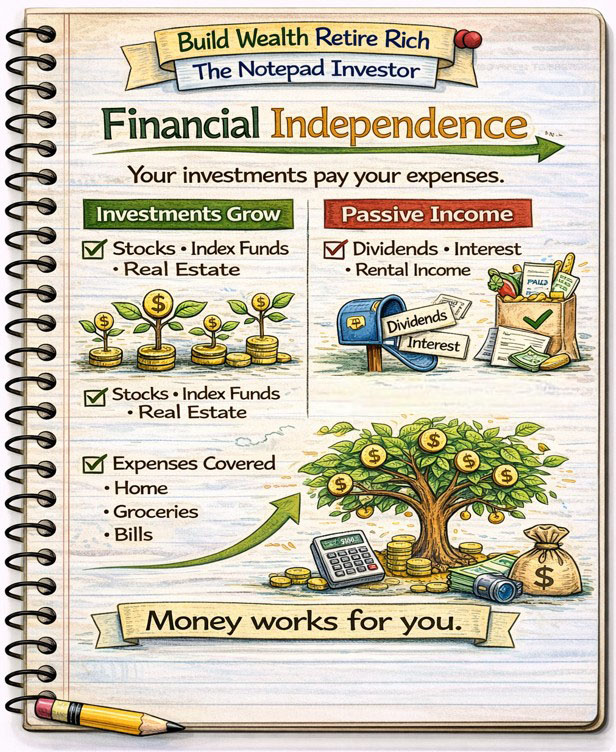
    Financial independence is the state of having sufficient wealth and passive income to cover living expenses indefinitely without requiring active employment—achieved when investment returns, rental income, business profits, or other passive sources generate enough to fund desired lifestyle without trading time for money. Unlike retirement requiring reaching age 65 and depending on limited savings, financial independence means work becomes optional at any age, with typical targets ranging from $1-3 million in invested assets producing $40,000-$120,000+ annually through 4% withdrawal rule, though exact amounts vary dramatically based on lifestyle costs and income expectations.

    Notebook sketch explaining personal finance

    This article is designed for anyone seeking work flexibility, individuals tired of mandatory employment, or those wanting to understand wealth building beyond traditional retirement. You do not need high incomes, inheritance, or business ownership to achieve financial independence—systematic saving (30-50%+ of income), strategic investing, and lifestyle optimization enable financial independence in 10-20 years for dedicated practitioners regardless of starting salary, though higher incomes and lower expenses dramatically accelerate timelines.

    Understanding financial independence matters because most people work 40+ years trading time for money until age 65, financial independence enables career changes without income pressure, geographic flexibility, extended travel, entrepreneurship risk-taking, caregiving time, or early retirement impossible while dependent on paychecks—yet many people assume wealth building requires decades of slow accumulation when aggressive saving and investing can achieve financial independence in 10-15 years for those willing to optimize spending and maximize savings rates.

    Educational disclaimer: This article provides general educational information about financial independence concepts. Individual circumstances, income levels, expenses, and timelines vary dramatically. Investment return assumptions use historical averages—actual returns vary and are not guaranteed. This is not financial, investment, or retirement advice. Consult qualified financial professionals for personalized guidance.

    Understanding Financial Independence

    What Is Financial Independence?

    Core definition: Passive income covers all living expenses without requiring employment

    Key characteristics:

    • Work becomes optional, not required
    • Investment income sustains desired lifestyle
    • Freedom from paycheck dependency
    • Time autonomy for pursuits beyond earning
    • Financial security through asset ownership

    What financial independence is NOT:

    • Not necessarily retirement (can choose to work)
    • Not unlimited wealth (specific to your expenses)
    • Not passive—requires active management and discipline
    • Not guaranteed—markets fluctuate, plans adjust
    • Not one-size-fits-all (highly personalized to lifestyle)

    Financial Independence vs Traditional Retirement

    Traditional retirement:

    • Work until age 65-67
    • Rely on Social Security + modest savings
    • Often insufficient funds
    • 40+ years of mandatory employment
    • Limited flexibility before retirement age

    Financial independence:

    • Achievable at any age (30s, 40s, 50s possible)
    • Self-funded through investments
    • Sufficient assets for complete lifestyle funding
    • 10-20 years possible with aggressive saving
    • Work flexibility at any point

    The FIRE Movement

    FIRE = Financial Independence, Retire Early

    Core principles:

    • Aggressive saving (50-70% of income)
    • Frugal living and lifestyle optimization
    • Low-cost index fund investing
    • Early retirement (30s-50s typical)
    • Focus on time freedom over material consumption

    FIRE variations:

    Lean FIRE:

    • Minimal expenses ($25,000-$40,000 annually)
    • Target: $625,000-$1,000,000 invested
    • Extreme frugality, geographic optimization
    • Fastest path to independence

    Regular FIRE:

    • Moderate expenses ($40,000-$60,000 annually)
    • Target: $1,000,000-$1,500,000 invested
    • Comfortable lifestyle, selective spending
    • Balanced approach

    Fat FIRE:

    • Higher expenses ($75,000-$150,000+ annually)
    • Target: $2,000,000-$4,000,000+ invested
    • Luxury lifestyle maintained
    • Requires high income or longer timeline

    Barista FIRE:

    • Partial financial independence
    • Part-time work covers expenses, investments preserve/grow
    • Reduced work stress, maintained engagement
    • Hybrid approach

    Coast FIRE:

    • Retirement savings sufficient, no additional contributions needed
    • Current work covers only current expenses
    • Investments grow to retirement through compounding
    • Pressure-free working years

    The 4% Rule

    Safe withdrawal rate principle: Can withdraw 4% of portfolio annually with high confidence money lasts 30+ years

    How it works:

    • $1,000,000 portfolio → $40,000 annual withdrawal
    • Adjust withdrawals annually for inflation
    • Portfolio continues growing despite withdrawals
    • Based on Trinity Study and historical market returns

    Calculating FI number:

    • Annual expenses × 25 = FI target
    • $40,000 expenses × 25 = $1,000,000 needed
    • $60,000 expenses × 25 = $1,500,000 needed
    • $100,000 expenses × 25 = $2,500,000 needed

    Why 25x expenses:

    • 4% withdrawal rate = 1/25 of portfolio
    • Diversified portfolio historically returns 7%+ after inflation
    • 4% withdrawals + 3%+ growth = sustainable indefinitely

    Conservative adjustments:

    • 3.5% rule: Annual expenses × 28.5
    • 3% rule: Annual expenses × 33
    • Used for early retirement (40+ year time horizon)
    • Extra buffer against sequence of returns risk
    Advertisement
    Reserved space for in-content ad

    The Path to Financial Independence

    Step 1: Calculate Your FI Number

    Determine annual expenses:

    • Track spending for 3-6 months
    • Calculate average monthly expenses
    • Multiply by 12 for annual total
    • Include all categories: housing, food, transportation, insurance, healthcare, discretionary

    Project future expenses:

    • Current: $50,000 annually
    • Post-FI adjustments: No work commute (-$3,000), no work wardrobe (-$1,000), no retirement savings (-$7,500), healthier lifestyle (-$2,000)
    • Adjusted expenses: $36,500 annually

    Calculate target:

    • $36,500 × 25 = $912,500 (4% rule)
    • $36,500 × 28.5 = $1,040,250 (3.5% conservative)
    • $36,500 × 33 = $1,204,500 (3% very conservative)

    Step 2: Assess Current Position

    Calculate net worth:

    • Assets: Retirement accounts, taxable investments, real estate equity, business value, cash
    • Liabilities: Mortgage, student loans, credit cards, auto loans, other debt
    • Net worth = Assets – Liabilities

    Determine FI progress:

    • Current net worth ÷ FI number = % to FI
    • Example: $250,000 net worth ÷ $1,000,000 target = 25% to FI

    Step 3: Maximize Savings Rate

    Savings rate formula: (Income – Expenses) ÷ Income × 100

    Savings rate and time to FI:

    • 10% savings rate: 51 years to FI
    • 20% savings rate: 37 years to FI
    • 30% savings rate: 28 years to FI
    • 40% savings rate: 22 years to FI
    • 50% savings rate: 17 years to FI
    • 60% savings rate: 12.5 years to FI
    • 70% savings rate: 8.5 years to FI

    Why higher savings rates dramatically accelerate FI:

    • Save more money (obvious benefit)
    • Need less total (lower lifestyle needs lower FI number)
    • Double benefit compounds: More saved + less needed = exponential timeline reduction

    Example comparison:

    Person A: $80,000 income, 15% savings rate

    • Saves: $12,000 annually
    • Spends: $68,000 annually
    • FI target: $1,700,000 (25 × $68,000)
    • Years to FI: ~35 years

    Person B: $80,000 income, 50% savings rate

    • Saves: $40,000 annually
    • Spends: $40,000 annually
    • FI target: $1,000,000 (25 × $40,000)
    • Years to FI: ~17 years

    Result: Same income, different savings rate = 18-year difference to FI

    Step 4: Increase Income

    Career advancement strategies:

    • Negotiate raises (target 5-10% annually vs typical 3%)
    • Strategic job changes (often 10-20% increases)
    • Skill development increasing market value
    • Performance exceeding expectations

    Side income development:

    • Freelance work leveraging existing skills
    • Consulting or coaching
    • Online businesses or digital products
    • Rental property income
    • Part-time work or gig economy

    Income increases + maintained expenses = accelerated FI:

    • $60,000 → $90,000 salary (50% increase)
    • Maintain $40,000 expenses (avoid lifestyle inflation)
    • Savings: $20,000 → $50,000 annually (150% increase)
    • FI timeline: Cut in half

    Step 5: Optimize Expenses

    Big three expenses (70-80% of budgets):

    Housing (25-35% of income typically):

    • Downsize to smaller/cheaper location
    • Geographic arbitrage (move to lower cost-of-living area)
    • House hacking (rent rooms, duplex living)
    • Potential savings: $500-$2,000+ monthly

    Transportation (15-20% typically):

    • Drive used vehicles 10+ years
    • One car instead of two for couples
    • Bike, walk, or public transit when possible
    • Potential savings: $300-$800+ monthly

    Food (10-15% typically):

    • Cook at home consistently
    • Meal planning reducing waste
    • Strategic grocery shopping
    • Limit dining out to special occasions
    • Potential savings: $200-$600+ monthly

    Total big three optimization: $1,000-$3,400+ monthly = $12,000-$40,800+ annually

    Step 6: Invest Strategically

    Asset allocation for FI accumulation:

    • 10+ years to FI: 90-100% stocks (maximum growth)
    • 5-10 years to FI: 80-90% stocks
    • 3-5 years to FI: Begin gradual shift to 70-80% stocks
    • Under 3 years: Accelerate to 60% stocks at FI (provides stability)

    Investment vehicles:

    • Tax-advantaged accounts first: 401k, IRA, HSA (maximize before taxable)
    • Low-cost index funds (total market, S&P 500)
    • International diversification (20-30% international stocks)
    • Minimize fees (under 0.20% expense ratios)
    • Taxable brokerage for amounts exceeding retirement limits

    Tax optimization:

    • Max 401k ($23,000 limit for 2024)
    • Max IRA ($7,000 limit for 2024)
    • Max HSA if eligible ($4,150 individual, $8,300 family for 2024)
    • Backdoor Roth conversions if income limits apply
    • Tax-loss harvesting in taxable accounts

    Financial Independence Timelines

    Scenario Examples

    Aggressive FI (10-year timeline):

    • Income: $100,000 (after-tax $75,000)
    • Expenses: $30,000 (60% savings rate)
    • Annual savings: $45,000
    • Starting net worth: $50,000
    • FI target: $750,000 (25 × $30,000)
    • Timeline: ~10 years at 8% returns

    Moderate FI (15-year timeline):

    • Income: $75,000 (after-tax $56,000)
    • Expenses: $35,000 (37.5% savings rate)
    • Annual savings: $21,000
    • Starting net worth: $20,000
    • FI target: $875,000 (25 × $35,000)
    • Timeline: ~15 years at 8% returns

    Steady FI (20-year timeline):

    • Income: $60,000 (after-tax $48,000)
    • Expenses: $36,000 (25% savings rate)
    • Annual savings: $12,000
    • Starting net worth: $10,000
    • FI target: $900,000 (25 × $36,000)
    • Timeline: ~20 years at 8% returns

    Accelerating Your Timeline

    Combined strategies:

    • Increase income 30% over 5 years: -3 years to FI
    • Reduce expenses 20%: -4 years to FI
    • Start with $100,000 instead of $0: -5 years to FI
    • Combined effect: 20-year timeline → 8-year timeline

    The power of early starts:

    • Start at 25: Achieve FI by 40-45
    • Start at 35: Achieve FI by 50-55
    • Start at 45: Achieve FI by 60-65 (traditional retirement age)
    • Every year delayed costs 1-2 years on backend
    Advertisement
    Reserved space for in-content ad

    Life After Financial Independence

    Common Post-FI Paths

    Traditional retirement:

    • Stop working completely
    • Travel, hobbies, family time
    • Leisure-focused lifestyle

    Passion work:

    • Pursue work you love without income pressure
    • Teaching, volunteering, creative pursuits
    • Purpose over profit

    Entrepreneurship:

    • Start business without financial risk
    • Experiment with ideas freely
    • FI provides safety net for calculated risks

    Semi-retirement:

    • Part-time or consulting work
    • Portfolio income + modest earnings
    • Maintain engagement while reducing stress

    Geographic freedom:

    • Extended travel or nomadic lifestyle
    • Living abroad in lower cost countries
    • Location independence

    Withdrawal Strategies

    4% rule withdrawal:

    • Year 1: Withdraw 4% of portfolio
    • Subsequent years: Adjust for inflation
    • Example: $1M portfolio → $40,000 year 1, $41,200 year 2 (3% inflation)

    Variable withdrawal:

    • Adjust withdrawals based on market performance
    • Good years: Withdraw 4.5-5%
    • Down years: Withdraw 3-3.5%
    • Reduces sequence of returns risk

    Income floor + upside:

    • Guaranteed income (Social Security, pension, annuity) covers essentials
    • Portfolio withdrawals for discretionary
    • Most secure approach

    Healthcare Considerations

    Before Medicare (under 65):

    • ACA marketplace insurance
    • Healthcare sharing ministries
    • High-deductible plan + HSA
    • Part-time work maintaining benefits
    • Spouse’s employer coverage

    Budget estimate:

    • $500-$1,500+ monthly for individuals
    • $1,000-$3,000+ monthly for families
    • Significant expense in early FI years

    Common Financial Independence Mistakes

    Underestimating Expenses

    Mistake: Calculating FI number based on current expenses without considering future needs

    Risk: Running out of money, forced return to work

    Solution: Add 20% buffer, account for healthcare, housing maintenance, travel desires

    Neglecting Tax Planning

    Mistake: Ignoring tax implications of withdrawals and conversions

    Cost: Unnecessarily high tax bills reducing available income

    Solution: Roth conversion ladder, strategic withdrawal sequencing, tax-bracket management

    All-or-Nothing Thinking

    Mistake: “If I can’t retire at 35, FI is useless”

    Reality: Partial FI provides freedom and security at any level

    Solution: Celebrate milestones—25% FI, 50% FI, Coast FI all valuable achievements

    Extreme Deprivation

    Mistake: Cutting expenses to bone creating miserable present for uncertain future

    Cost: Burnout, relationship strain, abandoning FI pursuit

    Solution: Sustainable lifestyle optimization, not punishment—cut low-value spending, maintain high-value expenses

    Ignoring Sequence of Returns Risk

    Mistake: Retiring into market crash depleting portfolio early

    Risk: Portfolio damaged beyond recovery

    Solution: 2-3 years expenses in bonds/cash, flexible withdrawals, willingness to reduce spending temporarily

    No Plan for Purpose

    Mistake: Achieving FI without plan for meaningful life

    Result: Depression, lack of fulfillment despite financial success

    Solution: Develop interests, relationships, purpose alongside wealth building—FI enables life, doesn’t create it

    Why Financial Independence Understanding Matters

    Without understanding financial independence, people assume 40-year careers are inevitable accepting limited control over time and choices, miss opportunities for aggressive wealth building enabling work optionality within 10-20 years, and settle for traditional retirement timelines when strategic saving and investing could provide freedom decades earlier—while those pursuing FI systematically build wealth enabling life design impossible through conventional approaches.

    Understanding financial independence enables individuals to:

    • Achieve work optionality at ages far younger than traditional retirement
    • Pursue careers and opportunities without financial pressure
    • Build substantial wealth through systematic high-savings strategies
    • Design lives around values and priorities rather than financial necessity
    • Create security through asset ownership and passive income
    • Gain time freedom for family, health, passions, and purposes beyond earning

    Financial independence awareness transforms resignation to 40-year work sentences into strategic paths to freedom achievable within 10-20 years through disciplined execution.

    Advertisement
    Reserved space for in-content ad

    Common Misunderstandings

    Many people assume financial independence requires high six-figure incomes or inheritance. In reality, FI depends more on savings rate than absolute income—someone earning $60,000 saving 50% ($30,000 annually, living on $30,000) achieves FI faster than someone earning $150,000 saving 10% ($15,000 annually, living on $135,000) because lower expenses reduce FI target while higher savings accelerate accumulation, proving discipline trumps income level.

    Another common misconception is that financial independence means never working again. In practice, FI means work becomes optional not forbidden—many FI achievers continue working in passion careers, part-time roles, entrepreneurship, or volunteering, but without financial pressure transforming work from necessity into choice, proving FI provides freedom to work meaningfully rather than mandatory retirement.

    Some believe pursuing FI requires extreme sacrifice making present life miserable. However, successful FI practitioners optimize spending cutting low-value expenses while maintaining high-value spending aligned with personal values—strategic lifestyle design rather than deprivation, proving FI pursuit can increase present life satisfaction while building future freedom when approached thoughtfully versus rigidly.

    How Financial Independence Fits Into Financial Success

    Financial independence provides ultimate goal organizing all financial decisions—every spending choice evaluated against FI timeline impact, career moves assessed for FI acceleration potential, and investment strategies optimized for FI accumulation, creating comprehensive framework transforming reactive money management into systematic wealth building with clear purpose and measurable progress toward complete financial autonomy.

    For example, two people earn $70,000 annually at age 30. Person A never considers FI—spends $65,000, saves $5,000 annually (7% savings rate), lives comfortably but paycheck to paycheck. After 30 years: $285,000 saved at 8% return, still working at 60, requiring continued employment into 70s. Person B discovers FI at 30—optimizes spending to $42,000 (cuts housing 30%, transportation 40%, eliminates unconscious spending), saves $28,000 annually (40% savings rate). After 17 years at 8% return: $850,000 saved, reaches FI at age 47 ($42,000 × 25 = $1,050,000 target nearly achieved). At 47: Person A still has 18 years until retirement, dependent on paycheck. Person B has work optionality—can retire, pursue passion work, travel extensively, or continue career by choice not necessity. Same starting income, different FI awareness and execution, one achieves freedom at 47 while other remains dependent at 60+.

    Financial independence understanding separates those achieving time freedom in 40s-50s from those working into 60s-70s by necessity through strategic wealth building enabling optional work versus mandatory employment.

    Recent Updates and Trends

    In recent years, FIRE movement has exploded—blogs, podcasts, communities proliferating sharing strategies and accountability, though some criticism emerged about sustainability, flexibility, and life balance requiring thoughtful adaptation versus dogmatic following.

    Remote work revolution has accelerated FI pursuit—geographic arbitrage easier (work in high-wage area remotely while living in low-cost area), reduced commuting expenses, and flexibility enabling side hustles, all accelerating savings and wealth accumulation.

    Market volatility has reinforced importance of conservative FI numbers—3.5% or 3% rules gaining traction versus 4% as sequence of returns risk becomes more appreciated, especially for very early retirement (40+ year timeframes).

    Healthcare costs have become major FI planning focus—ACA marketplace providing pre-Medicare coverage option, though costs significant ($500-$2,000+ monthly), making healthcare a major FI expense requiring careful planning especially for early retirees.

    Fundamental FI principles remain timeless: aggressive saving (40-70% of income) dramatically accelerates wealth accumulation, expense optimization reduces both savings required and FI target simultaneously, index fund investing provides simple effective growth strategy, and living below means while investing difference enables financial freedom within 10-20 years for dedicated practitioners—regardless of market conditions, economic cycles, or income levels, systematic high-savings execution produces financial independence for those willing to optimize lifestyle and prioritize time freedom over consumption.

    3 Things You Can Do Today

    Ready to pursue financial independence? Here are three simple steps you can take right now:

    1. Calculate your FI number and current progress – Track expenses for last 3 months, average monthly, multiply by 12 for annual. Multiply annual expenses by 25 (4% rule). Example: $45,000 annual expenses × 25 = $1,125,000 FI target. Calculate current net worth (assets minus debts). Divide net worth by FI number for % to FI. Example: $180,000 net worth ÷ $1,125,000 = 16% to FI. This creates concrete target and baseline measuring progress.

    2. Calculate current savings rate and FI timeline – Formula: (Annual income – Annual expenses) ÷ Annual income × 100. Example: ($75,000 – $60,000) ÷ $75,000 = 20% savings rate. Use online FI calculator (search “FI calculator” or “time to FI calculator”) inputting savings rate, current net worth, FI target, expected returns (8%). Result shows estimated years to FI. This reveals whether current trajectory achieves FI and when, enabling informed decisions about acceleration strategies.

    3. Identify three expense optimizations increasing savings rate 5-10% – Review last month’s spending. Find three areas with low value-to-cost ratio: expensive housing for rarely-used space, vehicle payments on depreciating assets, subscriptions barely used, dining out from convenience not enjoyment. Calculate savings if optimized. Example: Downsize apartment (-$300), sell financed car for paid-off used (-$250), cancel unused subscriptions (-$75), reduce dining out 50% (-$200) = $825 monthly = $9,900 annually. On $75,000 income with 20% savings ($15,000), this increases to 33% ($24,900), cutting FI timeline from 37 years to 25 years—12-year acceleration from expense optimization alone.

    These actions create FI awareness with concrete numbers transforming vague retirement hopes into actionable wealth-building plans with measurable timelines and specific strategies.

    Advertisement
    Reserved space for in-content ad

    Quick FAQ

    How much money do I need to be financially independent?
    Annual expenses × 25 using 4% rule. Example: $40,000 expenses = $1,000,000 needed. $60,000 expenses = $1,500,000. $100,000 expenses = $2,500,000. Conservative: Use 30-33x for 3-3.5% withdrawal rates if retiring very early (40+ year horizon). Amount depends entirely on YOUR spending—no universal number. Lower expenses = lower target = faster FI.

    Can I achieve FI on a modest income?
    Yes, but requires high savings rate. $50,000 income saving 50% ($25,000 annually, living on $25,000) needs $625,000 and can achieve in ~17 years at 8% returns. $100,000 income saving 20% ($20,000 annually, living on $80,000) needs $2,000,000 and requires ~35 years. Lower income with high savings rate beats high income with low savings rate. Savings rate matters most.

    What if the 4% rule fails or markets crash?
    Multiple safeguards: (1) Conservative 3-3.5% rule instead, (2) Flexible spending reducing withdrawals in down years, (3) 2-3 years expenses in bonds/cash weathering crashes, (4) Part-time work option if needed, (5) Social Security safety net eventually. 4% rule has 95%+ historical success rate—not guaranteed but highly probable. Diversification, flexibility, and buffers manage risk.

    Do I have to retire if I reach FI?
    No—FI means work becomes optional, not forbidden. Many continue careers they enjoy without financial pressure, pursue passion work, consult part-time, or start businesses. FI provides freedom to choose work for fulfillment rather than necessity. “Retire Early” in FIRE is option not requirement. Work on your terms when and how you want.

    What about inflation eroding my FI number over time?
    4% rule accounts for inflation—withdraw 4% year one, then adjust upward for inflation annually. $40,000 year 1 becomes $41,200 year 2 at 3% inflation. Portfolio continues growing despite withdrawals (historically 7%+ real returns after inflation). Real returns exceed withdrawals maintaining purchasing power. Inflation addressed in withdrawal strategy design.

    Is pursuing FI selfish or irresponsible with family obligations?
    Opposite—FI provides family security and time availability. Financial independence enables: being present for children, caregiving for aging parents, supporting spouse’s career flexibility, weathering job losses without crisis, pursuing meaningful family time versus mandatory overtime. FI pursuit through saving and investing demonstrates responsibility. Balance aggressive FI with present family needs, but FI and family obligations align more than conflict when approached thoughtfully.

    Explore More in Money Basics

    Disclosure

    This article is provided for educational purposes only and does not constitute financial, investment, retirement, or tax advice. Financial independence strategies involve significant lifestyle changes and investment risk. Investment return assumptions use historical averages—actual returns vary significantly and are not guaranteed. 4% rule and variations based on historical studies—past performance does not guarantee future results. Individual circumstances, income levels, expenses, risk tolerances, and timelines vary dramatically affecting appropriate strategies and achievable timelines. Healthcare costs, tax implications, and withdrawal strategies require personalized planning. Examples are illustrative using simplified assumptions—actual results depend on individual factors, market conditions, and execution quality. FI pursuit requires sustained discipline over many years—not suitable for everyone. Consult qualified financial planners, tax professionals, and investment advisors for personalized guidance considering specific situations. Advertisements or sponsored content may appear within or alongside this content. All information is presented independently.

    Interactive Quiz: Financial Independence

    Choose an answer and click Check Answer to learn why it is correct or incorrect.

    1. What best describes financial independence?

    2. What does the 4% rule suggest?

    3. How is a financial independence target commonly calculated?

    4. Which factor most strongly affects how quickly someone reaches financial independence?

    5. Which is a common mistake when planning for financial independence?

    Quiz Score

    0 / 5
  • 1.8 Short-Term vs Long-Term Financial Goals: What You Should Focus on First

    1.8 Short-Term vs Long-Term Financial Goals: What You Should Focus on First

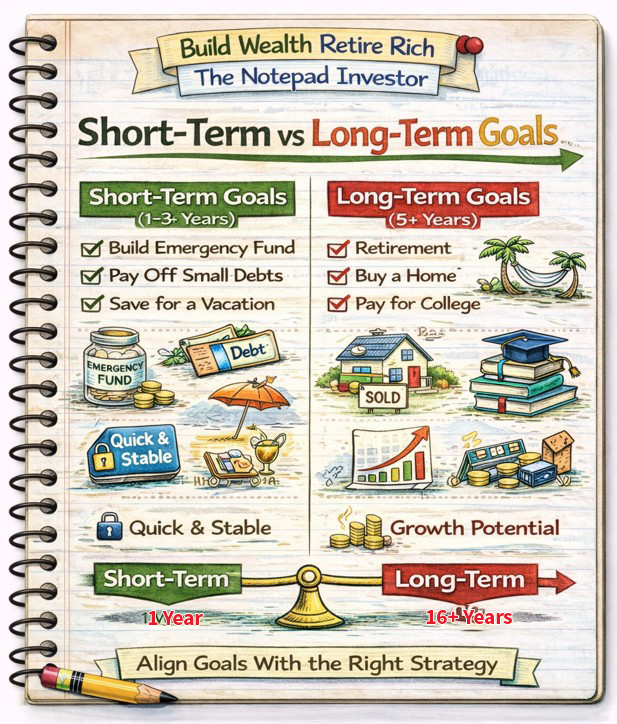
    Short-term vs long-term goals distinguish financial objectives by timeframe and approach—short-term goals span days to two years requiring immediate action and liquid savings (emergency funds, vacation savings, small debt payoff), while long-term goals extend 10+ years enabling compound growth through investments (retirement, homeownership, children’s education). Unlike treating all goals identically, understanding timeframe differences guides appropriate saving and investment strategies: short-term money stays accessible in savings accounts avoiding market volatility risk, long-term money invests in stocks accepting temporary fluctuations for superior growth compounding over decades.

    Notebook sketch explaining personal finance

    This article is designed for anyone balancing multiple financial priorities, individuals uncertain which goals to pursue first, or those making poor strategy choices for goal timeframes. You do not need investment expertise, large incomes, or complex financial knowledge to distinguish goal types—simple awareness that different timeframes require different strategies prevents costly mistakes like investing retirement money too conservatively or keeping down payment savings in volatile stocks.

    Understanding short-term versus long-term goals matters because investing emergency fund money risks needing it during market downturns forcing losses, keeping retirement savings in low-return accounts costs hundreds of thousands in forgone compound growth, and treating all goals identically leads to either excessive risk or insufficient returns—yet many people use same approach for three-month and thirty-year goals despite vastly different optimal strategies.

    Educational disclaimer: This article provides general educational information about goal timeframes and strategies. Individual circumstances, risk tolerance, and financial situations vary significantly. This is not financial planning or investment advice. Consult qualified financial professionals for personalized guidance.

    Defining Goal Timeframes

    Short-Term Goals (0-2 Years)

    Timeframe: Immediate to 24 months

    Characteristics:

    • Need money accessible within months or year
    • Cannot afford market volatility risk
    • Prioritize capital preservation over growth
    • Little time for compound growth benefit
    • Liquidity essential—must access quickly without penalty

    Common short-term goals:

    • Emergency fund building ($1,000-$10,000+)
    • Holiday shopping or gift budget
    • Vacation savings ($2,000-$5,000)
    • Minor home repairs or car maintenance fund
    • Small debt payoff ($2,000-$5,000 credit card)
    • Upcoming large purchase (furniture, electronics)
    • Tax payment savings
    • Wedding or event planning (12-18 months out)

    Appropriate vehicles:

    • High-yield savings accounts (4-5% currently)
    • Money market accounts
    • Short-term CDs (3-12 months)
    • Checking account for immediate needs

    Medium-Term Goals (2-10 Years)

    Timeframe: 2-10 years

    Characteristics:

    • More time allows modest growth pursuit
    • Can accept limited volatility but not major risk
    • Balance between safety and returns
    • Some compound growth potential
    • Moderate liquidity needs

    Common medium-term goals:

    • Home down payment ($20,000-$60,000+)
    • Vehicle replacement ($15,000-$35,000)
    • Major home renovation ($30,000-$100,000+)
    • Business startup capital
    • Career transition fund
    • Substantial debt payoff (student loans, mortgage acceleration)
    • Child’s upcoming college expenses (5-10 years away)

    Appropriate vehicles:

    • High-yield savings for conservative approach (2-5 year goals)
    • Conservative bond funds or balanced funds (5-10 year goals)
    • 60/40 stock/bond portfolio (7-10 year goals with moderate risk tolerance)
    • CDs laddered at different maturities
    • I Bonds (inflation-protected, 1-year minimum holding)

    Long-Term Goals (10+ Years)

    Timeframe: 10 years to several decades

    Characteristics:

    • Decades enable aggressive growth pursuit
    • Can weather market volatility—time to recover from downturns
    • Compound growth creates dramatic wealth multiplication
    • Growth prioritized over safety
    • Liquidity not required—can lock up funds long-term

    Common long-term goals:

    • Retirement savings (20-40+ years for young investors)
    • Children’s college fund (newborn to 18 years)
    • Financial independence/early retirement
    • Generational wealth building
    • Legacy and estate planning
    • Long-term real estate investment

    Appropriate vehicles:

    • Stock index funds (diversified equity exposure)
    • Target-date retirement funds
    • Individual stocks (for experienced investors)
    • Real estate investment
    • 401(k), IRA, Roth IRA, HSA (tax-advantaged accounts)
    • 529 college savings plans
    • 80/20 or 90/10 stock/bond allocation (aggressive growth)
    Advertisement
    Reserved space for in-content ad

    Key Differences in Strategy

    Risk Tolerance by Timeframe

    Short-term (0-2 years): Zero risk acceptable

    • Cannot afford losses—need full amount available on schedule
    • Market drop of 20% weeks before goal deadline catastrophic
    • Example: Need $10,000 for home repair in 6 months—cannot risk $8,000 remaining after market decline
    • Strategy: Guaranteed return vehicles only (savings, CDs, money market)

    Medium-term (2-10 years): Limited risk acceptable

    • Can accept modest volatility but not severe downturns
    • 5-10 years provides some recovery time from moderate declines
    • Example: Down payment in 7 years—can handle 10-15% temporary decline but not 40% crash
    • Strategy: Conservative investments with 20-40% stocks maximum, majority bonds/savings

    Long-term (10+ years): Significant risk acceptable and advisable

    • Decades to recover from market downturns
    • Historical evidence: Stocks always positive over 20+ year periods
    • Example: Retirement in 30 years—can endure multiple market crashes knowing long-term growth
    • Strategy: Aggressive stock allocation (80-100%) maximizing growth potential

    Expected Returns by Timeframe

    Short-term vehicles: 1-5% annually

    • High-yield savings: 4-5% (varies with interest rates)
    • Money market: 3-5%
    • Short CDs: 3-5%
    • Checking: 0-1%
    • Low returns but guaranteed safety

    Medium-term vehicles: 3-6% annually

    • Bond funds: 3-5%
    • Balanced funds (60/40): 5-7%
    • Conservative allocation: 4-6%
    • Moderate returns with moderate risk

    Long-term vehicles: 8-10%+ annually

    • Stock market historical average: 8-10%
    • Index funds: 8-10%
    • Aggressive growth funds: 9-12% (higher volatility)
    • Real estate: 8-12% (including appreciation and income)
    • High returns with high short-term volatility

    Compound Growth Impact

    $10,000 invested at different returns:

    Short-term (2 years at 4%):

    • Ending value: $10,816
    • Growth: $816 (8.2%)

    Medium-term (7 years at 6%):

    • Ending value: $15,036
    • Growth: $5,036 (50.4%)

    Long-term (30 years at 8%):

    • Ending value: $100,627
    • Growth: $90,627 (906%!)

    Insight: Time dramatically amplifies return differences—1-2% return difference negligible over 2 years but worth tens of thousands over decades

    Liquidity Needs

    Short-term: High liquidity essential

    • May need money within days or weeks
    • Cannot lock into long-term investments with penalties
    • Must access quickly without selling at loss
    • Example: Emergency fund must be instantly available

    Medium-term: Moderate liquidity

    • Know approximately when money needed
    • Can accept modest access delays or small penalties if necessary
    • Some flexibility in timing (can delay 3-6 months if needed)
    • Example: Down payment—if find house earlier than planned, can liquidate investments accepting small loss or delay home search

    Long-term: Liquidity not required

    • Decades before needing money
    • Can lock into retirement accounts with penalties for early withdrawal
    • Market timing irrelevant—withdraw on your schedule not market’s
    • Example: Retirement account—don’t need until 65, ignore market fluctuations before then

    Balancing Short and Long-Term Goals

    The Priority Hierarchy

    Level 1: Essential short-term (complete first)

    1. $1,000-$2,000 starter emergency fund
    2. Employer 401(k) match (technically long-term but priority due to free money)
    3. High-interest debt payoff (credit cards over 10%)

    Level 2: Foundation completion

    1. Full emergency fund (3-6 months expenses)
    2. Essential insurance (health, auto, life if dependents)

    Level 3: Balanced approach

    • 15%+ income to long-term retirement
    • Medium-term goals (home down payment, etc.)
    • Remaining debt payoff (student loans, mortgage)
    • Short-term lifestyle goals (vacation, etc.)

    Level 4: Wealth building

    • Maximize retirement contributions
    • Taxable investment accounts
    • Additional real estate
    • Business investments

    Simultaneous vs Sequential Goals

    Sequential approach (focused intensity):

    • Complete one goal before starting next
    • Fastest progress on individual goals
    • Best for: Debt payoff, emergency fund building
    • Example: Put all available money toward emergency fund until complete, then shift to next goal

    Simultaneous approach (balanced progress):

    • Fund multiple goals concurrently
    • Slower progress per goal but diversified effort
    • Best for: Balancing retirement + medium-term + short-term goals
    • Example: $500 monthly retirement, $300 monthly down payment, $200 monthly vacation fund

    Hybrid approach (recommended for most):

    • Sequential for foundation (emergency fund, debt)
    • Simultaneous after foundation complete
    • Example: Build emergency fund intensely, then split among retirement (15%), down payment (10%), other goals (5%)

    Time Horizon Shifting

    Goals transition between categories as time passes:

    Example: College savings for newborn

    • Age 0-8 (18-10 years remaining): Long-term → Aggressive 90% stock allocation
    • Age 9-13 (9-5 years remaining): Medium-term → Shift to 70% stocks, 30% bonds
    • Age 14-17 (4-1 years remaining): Short-term → Move to 50% stocks, 50% bonds/savings
    • Age 18 (immediate need): Cash → High-yield savings for upcoming tuition payments

    Strategy adjustment principle: As goals approach deadline, reduce risk protecting accumulated value

    Resource Allocation

    Sample balanced allocation on $5,000 monthly income ($4,000 after taxes):

    Assuming foundation complete (emergency fund + no high-interest debt):

    • Essential expenses: $2,400 (60%)
    • Long-term retirement: $600 (15%)
    • Medium-term down payment: $400 (10%)
    • Short-term vacation/gifts: $200 (5%)
    • Discretionary spending: $400 (10%)
    • Total: $4,000

    Adjustment as income grows: Increase long-term percentage first (retirement), then medium-term, finally short-term lifestyle

    Advertisement
    Reserved space for in-content ad

    Common Mistakes in Goal Timeframes

    Investing Short-Term Money

    Mistake: Putting emergency fund or 6-month-away down payment in stock market

    Cost: Market drops 20% weeks before needing money, forced to sell at loss, goal delayed or abandoned

    Example: $20,000 down payment in stocks for home purchase in 8 months—market crashes, value drops to $16,000, cannot afford home

    Solution: Money needed within 2 years stays in savings accounts regardless of potential returns forgone

    Keeping Long-Term Money Too Conservative

    Mistake: Keeping 30-year retirement money in savings accounts earning 4%

    Cost: Missing 8-10% stock market returns—difference compounds to hundreds of thousands over decades

    Example: $500 monthly for 30 years at 4% = $347,000 vs 8% = $745,000—conservative approach costs $398,000

    Solution: Money not needed for 10+ years invests aggressively in stocks accepting volatility for superior growth

    Prioritizing Long-Term Over Short-Term Foundation

    Mistake: Contributing to retirement while carrying credit card debt and no emergency fund

    Cost: Emergency requires debt, 20% credit card interest negates 8% investment returns, debt spiral destroys wealth

    Example: Investing $300 monthly retirement while paying 20% on $8,000 credit card—losing net 12% annually despite “saving”

    Solution: Complete foundation (starter emergency fund, high-interest debt payoff) before aggressive long-term investing

    No Medium-Term Goals

    Mistake: Only short-term (bills) and long-term (retirement), nothing for 2-10 year goals

    Cost: Major life purchases (home, car) require debt or raiding retirement with penalties and taxes

    Example: Need $25,000 car at 35, no savings, choose between auto loan (pay interest) or 401k withdrawal (penalty + taxes + retirement setback)

    Solution: Balance all three timeframes—maintain short-term security, medium-term flexibility, long-term growth simultaneously

    Rigid Timeframe Categories

    Mistake: “This is 8-year goal so must stay in bonds” even as goal becomes 2-year goal

    Cost: Taking inappropriate risk as goal deadline approaches, potential loss when need stability

    Example: Down payment fund stays 70% stocks when only 18 months until home purchase—market drop devastates nearly-complete goal

    Solution: Reassess timeframe and risk annually, shift to more conservative as goals approach

    Lifestyle Inflation Consuming Long-Term Capacity

    Mistake: Every raise goes to short-term lifestyle spending (bigger apartment, nicer car, more dining)

    Cost: No increase in long-term savings, perpetual retirement shortfall despite income growth

    Example: Income grows from $50,000 to $80,000 over decade, retirement contribution stays $200 monthly—spending grew 60%, retirement 0%

    Solution: Direct 50-100% of raises to long-term goals before lifestyle adjusts

    Why Understanding Timeframes Matters

    Without understanding goal timeframes, people invest emergency funds risking unavailability during actual emergencies, keep retirement money in savings accounts forfeiting hundreds of thousands in compound growth, and create unstable financial foundations by prioritizing long-term over essential short-term needs—while those matching strategies to timeframes build secure foundations, grow wealth through appropriate risk-taking, and achieve both immediate and distant financial objectives.

    Understanding short-term versus long-term goals enables individuals to:

    • Match investment risk to goal timelines appropriately
    • Maximize compound growth on long-term money through aggressive allocation
    • Protect short-term money from market volatility ensuring availability
    • Build balanced financial plans addressing immediate and distant needs
    • Avoid costly mistakes from timeframe-strategy mismatches
    • Achieve superior outcomes through timeframe-appropriate approaches

    Timeframe awareness transforms financial planning from one-size-fits-all approaches to optimized strategies for each goal’s specific horizon.

    Advertisement
    Reserved space for in-content ad

    Common Misunderstandings

    Many people assume market investments are always better than savings accounts because higher returns. In reality, timeframe determines optimal vehicle—stocks superior for 10+ year goals but catastrophic for 6-month goals when market timing risk exists, proving investment returns meaningless if forced to sell during downturns before recovery time available.

    Another common misconception is that conservative approaches (keeping everything in savings) protects wealth. In practice, inflation and opportunity cost erode conservative long-term holdings—retirement money in 4% savings versus 8% stocks costs $400,000+ over 30 years on $500 monthly contributions, proving conservative approaches appropriate for short-term protection but devastating for long-term growth.

    Some believe they must choose between short-term security and long-term wealth building. However, proper financial planning addresses both simultaneously through prioritized sequencing—foundation first (emergency fund, debt), then balanced allocation across timeframes ensuring both immediate stability and distant prosperity rather than sacrificing one for the other.

    How Goal Timeframes Fit Into Financial Success

    Goal timeframe understanding provides framework matching strategies to horizons—short-term money protected in liquid accounts, medium-term money balanced between growth and safety, long-term money invested aggressively for maximum compound benefit—creating financial plans that address immediate needs while building substantial future wealth through appropriate risk-taking based on time available.

    For example, two 30-year-olds each earning $60,000 with $1,000 monthly available for goals. Person A doesn’t distinguish timeframes—puts all money in savings earning 4% for both emergency fund and retirement. Person B understands timeframes—builds $10,000 emergency fund in savings (short-term), then splits remaining funds: $700 monthly to stocks for retirement (long-term aggressive 8%), $300 monthly to balanced fund for home down payment in 7 years (medium-term moderate 6%). After 30 years: Person A has $693,000 total in savings (emergency fund + retirement). Person B has $10,000 emergency fund, bought home after 7 years, and $1,263,000 retirement portfolio (from $700 monthly at 8%)—plus home equity. Person B’s timeframe-appropriate strategies produced $580,000 additional retirement wealth plus homeownership versus Person A’s one-size-fits-all conservative approach. Same monthly amount, different timeframe understanding, dramatically different outcomes.

    Timeframe awareness multiplies wealth by optimizing each goal’s strategy for its specific horizon rather than treating all goals identically.

    Recent Updates and Trends

    In recent years, high-yield savings accounts reaching 4-5% have made short-term vehicles more attractive—better returns on emergency funds and near-term goals reduce pressure to take inappropriate risks chasing yield.

    Target-date funds have simplified long-term investing—automatically adjust from aggressive to conservative as retirement approaches, solving timeframe-shifting challenge for hands-off investors.

    FIRE movement emphasis on early retirement has highlighted medium-term goal importance—bridge accounts between current income and traditional retirement age require 5-15 year planning beyond typical short/long dichotomy.

    Market volatility awareness has increased—2020 pandemic crash and 2022 bear market reminded investors that short-term money in stocks risks significant losses when needed most, reinforcing timeframe-appropriate positioning.

    Fundamental timeframe principles remain timeless: short-term money prioritizes safety and liquidity over returns, long-term money prioritizes growth over stability accepting volatility for compound benefit, medium-term money balances both objectives, and matching strategy to timeframe produces superior outcomes versus one-size-fits-all approaches—regardless of current market conditions, interest rate environment, or economic circumstances, appropriate timeframe strategy optimization separates financial success from preventable failures.

    3 Things You Can Do Today

    Ready to optimize goal timeframes? Here are three simple steps you can take right now:

    1. Categorize all current financial goals by timeframe – List every financial goal: emergency fund, vacation, down payment, retirement, debt payoff, etc. Label each: Short (0-2 years), Medium (2-10 years), Long (10+ years). Review where money is currently held. Example: If emergency fund in stocks or retirement in savings, timeframe mismatch identified. This audit reveals inappropriate placements requiring correction preventing costly mistakes.

    2. Verify short-term money in appropriate vehicles – Identify all money needed within 2 years (emergency fund, upcoming large purchases, near-term savings). Check current location. If any in stocks, bonds, or volatile investments, move to high-yield savings account this week. Accept lower returns for guaranteed safety and liquidity. Example: $5,000 emergency fund in stock fund moves to savings earning 4-5%—small return sacrifice prevents devastating loss if market crashes when emergency occurs.

    3. Verify long-term money invested for growth – Identify all money not needed for 10+ years (primarily retirement accounts). Check current allocation. If over 50% in savings/bonds/CDs, create plan to shift to stock index funds over next 3-6 months. Use online calculator to see cost of conservative approach. Example: $300 monthly for 25 years at 4% = $184,000 vs 8% = $281,000—$97,000 cost of staying too conservative. Moving to appropriate aggressive allocation captures growth potential.

    These actions align financial positioning with goal timeframes eliminating costly mismatches between when money is needed and how it’s invested.

    Advertisement
    Reserved space for in-content ad

    Quick FAQ

    How do I know if a goal is short-term or long-term?
    Simple rule: Will you need the money within 2 years? Short-term. Between 2-10 years? Medium-term. More than 10 years? Long-term. When uncertain, err conservative—treat 3-year goal as short-term if uncomfortable with any volatility, or as medium-term if can delay 6-12 months if needed. Exact boundaries matter less than matching strategy to approximate horizon.

    What if I have multiple goals with different timeframes?
    Separate money into different accounts matching each timeframe: Short-term in savings accounts, medium-term in conservative investments or savings depending on exact timeline, long-term in stock-focused investments. Example: $800 monthly split: $200 savings for vacation (short), $200 balanced fund for down payment (medium), $400 stock index for retirement (long). Each goal gets appropriate vehicle.

    Can I ever put short-term money in stocks?
    Only if you can genuinely delay goal by 3-5 years if market crashes. True emergencies and fixed deadlines require guaranteed-safe vehicles. Flexible short-term goals (vacation you could postpone, home purchase you could delay) might accept limited stock exposure (20-30%) if willing to adjust timing. But classic emergency fund? Never in stocks—defeats purpose.

    When should I shift from aggressive to conservative as goals approach?
    General guideline: Start shifting from stocks to bonds/savings when 3-5 years from goal deadline. Example: College fund for high schooler ages 14-18, down payment fund within 5 years of anticipated home purchase, retirement at age 60-65 (shift at 55-60). Gradual shift over several years better than sudden change preventing forced selling during temporary downturn.

    What about emergency funds—are they really short-term?
    Yes, always treat as short-term even though hopefully never needed. Purpose is immediate availability during emergencies which may occur anytime. Cannot risk market being down when job loss or medical emergency strikes. Emergency funds in stocks defeats entire purpose—might need when market down 30%, forced to sell at loss. Keep in high-yield savings regardless of years before potentially needed.

    Should all my retirement money be in stocks even if I’m close to retirement?
    No. General guideline: Percentage in stocks = 110 minus age. Age 35: 75% stocks. Age 55: 55% stocks. Age 65: 45% stocks. Rationale: Retirement lasts 20-30 years—money needed in year 1 is short-term (bonds/savings), money for year 20 is long-term (stocks). Gradually shift but maintain growth allocation since retirement is multi-decade period, not single event.

    Explore More in Money Basics

    Disclosure

    This article is provided for educational purposes only and does not constitute financial planning, investment, or professional advice. Individual circumstances, risk tolerance, financial situations, and goals vary significantly. Timeframe categories and strategies are generalizations—specific appropriate approaches depend on personal factors. Investment return examples use historical averages—actual returns vary significantly and are not guaranteed. Risk tolerance varies individually—some may prefer more conservative approaches even for long-term goals. Asset allocation suggestions are general guidelines, not personalized recommendations. Market conditions change affecting optimal strategies. Consult qualified financial planners, investment advisors, and professionals for personalized guidance considering specific situations, timelines, and risk tolerances. Advertisements or sponsored content may appear within or alongside this content. All information is presented independently.

    Interactive Quiz: Short-Term vs Long-Term Goals

    Choose an answer and click Check Answer to see the explanation.

    1. What is the primary difference between short-term and long-term financial goals?

    2. Which of the following is typically considered a short-term financial goal?

    3. Why are savings accounts typically recommended for short-term financial goals?

    4. Which investment approach is generally appropriate for long-term financial goals?

    5. What is a common mistake people make when managing goal timeframes?

    Quiz Score

    0 / 5
  • 1.7 How to Set Financial Goals That Actually Work (Step-by-Step Guide)

    1.7 How to Set Financial Goals That Actually Work (Step-by-Step Guide)

    Financial goals are specific, measurable targets for achieving desired financial outcomes within defined timeframes—ranging from building a $5,000 emergency fund within 12 months to accumulating $1 million for retirement over 30 years. Unlike vague wishes like “save more money” or “get out of debt,” effective financial goals include concrete amounts, clear deadlines, and actionable plans transforming aspirations into systematic progress through budgeting, saving, investing, and strategic decision-making aligned with priorities.

    Notebook sketch explaining personal finance

    This article is designed for anyone wanting to improve financial situations, individuals feeling financially directionless, or those with money but unclear purposes for it. You do not need wealth, financial expertise, or perfect credit to set financial goals—goals work at all income levels and financial situations, providing direction transforming reactive money management into intentional wealth building regardless of starting point.

    Understanding financial goals matters because people without clear targets save inconsistently achieving minimal progress, those with vague aspirations lack motivation and accountability making poor trade-off decisions, and individuals without prioritized goals pursue everything simultaneously accomplishing nothing—while goal-setters systematically build emergency funds, eliminate debt, buy homes, and retire comfortably through focused effort toward specific targets rather than diffuse hoping.

    Educational disclaimer: This article provides general educational information about setting financial goals. Individual circumstances, priorities, and timelines vary significantly. This is not financial planning or investment advice. Consult qualified financial professionals for personalized guidance based on specific situations.

    What Are Financial Goals?

    Definition and Purpose

    Financial goal: A specific financial outcome you want to achieve within a defined timeframe

    Components of effective financial goals:

    • Specific target (dollar amount, outcome, milestone)
    • Measurable progress markers
    • Realistic given income and timeline
    • Time-bound with clear deadline
    • Aligned with personal values and priorities

    Why financial goals matter:

    • Provide direction for financial decisions
    • Create motivation and accountability
    • Enable measurement of progress
    • Facilitate prioritization and trade-offs
    • Transform wishes into actionable plans
    • Reduce financial stress through clarity and control

    Vague Wishes vs Clear Goals

    Vague wish examples (ineffective):

    • “I want to save more money”
    • “I need to get out of debt”
    • “I should invest for retirement”
    • “I’d like to buy a house someday”

    Clear goal examples (effective):

    • “Save $6,000 emergency fund by December 31, 2026 ($500/month)”
    • “Pay off $8,000 credit card debt by June 2027 (18 months, $445/month)”
    • “Contribute $6,000 to Roth IRA in 2026 ($500/month)”
    • “Save $40,000 home down payment by January 2028 (24 months, $1,667/month)”

    Difference: Specific amounts, deadlines, and implied monthly action plans enable tracking progress and maintaining motivation versus vague intentions creating no accountability

    SMART Goal Framework

    Specific: Precisely defined outcome, not general aspiration

    • Bad: “Save money for retirement”
    • Good: “Accumulate $500,000 in retirement accounts by age 60”

    Measurable: Quantifiable progress tracking

    • Bad: “Pay down debt”
    • Good: “Reduce credit card balance from $12,000 to $6,000 this year”

    Achievable: Realistic given income, expenses, and timeline

    • Bad: “Save $50,000 on $40,000 salary in one year” (impossible)
    • Good: “Save $6,000 on $40,000 salary in one year” (15% savings rate, challenging but possible)

    Relevant: Aligned with values, priorities, and life circumstances

    • Bad: “Buy sports car” (when need family vehicle and have kids)
    • Good: “Buy reliable minivan for growing family”

    Time-bound: Clear deadline creating urgency

    • Bad: “Eventually pay off student loans”
    • Good: “Pay off $25,000 student loans by December 2028 (36 months)”
    Advertisement
    Reserved space for in-content ad

    Types of Financial Goals

    By Timeline

    Short-term goals (0-2 years):

    • Build starter emergency fund ($1,000-$2,000)
    • Pay off small credit card balances
    • Save for vacation or holiday gifts
    • Build full emergency fund (3-6 months expenses)
    • Save for minor home repairs or car maintenance

    Medium-term goals (2-10 years):

    • Save home down payment
    • Pay off car loan or student loans
    • Save for vehicle replacement
    • Fund major home renovations
    • Save for child’s education or wedding
    • Build substantial investment portfolio

    Long-term goals (10+ years):

    • Retirement savings and preparation
    • Pay off mortgage
    • Achieve financial independence
    • Fund children’s college education
    • Build generational wealth
    • Major lifestyle transitions (career change, early retirement)

    By Category

    Foundation goals (priority):

    • Emergency fund establishment
    • High-interest debt elimination
    • Basic insurance coverage
    • Positive monthly cash flow creation

    Growth goals:

    • Retirement account contributions
    • Investment portfolio building
    • Real estate acquisition
    • Business ownership or side income development

    Lifestyle goals:

    • Home purchase or upgrade
    • Vehicle purchase
    • Travel and experiences
    • Hobbies and recreation funding

    Legacy goals:

    • Children’s education funding
    • Estate planning and wealth transfer
    • Charitable giving
    • Family financial security beyond own lifetime

    Common Financial Goals Examples

    Emergency fund:

    • “Save $1,500 starter emergency fund within 6 months”
    • “Build $15,000 emergency fund (6 months expenses) within 24 months”

    Debt elimination:

    • “Pay off $5,000 credit card balance in 12 months”
    • “Eliminate all consumer debt ($18,000) by December 2027”
    • “Pay off mortgage 10 years early by age 50”

    Retirement:

    • “Contribute $7,000 to IRA annually (max contribution)”
    • “Increase 401k contribution from 5% to 15% of salary over 2 years”
    • “Accumulate $1 million retirement savings by age 65”
    • “Achieve financial independence by age 55”

    Home ownership:

    • “Save $30,000 down payment (10% on $300k home) in 36 months”
    • “Save $60,000 for 20% down payment avoiding PMI in 48 months”

    Education:

    • “Save $50,000 in 529 plan by child’s 18th birthday (starting at birth)”
    • “Fund certification program ($5,000) within 6 months for career advancement”

    Income increase:

    • “Develop skills enabling $10,000 salary increase within 18 months”
    • “Launch side hustle generating $500 monthly by end of year”

    Setting Effective Financial Goals

    Step 1: Assess Current Financial Situation

    Calculate net worth:

    • List all assets (cash, investments, home equity, vehicles)
    • List all debts (credit cards, loans, mortgage)
    • Net worth = Assets – Debts
    • Provides baseline snapshot

    Determine monthly cash flow:

    • Total monthly income (after taxes)
    • Total monthly expenses (all categories)
    • Cash flow = Income – Expenses
    • Reveals available funds for goals

    Identify financial strengths and weaknesses:

    • Adequate emergency fund? (strength/weakness)
    • High-interest debt? (weakness requiring priority)
    • Retirement on track? (strength/weakness)
    • Insurance coverage adequate? (strength/weakness)

    Step 2: Clarify Values and Priorities

    Ask key questions:

    • What matters most in life? (family, freedom, security, experiences, legacy)
    • What financial stresses need addressing urgently?
    • What future lifestyle do you envision?
    • What would financial success look like in 5, 10, 20 years?

    Common value-goal alignments:

    • Value security → Prioritize emergency fund and insurance
    • Value freedom → Focus on debt elimination and passive income
    • Value family → Children’s education and family home
    • Value experiences → Travel fund and adventure savings
    • Value independence → Early retirement and financial independence

    Step 3: Set Specific Goals

    Start with foundation goals (non-negotiable):

    1. $1,000-$2,000 starter emergency fund
    2. Eliminate high-interest debt (credit cards over 15% APR)
    3. Build 3-6 month emergency fund
    4. Start retirement savings (minimum employer match)

    Then add priority goals based on values:

    • Select 2-3 major goals per timeframe (short/medium/long)
    • Make each goal SMART (specific, measurable, achievable, relevant, time-bound)
    • Write goals down with exact amounts and deadlines

    Example goal set:

    • Short-term (12 months): Build $9,000 emergency fund ($750/month)
    • Medium-term (36 months): Save $36,000 home down payment ($1,000/month)
    • Long-term (ongoing): Max out Roth IRA annually ($7,000/year = $583/month)
    • Total monthly commitment: $2,333 (requires income supporting this)

    Step 4: Calculate Required Actions

    Work backward from goal to monthly amount:

    • Goal: $10,000 in 20 months
    • Required: $10,000 ÷ 20 = $500/month

    Account for investment returns when applicable:

    • Goal: $100,000 in 15 years
    • At 8% annual return: Requires $318/month
    • Without returns: Would require $556/month
    • Investment growth reduces required contributions

    Identify funding sources:

    • Reduce current expenses by $X
    • Allocate existing surplus of $Y
    • Increase income by $Z through raise/side hustle
    • Total = Monthly goal funding

    Step 5: Create Action Plan

    Automate when possible:

    • Automatic transfers to savings/investment accounts on payday
    • Automatic retirement contributions through payroll
    • Automatic extra debt payments
    • Removes willpower requirement

    Set up tracking system:

    • Spreadsheet with target amounts and current balances
    • Budgeting app showing goal progress
    • Monthly review of goal status
    • Adjust as needed based on income/expense changes

    Build accountability:

    • Share goals with spouse/partner
    • Join online community with similar goals
    • Work with financial advisor or coach
    • Schedule quarterly goal reviews

    Step 6: Prioritize and Sequence Goals

    Recommended priority order:

    1. Starter emergency fund ($1,000-$2,000)
    2. Employer 401k match (free money, immediate priority)
    3. High-interest debt payoff (over 8-10% interest)
    4. Full emergency fund (3-6 months expenses)
    5. Retirement savings increase (15%+ of income)
    6. Medium/low-interest debt payoff and other goals
    7. Additional wealth building and lifestyle goals

    Balancing multiple goals:

    • Some goals require sequential focus (emergency fund before investing)
    • Some goals can run simultaneously (retirement + home down payment)
    • Limited resources require prioritization—can’t pursue everything at once
    • Life stages affect priorities (young: retirement, mid-career: home/education, pre-retirement: maximize retirement)
    Advertisement
    Reserved space for in-content ad

    Common Financial Goal Mistakes

    Setting Too Many Goals Simultaneously

    Mistake: Pursuing 10+ goals at once with minimal progress on any

    Cost: Diffuse effort produces minimal results, creates frustration, leads to abandoning all goals

    Solution: Focus on 2-4 major goals at a time, complete sequentially, then move to next priorities

    Unrealistic Timelines or Amounts

    Mistake: “Save $50,000 in 12 months on $45,000 salary”

    Cost: Immediate failure and discouragement, abandoning goal-setting entirely

    Solution: Calculate required monthly amount, ensure it’s 30% or less of income, extend timeline if needed

    No Specific Numbers or Deadlines

    Mistake: “Save more for retirement” or “pay down debt”

    Cost: No accountability, no progress tracking, no motivation

    Solution: Always include exact dollar amount and specific completion date

    Ignoring Foundation Before Aspirational Goals

    Mistake: Saving for vacation while carrying credit card debt and no emergency fund

    Cost: Financial fragility—emergency creates debt spiral negating all progress

    Solution: Complete foundation (emergency fund, high-interest debt payoff) before discretionary goals

    Not Adjusting Goals to Life Changes

    Mistake: Maintaining aggressive goals through job loss, medical emergency, or major life transition

    Cost: Unnecessary stress, potential failure, feeling inadequate

    Solution: Review goals quarterly, adjust to current reality, temporary goal pausing acceptable during crisis

    Comparing to Others’ Goals

    Mistake: Setting goals based on peers’ achievements or social media rather than personal values

    Cost: Pursuing wrong priorities, financial stress, dissatisfaction even with success

    Solution: Align goals with YOUR values, circumstances, and priorities—ignore others’ timelines and choices

    Tracking and Adjusting Goals

    Monthly Review Process

    Review each goal:

    • Current balance or progress
    • Target amount for this month
    • Actual contribution or progress
    • Ahead/behind/on-track assessment

    Identify obstacles:

    • Income lower than expected?
    • Unexpected expenses derailing savings?
    • Motivation declining?
    • Goal unrealistic given current reality?

    Make adjustments:

    • Increase/decrease monthly amounts
    • Extend/shorten timelines
    • Reprioritize goals
    • Add/remove goals based on changes

    Celebrating Milestones

    Recognize progress:

    • 25%, 50%, 75% completion markers
    • Celebrate without derailing (free or minimal-cost rewards)
    • Share achievements with accountability partners
    • Reflect on effort and discipline demonstrated

    Completion celebrations:

    • Acknowledge goal achievement
    • Analyze what worked well for future goals
    • Set next goal in sequence
    • Small celebration reward (dinner out, small purchase) without negating achievement

    Handling Setbacks

    Common setbacks:

    • Job loss or income reduction
    • Medical emergency or major unexpected expense
    • Life changes (marriage, divorce, children, relocation)
    • Economic changes (recession, inflation, market crash)

    Response strategies:

    • Pause aggressive goals temporarily if necessary
    • Maintain foundation goals (basic emergency fund, minimum retirement)
    • Extend timelines rather than abandoning goals
    • Resume full effort when circumstances stabilize
    • Remember: Temporary pause not permanent failure

    Why Financial Goals Matter

    Without financial goals, people save sporadically accumulating minimal wealth, make impulsive financial decisions lacking direction, and reach retirement unprepared discovering decades of earnings produced inadequate security—while goal-setters systematically build emergency funds, eliminate debt, accumulate investment portfolios, and achieve financial milestones through focused sustained effort toward specific targets.

    Understanding and implementing financial goals enables individuals to:

    • Transform vague aspirations into concrete measurable progress
    • Make informed trade-off decisions aligned with priorities
    • Maintain motivation through visible progress tracking
    • Achieve financial milestones impossible through unfocused effort
    • Reduce financial stress through clarity and control
    • Build wealth systematically regardless of income level

    Financial goals transform reactive money management into intentional wealth building through sustained focused action.

    Advertisement
    Reserved space for in-content ad

    Common Misunderstandings

    Many people assume financial goals only work for high earners with surplus income. In reality, goals work at all income levels—someone earning $35,000 setting goal to save $100 monthly builds $1,200 emergency fund in one year plus investment growth, proving modest systematic effort achieves meaningful results regardless of income when goals create focus and accountability.

    Another common misconception is that setting goals creates rigidity eliminating life enjoyment. In practice, goals enable better enjoyment by clarifying priorities—knowing you’re on track for important goals allows guilt-free spending on values-aligned wants, while lack of goals creates constant uncertainty whether spending is responsible, proving structure increases rather than decreases satisfaction.

    Some believe once goals are set they must be achieved exactly as planned or they’ve failed. However, goals serve as direction and motivation tools, not rigid contracts—adjusting timelines, amounts, or priorities based on life changes represents healthy adaptation not failure, with modified goals still producing dramatically better outcomes than no goals at all.

    How Financial Goals Fit Into Financial Success

    Financial goals provide roadmap transforming income into wealth—each dollar earned gets assigned purpose through goals rather than disappearing into unconscious spending, creating systematic progress toward emergency funds, debt elimination, homeownership, and retirement rather than perpetual paycheck-to-paycheck living despite adequate incomes.

    For example, two people earn identical $65,000 salaries. Person A never sets specific goals—saves when feeling motivated, spends remainder, vaguely worries about future but takes no focused action. After 10 years: minimal savings, still renting, retirement account under $30,000, financially fragile. Person B sets clear goals at 25: (1) $10,000 emergency fund in 18 months, (2) $50,000 home down payment in 5 years, (3) 15% retirement contributions ongoing. Creates budget allocating $500 monthly emergency fund (completed in 20 months), $800 monthly home savings (completed in 64 months), $812 monthly retirement. After 10 years: $10,000 emergency fund maintained, owns home with growing equity, retirement account $147,000+ through consistent contributions and growth. Same income, different goal-setting discipline, dramatically different financial positions. Goals transformed identical earnings into substantial wealth through focused sustained action toward specific targets.

    Financial goals convert aspirations into achievements through systematic intentional progress toward defined targets.

    Recent Updates and Trends

    In recent years, FIRE movement (Financial Independence Retire Early) has popularized extreme goal-setting—followers set aggressive targets like saving 50-70% of income enabling retirement in 10-15 years through hyper-focused goals and spending discipline.

    Goal-tracking apps and tools have proliferated—platforms like YNAB, Mint, Personal Capital visualize goal progress automatically making tracking effortless versus manual spreadsheets, increasing goal achievement rates through visible accountability.

    Social goal-sharing has increased—online communities, social media accountability, and shared goals with friends/family normalize goal discussion previously considered private or taboo, creating external motivation supporting achievement.

    Economic uncertainty has shifted goal priorities—more people prioritizing emergency funds and debt elimination over aggressive investing or lifestyle upgrades, recognizing foundation importance during volatile periods.

    Fundamental goal-setting principles remain timeless: specific measurable targets outperform vague wishes, written goals with deadlines create accountability, foundation goals precede aspirational goals, focused sequential progress beats diffuse simultaneous pursuit, and regular review with adjustment produces better outcomes than rigid adherence to outdated plans—regardless of economic conditions, technological tools, or social trends, goal-setting discipline separates financial success from perpetual struggle.

    3 Things You Can Do Today

    Ready to set financial goals? Here are three simple steps you can take right now:

    1. Write down three specific financial goals with exact amounts and deadlines – Choose one short-term (under 2 years), one medium-term (2-10 years), one long-term (10+ years). Make each SMART: specific dollar amount, measurable, achievable given income, relevant to values, time-bound with deadline. Example: “Save $5,000 emergency fund by December 31, 2026,” “Save $30,000 home down payment by January 2029,” “Accumulate $750,000 retirement by age 65 (current age 35).” Writing creates commitment and clarity transforming wishes into targets.

    2. Calculate required monthly action for each goal – For each goal, work backward: divide target amount by months remaining. Adjust for investment returns if applicable (use online calculator for long-term goals). Example: $5,000 in 10 months = $500/month. $30,000 in 36 months = $833/month. $750,000 in 30 years at 8% return = $730/month. Total these. If total exceeds available income, prioritize foundation goal first (emergency fund), extend other timelines, or increase income. This reveals exact actions required making goals concrete and actionable.

    3. Automate funding for highest priority goal starting this week – Choose most important goal (likely emergency fund if none exists). Set up automatic transfer from checking to dedicated savings account on payday for calculated monthly amount. Even if can’t fund all goals immediately, automating one creates momentum and demonstrates commitment. First automated goal success builds confidence and systems for additional goals. Action today matters more than perfect planning—start even imperfectly rather than waiting for ideal conditions never arriving.

    These actions transform financial goal-setting from abstract concept into concrete commitments with visible progress toward specific achievements.

    Advertisement
    Reserved space for in-content ad

    Quick FAQ

    How many financial goals should I have at once?
    Focus on 2-4 major goals simultaneously—one from each timeframe (short/medium/long) works well. Example: emergency fund (short), home down payment (medium), retirement (long). More than 5-6 goals dilutes focus creating minimal progress on any. Complete foundation goals (emergency fund, high-interest debt) before adding others. Quality execution of few goals beats poor execution of many.

    What if I can’t afford to fund all my goals?
    Prioritize sequentially rather than simultaneously. Complete foundation (emergency fund, debt payoff) first, then move to next priority. Alternatively, extend timelines making monthly amounts achievable. Example: Can’t save $1,000/month for home? Extend from 3 years to 5 years reducing to $600/month. Better to achieve goals slowly than abandon them entirely. Increase income through raises/side hustles expanding capacity over time.

    Should I pay off debt or save for goals first?
    Standard priority: (1) $1,000 starter emergency fund, (2) pay off high-interest debt over 8-10% APR, (3) build full 3-6 month emergency fund, (4) pursue other goals while making minimum payments on remaining low-interest debt. High-interest debt (credit cards) destroys wealth—eliminate before other goals. Low-interest debt (mortgage 4%) can continue while building wealth through investments.

    How often should I review and adjust goals?
    Monthly: Quick progress check—are you on track? Quarterly: Deeper review—adjust amounts/timelines if needed. Annually: Major review—reassess priorities, add new goals, remove completed ones. Also review after major life changes (job change, marriage, children, health issues, economic shifts). Goals should evolve with circumstances—rigid adherence to outdated goals counterproductive.

    What if I keep failing to achieve my goals?
    Diagnose why: (1) Unrealistic amounts/timelines? Adjust to achievable levels. (2) Lack of automation? Set up automatic transfers removing willpower requirement. (3) Wrong priorities? Ensure goals align with actual values not “shoulds.” (4) Life circumstances changed? Adjust or pause temporarily. (5) Need accountability? Share goals with partner/friend/advisor. Repeated failure usually indicates goal mismatch with reality—adjust goals rather than continuing same approach expecting different results.

    Is it okay to have fun/lifestyle goals or should all goals be practical?
    Include lifestyle goals aligned with values AFTER foundation established. Emergency fund + no high-interest debt + basic retirement = foundation complete, then add lifestyle goals guilt-free. Example: After foundation, setting goal to save $5,000 for dream vacation over 10 months is perfectly appropriate. Balance practical (security/retirement) with experiential (travel/hobbies) reflecting whole life priorities. All-practical goals create joyless deprivation; all-lifestyle goals create financial fragility. Balance both.

    Explore More in Money Basics

    Disclosure

    This article is provided for educational purposes only and does not constitute financial planning, investment, or professional advice. Individual financial situations, priorities, income levels, and goals vary significantly. Goal examples are illustrative—appropriate goals depend on personal circumstances, values, timeline, and resources. Calculation examples use simplified assumptions—actual investment returns vary and are not guaranteed. Timeline and amount recommendations are generalizations—specific appropriate goals require personalized assessment. No judgment implied about any financial priorities or goal choices—article aims to provide framework for informed goal-setting based on individual values. Consult qualified financial planners, advisors, and professionals for personalized guidance considering specific situations. Advertisements or sponsored content may appear within or alongside this content. All information is presented independently.

    Interactive Quiz: Financial Goals

    Choose an answer and click Check Answer to see the explanation.

    1. What best defines a financial goal?

    2. Which of the following is an example of a clear financial goal?

    3. According to the SMART goal framework, what does the “M” represent?

    4. Which of the following is considered a foundation financial goal?

    5. What is a common mistake when setting financial goals?

    Quiz Score

    0 / 5
  • 1.6 How Inflation Is Quietly Destroying Your Money (And What You Can Do)

    1.6 How Inflation Is Quietly Destroying Your Money (And What You Can Do)

    Inflation and purchasing power represent inverse relationships describing how money’s value changes over time—inflation measures the rate prices increase annually, typically 2-3% in stable economies, while purchasing power describes how much goods and services money can buy, declining as inflation rises. Unlike assuming dollars maintain constant value, understanding inflation reveals that $100 today buys what $74 bought 10 years ago at 3% inflation, requiring strategic responses like investing for returns exceeding inflation, negotiating salary increases matching cost-of-living growth, and planning retirement needs accounting for decades of price increases eroding fixed savings.

    Notebook sketch explaining personal finance

    This article is designed for anyone planning long-term finances, individuals on fixed incomes, or those seeking to preserve wealth over time. You do not need economics degrees, complex mathematics, or market expertise to understand inflation’s impact—simple awareness that money loses value over time through rising prices transforms financial planning from static to dynamic, from short-term to inflation-adjusted thinking spanning decades.

    Understanding inflation and purchasing power matters because ignoring inflation costs retirees 30-50% of purchasing power over retirement decades, keeping savings in 1% accounts while inflation runs 3% guarantees 2% annual real loss compounding to 45% wealth erosion over 30 years, and failing to negotiate salary increases matching inflation creates effective pay cuts despite stable nominal income—yet many people make financial plans treating money as having constant value when reality proves otherwise.

    Educational disclaimer: This article provides general educational information about inflation and purchasing power. Inflation rates vary by country, time period, and economic conditions. Examples use historical averages—actual rates differ. This is not financial, investment, or economic advice. Consult qualified financial professionals for personalized guidance.

    Understanding Inflation

    What Is Inflation?

    Definition: The rate at which general price level of goods and services increases over time, eroding purchasing power

    Simple explanation: Things cost more money each year—inflation measures how much more

    Key characteristics:

    • Expressed as annual percentage rate
    • Normal feature of growing economies (2-3% typical target)
    • Affects all prices though individual items vary
    • Continuous process—prices generally don’t decrease

    How Inflation Is Measured

    Consumer Price Index (CPI):

    • Most common inflation measure
    • Tracks prices of basket of common consumer goods
    • Includes: Housing, food, transportation, healthcare, education, etc.
    • Updated monthly by Bureau of Labor Statistics
    • Annual inflation = percentage change in CPI year-over-year

    Core CPI (Core Inflation):

    • CPI excluding volatile food and energy prices
    • Provides clearer trend without temporary fluctuations
    • Federal Reserve focuses on core inflation for policy

    Personal Consumption Expenditures (PCE):

    • Alternative inflation measure
    • Broader than CPI, includes more services
    • Federal Reserve’s preferred inflation metric

    Historical Inflation Context

    Recent U.S. inflation rates:

    • 1960s-1970s: Average 4-5%, peaking at 13.5% (1980)
    • 1980s-1990s: Declining from 10%+ to 2-3%
    • 2000-2019: Stable 1.5-3% range
    • 2020-2021: Pandemic-related volatility
    • 2022-2023: 8%+ peak, returning toward 3-4%
    • Long-term average (1926-2024): ~3% annually

    Federal Reserve target: 2% annual inflation considered optimal for healthy economy

    What Causes Inflation?

    Demand-pull inflation:

    • Too much money chasing too few goods
    • High consumer demand exceeds supply capacity
    • Example: Pandemic stimulus + supply chain disruptions

    Cost-push inflation:

    • Rising production costs (labor, materials, energy)
    • Businesses pass costs to consumers through higher prices
    • Example: Oil price shocks increasing transportation costs

    Monetary inflation:

    • Central bank increases money supply
    • More currency in circulation reduces each dollar’s value
    • Example: Quantitative easing programs

    Built-in inflation (wage-price spiral):

    • Workers demand higher wages to maintain purchasing power
    • Higher wages increase production costs
    • Businesses raise prices to cover costs
    • Creates self-reinforcing cycle
    Advertisement
    Reserved space for in-content ad

    Understanding Purchasing Power

    What Is Purchasing Power?

    Definition: The quantity of goods and services money can buy

    Relationship to inflation: Purchasing power and inflation move inversely—as inflation rises, purchasing power falls

    Formula: Real purchasing power = Nominal dollars ÷ (1 + inflation rate)^years

    Purchasing Power Erosion Examples

    $100 purchasing power at 3% annual inflation:

    • Today: Buys $100 worth of goods
    • 5 years: Buys $86 worth of goods (14% loss)
    • 10 years: Buys $74 worth of goods (26% loss)
    • 20 years: Buys $55 worth of goods (45% loss)
    • 30 years: Buys $41 worth of goods (59% loss)

    $50,000 annual income at 3% inflation:

    • Without raises maintaining purchasing power:
    • Year 10: Buying power equivalent to $37,000 today
    • Year 20: Buying power equivalent to $27,500 today
    • Year 30: Buying power equivalent to $20,500 today

    Required income to maintain $50,000 purchasing power:

    • Year 10: $67,196 needed
    • Year 20: $90,306 needed
    • Year 30: $121,363 needed

    Real vs Nominal Values

    Nominal value:

    • Dollar amount not adjusted for inflation
    • Face value or stated amount
    • Example: $50,000 salary

    Real value:

    • Purchasing power adjusted for inflation
    • Value in constant dollars (often using base year)
    • Example: $50,000 salary in 2025 = $37,000 purchasing power in 2035 at 3% inflation

    Critical insight: Focus on real values for long-term planning—nominal amounts mislead without inflation adjustment

    Inflation’s Uneven Impact

    Not all prices rise equally:

    Above-average inflation sectors:

    • Healthcare: 4-6% annually (exceeds general inflation)
    • College tuition: 5-8% annually historically
    • Housing in high-demand areas: 4-7%

    Below-average inflation sectors:

    • Technology products: Often deflation (better/cheaper over time)
    • Clothing: Modest increases or stable
    • Household goods: Generally lower than CPI

    Implication: Personal inflation rate depends on spending composition—retirees with high healthcare costs experience higher personal inflation than young professionals with low healthcare needs

    Inflation’s Impact on Financial Planning

    Retirement Planning

    Challenge: Retirement may span 20-30+ years—inflation dramatically affects needed savings

    Example: Planning for $50,000 annual retirement income

    Ignoring inflation (wrong approach):

    • Assume need $50,000 annually for 30 years
    • At 4% withdrawal rule: Need $1.25 million saved

    Accounting for 3% inflation (correct approach):

    • Year 1: $50,000
    • Year 10: $65,227 needed for same purchasing power
    • Year 20: $85,195 needed
    • Year 30: $111,272 needed
    • Average need over 30 years: ~$75,000 annually
    • Actually need $1.875 million saved ($750,000 more than nominal calculation)

    Critical lesson: Ignoring inflation in retirement planning creates 50%+ shortfalls

    Savings and Cash Holdings

    Scenario: $100,000 in savings account earning 1% annually with 3% inflation

    10-year outcome:

    • Nominal value: $110,462 (grew 10.5%)
    • Real purchasing power: $82,035 in today’s dollars (lost 18%)
    • Net result: Lost purchasing power despite nominal growth

    Required return to maintain purchasing power:

    • Must earn at minimum the inflation rate
    • 3% inflation requires 3%+ investment returns
    • Returns below inflation = guaranteed real losses

    Implication: Cash and low-return savings accounts lose value over time—appropriate for emergency funds and short-term needs only, not long-term wealth building

    Fixed Income and Pensions

    Challenge: Fixed payments maintain nominal value but lose real value

    Example: $3,000 monthly pension without cost-of-living adjustment (COLA)

    Real purchasing power at 3% inflation:

    • Year 1: $3,000 ($36,000 annually)
    • Year 10: $2,228 real value ($26,736 annually)
    • Year 20: $1,654 real value ($19,848 annually)
    • Year 30: $1,228 real value ($14,736 annually)

    30-year result: Nominal income stayed $36,000 but purchasing power declined to $14,736—59% loss

    Solution: Seek pensions with COLA increases or supplement with inflation-protected investments

    Debt Management

    Inflation benefits borrowers with fixed-rate debt:

    Example: $200,000 mortgage at 4% fixed, 30-year term

    • Monthly payment: $955 (fixed nominally)
    • Real cost of payment declines over time
    • Year 1: $955 payment = $955 real cost
    • Year 15 (at 3% inflation): $955 payment = $611 real cost
    • Year 30: $955 payment = $392 real cost

    Implication: Fixed-rate debt payments become easier over time as inflation erodes real cost—one reason mortgages are valuable

    However: High inflation with low wages growth still makes payments difficult—inflation helps only if income keeps pace

    Salary Negotiations

    Maintaining purchasing power requires inflation-matching raises:

    $60,000 salary with no raises, 3% annual inflation:

    • Year 5: $51,674 real purchasing power (14% pay cut)
    • Year 10: $44,523 real purchasing power (26% pay cut)
    • Year 15: $38,357 real purchasing power (36% pay cut)

    Required raises to maintain purchasing power:

    • Annual 3% minimum just to stay even
    • Real raises require exceeding inflation rate
    • 5% raise with 3% inflation = 2% real increase
    Advertisement
    Reserved space for in-content ad

    Protecting Against Inflation

    Investment Strategies

    1. Stocks (Historically best inflation hedge)

    • Average 8-10% annual returns exceed typical 2-3% inflation
    • Companies can raise prices maintaining profitability
    • Long-term stock ownership preserves purchasing power
    • Short-term volatility but long-term growth

    2. Real Estate

    • Property values generally rise with inflation
    • Rental income increases with inflation
    • Fixed-rate mortgages benefit from inflation
    • Tangible asset with inherent value

    3. Treasury Inflation-Protected Securities (TIPS)

    • Principal adjusts with CPI inflation
    • Interest payments rise as principal increases
    • Guaranteed inflation protection
    • Lower returns but explicit inflation hedge

    4. I Bonds (Series I Savings Bonds)

    • Interest rate adjusts every 6 months with inflation
    • Safe, government-backed
    • Tax advantages (defer federal tax, exempt from state/local)
    • Purchase limits: $10,000 electronic + $5,000 paper annually

    5. Commodities and Precious Metals

    • Gold, silver, oil often rise with inflation
    • Diversification benefit
    • High volatility, no income generation
    • Better as small portfolio allocation (5-10%)

    Income Strategies

    Negotiate regular raises:

    • Minimum: Inflation-matching increases
    • Goal: Inflation + merit raises (5-7% annually)
    • Track personal performance justifying above-inflation increases

    Develop inflation-resistant income sources:

    • Skills and expertise that appreciate over time
    • Business ownership with pricing power
    • Royalties and passive income adjustable with inflation

    Diversify income streams:

    • Multiple sources reduce single-income risk
    • Investment income supplements wage income
    • Side businesses provide flexibility raising prices

    Spending Strategies

    Lock in long-term fixed costs when possible:

    • Fixed-rate mortgages protect against housing inflation
    • Long-term service contracts at fixed rates
    • Prepay future expenses at current prices when advantageous

    Prioritize inflation-sensitive expense reduction:

    • Healthcare, housing, education have above-average inflation
    • Reducing exposure protects against personal inflation rate
    • Location choices significantly affect housing inflation exposure

    Social Security Considerations

    Automatic inflation protection:

    • Social Security includes annual COLA (cost-of-living adjustment)
    • Benefits increase with CPI inflation
    • Maintains purchasing power automatically
    • One reason Social Security valuable in retirement planning

    Common Inflation Mistakes

    Keeping Too Much Cash Long-Term

    Mistake: Large emergency fund or savings sitting in low-yield accounts for years

    Cost: 2% annual real loss (3% inflation minus 1% return) compounds to 45% purchasing power loss over 30 years

    Solution: Right-size emergency fund (3-6 months), invest excess in inflation-beating assets

    Ignoring Inflation in Retirement Planning

    Mistake: Calculating retirement needs in today’s dollars without adjusting for future costs

    Cost: 50%+ retirement savings shortfall

    Solution: Plan retirement income needs increasing 3% annually, adjust savings targets accordingly

    Accepting Nominal Salary Stability

    Mistake: Staying at same salary year after year thinking you’re maintaining position

    Cost: 3% annual real pay cut compounding to 26% loss over 10 years

    Solution: Negotiate annual raises minimum matching inflation, change jobs if necessary

    Fixed Annuities Without Inflation Protection

    Mistake: Purchasing annuity with fixed payments thinking it provides lifetime security

    Cost: Payments lose 40-60% purchasing power over 20-30 year retirement

    Solution: Choose annuities with inflation riders or supplement with inflation-protected investments

    Overweighting Bonds in Long Time Horizons

    Mistake: Conservative bond-heavy portfolio decades before retirement

    Cost: 3-4% bond returns barely exceed inflation, missing stock market’s 8-10% long-term returns

    Solution: Match asset allocation to time horizon—stocks for 10+ year goals, bonds for near-term needs

    Why Understanding Inflation and Purchasing Power Matters

    Without understanding inflation, people plan retirements based on today’s costs discovering decades later their savings insufficient, keep emergency funds too large in low-return accounts losing purchasing power systematically, and accept stagnant salaries unaware they’re experiencing real pay cuts—while those accounting for inflation invest strategically, negotiate raises protecting purchasing power, and plan dynamically for inflation-adjusted futures.

    Understanding inflation and purchasing power enables individuals to:

    • Plan retirement needs accounting for decades of price increases
    • Invest strategically for returns exceeding inflation preserving wealth
    • Negotiate compensation maintaining and growing real purchasing power
    • Make informed financial decisions in real rather than nominal terms
    • Protect against systematic wealth erosion from holding cash long-term
    • Structure debt and financial commitments advantageously relative to inflation

    Inflation awareness transforms financial planning from static nominal thinking to dynamic purchasing power preservation spanning decades.

    Advertisement
    Reserved space for in-content ad

    Common Misunderstandings

    Many people assume inflation only affects prices but doesn’t impact their personal finances if income stays stable. In reality, stable nominal income with 3% annual inflation creates automatic 26% real pay cut over decade—inflation silently erodes purchasing power requiring active responses through raises, investments, or career advancement maintaining real living standards.

    Another common misconception is that low inflation periods mean inflation doesn’t matter. In practice, even 2% annual inflation compounds to 49% purchasing power loss over 30 years—seemingly modest inflation rates create substantial long-term impacts requiring strategic responses regardless of whether inflation feels immediate or urgent.

    Some believe investing is unnecessary because keeping money “safe” in savings accounts preserves value. However, 1-2% savings returns versus 3% inflation guarantees 1-2% annual real losses compounding to 26-45% wealth erosion over 20-30 years—safety from market volatility trades for guaranteed purchasing power destruction through inflation exceeding returns.

    How Inflation Understanding Fits Into Financial Success

    Inflation awareness provides framework distinguishing nominal changes from real changes, enabling proper evaluation of investments (returns must exceed inflation), compensation (raises must match or exceed inflation), and long-term planning (future needs grow with inflation)—separating those preserving wealth from those experiencing systematic purchasing power erosion despite appearing financially stable.

    For example, two people earn $60,000 annually. Person A never considers inflation—keeps $50,000 emergency fund in savings earning 1%, never negotiates raises maintaining $60,000 salary for 15 years, plans retirement needing $40,000 annually in today’s dollars. Person B accounts for inflation—invests excess emergency fund beyond $20,000 earning 8%, negotiates 4-5% annual raises growing salary to $110,000 over 15 years, plans retirement needing $62,000 annually adjusted for inflation. After 15 years: Person A has $60,000 salary worth $39,000 in purchasing power (35% real decline), emergency fund worth $33,000 purchasing power (lost 34% real value), severely under-saved for retirement. Person B has $110,000 salary exceeding inflation maintaining purchasing power growth, investments growing ahead of inflation, realistic retirement planning. Same starting salary, different inflation awareness, dramatically different financial outcomes. Understanding purchasing power erosion enabled strategic responses preserving and growing real wealth.

    Inflation understanding separates those building lasting wealth from those experiencing silent systematic value destruction despite nominal stability.

    Recent Updates and Trends

    In recent years, post-pandemic inflation spike reached 8%+ (2022) highlighting inflation’s impact—many people experienced inflation’s wealth erosion directly for first time in decades, increasing awareness and concern about purchasing power protection.

    Remote work has changed geographic inflation impact—ability to work remotely from lower-cost areas enables escaping high-inflation housing markets, reducing personal inflation rates through location arbitrage.

    Inflation-protected securities have gained popularity—TIPS and I Bonds seeing increased demand as investors seek explicit inflation hedges amid elevated inflation concerns.

    Federal Reserve policy more transparent—regular communications about 2% inflation target and policy adjustments help individuals plan around expected inflation ranges.

    Fundamental inflation principles remain timeless: prices generally rise over time eroding money’s purchasing power, returns must exceed inflation preserving real wealth, long-term planning requires inflation adjustment transforming nominal projections to purchasing power reality, and proactive strategies (investing, negotiating, diversifying) protect against systematic wealth erosion—regardless of whether current inflation runs 2% or 8%, understanding purchasing power dynamics enables appropriate strategic responses.

    3 Things You Can Do Today

    Ready to protect against inflation? Here are three simple steps you can take right now:

    1. Calculate your real salary change over past 5-10 years – Find salary from 5 and 10 years ago. Use inflation calculator (search “inflation calculator”) to convert past salaries to today’s dollars. Compare to current salary. Example: $50,000 ten years ago = $67,196 today at 3% inflation. If current salary under $67,196, you’ve taken real pay cut. This reveals whether you’re maintaining, gaining, or losing purchasing power—awareness enables strategic career decisions.

    2. Audit savings and cash holdings against inflation – Total all cash in savings accounts, checking, CDs earning under 3%. If over 6 months expenses, excess is losing purchasing power. Compare account interest rates to current inflation rate. Any accounts earning less than inflation are guaranteed losers. Action: Move excess beyond emergency fund to investments earning inflation-beating returns (stock index funds averaging 8-10% long-term). This protects purchasing power while maintaining adequate emergency reserves.

    3. Recalculate one long-term financial goal with inflation – Choose major goal: retirement, home down payment, education fund. Calculate using today’s costs. Then recalculate using inflation-adjusted future costs: multiply by (1.03)^years for 3% inflation. Example: $50,000 needed in 20 years = $90,306 actual need. This reveals true target versus nominal planning—many people discover they’re saving for goals requiring 50-100% more than originally thought when properly accounting for inflation.

    These actions create inflation awareness transforming nominal financial planning into purchasing power reality enabling strategic adjustments protecting and building real wealth.

    Advertisement
    Reserved space for in-content ad

    Quick FAQ

    What’s a “good” inflation rate?
    Federal Reserve targets 2% annual inflation as optimal—high enough encouraging economic activity (people spend rather than hoarding cash) but low enough preserving purchasing power and preventing economic distortion. Under 2% risks deflation (prices falling, economically problematic). Over 4% creates uncertainty and rapid purchasing power erosion. 2-3% range considered healthy balance.

    How much should my investments return to beat inflation?
    Minimum: Match inflation rate (3%) preserving purchasing power. Better: Exceed inflation by 3-5% (6-8% total return) building real wealth. Stock market historical average ~8-10% provides ~5-7% real return above 3% inflation. Bonds ~3-5% barely beat inflation. Savings accounts ~1-2% lose to inflation. Target investments averaging 6-8%+ long-term.

    Should I pay off my mortgage or invest during high inflation?
    High inflation makes fixed-rate mortgages more attractive—payment’s real cost declines over time. If mortgage rate 4% and inflation 3%, real cost only 1%. Meanwhile, investments potentially return 8%+ nominal (5%+ real). Generally better to invest rather than accelerate low-rate mortgage payoff during inflation. Exception: Approaching retirement or uncomfortable with debt regardless of economics.

    How does inflation affect Social Security?
    Social Security includes automatic COLA (cost-of-living adjustment) increasing benefits annually with CPI inflation. This maintains purchasing power unlike fixed pensions or annuities. Makes Social Security particularly valuable in retirement—rare inflation-protected income source. However, COLA sometimes lags actual inflation or uses different calculation than CPI, creating modest erosion some years.

    What if we experience deflation instead of inflation?
    Deflation (falling prices) is economically problematic—people delay purchases expecting lower prices, reducing economic activity, causing recession. Also increases real burden of debt. Rarely occurs in modern economies—Japan 1990s-2000s and Great Depression are examples. Central banks actively prevent deflation through monetary policy. Focus planning on inflation since far more common and likely than sustained deflation.

    How do I protect my retirement from inflation?
    Multiple strategies: (1) Continue stock market exposure in retirement (60/40 or 50/50 stocks/bonds vs traditional conservative allocation), (2) TIPS or I Bonds for portion of portfolio, (3) Real estate or REITs providing inflation-linked income, (4) Social Security delay maximizing COLA-protected benefit, (5) Flexible withdrawal strategy adjusting spending during high inflation years. Diversification across inflation-protected income sources provides best protection.

    Explore More in Money Basics

    Disclosure

    This article is provided for educational purposes only and does not constitute financial, investment, or economic advice. Inflation rates vary by country, region, time period, and individual spending patterns. Historical inflation data does not guarantee future rates. Investment returns mentioned are historical averages—actual returns vary significantly and are not guaranteed. Individual circumstances differ based on spending composition, income sources, investment horizons, and risk tolerance. Examples use simplified assumptions and hypothetical scenarios—actual results vary. Inflation-protected investments like TIPS and I Bonds have specific terms, restrictions, and tax implications requiring research. Consult qualified financial professionals, tax advisors, and investment advisors for personalized guidance. Advertisements or sponsored content may appear within or alongside this content. All information is presented independently.

    Interactive Quiz: Inflation and Purchasing Power

    Choose an answer and click Check Answer to learn why it is right or wrong.

    1. What does inflation measure?

    2. What happens to purchasing power when inflation rises?

    3. According to the article, what would $100 buy after 10 years at 3% inflation?

    4. Which measure tracks prices of a basket of consumer goods and services?

    5. Why can keeping money in low-interest savings accounts be risky during inflation?

    Quiz Score

    0 / 5
  • 1.5 Time Value of Money Explained: Why $100 Today Is Worth More Than Tomorrow

    1.5 Time Value of Money Explained: Why $100 Today Is Worth More Than Tomorrow

    Time value of money is the financial principle stating that money available now is worth more than the same amount in the future due to its earning potential—$1,000 today can be invested to grow into $2,000+ over a decade while $1,000 received in ten years remains static, making present money more valuable. Unlike treating all dollars equally regardless of when received, time value of money recognizes that money can earn returns through investment, inflation erodes purchasing power over time, and earlier access to funds provides flexibility and opportunity unavailable with delayed receipt.

    Notebook sketch explaining personal finance

    This article is designed for anyone making financial decisions involving time, individuals evaluating investment opportunities, or those planning retirement and long-term financial goals. You do not need mathematics expertise, finance degrees, or complex calculations to understand time value of money—grasping this fundamental concept transforms how you view savings, debt, investment timing, and major life decisions involving money and time trade-offs.

    Understanding time value of money matters because starting retirement savings at 25 versus 35 creates hundreds of thousands in wealth difference through compound growth, paying extra on mortgages saves tens of thousands in interest through time value principles, and ignoring time value leads to poor financial decisions undervaluing future outcomes or overvaluing present consumption—yet most people make financial choices without considering how time affects money’s worth.

    Educational disclaimer: This article provides general educational information about time value of money concepts. Calculations use simplified assumptions—actual investment returns vary and are not guaranteed. Individual circumstances differ significantly. This is not financial, investment, or tax advice. Consult qualified financial professionals for personalized guidance based on specific situations.

    Understanding Time Value of Money

    The Core Principle

    Fundamental concept: A dollar today is worth more than a dollar tomorrow

    Three reasons why:

    1. Earning potential (opportunity to invest):

    • Money received today can be invested immediately
    • Investments generate returns (interest, dividends, appreciation)
    • Earlier investment means longer compounding period
    • $1,000 today invested at 8% becomes $2,159 in 10 years
    • $1,000 received in 10 years remains $1,000

    2. Inflation (purchasing power erosion):

    • Prices increase over time
    • Same dollars buy less in future
    • 3% annual inflation means $1,000 today buys what $744 buys in 10 years
    • Future money worth less in real purchasing power

    3. Risk and uncertainty:

    • Future payment involves uncertainty
    • Circumstances change (bankruptcy, death, default)
    • Money in hand eliminates future receipt risk
    • Guaranteed present value preferred over uncertain future value

    Present Value vs Future Value

    Present Value (PV):

    • Current worth of future money
    • Discounts future amounts to today’s equivalent
    • Question: “How much is $1,000 in 10 years worth today?”
    • Answer depends on discount rate (opportunity cost of capital)

    Future Value (FV):

    • Amount current money will grow to over time
    • Projects today’s amounts to future equivalent
    • Question: “How much will $1,000 today be worth in 10 years?”
    • Answer depends on investment return rate

    The relationship:

    • Present and future values are reciprocals through time and interest rates
    • Higher interest rates = lower present values of future money
    • Longer time periods = lower present values, higher future values

    Simple Example

    Scenario: Win $1,000 today or $1,100 in one year?

    Analysis:

    • If you can invest at 8% annual return:
    • $1,000 today grows to $1,080 in one year
    • $1,100 in one year worth $1,019 today (discounting at 8%)
    • Decision: Take $1,100 in one year (better value)

    If you can invest at 12% annual return:

    • $1,000 today grows to $1,120 in one year
    • $1,100 in one year worth $982 today (discounting at 12%)
    • Decision: Take $1,000 today (better value)

    Key insight: Time value calculations depend on your opportunity cost (what you could earn on money)

    Advertisement
    Reserved space for in-content ad

    Compound Interest: Time Value’s Power

    What Is Compound Interest?

    Definition: Earning returns on both initial investment and accumulated returns

    Simple interest vs compound interest:

    Simple interest (rare in practice):

    • Earn only on initial principal
    • $1,000 at 8% simple: Earn $80 annually forever
    • 10 years: $1,000 + ($80 × 10) = $1,800

    Compound interest (standard for investments):

    • Earn on principal plus accumulated interest
    • $1,000 at 8% compound: Earn $80 year 1, $86.40 year 2, $93.31 year 3, etc.
    • 10 years: $2,159
    • Difference: $359 additional through compounding

    The Rule of 72

    Quick estimation tool: How long to double money at given return rate

    Formula: Years to double = 72 ÷ Annual return rate

    Examples:

    • 6% return: 72 ÷ 6 = 12 years to double
    • 8% return: 72 ÷ 8 = 9 years to double
    • 10% return: 72 ÷ 10 = 7.2 years to double
    • 12% return: 72 ÷ 12 = 6 years to double

    Application: $10,000 invested at 8% doubles every 9 years: $20K (year 9), $40K (year 18), $80K (year 27), $160K (year 36)

    Compound Growth Examples

    $10,000 invested at different rates over time:

    At 6% annual return:

    • 10 years: $17,908
    • 20 years: $32,071
    • 30 years: $57,435
    • 40 years: $102,857

    At 8% annual return:

    • 10 years: $21,589
    • 20 years: $46,610
    • 30 years: $100,627
    • 40 years: $217,245

    At 10% annual return:

    • 10 years: $25,937
    • 20 years: $67,275
    • 30 years: $174,494
    • 40 years: $452,593

    Key observation: Small return rate differences create enormous long-term value differences through compounding

    Monthly Contributions Amplify Growth

    $500 monthly investment at 8% annual return:

    • 10 years: $91,473 (contributed $60,000, earned $31,473)
    • 20 years: $294,510 (contributed $120,000, earned $174,510)
    • 30 years: $745,180 (contributed $180,000, earned $565,180)
    • 40 years: $1,745,503 (contributed $240,000, earned $1,505,503)

    Insight: Contributions of $240,000 over 40 years grow to $1.7+ million through time value and compounding—more than 7x return

    Starting Early: The Ultimate Time Value Advantage

    Scenario: $500 monthly at 8% return

    Starting at age 25, saving until 65 (40 years):

    • Total contributions: $240,000
    • Account value at 65: $1,745,503

    Starting at age 35, saving until 65 (30 years):

    • Total contributions: $180,000
    • Account value at 65: $745,180

    Cost of 10-year delay:

    • Contributed $60,000 less
    • Account value $1,000,000+ less
    • 10-year delay cost: $1 million in lost wealth

    Starting at age 45, saving until 65 (20 years):

    • Total contributions: $120,000
    • Account value at 65: $294,510

    Cost of 20-year delay:

    • Contributed $120,000 less
    • Account value $1,450,000+ less
    • 20-year delay cost: $1.45 million in lost wealth

    Critical lesson: Starting early is most powerful wealth-building tool through time value of money

    Practical Applications

    Retirement Planning

    Question: How much to save for retirement?

    Time value analysis:

    • Need $50,000 annually in retirement (today’s dollars)
    • Retire at 65, life expectancy 90 (25 years retirement)
    • 4% withdrawal rule suggests need $1.25 million ($50K ÷ 4%)
    • Currently age 30 (35 years to retirement)
    • Expected 8% annual return

    Options:

    • Lump sum today: $86,200 grows to $1.25M in 35 years
    • Monthly contributions: $430 monthly grows to $1.25M in 35 years
    • Wait 10 years, start at 40: $1,034 monthly required (2.4x more per month)

    Insight: Earlier start requires dramatically less monthly contribution due to time value

    Debt Payoff Decisions

    Scenario: $10,000 windfall—invest or pay extra on mortgage?

    Option A: Pay extra on 4% mortgage

    • Saves 4% interest guaranteed
    • $10,000 payment reduces interest by ~$6,500 over 15 remaining years
    • Equivalent to 4% guaranteed return

    Option B: Invest in stock market (expected 8% return)

    • $10,000 grows to $31,722 in 15 years at 8%
    • Gain after mortgage savings: $31,722 – $16,500 = $15,222 advantage to investing

    Decision framework:

    • Debt interest rate < expected investment return: Invest instead of extra payments
    • Debt interest rate > expected investment return: Pay debt instead
    • Consider risk tolerance and guaranteed vs uncertain returns

    Large Purchase Timing

    Scenario: Buy $30,000 car now or wait 3 years?

    Option A: Buy now with loan

    • $30,000 at 6% for 5 years
    • Monthly payment: $580
    • Total paid: $34,800
    • Interest cost: $4,800

    Option B: Save and buy in 3 years

    • Invest $500 monthly for 36 months at 8% return
    • Accumulate: $20,097
    • Need additional $9,903 to buy $30,000 car
    • If car depreciates to $24,000 by year 3, only need $3,903 additional

    Time value insight: Delaying purchase while saving produces better outcome through investment returns and depreciation

    Education Funding

    Child born today, college in 18 years

    • Current college cost: $100,000 total
    • Projected cost in 18 years (5% annual increase): $241,000

    Saving strategies:

    Start immediately:

    • $445 monthly at 8% return = $241,000 in 18 years

    Wait 10 years:

    • $1,473 monthly at 8% return = $241,000 in 8 years
    • 3.3x more per month required

    Time value advantage: Early start reduces monthly burden dramatically

    Salary Negotiation and Career Decisions

    Scenario: Job A offers $70,000, Job B offers $75,000

    Simple view: $5,000 annual difference

    Time value view (30-year career):

    • $5,000 difference annually
    • Assume 3% annual raises on base salary
    • Total additional earnings over 30 years: $238,000+
    • If investing 10% of difference: $23,800 invested
    • $23,800 growing at 8% over 30 years: $239,000

    Insight: $5,000 salary difference compounds to ~$500,000 additional lifetime value through time value of money

    Advertisement
    Reserved space for in-content ad

    Common Time Value Mistakes

    Delaying Retirement Savings

    Mistake: “I’ll start saving seriously in my 40s when I earn more”

    Cost: Missing decades of compound growth—10-year delay costs $1+ million in lost wealth

    Solution: Start immediately even with small amounts. $100 monthly starting at 25 beats $500 monthly starting at 45

    Ignoring Inflation in Long-Term Planning

    Mistake: Planning to retire on $50,000 annually without adjusting for inflation

    Cost: $50,000 in 30 years buys what ~$21,000 buys today at 3% inflation

    Solution: Plan retirement needs in today’s dollars but project future costs with inflation

    Paying Only Minimum on High-Interest Debt

    Mistake: Minimum payments on 20% APR credit card while money sits in 1% savings

    Cost: Losing 19% annually (20% debt cost minus 1% savings return)

    Solution: Accelerate high-interest debt payoff—guaranteed 20% “return” beats uncertain investment returns

    Keeping Emergency Fund Too Large

    Mistake: $50,000 emergency fund earning 1% when only need $15,000

    Cost: $35,000 not invested at 8% = $75,000 in 10 years, $240,000 in 20 years

    Solution: Right-size emergency fund (3-6 months expenses), invest excess

    Lifestyle Inflation Preventing Investment

    Mistake: Spending every raise instead of increasing savings

    Cost: $5,000 annual raise spent vs invested at 8% = $575,000 over 30 years

    Solution: Direct 50-100% of raises to savings and investment before lifestyle adjusts

    Analysis Paralysis Delaying Investment

    Mistake: Waiting for “perfect” market timing or investment selection

    Cost: Every year delayed waiting costs 8%+ growth plus compounds over remaining years

    Solution: Start immediately with simple index funds. Imperfect action beats perfect planning.

    Time Value Formulas (Simplified)

    Future Value of Lump Sum

    Formula: FV = PV × (1 + r)^n

    • FV = Future Value
    • PV = Present Value (amount today)
    • r = Annual interest rate (as decimal)
    • n = Number of years

    Example: $10,000 at 8% for 10 years

    • FV = $10,000 × (1.08)^10
    • FV = $10,000 × 2.159
    • FV = $21,590

    Present Value of Future Sum

    Formula: PV = FV ÷ (1 + r)^n

    Example: $50,000 in 20 years, discounted at 8%

    • PV = $50,000 ÷ (1.08)^20
    • PV = $50,000 ÷ 4.661
    • PV = $10,727

    Interpretation: $50,000 in 20 years equals $10,727 today at 8% discount rate

    Note on Calculations

    While formulas provide precision, understanding concepts matters more than calculations. Online calculators and financial tools handle complex math. Focus on principles: time multiplies money through compound growth, earlier investment beats later investment, and small rate differences create enormous long-term value differences.

    Why Time Value of Money Matters

    Without understanding time value of money, people delay retirement savings costing hundreds of thousands in lost compound growth, ignore investment opportunities while keeping cash in low-return accounts, and make poor financial decisions treating present and future money as equivalent when time dramatically affects value—while those understanding time value strategically position investments maximizing compounding periods and returns.

    Understanding time value of money enables individuals to:

    • Start investing early maximizing compound growth benefits
    • Make informed decisions comparing present and future values
    • Evaluate debt payoff versus investment alternatives rationally
    • Plan retirement and long-term goals with realistic projections
    • Negotiate salaries understanding lifetime value implications
    • Allocate resources strategically to highest time-adjusted returns

    Time value awareness transforms financial decision-making from short-term focus to long-term wealth optimization through strategic timing and compounding.

    Advertisement
    Reserved space for in-content ad

    Common Misunderstandings

    Many people assume time value of money only matters for large sums or wealthy individuals. In reality, time value affects all financial decisions regardless of amount—$50 monthly invested over 40 years creates more wealth than $500 monthly invested over 10 years through time value principles, proving timing matters more than amount for building wealth.

    Another common misconception is that waiting to invest until you “have enough money” is prudent. In practice, delaying investment while accumulating lump sum costs more through lost compound growth than starting immediately with small regular contributions—time in market beats timing market, and earlier small investments compound into larger values than later large investments.

    Some believe time value calculations are too complex for practical use. However, understanding basic principles—money grows over time, earlier investment beats later investment, compound growth accelerates with time—enables better financial decisions without mathematical expertise. Simple awareness of time value transforms decision quality dramatically without requiring precise calculations.

    How Time Value Fits Into Financial Success

    Time value of money provides mathematical foundation explaining why starting retirement savings early matters more than contribution amounts, why carrying high-interest debt destroys wealth systematically, and why delaying financial decisions costs exponentially more than immediate action—creating framework for evaluating all financial choices involving time dimensions.

    For example, two people commit to saving $100,000 for retirement. Person A starts at 25 investing $200 monthly at 8% return, reaching $100,000 by age 44 (19 years). Continues until 65 accumulating $351,428 total. Person B waits until 35, needs $380 monthly to reach $100,000 by age 54 (19 years, same timeframe). Continues until 65 accumulating only $265,180 total. Both “saved” for 19 years but Person A started 10 years earlier, resulting in $86,248 additional wealth ($351,428 vs $265,180) despite identical saving periods. Time value advantage from earlier start created $86,000+ difference through compound growth—decade of time worth nearly as much as two decades of contributions through time value principles.

    Time value understanding transforms “I’ll start later” into “I must start now” enabling wealth accumulation impossible through procrastination.

    Recent Updates and Trends

    In recent years, inflation has increased highlighting time value importance—money losing purchasing power at 3-8% annually makes time value considerations more critical for maintaining real wealth versus nominal values.

    Compound interest calculators and visualization tools have made time value concepts more accessible—interactive tools showing growth curves and comparing scenarios make abstract principles concrete and emotionally resonant.

    Low interest rates on savings (1-2%) versus historical market returns (8-10%) have widened opportunity cost of holding excess cash, making time value optimization through proper investment more valuable.

    Retirement age uncertainty and longevity increases have lengthened required investment timeframes—30-40 year horizons make time value of early investment even more dramatic through extended compound periods.

    Fundamental time value principles remain timeless: money can earn returns making present money more valuable than future money, compound growth accelerates over time making early investment disproportionately powerful, and inflation erodes purchasing power making future money worth less in real terms—understanding time value enables strategic positioning maximizing wealth accumulation regardless of market conditions or economic environment.

    3 Things You Can Do Today

    Ready to apply time value of money? Here are three simple steps you can take right now:

    1. Calculate your retirement savings trajectory – Use free compound interest calculator (search “compound interest calculator”). Input: current savings, monthly contribution, years until retirement, expected 8% return. Compare result to retirement needs. If insufficient, calculate what monthly contribution reaches goal. This visualization makes time value concrete—seeing $500 monthly grow to $1+ million over 35 years transforms abstract concept into motivating reality.

    2. Start or increase retirement contribution today—even $50 monthly – If not contributing to retirement account, start with minimum amount today (even $50-100 monthly). If already contributing, increase by $50-100 monthly. $50 monthly at 8% over 30 years = $75,000. Small amounts matter through time value—starting today is more valuable than waiting to contribute larger amounts later. Time in market beats timing market.

    3. Calculate time value cost of one current expense – Choose one regular expense: $150 monthly subscription, $200 dining out, $100 shopping. Calculate 30-year future value at 8% if invested instead (use calculator from step 1). Example: $150 monthly = $224,000 in 30 years. Seeing this single expense’s opportunity cost makes time value personal and actionable. May or may not change spending choice, but creates awareness enabling conscious decisions.

    These actions transform abstract time value concepts into personal financial decisions improving wealth accumulation through compound awareness and strategic timing.

    Advertisement
    Reserved space for in-content ad

    Quick FAQ

    What’s more important: how much I save or when I start?
    When you start matters more initially. $200 monthly from 25-65 (40 years) at 8% = $622,000. $400 monthly from 45-65 (20 years) at 8% = $246,000. Half the monthly amount for double the time creates 2.5x more wealth through time value. However, both timing AND amount matter—ideal: start early AND save aggressively.

    Should I pay off low-interest debt or invest?
    Compare debt interest rate to expected investment return. Debt under 5%: Generally invest instead (expected 8%+ market return). Debt 5-7%: Personal preference balancing guaranteed return (debt payoff) versus potential return (investment). Debt over 8%: Pay off before investing—guaranteed return exceeds uncertain investment returns. Consider risk tolerance and behavior—some prefer debt-free peace of mind.

    How do I account for inflation in time value calculations?
    Use “real return” instead of nominal return. Real return = nominal return – inflation rate. Example: 8% investment return minus 3% inflation = 5% real return. Plan retirement needs in today’s dollars for mental clarity, then calculate using real returns. Alternatively, project future costs with inflation then calculate needed savings with nominal returns.

    Is it ever too late to start investing?
    Never too late—time value still works over any period. Starting at 50 with 15 years to 65: $1,000 monthly at 8% = $348,000. Not millions but substantial. Also, retirement may last 20-30 years providing additional time for growth. Best time to start was 20 years ago; second best time is today. Every year delayed reduces final wealth—start immediately regardless of age.

    What return rate should I use in time value calculations?
    Conservative planning: 6-7% (below historical 8-10% stock market average). Moderate: 8% (historical long-term stock average). Aggressive: 9-10% (optimistic). Bonds: 3-5%. Savings accounts: 1-4%. Use conservative estimates for critical goals like retirement. Actual returns vary—estimates provide planning framework, not guarantees. Adjust plans as actual results differ from projections.

    How does time value of money relate to opportunity cost?
    Time value is specific type of opportunity cost—money spent today costs not just the amount but also the investment returns forgone. Spending $1,000 costs $1,000 plus $9,000 it could have grown to in 30 years at 8% = $10,000 total opportunity cost. Time value quantifies opportunity cost of consumption versus investment through compound growth calculations.

    Explore More in Money Basics

    Disclosure

    This article is provided for educational purposes only and does not constitute financial, investment, or tax advice. Time value calculations use simplified assumptions and hypothetical examples—actual investment returns vary significantly and are not guaranteed. Historical returns do not guarantee future performance. Individual circumstances differ based on age, risk tolerance, financial situation, and goals. Examples use assumed rates of return for illustration—actual returns may be higher or lower affecting outcomes substantially. Inflation rates vary and are unpredictable. Consult qualified financial professionals for personalized guidance considering specific situations, investment horizons, and risk tolerances. Information current as of publication but financial products, market conditions, and tax laws change. Advertisements or sponsored content may appear within or alongside this content. All information is presented independently.

    Interactive Quiz: Time Value of Money

    Choose an answer for each question and click Check Answer to learn why it is right or wrong.

    1. What is the core principle of time value of money?

    2. Which is NOT one of the three main reasons money today is worth more than money later?

    3. What does future value mean?

    4. According to the article, what is a major cost of delaying retirement savings by 10 years?

    5. What does the Rule of 72 help estimate?

    Quiz Score

    0 / 5
  • 1.4 Opportunity Cost Explained: The Hidden Cost of Every Money Decision

    1.4 Opportunity Cost Explained: The Hidden Cost of Every Money Decision

    Opportunity cost is the value of the next best alternative you give up when making a choice—representing benefits, experiences, or financial gains sacrificed when selecting one option over another. Unlike focusing solely on what you gain from decisions, opportunity cost acknowledges that every choice involves trade-offs, with spending $100 on dining out meaning $100 not invested potentially growing to $200+ over a decade, taking a vacation meaning time not spent on side hustles earning income, or buying a luxury car meaning money not available for home down payment or retirement savings.

    Notebook sketch explaining personal finance

    This article is designed for anyone making financial decisions, individuals seeking to improve money management, or those wanting to understand true costs of choices beyond price tags. You do not need economics degrees, complex calculations, or advanced financial knowledge to apply opportunity cost thinking—simple awareness that every choice excludes alternatives transforms decision-making from impulsive to strategic, from short-term focused to long-term oriented.

    Understanding opportunity cost matters because ignoring forgone alternatives leads to poor financial decisions focusing only on immediate satisfaction, unconscious spending patterns waste resources on low-value choices when higher-value alternatives exist, and failure to consider long-term investment opportunities costs hundreds of thousands in wealth accumulation over lifetimes—yet most people make financial decisions considering only direct costs, not what they’re sacrificing by choosing one option over another.

    Educational disclaimer: This article provides general educational information about opportunity cost concepts. Individual circumstances, priorities, and values vary significantly affecting optimal choices. This is not financial, investment, or life advice. Consult qualified financial professionals for personalized guidance based on specific situations.

    Understanding Opportunity Cost

    What Is Opportunity Cost?

    Definition: The value of the best alternative forgone when making a choice—what you give up to get something else

    Key principle: Every decision involves trade-offs. Resources (money, time, energy) are limited. Choosing one option means not choosing others.

    Formal economics definition: The loss of potential gain from other alternatives when one alternative is chosen

    Simplified: What you could have done instead with the same resources

    Why Opportunity Cost Matters

    Resources are finite:

    • Limited money available for spending, saving, investing
    • Limited time in days, weeks, years, lifetimes
    • Limited energy and attention
    • Every choice directs resources to one path, excluding others

    True cost includes what’s sacrificed:

    • Direct cost: Price tag or visible expense
    • Opportunity cost: Value of alternative not chosen
    • Total cost = Direct cost + Opportunity cost

    Example:

    • Buy $30,000 luxury car vs $15,000 reliable car
    • Direct cost difference: $15,000
    • Opportunity cost: $15,000 not invested at 8% annual return = $32,383.87 in 10 years, $69,914.36 in 20 years
    • True cost of luxury upgrade: $15,000 plus $32,000-$70,000 in forgone investment growth

    Visible Costs vs Hidden Opportunity Costs

    Visible costs (what people naturally consider):

    • Purchase price of items
    • Monthly subscription fees
    • Explicit expenses
    • Immediate sacrifices

    Hidden opportunity costs (often ignored):

    • Investment returns not earned
    • Debt interest accumulated instead of savings interest earned
    • Time spent that could generate income
    • Skills not developed while pursuing other activities
    • Relationships not built while focused elsewhere

    Why opportunity costs are overlooked:

    • Invisible and abstract vs concrete prices
    • Require imagination of alternatives
    • Long-term vs immediate
    • Psychological easier to ignore what you don’t see
    Advertisement
    Reserved space for in-content ad

    Financial Opportunity Cost Examples

    Spending vs Investing

    Scenario: Daily $5 coffee

    • Direct cost: $5 × 250 workdays = $1,250 annually
    • Opportunity cost (if invested instead at 8% annual return):
      • 10 years: $18,000+
      • 20 years: $57,000+
      • 30 years: $140,000+
      • 40 years: $323,000+
    • Choice: $5 daily enjoyment now vs $323,000+ wealth later

    Scenario: New car vs used car

    • New car: $35,000
    • Reliable used car: $15,000
    • Direct savings: $20,000
    • Opportunity cost of new car: $20,000 not invested
      • 10 years at 8%: $43,000+
      • 20 years at 8%: $93,000+
      • 30 years at 8%: $201,000+
    • True cost of “treating yourself” to new car: $20,000 plus $43,000-$201,000 in forgone wealth

    Scenario: Carrying credit card balance

    • $5,000 credit card balance at 20% APR
    • Minimum payments extending 13+ years
    • Total interest paid: $6,000+
    • Direct cost: $6,000 in interest
    • Opportunity cost: $6,000 not earning investment returns (could have grown to $13,000+ over same period)
    • Total cost: $5,000 + $6,000 interest + $13,000 opportunity cost = $24,000 true cost

    Time Opportunity Costs

    Scenario: Watching TV vs side hustle

    • Choice: 2 hours daily watching TV
    • Alternative: 2 hours daily freelancing at $25/hour
    • Opportunity cost: $50 daily = $18,000+ annually not earned
    • Compounded over 10 years invested: $260,000+

    Scenario: Long commute

    • Job A: 60-minute commute each way, $70,000 salary
    • Job B: 20-minute commute each way, $65,000 salary
    • Time difference: 80 minutes daily = 333 hours annually
    • Analysis: Is $5,000 more worth 333 hours? ($15/hour effective rate for commute time)
    • Opportunity cost: 333 hours could be spent with family, exercising, side hustle ($8,000+ at $25/hour), or sleeping (health value)

    Scenario: DIY vs hiring professionals

    • Home repair: 10 hours DIY saving $300 vs hiring professional
    • Effective rate: $30/hour saved
    • Opportunity cost: If your skills earn $50+/hour, economically better to work and hire
    • Non-financial factors: Enjoyment of DIY, learning value, quality differences

    Career and Education Opportunity Costs

    Scenario: College vs immediate work

    • College: 4 years, $100,000 total cost (tuition, room, board)
    • Opportunity cost: 4 years not working (forgone income ~$120,000 at $30K/year)
    • Total investment: $220,000 (direct cost + opportunity cost)
    • Return: Higher lifetime earnings (average $1M+ more over career)
    • Break-even: Typically 10-15 years post-graduation

    Scenario: Job change for passion vs income

    • Current job: $90,000, unfulfilling
    • Dream job: $60,000, passion work
    • Opportunity cost: $30,000 annually = $600,000 over 20 years (not including raises)
    • Trade-off: Life satisfaction and happiness vs financial security
    • No “right” answer—values-dependent decision requiring conscious choice

    Lifestyle Opportunity Costs

    Scenario: Housing choices

    • Option A: $2,000 rent downtown, walkable, social
    • Option B: $1,200 rent suburbs, 30-minute commute
    • Direct savings: $800 monthly = $9,600 annually
    • Opportunity cost of downtown: $9,600 not saved/invested = $440,000+ over 30 years
    • Counter-opportunity cost of suburbs: Time commuting, reduced social connections, gas costs
    • Balance: Quality of life considerations with financial impact

    Scenario: Wedding expenses

    • Average wedding: $30,000
    • Simple wedding: $5,000
    • Difference: $25,000
    • Opportunity cost: $25,000 toward home down payment (reduces mortgage interest by $50,000+ over 30 years) OR invested grows to $172,000 over 30 years
    • Choice: One-day event vs lifetime financial impact

    Scenario: Children

    • Average cost raising child to 18: $300,000+
    • Opportunity cost: $300,000 not invested grows to $1,500,000+ over 30 years
    • Income opportunity cost: Career interruptions, reduced earning years
    • Note: Children provide non-financial value impossible to quantify—this example illustrates concept, not recommendation

    Calculating Opportunity Cost

    Basic Formula

    Opportunity Cost = Value of Next Best Alternative – Value of Chosen Option

    Simplified approach: What could you do instead with the same resources that would provide value?

    Step-by-Step Process

    Step 1: Identify the choice

    • What decision are you making?
    • What resources are involved? (money, time, energy)

    Step 2: List viable alternatives

    • What else could you do with same resources?
    • Be realistic—focus on likely alternatives, not fantasies

    Step 3: Identify the next best alternative

    • Of alternatives listed, which provides most value?
    • This is your opportunity cost comparison point

    Step 4: Compare benefits

    • What do you gain from chosen option?
    • What would you gain from next best alternative?
    • Consider financial returns, time savings, satisfaction, long-term impacts

    Step 5: Make informed decision

    • Choose option providing greatest value relative to your priorities
    • Consciously accept trade-offs involved

    Practical Example Walkthrough

    Decision: Buy $1,000 designer handbag

    Step 1: Identify choice

    • Resource: $1,000 cash

    Step 2: List alternatives

    • Buy functional $100 handbag, invest $900
    • Take weekend trip
    • Pay extra $1,000 toward debt
    • Emergency fund contribution
    • Purchase course developing career skills

    Step 3: Next best alternative

    • Assume: Invest $900 (after $100 functional bag) is highest value alternative

    Step 4: Compare benefits

    • Designer bag: Status, aesthetic enjoyment, quality
    • Investment: $900 at 8% grows to $1,940 in 10 years, $4,200 in 20 years, $9,000 in 30 years

    Step 5: Decision

    • If status and enjoyment worth more than $9,000 in 30 years, buy bag
    • If long-term wealth more valuable, invest
    • No “right” answer—depends on values and circumstances
    • Critical: Make conscious choice understanding trade-offs, not impulse purchase
    Advertisement
    Reserved space for in-content ad

    Common Opportunity Cost Traps

    Sunk Cost Fallacy

    Mistake: Continuing investment in something because of money/time already spent

    Examples:

    • Staying in bad relationship because “invested 5 years already”
    • Continuing failed business because “already spent $50,000”
    • Finishing unenjoyable movie because “already watched 90 minutes”

    Reality: Sunk costs are gone regardless. Future decisions should consider only future costs and benefits, not past investments.

    Correct thinking: “Given where I am now, what’s the best use of my next dollar/hour/year?”

    Focusing Only on Direct Costs

    Mistake: Considering only price tags, ignoring forgone alternatives

    Example:

    • Thinking: “This $200 purchase is affordable”
    • Missing: $200 not saved = $800+ in 20 years invested

    Solution: Ask “What else could I do with this money/time that would provide value?”

    Present Bias (Hyperbolic Discounting)

    Mistake: Overvaluing immediate gratification, undervaluing future benefits

    Example:

    • Choosing $100 spending now over $10,000 wealth in 20 years
    • Psychologically, immediate pleasure feels more real than distant future gains

    Solution: Visualize future self. Would 65-year-old you prefer you enjoyed $100 now or had $10,000 then?

    “Free” Illusion

    Mistake: Assuming free things have no opportunity cost

    Example:

    • Free concert: No money cost
    • Opportunity cost: 4 hours not working side hustle ($100 potential), not studying for certification (career advancement), not exercising (health), not spending with family (relationships)

    Reality: Time always has opportunity cost even when money doesn’t

    Analysis Paralysis

    Mistake: Overthinking every small decision calculating infinite opportunity costs

    Balance needed:

    • Small decisions ($10-50): Quick intuitive assessment
    • Medium decisions ($50-500): Brief opportunity cost consideration
    • Large decisions ($500+): Thorough opportunity cost analysis
    • Life-changing decisions (career, relationships, major purchases): Extensive evaluation

    Rule of thumb: Analysis effort should match decision importance

    Ignoring Non-Financial Costs and Benefits

    Mistake: Calculating only financial opportunity costs, ignoring quality of life impacts

    Reality: Some opportunity costs and benefits are non-financial but valuable:

    • Health and longevity
    • Relationships and social connections
    • Personal growth and learning
    • Happiness and life satisfaction
    • Purpose and meaning

    Solution: Consider both financial and life-quality factors in decisions

    Applying Opportunity Cost Thinking

    Before Major Purchases

    Ask:

    • What else could I do with this money?
    • If invested, what would it grow to over 10, 20, 30 years?
    • What future goal am I delaying by spending now?
    • Will I remember/value this purchase in 5 years?
    • Is immediate gratification worth long-term sacrifice?

    Career Decisions

    Consider:

    • Income differences compounded over career span
    • Work-life balance and time with family
    • Skill development opportunities affecting future earning
    • Job satisfaction and mental health
    • Growth potential vs current compensation

    Time Management

    Evaluate:

    • Highest-value use of next hour
    • Activities providing most satisfaction per time unit
    • Time investments generating future returns (education, networking, health)
    • Balance between present enjoyment and future benefit

    Investment Decisions

    Compare:

    • Expected returns of different investment options
    • Paying off debt vs investing (guaranteed return vs potential return)
    • Tax-advantaged accounts vs taxable accounts
    • Real estate vs stock market vs business ownership

    Building Wealth Through Opportunity Cost Awareness

    The compound effect:

    • Small opportunity cost decisions compound dramatically over time
    • $200 monthly dining out reduction = $2,400 annually = $110,000+ in 30 years invested
    • Conscious opportunity cost thinking = hundreds of thousands in additional lifetime wealth

    Strategic approach:

    • Not about deprivation—about conscious choice
    • Spend on high-value items bringing genuine satisfaction
    • Cut low-value spending where opportunity cost exceeds enjoyment
    • Direct savings to investments multiplying over time

    Why Opportunity Cost Understanding Matters

    Without understanding opportunity cost, people make decisions considering only immediate direct costs missing long-term wealth implications, spend unconsciously on low-value items when high-value alternatives exist, and accumulate small poor decisions that compound into hundreds of thousands in forgone wealth over lifetimes—while those understanding opportunity costs make strategic choices building substantial assets through conscious trade-offs.

    Understanding opportunity cost enables individuals to:

    • Make informed decisions considering full costs including forgone alternatives
    • Build wealth through strategic spending and investing choices
    • Allocate limited resources (money, time, energy) to highest-value uses
    • Avoid impulse decisions by visualizing what’s sacrificed
    • Achieve long-term goals by accepting short-term trade-offs consciously
    • Create life satisfaction through intentional rather than unconscious choices

    Opportunity cost awareness transforms decision-making from reactive to strategic, from short-term to long-term, from unconscious to intentional.

    Advertisement
    Reserved space for in-content ad

    Common Misunderstandings

    Many people assume opportunity cost thinking requires calculating exact future values for every decision. In reality, awareness of trade-offs without precise calculations transforms decision quality—simply asking “what else could I do with this money/time?” prevents poor choices even without spreadsheets or complex math.

    Another common misconception is that opportunity cost thinking means never spending on wants or enjoyment. In practice, opportunity cost awareness enables better spending on things genuinely valued—by eliminating unconscious low-value spending, more resources become available for high-value wants while simultaneously building wealth, proving deliberate spending more satisfying than unconscious consumption.

    Some believe focusing on opportunity costs creates regret about past decisions. However, opportunity cost thinking applies to future decisions only—past choices are sunk costs unchangeable now. Understanding opportunity costs improves future decision-making without dwelling on past, though past patterns may inform better future choices through learning.

    How Opportunity Cost Fits Into Financial Success

    Opportunity cost awareness provides decision framework for all resource allocation—every spending choice becomes conscious trade-off between immediate gratification and future wealth, time investments balance present enjoyment with future returns, and career decisions weigh income differences against quality of life considerations, enabling systematic optimization toward financial and life goals.

    For example, two people earn identical $75,000 salaries. Person A never considers opportunity costs—spends $200 weekly dining out ($10,400 annually), buys new car every 5 years instead of driving reliable used, takes expensive vacations, lives entirely in present. Person B understands opportunity costs—reduces dining to $75 weekly (half), saves $5,200 annually, drives used cars saving $15,000 per purchase cycle, takes budget-conscious trips. Over 30 years: Person A has minimal savings, dependent on continued employment, accumulated no investable assets. Person B invested the differences ($15,000+ annually) growing to $1,700,000+ at 8% return, achieving financial independence enabling early retirement or work flexibility. Same incomes, different opportunity cost awareness, dramatically different outcomes. Understanding forgone alternatives transformed accumulating small conscious choices into life-changing wealth.

    Opportunity cost awareness multiplies lifetime wealth through compound effect of strategic decision-making.

    Recent Updates and Trends

    In recent years, FIRE movement (Financial Independence Retire Early) has popularized extreme opportunity cost awareness—followers rigorously evaluate spending against investment alternatives, achieving 50-70% savings rates enabling retirement in 10-15 years through compound opportunity cost optimization.

    Compound interest calculators and visualization tools have made opportunity costs more tangible—apps showing “this $100 purchase costs you $800 in 20 years” make abstract future values concrete and emotionally resonant.

    Minimalism and intentional living movements emphasize opportunity cost thinking beyond finances—time and energy opportunity costs receive attention alongside financial considerations in life design decisions.

    Economic uncertainty has increased opportunity cost awareness—more people evaluating present spending against future security needs as retirement concerns and economic volatility highlight long-term planning importance.

    Fundamental opportunity cost principles remain timeless: every choice involves trade-offs, resources directed to one use cannot serve alternatives simultaneously, long-term compounding makes today’s small decisions tomorrow’s large outcomes, and conscious awareness of forgone alternatives improves decision quality across all life domains regardless of economic conditions or personal circumstances.

    3 Things You Can Do Today

    Ready to apply opportunity cost thinking? Here are three simple steps you can take right now:

    1. Calculate one recurring expense’s 30-year opportunity cost – Choose one regular expense: daily coffee, monthly subscription, weekly dining out. Calculate annual cost. Use online compound interest calculator to see growth over 30 years at 8% return. Example: $150 monthly subscription = $1,800 annually = $204,000 in 30 years. This single calculation makes abstract opportunity costs concrete and motivating. Do this visualization exercise changes perspective on “small” recurring expenses.

    2. Pause before next non-essential purchase and ask the opportunity cost question – Before buying anything over $50, stop and ask: “What else could I do with this money that would provide value?” List 3-5 specific alternatives. Compare value received from purchase against best alternative. If purchase still wins, buy guilt-free knowing you made conscious choice. If alternative provides more value, choose that instead. This habit prevents impulse purchases costing thousands annually.

    3. Evaluate one upcoming major decision through opportunity cost lens – Identify significant pending decision: job change, major purchase, investment, time commitment. List all viable alternatives. For each alternative, write potential benefits (financial and life quality). Compare honestly. Choose option providing greatest total value aligned with your priorities. Document reasoning. This structured approach improves high-stakes decisions dramatically preventing expensive mistakes.

    These actions build opportunity cost awareness muscle transforming unconscious decisions into strategic choices compounding into substantial lifetime benefits.

    Advertisement
    Reserved space for in-content ad

    Quick FAQ

    How do I calculate opportunity cost for everyday decisions?
    Simple approach: For spending decisions, ask “If I invested this money at 8% annual return, what would it grow to in 20-30 years?” For time decisions, ask “What’s the next best use of this time?” Don’t need exact calculations—awareness of trade-offs is most important. Online compound interest calculators make financial opportunity costs quick to estimate.

    Does opportunity cost thinking mean I should never spend money?
    No. Opportunity cost awareness enables better spending on things you genuinely value by eliminating unconscious low-value spending. Spend deliberately on high-satisfaction items, cut low-satisfaction spending, invest the difference. This approach increases both present happiness (better spending choices) and future wealth (strategic saving) simultaneously. Balance matters more than extremes.

    What if I regret past decisions after learning about opportunity cost?
    Don’t dwell on sunk costs—past decisions are unchangeable now. Apply opportunity cost thinking to future decisions only. Every person makes financial mistakes; learning improves future choices without requiring regret about past. Focus forward. Even understanding opportunity costs today versus tomorrow has massive lifetime impact—start now regardless of past.

    How do I compare financial opportunity costs to life quality factors?
    No perfect formula—values-dependent. Ask: “Will I value the experience/item in 5 years?” and “What life quality am I sacrificing by spending vs saving?” Some spending enhances life dramatically (health, relationships, skills) justifying opportunity costs. Some spending provides minimal lasting value (impulse purchases, status items) making opportunity costs clear losses. Honest self-assessment reveals which is which.

    Should I calculate opportunity cost for small purchases like coffee?
    Daily recurring small purchases warrant opportunity cost consideration because they compound dramatically—$5 daily = $1,250 annually = $140,000+ in 30 years. One-time small purchases usually don’t merit analysis unless you make dozens monthly (then analyze the pattern, not individual purchases). Reserve detailed analysis for purchases over $100 and recurring expenses over $25 monthly.

    Can opportunity cost thinking backfire by causing analysis paralysis?
    Yes, if taken to extremes. Balance needed: (1) Small decisions ($0-50): Quick gut check, (2) Medium decisions ($50-500): Brief opportunity cost consideration, (3) Large decisions ($500-5,000): Thorough analysis, (4) Life-changing decisions: Extensive evaluation. Match analysis effort to decision importance. Perfect decisions impossible—good decisions consistently applied create excellent outcomes.

    Explore More in Money Basics

    Disclosure

    This article is provided for educational purposes only and does not constitute financial, investment, or life advice. Opportunity cost calculations are estimates based on assumed investment returns—actual returns vary and are not guaranteed. Investment examples illustrative only—past performance does not guarantee future results. Individual circumstances, priorities, and values vary significantly affecting optimal choices. What represents good value for one person may differ for another based on goals, life stage, and personal preferences. Examples of spending and lifestyle choices are illustrative—no judgment implied about any financial decisions. Consult qualified financial professionals for personalized guidance. Advertisements or sponsored content may appear within or alongside this content. All information is presented independently.

    Interactive Quiz: Opportunity Cost

    Choose an answer for each question and click Check Answer to learn why it is right or wrong.

    1. What is opportunity cost?

    2. According to the article, what is the true cost of a decision?

    3. Which is an example of a hidden opportunity cost?

    4. What is the sunk cost fallacy?

    5. What is one major benefit of opportunity cost thinking?

    Quiz Score

    0 / 5
  • 1.3 Needs vs Wants: The Simple Rule That Can Save You Thousands

    1.3 Needs vs Wants: The Simple Rule That Can Save You Thousands

    Needs vs wants represents the critical distinction between essential expenses required for basic survival and well-being versus discretionary desires enhancing comfort or lifestyle but remaining non-essential—needs include shelter, food, basic clothing, healthcare, and transportation enabling work, while wants encompass dining out, entertainment, premium versions of necessities, luxury items, and lifestyle upgrades. Unlike treating all expenses equally, distinguishing needs from wants enables strategic spending decisions, emergency budget creation, debt elimination planning, and wealth building through conscious prioritization of essential over discretionary spending.

    Notebook sketch explaining personal finance

    This article is designed for anyone struggling with spending decisions, individuals living paycheck to paycheck despite adequate incomes, or those seeking to reduce expenses and increase savings. You do not need financial expertise, restrictive diets, or extreme frugality to benefit from needs versus wants clarity—understanding this fundamental distinction transforms spending from unconscious reaction to intentional choice aligned with priorities and financial goals.

    Understanding needs vs wants matters because conflating wants with needs leads to overspending on non-essentials preventing wealth building, unclear priorities during financial stress force poor crisis decisions, and inability to distinguish essential from discretionary spending creates perpetual cash flow problems and debt accumulation regardless of income level, leaving people financially vulnerable despite spending on items they believed necessary.

    Educational disclaimer: This article provides general educational information about distinguishing needs from wants. Individual circumstances vary—what’s essential for one person may be discretionary for another based on health, location, work requirements, and family situations. This is not financial or budgeting advice. Consult qualified financial professionals for personalized guidance.

    Defining Needs

    What Are Needs?

    Definition: Expenses required for basic survival, health, safety, and ability to earn income

    Core characteristics of needs:

    • Essential for physical survival or safety
    • Required to maintain employment (income generation)
    • Necessary for legal or health compliance
    • Cannot be eliminated without serious consequences
    • Would cause harm if absent

    The Hierarchy of Needs (Maslow Applied to Finance)

    Level 1: Physiological needs (absolute essentials)

    • Food for basic nutrition
    • Water and basic utilities
    • Shelter from elements
    • Basic clothing for protection
    • Essential medications and healthcare

    Level 2: Safety and security needs

    • Safe housing in secure area
    • Health insurance for catastrophic protection
    • Minimum liability insurance (auto if driving)
    • Basic emergency fund preventing homelessness

    Level 3: Income-generating needs

    • Transportation to work
    • Work-appropriate clothing
    • Phone/internet if required for employment
    • Childcare enabling work
    • Tools or equipment for profession

    True Needs Categories

    Housing (basic shelter):

    • Rent or mortgage payment
    • Property taxes and essential insurance
    • Basic utilities (electric, gas, water, heat)
    • Essential home maintenance preventing deterioration

    Food (basic nutrition):

    • Groceries for home-cooked meals
    • Basic nutritious foods meeting caloric needs
    • Does NOT include: Restaurants, takeout, delivery, premium brands, convenience foods

    Healthcare:

    • Health insurance premiums
    • Necessary medical treatments and prescriptions
    • Preventive care maintaining health
    • Dental and vision care for health (not purely cosmetic)

    Transportation (to work/essential activities):

    • Car payment if vehicle essential for work
    • Gas and basic maintenance
    • Auto insurance (legally required)
    • Public transportation if available alternative

    Clothing (basic):

    • Weather-appropriate clothing
    • Work-required attire
    • Basic wardrobe replacements when worn out
    • Children’s clothing as they grow

    Legal obligations:

    • Minimum debt payments avoiding default
    • Court-ordered payments (child support, alimony)
    • Required insurance coverage
    • Necessary taxes

    Context-Dependent Needs

    Some items are needs for certain people but wants for others based on circumstances:

    Car ownership:

    • Need: Rural area with no public transit, required for work commute
    • Want: Urban area with robust public transportation, walkable neighborhood

    Internet/phone service:

    • Need: Required for remote work, job searching, essential communications
    • Want: Entertainment only, luxury unlimited data plan

    Gym membership:

    • Need: Medical condition requiring supervised exercise, physical therapy
    • Want: Convenience preference, social activity, aesthetic goals

    Eating out:

    • Need: Business meals required for work, medical condition preventing cooking
    • Want: Convenience, social activity, treat, dislike cooking
    Advertisement

    Financial Wellness Planner

    Defining Wants

    What Are Wants?

    Definition: Discretionary expenses enhancing lifestyle, comfort, or enjoyment but not required for survival or basic functioning

    Core characteristics of wants:

    • Enhance quality of life but not essential
    • Can be delayed or eliminated without harm
    • Represent preferences and choices
    • Often emotional or social motivations
    • Upgrades beyond basic necessity

    Common Wants Categories

    Food and dining upgrades:

    • Restaurants and takeout
    • Food delivery services
    • Premium or organic groceries beyond health necessity
    • Specialty foods and gourmet items
    • Alcohol and beverages beyond water/milk
    • Coffee shop drinks vs home brewing

    Entertainment:

    • Streaming services (Netflix, Hulu, Disney+, etc.)
    • Cable TV
    • Movies, concerts, sporting events
    • Hobbies and recreational activities
    • Gaming consoles and video games
    • Books, magazines, music (beyond free library options)

    Upgraded versions of needs:

    • Luxury car vs reliable basic transportation
    • Designer clothing vs functional basics
    • Large home in premium area vs adequate shelter
    • Latest smartphone vs functional older model
    • Organic/premium groceries vs standard nutrition

    Technology and gadgets:

    • Latest smartphone when current one functions
    • Smart home devices
    • Tablets, smartwatches, earbuds
    • Gaming systems
    • Upgraded electronics beyond basic needs

    Personal care upgrades:

    • Salon services vs home hair care
    • Professional manicures/pedicures
    • Premium beauty and skincare products
    • Spa treatments and massages
    • Cosmetic procedures

    Travel and experiences:

    • Vacations and trips
    • Weekend getaways
    • Leisure travel
    • Adventure activities

    Lifestyle conveniences:

    • House cleaning services
    • Meal delivery kits
    • Premium subscriptions
    • Convenience services

    The “Wants Disguised as Needs” Trap

    Common rationalizations:

    • “I need my daily coffee” (want: habit/ritual, need: caffeine from home brewing)
    • “I need a new car” (want: new model, need: reliable transportation—used works)
    • “I need cable TV” (want: entertainment, need: none—free options exist)
    • “I need to eat out for work” (want: convenience, need: none—meal prep possible)
    • “I need this for my mental health” (sometimes valid, often rationalization)

    The “deserve it” justification:

    • “I work hard, I deserve this vacation”
    • “I deserve to treat myself”
    • “I deserve nice things”
    • Deserving doesn’t make it a need—still a want requiring budgeting

    The Gray Area: Needs vs Wants Spectrum

    Understanding the Spectrum

    Not all expenses fit neatly into “need” or “want” categories—many exist on a spectrum from absolute necessity to pure luxury.

    Example: Transportation spectrum

    • Pure need: Used reliable car for work commute (no transit alternative)
    • Need with want elements: Newer car with safety features
    • Middle ground: Reliable car with comfort features
    • Want with need elements: Nice car enabling confidence at work
    • Pure want: Luxury sports car for enjoyment

    Example: Housing spectrum

    • Pure need: Safe, basic shelter adequate for family size
    • Need with want elements: Extra bedroom for home office
    • Middle ground: Desirable neighborhood with good schools
    • Want with need elements: Larger home for entertaining
    • Pure want: Luxury home with amenities beyond family needs

    The 80/20 Need-Want Analysis

    Apply to each expense:

    • What portion is truly necessary?
    • What portion is discretionary upgrade?

    Example: $150 grocery bill

    • $100 = basic nutritious food (need)
    • $30 = convenience and premium items (want)
    • $20 = treats and snacks (want)
    • 67% need, 33% want

    Example: $800 rent

    • $600 = basic safe shelter (need)
    • $200 = upgraded location/amenities (want)
    • 75% need, 25% want

    Quality of Life Needs

    Some “wants” become needs for long-term sustainability:

    • Mental health: Occasional leisure preventing burnout
    • Social connection: Some social spending maintaining relationships
    • Work effectiveness: Tools or environment enabling productivity
    • Family harmony: Activities preventing constant conflict

    Balance required: Recognize these as important but budget for them consciously as “quality of life” category rather than justifying all discretionary spending as necessity.

    Practical Application: Using Needs vs Wants

    Creating a Needs-Only Budget

    Purpose: Understand bare minimum living costs for emergency situations or debt payoff

    Process:

    1. List all current expenses
    2. Mark each as “need” or “want”
    3. For mixed items, separate need portion from want portion
    4. Total all true needs
    5. Result = Survival budget baseline

    Example needs-only budget:

    • Rent: $1,000 (need)
    • Utilities: $150 (need)
    • Groceries: $300 (need portion of $400 total)
    • Car payment: $250 (need if required for work)
    • Car insurance: $100 (need – legally required)
    • Gas: $150 (need for work commute)
    • Health insurance: $200 (need)
    • Phone: $40 (need – basic plan only)
    • Minimum debt payments: $200 (need – legal obligation)
    • Total needs: $2,390

    Wants that could be eliminated temporarily:

    • Streaming services: $40
    • Dining out: $200
    • Premium groceries: $100
    • Gym: $50
    • Shopping/clothes: $100
    • Entertainment: $75
    • Total wants: $565

    Insight: If income $3,500 and total spending $2,955 ($2,390 needs + $565 wants), survival possible on $2,390 freeing $1,110 monthly for emergency debt payoff or wealth building.

    The 50/30/20 Budget Framework

    Rule:

    • 50% of net income = Needs
    • 30% of net income = Wants
    • 20% of net income = Savings and debt payoff

    Example with $4,000 monthly net income:

    • Needs budget: $2,000 (50%)
    • Wants budget: $1,200 (30%)
    • Savings/debt: $800 (20%)

    Flexibility:

    • High cost-of-living areas: May need 60/20/20
    • Aggressive savers: 50/10/40 or better
    • Debt payoff mode: 50/0/50 temporarily

    Decision Framework for Purchases

    Before any purchase, ask:

    1. Is this a need or want? Be honest, no rationalization
    2. If a need, what’s the minimum viable version? Avoid upgrading needs unnecessarily
    3. If a want, does it fit in my wants budget? Check remaining discretionary funds
    4. What am I trading for this want? Every dollar spent on wants delays financial goals
    5. Will I remember/value this in 6 months? Avoid regret purchases

    The 24-hour rule for wants:

    • Wait 24 hours before purchasing any non-essential item over $50
    • If still want it after waiting, evaluate against wants budget
    • Prevents impulse purchases disguised as needs
    • Reduces regret and wasted money
    Advertisement
    Reserved space for in-content ad

    Common Needs vs Wants Mistakes

    Lifestyle Creep (Needs Inflation)

    Pattern: Yesterday’s wants become today’s “needs” as income increases

    • First apartment: $600 studio = need
    • After raise: $1,200 one-bedroom = “need bigger space”
    • After promotion: $1,800 two-bedroom = “need home office”
    • Income doubled but housing more than tripled

    Solution: Revisit needs definition regularly. Challenge upgrades as wants, budget accordingly.

    Comparison-Driven “Needs”

    Pattern: Defining needs based on peers rather than actual requirements

    • “Everyone has Netflix/Hulu/Disney+ so I need them”
    • “My coworkers drive nice cars so I need one too”
    • “My friends take vacations so I need to travel”

    Solution: Define needs based on YOUR life requirements, not others’ choices. Their wants aren’t your needs.

    Emergency Justification

    Pattern: Claiming wants as needs during specific situations

    • “I need this vacation—I’m so stressed” (want: relief, need: stress management has free options)
    • “I need new clothes for this event” (want: new outfit, need: wear existing clothing)
    • “I need to order food, too tired to cook” (want: convenience, need: nutrition has home options)

    Solution: Acknowledge wants honestly. Budget for them if possible, but don’t pretend they’re needs.

    Kids’ Wants Become Parents’ “Needs”

    Pattern: Children’s desires reframed as necessities

    • “They need the latest phone for school” (want: status, need: basic communication)
    • “They need brand-name shoes” (want: peer acceptance, need: functional footwear)
    • “They need this experience/activity” (want: enrichment, need: free alternatives exist)

    Solution: Distinguish actual needs (education, safety, health) from wants (status items, premium experiences). Budget for some wants but be honest about categorization.

    Confusion Between Habits and Needs

    Pattern: Long-standing habits mistaken for requirements

    • “I need my morning Starbucks” (habit, not need—home coffee works)
    • “I need to eat out for lunch” (habit, not need—packing lunch possible)
    • “I need cable TV” (habit, not need—streaming or antenna alternatives)

    Solution: Examine regular expenses. Habits feel like needs but remain wants if alternatives exist.

    Why Needs vs Wants Understanding Matters

    Without distinguishing needs from wants, people overspend on discretionary items believing them essential preventing savings accumulation, financial emergencies become catastrophic because basic survival costs unclear, and debt accumulation occurs through unconscious want spending rationalized as necessary rather than discretionary choices enabling financial fragility regardless of income level.

    Understanding needs vs wants enables individuals to:

    • Create realistic budgets distinguishing essential from discretionary
    • Survive financial emergencies by cutting to needs-only spending
    • Accelerate debt payoff through temporary want elimination
    • Make conscious spending choices aligned with priorities
    • Reduce financial stress through clarity about true requirements
    • Build wealth faster by controlling want spending strategically

    Needs versus wants clarity transforms spending from emotional reaction to intentional choice supporting financial goals and security.

    Advertisement
    Reserved space for in-content ad

    Common Misunderstandings

    Many people assume needs versus wants distinction requires extreme deprivation or elimination of all enjoyment. In reality, understanding the difference enables strategic allocation of discretionary spending to highest-value wants rather than unconscious spending on low-value items—knowing what’s truly needed creates freedom to spend on wants deliberately and guilt-free within budget constraints.

    Another common misconception is that wants are bad or wasteful. In practice, wants enhance life quality and happiness when budgeted appropriately—problem arises when wants consume resources needed for financial security or when wants are rationalized as needs preventing honest budget management and conscious choice-making.

    Some believe their personal needs are objectively higher than average requiring more spending. However, most people’s true survival needs are similar—differences lie in quality preferences, location choices, and lifestyle standards representing wants added to basic needs, not genuinely higher baseline requirements for survival and functioning.

    How Needs vs Wants Fits Into Financial Health

    Needs versus wants distinction provides framework for all financial decisions—emergency budgets cut to needs only, debt payoff prioritizes needs funding wants elimination, and wealth building requires conscious want control directing surplus toward savings and investment rather than lifestyle inflation consuming income increases.

    For example, person earning $4,000 monthly treats all spending as needs—$3,900 total expenses seem necessary, leaving only $100 monthly for savings. Financial emergency occurs requiring budget cuts but person believes they “can’t cut anything because everything is a need.” Result: Credit card debt accumulation at 20% interest. Contrast: Similar person honestly categorizes $2,200 as true needs, $1,700 as wants. Emergency occurs—immediately cuts wants to zero, maintains $2,200 needs, uses $1,800 monthly surplus to handle emergency without debt. After emergency passes, gradually adds back highest-value wants while maintaining $800+ monthly savings. Needs versus wants clarity enabled emergency navigation without debt spiral plus sustainable wealth building.

    Needs versus wants distinction creates financial flexibility and resilience impossible when all spending treated as equally necessary.

    Recent Updates and Trends

    In recent years, subscription creep has blurred needs-wants lines—multiple streaming services, apps, memberships accumulating creating perception of necessity when all are wants requiring conscious evaluation and elimination.

    Minimalism movement has popularized needs-wants distinction—deliberate living emphasizing need satisfaction while questioning want accumulation, though some interpretations become extreme rather than balanced.

    Influencer culture has intensified wants-as-needs confusion—social media showcasing lifestyles creating artificial needs through comparison and FOMO (fear of missing out) driving discretionary spending rationalized as necessary.

    Economic uncertainty has renewed interest in needs-only budgeting—more people creating survival budgets understanding bare minimum costs as financial fragility protection.

    Fundamental needs versus wants principles remain timeless: distinguish essential survival requirements from discretionary enhancements, budget for both honestly rather than rationalizing wants as needs, maintain ability to cut to needs-only during emergencies, and consciously allocate discretionary spending to highest-value wants rather than unconscious accumulation of low-satisfaction purchases.

    3 Things You Can Do Today

    Ready to clarify needs vs wants? Here are three simple steps you can take right now:

    1. Categorize last month’s expenses as needs vs wants – Pull last month’s bank and credit card statements. List every expense. Mark each honestly as “need” or “want” (no rationalization allowed). For mixed items, separate need portion from want portion. Total each category. Calculate percentages. This reveals actual spending patterns versus assumptions. Most people discover 40-60% of spending is wants they believed were needs.

    2. Create your needs-only survival budget – List minimum expenses for basic survival if emergency required drastic cuts: shelter, basic utilities, minimum groceries, essential transportation, legally required insurance and payments, critical healthcare. Total these. This number = emergency baseline. Knowing this amount reduces financial anxiety—you know exact minimum required for survival. Typical needs-only budget: 50-60% of current spending.

    3. Implement the 24-hour want delay rule – Starting today: Before purchasing any non-essential item over $50, wait 24 hours. Write down the item and date. If still want it tomorrow, evaluate against monthly wants budget. If fits budget and still desired, purchase. This single rule prevents impulse want purchases saving $100-$500+ monthly for most people—those savings compound to $50,000-$250,000+ over 20 years invested.

    These actions create needs versus wants clarity enabling conscious spending choices rather than unconscious rationalization and impulse purchases.

    Advertisement
    Reserved space for in-content ad

    Quick FAQ

    How do I know if something is really a need?
    Ask: “What happens if I don’t have this?” If answer includes: physical harm, homelessness, inability to work, legal consequences, health deterioration—it’s likely a need. If answer is: disappointment, inconvenience, missing out, looking less successful—it’s a want. Most honest self-assessment reveals 70%+ of “needs” are actually wants we strongly prefer.

    Are any wants actually okay to have?
    Absolutely! Wants are not evil or wasteful—they enhance life quality and happiness. Problem arises when: (1) wants consume resources needed for financial security, (2) wants are rationalized as needs preventing honest budgeting, (3) want spending is unconscious rather than intentional. Budget consciously for wants within your discretionary income after covering needs and savings goals.

    What percentage of my budget should be needs vs wants?
    General guideline: 50% needs, 30% wants, 20% savings (50/30/20 rule). High cost-of-living areas might be 60/20/20. Aggressive savers: 50/10/40. During debt payoff: 50/0/50 temporarily. Adapt to your situation but maintain clear separation and honest categorization. Most people claim 80-90% needs when actually 50-60%.

    Is a car a need or want?
    Depends entirely on circumstances. Need: Rural area, no public transit, required for work commute with no alternatives. Want: Urban area with robust public transportation, walkable neighborhood, or remote work. Even when car is need, luxury model vs. reliable used vehicle represents want portion. Context matters—examine your specific situation honestly.

    How can I afford wants on a tight budget?
    After covering needs and minimum savings (even $50-100 monthly), allocate specific wants budget from remaining income. Choose highest-value wants that bring most joy per dollar. Example: $100 monthly wants budget might go to one streaming service ($15), one nice dinner ($40), hobby supplies ($30), social activity ($15). Strategic want spending beats unconscious want accumulation exceeding budget.

    What if my needs exceed my income?
    Two options: (1) Reduce needs through major changes (cheaper housing, eliminate car via public transit, roommates, move to lower-cost area), (2) Increase income urgently (second job, higher-paying work, government assistance if eligible). Unsustainable long-term—requires immediate action. Examine “needs” critically—often contain want elements that can be reduced (cheaper housing location, basic food vs premium groceries, etc.).

    Explore More in Money Basics

    Disclosure

    This article is provided for educational purposes only and does not constitute financial or budgeting advice. What constitutes a “need” versus “want” varies by individual circumstances including health conditions, location, work requirements, family situations, and personal values. Information presented represents general frameworks—specific categorizations depend on individual contexts. Examples are illustrative—actual spending patterns and appropriate needs-wants balances vary significantly. No judgment intended for any spending choices—article aims to provide clarity for informed decision-making, not prescribe specific lifestyles. Consult qualified financial professionals for personalized guidance. Advertisements or sponsored content may appear within or alongside this content. All information is presented independently.

    Interactive Quiz: Needs vs Wants

    Choose an answer for each question and click Check Answer to learn why it is right or wrong.

    1. Which statement best describes a need?

    2. Which of the following is most clearly a want according to the article?

    3. What is the purpose of a needs-only budget?

    4. According to the article, what is the “wants disguised as needs” trap?

    5. What does the 24-hour rule for wants help prevent?

    Quiz Score

    0 / 5
  • 1.2 Income vs Expenses: Why You’re Always Broke (And How to Fix It)

    1.2 Income vs Expenses: Why You’re Always Broke (And How to Fix It)

    Income vs expenses represents the fundamental financial equation determining whether you’re building wealth, treading water financially, or sliding into debt—income encompasses all money flowing into your household while expenses represent all money flowing out, with the critical difference between these numbers determining financial trajectory. Unlike focusing on income alone, understanding the relationship between earnings and spending reveals true financial health, with positive cash flow (income exceeding expenses) enabling savings and wealth building while negative cash flow (expenses exceeding income) forces debt accumulation regardless of income level.

    Notebook sketch explaining personal finance

    This article is designed for anyone wanting to understand their true financial position, individuals struggling financially despite decent incomes, or those seeking to improve cash flow and build wealth. You do not need accounting expertise, financial degrees, or complex spreadsheets to analyze income versus expenses—simple tracking and awareness of this fundamental relationship transforms financial outcomes more than any other single factor.

    Understanding income vs expenses matters because high earners living paycheck to paycheck prove income alone doesn’t create financial security, modest earners with disciplined spending build substantial wealth demonstrating expense control matters more than income level, and unconscious spending patterns destroy financial potential forcing people to work longer than necessary or remain trapped in jobs they dislike despite adequate or even high incomes.

    Educational disclaimer: This article provides general educational information about income and expense management. Individual financial situations vary significantly. This is not financial, tax, or investment advice. Consult qualified financial professionals for personalized guidance based on specific circumstances.

    Understanding Income

    Types of Income

    Earned income (active income):

    • Wages and salary from employment
    • Hourly pay or commissioned earnings
    • Tips and bonuses
    • Self-employment income
    • Freelance or gig work earnings
    • Requires active work to generate

    Passive income:

    • Rental property income
    • Dividend and interest from investments
    • Royalties from creative work
    • Business income with minimal involvement
    • Continues with limited ongoing effort

    Government benefits:

    • Social Security retirement or disability
    • Unemployment compensation
    • Veterans benefits
    • Supplemental Security Income (SSI)
    • Child tax credits or stimulus payments

    Other income sources:

    • Alimony or child support
    • Pension payments
    • Annuity distributions
    • Trust distributions
    • Gifts or inheritance (irregular)

    Gross Income vs Net Income

    Gross income:

    • Total earnings before any deductions
    • Listed on pay stubs and tax returns
    • Used for loan qualifications and rent applications
    • Example: $75,000 annual salary = $75,000 gross income

    Net income (take-home pay):

    • Money actually received after deductions
    • What deposits into bank account
    • What’s available for spending and saving
    • Critical number for budgeting

    Common deductions from gross to net:

    • Federal income tax (10-37% depending on bracket)
    • State income tax (0-13% depending on state)
    • FICA taxes (7.65%: Social Security 6.2% + Medicare 1.45%)
    • Health insurance premiums
    • Retirement contributions (401k, 403b)
    • HSA or FSA contributions
    • Other voluntary deductions

    Example calculation:

    • Gross salary: $75,000 annually ($6,250 monthly)
    • Federal tax (est.): -$900 monthly
    • State tax (est.): -$300 monthly
    • FICA: -$478 monthly
    • Health insurance: -$200 monthly
    • 401k (10%): -$625 monthly
    • Net income: $3,747 monthly (60% of gross)

    Critical point: Budget based on net income, not gross. Many people overspend by mentally spending gross income unavailable to them.

    Variable vs Stable Income

    Stable income characteristics:

    • Predictable amounts each pay period
    • Salaried positions or hourly with consistent hours
    • Easy to budget with certainty
    • Lower financial stress

    Variable income characteristics:

    • Fluctuates month to month
    • Commission-based sales, freelance work, seasonal businesses
    • Requires different budgeting approach
    • Needs larger emergency fund for lean months

    Budgeting with variable income:

    • Calculate average monthly income (last 12 months)
    • Budget based on lowest earning months
    • Save excess from high-earning months for low months
    • Maintain larger emergency fund (6-12 months vs 3-6)
    • Prioritize essential expenses first

    Understanding Expenses

    Fixed Expenses

    Definition: Costs that remain constant month to month, due on specific dates

    Examples:

    • Rent or mortgage payment
    • Car payment or lease
    • Insurance premiums (auto, health, life, renters/homeowners)
    • Loan payments (student loans, personal loans)
    • Subscriptions (streaming services, gym memberships, software)
    • Phone and internet bills
    • Childcare costs

    Characteristics:

    • Predictable and consistent
    • Easy to budget for
    • Often contractual obligations
    • Difficult to change short-term
    • Should total 50-60% of net income ideally

    Variable Expenses

    Definition: Costs that fluctuate month to month based on usage or consumption

    Examples:

    • Groceries and household supplies
    • Utilities (electric, gas, water)
    • Gasoline and transportation
    • Medical expenses and prescriptions
    • Clothing and personal care
    • Home and auto maintenance

    Characteristics:

    • Change monthly based on behavior and needs
    • Some control possible through conscious choices
    • Require monthly budget adjustments
    • Can estimate based on historical averages

    Discretionary Expenses

    Definition: Non-essential spending on wants rather than needs

    Examples:

    • Dining out and takeout
    • Entertainment (movies, concerts, events)
    • Hobbies and recreation
    • Travel and vacations
    • Shopping for non-essentials
    • Premium subscriptions beyond basic needs

    Characteristics:

    • Completely controllable
    • First area to cut when budgets tight
    • Should be 20-30% of net income maximum
    • Often unconscious spending category
    • Significant wealth-building opportunity through reduction

    Periodic/Irregular Expenses

    Definition: Expenses occurring less frequently than monthly but predictably

    Examples:

    • Annual insurance premiums
    • Property taxes (quarterly or annually)
    • Vehicle registration and smog checks
    • Quarterly HOA fees
    • Annual membership renewals
    • Holiday and birthday gifts
    • Back-to-school expenses

    Budgeting strategy:

    • Calculate annual total for all periodic expenses
    • Divide by 12 to get monthly amount
    • Save monthly amount in separate account
    • Pay periodic bills from accumulated savings
    • Prevents financial surprises and debt accumulation

    Example:

    • Car insurance: $1,200 annually
    • Property tax: $3,600 annually
    • Gifts: $1,200 annually
    • Total: $6,000 annually = $500 monthly to save

    Essential vs Non-Essential Expenses

    Essential (needs):

    • Housing (rent/mortgage, utilities)
    • Food (groceries for home cooking)
    • Transportation (car payment, gas, insurance OR public transit)
    • Basic clothing
    • Healthcare (insurance, medications, necessary care)
    • Minimum debt payments
    • Basic phone/internet for work and safety

    Non-essential (wants):

    • Dining out and delivery
    • Cable TV or premium streaming
    • New clothing beyond basic needs
    • Entertainment and recreation
    • Upgraded phone or car beyond needs
    • Vacations and travel
    • Hobbies and luxury items

    Gray area items (depends on circumstances):

    • Car (essential in some areas, luxury in cities with transit)
    • Internet/phone (essential for work, but premium plans may not be)
    • Gym membership (health necessity for some, luxury for others)
    • Eating out (occasional socializing vs daily convenience)

    The Critical Income vs Expenses Relationship

    Three Possible Scenarios

    Scenario 1: Negative Cash Flow (Expenses > Income)

    • Spending more than earning monthly
    • Accumulating credit card debt or depleting savings
    • Unsustainable long-term
    • Leads to financial crisis without correction
    • Common even among high earners with lifestyle inflation

    Example: Net income $4,000, expenses $4,500 = -$500 monthly deficit = $6,000 annual debt accumulation

    Scenario 2: Break Even (Expenses = Income)

    • Spending entire paycheck monthly
    • Living paycheck to paycheck
    • No savings accumulation or wealth building
    • Vulnerable to any financial emergency
    • Majority of Americans in this situation

    Example: Net income $4,000, expenses $4,000 = $0 savings = financial fragility

    Scenario 3: Positive Cash Flow (Income > Expenses)

    • Earning more than spending
    • Surplus available for saving and investing
    • Building emergency fund and wealth
    • Financial security increasing over time
    • Achievable at any income level through disciplined spending

    Example: Net income $4,000, expenses $3,200 = $800 monthly surplus = $9,600 annual savings/investment

    The Savings Rate Concept

    Formula: Savings Rate = (Net Income – Expenses) ÷ Net Income × 100

    Savings rate targets:

    • Minimum viable: 10-15% (basic retirement funding)
    • Good: 20-30% (comfortable retirement, financial flexibility)
    • Excellent: 30-50% (early retirement possible, rapid wealth building)
    • Extreme: 50-70%+ (early retirement in 10-15 years feasible)

    Examples:

    • Income $4,000, expenses $3,600, savings $400 = 10% rate
    • Income $4,000, expenses $3,200, savings $800 = 20% rate
    • Income $4,000, expenses $2,400, savings $1,600 = 40% rate

    Critical insight: Savings rate matters more than income level for wealth building. Someone earning $50,000 saving 30% builds wealth faster than someone earning $100,000 saving 5%.

    Income Level vs Financial Health

    High income doesn’t guarantee financial health:

    • Earning $150,000 but spending $160,000 = financial distress
    • Lifestyle inflation consuming raises
    • Expensive housing, cars, lifestyle commitments
    • High earners can be broke

    Modest income can build substantial wealth:

    • Earning $50,000 but spending $35,000 = $15,000 annual savings
    • 30% savings rate building wealth rapidly
    • Modest lifestyle enabling financial freedom
    • Discipline matters more than income

    Real-world example comparison:

    Person A:

    • Income: $150,000 gross ($100,000 net)
    • Expenses: $95,000 annually
    • Savings: $5,000 annually (5% rate)
    • After 20 years: ~$200,000 saved

    Person B:

    • Income: $60,000 gross ($45,000 net)
    • Expenses: $33,000 annually
    • Savings: $12,000 annually (27% rate)
    • After 20 years: ~$480,000 saved

    Conclusion: Person B earning less than half Person A’s income accumulates more than double the wealth through disciplined expense control and higher savings rate.

    Improving Your Income vs Expenses Ratio

    Strategy 1: Increase Income

    Career advancement:

    • Pursue promotions and raises (average 3% annual, negotiate for 10-20%)
    • Develop high-value skills increasing marketability
    • Professional certifications or additional education
    • Change employers strategically (often 10-20% income increase)

    Side income:

    • Freelance work in existing skills ($500-$2,000+ monthly possible)
    • Part-time job or gig work (delivery, tutoring, etc.)
    • Sell items or start small business
    • Rent spare room or parking space

    Passive income development:

    • Investment dividends and interest
    • Rental property income
    • Create and sell digital products
    • Build assets generating ongoing revenue

    Reality check: Income increases often trigger lifestyle inflation, negating benefits unless spending discipline maintained.

    Strategy 2: Decrease Expenses (Often Faster and More Controllable)

    Fixed expense reduction:

    • Refinance mortgage or negotiate rent (save $100-$500+ monthly)
    • Shop insurance annually (save $50-$200+ monthly)
    • Eliminate or downgrade subscriptions (save $50-$200+ monthly)
    • Refinance high-interest debt to lower rates
    • Downsize housing or vehicles if significantly oversized

    Variable expense reduction:

    • Meal planning and cooking vs eating out (save $200-$600+ monthly)
    • Reduce utility usage through conservation (save $20-$100+ monthly)
    • Generic vs name brand products (save $50-$150+ monthly)
    • DIY vs hiring for some services

    Discretionary expense reduction:

    • Entertainment at home vs expensive outings (save $100-$400+ monthly)
    • Free or low-cost hobbies and activities
    • Strategic shopping vs impulse purchases
    • Delay or eliminate non-essential purchases

    Expense reduction example (moderate cuts):

    • Meal planning vs takeout: -$300 monthly
    • Insurance shopping: -$100 monthly
    • Subscription audit: -$75 monthly
    • Entertainment choices: -$150 monthly
    • Total reduction: -$625 monthly = $7,500 annual savings increase

    Strategy 3: Optimize Both Simultaneously

    Most effective approach:

    • Increase income through career development and side hustles
    • Simultaneously reduce or maintain expenses despite income increases
    • Direct all income increases to savings and investment
    • Avoid lifestyle inflation consuming raises
    • Maximize savings rate through dual approach

    Example:

    • Year 1: Income $50,000, expenses $42,000, savings $8,000 (16% rate)
    • Year 3: Income $65,000 (promotion + side hustle), expenses $42,000 (maintained), savings $23,000 (35% rate)
    • Income increased 30%, expenses stayed flat, savings increased 188%

    Tracking Income vs Expenses

    Why Tracking Matters

    • Reveals actual spending vs perceived spending (often shockingly different)
    • Identifies unconscious money leaks
    • Enables informed budget adjustments
    • Provides accountability for financial goals
    • Increases financial awareness changing behaviors

    Tracking Methods

    Manual tracking (spreadsheet or notebook):

    • Complete control and customization
    • Free
    • Requires discipline to maintain
    • Good for understanding financial details

    Budgeting apps (Mint, YNAB, EveryDollar):

    • Automatic transaction categorization
    • Real-time spending tracking
    • Budget alerts and reports
    • Free or $10-$15 monthly
    • Easiest long-term maintenance

    Bank/credit card tracking features:

    • Built into many banking apps
    • Automatic categorization
    • Spending insights and trends
    • Free but limited features

    What to Track

    • All income sources and amounts with dates
    • Every expense categorized by type
    • Payment methods (cash, debit, credit)
    • Monthly totals by category
    • Net cash flow (income – expenses)
    • Savings and investment contributions

    Tracking Frequency

    • Record transactions: Daily or weekly (before forgetting)
    • Review spending: Weekly (adjust behavior in real-time)
    • Analyze patterns: Monthly (identify trends and adjust budget)
    • Comprehensive review: Quarterly or annually (big-picture assessment)

    Why Income vs Expenses Understanding Matters

    Without understanding income versus expenses relationship, people focus solely on earning more while spending proportionally, earning $100,000 yet living paycheck to paycheck proving income alone doesn’t create wealth, and remain perpetually financially stressed despite adequate incomes because unconscious spending patterns consume all earnings preventing savings accumulation and wealth building.

    Understanding income vs expenses enables individuals to:

    • Identify true financial position beyond income level
    • Build wealth through spending discipline regardless of earnings
    • Eliminate paycheck-to-paycheck living through positive cash flow
    • Make informed decisions about lifestyle affordability
    • Achieve financial goals through systematic surplus management
    • Reduce financial stress through expense awareness and control

    Income versus expenses awareness transforms financial outcomes through behavior change more than income increases alone.

    Money Management Basics Book Cover
    Explore the Easy Learning Series

    Money Management Basics

    Simple steps to take control of your finances — learn how to track spending, build savings, and reduce debt with clear, practical guidance.

    View on Amazon →

    Common Misunderstandings

    Many people assume wealth comes primarily from high income. In reality, wealth accumulation depends more on savings rate (income minus expenses gap) than absolute income level—disciplined moderate earners often accumulate more wealth than high earners with proportionally high spending through superior expense management.

    Another common misconception is that cutting expenses means deprivation and miserable living. In practice, strategic expense reduction focuses on eliminating unconscious waste and low-value spending while maintaining or improving life satisfaction—most people find happiness unchanged or improved when cutting expenses they barely noticed or valued.

    Some believe tracking every expense is obsessive or unnecessary micromanagement. However, initial tracking phase (3-6 months) reveals spending patterns enabling informed decisions, after which many people maintain financial health with periodic reviews rather than detailed daily tracking—temporary detailed awareness creates lasting beneficial behavior changes.

    How Income vs Expenses Fits Into Financial Success

    Income versus expenses relationship determines financial trajectory—positive cash flow enables emergency funds, debt elimination, investment, and wealth accumulation while negative cash flow forces debt accumulation, financial stress, and perpetual paycheck-to-paycheck living regardless of income level achieved.

    For example, two households both earn $75,000 annually. Household A focuses exclusively on income—works overtime, pursues raises, adds side hustles increasing income to $90,000 over three years but simultaneously lifestyle inflates, now spending $88,000 annually with minimal savings despite higher income. Household B earns steady $75,000 but focuses on expense optimization—reduces spending from $70,000 to $55,000 through strategic cuts, maintains modest lifestyle, saves $20,000 annually. After 10 years: Household A has minimal savings despite higher income, still financially stressed. Household B has $250,000+ saved and invested, financial security, and work optionality. Same starting income, different expense discipline, dramatically different financial outcomes.

    Income vs expenses relationship determines financial destiny more than income level alone.

    Recent Updates and Trends

    In recent years, FIRE movement (Financial Independence Retire Early) has popularized extreme savings rates—followers save 50-70% of income through aggressive expense optimization enabling retirement in 10-15 years rather than traditional 40-year careers.

    Budgeting apps have democratized expense tracking—automatic transaction categorization, real-time alerts, and spending insights make tracking effortless versus traditional manual methods, increasing adoption and awareness.

    Lifestyle inflation awareness has increased—more people consciously combat tendency to increase spending with income, directing raises to savings rather than upgraded lifestyles.

    Side hustle culture has normalized multiple income streams—gig economy enables easier income supplementation, though expense discipline remains critical to prevent additional income funding additional spending.

    Fundamental income vs expenses principles remain timeless: positive cash flow (spending less than earning) is foundation of wealth building, savings rate matters more than income level, expense awareness and control create financial security, and disciplined spending enables financial freedom regardless of income achieved.

    3 Things You Can Do Today

    Ready to optimize income vs expenses? Here are three simple steps you can take right now:

    1. Calculate your exact monthly cash flow – List all income sources this month (net amounts deposited). List all expenses this month across all accounts and payment methods. Subtract expenses from income. Result shows if you have positive (surplus), zero (break even), or negative (deficit) cash flow. Then calculate savings rate: (Income – Expenses) ÷ Income × 100. This reveals true financial position in 30 minutes.

    2. Track all spending for next 30 days – Download budgeting app (Mint, YNAB, EveryDollar) or create simple spreadsheet. Record every expense for one month—coffee, groceries, bills, everything. Categorize by type (housing, food, transportation, discretionary, etc.). This reveals actual spending patterns versus assumptions. Most people discover $200-$500+ monthly unconscious spending in first tracking month.

    3. Identify three expense reduction opportunities – Review last month’s spending. Find three cuts requiring minimal lifestyle impact: unused subscriptions ($10-$50+ monthly), excessive dining out (reduce 25% = $100-$200+ monthly), insurance shopping ($50-$100+ monthly), generic products ($20-$50+ monthly). Make changes today. Small cuts compound—$200 monthly reduction = $2,400 annually = $24,000+ over 10 years invested.

    These actions transform vague financial awareness into concrete data enabling informed decisions improving income versus expenses relationship.

    Quick FAQ

    What’s a good income to expenses ratio?
    Aim for 80/20 rule: Expenses maximum 80% of net income, savings minimum 20%. Better: 70/30 (expenses 70%, savings 30%). Excellent: 60/40 or better. Minimum viable: 85/15 (expenses 85%, savings 15% for basic retirement funding). Key: Consistent positive cash flow with meaningful savings rate regardless of specific ratio.

    Is it better to increase income or decrease expenses?
    Both matter, but expense reduction often faster and more controllable. Can cut expenses $500 monthly in weeks; increasing income $500 monthly may take months or years. Best approach: Optimize both simultaneously—reduce expenses while pursuing income increases, direct all raises to savings avoiding lifestyle inflation. This maximizes savings rate improvement.

    How do I stop living paycheck to paycheck?
    Four steps: (1) Track all spending for one month identifying waste, (2) Cut expenses 10-20% through strategic reductions, (3) Save surplus in separate account, (4) Build $1,000 starter emergency fund preventing debt during minor emergencies. Then continue building 3-6 month emergency fund. Positive cash flow plus emergency cushion breaks paycheck-to-paycheck cycle.

    What if my expenses exceed my income?
    Immediate action required—unsustainable long-term. Options: (1) Reduce expenses drastically (needs-only budget temporarily), (2) Increase income urgently (second job, side hustle, sell possessions), (3) Combination approach. Prioritize: Stop accumulating new debt, make minimum debt payments, reduce all discretionary spending to zero temporarily. Get to break-even minimum, then build surplus.

    Should I budget on gross or net income?
    Always budget based on net (take-home) income—what actually deposits in your account after taxes and deductions. Budgeting on gross income leads to overspending since 20-40% of gross never reaches you. Exception: When calculating savings rate including 401k contributions, use gross income since retirement savings count toward rate even though pre-tax.

    How much should I spend on different expense categories?
    General guideline (50/30/20 rule): 50% needs (housing, food, transportation, insurance, minimum debt payments), 30% wants (entertainment, dining out, hobbies, non-essentials), 20% savings and extra debt payments. Adjust based on circumstances: High cost-of-living areas may need 60% needs, 20% wants, 20% savings. Aggressive savers: 50% needs, 10% wants, 40% savings.

    Explore More in Money Basics

    Disclosure

    This article is provided for educational purposes only and does not constitute financial, tax, or investment advice. Individual financial situations vary significantly based on income levels, living costs, family circumstances, and personal priorities. Expense reduction strategies and savings rate targets are generalizations—specific appropriate levels depend on individual circumstances. Examples are illustrative—actual results vary based on income, expenses, investment returns, and time horizons. Information current as of publication but personal finance best practices and available tools evolve. Consult qualified financial professionals for personalized guidance. Advertisements or sponsored content may appear within or alongside this content. All information is presented independently.

    Interactive Quiz: Income vs Expenses

    Choose an answer for each question and click Check Answer to learn why it is right or wrong.

    1. What does positive cash flow mean?

    2. Which income figure should usually be used for budgeting?

    3. Which of the following is an example of a discretionary expense?

    4. According to the article, what matters more for wealth building than income level alone?

    5. What is the recommended budgeting approach for people with variable income?

    Quiz Score

    0 / 5
  • 1.1 What Is Personal Finance? A Simple Beginner Guide (With Real-Life Examples)

    1.1 What Is Personal Finance? A Simple Beginner Guide (With Real-Life Examples)

    Personal finance is the management of all financial decisions and activities affecting individuals or households including budgeting, saving, investing, debt management, insurance, taxes, retirement planning, and estate planning. Unlike corporate finance managing business assets or public finance managing government resources, personal finance focuses on individual financial health—maximizing income, controlling spending, building wealth, protecting against risks, and achieving life goals through strategic money management.

    Notebook sketch explaining personal finance

    This lesson is designed for anyone wanting to understand personal finance fundamentals, young adults beginning financial journeys, or individuals seeking to improve money management skills. You do not need financial expertise, business degrees, or wealth to benefit from personal finance knowledge—sound financial principles apply whether earning $30,000 or $300,000 annually, though specific strategies adjust to income levels and circumstances.

    Understanding what personal finance is matters because poor money management causes chronic stress affecting mental and physical health, financial illiteracy costs average American hundreds of thousands in unnecessary fees and lost investment returns over lifetimes, and systematic financial planning creates security, freedom, and opportunities impossible through income alone—yet most people never receive formal personal finance education despite its critical life impact.

    Educational disclaimer: This article provides general educational information about personal finance concepts. Individual financial situations vary significantly. This is not financial, investment, tax, or legal advice. Consult qualified financial professionals for personalized guidance based on specific circumstances.

    Core Components of Personal Finance

    1. Income Management

    Definition: Earning, maximizing, and strategically managing money flowing into household

    Income sources:

    • Employment wages or salary
    • Self-employment or business income
    • Investment returns (dividends, interest, capital gains)
    • Rental property income
    • Side hustles or freelance work
    • Government benefits or pensions

    Key considerations:

    • Maximizing earning potential through skills, education, career advancement
    • Diversifying income sources reducing dependence on single stream
    • Understanding gross vs net income (before vs after taxes and deductions)
    • Tax optimization strategies maximizing take-home pay

    2. Budgeting and Spending

    Definition: Planning, tracking, and controlling money outflows ensuring spending aligns with priorities and income

    Fundamental budgeting principle: Income – Savings = Spending (not Income – Spending = Savings)

    Expense categories:

    • Fixed expenses: Rent/mortgage, insurance, loan payments, subscriptions
    • Variable expenses: Groceries, utilities, transportation, entertainment
    • Discretionary spending: Dining out, hobbies, shopping, travel
    • Periodic expenses: Annual insurance, property taxes, car maintenance

    Common budgeting methods:

    • 50/30/20 rule: 50% needs, 30% wants, 20% savings/debt
    • Zero-based budgeting: Every dollar assigned specific purpose
    • Envelope system: Cash allocated to spending categories
    • Pay yourself first: Automate savings before discretionary spending

    3. Saving

    Definition: Setting aside money for future needs, goals, and emergencies

    Savings priorities:

    Emergency fund (first priority):

    • 3-6 months living expenses for financial stability
    • Prevents debt accumulation during emergencies
    • Stored in high-yield savings account for accessibility
    • Foundation of financial security

    Short-term savings (0-3 years):

    • Vacation funds, vehicle down payment, home repairs
    • Savings accounts, CDs, money market accounts
    • Prioritize liquidity and principal protection over returns

    Medium-term savings (3-10 years):

    • Home down payment, car purchase, education costs
    • Balanced approach between growth and stability
    • Conservative investment portfolios or high-yield savings

    Long-term savings (10+ years):

    • Retirement, children’s education, wealth building
    • Investment accounts with growth focus
    • Accept short-term volatility for long-term returns

    4. Investing

    Definition: Putting money into assets expected to generate returns over time, building wealth beyond savings

    Investment vehicles:

    • Stocks: Ownership shares in companies, higher risk/return potential
    • Bonds: Loans to companies/governments, lower risk/steady income
    • Mutual funds: Professionally managed portfolios of stocks/bonds
    • Index funds: Passive funds tracking market indexes, low fees
    • Exchange-traded funds (ETFs): Similar to index funds, trade like stocks
    • Real estate: Property ownership for rental income or appreciation
    • Retirement accounts: 401(k), IRA, Roth IRA with tax advantages

    Investment principles:

    • Start early: Compound growth multiplies over decades
    • Diversification: Spread risk across asset types
    • Asset allocation: Balance risk and return based on timeline
    • Low fees: High fees erode returns significantly over time
    • Long-term focus: Avoid emotional reactions to market volatility

    5. Debt Management

    Definition: Strategic borrowing, repayment, and minimization of interest costs

    Debt categories:

    “Good” debt (potentially):

    • Mortgage: Builds home equity, often tax-deductible, appreciation potential
    • Student loans: Education investment increasing earning potential
    • Business loans: Revenue-generating business assets

    “Bad” debt (typically):

    • Credit card debt: High interest (15-25%+), consumables
    • Payday loans: Extremely high interest (400%+ APR)
    • Auto loans: Depreciating asset, often unnecessary

    Debt repayment strategies:

    • Debt avalanche: Pay highest interest rate first (mathematically optimal)
    • Debt snowball: Pay smallest balance first (psychological wins)
    • Debt consolidation: Combine multiple debts at lower interest rate
    • Balance transfers: Move high-interest debt to 0% promotional cards

    6. Insurance and Risk Management

    Definition: Protecting against financial catastrophes through insurance coverage

    Essential insurance types:

    • Health insurance: Medical expense coverage (often legally required)
    • Auto insurance: Vehicle accident liability and damage (legally required)
    • Homeowners/renters: Property damage and liability protection
    • Life insurance: Income replacement for dependents upon death
    • Disability insurance: Income replacement if unable to work (often overlooked)
    • Umbrella insurance: Additional liability coverage beyond base policies

    Insurance principles:

    • Insure against catastrophic losses, not minor inconveniences
    • Higher deductibles reduce premiums if emergency fund adequate
    • Shop and compare rates regularly
    • Review coverage annually as circumstances change

    7. Retirement Planning

    Definition: Systematic preparation for financial independence without employment income

    Retirement savings vehicles:

    • 401(k): Employer-sponsored, often with matching contributions
    • Traditional IRA: Tax-deductible contributions, taxed upon withdrawal
    • Roth IRA: After-tax contributions, tax-free withdrawals in retirement
    • SEP IRA/Solo 401(k): Self-employed retirement options
    • Taxable investment accounts: No contribution limits or restrictions

    Retirement planning factors:

    • Desired retirement age and lifestyle
    • Estimated expenses in retirement (typically 70-80% of pre-retirement)
    • Social Security benefits (supplement, not full replacement)
    • Healthcare costs (Medicare gaps, long-term care)
    • Withdrawal strategies minimizing taxes

    Retirement savings targets:

    • General guideline: 1x salary by 30, 3x by 40, 6x by 50, 8x by 60, 10x by 67
    • 4% rule: Can safely withdraw 4% of portfolio annually in retirement
    • Example: $40,000 annual expenses requires $1 million portfolio ($1M × 4% = $40K)

    8. Tax Planning

    Definition: Strategic management of tax obligations maximizing after-tax income and wealth

    Tax considerations:

    • Understanding tax brackets and marginal vs effective rates
    • Maximizing deductions and credits
    • Tax-advantaged account utilization (retirement accounts, HSAs)
    • Strategic income and deduction timing
    • Capital gains vs ordinary income tax rates
    • Estate tax planning for high net worth

    9. Estate Planning

    Definition: Preparing for asset transfer and end-of-life decisions

    Essential estate planning documents:

    • Will: Specifies asset distribution and guardianship
    • Durable power of attorney: Financial decision authority if incapacitated
    • Healthcare proxy: Medical decision authority
    • Living will: End-of-life care preferences
    • Beneficiary designations: Retirement accounts, life insurance
    • Trusts: Asset management and transfer (for complex estates)

    Personal Finance Life Stages

    Early Career (20s-30s)

    Financial priorities:

    • Build emergency fund (3-6 months expenses)
    • Eliminate high-interest debt
    • Start retirement savings (capture employer match minimum)
    • Establish good credit habits
    • Increase earning potential through career development

    Common challenges: Student loans, entry-level income, learning budgeting discipline

    Family Building (30s-40s)

    Financial priorities:

    • Increase retirement savings (10-15% of income)
    • Save for home down payment
    • Life and disability insurance coverage
    • Children’s education savings (529 plans)
    • Estate planning documents

    Common challenges: Childcare costs, mortgage, balancing multiple goals simultaneously

    Peak Earning Years (40s-50s)

    Financial priorities:

    • Maximize retirement contributions (15-20%+)
    • Accelerate debt payoff (mortgage, remaining student loans)
    • College funding for children
    • Protect peak earning capacity with adequate insurance
    • Tax optimization strategies

    Common challenges: Lifestyle inflation, college expenses, caring for aging parents

    Pre-Retirement (50s-60s)

    Financial priorities:

    • Aggressive retirement savings (catch-up contributions)
    • Debt elimination before retirement
    • Healthcare cost planning
    • Social Security timing strategy
    • Transition planning (phased retirement, consulting)

    Common challenges: Making up for savings gaps, market volatility risk near retirement

    Retirement (65+)

    Financial priorities:

    • Sustainable withdrawal strategies
    • Healthcare management (Medicare, supplements, long-term care)
    • Tax-efficient distribution from retirement accounts
    • Estate planning finalization
    • Legacy and charitable giving

    Common challenges: Inflation protection, healthcare costs, cognitive decline protection

    Personal Finance Principles

    Pay Yourself First

    Automate savings and investment contributions before discretionary spending, ensuring financial goals fund consistently rather than saving “what’s left” (typically nothing).

    Live Below Your Means

    Spend less than you earn consistently, creating gap enabling savings, investment, and financial security. Applies at all income levels—high earners can be broke, modest earners can build wealth.

    Compound Interest Is Powerful

    Time multiplies money exponentially—$10,000 invested at 8% annual return becomes $100,000+ in 30 years through compound growth. Starting early creates dramatic long-term advantages.

    Emergency Fund Is Foundation

    3-6 months expenses in accessible savings prevents debt accumulation during job loss, medical issues, or unexpected expenses. Build before aggressive investing.

    Debt Is Tool, Not Lifestyle

    Strategic debt (mortgage, education) can build wealth. Consumer debt (credit cards, auto loans) typically destroys wealth through interest payments. Minimize high-interest debt aggressively.

    Diversification Reduces Risk

    Spread investments across asset types, sectors, and geographies rather than concentrating in single stocks or asset classes. Reduces volatility without sacrificing long-term returns.

    Insurance Protects Wealth

    Adequate insurance coverage prevents catastrophic financial setbacks from medical emergencies, disability, premature death, or liability lawsuits. Pay for protection, not to profit.

    Tax Awareness Increases Wealth

    Understanding tax implications of financial decisions—retirement account types, investment holding periods, income timing—saves thousands annually through strategic optimization.

    Financial Education Is Ongoing

    Personal finance evolves with life stages, economic conditions, and tax laws. Continuous learning through books, courses, advisors maintains financial competence throughout life.

    Common Personal Finance Mistakes

    No Budget or Spending Awareness

    Spending unconsciously without tracking leads to chronic overspending, no savings accumulation, and perpetual financial stress despite adequate income.

    Living Paycheck to Paycheck

    Spending entire income monthly creates vulnerability to any disruption—job loss, medical emergency, car repair—forcing debt accumulation or crisis.

    Delaying Retirement Savings

    Waiting until 40s to start retirement savings loses decades of compound growth. Starting at 25 vs 35 makes 10-year difference requiring 2-3x higher contributions for same retirement outcome.

    Carrying Credit Card Balances

    Paying 15-25% interest on credit cards while earning 1-2% in savings account represents massive wealth transfer to credit card companies. Eliminate high-interest debt urgently.

    No Emergency Fund

    Living without financial cushion forces debt accumulation during inevitable emergencies, creating debt spirals difficult to escape.

    Lifestyle Inflation

    Increasing spending proportionally with every raise prevents wealth accumulation despite rising income. Maintain modest lifestyle while income grows, direct increases to savings/investment.

    Ignoring Insurance Needs

    Inadequate health, life, or disability insurance exposes families to financial catastrophe from medical emergencies or premature death of breadwinner.

    Investment Paralysis or Timing

    Waiting for “perfect” market entry or avoiding investing due to fear costs decades of growth. Consistent investing through market cycles beats market timing attempts.

    No Estate Planning

    Dying without will creates expensive legal processes, potential family conflicts, and outcomes contrary to wishes. Basic estate documents essential for everyone with assets or dependents.

    Why Personal Finance Matters

    Without understanding personal finance, individuals make expensive mistakes through financial ignorance, lose hundreds of thousands in unnecessary fees and missed investment returns over lifetimes, and experience chronic financial stress affecting mental health, relationships, and life satisfaction despite adequate or even high incomes.

    Understanding personal finance enables individuals to:

    • Achieve financial security through systematic money management
    • Build wealth beyond income limitations through strategic saving and investing
    • Reduce financial stress improving mental and physical health
    • Reach life goals (homeownership, travel, career flexibility) through planning
    • Protect against catastrophic financial setbacks through insurance and emergency funds
    • Retire comfortably maintaining desired lifestyle without employment income

    Personal finance knowledge transforms money from source of stress into tool enabling chosen life rather than accepting default circumstances.

    Advertisement
    Reserved space for in-content ad

    Common Misunderstandings

    Many people assume personal finance is only relevant for wealthy individuals or requires complex strategies. In reality, basic personal finance principles—spending less than you earn, building emergency funds, avoiding high-interest debt, saving for retirement—apply universally regardless of income level and create more impact for middle-income households than complex wealth strategies.

    Another common misconception is that high income guarantees financial success. In practice, income level matters less than financial behaviors—many high earners live paycheck to paycheck through lifestyle inflation while modest earners build substantial wealth through disciplined saving and investing, proving financial management skills trump income alone.

    Some believe personal finance requires constant attention and complex tracking. However, once basic systems establish—automated savings, budgeting framework, investment allocations—personal finance requires minimal ongoing effort, perhaps monthly reviews and annual adjustments, not daily obsession over every transaction or market movement.

    How Personal Finance Fits Into Life Success

    Personal finance provides foundation enabling life choices and security, transforming money from constraint limiting options into tool expanding possibilities through strategic management creating freedom, reducing stress, and supporting chosen lifestyle regardless of income level.

    For example, two people earn identical $75,000 salaries. First person has no financial plan—spends entire income, carries $15,000 credit card debt at 20% interest, has no emergency fund or retirement savings, lives paycheck to paycheck despite decent income, experiences constant financial stress. Second person implements personal finance fundamentals—budgets spending at $60,000 annually, maintains 6-month emergency fund, contributes 15% to retirement ($11,250 annually), has no credit card debt. After 20 years: First person has minimal net worth, still working out of necessity, financial stress ongoing. Second person has $500,000+ retirement savings, home equity, zero debt, financial flexibility enabling career changes or early retirement. Same income, different financial management, dramatically different life outcomes and stress levels.

    Personal finance knowledge transforms money from stress source into security and freedom enabler regardless of income level.

    Recent Updates and Trends

    In recent years, financial technology (fintech) has democratized access—apps like Mint, YNAB, Personal Capital make budgeting, tracking, and investing accessible to everyone with smartphones, often free or low-cost.

    Automated investing through robo-advisors like Betterment, Wealthfront provides professional portfolio management at fraction of traditional advisor costs, making investment management accessible to smaller portfolios.

    High-yield online savings accounts now offer 4-5% interest versus traditional banks’ 0.01%, significantly improving emergency fund and short-term savings returns.

    Financial literacy education has increased—more schools teaching personal finance, online resources abundant, reducing excuse of ignorance though voluntary engagement still required.

    Fundamental personal finance principles remain unchanged: spend less than you earn, build emergency reserves, avoid high-interest debt, invest for long-term systematically, protect against catastrophic risks, plan for retirement early, and continuously educate yourself—timeless wisdom regardless of economic conditions or technological tools.

    3 Things You Can Do Today

    Ready to improve your personal finance? Here are three simple steps you can take right now:

    1. Calculate your net worth and monthly cash flow – List all assets (bank accounts, investments, home equity, retirement) and all debts (credit cards, loans, mortgage). Assets minus debts equals net worth—provides baseline snapshot. Then calculate: monthly income minus monthly expenses equals cash flow. Positive cash flow means living below means (good); negative means overspending requiring adjustment. This 30-minute exercise reveals true financial position versus assumptions.

    2. Set up automated savings today – Log into bank account. Create automatic transfer from checking to savings on paydays—start with even $50-$100 per paycheck if necessary. Set up retirement account contributions if not already (even 1-3% if employer offers 401k). Automation removes willpower requirement—savings occur before spending temptation. This single action transforms financial trajectory more than any other behavioral change.

    3. Create simple monthly budget framework – List monthly take-home income. List all fixed expenses (rent, insurance, loan payments, subscriptions). Subtract from income. Remaining amount available for variable expenses (groceries, gas, discretionary). Allocate specific amounts to categories. Track actual spending this month comparing to budget. This creates spending awareness—first step toward intentional rather than unconscious financial choices.

    These actions establish personal finance foundation enabling systematic improvement toward financial goals and security.

    Quick FAQ

    Do I need a lot of money to practice personal finance?
    No. Personal finance principles apply at all income levels. Budgeting, emergency funds, avoiding unnecessary debt, and retirement savings matter whether earning $30,000 or $300,000. Starting with modest amounts builds habits and knowledge enabling wealth building as income grows. Personal finance is behavior and systems, not requiring large starting capital.

    What should I prioritize first in personal finance?
    Follow this order: (1) Build starter emergency fund ($1,000-$2,000), (2) Eliminate high-interest debt (credit cards), (3) Build full emergency fund (3-6 months expenses), (4) Save for retirement (capture employer match minimum), (5) Increase retirement savings (15%+ of income), (6) Save for other goals (home, education, wealth building). This sequence balances security with growth.

    How much should I save for retirement?
    General guideline: Save 15-20% of gross income for retirement starting in 20s. If starting later, increase percentage. Aim for net worth milestones: 1x annual salary by 30, 3x by 40, 6x by 50, 8x by 60, 10x by 67. These provide comfortable retirement replacing 70-80% of pre-retirement income through withdrawals and Social Security.

    Should I pay off debt or invest?
    Depends on interest rates. Pay off high-interest debt (credit cards 15%+) before investing—guaranteed “return” of interest saved beats uncertain investment returns. For low-interest debt (mortgage 3-4%), invest while making minimum payments—investment returns likely exceed low interest cost. Middle ground (student loans 5-7%): split between accelerated payoff and investing.

    Do I need a financial advisor?
    Not necessarily. Many people successfully manage finances using online resources, budgeting apps, and low-cost index funds through platforms like Vanguard or Fidelity. Consider advisor if: complex situation (high income, business ownership, inheritance), lack time/interest to self-manage, or want accountability. Fee-only fiduciary advisors (not commission-based) recommended if hiring.

    What if I’m already behind on retirement savings?
    Never too late to start. Begin saving whatever amount possible now—even small amounts grow over time. Increase savings rate with every raise. Work longer than planned. Reduce retirement lifestyle expectations. Combination of aggressive saving, extended work, and modest retirement spending closes gaps. Starting immediately, even late, always better than continued delay.

    Explore More in Money Basics

    Disclosure

    This article is provided for educational purposes only and does not constitute financial, investment, tax, or legal advice. Individual financial situations vary significantly based on income, expenses, goals, risk tolerance, and circumstances. Information is current as of publication but financial products, tax laws, and best practices evolve. Examples are illustrative—actual results vary based on individual factors and market conditions. Savings targets and retirement guidelines are generalizations—specific needs require personalized calculation. Consult qualified financial advisors, tax professionals, and legal counsel for guidance based on specific situations. Advertisements or sponsored content may appear within or alongside this content. All information is presented independently.


    Interactive Quiz: What Is Personal Finance?

    Choose an answer for each question and click Check Answer to learn why it is right or wrong.

    1. What best defines personal finance?

    2. Which formula reflects the fundamental budgeting principle in the article?

    3. According to the article, what should usually be the first savings priority?

    4. Which statement about retirement planning is supported by the article?

    5. Which is listed as a common personal finance mistake?

    Quiz Score

    0 / 5