Needs vs Wants: A Simple Guide for College Students | The Campus Investor
The Campus Investor
Money Smarts for Real Life
🛒 Issue No. 05 · Financial Literacy Series
Needs vs Wants: A Simple Guide for College Students
May 2026 | 6 min read | For College Students
You get paid. You pay your bills. Then somehow, by the end of the month, there’s almost nothing left — and you can’t quite explain where it went. Sound familiar? The answer almost always comes down to one blurry line: the difference between what you actually need and what you simply want.
This distinction sounds obvious until you’re standing in line at a coffee shop, talking yourself into a $7 latte because “I need caffeine to study.” Or justifying a new pair of shoes because “I needed something to wear to the interview.” The line between needs and wants isn’t always clean — and that’s exactly the problem.
This guide gives you a clear framework for telling them apart, a practical way to audit your own spending, and the tools to make smarter decisions every single month.
of student spending goes to non-essential “want” categories each month
$220
Average monthly amount students spend on dining out beyond meal plans
60%
of impulse purchases are regretted within 48 hours
What Needs and Wants Actually Mean
The classic definition: a need is something you must have to survive and function. A want is something that improves your life or brings enjoyment but isn’t essential. Simple in theory. Messy in practice — especially for a college student whose entire context is different from a working adult.
🏠
NEED
Essential to function
Things you genuinely cannot function without — your safety, health, ability to attend class, and basic daily living.
Rent or on-campus housing
Groceries and basic food
Utilities — electricity, water, heat
Required textbooks and course materials
Transportation to class or work
Health insurance and medications
Basic clothing appropriate for weather
Phone (for safety and class communication)
Internet for coursework
Minimum debt payments
🛍️
WANT
Nice to have, not essential
Things that add comfort, entertainment, or enjoyment — but that you could live and study without.
Daily coffee shop runs
Dining out beyond your meal plan
Streaming subscriptions
New clothes beyond basic needs
Concerts, events, nights out
Gaming or hobby purchases
Upgraded phone or laptop
Gym membership (if campus gym exists)
Brand-name vs generic products
Convenience food and delivery apps
Notice that some of these feel debatable. A phone is listed as a need — but a brand-new iPhone is a want. Internet is a need — but a $100/month premium plan when a $40 plan works just as well is a want. The category matters less than your honest answer to: “Could I manage without this specific version of it?”
The most expensive financial mistakes students make live in the grey zone — the space between a clear need and a clear want. These are purchases that start as legitimate needs but get upgraded into wants without anyone noticing.
Item
The Need Version
The Want Version
Verdict
Food
Groceries, meal plan, cooking at home
DoorDash 4x a week, restaurant meals, daily Starbucks
Depends
Phone
A working phone on a reasonable plan
Latest iPhone, $90/month unlimited premium plan
Depends
Laptop
A functional laptop for coursework
Upgrading a working laptop “because it’s slow”
Depends
Transportation
Bus pass, bike, carpool to class
Uber everywhere because “it’s faster”
Depends
Clothing
Weather-appropriate, interview-ready basics
New outfit every month, brand loyalty shopping
Depends
Textbooks
Required course materials, library copies, PDFs
Buying new when rentals or PDFs exist
Depends
Internet
Reliable connection for classes and work
$110/month gigabit plan for a single user
Depends
Social spending
Occasional meals or events with friends
Saying yes to every outing out of FOMO
Depends
“The grey zone is where budgets break down. The need is real — but the version of it you’re buying is a want in disguise.”
Mini-Case · The Food Budget Illusion
Sofia, Junior — Nursing
Sofia told herself she spent around $200 a month on food. She had a partial meal plan, cooked sometimes, and grabbed coffee a few times a week. When she actually pulled her bank statements, the real number was $410 — nearly double her estimate.
The gap was all grey zone: $80 in delivery apps she’d forgotten about, $55 in coffee shop runs she counted as “study expenses,” and $75 in spontaneous dining out she never tracked. None of it felt like overspending in the moment. Together it was $210 she hadn’t planned for.
The lesson: Food is absolutely a need. Daily delivery, premium coffee, and spontaneous restaurant meals are wants wearing a need’s clothing. The category is legitimate — the version matters enormously.
✉ Free Newsletter — Join 5,000+ Students
Something went wrong. Please try again.
Your subscription has been successful.
A 4-Question Framework to Decide in Real Time
The best time to classify a purchase isn’t when you’re budgeting — it’s at the moment of decision, standing in the store or about to hit “place order.” Here are four questions to run through before any non-routine purchase:
1
Can I physically function without this today?
If you’d miss a class, compromise your health, or be unable to complete required work without it — it’s a need. If life goes on normally without it — it’s a want. This is the most honest filter first.
2
Is there a cheaper version that serves the same purpose?
If yes, the need is real but the specific purchase may be a want. You need food — the $14 delivery fee is a want. You need a textbook — the $180 new copy when a $20 rental exists is a want. Always check for the “need version” of the purchase first.
3
Am I buying this because I want it, or because I feel like I should?
Social pressure and FOMO are the hidden drivers behind most student overspending. “Everyone’s going” or “I’d feel left out” are want-based motivations, not need-based ones. Recognizing the difference takes practice — but it’s worth developing.
4
Is this in my budget this month?
Even legitimate wants are fine — if they’re budgeted for. A concert ticket isn’t inherently bad spending. A concert ticket that pushes your grocery budget into a credit card charge is. The question isn’t just need or want — it’s need or want and is it planned for?
⏱ The 24-Hour Rule
For any unplanned purchase over $30, wait 24 hours before buying. If you still want it the next day and it fits your budget — buy it guilt-free. Most impulse purchases disappear in that window. For purchases over $100, make it 48 hours. This one habit alone can save students hundreds of dollars a semester.
How to Audit Your Own Spending
Theory is useful. Seeing your own actual numbers is better. A spending audit takes about 20 minutes and will show you more about your financial habits than any quiz or framework ever could.
Pull up your last 30 days of bank and credit card transactions. Go through each one and sort it into one of three buckets:
✅
Keep
Essential needs and planned wants that fit your budget. These stay as-is.
✂️
Trim
Real needs being met in an expensive way. Find a cheaper version — same result, less cost.
❌
Cut
Wants you didn’t plan for, don’t use, or that don’t bring enough value. Eliminate these first.
Mini-Case · The Audit That Paid Off
Marcus, Senior — Engineering
Marcus did his first-ever spending audit during finals week — not the ideal timing, but the results were eye-opening. In 30 minutes he found: two streaming services he’d forgotten about ($28/month), a gym membership he hadn’t used since September ($35/month), daily energy drinks from the campus store ($55/month), and $120 in Uber rides he could have replaced with the free campus shuttle.
Total identified: $238/month he wasn’t conscious of spending. He cut the gym and one streaming service immediately, switched to making coffee in his dorm, and started using the shuttle. The following month he had $180 more — without changing anything about his actual lifestyle.
The lesson: The spending audit doesn’t tell you to stop enjoying life. It tells you where your money went without your permission — and gives it back.
Once you understand needs vs wants, they slot directly into the 50/30/20 budget rule covered in Issue 02 of this series. Needs live in the 50% category. Wants live in the 30% category. Savings and debt payoff take the remaining 20%.
The power of knowing your needs vs wants is that it helps you defend your budget categories under pressure. When you’re tempted to dip into your savings for a want, you know what you’re doing. When a surprise expense hits your needs category, you know where to pull from — your wants budget, not your savings.
📊 A Rule Worth Remembering
Wants aren’t the enemy. A budget that has zero room for enjoyment won’t last two weeks. The goal is to make your wants intentional and planned — not to eliminate them. Give yourself a monthly “wants allowance,” spend it freely, and don’t feel guilty about it. The guilt comes from unplanned want spending, not from spending on wants itself.
The Mindset Shift That Makes It All Easier
The biggest obstacle to distinguishing needs from wants isn’t knowledge — it’s the story we tell ourselves in the moment. “I deserve this.” “I’ve been stressed.” “Everyone else has one.” “It’s on sale.” These narratives are powerful and they arrive instantly. The framework above gives you a pause — a moment between the impulse and the action where a better decision can live.
But the deeper shift is this: stop thinking about money as something that runs out and start thinking of it as something you direct. Every dollar you spend on a want you didn’t plan for is a dollar that could have been directed toward a goal you actually care about. The latte isn’t just $7 — it’s $7 that wasn’t going toward your emergency fund, your loan balance, or your first investment.
That framing isn’t meant to make you feel guilty. It’s meant to give you agency. You’re not deprived when you skip the $7 latte. You’re choosing your goal over your impulse — and that’s a different kind of power entirely.
“Every want you choose intentionally makes you richer. Every want that sneaks past your budget makes you poorer. The difference is awareness.”
◆ ◆ ◆
Your Needs vs Wants Action List — This Week
Pull up your last 30 days of transactions and sort each into Need, Want, or Grey Zone
Identify your top three unplanned want categories — these are your budget leaks
Find one “grey zone” item you’re spending on the want version of — switch to the need version
Set a monthly wants allowance in your budget and stick to it guilt-free
Apply the 24-hour rule to every unplanned purchase over $30 this month
Review your subscriptions — cancel anything you haven’t used in 30 days
What is the difference between needs and wants for college students?
A need is something essential to your health, safety, and ability to function as a student — rent, basic food, utilities, required course materials, transportation to class. A want is anything that improves your comfort or enjoyment but isn’t essential — dining out, streaming services, new clothes beyond basics, daily coffee shop runs. The blurry part is the grey zone: items that are genuine needs being fulfilled in a want-level way, like food via delivery apps instead of cooking.
How do I stop impulse spending as a college student?
The single most effective tool is the 24-hour rule: for any unplanned purchase over $30, wait 24 hours before buying. Most impulse purchases disappear in that window. For purchases over $100, wait 48 hours. Combined with a monthly “wants allowance” — a fixed amount you can spend on anything guilt-free — you get both discipline and freedom without feeling deprived.
Is daily coffee a need or a want for students?
Coffee itself could be argued as a need for focus and studying — but daily coffee shop runs at $5–$7 each are a want. The need version is making coffee at your dorm or apartment. The want version is the experience, convenience, and specific brand of the coffee shop. At $6 a day, five days a week, that’s $120 a month — $960 over an 8-month academic year — on the want version of a need.
How do needs and wants fit into a student budget?
Using the 50/30/20 rule: needs should consume no more than 50% of your monthly income, wants up to 30%, and the remaining 20% goes to savings and debt payoff. The key is giving yourself a planned wants allowance each month — a fixed amount you can spend freely on whatever brings you joy. Guilt comes from unplanned want spending, not from spending on wants itself.
How do I do a spending audit as a student?
Pull up your last 30 days of bank and credit card transactions. Go through each one and label it Keep (essential or planned), Trim (real need being met expensively — find a cheaper version), or Cut (unplanned want or unused subscription). Most students find $100–$250 per month in Trim and Cut categories in their first audit — money they were spending without noticing or intending to.
How to Set Financial Goals as a Student (Step-by-Step) | The Campus Investor
The Campus Investor
Money Smarts for Real Life
🎯 Issue No. 04 · Financial Literacy Series
How to Set Financial Goals as a Student (Step-by-Step)
May 2026 | 6 min read | For College Students
Most students don’t lack motivation when it comes to money. They lack direction. They want to save more, spend less, get out of debt — but without a concrete goal attached to a concrete plan, “wanting” never becomes “doing.”
Financial goals are the bridge between where you are and where you want to be. Set them well and money suddenly has purpose. Skip them and you’ll spend four years reacting to your bank account instead of directing it.
This guide walks you through exactly how to set financial goals that are realistic, motivating, and built for a student life — step by step.
more likely to achieve goals when written down vs. kept in your head
$0
average savings of students with no savings goal
Why Most Students Skip Financial Goals — And Pay For It
Setting financial goals sounds like something responsible adults do — not something relevant to a student living on dining hall food and a part-time barista salary. That’s the first misconception. Goals aren’t about how much money you have. They’re about telling the money you do have where to go.
Without a goal, every financial decision gets made in the moment — based on mood, peer pressure, or whatever sale just hit your inbox. That’s how students end up $800 into a semester with no memory of where it went.
Mini-Case · No Goal, No Direction
Ryan, Sophomore — Marketing
Ryan worked 12 hours a week at a campus coffee shop, bringing in around $480 a month after taxes. He wasn’t spending recklessly — a dinner here, a concert ticket there, some new clothes in October. By November he had $14 in his account and no idea what happened.
When his car needed a $380 repair, he had no choice but to call his parents. The embarrassment led him to finally sit down and write out three specific goals. Within six months he had a $600 emergency fund and was making progress on his credit card balance for the first time.
The lesson: Ryan didn’t have an income problem. He had a direction problem. Three written goals changed everything — not because he earned more, but because he finally told his money where to go.
The Three Types of Financial Goals Every Student Needs
Not all goals are created equal. A strong personal finance plan includes goals across three time horizons — short, mid, and long-term. Each serves a different purpose and keeps you motivated at different stages of your financial journey.
Short-Term
1–12 Months
Build a $500 emergency fund
Pay off one credit card
Set up a monthly budget
Save $50/month consistently
Cancel unused subscriptions
Mid-Term
1–4 Years
Graduate with under $X in debt
Build a 700+ credit score
Save 3 months of expenses
Open and fund a Roth IRA
Pay off all credit card debt
Long-Term
5+ Years
Be debt-free by age 30
Save first home down payment
Reach $50K invested by 28
Build a 6-month emergency fund
Achieve financial independence
You don’t need goals in all three categories right now. But having at least one goal from each tier gives you something to work toward today, something to build toward this year, and something to stay motivated about for the long haul.
“A goal without a deadline is just a wish. A goal without a number is just a dream. A real financial goal has both — and a plan attached.”
You’ve probably heard of SMART goals in an academic context. The framework works just as well — actually better — for personal finance. Vague goals produce vague results. SMART goals produce specific ones.
Here’s how it breaks down for a financial goal:
Letter
What It Means
Financial Example
S
Specific — Exactly what do you want to achieve?
“Save $600 in an emergency fund” not “save more money”
M
Measurable — How will you know you’ve hit it?
A dollar amount, a balance, a date — something you can check
A
Achievable — Is this realistic for your income?
Saving $75/month is achievable on $900/month income
R
Relevant — Does this goal matter to your life?
An emergency fund matters if your car is your only transport
T
Time-bound — When will you reach this goal?
“By December 31” beats “eventually” every single time
💡 Before vs. After SMART
Before: “I want to save money this semester.” | After: “I will save $75 per month for 8 months to build a $600 emergency fund by December 31.” The second version is a goal. The first is a wish.
✉ Free Newsletter — Join 5,000+ Students
Something went wrong. Please try again.
Your subscription has been successful.
The 5-Step Process for Setting Your Goals
Here is the exact process — five steps, done once at the start of each semester, reviewed once a month. It takes about 45 minutes the first time and 10 minutes each month after that.
1
Step One
Know Your Current Financial Position
You can’t set a destination if you don’t know where you’re starting. Before writing a single goal, spend 15 minutes getting a clear snapshot of your finances: total monthly income from all sources, total monthly fixed expenses, current bank balance, total debt owed (loans, credit cards), and current savings balance.
Write these numbers down. Don’t estimate — look them up. This is your financial baseline, and every goal you set will be built on it.
2
Step Two
Identify What Matters Most to You Right Now
Not every financial goal is equally urgent. A freshman with $1,200 in credit card debt should prioritize paying that off before thinking about long-term investing. A senior with no emergency fund and graduation three months away has a different priority than a sophomore who’s debt-free.
Ask yourself: what financial problem is causing me the most stress right now? That’s usually where your first goal should live. Solving your biggest pain point first creates momentum for everything else.
3
Step Three
Write One Goal Per Category Using the SMART Framework
Pick one goal from the short-term, mid-term, and long-term categories. Write each one as a complete SMART goal — specific, measurable, achievable, relevant, and time-bound. Resist the urge to write ten goals. One per category means three total. Three focused goals beat ten vague ones every time.
Keep them somewhere visible — your phone notes, a sticky note on your laptop, a whiteboard. Out of sight means out of mind.
4
Step Four
Break Each Goal Into Monthly Actions
A goal without a monthly action is just a wish with a deadline. Once you’ve written your goals, work backward: if you want to save $600 by December and it’s May, that’s 7 months — you need to save $86 a month. Put that $86 in your budget as a fixed line item, not an afterthought.
This step turns your goals from aspirational to operational. Every goal becomes a monthly number. Every monthly number goes into your budget. Your budget runs on autopilot from there.
5
Step Five
Schedule a Monthly 10-Minute Review
Set a recurring calendar reminder — first Sunday of every month, 10 minutes. Pull up your goals, check your progress, and adjust if needed. Did you hit your savings target? Did an unexpected expense knock you off course? What needs to change next month?
The review is what separates students who achieve goals from students who set them and forget them. Ten minutes a month is the entire maintenance cost of a working financial plan.
Tracking doesn’t need to be complicated. The simplest system that works is better than the perfect system you abandon after two weeks. Here’s a fill-in template you can copy into your notes app or a notebook right now:
📋 My Financial Goal Template
e.g. Short-term / Mid-term / Long-term
e.g. Save $600 emergency fund
e.g. $600
e.g. December 31, 2026
e.g. Transfer $86 to savings on the 1st
e.g. $172 saved (Month 2 of 7)
🔁 Monthly Review Prompt
Every first Sunday of the month, ask yourself three questions: (1) Did I hit my monthly action this month? (2) What got in the way? (3) What’s one thing I’ll do differently next month? That’s the entire review. Three questions, ten minutes, consistent momentum.
Real Goal Examples by Year in College
Not sure where to start? Here are realistic financial goals matched to where you likely are in your college journey:
Freshman Year
Just Getting Started
Short-term: Build a $300 emergency fund by end of first semester. Mid-term: Graduate with a credit score above 680. Long-term: Understand how your student loans work and what you’ll owe at graduation.
Focus: Build the habit of tracking your money, open a student credit card and use it responsibly, and never borrow more in loans than you’ve looked up and acknowledged.
Sophomore Year
Building Momentum
Short-term: Save $50/month consistently for 6 months. Mid-term: Pay off any credit card balance — zero balance by end of year. Long-term: Open a Roth IRA even if you only contribute $25/month.
Focus: Lock in the savings habit, get debt-free on revolving credit, and plant the first seed of long-term investing. Small numbers right now, massive impact later.
Junior Year
Picking Up Speed
Short-term: Build a full $1,000 emergency fund. Mid-term: Increase Roth IRA contributions to $50–$100/month. Long-term: Research income-driven repayment options for your student loans.
Focus: Strengthen your financial cushion, accelerate investing, and get ahead of the student loan reality so graduation doesn’t catch you off guard.
Senior Year
Preparing for Launch
Short-term: Know your exact total loan balance and monthly payment before you graduate. Mid-term: Have 1 month of post-graduation living expenses saved before your last day. Long-term: Draft a post-graduation budget based on your starting salary before you accept a job offer.
Focus: Transition planning. The students who thrive financially after graduation are the ones who treated the last semester as a financial prep period, not just a finish line.
◆ ◆ ◆
Financial goals aren’t about being perfect with money. They’re about being intentional. One well-written goal, reviewed monthly, acted on consistently, will do more for your financial future than ten vague intentions that never left your head.
“You don’t need a perfect financial situation to set financial goals. You need a piece of paper, a number, and a date. Everything else follows from that.”
Your Goal-Setting Action List — Do This Today
Write down your current income, expenses, savings balance, and total debt — your financial baseline
Identify your single biggest financial stress right now — that’s your first goal
Write one SMART goal for short-term, mid-term, and long-term
Break each goal into a monthly dollar action and add it to your budget
Set a recurring calendar reminder for a 10-minute monthly review
Tell one person your most important goal — accountability doubles your chances of success
What financial goals should a college student set first?
Start with your biggest pain point — usually the financial stress causing you the most anxiety right now. For most students that’s either building a $500 emergency fund, paying off a credit card balance, or understanding their student loan total. Solve that first. Once you have one win, momentum builds naturally toward mid and long-term goals.
What are SMART financial goals for students?
A SMART financial goal is Specific, Measurable, Achievable, Relevant, and Time-bound. Instead of “save more money,” a SMART version is “save $75 per month for 8 months to build a $600 emergency fund by December 31.” The difference is a clear number, a clear deadline, and a monthly action that turns the goal from aspirational to operational.
How many financial goals should a student have at once?
Three is the ideal number — one short-term (1–12 months), one mid-term (1–4 years), and one long-term (5+ years). More than three goals at once usually means none get the focused attention they need. Write them down, break each into a monthly dollar action, and review all three once a month. Simple, consistent, and visible beats complex and forgotten every time.
What is a realistic financial goal for a college freshman?
Three realistic freshman goals: build a $300–$500 emergency fund by end of the first semester, open a student credit card and pay it in full every month, and log into StudentAid.gov to know your loan balance. These three actions take minimal income and minimal time, but they set you up for every financial decision you’ll make over the next four years.
How do you stay on track with financial goals in college?
Schedule a 10-minute monthly review — first Sunday of every month. Check your progress on each goal, ask what worked and what didn’t, and adjust next month’s actions accordingly. Automate whatever you can — automatic savings transfers, automatic credit card payments, automatic investment contributions. Automation removes willpower from the equation entirely, which is the single most effective habit in personal finance.
Personal Finance for Students: A Complete Beginner’s Guide | The Campus Investor
The Campus Investor
Money Smarts for Real Life
📖 Issue No. 02 · Financial Literacy Series
Personal Finance for Students: A Complete Beginner’s Guide
May 2026 | 7 min read | For College Students
Nobody hands you a money manual when you move into the dorms. You figure out your major, your schedule, your roommate situation — and somehow, managing your finances is just supposed to happen. For most students, it doesn’t. Not well, anyway.
This guide is your manual. No finance degree required. No confusing jargon. Just the five building blocks of personal finance — explained simply, with examples from student life — so you can start making smarter money decisions starting today.
of college students report significant financial stress
$3,280
Average credit card balance carried by college students
1 in 4
Students skip meals to save money
These numbers aren’t meant to scare you — they’re meant to show you that financial stress on campus is real, common, and largely preventable. The students who avoid it aren’t smarter or richer. They just learned a few fundamentals early.
Step 1 — Know Your Income
Before you can manage money, you need to know exactly how much money you actually have. This sounds obvious, but most students have a blurry picture — a mix of financial aid, a part-time job, family support, and the occasional birthday check from grandma.
List every income source you have and how often it comes in. Then convert everything to a monthly number. That single figure — your monthly income — is your starting point for everything else.
💡 Quick Action
Open your bank app right now. Add up all money that came in last month from every source. Write that number down. That’s your baseline. If it varies a lot month to month, average the last three months.
Mini-Case · Knowing the Number
Taylor, Sophomore — Nursing
Taylor thought she had “plenty of money” between her scholarship, a part-time shift at a coffee shop, and monthly transfers from her parents. She’d never added it all up until her intro econ professor made the class do a cash flow exercise.
The total: $1,340 per month. She’d been spending closer to $1,600. The gap — $260 every month — was quietly building up on her credit card without her realizing it.
The lesson: You can’t manage what you haven’t measured. Knowing your exact monthly income is step zero. Everything else is built on that number.
Budgeting has a reputation for being restrictive and boring. It’s not. A budget is just a plan for your money — one you write before the month starts, instead of wondering where everything went after it ends.
The simplest system for students is the 50/30/20 rule: allocate 50% of your income to needs, 30% to wants, and 20% to savings and debt payoff. Here’s what that looks like on a $1,200/month student budget:
Dining out, streaming, social events, clothes, hobbies
20% — Save & Pay Debt$240
Emergency fund, loan payments, Roth IRA contributions
The 50/30/20 split isn’t gospel — it’s a starting point. If your rent eats up 60% of your income, adjust the want category down. The important thing is that every dollar has a category before the month begins.
Mini-Case · The Budget That Changed Everything
Devon, Junior — Business Administration
Devon had tried budgeting three times and quit each time because it felt like too much work. His fourth attempt was different: he used a free app (YNAB — You Need A Budget) and spent 20 minutes on the first of every month assigning his income to categories.
Within two months he’d stopped overdrafting his account. Within four months he had $600 in savings — the first time he’d ever had a financial cushion in his adult life.
The lesson: The best budget isn’t the most detailed one. It’s the one you’ll actually stick to. Simple, consistent, and reviewed monthly beats perfect and abandoned.
✉ Free Newsletter — Join 5,000+ Students
Something went wrong. Please try again.
Your subscription has been successful.
Step 3 — Save Before You Spend
Most people save whatever’s left at the end of the month. Spoiler: there’s usually nothing left. The students who actually build savings do it differently — they save first, then spend what remains.
This is called “paying yourself first.” Even $25 or $50 a month matters. It builds the habit, grows an emergency fund, and stops you from starting adult life with zero financial buffer.
🎯 Your First Savings Goal
Start with a $500 emergency fund. Put it in a high-yield savings account (many online banks offer 4–5% APY). This single cushion will prevent you from reaching for a credit card the next time your car breaks down or your laptop dies.
Not all debt is the same. Understanding the difference between the debt working against you and the debt that’s manageable — is one of the most important financial skills you can develop in college.
⚠
Bad Debt — Avoid This
Credit card balances with 20–30% APR. Payday loans. Buy-now-pay-later plans you can’t afford. This debt compounds fast and eats your future income.
✓
Manageable Debt — Handle This
Federal student loans at fixed low rates. These have income-driven repayment options, deferment, and forgiveness programs. Know your balance and your options.
The single most important thing you can do with student loans right now: log into StudentAid.gov, find your exact balance, and understand your repayment options before graduation. Many students are shocked by the number — don’t be one of them.
Mini-Case · The Ignored Loan
Chris, Recent Graduate — Psychology
Chris borrowed “whatever the financial aid office offered” each year without tracking the total. He signed the promissory notes online each fall without reading them — it only took a minute. When he graduated, he finally logged in to StudentAid.gov for the first time.
The balance: $54,000. His monthly payment on the standard 10-year plan was $562. On his $36,000 starting salary, that was nearly 19% of his gross income — before taxes, rent, or food.
The lesson: Know your loan balance every single semester. And before you graduate, spend one hour researching income-driven repayment plans — they can cut your monthly payment dramatically.
Step 5 — Build Credit the Right Way
Your credit score follows you into every major life decision after college: renting an apartment, financing a car, getting a mortgage, and sometimes even job applications. Building it in college — the right way — gives you a massive head start.
The 5 Rules of Building Credit as a Student
Get one student credit card with a low limit — treat it like a debit card
Never spend more than 30% of your credit limit (this is your “utilization rate”)
Pay the full balance every single month — never carry a balance
Set up autopay for the minimum so you never miss a due date
Check your credit report for free every year at AnnualCreditReport.com
“A credit score isn’t about debt. It’s a track record that proves you can borrow and repay responsibly. Build it early and you’ll never have to beg for a good rate.”
If you have anything left after covering your budget and hitting your savings goals, it’s time to think about your first investment. And no — you don’t need hundreds of dollars or a brokerage account with a confusing interface.
The best first investment for most college students is a Roth IRA. You contribute after-tax dollars now, and the money grows completely tax-free for the rest of your life. The contribution limit is $7,500 per year (2026), but even $50 or $100 a month is an extraordinary start.
1
Open a Roth IRA
Fidelity, Vanguard, and Charles Schwab all offer free Roth IRAs with no minimums. It takes about 10 minutes online.
2
Buy One Index Fund
Search for a total market index fund (like FSKAX or VTSAX). One fund, low fees, instant diversification across thousands of companies.
3
Set It to Auto
Set up an automatic monthly contribution — even $25. Automation removes emotion and willpower from investing entirely.
4
Leave It Alone
Don’t check it every day. Don’t sell when markets drop. Time in the market beats timing the market — every time.
Personal finance is only overwhelming when you try to do everything at once. Take it one step at a time, in order. Here’s your starting point:
Do These 5 Things This Week
Add up your total monthly income from all sources — write the number down
Download a budgeting app (YNAB, Mint, or even a simple spreadsheet) and set up your 50/30/20 categories
Open a high-yield savings account and start a $500 emergency fund goal
Log into StudentAid.gov and check your exact loan balance and repayment options
Check your credit score for free — try Credit Karma, your bank app, or Experian
You don’t need to be wealthy to start. You don’t need a finance degree. You need about an hour this weekend and the willingness to take the first step. Every financially confident adult you admire started exactly where you are right now — they just started.
Personal finance isn’t about perfection. It’s about making slightly better decisions than last month — and doing that every single month for the rest of your life.
Frequently Asked Questions
What is the 50/30/20 rule and how does it work for students?
The 50/30/20 rule splits your monthly income into three categories: 50% for needs (rent, groceries, utilities, transportation), 30% for wants (dining out, entertainment, hobbies), and 20% for savings and debt repayment. On a $1,200/month student income that means $600 for needs, $360 for wants, and $240 toward savings or debt. It’s a starting framework — adjust the percentages to fit your situation.
Should college students open a Roth IRA?
Yes — if you have any earned income (from a part-time job or work-study), you’re eligible to open a Roth IRA. Contributions are made with after-tax money and grow completely tax-free. Even $25–$50 a month started in college can grow to hundreds of thousands by retirement due to compound growth. Fidelity, Vanguard, and Schwab all offer Roth IRAs with no minimums and no fees.
How much should a college student have in an emergency fund?
Start with a $500 goal — enough to cover a car repair, a medical co-pay, or a laptop issue without touching a credit card. Once you hit $500, build toward one full month of your essential expenses. Keep it in a separate high-yield savings account so it’s accessible but not mixed with your spending money.
What is a good credit score for a college student?
Any score above 670 is considered “good” by most lenders. For a college student just starting to build credit, a score between 650–720 by graduation is an excellent target. The keys are simple: get one student credit card, keep your utilization below 30%, and pay the full balance every month. Consistency over 12–24 months builds a strong credit history.
What’s the difference between good debt and bad debt for students?
Good debt is borrowed at low interest rates for something that builds future value — federal student loans are the classic example. Bad debt is borrowed at high interest rates for consumption — credit card balances at 20–30% APR are the most common student example. The key difference is the interest rate and what you’re financing. Avoid carrying a credit card balance. Understand but don’t fear federal student loans — just know your balance and repayment options.
Why Financial Literacy is Important for College Students | The Campus Investor
The Campus Investor
Build Wealth from Day One
📚 Issue No. 01 · Financial Literacy Series
Why Financial Literacy is Important for College Students
May 2026 | 6 min read | For College Students
You can study four years at a university, earn a degree, and graduate with strong grades — and still have no idea how to manage a credit card, understand a student loan statement, or know the difference between a Roth IRA and a savings account. That’s not a personal failing. That’s a gap in the education system.
Financial literacy — the ability to understand and apply basic money concepts — is one of the most practical life skills available to you. Yet most college students enter the workforce without it. The result is predictable: debt they didn’t plan for, savings they never started, and financial decisions made by default rather than by design.
This guide explains exactly why financial literacy matters for college students, what it actually covers, and how you can start building it today — even on a student income.
Average student loan debt per borrower in the U.S.
65%
College students who feel financially unprepared after graduation
1 in 3
Gen Z adults with zero emergency savings
What Financial Literacy Actually Means
Financial literacy is not about being wealthy. It’s not about having a finance degree or reading the Wall Street Journal every morning. It’s simply the ability to understand how money works — and to use that understanding to make better decisions about the money you have.
A financially literate student knows how to build a monthly budget, understands what an interest rate means, knows the difference between good and bad debt, can read a bank statement, and has a basic grasp of how saving and investing work over time. None of this requires advanced knowledge. All of it requires learning things the school system rarely teaches.
💡 A Simple Definition
Financial literacy = the knowledge and skills to manage your money effectively. It’s not about how much you earn — it’s about how confidently and intentionally you handle what you do earn. A student earning $800 a month with financial literacy is better positioned than a graduate earning $60,000 without it.
Why Financial Literacy Matters Especially in College
College is the first time most people manage their own money independently. Financial aid arrives in a lump sum. Credit card companies target students aggressively. Student loans are signed with a click. Rent, groceries, textbooks, and social spending all compete for the same limited income. For many students, it’s overwhelming — and without financial literacy, the defaults are expensive.
Reason 01
You’re making real financial decisions for the first time
College is the stage where financial decisions begin to have lasting consequences. The credit habits you build now follow you for years. The student loans you sign without reading are real legal obligations. The savings habit you either develop or skip in college shapes your financial baseline going into your 30s and beyond.
Reason 02
Compound interest works for or against you — starting now
Every year you delay investing is a year of compound growth you can never get back. Every year you carry high-interest credit card debt is a year that compound interest works against you. Financial literacy helps you understand this dynamic early — when the difference between acting and waiting is still relatively small in dollars but enormous in decades.
Reason 03
Student loans are one of the largest financial decisions of your life
The average student borrower graduates with over $37,000 in federal loan debt. Many have significantly more. Yet most students sign their promissory notes each year without reading them, without tracking their running total, and without understanding how repayment works. Financial literacy doesn’t eliminate student loans — it ensures you make informed decisions about how much to borrow and how to manage what you owe.
Reason 04
Credit history starts in college — and follows you everywhere
Your credit score affects your ability to rent an apartment, finance a car, qualify for a mortgage, and sometimes even get a job. Building credit thoughtfully in college — with one card, low utilization, and on-time payments — can get you to a 700+ score by graduation. Ignoring credit, or misusing it, can set you back years. Financial literacy is what makes the difference.
Reason 05
The financial gap between your peers starts here
Two students can graduate from the same program, enter similar jobs, and end up in dramatically different financial positions ten years later — not because of salary differences, but because of the habits, knowledge, and systems they built (or didn’t build) in college. Financial literacy is not a guarantee of wealth. It is the foundation that makes wealth possible.
What Financial Literacy Covers
Financial literacy isn’t one skill — it’s a set of interconnected concepts that build on each other. You don’t need to master all of them at once. But knowing what’s included helps you prioritize where to start.
📋
Budgeting
Knowing your income, tracking your spending, and allocating money intentionally before the month begins.
💳
Credit & Credit Scores
Understanding how credit scores work, what affects them, and how to build credit responsibly from day one.
🏦
Saving & Emergency Funds
Building a financial cushion so unexpected expenses don’t become debt. Knowing where to keep savings.
🧾
Debt Management
Distinguishing good debt from bad, understanding interest rates, and knowing how repayment actually works.
📈
Investing Basics
Understanding compound interest, index funds, Roth IRAs, and why starting young changes everything.
🎯
Financial Goal Setting
Knowing how to set specific, measurable financial goals — and how to track and achieve them consistently.
Mini-Case · No One Told Marcus
Marcus, Junior — Computer Science
Marcus got his first credit card freshman year with a $2,000 limit. He used it for takeout, concert tickets, and a new laptop — paying only the $35 minimum each month. Nobody had ever explained how APR worked. Nobody told him that 24% annual interest compounds monthly.
By junior year his balance was $1,900. He was paying more in monthly interest than he was reducing the principal. The laptop had effectively cost him $1,700 and counting. He wasn’t irresponsible — he was uninformed.
The lesson: Marcus’s situation wasn’t caused by recklessness. It was caused by a gap in financial education that one afternoon of learning could have prevented. Financial literacy isn’t about being smarter — it’s about having information that changes how you act.
✉ Free Newsletter — Join 5,000+ Students
Something went wrong. Please try again.
Your subscription has been successful.
The Real Cost of Financial Illiteracy
Financial illiteracy isn’t just an abstract disadvantage. It has concrete, dollar-denominated consequences that compound over years — often without the person realizing what’s happening until the damage is done.
Mini-Case · High GPA, Empty Account
Jordan, Recent Graduate — Pre-Law
Jordan graduated with a strong GPA and $62,000 in student loan debt. His $58,000 starting salary felt like a victory — until he did the math. After taxes, rent, loan payments on the standard 10-year plan, and a car payment he hadn’t properly compared rates on, Jordan had less than $200 left each month.
He had never made a budget. He didn’t know income-driven repayment plans existed. His car loan carried a 17% interest rate — predatory, but he had signed without reading. His credit card had a $1,200 balance at 22% APR.
The lesson: A strong academic record and a decent salary don’t equal financial health. Financial literacy is what bridges the gap between earning money and actually keeping — and growing — it.
Mini-Case · Small Habit, Big Outcome
Priya, Senior — Communications
Priya worked 15 hours a week at the campus library — around $450 a month after taxes. After expenses she had $80 left over. Instead of spending it, she read about Roth IRAs one Sunday afternoon, opened a Fidelity account that same day, and set up an $80 monthly automatic contribution into a total market index fund.
She wasn’t wealthy. She didn’t have a finance degree. She had one afternoon of financial literacy and the discipline to act on it.
The lesson: At a 8% average annual return, Priya’s $80/month habit has the potential to grow to over $279,000 in 40 years — completely tax-free in her Roth IRA. Financial literacy didn’t require a high income. It required information and one decision.
Financial literacy isn’t built in a semester — it’s built in small steps over time. The good news is that the most impactful concepts take very little time to understand, and acting on them early creates disproportionately large results.
You don’t need to read every personal finance book or take a course. You need five actions, done in order, and one commitment to keep learning as your situation evolves.
Your 5 Starting Points — This Week
Know your number: Add up all your monthly income from every source. Write that number down. It’s your financial baseline — everything else is built on it.
Track your spending for one month: Don’t budget yet — just watch. Pull up your last 30 days of transactions and categorize them. You cannot improve what you haven’t measured.
Check your credit score: Use Credit Karma, Experian, or your bank app — most offer free access. Know where you stand and what’s affecting your score.
Log into StudentAid.gov: Find your exact loan balance, interest rate, and repayment options. Many students have never done this. It takes five minutes and changes how you think about every borrowing decision going forward.
Open a high-yield savings account: Move your savings from a traditional bank (0.01% APY) to an online bank offering 4–5% APY. Same money, automatically earning more. Takes 10 minutes.
“Financial literacy isn’t about knowing everything. It’s about knowing enough to make better decisions than you would have otherwise — and learning one more thing each month for the rest of your life.”
The students who graduate financially prepared aren’t necessarily the ones who studied finance. They’re the ones who took the time to understand how money works in their own life — and who started that process early enough for the information to actually shape their decisions.
This series exists to be that starting point. Each issue covers one topic — budgeting, credit, debt, saving, investing, financial goals — in plain language with real student examples. Start here. Keep going.
◆ ◆ ◆
Frequently Asked Questions
Why is financial literacy important for college students specifically?
College is when most people make their first independent financial decisions — managing income, signing student loans, opening credit cards, paying rent. These decisions have long-term consequences, yet financial literacy is rarely taught in school. Students who understand money basics in college build credit, avoid unnecessary debt, start saving early, and enter the workforce with a significant financial head start over peers who never learned.
What does financial literacy include for students?
Financial literacy for students covers six core areas: budgeting (knowing your income and controlling spending), credit scores (building and protecting your credit history), saving and emergency funds (creating a financial cushion), debt management (understanding student loans and avoiding high-interest traps), investing basics (compound interest, index funds, Roth IRAs), and financial goal setting (turning intentions into specific plans with deadlines and monthly actions).
How does financial literacy affect a student’s future?
The financial habits and decisions made in college compound significantly over time. A student who builds good credit, avoids carrying a credit card balance, starts a small Roth IRA, and manages their student loans wisely will have meaningfully different financial outcomes at 35 and 45 than a peer with the same salary who never learned these concepts. Financial literacy doesn’t change income — it changes what you do with income.
Can you be financially literate on a small student income?
Yes — and in some ways it’s easier. The core concepts of financial literacy are the same at $900/month as they are at $9,000/month: spend less than you earn, build an emergency fund, avoid high-interest debt, and start investing something consistently. A student earning $900 a month who does all four is more financially literate — and better positioned for the future — than a professional earning $8,000 who does none of them.
What is the easiest way to start building financial literacy as a student?
Start with your actual numbers: know your monthly income, look at your last 30 days of spending, and check your credit score and student loan balance. These four actions take under an hour and immediately change how you see your finances. From there, read one personal finance article or watch one explainer video per week — covering budgeting, credit, saving, investing, and debt in that order. Knowledge in use is what builds literacy, not knowledge in theory.
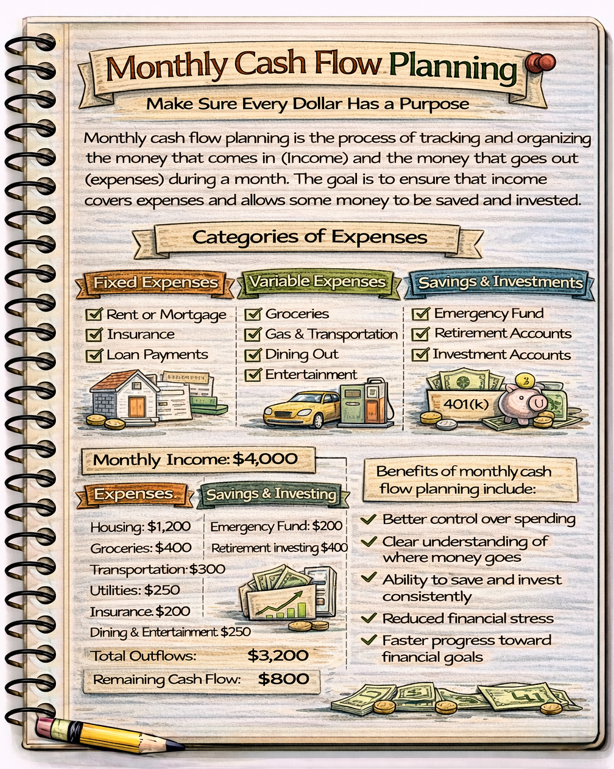
Monthly cash flow planning is the strategic coordination of income receipts and expense payments throughout the month—mapping when money arrives against when bills are due, ensuring sufficient funds available for each payment, and preventing overdrafts or late payments through deliberate timing management. Unlike simple budgeting that tracks total monthly income and expenses without considering timing, cash flow planning addresses the critical when dimension creating detailed calendar showing paycheck dates, bill due dates, and available balances preventing situations where adequate monthly income exists but poor timing creates temporary shortfalls causing overdraft fees, late charges, and financial stress.
This article is designed for anyone experiencing overdrafts despite adequate income, individuals living paycheck-to-paycheck through timing mismatches, or those wanting to eliminate financial stress from bill payment timing. You do not need financial expertise, complex software, or advanced knowledge to plan cash flow effectively—simple calendar listing paydays and bill due dates with basic arithmetic creates powerful coordination preventing costly timing errors, though method works best for those with relatively predictable income and expense timing enabling forward planning.
Understanding monthly cash flow planning matters because adequate total monthly income doesn’t prevent overdrafts when bills due before paychecks arrive, many people experience financial stress not from insufficient total income but from timing mismatches between receipts and payments, and lack of forward calendar awareness creates preventable crises requiring expensive solutions like payday loans or overdraft fees—while cash flow planners coordinate timing deliberately avoiding mismatches, maintain smooth financial operations through strategic scheduling, and eliminate timing-based stress achieving calm confidence impossible through total-only budgeting ignoring when money flows.
Educational disclaimer: This article provides general educational information about cash flow planning concepts. Individual circumstances, income timing, bill schedules, and financial situations vary significantly. Cash flow planning assumes relatively predictable income and expense timing—less applicable for highly irregular situations. This is not financial planning or professional advice. Consult qualified financial professionals for personalized guidance.
Understanding Cash Flow Planning
What Is Cash Flow?
Core definition: The movement of money in and out of accounts over time, with timing being as critical as total amounts
Cash inflows (money in):
Paychecks (salary, wages)
Side income and freelance payments
Investment income (dividends, interest)
Bonuses and commissions
Tax refunds
Any money depositing to accounts
Cash outflows (money out):
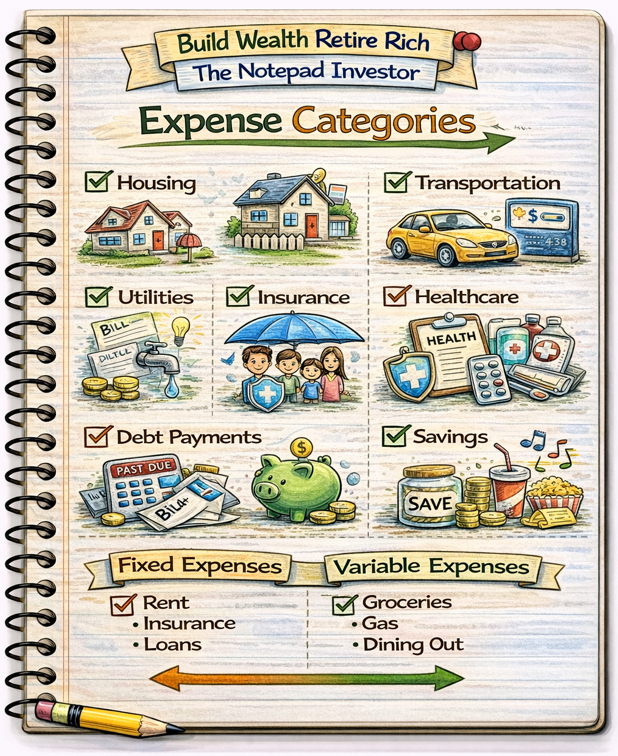
Fixed bills (rent, car payment, insurance)
Variable expenses (utilities, groceries, gas)
Debt payments
Savings transfers
Discretionary spending
Any money leaving accounts
Positive cash flow: More money coming in than going out during period
Negative cash flow: More money going out than coming in during period
Timing gaps: Period between when money needed and when money available
Why Timing Matters
The paycheck-to-paycheck timing trap:
Example scenario:
Monthly income: $4,000 (paid on 1st and 15th, $2,000 each)
Monthly expenses: $3,800 (plenty of income to cover)
Bill schedule: Rent $1,200 due 5th, Car $350 due 8th, Insurance $200 due 10th, Utilities $150 due 12th
Problem: Total bills due 5th-12th = $1,900, but only $2,000 available from first paycheck
After rent and bills: $100 remaining until 15th (two weeks away)
Need groceries, gas, other necessities = overdrafts despite adequate monthly income
The overdraft despite positive budget:
Total monthly income exceeds expenses—should work fine
But timing mismatch creates temporary shortfalls
Overdraft fees ($35 each) compound problem
Stress and scrambling despite being “on budget” overall
Cash Flow vs Budgeting
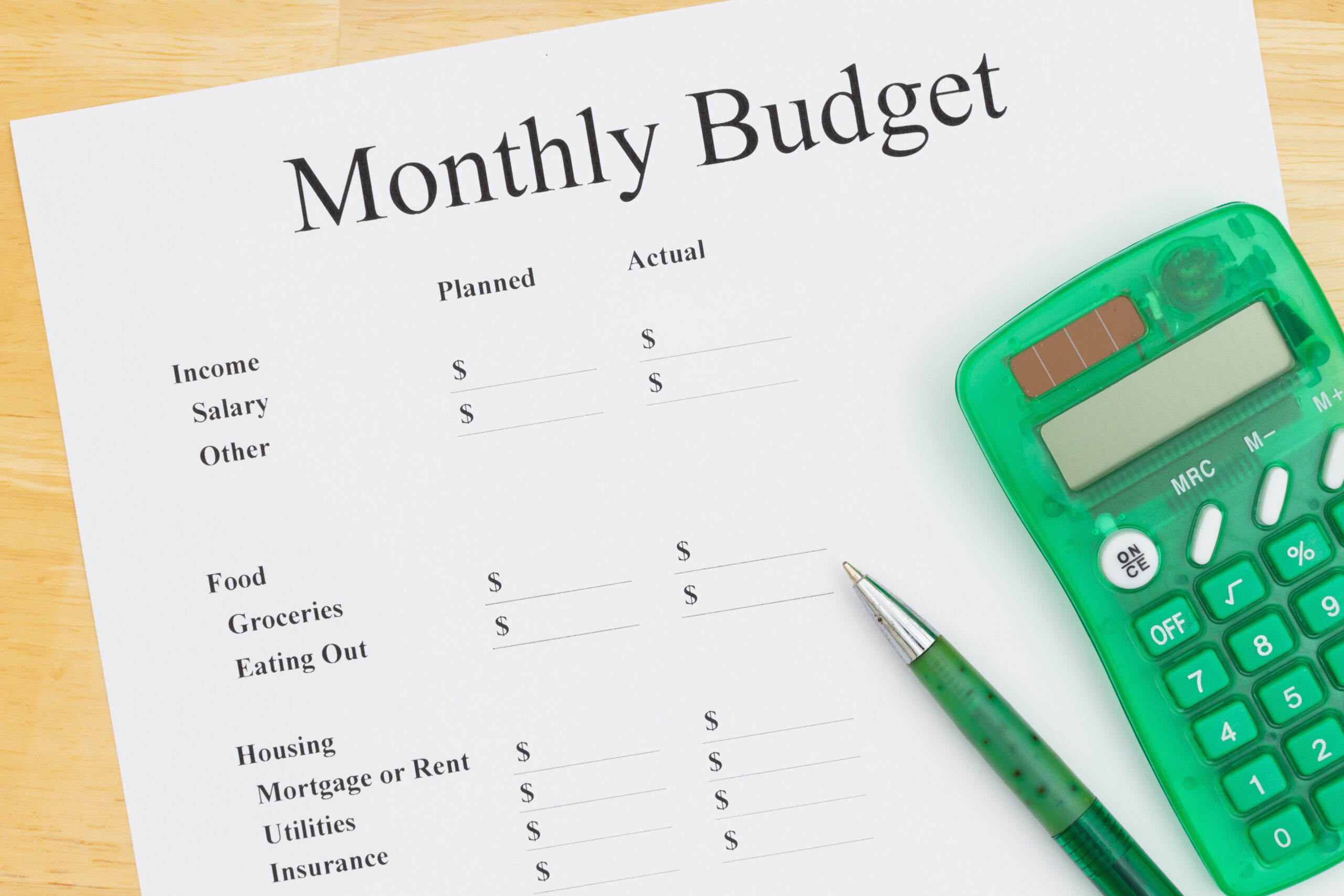
Budget (what and how much):
Income: $4,000
Rent: $1,200
Food: $500
Transportation: $400
Etc.
Totals match—budget balanced
Cash flow (when):
March 1: Receive $2,000
March 5: Pay rent $1,200 (balance $800)
March 8-14: Pay other bills $700 (balance $100)
March 15: Receive $2,000 (balance $2,100)
March 16-31: Remaining expenses
Integration: Budget tells you what to spend, cash flow tells you when you can spend it
Advertisement
Creating a Monthly Cash Flow Plan
Step 1: List All Income and Dates
Create income calendar:
Example:
March 1: Paycheck $2,000
March 15: Paycheck $2,000
March 20: Freelance payment $500 (estimated)
Total monthly income: $4,500
For irregular income:
Use conservative estimates (lower end of typical range)
Note estimated/uncertain amounts differently
Plan primary expenses around guaranteed income only
Step 2: List All Expenses and Due Dates
Fixed bills with specific due dates:
March 1: Rent $1,200
March 5: Car payment $350
March 10: Insurance $200
March 15: Credit card minimum $100
March 20: Student loan $250
March 25: Phone bill $85
Variable expenses (estimate timing):
Groceries: $125 weekly (roughly March 7, 14, 21, 28)
Gas: $80 every 2 weeks (March 10, 24)
Utilities: $150 (due March 12)
Discretionary spending (distribute):
Dining out: $200 total (allocate $50 per week)
Entertainment: $100 total (spread throughout month)
Step 3: Create Cash Flow Calendar
Month-at-a-glance format:
March 2026 Cash Flow Plan:
Week 1 (March 1-7):
3/1: Income $2,000 | Starting balance: $200 | New balance: $2,200
3/1: Rent -$1,200 | Balance: $1,000
3/5: Car payment -$350 | Balance: $650
3/7: Groceries -$125 | Balance: $525
Week 2 (March 8-14):
3/10: Insurance -$200 | Balance: $325
3/10: Gas -$80 | Balance: $245
3/12: Utilities -$150 | Balance: $95
3/14: Groceries -$125 | Balance: -$30 ⚠️ PROBLEM IDENTIFIED
Week 3 (March 15-21):
3/15: Income $2,000 | Balance: $1,970
3/15: Credit card -$100 | Balance: $1,870
3/20: Student loan -$250 | Balance: $1,620
3/20: Freelance income $500 | Balance: $2,120
3/21: Groceries -$125 | Balance: $1,995
Week 4 (March 22-31):
3/24: Gas -$80 | Balance: $1,915
3/25: Phone -$85 | Balance: $1,830
3/28: Groceries -$125 | Balance: $1,705
3/31: End of month carryover | Balance: $1,705
Analysis: Identified negative balance week 2—need to adjust timing or build buffer
Step 4: Identify and Fix Timing Gaps
Problem identified: Week 2 goes negative by $30
Solutions:
Option 1: Adjust bill due dates
Call insurance company requesting due date change from 10th to 20th
Spreads expenses more evenly across pay periods
Many companies accommodate reasonable due date requests
Option 2: Build buffer in checking
Temporarily reduce discretionary spending or savings
Build $500-1,000 cushion in checking account
Prevents timing gaps from causing overdrafts
Once established, maintain as minimum balance
Option 3: Reduce variable expenses in tight weeks
Delay 3/14 grocery trip to 3/16 (after paycheck)
Or reduce 3/7 and 3/14 groceries to $100 each, shop larger 3/21
Strategic timing of controllable expenses around fixed obligations
Option 4: Split automatic savings between paychecks
If automatically saving $500 monthly all on 1st, creates tighter first half
Split to $250 on 1st and $250 on 15th balancing cash availability
Step 5: Monitor and Adjust Weekly
Weekly check-in process:
Sunday or Monday: Review upcoming week’s planned cash flow
Compare actual balance to planned balance
Identify any discrepancies or upcoming tight periods
Adjust variable spending if needed
End-of-month review:
Compare actual cash flow to plan
Note where predictions were off
Adjust next month’s plan based on learnings
Improve accuracy over time
Common Cash Flow Challenges
Challenge 1: Bill Stacking (Multiple Bills Due Same Week)
Problem:
Rent, car payment, and insurance all due first week of month
$1,750 total bills before first paycheck covers them
Creates tight second half of previous month
Solutions:
Stagger due dates: Request companies move payment dates spreading across month
Build buffer: Maintain balance covering largest bill cluster
Pay early strategically: If financially ahead, pay next month’s clustered bills early spreading workload
Challenge 2: Bi-Weekly Pay with Monthly Bills
Problem:
Paid every 2 weeks (26 paychecks annually)
Bills monthly (12 payment cycles annually)
Some months get 2 paychecks, some get 3 (2 months per year)
Payday dates shift relative to bill due dates monthly
Solutions:
Budget based on 2 paychecks: Plan each month assuming 2 paychecks only
Treat 3rd paycheck as bonus: Use extra paychecks for savings, debt payoff, buffer building
Create detailed annual calendar: Map all 26 paychecks against 12 months identifying potential tight periods
Build 1-month buffer: Eventually live on previous month’s income eliminating timing stress completely
Challenge 3: Irregular Income
Problem:
Freelance, commission, or seasonal income varies monthly
Can’t predict exact amounts or timing
Fixed bills still due regardless of income receipt
Solutions:
Conservative baseline planning: Plan bills around minimum expected monthly income only
Tier 2 ($4,500): All bills, normal discretionary, some savings
Tier 3 ($6,000): Everything plus aggressive savings/debt payoff
Flexible execution: Adjust spending month-to-month based on actual income while ensuring essentials always covered
Cash Flow Planning Tools
Spreadsheet Template
Simple cash flow tracker:
Column A: Date
Column B: Description (paycheck, bill name)
Column C: Income (if applicable)
Column D: Expense (if applicable)
Column E: Balance (running total)
Formula in Column E: Previous balance + Income – Expense
Benefit: See projected balance for every day of month
Calendar-Based Planning
Physical or digital calendar:
Mark payday dates in green
Mark bill due dates in red with amounts
Visual overview of cash flow peaks and valleys
Easy to spot potential problem weeks
Budgeting Apps with Cash Flow Features
YNAB (You Need A Budget):
Age of Money metric (measures cash flow buffer)
Category-based budgeting with timing awareness
Simplifi by Quicken:
Cash flow projection feature
Alerts for upcoming low balances
Monarch Money:
Cash flow dashboard
Income vs expense timing visualization
Bank Tools
Low balance alerts:
Set notification when balance drops below threshold ($500)
Warns of potential timing issues before overdraft
Transaction scheduling:
Some banks show pending scheduled payments
Available balance vs actual balance visibility
Why Monthly Cash Flow Planning Matters
Without cash flow planning, adequate total monthly income doesn’t prevent overdrafts when timing mismatches create temporary shortfalls, many people experience preventable financial stress from bills due before paychecks arrive despite having sufficient funds overall, and lack of forward timing awareness leads to costly overdraft fees, late payment penalties, and constant scrambling—while cash flow planners coordinate receipts and payments deliberately avoiding timing gaps, maintain smooth operations through strategic due date management, and achieve financial calm impossible through total-only budgeting ignoring critical when dimension of money management.
Understanding and implementing monthly cash flow planning enables individuals to:
Eliminate overdraft fees through strategic timing coordination
Reduce financial stress by preventing paycheck-to-paycheck timing gaps
Optimize bill due dates creating balanced cash flow across pay periods
Identify and fix timing problems before they cause crises
Achieve financial calm and control impossible through timing-blind budgeting
Monthly cash flow planning transforms timing chaos into coordinated smooth operations eliminating preventable crises through forward calendar awareness and strategic scheduling.
Advertisement
Reserved space for in-content ad
Common Misunderstandings
Many people assume having adequate total monthly income eliminates need for cash flow planning since money eventually covers expenses. In reality, timing gaps between when bills due and when paychecks arrive create temporary shortfalls causing overdrafts despite sufficient monthly totals, proving timing coordination as critical as amount adequacy for smooth financial operations requiring both budgeting and cash flow planning together.
Another common misconception is that cash flow planning only matters for those living paycheck-to-paycheck making it irrelevant for higher earners with surplus. In practice, anyone can experience timing mismatches—someone earning $150,000 with all bills due early month and paychecks mid-month faces identical timing gaps as someone earning $40,000, proving principle applies universally across income levels when payment timing misaligned with receipt timing regardless of absolute amounts.
Some believe building one-month buffer solves all cash flow issues permanently eliminating need for ongoing planning. However, buffer provides cushion not automatic optimization—without continued awareness, spending can drift consuming buffer requiring rebuilding, and life changes alter timing patterns requiring planning updates, proving buffer helps tremendously but doesn’t eliminate value of ongoing cash flow coordination and awareness.
How Monthly Cash Flow Planning Fits Into Financial Success
Monthly cash flow planning provides essential timing coordination complementing budget amount planning, prevents costly overdrafts and late fees through forward awareness and strategic scheduling, and eliminates timing-based financial stress enabling calm confident money management impossible when considering totals without timing, making cash flow planning critical operational component of complete financial system working alongside budgeting and savings strategies.
For example, two people both earn $4,000 monthly with identical $3,800 expenses and budgets—both should succeed financially. Person A budgets carefully tracking totals but ignores timing—rent $1,200 due 1st, major bills totaling $1,400 due 5th-10th, receives paychecks 15th and 30th ($2,000 each). Month after month: Scrambles paying rent from previous month’s remainder (barely works), bills early month create repeated overdrafts (3-4 monthly at $35 each = $105-140 fees), constant stress wondering if money available, occasionally pays bills late incurring $25-40 penalties. Annual cost: $1,500+ in overdraft fees, $300+ in late fees, chronic anxiety despite adequate income. Person B implements cash flow planning—creates monthly calendar showing all paydays and bills, identifies timing gap in early month, requests insurance company move due date from 8th to 20th balancing expense timing across pay periods, builds $800 buffer over 3 months providing cushion, reviews weekly ensuring coordination. Result: Zero overdrafts (saves $1,500+ annually), zero late fees (saves $300+ annually), calm confidence knowing timing coordinated, same budget as Person A but dramatically better execution. Difference: Person B added timing dimension to amount budgeting creating smooth operations impossible for Person A focusing only on totals.
Monthly cash flow planning separates smooth operators from stressed scramblers through timing coordination preventing crises predictable through forward calendar awareness but invisible without deliberate coordination planning.
Recent Updates and Trends
In recent years, earned wage access programs have emerged—apps like Earnin and Dave allowing workers accessing earned wages before payday, addressing cash flow gaps though potentially creating dependency and fees requiring careful evaluation versus traditional cash flow planning solving root cause.
Banking innovation has helped—real-time payment systems and instant transfers between accounts enabling faster correction of timing mismatches versus previous 2-3 day delays exacerbating gaps, though instant access also enables unconscious spending requiring continued discipline.
Subscription economy has complicated cash flow—dozens of small recurring charges spread throughout month creating unpredictable daily cash flow versus historical larger monthly bills enabling simpler planning, requiring more frequent monitoring and awareness preventing surprise deductions.
Gig economy prevalence has increased irregular income situations—more people facing variable timing and amounts requiring sophisticated cash flow planning versus predictable biweekly paychecks enabling simpler coordination, making planning skills more critical than ever.
Fundamental cash flow planning principles remain timeless: timing coordination as critical as total amounts, forward calendar awareness prevents predictable crises, strategic bill scheduling balances cash availability across periods, and buffer building provides cushion smoothing natural variations—regardless of earned wage access, instant transfers, subscription complexity, or income irregularity, deliberate timing coordination through monthly planning produces superior financial operations versus timing-blind approaches focusing solely on totals.
3 Things You Can Do Today
Ready to implement cash flow planning? Here are three simple steps you can take right now:
1. Create next month’s cash flow calendar listing all paydays and bill due dates – Get calendar or open spreadsheet for next month. List every payday with amount and date. List every bill with amount and due date—rent, car, insurance, utilities, subscriptions, loan payments, everything. Include estimated variable expenses like groceries distributed weekly. Calculate running balance after each transaction showing daily projected balance throughout month. Takes 30-45 minutes creating complete visibility. This reveals timing gaps immediately—days when balance goes negative despite adequate monthly income identifying problems before they occur.
2. Identify your tightest cash flow week and create solution – Review cash flow calendar from step 1. Which week has lowest projected balance or goes negative? This is your problem week. Solutions: (1) Call 1-2 companies whose bills due that week requesting due date changes to spread more evenly (many accommodate), (2) Delay controllable expenses (groceries, gas fill-up) to after next paycheck if possible, (3) If repeatedly tight, commit to building $500-1,000 buffer over next 3 months preventing timing stress. Implement one solution this week preventing next month’s crisis. Takes 15-30 minutes identifying and addressing timing gap.
3. Set up weekly 10-minute cash flow review ritual – Choose day (recommend Sunday or Monday) and time for weekly check-in. Add recurring calendar reminder: “Cash flow check.” Each week spend 10 minutes: Review current balance, compare to plan, check upcoming week’s bills and paydays, ensure sufficient funds available, adjust variable spending if needed. This weekly touchpoint catches problems early preventing crisis scrambling. First month requires more attention establishing rhythm, becomes quick routine by month 2-3. Takes 10 minutes weekly preventing hours of stress and costly mistakes. Consistency matters more than perfection—weekly awareness dramatically improves coordination.
These actions create functional cash flow planning system within one day—complete monthly calendar showing timing, identified solution for tightest period, and weekly review ritual maintaining coordination—eliminating timing-based overdrafts and stress starting immediately.
Advertisement
Reserved space for in-content ad
Quick FAQ
What’s the difference between budgeting and cash flow planning?
Budgeting = totals and categories (income $4,000, rent $1,200, food $500). Cash flow planning = timing (rent due 5th, paycheck arrives 15th, balance after bills). Budget tells you WHAT to spend and HOW MUCH. Cash flow tells you WHEN you can spend it based on WHEN money arrives. Need both: Budget for amounts, cash flow for timing. Many people budget well but experience overdrafts from poor timing—adequate monthly income but bills due before paychecks arrive. Cash flow planning prevents this.
How much buffer should I maintain in my checking account?
Minimum: $500-1,000 preventing most timing gaps. Comfortable: One month’s expenses ($3,000-5,000 typical) eliminating all timing stress. Building process: Start with $500 goal (achievable in 2-3 months), increase to $1,000 over 6 months, eventually build to full month over 1-2 years. Buffer amount depends on income regularity—irregular income needs larger buffer (1-2 months), stable biweekly paycheck needs less (2-4 weeks). Don’t let perfect be enemy of good—$500 buffer dramatically better than $0 even if $3,000 ideal.
Can I do cash flow planning with irregular freelance income?
Yes but requires adaptation: (1) Conservative planning—base bills on minimum expected monthly income only, (2) Larger buffer essential—maintain 1-2 months expenses in checking smoothing variability, (3) Tier spending—pay essentials when income arrives, discretionary only after essentials secured, (4) Annual calendar—track typical income patterns identifying predictable slow/strong periods planning accordingly. More challenging than regular paycheck but more important—irregular income makes timing coordination critical not optional. Many freelancers successfully use separate account depositing all income then transferring fixed monthly “salary” creating artificial stability.
What if my bills are all due around the same time creating cash flow problems?
Three solutions: (1) Request due date changes—call companies asking to move payment dates spreading across month, most accommodate reasonable requests, (2) Build buffer—one month expenses in checking eliminates timing sensitivity, pay bills whenever without checking paycheck date, (3) Strategic payment timing—if financially ahead, pay next month’s clustered bills early from previous month spreading load. Best approach: Combine all three—request date changes for better distribution, maintain buffer providing cushion, pay strategically when able. Bills clustering common problem with simple solutions.
How do I handle annual or semi-annual bills in monthly cash flow planning?
Sinking funds: Calculate annual cost ÷ 12 = monthly amount. Example: $1,200 annual insurance ÷ 12 = $100 monthly. Include $100 in every month’s cash flow plan as regular “bill” transferring to dedicated savings. When annual bill arrives, pay from accumulated sinking fund not disrupting monthly cash flow. Alternative: Request monthly payment plans if available (some companies offer). Key: Convert irregular large bills to consistent monthly amounts preventing crisis months when lump sums due. Track sinking funds separately ensuring money reserved when needed.
Is cash flow planning worth the time if I’m not living paycheck-to-paycheck?
Yes—prevents unnecessary fees and stress at any income level. Someone earning $150,000 with poor timing still experiences overdrafts if all bills due before paycheck arrives. Cash flow planning provides: (1) Overdraft prevention (saves $35 per occurrence), (2) Late fee avoidance (saves $25-40 each), (3) Stress reduction (knowing timing coordinated), (4) Strategic timing optimization (paying bills when most advantageous). Time investment: 30-45 minutes monthly setup, 10 minutes weekly review. Payoff: $200-500+ annual fee savings, eliminated timing anxiety, smooth operations. Worth it regardless of income level or financial position.
This article is provided for educational purposes only and does not constitute financial planning or professional advice. Cash flow planning strategies assume relatively predictable income and expense timing—less applicable for highly irregular situations. Individual circumstances vary significantly—appropriate buffer amounts, timing coordination strategies, and planning approaches differ by situation. Examples use simplified scenarios—actual cash flows more complex. Bank features, app capabilities, and bill payment flexibility vary by institution and provider. Building buffers assumes available income margin—those unable to meet basic needs require different interventions. Consult qualified financial planners and advisors for personalized guidance. Advertisements or sponsored content may appear within or alongside this content. All information is presented independently.
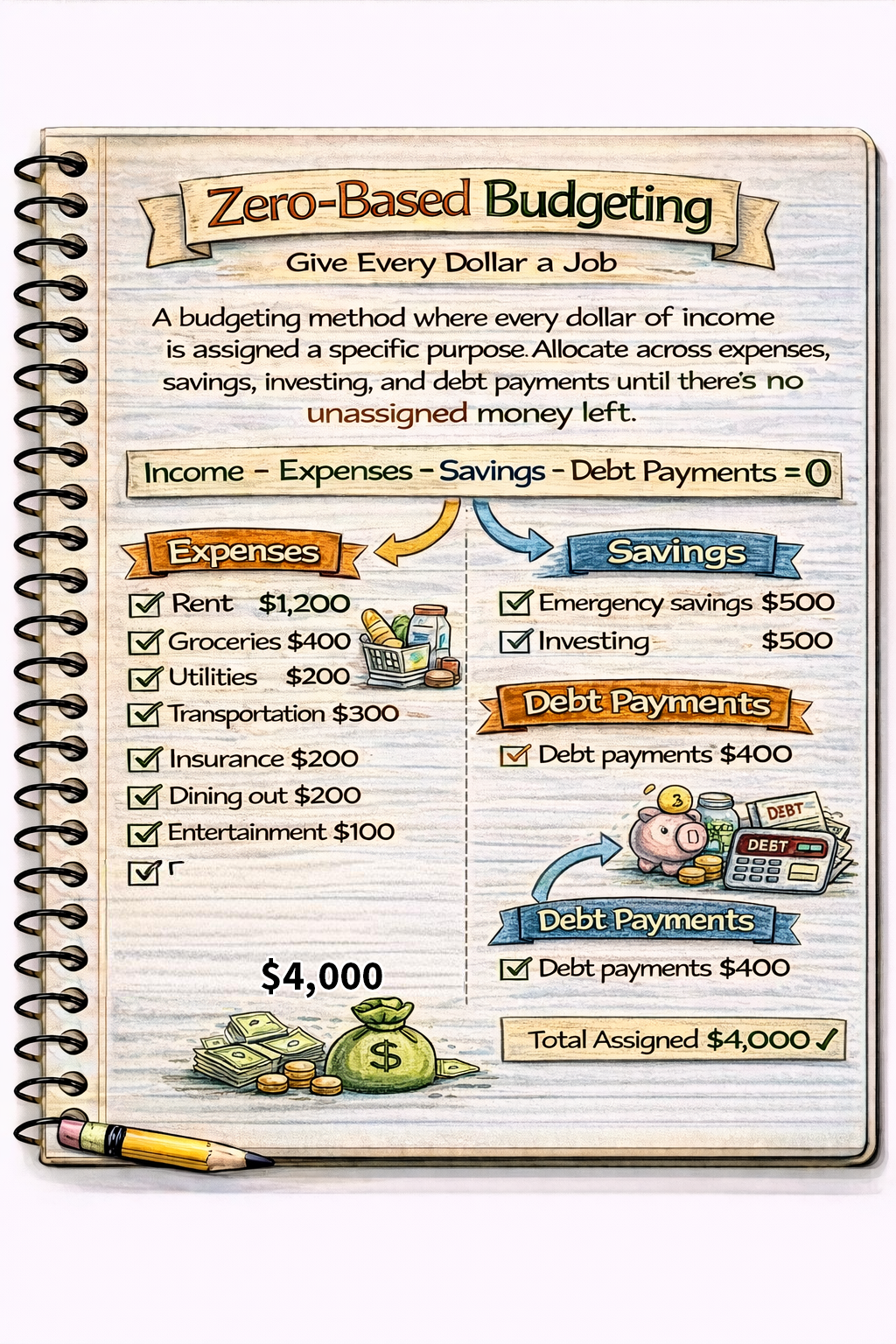
Zero-based budgeting is a budgeting method where every dollar of income is assigned a specific purpose—spending, saving, or debt repayment—until income minus all allocations equals exactly zero, ensuring no money remains unallocated at month’s end. Unlike traditional budgeting where leftover money sits in checking accounts getting spent unconsciously, zero-based budgeting gives every single dollar a job before the month begins, whether allocated to bills, groceries, savings, entertainment, or other categories, creating intentional complete allocation preventing unconscious spending leaks and maximizing money working toward priorities.
This article is designed for anyone seeking maximum budgeting control, individuals losing track of money despite budgeting efforts, or those wanting intentional allocation of every dollar earned. You do not need accounting expertise, complex software, or mathematical skills to implement zero-based budgeting—simple income-minus-expenses calculation until reaching exactly zero creates functional framework enabling complete money control regardless of income level, though method works best for detail-oriented individuals comfortable with active monthly planning.
Understanding zero-based budgeting matters because traditional budgets often leave money unallocated creating unconscious spending on forgotten items, people with “leftover” money frequently wonder where it went despite budgeting other categories, and lack of complete intentional allocation prevents maximizing money working toward goals—while zero-based budgeters maintain total control through every-dollar assignment, eliminate unconscious spending completely, and ensure maximum allocation toward priorities through comprehensive intentional planning impossible with partial budgeting approaches.
Educational disclaimer: This article provides general educational information about zero-based budgeting methodology. Individual circumstances, income levels, expenses, and budgeting preferences vary significantly. Zero-based budgeting requires time investment and detail orientation—not suitable for everyone. This is not financial planning or professional advice. Consult qualified financial professionals for personalized guidance.
Understanding Zero-Based Budgeting
What Is Zero-Based Budgeting?
Core definition: Budgeting method where income minus all allocations equals exactly zero
The fundamental equation:
Income – (Expenses + Savings + Debt Payments) = $0
Or rearranged: Income = Expenses + Savings + Debt Payments
Every dollar gets assigned to a category until nothing remains
Key principle: Give every dollar a name and purpose before month begins
What “zero” means:
NOT: Spend everything leaving zero in accounts
INSTEAD: Allocate everything intentionally (including savings) leaving zero unassigned dollars
Example:
Income: $4,500
Rent: $1,200
Utilities: $180
Groceries: $450
Gas: $120
Dining out: $200
Entertainment: $150
Debt payments: $350
Emergency fund: $500
Retirement: $400
Misc/buffer: $100
Car insurance: $150
Phone: $85
Subscriptions: $65
Clothing: $50
Total allocated: $4,500
Remaining: $0
Every dollar assigned a job—no money floating unallocated
Zero-Based Budgeting vs Traditional Budgeting
Traditional budgeting:
Income: $4,500
Major categories budgeted: $3,800
Remaining “leftover”: $700
Leftover money often spent unconsciously or sits vaguely designated
Key difference: Complete intentional allocation vs partial budgeting with unassigned remainder
Origin and Philosophy
Business origins: Developed for corporate budgeting requiring departments to justify every dollar from zero each cycle rather than using previous budgets as baselines
Personal finance adaptation: Popularized by Dave Ramsey and YNAB (You Need A Budget) for individuals
Underlying philosophy:
Every dollar represents potential—earning potential, savings potential, enjoyment potential
Unconscious spending wastes potential through drift
Intentional allocation maximizes every dollar’s impact
Strategy: Temporarily minimal discretionary spending, maximum debt payoff, maintained small emergency fund contribution
Advertisement
Reserved space for in-content ad
Advanced Zero-Based Budgeting Concepts
Sinking Funds in Zero-Based Budgets
What are sinking funds: Monthly savings for irregular predictable expenses
Common sinking fund categories:
Car maintenance and repairs
Car insurance (if paid annually or semi-annually)
Holiday gifts
Vacation
Home maintenance
Property taxes (if not escrowed)
Annual subscriptions
Medical deductible
How to calculate:
Estimate annual cost for each category
Divide by 12 for monthly allocation
Include in zero-based budget as line item
Example sinking fund allocation:
Car maintenance: $1,200 annual ÷ 12 = $100 monthly
Holiday gifts: $600 annual ÷ 12 = $50 monthly
Vacation: $2,400 annual ÷ 12 = $200 monthly
Home repairs: $1,800 annual ÷ 12 = $150 monthly
Total sinking funds: $500 monthly allocated in budget
Benefit: Large irregular expenses don’t destroy budget when they occur—money already saved
Handling Variable Income
Priority-based budgeting approach:
Tier 1 (Essential – fund first):
Housing (rent/mortgage)
Utilities (basic levels)
Food (groceries)
Transportation (essential for work)
Insurance (health, required auto)
Tier 2 (Important – fund after essentials):
Minimum debt payments
Basic emergency fund contribution
Childcare if applicable
Tier 3 (Discretionary – fund if income allows):
Dining out
Entertainment
Upgraded versions of basics
Tier 4 (Goals – fund extra income):
Extra debt payments
Increased savings
Sinking funds
Implementation:
Low income month ($3,000): Fund Tier 1 + 2 only = $2,800, remaining $200 to Tier 3
Average month ($4,500): Fund Tiers 1-3 = $3,800, remaining $700 to Tier 4
High income month ($6,000): Fund all tiers fully plus extra to Tier 4 goals
Still zero-based: Every dollar allocated even when amounts vary—just allocated differently based on income level
Rolling With The Punches (Mid-Month Adjustments)
YNAB principle: Budget isn’t failed when reality differs from plan—adjust budget to match reality
Example scenario:
Budgeted groceries: $400
Actual spent week 1-2: $280
Unexpected medical expense: $150
Solution: Reduce remaining grocery budget to $120, reallocate $150 from dining out budget to medical
Result: Still zero-based, categories adjusted to reality
Key mindset: Budget is plan, not prison—adjust as needed while maintaining every-dollar allocation
Age of Money Concept
Definition: Average age of dollars in your accounts (how long ago you earned the money you’re spending today)
Goals:
New to budgeting: 0-10 days (spending money earned this pay period)
Building stability: 20-30 days (spending last month’s money)
Financial stability: 30+ days (living on previous month’s income)
Strong position: 60+ days
Benefit: Higher age of money = less paycheck-to-paycheck stress, easier to handle irregular income and timing mismatches
Advantages of Zero-Based Budgeting
Maximum Intentionality
Every single dollar assigned purpose before spending
No unconscious drift or forgotten allocations
Forces conscious trade-off decisions
Maximizes money working toward priorities
Eliminates “Where Did My Money Go?” Syndrome
Common problem: Budget major categories but lose track of $300-800 monthly
Zero-based solution: Those amounts explicitly allocated preventing disappearance
Complete account for every dollar
Flexibility Within Structure
Can reallocate between categories as needed
Adjustments maintain zero-based principle
Adapts to irregular income through priority-based allocation
Handles unexpected expenses through reallocation not budget failure
Proactive Planning
Budget created before month begins, not reactively during month
Anticipates upcoming expenses through sinking funds
Enables strategic allocation toward goals
Reduces stress through preparedness
Accelerated Goal Achievement
Explicit allocation to savings, debt payoff, goals ensures progress
Prevents “I’ll save what’s left” failure (nothing left)
Pay yourself first integrated into every-dollar allocation
Disadvantages and Challenges
Time Investment
Initial setup: 2-4 hours creating detailed budget
Monthly planning: 1-2 hours before each month
Weekly tracking: 15-30 minutes reviewing balances
More intensive than 50/30/20 or automated approaches
Requires Detail Orientation
Must track spending consistently
Need comfort with numbers and categories
Overwhelming for some personalities preferring simplicity
Learning Curve
First 2-3 months require frequent adjustments
Finding realistic category amounts takes trial and error
Mindset shift from “leftover” to “every dollar assigned” takes practice
Potential for Obsessiveness
Some people become overly rigid
Can create stress if treated as inflexible law rather than flexible plan
Balance needed between intentionality and flexibility
May Be Overkill for High Earners
Someone earning $200,000 spending $80,000 may not need every-dollar precision
General awareness and automated savings may suffice
Time investment not worth marginal improvement for some
Why Zero-Based Budgeting Matters
Without complete intentional allocation, people budget major categories but lose track of hundreds monthly wondering where money went, leave “leftover” amounts floating unassigned getting spent unconsciously on forgotten items, and fail to maximize money working toward priorities through partial planning—while zero-based budgeters maintain total control through every-dollar assignment, eliminate all unconscious spending, and ensure maximum allocation toward goals through comprehensive intentional planning impossible with partial budgeting creating superior wealth-building outcomes.
Understanding and implementing zero-based budgeting enables individuals to:
Maintain complete control through intentional allocation of every dollar
Eliminate unconscious spending completely through comprehensive assignment
Maximize money working toward priorities through deliberate planning
Handle irregular income and expenses through flexible priority allocation
Accelerate goal achievement through explicit savings and debt allocations
Build wealth systematically through maximum intentional money management
Zero-based budgeting transforms partial budgeting into complete intentional allocation enabling maximum control and wealth building for dedicated practitioners.
Advertisement
Reserved space for in-content ad
Common Misunderstandings
Many people assume “zero-based budgeting” means spending all money leaving bank account at zero by month-end. In reality, zero refers to unallocated dollars not account balance—someone might allocate $2,000 to savings and $1,000 to emergency fund within their zero-based budget, maintaining substantial account balances while achieving zero unassigned dollars, proving method maximizes intentional saving not spending.
Another common misconception is that zero-based budgeting requires perfect accuracy with no mid-month adjustments allowed. In practice, budget serves as starting plan with regular adjustments expected as reality unfolds—overspending one category covered by reducing another maintaining every-dollar allocation, proving flexibility and adaptability are features not bugs when implemented properly.
Some believe zero-based budgeting only works for people with consistent predictable incomes making irregular earners unsuitable. However, zero-based budgeting adapts excellently to variable income through priority-based allocation—allocating dollars as they arrive toward tiered categories based on actual received amounts, proving method works across all income patterns when approached appropriately.
How Zero-Based Budgeting Fits Into Financial Success
Zero-based budgeting provides maximum intentional control enabling comprehensive allocation of every dollar toward priorities, eliminates unconscious spending completely through systematic assignment, and accelerates goal achievement through explicit savings and debt payoff allocations, creating financial management system producing superior wealth-building outcomes for dedicated practitioners willing to invest time in detailed planning and tracking.
For example, two people earn $4,500 monthly both attempting to save and pay down debt. Person A uses traditional budgeting—budgets major categories ($3,800), has vague plan for remaining $700 (“save some, pay extra on debt”), ends each month finding $200-300 disappeared to forgotten spending (coffee, impulse purchases, small items), saves $250-400 sporadically. After year: saved $3,600 inconsistently, paid extra $1,200 toward debt. Person B implements zero-based budgeting—allocates all $4,500 explicitly including $500 emergency fund, $250 extra debt payment, $150 sinking funds, $100 miscellaneous buffer, tracks spending weekly adjusting as needed. Every dollar assigned prevents unconscious leaks. After year: saved $6,000 emergency fund ($500 × 12), paid extra $3,000 debt ($250 × 12), built $1,800 sinking funds. Total: Person B achieved $10,800 in savings/debt progress versus Person A’s $4,800—125% better outcome through complete intentional allocation versus partial budgeting losing $300+ monthly to unconscious drift.
Zero-based budgeting separates maximum wealth builders from partial budgeters through every-dollar allocation eliminating unconscious leaks and maximizing goal progress impossible with incomplete planning.
Recent Updates and Trends
In recent years, YNAB (You Need A Budget) has popularized zero-based budgeting principles reaching millions through app and methodology emphasizing every-dollar assignment, though subscription cost ($99 annually) creates barrier for some versus free alternatives.
Envelope system evolution has modernized—traditional cash envelopes being replaced by digital envelope systems in apps maintaining zero-based allocation without physical cash inconvenience, making method accessible to cashless younger generations.
Subscription fatigue has highlighted zero-based budgeting value—explicit allocation reveals forgotten subscriptions totaling $100-300+ monthly for many people, enabling cancellation through visibility created by every-line-item assignment.
Irregular income prevalence has increased zero-based budgeting relevance—gig economy and freelance work creating variable income situations where priority-based zero-based allocation provides superior control versus fixed-amount budgets failing during low months.
Fundamental zero-based budgeting principles remain timeless: every dollar assigned specific purpose before month begins, complete intentional allocation prevents unconscious spending, flexibility within structure through mid-month reallocation, and proactive planning beats reactive hoping—regardless of app availability, payment method trends, or income patterns, systematic every-dollar assignment produces superior financial outcomes versus partial budgeting approaches leaving money unallocated and vulnerable to unconscious drift.
3 Things You Can Do Today
Ready to try zero-based budgeting? Here are three simple steps you can take right now:
1. Calculate your budgetable income and create starting number – Review last month’s income: all after-tax deposits to accounts. If you contribute to 401(k) pre-tax, add that back (it’s allocated to savings already). This total is your starting number to allocate to zero. Example: $3,800 take-home + $400 401(k) = $4,200 to allocate. Write this number at top of page—this is what you’re allocating to exactly zero. If income varies, use conservative estimate (lowest typical month or 6-month average). Takes 5 minutes establishing foundation.
2. List every expense category and assign dollar amount to each – Write comprehensive list: housing, utilities, groceries, gas, insurance, debt payments, dining out, entertainment, subscriptions, savings, emergency fund, sinking funds, clothing, personal care, miscellaneous—everything. Assign realistic dollar amount to each based on recent months. Include savings and debt payoff categories (not just spending). Add buffer/miscellaneous category ($50-150) for unexpected small items. Total all categories. Takes 30-45 minutes creating complete allocation.
3. Adjust allocations until total exactly matches income – Compare category total to income from step 1. Over income? Reduce variable categories (dining out, entertainment, shopping) until balanced. Under income? Don’t leave money unallocated—add to savings, emergency fund, debt payoff, or sinking funds until reaching exactly zero remaining. Final check: Income minus all allocations = $0. This is your zero-based budget. Takes 15-20 minutes achieving balance. Implementation next: track spending this month against allocations adjusting as reality unfolds.
These actions create functional zero-based budget within 60-90 minutes establishing every-dollar allocation framework enabling maximum intentional control starting immediately.
Advertisement
Reserved space for in-content ad
Quick FAQ
What does “zero” mean in zero-based budgeting?
Zero means zero dollars left unallocated, NOT zero dollars in bank account. Formula: Income – (All Expenses + Savings + Debt Payments) = $0. Every dollar gets assigned job (spending, saving, debt payoff) until none remain unallocated. Example: $4,000 income allocated $2,500 expenses + $800 savings + $700 debt = $0 unassigned (but $800 sitting in savings account). Zero-based maximizes intentional saving, not spending.
How is zero-based budgeting different from the 50/30/20 rule?
50/30/20 uses percentage allocations to three broad categories (needs, wants, savings). Zero-based budgeting uses detailed line-item categories allocating every specific dollar. 50/30/20 simpler (less tracking, broader categories). Zero-based more detailed (every expense its own line, complete allocation). Can combine: Use 50/30/20 percentages as guide, but allocate every dollar within those buckets zero-based style. Choose based on preference for simplicity (50/30/20) vs maximum control (zero-based).
What if I overspend in one category—does that ruin my zero-based budget?
No—adjust budget covering overspending by reducing another category. Example: Overspent groceries by $50, reduce dining out by $50. This maintains zero-based allocation—every dollar still assigned, just reassigned mid-month based on reality. “Rolling with the punches”—budget is plan not prison. Flexibility within structure is feature allowing real-life adjustment while maintaining every-dollar accountability. Only “fails” if you ignore overspending allowing unconscious drift.
Do I need YNAB or special software for zero-based budgeting?
No—zero-based budgeting is methodology, not software requirement. Can implement with: Spreadsheet (Google Sheets or Excel), EveryDollar app (free basic version), Paper and pen, YNAB ($99 annually, designed specifically for zero-based). Software makes tracking easier but isn’t required. Start with free spreadsheet, upgrade to paid app only if needed. Methodology matters more than tool.
How long does zero-based budgeting take each month?
Initial setup: 2-4 hours first month creating categories and establishing amounts. Ongoing monthly: 1-2 hours before month creating next month’s budget. Weekly tracking: 15-30 minutes reviewing balances and adjusting if needed. Total: 3-4 hours monthly after initial setup. More time than 50/30/20 but produces maximum control. Efficiency improves after 3-4 months as categories stabilize and process becomes routine. Worth time investment if “where did my money go?” is recurring problem.
Can zero-based budgeting work with irregular or variable income?
Yes—use priority-based allocation. Create tiered categories: Tier 1 essentials (housing, utilities, basic food), Tier 2 important (debt minimums, basic savings), Tier 3 discretionary (dining out, entertainment), Tier 4 goals (extra debt/savings). Low month: Allocate dollars as received to Tier 1 first, then 2, stop when money gone. High month: Allocate through all tiers plus extra to Tier 4. Every dollar still gets assigned—just allocated differently each month based on available amount. Maintains zero-based principle with flexible amounts.
This article is provided for educational purposes only and does not constitute financial planning or budgeting advice. Zero-based budgeting methodology requires time investment and detail orientation—suitability varies by individual preferences and circumstances. App and software mentions (YNAB, EveryDollar, etc.) are informational—no endorsements implied, costs and features change. Examples are illustrative using simplified scenarios—actual budgets vary significantly. Success requires consistent implementation and tracking. Consult qualified financial planners and advisors for personalized guidance. Advertisements or sponsored content may appear within or alongside this content. All information is presented independently.
Expense categories are groupings of similar spending types used to organize, track, and analyze money flowing out of accounts—ranging from broad classifications like housing, transportation, and food to detailed subcategories such as mortgage, car insurance, and groceries. Unlike recording transactions without organization creating chaotic unanalyzable data, systematic categorization reveals spending patterns, identifies waste, enables budget creation, and facilitates informed financial decisions through clear visibility into where money goes across major life areas.
This article is designed for anyone creating budgets, individuals tracking expenses, or those wanting to understand spending patterns and optimize allocation. You do not need accounting expertise, complex software, or financial backgrounds to categorize expenses effectively—simple groupings transforming transaction lists into actionable insights work at all income levels and financial situations, with categorization complexity scaling from basic 10-category systems to detailed 50+ category breakdowns based on personal preferences and needs.
Understanding expense categories matters because uncategorized spending prevents pattern recognition leaving waste invisible, vague expense awareness creates budgets missing major categories causing systematic overspending, and lack of organized spending data makes financial optimization impossible through guesswork rather than data-driven decisions—while systematic categorizers identify unconscious leaks, optimize allocation across priorities, create accurate budgets, and build wealth through informed spending management impossible with chaotic recordkeeping.
Educational disclaimer: This article provides general educational information about expense categorization systems. Individual spending patterns, priorities, and budgeting needs vary significantly. Recommended categories are starting frameworks—customize to personal situations. This is not financial planning or accounting advice. Consult qualified financial professionals for personalized guidance.
Understanding Expense Categories
What Are Expense Categories?
Core definition: Groupings of similar expenses enabling organized tracking, analysis, and budgeting
Purpose:
Transform transaction lists into meaningful insights
Reveal spending patterns across life areas
Enable budget creation with realistic allocations
Identify optimization opportunities through category analysis
Facilitate spending comparisons over time
Support financial goal planning and prioritization
Basic categorization principle: Group similar expenses together enabling aggregate analysis
Solution: Calculate annual periodic expenses, divide by 12, include in monthly budget categories
Why Expense Categories Matter
Without systematic expense categorization, people track transactions producing unusable data piles revealing no patterns, create budgets missing major spending areas causing systematic failures, and attempt financial optimization through guesswork rather than data-driven decisions—while categorizers transform transaction chaos into organized insights enabling waste identification, budget accuracy, informed allocation decisions, and systematic wealth building through visibility impossible with uncategorized spending.
Understanding and implementing expense categories enables individuals to:
Identify spending patterns and unconscious waste through category analysis
Create accurate budgets based on historical category spending
Make informed optimization decisions using category-level data
Track progress toward spending reduction or reallocation goals
Compare spending to benchmarks and adjust toward targets
Build wealth systematically through organized intentional allocation
Expense categorization transforms transaction lists into actionable financial intelligence enabling informed decisions impossible through uncategorized chaos.
Advertisement
Reserved space for in-content ad
Common Misunderstandings
Many people assume expense categories must follow standard lists exactly matching budgeting advice or app defaults. In reality, effective categorization reflects YOUR actual spending patterns and priorities—someone without car creates public transit category instead of auto expenses, frequent traveler splits travel from entertainment, chronic condition requires detailed medical tracking, proving customization matters more than standard templates.
Another common misconception is that categorization requires perfect precision with every transaction. In practice, general accuracy beats perfect precision—groceries rounded to nearest $10, mixed purchases assigned to primary category, occasional miscategorization acceptable if overall patterns clear, proving 90% accuracy with consistent effort produces better results than pursuing 100% precision causing burnout and abandonment.
Some believe once categories established they remain fixed permanently. However, category systems evolve with life changes—new baby adds childcare and baby supplies categories, job change eliminates commute expenses, home purchase adds maintenance and HOA categories, proving dynamic adjustment represents healthy adaptation not failure of original system.
How Expense Categories Fit Into Financial Success
Expense categorization provides essential data foundation enabling all spending optimization—reveals where money actually goes versus assumptions, identifies high-impact areas for reduction or reallocation, creates baseline for budgets and goals, and enables measurement of progress through category-level tracking transforming vague spending awareness into precise actionable insights driving systematic wealth building.
For example, two people earn $70,000 annually spending $65,000 with minimal savings. Person A tracks expenses without categories—has transaction list showing every purchase but no patterns visible, attempts budget cuts randomly, uncertain which categories contain waste. After year: saved $2,000 through unfocused sporadic efforts, frustrated by lack of progress. Person B categorizes all spending into 25 categories—discovers dining out $6,500 annually (18% of spending vs 8% typical), subscriptions $1,800 (many forgotten), utilities $5,400 (high for size). Takes targeted actions: reduces dining 40% saving $2,600, cancels unused subscriptions saving $900, weatherizes home saving $600 utilities. Total: $4,100 annual savings from three targeted optimizations identified through category analysis. After year: Person B saved 2x more than Person A through data-driven decisions versus random guessing, with clear understanding of exact sources and sustainability.
Expense categorization separates informed optimizers from random guessers through organized data enabling targeted high-impact decisions impossible with transaction chaos.
Recent Updates and Trends
In recent years, AI-powered automatic categorization has improved dramatically—apps now accurately assign 80-90% of transactions correctly using merchant data and purchase patterns, reducing manual categorization burden significantly though occasional review still necessary.
Subscription tracking has become critical category—average household now carries 10-15 subscriptions totaling $200-500 monthly making subscription-specific tracking increasingly important for waste identification and reduction.
Gig economy has complicated categorization—people with multiple income streams need business expense categories previously unnecessary for W-2 employees, blending personal and business spending requiring clear separation for tax purposes.
Spending comparison tools have emerged—apps showing category spending versus national averages, age groups, or income levels providing benchmarks for optimization though individual circumstances vary making blind comparison problematic.
Fundamental categorization principles remain timeless: group similar expenses enabling pattern recognition, balance detail with simplicity avoiding overwhelming complexity, maintain consistency in assignment rules, customize to personal spending patterns, and use category data driving informed optimization decisions—regardless of automation advances, subscription proliferation, or benchmark availability, systematic organized categorization produces superior financial outcomes versus uncategorized transaction chaos.
3 Things You Can Do Today
Ready to implement expense categorization? Here are three simple steps you can take right now:
1. Review last month’s statements and list all transaction types – Pull last month’s bank and credit card statements. List every different type of expense appearing: rent, utilities, groceries, gas, restaurants, insurance, subscriptions, shopping, etc. This reveals natural categories based on YOUR actual spending. Most people discover 15-25 distinct expense types. This 30-minute exercise creates foundation for category system reflecting reality not theory.
2. Choose 20-30 categories matching your spending patterns – Use standard categories listed in article as starting point. Add categories for significant spending areas identified in step 1 (if spend on kids add childcare, if pets add pet category, if frequent travel add travel). Remove irrelevant categories (no car skip auto, no kids skip childcare). Write final list—this is your categorization system. Simple spreadsheet or budgeting app dropdown ensuring consistency.
3. Categorize last month’s expenses and calculate category totals – Go through last month’s transactions assigning each to a category from your list. Tally totals per category. Calculate percentages of income. Compare to typical percentages mentioned in article. This reveals: where money actually goes, which categories over/under spending, high-impact optimization opportunities. Takes 45-60 minutes first time, 15-20 minutes monthly ongoing. This single exercise often reveals $200-500 monthly unconscious waste enabling immediate targeted reduction.
These actions create categorization foundation transforming transaction lists into organized spending insights enabling data-driven optimization impossible through uncategorized chaos.
Advertisement
Reserved space for in-content ad
Quick FAQ
How many expense categories should I have?
Start with 20-30 categories covering major spending areas. Add detail where specific tracking needed (separate coffee shops from dining out if trying to reduce coffee spending). Remove categories not relevant to your life (no car = no auto categories). Sweet spot: Enough categories for meaningful insights, few enough for sustainable tracking. Too many (50+) overwhelms, too few (under 15) provides insufficient insight.
Should I use the same categories as budgeting apps suggest?
Start with app defaults, then customize. Most apps provide 30-50 standard categories—good starting point. However, modify based on YOUR spending: combine rarely-used categories, split frequently-used categories needing detail, rename for clarity. Your category system should reflect your actual spending patterns and tracking needs, not theoretical ideal person’s budget.
How do I categorize transactions with multiple items like Target or Amazon?
Two approaches: (1) Categorize by primary purchase—if 80% groceries call it groceries, (2) Split significant mixed purchases over $50-100 by approximate proportions—$150 Target purchase: $80 groceries, $40 household, $30 clothing. Don’t split every transaction (overwhelming), but split large mixed purchases for category accuracy. Choose one approach consistently.
What percentage of spending should each category represent?
General guidelines: Housing 25-35%, Transportation 10-20%, Food 10-15%, Healthcare 5-15%, Savings 15-20%+, Discretionary 15-25%. These vary by location (high cost-of-living increases housing), life stage (young adults less healthcare, families more), and goals (aggressive savers 30-50% to savings). Use as benchmarks not rigid rules—compare your percentages identifying significant deviations requiring investigation or justification.
How often should I review and update my categories?
Monthly: Review category totals, adjust next month’s budget allocations based on actuals. Quarterly: Analyze trends, ensure categorization still accurate, merge or split categories if needed. Annually: Major review coinciding with life changes—new job, move, family changes. Also update when: Miscellaneous exceeds 10% (suggests missing categories), new recurring expense type appears, goal focus changes requiring different tracking detail.
What if my spending doesn’t fit neatly into categories?
Create custom categories for significant spending not fitting standard lists. Examples: “Side Business Expenses” for entrepreneurial costs, “Caregiving” for elder care, “Alimony/Support” for payments. Also acceptable: “Other” or “Miscellaneous” category for truly random one-off expenses, but should remain under 5-10% of total spending. If miscellaneous grows large, review what’s landing there and create specific categories for patterns.
This article is provided for educational purposes only and does not constitute financial planning or accounting advice. Expense categories and recommended percentages are general guidelines—individual circumstances vary by location, family size, life stage, income level, and personal priorities. Category systems should be customized to personal spending patterns and needs. Examples are illustrative using simplified scenarios—actual spending varies significantly. App and software mentions are informational—no endorsements implied. Consult qualified financial planners and advisors for personalized guidance. Advertisements or sponsored content may appear within or alongside this content. All information is presented independently.
A budget is a financial plan allocating expected income across various expense categories and savings goals for a specific period, typically monthly—serving as spending roadmap ensuring money flows intentionally toward priorities rather than disappearing unconsciously. Unlike restrictive punishment limiting enjoyment, an effective budget functions as permission slip enabling guilt-free spending on values-aligned categories while preventing wasteful leaks on low-value purchases, with typical categories including housing, transportation, food, insurance, debt payments, savings, and discretionary spending totaling exactly monthly take-home income through deliberate allocation.
This article is designed for anyone wanting to control money, individuals living paycheck to paycheck despite adequate incomes, or those seeking to understand where money goes each month. You do not need accounting expertise, complex software, or mathematical skills to create and maintain budgets—simple tracking and intentional allocation transform chaotic spending into purposeful money management regardless of income level, with budgeting working equally well for $30,000 earners and $300,000 earners through principles scalable across all financial situations.
Understanding budgets matters because people without spending plans consistently overspend creating perpetual paycheck-to-paycheck living, unconscious money leaks waste thousands annually on forgotten subscriptions and impulse purchases, and lack of intentionality prevents savings accumulation despite earning adequate incomes—yet budgeters systematically control spending, eliminate waste, fund priorities, build savings, and achieve financial goals impossible through reactive money management hoping for best outcomes.
Educational disclaimer: This article provides general educational information about budgeting concepts and methods. Individual financial situations, income levels, expenses, and priorities vary significantly. This is not financial planning or professional advice. Budgeting approaches should be adapted to personal circumstances. Consult qualified financial professionals for personalized guidance.
Understanding Budgets
What Is a Budget?
Core definition: A plan for spending and saving money during a specific time period
Savings: Money set aside for goals and future needs
Fundamental budget equation: Income = Expenses + Savings
Not: Income – Expenses = Savings (this approach fails—nothing left to save)
Instead: Income – Savings = Maximum allowable expenses (pay yourself first)
What Budgets Are NOT
Common misconceptions:
Not restriction or deprivation: Budget enables intentional spending on priorities, not eliminating enjoyment
Not complicated math: Basic addition and subtraction—no advanced calculations required
Not one-time task: Living document requiring monthly review and adjustment
Not rigid unchangeable contract: Flexible plan adapting to life changes and priorities
Not only for poor people: All income levels benefit from intentional allocation
Why Budgets Work
Awareness creates control:
Tracking reveals unconscious spending patterns
Seeing exact amounts changes behaviors
Intentional allocation prevents waste
Written plan creates accountability
Prioritization enables achievement:
Deliberate allocation ensures important categories fund first
Savings happen before discretionary spending
Goals receive consistent funding
Values alignment rather than unconscious drift
Permission eliminates guilt:
Planned spending on budgeted categories = guilt-free
Know exactly what’s available for discretionary purchases
Enjoy allocated funds without stress
Clear boundaries prevent overspending anxiety
The Psychology of Budgeting
Budgets work when reframed positively:
Old mindset: “Budget restricts my freedom”
New mindset: “Budget enables my priorities”
Example reframe:
Negative: “I can only spend $400 on groceries” (feels limiting)
Positive: “I have $400 for groceries, $200 for dining out, and $300 for entertainment—I can enjoy these guilt-free knowing bills and savings are covered” (feels empowering)
Advertisement
Reserved space for in-content ad
Types of Budgets
Traditional Line-Item Budget
How it works:
List all income sources
List every expense category with allocated amount
Allocate every dollar until income = $0 remaining
Track actual spending against budgeted amounts
Example monthly budget:
Income: $4,500 (take-home)
Housing: $1,200 (rent)
Utilities: $150 (electric, gas, water)
Transportation: $400 (car payment $250, insurance $80, gas $70)
Savings: $600 (emergency fund $400, retirement $200)
Phone/Internet: $100
Entertainment: $150
Personal care: $100
Clothing: $100
Miscellaneous: $100
Emergency buffer: $100
Total: $4,500 (every dollar allocated)
Best for: People wanting detailed control and visibility
50/30/20 Budget
How it works:
50% of income → Needs (housing, utilities, transportation, insurance, minimum debt payments)
30% of income → Wants (dining out, entertainment, hobbies, subscriptions, non-essentials)
20% of income → Savings and debt payoff (emergency fund, retirement, extra debt payments)
Example with $4,000 monthly income:
Needs (50%): $2,000
Wants (30%): $1,200
Savings/Debt (20%): $800
Best for: Beginners wanting simple framework, high-level guidance
Modifications:
High cost-of-living areas: 60/20/20
Aggressive savers: 50/10/40 or 40/10/50
Debt elimination focus: 50/0/50 temporarily
Zero-Based Budget
How it works:
Assign every single dollar a specific job
Income minus all allocations = exactly $0
No unallocated money at month end
Every dollar either spent, saved, or invested intentionally
Philosophy: Give every dollar a name and purpose before month begins
Best for: People wanting maximum intentionality and control, YNAB methodology fans
Pay Yourself First Budget
How it works:
Automate savings and investment transfers on payday
Pay fixed expenses automatically
Spend whatever remains freely
Simple: Savings first, bills second, discretionary third
Example:
Income: $4,500
Auto-transfer $900 to savings/retirement (20%)
Auto-pay $2,600 fixed bills
Remaining $1,000 = discretionary spending
Best for: People preferring automation over detailed tracking
Envelope Budget
How it works:
Use cash for variable categories (groceries, gas, entertainment, dining out)
Put allocated amount in labeled envelope each month
Spend only cash from designated envelope
When envelope empty, spending stops for that category
Digital version: Bank account with multiple sub-accounts or budgeting app envelopes
Best for: People struggling with overspending, psychological connection to physical cash
Reverse Budget (Anti-Budget)
How it works:
Set savings target (percentage or dollar amount)
Automate savings transfer
Spend remainder however desired
Only rule: Hit savings target consistently
Example:
Income: $5,000
Savings target: $1,500 (30%)
Automatically save $1,500
Spend remaining $3,500 freely without detailed tracking
Best for: Disciplined spenders who naturally live below means, people resisting traditional budgeting
Creating Your First Budget
Step 1: Calculate Monthly Take-Home Income
Include all income sources (after-tax amounts):
Primary job salary/wages
Second job or part-time work
Side hustle or freelance income
Investment income (dividends, interest)
Rental property income
Alimony or child support
Government benefits
For irregular income:
Calculate average from last 12 months
Use lowest earning month as base (conservative approach)
Budget using base, save excess from high months
Step 2: Track Expenses for 1-3 Months
Methods:
Save all receipts, categorize weekly
Review bank and credit card statements
Use budgeting app automatically categorizing transactions
Carry small notebook recording cash purchases
Categories to track:
Housing (rent/mortgage, utilities, maintenance)
Transportation (car payment, insurance, gas, maintenance, public transit)
Food (groceries, dining out, coffee shops)
Insurance (health, life, disability)
Debt payments (credit cards, loans)
Personal care (haircuts, toiletries, gym)
Entertainment (streaming, hobbies, events)
Clothing
Healthcare (copays, medications, therapy)
Miscellaneous
Revelation moment: Most people shocked discovering actual spending patterns—$200-500+ monthly on forgotten subscriptions, impulse purchases, convenience spending
Step 3: Categorize and Analyze Spending
Group expenses:
Fixed/essential: Must pay monthly, consistent amounts (rent, insurance, debt minimums)
Variable/essential: Must pay but amounts fluctuate (groceries, utilities, gas)
Reward within budget (nice dinner, movie, small purchase)
Why Understanding Budgets Matters
Without budgets, people spend unconsciously discovering at month-end money disappeared into forgotten purchases and low-value expenses, live paycheck to paycheck despite adequate incomes through lack of intentional allocation, and never achieve financial goals lacking systematic funding and accountability—while budgeters control spending, eliminate waste, prioritize savings, and systematically build wealth through deliberate money allocation impossible through reactive hoping.
Understanding budgets enables individuals to:
Control spending through conscious intentional allocation
Achieve financial goals through consistent systematic funding
Reduce financial stress through clarity and permission-based spending
Build savings and wealth impossible through unconscious money management
Align spending with values and priorities rather than drifting randomly
Budgeting transforms chaotic reactive money management into intentional purposeful wealth building through systematic allocation and accountability.
Advertisement
Reserved space for in-content ad
Common Misunderstandings
Many people assume budgets require tracking every penny and eliminating all enjoyment. In reality, effective budgets focus on major categories and include discretionary spending for entertainment and fun—detailed precision less important than general awareness and intentionality, proving budgets enable rather than restrict enjoyment when framed as permission slips for planned spending.
Another common misconception is that budgets work only for people with stable predictable incomes. In practice, budgets help irregular income earners more than anyone—by budgeting conservatively using lowest earning months as baseline and saving excess from high months, variable income becomes manageable rather than chaotic, proving budgeting adapts to all income patterns when approached appropriately.
Some believe creating budget once solves financial problems permanently. However, budgets require ongoing monthly adjustments reflecting life changes, expense variations, and priority evolution—living document requiring regular review and modification not one-time task, proving budgeting is dynamic process not static plan though becomes easier and faster with practice.
How Budgeting Fits Into Financial Success
Budgeting provides foundation for all financial progress—enables emergency fund accumulation through intentional savings allocation, facilitates debt elimination through aggressive payment prioritization, funds retirement and investment goals consistently, and creates spending awareness preventing unconscious waste, making budgets essential first step in personal finance roadmap enabling all subsequent wealth-building actions.
For example, two people earn identical $65,000 salaries ($4,500 monthly take-home). Person A never budgets—spends reactively, believes they’re careful, ends each month wondering where money went. After year: saved $600 randomly, accumulated $2,000 additional credit card debt, stressed about finances. Person B creates simple budget month one: allocates $900 to savings first (20%), $2,600 to fixed expenses, $1,000 to variable/discretionary. Tracks spending weekly adjusting behaviors to stay within allocations. After year: saved $10,800 systematically, eliminated $3,000 credit card debt, stress reduced through clarity and control. Same income, different budgeting discipline—one achieved $14,000+ net worth improvement ($10,800 savings + $3,000 debt elimination vs -$1,400 position) simply through conscious intentional allocation versus unconscious reactive spending.
Budgeting separates financial controllers from financial reactors through intentional allocation creating systematic progress impossible through unconscious hoping.
Recent Updates and Trends
In recent years, budgeting apps have proliferated making tracking effortless—automatic transaction categorization, real-time spending alerts, visual progress dashboards eliminate manual effort previously required, increasing budget adoption and success rates dramatically.
Zero-based budgeting has gained popularity through YNAB (You Need A Budget) methodology—assigning every dollar specific job before month begins creates intentionality and accountability many find more effective than traditional percentage-based approaches.
Behavioral economics integration has improved budgeting effectiveness—apps using psychological techniques (automated savings, spending limits, visual progress) align budgets with how humans actually make decisions rather than how we wish we made decisions.
Inflation awareness has renewed budgeting importance—rising costs making conscious allocation and waste elimination more critical as purchasing power decreases, with budgets enabling strategic spending preservation through intentional prioritization.
Fundamental budgeting principles remain timeless: intentional allocation beats unconscious spending, tracking creates awareness changing behaviors, paying yourself first ensures savings happen, and realistic sustainable budgets succeed where overly restrictive approaches fail—regardless of technological tools, economic conditions, or income levels, systematic intentional money allocation through budgeting produces superior financial outcomes versus reactive hoping and unconscious drift.
3 Things You Can Do Today
Ready to start budgeting? Here are three simple steps you can take right now:
1. Track all spending for next 30 days starting today – Download free budgeting app (Mint, EveryDollar, YNAB trial) connecting to bank accounts, or create simple spreadsheet/notebook. Record every single expense for one month—coffee, groceries, bills, subscriptions, everything. Categorize as you go: housing, food, transportation, entertainment, etc. Don’t judge or change behaviors yet, just observe. This reveals actual spending patterns versus assumptions—most people discover $300-800 monthly in unconscious leaks (forgotten subscriptions, impulse purchases, convenience spending). Awareness alone often changes behaviors without formal budget.
2. Calculate your monthly take-home income and essential expenses – Review last month’s paystubs. Add all after-tax income deposited to accounts. This is budgetable amount, not gross salary. Then list all non-negotiable monthly expenses: rent/mortgage, utilities, insurance, minimum debt payments, groceries, gas, phone. Total these. Subtract from income. Remainder = available for discretionary spending and savings. If negative (expenses exceed income), crisis requiring immediate expense cuts or income increases. If positive, you have capacity to save—next step is deciding how much.
3. Set up automatic savings transfer for next payday – Even before completing full budget, start paying yourself first. Decide realistic savings amount (10-20% of income ideal, but start with what’s possible even if 5%). Set up automatic transfer from checking to savings account on payday for this amount. Example: $4,000 monthly income × 10% = $400 automatic transfer. This single action ensures savings happen before discretionary spending, building wealth systematically. Can adjust amount after month one of tracking reveals spending patterns, but automation today beats perfect planning later that never comes.
These actions create budgeting foundation through tracking awareness, income-expense clarity, and automated savings establishing habit and momentum toward systematic money management.
Advertisement
Reserved space for in-content ad
Quick FAQ
How long does creating and maintaining a budget take?
Initial setup: 2-3 hours creating first budget, gathering account info, setting up tracking system. Ongoing: 15-30 minutes weekly checking spending, 30-60 minutes monthly reconciling and adjusting next month’s budget. Total: 3-4 hours monthly first few months, declining to 1-2 hours monthly once established. Apps with automatic syncing reduce time significantly versus manual tracking. Investment pays off through thousands saved annually.
What if I fail to stay within my budget the first month?
Expect this—nearly everyone overspends some category first month. Budget perfection takes 2-3 months learning realistic allocations. Overspent groceries? Increase allocation slightly next month or examine why overspent. Underspent utilities? Reduce allocation, redirect to savings. Each month improves accuracy. Don’t quit after first “failure”—adjust and continue. Progress over perfection. Budget working when trending toward goals even with monthly variations.
Should I budget on gross income or take-home pay?
Always take-home (net) pay—actual money depositing in accounts available for spending. Gross income includes taxes, retirement contributions, insurance premiums already deducted before you receive money. Budgeting on gross causes overspending by budgeting dollars you never receive. Exception: When calculating savings rate including pre-tax retirement contributions, use gross—but for monthly spending budget, always use net.
What percentage of income should go to each category?
General guidelines: Housing 25-30%, Transportation 10-15%, Food 10-15%, Insurance 10-15%, Savings 15-20%, Debt payments 5-10%, Discretionary 15-25%. These vary by location (high cost-of-living areas need more housing), life stage (young adults less insurance, families more), and goals (aggressive savers 30-50%+ to savings). Use as starting point, adjust to personal circumstances. Key: Savings minimum 10-15%, ideally 20%+.
How do I budget irregular income (freelance, commission, seasonal)?
Two approaches: (1) Conservative: Calculate average monthly income last 12 months, use lowest earning month as budget baseline, save excess from high months for low months. (2) Percentage: Allocate by percentages not dollars—50% needs, 30% wants, 20% savings adjusts automatically to income variations. Also maintain larger emergency fund (6-12 months vs 3-6 months) buffering income volatility. Key: Live on less than minimum income, save all excess.
What budgeting app/tool is best?
No universal best—depends on preferences. Mint: Free, automatic syncing, basic functionality. YNAB (You Need A Budget): $99 annually, zero-based methodology, powerful but learning curve. EveryDollar: Free basic/$130 premium, Dave Ramsey methodology, simple interface. Spreadsheet: Free, complete control, manual. Start with free option (Mint or spreadsheet), upgrade only if needed. Tool matters less than consistent usage—best budget is one you’ll actually maintain.
This article is provided for educational purposes only and does not constitute financial planning or professional advice. Budgeting approaches should be adapted to individual circumstances, income levels, expenses, and goals. Budget category percentages are general guidelines—specific appropriate allocations vary by location, life stage, and priorities. App and tool mentions are informational—no endorsements implied. Individual results vary based on consistency, accuracy, and personal behaviors. Examples are illustrative using simplified scenarios—actual situations vary. Consult qualified financial planners and advisors for personalized guidance. Advertisements or sponsored content may appear within or alongside this content. All information is presented independently.
Interactive Quiz: What Is a Budget?
Test your understanding of budgeting fundamentals.
1. What is a budget?
2. What is the main goal of budgeting?
3. Which basic formula represents budgeting?
4. Why is tracking expenses important when creating a budget?
5. What is a common benefit of maintaining a budget?
Income vs expenses represents the fundamental financial equation determining whether you’re building wealth, treading water financially, or sliding into debt—income encompasses all money flowing into your household while expenses represent all money flowing out, with the critical difference between these numbers determining financial trajectory. Unlike focusing on income alone, understanding the relationship between earnings and spending reveals true financial health, with positive cash flow (income exceeding expenses) enabling savings and wealth building while negative cash flow (expenses exceeding income) forces debt accumulation regardless of income level.
This article is designed for anyone wanting to understand their true financial position, individuals struggling financially despite decent incomes, or those seeking to improve cash flow and build wealth. You do not need accounting expertise, financial degrees, or complex spreadsheets to analyze income versus expenses—simple tracking and awareness of this fundamental relationship transforms financial outcomes more than any other single factor.
Understanding income vs expenses matters because high earners living paycheck to paycheck prove income alone doesn’t create financial security, modest earners with disciplined spending build substantial wealth demonstrating expense control matters more than income level, and unconscious spending patterns destroy financial potential forcing people to work longer than necessary or remain trapped in jobs they dislike despite adequate or even high incomes.
Educational disclaimer: This article provides general educational information about income and expense management. Individual financial situations vary significantly. This is not financial, tax, or investment advice. Consult qualified financial professionals for personalized guidance based on specific circumstances.
Understanding Income
Types of Income
Earned income (active income):
Wages and salary from employment
Hourly pay or commissioned earnings
Tips and bonuses
Self-employment income
Freelance or gig work earnings
Requires active work to generate
Passive income:
Rental property income
Dividend and interest from investments
Royalties from creative work
Business income with minimal involvement
Continues with limited ongoing effort
Government benefits:
Social Security retirement or disability
Unemployment compensation
Veterans benefits
Supplemental Security Income (SSI)
Child tax credits or stimulus payments
Other income sources:
Alimony or child support
Pension payments
Annuity distributions
Trust distributions
Gifts or inheritance (irregular)
Gross Income vs Net Income
Gross income:
Total earnings before any deductions
Listed on pay stubs and tax returns
Used for loan qualifications and rent applications
Example: $75,000 annual salary = $75,000 gross income
Net income (take-home pay):
Money actually received after deductions
What deposits into bank account
What’s available for spending and saving
Critical number for budgeting
Common deductions from gross to net:
Federal income tax (10-37% depending on bracket)
State income tax (0-13% depending on state)
FICA taxes (7.65%: Social Security 6.2% + Medicare 1.45%)
Health insurance premiums
Retirement contributions (401k, 403b)
HSA or FSA contributions
Other voluntary deductions
Example calculation:
Gross salary: $75,000 annually ($6,250 monthly)
Federal tax (est.): -$900 monthly
State tax (est.): -$300 monthly
FICA: -$478 monthly
Health insurance: -$200 monthly
401k (10%): -$625 monthly
Net income: $3,747 monthly (60% of gross)
Critical point: Budget based on net income, not gross. Many people overspend by mentally spending gross income unavailable to them.
Variable vs Stable Income
Stable income characteristics:
Predictable amounts each pay period
Salaried positions or hourly with consistent hours
Extreme: 50-70%+ (early retirement in 10-15 years feasible)
Examples:
Income $4,000, expenses $3,600, savings $400 = 10% rate
Income $4,000, expenses $3,200, savings $800 = 20% rate
Income $4,000, expenses $2,400, savings $1,600 = 40% rate
Critical insight: Savings rate matters more than income level for wealth building. Someone earning $50,000 saving 30% builds wealth faster than someone earning $100,000 saving 5%.
Income Level vs Financial Health
High income doesn’t guarantee financial health:
Earning $150,000 but spending $160,000 = financial distress
Lifestyle inflation consuming raises
Expensive housing, cars, lifestyle commitments
High earners can be broke
Modest income can build substantial wealth:
Earning $50,000 but spending $35,000 = $15,000 annual savings
30% savings rate building wealth rapidly
Modest lifestyle enabling financial freedom
Discipline matters more than income
Real-world example comparison:
Person A:
Income: $150,000 gross ($100,000 net)
Expenses: $95,000 annually
Savings: $5,000 annually (5% rate)
After 20 years: ~$200,000 saved
Person B:
Income: $60,000 gross ($45,000 net)
Expenses: $33,000 annually
Savings: $12,000 annually (27% rate)
After 20 years: ~$480,000 saved
Conclusion: Person B earning less than half Person A’s income accumulates more than double the wealth through disciplined expense control and higher savings rate.
Professional certifications or additional education
Change employers strategically (often 10-20% income increase)
Side income:
Freelance work in existing skills ($500-$2,000+ monthly possible)
Part-time job or gig work (delivery, tutoring, etc.)
Sell items or start small business
Rent spare room or parking space
Passive income development:
Investment dividends and interest
Rental property income
Create and sell digital products
Build assets generating ongoing revenue
Reality check: Income increases often trigger lifestyle inflation, negating benefits unless spending discipline maintained.
Strategy 2: Decrease Expenses (Often Faster and More Controllable)
Fixed expense reduction:
Refinance mortgage or negotiate rent (save $100-$500+ monthly)
Shop insurance annually (save $50-$200+ monthly)
Eliminate or downgrade subscriptions (save $50-$200+ monthly)
Refinance high-interest debt to lower rates
Downsize housing or vehicles if significantly oversized
Variable expense reduction:
Meal planning and cooking vs eating out (save $200-$600+ monthly)
Reduce utility usage through conservation (save $20-$100+ monthly)
Generic vs name brand products (save $50-$150+ monthly)
DIY vs hiring for some services
Discretionary expense reduction:
Entertainment at home vs expensive outings (save $100-$400+ monthly)
Free or low-cost hobbies and activities
Strategic shopping vs impulse purchases
Delay or eliminate non-essential purchases
Expense reduction example (moderate cuts):
Meal planning vs takeout: -$300 monthly
Insurance shopping: -$100 monthly
Subscription audit: -$75 monthly
Entertainment choices: -$150 monthly
Total reduction: -$625 monthly = $7,500 annual savings increase
Strategy 3: Optimize Both Simultaneously
Most effective approach:
Increase income through career development and side hustles
Simultaneously reduce or maintain expenses despite income increases
Direct all income increases to savings and investment
Avoid lifestyle inflation consuming raises
Maximize savings rate through dual approach
Example:
Year 1: Income $50,000, expenses $42,000, savings $8,000 (16% rate)
Year 3: Income $65,000 (promotion + side hustle), expenses $42,000 (maintained), savings $23,000 (35% rate)
Income increased 30%, expenses stayed flat, savings increased 188%
Tracking Income vs Expenses
Why Tracking Matters
Reveals actual spending vs perceived spending (often shockingly different)
Identifies unconscious money leaks
Enables informed budget adjustments
Provides accountability for financial goals
Increases financial awareness changing behaviors
Tracking Methods
Manual tracking (spreadsheet or notebook):
Complete control and customization
Free
Requires discipline to maintain
Good for understanding financial details
Budgeting apps (Mint, YNAB, EveryDollar):
Automatic transaction categorization
Real-time spending tracking
Budget alerts and reports
Free or $10-$15 monthly
Easiest long-term maintenance
Bank/credit card tracking features:
Built into many banking apps
Automatic categorization
Spending insights and trends
Free but limited features
What to Track
All income sources and amounts with dates
Every expense categorized by type
Payment methods (cash, debit, credit)
Monthly totals by category
Net cash flow (income – expenses)
Savings and investment contributions
Tracking Frequency
Record transactions: Daily or weekly (before forgetting)
Review spending: Weekly (adjust behavior in real-time)
Analyze patterns: Monthly (identify trends and adjust budget)
Comprehensive review: Quarterly or annually (big-picture assessment)
Why Income vs Expenses Understanding Matters
Without understanding income versus expenses relationship, people focus solely on earning more while spending proportionally, earning $100,000 yet living paycheck to paycheck proving income alone doesn’t create wealth, and remain perpetually financially stressed despite adequate incomes because unconscious spending patterns consume all earnings preventing savings accumulation and wealth building.
Understanding income vs expenses enables individuals to:
Identify true financial position beyond income level
Build wealth through spending discipline regardless of earnings
Eliminate paycheck-to-paycheck living through positive cash flow
Make informed decisions about lifestyle affordability
Achieve financial goals through systematic surplus management
Reduce financial stress through expense awareness and control
Income versus expenses awareness transforms financial outcomes through behavior change more than income increases alone.
Many people assume wealth comes primarily from high income. In reality, wealth accumulation depends more on savings rate (income minus expenses gap) than absolute income level—disciplined moderate earners often accumulate more wealth than high earners with proportionally high spending through superior expense management.
Another common misconception is that cutting expenses means deprivation and miserable living. In practice, strategic expense reduction focuses on eliminating unconscious waste and low-value spending while maintaining or improving life satisfaction—most people find happiness unchanged or improved when cutting expenses they barely noticed or valued.
Some believe tracking every expense is obsessive or unnecessary micromanagement. However, initial tracking phase (3-6 months) reveals spending patterns enabling informed decisions, after which many people maintain financial health with periodic reviews rather than detailed daily tracking—temporary detailed awareness creates lasting beneficial behavior changes.
How Income vs Expenses Fits Into Financial Success
Income versus expenses relationship determines financial trajectory—positive cash flow enables emergency funds, debt elimination, investment, and wealth accumulation while negative cash flow forces debt accumulation, financial stress, and perpetual paycheck-to-paycheck living regardless of income level achieved.
For example, two households both earn $75,000 annually. Household A focuses exclusively on income—works overtime, pursues raises, adds side hustles increasing income to $90,000 over three years but simultaneously lifestyle inflates, now spending $88,000 annually with minimal savings despite higher income. Household B earns steady $75,000 but focuses on expense optimization—reduces spending from $70,000 to $55,000 through strategic cuts, maintains modest lifestyle, saves $20,000 annually. After 10 years: Household A has minimal savings despite higher income, still financially stressed. Household B has $250,000+ saved and invested, financial security, and work optionality. Same starting income, different expense discipline, dramatically different financial outcomes.
Income vs expenses relationship determines financial destiny more than income level alone.
Recent Updates and Trends
In recent years, FIRE movement (Financial Independence Retire Early) has popularized extreme savings rates—followers save 50-70% of income through aggressive expense optimization enabling retirement in 10-15 years rather than traditional 40-year careers.
Budgeting apps have democratized expense tracking—automatic transaction categorization, real-time alerts, and spending insights make tracking effortless versus traditional manual methods, increasing adoption and awareness.
Lifestyle inflation awareness has increased—more people consciously combat tendency to increase spending with income, directing raises to savings rather than upgraded lifestyles.
Side hustle culture has normalized multiple income streams—gig economy enables easier income supplementation, though expense discipline remains critical to prevent additional income funding additional spending.
Fundamental income vs expenses principles remain timeless: positive cash flow (spending less than earning) is foundation of wealth building, savings rate matters more than income level, expense awareness and control create financial security, and disciplined spending enables financial freedom regardless of income achieved.
3 Things You Can Do Today
Ready to optimize income vs expenses? Here are three simple steps you can take right now:
1. Calculate your exact monthly cash flow – List all income sources this month (net amounts deposited). List all expenses this month across all accounts and payment methods. Subtract expenses from income. Result shows if you have positive (surplus), zero (break even), or negative (deficit) cash flow. Then calculate savings rate: (Income – Expenses) ÷ Income × 100. This reveals true financial position in 30 minutes.
2. Track all spending for next 30 days – Download budgeting app (Mint, YNAB, EveryDollar) or create simple spreadsheet. Record every expense for one month—coffee, groceries, bills, everything. Categorize by type (housing, food, transportation, discretionary, etc.). This reveals actual spending patterns versus assumptions. Most people discover $200-$500+ monthly unconscious spending in first tracking month.
3. Identify three expense reduction opportunities – Review last month’s spending. Find three cuts requiring minimal lifestyle impact: unused subscriptions ($10-$50+ monthly), excessive dining out (reduce 25% = $100-$200+ monthly), insurance shopping ($50-$100+ monthly), generic products ($20-$50+ monthly). Make changes today. Small cuts compound—$200 monthly reduction = $2,400 annually = $24,000+ over 10 years invested.
These actions transform vague financial awareness into concrete data enabling informed decisions improving income versus expenses relationship.
What’s a good income to expenses ratio?
Aim for 80/20 rule: Expenses maximum 80% of net income, savings minimum 20%. Better: 70/30 (expenses 70%, savings 30%). Excellent: 60/40 or better. Minimum viable: 85/15 (expenses 85%, savings 15% for basic retirement funding). Key: Consistent positive cash flow with meaningful savings rate regardless of specific ratio.
Is it better to increase income or decrease expenses?
Both matter, but expense reduction often faster and more controllable. Can cut expenses $500 monthly in weeks; increasing income $500 monthly may take months or years. Best approach: Optimize both simultaneously—reduce expenses while pursuing income increases, direct all raises to savings avoiding lifestyle inflation. This maximizes savings rate improvement.
How do I stop living paycheck to paycheck?
Four steps: (1) Track all spending for one month identifying waste, (2) Cut expenses 10-20% through strategic reductions, (3) Save surplus in separate account, (4) Build $1,000 starter emergency fund preventing debt during minor emergencies. Then continue building 3-6 month emergency fund. Positive cash flow plus emergency cushion breaks paycheck-to-paycheck cycle.
What if my expenses exceed my income?
Immediate action required—unsustainable long-term. Options: (1) Reduce expenses drastically (needs-only budget temporarily), (2) Increase income urgently (second job, side hustle, sell possessions), (3) Combination approach. Prioritize: Stop accumulating new debt, make minimum debt payments, reduce all discretionary spending to zero temporarily. Get to break-even minimum, then build surplus.
Should I budget on gross or net income?
Always budget based on net (take-home) income—what actually deposits in your account after taxes and deductions. Budgeting on gross income leads to overspending since 20-40% of gross never reaches you. Exception: When calculating savings rate including 401k contributions, use gross income since retirement savings count toward rate even though pre-tax.
How much should I spend on different expense categories?
General guideline (50/30/20 rule): 50% needs (housing, food, transportation, insurance, minimum debt payments), 30% wants (entertainment, dining out, hobbies, non-essentials), 20% savings and extra debt payments. Adjust based on circumstances: High cost-of-living areas may need 60% needs, 20% wants, 20% savings. Aggressive savers: 50% needs, 10% wants, 40% savings.
This article is provided for educational purposes only and does not constitute financial, tax, or investment advice. Individual financial situations vary significantly based on income levels, living costs, family circumstances, and personal priorities. Expense reduction strategies and savings rate targets are generalizations—specific appropriate levels depend on individual circumstances. Examples are illustrative—actual results vary based on income, expenses, investment returns, and time horizons. Information current as of publication but personal finance best practices and available tools evolve. Consult qualified financial professionals for personalized guidance. Advertisements or sponsored content may appear within or alongside this content. All information is presented independently.
Interactive Quiz: Income vs Expenses
Choose an answer for each question and click Check Answer to learn why it is right or wrong.
1. What does positive cash flow mean?
2. Which income figure should usually be used for budgeting?
3. Which of the following is an example of a discretionary expense?
4. According to the article, what matters more for wealth building than income level alone?
5. What is the recommended budgeting approach for people with variable income?
Personal finance is the management of all financial decisions and activities affecting individuals or households including budgeting, saving, investing, debt management, insurance, taxes, retirement planning, and estate planning. Unlike corporate finance managing business assets or public finance managing government resources, personal finance focuses on individual financial health—maximizing income, controlling spending, building wealth, protecting against risks, and achieving life goals through strategic money management.
This lesson is designed for anyone wanting to understand personal finance fundamentals, young adults beginning financial journeys, or individuals seeking to improve money management skills. You do not need financial expertise, business degrees, or wealth to benefit from personal finance knowledge—sound financial principles apply whether earning $30,000 or $300,000 annually, though specific strategies adjust to income levels and circumstances.
Understanding what personal finance is matters because poor money management causes chronic stress affecting mental and physical health, financial illiteracy costs average American hundreds of thousands in unnecessary fees and lost investment returns over lifetimes, and systematic financial planning creates security, freedom, and opportunities impossible through income alone—yet most people never receive formal personal finance education despite its critical life impact.
Educational disclaimer: This article provides general educational information about personal finance concepts. Individual financial situations vary significantly. This is not financial, investment, tax, or legal advice. Consult qualified financial professionals for personalized guidance based on specific circumstances.
Core Components of Personal Finance
1. Income Management
Definition: Earning, maximizing, and strategically managing money flowing into household
Income sources:
Employment wages or salary
Self-employment or business income
Investment returns (dividends, interest, capital gains)
Rental property income
Side hustles or freelance work
Government benefits or pensions
Key considerations:
Maximizing earning potential through skills, education, career advancement
Diversifying income sources reducing dependence on single stream
Understanding gross vs net income (before vs after taxes and deductions)
Tax-efficient distribution from retirement accounts
Estate planning finalization
Legacy and charitable giving
Common challenges: Inflation protection, healthcare costs, cognitive decline protection
Personal Finance Principles
Pay Yourself First
Automate savings and investment contributions before discretionary spending, ensuring financial goals fund consistently rather than saving “what’s left” (typically nothing).
Live Below Your Means
Spend less than you earn consistently, creating gap enabling savings, investment, and financial security. Applies at all income levels—high earners can be broke, modest earners can build wealth.
Compound Interest Is Powerful
Time multiplies money exponentially—$10,000 invested at 8% annual return becomes $100,000+ in 30 years through compound growth. Starting early creates dramatic long-term advantages.
Emergency Fund Is Foundation
3-6 months expenses in accessible savings prevents debt accumulation during job loss, medical issues, or unexpected expenses. Build before aggressive investing.
Debt Is Tool, Not Lifestyle
Strategic debt (mortgage, education) can build wealth. Consumer debt (credit cards, auto loans) typically destroys wealth through interest payments. Minimize high-interest debt aggressively.
Diversification Reduces Risk
Spread investments across asset types, sectors, and geographies rather than concentrating in single stocks or asset classes. Reduces volatility without sacrificing long-term returns.
Insurance Protects Wealth
Adequate insurance coverage prevents catastrophic financial setbacks from medical emergencies, disability, premature death, or liability lawsuits. Pay for protection, not to profit.
Tax Awareness Increases Wealth
Understanding tax implications of financial decisions—retirement account types, investment holding periods, income timing—saves thousands annually through strategic optimization.
Financial Education Is Ongoing
Personal finance evolves with life stages, economic conditions, and tax laws. Continuous learning through books, courses, advisors maintains financial competence throughout life.
Common Personal Finance Mistakes
No Budget or Spending Awareness
Spending unconsciously without tracking leads to chronic overspending, no savings accumulation, and perpetual financial stress despite adequate income.
Living Paycheck to Paycheck
Spending entire income monthly creates vulnerability to any disruption—job loss, medical emergency, car repair—forcing debt accumulation or crisis.
Delaying Retirement Savings
Waiting until 40s to start retirement savings loses decades of compound growth. Starting at 25 vs 35 makes 10-year difference requiring 2-3x higher contributions for same retirement outcome.
Carrying Credit Card Balances
Paying 15-25% interest on credit cards while earning 1-2% in savings account represents massive wealth transfer to credit card companies. Eliminate high-interest debt urgently.
No Emergency Fund
Living without financial cushion forces debt accumulation during inevitable emergencies, creating debt spirals difficult to escape.
Lifestyle Inflation
Increasing spending proportionally with every raise prevents wealth accumulation despite rising income. Maintain modest lifestyle while income grows, direct increases to savings/investment.
Ignoring Insurance Needs
Inadequate health, life, or disability insurance exposes families to financial catastrophe from medical emergencies or premature death of breadwinner.
Investment Paralysis or Timing
Waiting for “perfect” market entry or avoiding investing due to fear costs decades of growth. Consistent investing through market cycles beats market timing attempts.
No Estate Planning
Dying without will creates expensive legal processes, potential family conflicts, and outcomes contrary to wishes. Basic estate documents essential for everyone with assets or dependents.
Without understanding personal finance, individuals make expensive mistakes through financial ignorance, lose hundreds of thousands in unnecessary fees and missed investment returns over lifetimes, and experience chronic financial stress affecting mental health, relationships, and life satisfaction despite adequate or even high incomes.
Understanding personal finance enables individuals to:
Achieve financial security through systematic money management
Build wealth beyond income limitations through strategic saving and investing
Reduce financial stress improving mental and physical health
Reach life goals (homeownership, travel, career flexibility) through planning
Protect against catastrophic financial setbacks through insurance and emergency funds
Retire comfortably maintaining desired lifestyle without employment income
Personal finance knowledge transforms money from source of stress into tool enabling chosen life rather than accepting default circumstances.
Advertisement
Reserved space for in-content ad
Common Misunderstandings
Many people assume personal finance is only relevant for wealthy individuals or requires complex strategies. In reality, basic personal finance principles—spending less than you earn, building emergency funds, avoiding high-interest debt, saving for retirement—apply universally regardless of income level and create more impact for middle-income households than complex wealth strategies.
Another common misconception is that high income guarantees financial success. In practice, income level matters less than financial behaviors—many high earners live paycheck to paycheck through lifestyle inflation while modest earners build substantial wealth through disciplined saving and investing, proving financial management skills trump income alone.
Some believe personal finance requires constant attention and complex tracking. However, once basic systems establish—automated savings, budgeting framework, investment allocations—personal finance requires minimal ongoing effort, perhaps monthly reviews and annual adjustments, not daily obsession over every transaction or market movement.
How Personal Finance Fits Into Life Success
Personal finance provides foundation enabling life choices and security, transforming money from constraint limiting options into tool expanding possibilities through strategic management creating freedom, reducing stress, and supporting chosen lifestyle regardless of income level.
For example, two people earn identical $75,000 salaries. First person has no financial plan—spends entire income, carries $15,000 credit card debt at 20% interest, has no emergency fund or retirement savings, lives paycheck to paycheck despite decent income, experiences constant financial stress. Second person implements personal finance fundamentals—budgets spending at $60,000 annually, maintains 6-month emergency fund, contributes 15% to retirement ($11,250 annually), has no credit card debt. After 20 years: First person has minimal net worth, still working out of necessity, financial stress ongoing. Second person has $500,000+ retirement savings, home equity, zero debt, financial flexibility enabling career changes or early retirement. Same income, different financial management, dramatically different life outcomes and stress levels.
Personal finance knowledge transforms money from stress source into security and freedom enabler regardless of income level.
Recent Updates and Trends
In recent years, financial technology (fintech) has democratized access—apps like Mint, YNAB, Personal Capital make budgeting, tracking, and investing accessible to everyone with smartphones, often free or low-cost.
Automated investing through robo-advisors like Betterment, Wealthfront provides professional portfolio management at fraction of traditional advisor costs, making investment management accessible to smaller portfolios.
High-yield online savings accounts now offer 4-5% interest versus traditional banks’ 0.01%, significantly improving emergency fund and short-term savings returns.
Financial literacy education has increased—more schools teaching personal finance, online resources abundant, reducing excuse of ignorance though voluntary engagement still required.
Fundamental personal finance principles remain unchanged: spend less than you earn, build emergency reserves, avoid high-interest debt, invest for long-term systematically, protect against catastrophic risks, plan for retirement early, and continuously educate yourself—timeless wisdom regardless of economic conditions or technological tools.
3 Things You Can Do Today
Ready to improve your personal finance? Here are three simple steps you can take right now:
1. Calculate your net worth and monthly cash flow – List all assets (bank accounts, investments, home equity, retirement) and all debts (credit cards, loans, mortgage). Assets minus debts equals net worth—provides baseline snapshot. Then calculate: monthly income minus monthly expenses equals cash flow. Positive cash flow means living below means (good); negative means overspending requiring adjustment. This 30-minute exercise reveals true financial position versus assumptions.
2. Set up automated savings today – Log into bank account. Create automatic transfer from checking to savings on paydays—start with even $50-$100 per paycheck if necessary. Set up retirement account contributions if not already (even 1-3% if employer offers 401k). Automation removes willpower requirement—savings occur before spending temptation. This single action transforms financial trajectory more than any other behavioral change.
3. Create simple monthly budget framework – List monthly take-home income. List all fixed expenses (rent, insurance, loan payments, subscriptions). Subtract from income. Remaining amount available for variable expenses (groceries, gas, discretionary). Allocate specific amounts to categories. Track actual spending this month comparing to budget. This creates spending awareness—first step toward intentional rather than unconscious financial choices.
These actions establish personal finance foundation enabling systematic improvement toward financial goals and security.
Do I need a lot of money to practice personal finance?
No. Personal finance principles apply at all income levels. Budgeting, emergency funds, avoiding unnecessary debt, and retirement savings matter whether earning $30,000 or $300,000. Starting with modest amounts builds habits and knowledge enabling wealth building as income grows. Personal finance is behavior and systems, not requiring large starting capital.
What should I prioritize first in personal finance?
Follow this order: (1) Build starter emergency fund ($1,000-$2,000), (2) Eliminate high-interest debt (credit cards), (3) Build full emergency fund (3-6 months expenses), (4) Save for retirement (capture employer match minimum), (5) Increase retirement savings (15%+ of income), (6) Save for other goals (home, education, wealth building). This sequence balances security with growth.
How much should I save for retirement?
General guideline: Save 15-20% of gross income for retirement starting in 20s. If starting later, increase percentage. Aim for net worth milestones: 1x annual salary by 30, 3x by 40, 6x by 50, 8x by 60, 10x by 67. These provide comfortable retirement replacing 70-80% of pre-retirement income through withdrawals and Social Security.
Should I pay off debt or invest?
Depends on interest rates. Pay off high-interest debt (credit cards 15%+) before investing—guaranteed “return” of interest saved beats uncertain investment returns. For low-interest debt (mortgage 3-4%), invest while making minimum payments—investment returns likely exceed low interest cost. Middle ground (student loans 5-7%): split between accelerated payoff and investing.
Do I need a financial advisor?
Not necessarily. Many people successfully manage finances using online resources, budgeting apps, and low-cost index funds through platforms like Vanguard or Fidelity. Consider advisor if: complex situation (high income, business ownership, inheritance), lack time/interest to self-manage, or want accountability. Fee-only fiduciary advisors (not commission-based) recommended if hiring.
What if I’m already behind on retirement savings?
Never too late to start. Begin saving whatever amount possible now—even small amounts grow over time. Increase savings rate with every raise. Work longer than planned. Reduce retirement lifestyle expectations. Combination of aggressive saving, extended work, and modest retirement spending closes gaps. Starting immediately, even late, always better than continued delay.
This article is provided for educational purposes only and does not constitute financial, investment, tax, or legal advice. Individual financial situations vary significantly based on income, expenses, goals, risk tolerance, and circumstances. Information is current as of publication but financial products, tax laws, and best practices evolve. Examples are illustrative—actual results vary based on individual factors and market conditions. Savings targets and retirement guidelines are generalizations—specific needs require personalized calculation. Consult qualified financial advisors, tax professionals, and legal counsel for guidance based on specific situations. Advertisements or sponsored content may appear within or alongside this content. All information is presented independently.
Interactive Quiz: What Is Personal Finance?
Choose an answer for each question and click Check Answer to learn why it is right or wrong.
1. What best defines personal finance?
2. Which formula reflects the fundamental budgeting principle in the article?
3. According to the article, what should usually be the first savings priority?
4. Which statement about retirement planning is supported by the article?
5. Which is listed as a common personal finance mistake?