Title: What Is Simple Interest? — The Foundation of Financial Growth Meta Description: Learn how simple interest works, how to calculate it, and why it’s the first step toward understanding compound interest and long-term investing.
💡 Definition: What Is Simple Interest?
Simple interest is the most basic form of earning or paying interest. It’s calculated only on your original amount — the principal — not on the interest that builds up along the way.
When you deposit money in a savings account, a bank pays you interest for allowing them to use your funds. When you take a loan, you pay the lender interest for borrowing their money. In both cases, the simple interest formula stays the same:
🧮 Simple Interest = Principal × Rate × Time
This predictable structure makes simple interest a great starting point for understanding how money grows (or costs) over time.
📈 Example: How to Calculate Simple Interest
Let’s say you deposit $1,000 in a short-term savings product that pays 5% per year.
Year 1: 1,000 × 0.05 × 1 = $50
Year 2: Another $50
After 2 years: You’ve earned $100 total interest
Your final balance will be $1,100. Notice that the second year earns the same $50 because you’re not earning interest on the interest — only on the original $1,000.
Simple interest is straightforward: easy to calculate, easy to predict. That’s why it’s commonly used in short-term loans, car financing, and savings certificates.
🧠 Why Simple Interest Matters
Understanding simple interest gives you control and confidence over your money. It helps you:
Estimate returns on fixed-term deposits, CDs, and treasury bills.
Compare loans — to see how much total interest you’ll pay.
Build awareness for how your money grows (or your debt accumulates).
It also prepares you for the next step in wealth building: compound interest — where interest begins earning its own interest, creating exponential growth.
Knowing how simple interest works ensures you don’t get confused when comparing savings accounts or loan terms. It’s your first step in financial literacy.
🚀 How to Use Simple Interest in Real Life
For Saving: Choose short-term simple-interest products if you value predictability.
For Borrowing: Calculate total loan interest upfront — avoid surprises.
For Learning: Use simple interest examples to understand time, rate, and principal relationships before moving to compounding.
For Planning: If your goal is steady, guaranteed growth for a short period, simple interest is ideal.
💡 Money Tip: The more time your money is invested, the more important it becomes to switch from simple interest to compound interest to accelerate your growth.
🌱 Final Thought
Simple interest is the foundation of financial awareness. It teaches you how money grows in its most basic form — steady, transparent, and easy to calculate.
Once you master simple interest, the next step is learning how compound interest builds on it — turning simple growth into exponential wealth over time.
The Time Value of Money (TVM) is one of the most fundamental financial principles. It explains that money today is worth more than the same amount in the future due to its earning potential. Whether you’re saving for retirement, paying off a loan, or planning an investment, our TVM Calculator at Build Wealth Retire Rich makes complex financial calculations easy.
This guide walks you through how to use the calculator to make smarter financial decisions.
TVM Calculator
TVM Calculator
Key Features of the TVM Calculator
Our TVM Calculator is designed for ease of use and allows you to:
✔️ Select whether payments occur at the beginning or end of the period ✔️ Enter a Present Value (PV), Future Value (FV), or solve for either ✔️ Choose a payment frequency (weekly, monthly, annually, etc.) ✔️ Adjust for different compounding periods (annually, monthly, weekly, or daily) ✔️ Automatically compute results based on your inputs
Key Inputs
Present Value (PV): The starting amount of money (investment or loan).
Payment (PMT): The regular contribution or withdrawal per period.
Future Value (FV): The amount accumulated at the end of the given years.
Annual Interest Rate (%): The yearly rate of return or loan interest.
Periods (Number of Years): The total number of years for the investment or loan.
Compounding Frequency: Choose from annually, monthly, weekly, or daily.
Important:
If you deposit or invest money, enter PV and PMT as negative numbers because they represent cash outflows.
If you are taking out a loan, enter PV as a positive number since it represents borrowed money.
How to Use the TVM Calculator for Different Financial Goals
1. Calculate Future Value of an Investment
To find out how much your money will grow over time:
✔️ Enter Present Value (PV): Initial investment amount (negative value). ✔️ Enter Payment (PMT): Recurring contribution (negative value). ✔️ Enter Annual Interest Rate (%): Expected return. ✔️ Enter Periods (Number of Years): Duration of the investment. ✔️ Select Compounding Frequency: Choose how often interest compounds. ✔️ Click “Compute” next to FV to calculate your total future amount.
Example:
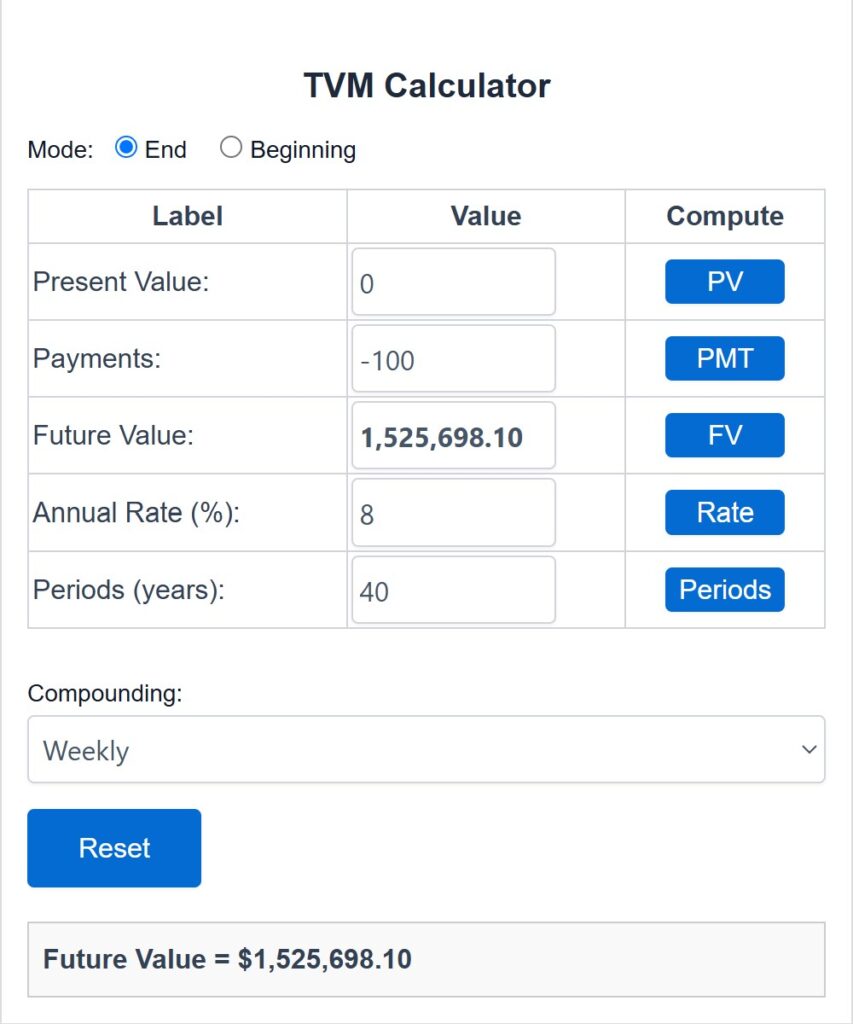
Investment: $100 a week
Annual Interest Rate: 8%
Years: 40
Compounded Weekly
Input:
PV: 0
Payments: -100 (if contributing $100 per week)
Annual Rate: 8
Period Years: 40
Compounding: Weekly
Output:Future Value (FV) = $1,525,698.10
2. Find Out How Much You Need to Save to Reach a Goal
✔️ Enter Future Value (FV): Your desired final amount. ✔️ Enter Present Value (PV): Any initial savings (negative value). ✔️ Enter Annual Interest Rate (I/Y): Expected return. ✔️ Enter Number of Years: Time until your goal. ✔️ Select Compounding Frequency: Choose compounding method. ✔️ Click “Compute” next to PMT to see how much you need to save per period.
Example:
Goal: $500,000
Annual Interest Rate: 7%
Periods (Years): 20
Compounded Monthly
Input:
Present Value: 0
Annual Rate (%): 7
Years: 20
Compounding: Monthly
Compute PMT
Output:
You need to save $959.83 per month
3. Calculate Loan or Mortgage Payments
✔️ Enter Present Value (PV): Loan amount (positive value). ✔️ Enter Annual Interest Rate (I/Y): Loan interest rate. ✔️ Enter Number of Years: Loan duration. ✔️ Select Compounding Frequency: Choose how often interest compounds. ✔️ Click “Compute” next to PMT to see required payment per period.
Example:
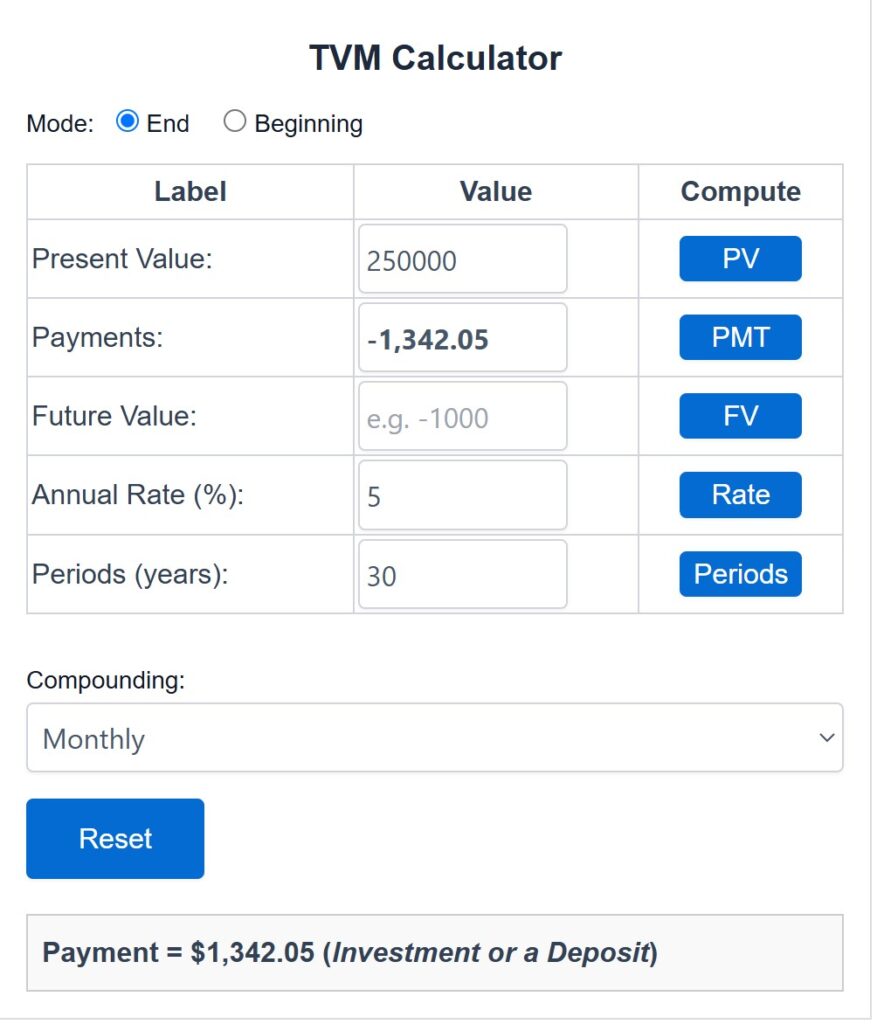
Loan Amount: $250,000
Annual Interest Rate: 5%
Years: 30
Compounded Monthly
Input:
Present Value: 250,000
Annual Rate (%): 5
Periods(Years: 30
Compounding: Monthly
Compute PMT
Output:
Monthly Payment (PMT) = $1,342.05 (Deposit)
Note: The negative sign means this is a payment (cash outflow).
Understanding Mode: End vs. Beginning Payments
The TVM Calculator allows you to choose whether payments occur at the beginning or end of each period.
✔️ End Mode: Most common setting, where payments are made at the end of each period. ✔️ Beginning Mode: Used for cases where payments are made at the start of each period (e.g., rent payments).
Example: If rent is due at the start of the month, use Beginning Mode; if payments are made after a service period, use End Mode.
Why Use This TVM Calculator?
✔️ Simple & Intuitive: Just enter values and hit “Compute”—no manual formulas required! ✔️ Multiple Payment & Compounding Options: Supports annual, monthly, weekly, and daily compounding. ✔️ Accurate Results: Ensures correct calculations without needing Excel or a financial calculator. ✔️ Works for Both Investments & Loans: Helps with retirement planning, wealth building, and debt management.
Start Planning Your Financial Future Today!
The TVM Calculator is an essential tool for financial success. Whether you’re investing, saving, or borrowing, mastering the Time Value of Money will help you maximize wealth and avoid costly financial mistakes.
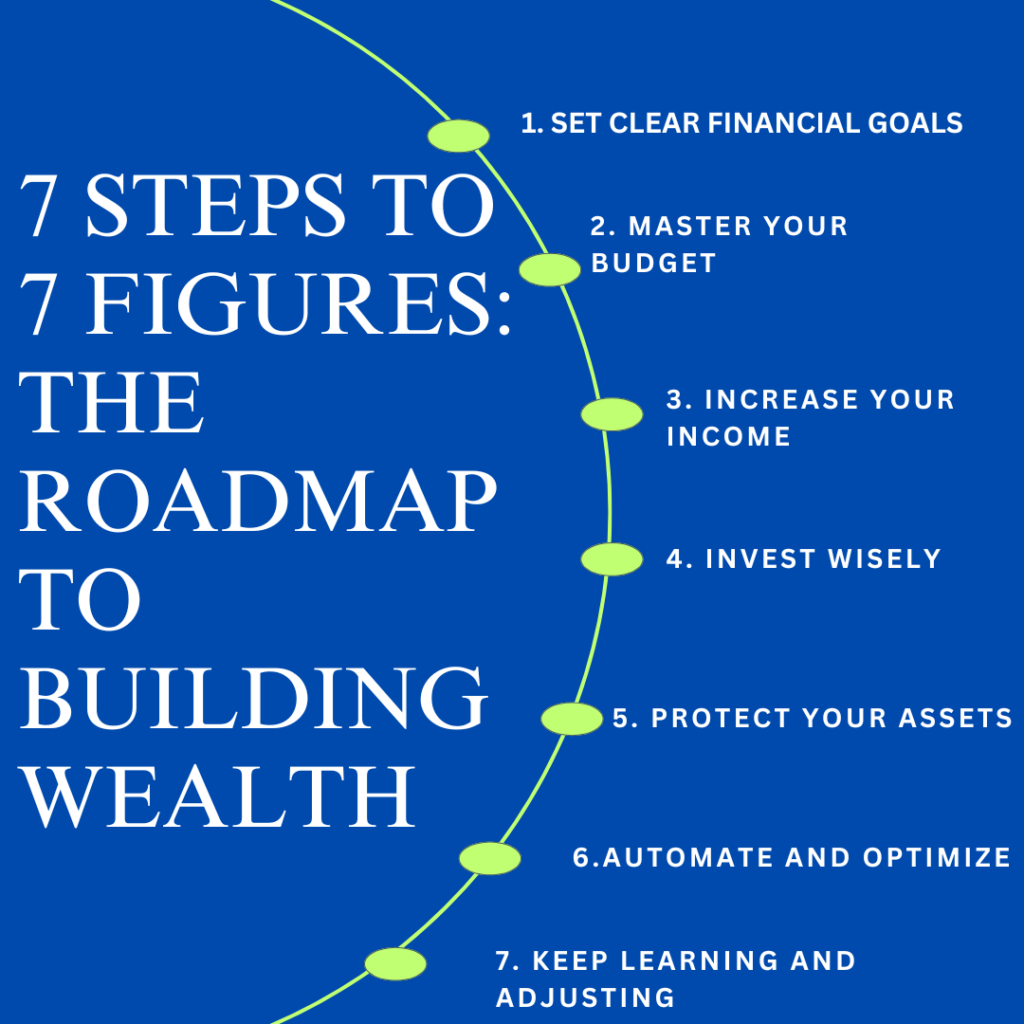
Achieving a seven-figure net worth may seem like a distant dream, but with discipline, strategy, and consistency, it’s well within your reach. Whether you’re starting from scratch or looking to grow your existing wealth, these seven steps will set you on the path to financial success.
Step 1: Set Clear Financial Goals
Before embarking on your journey, define what “7 figures” means to you. Are you aiming for $1 million in liquid assets, investments, or total net worth? Break down your goal into smaller, actionable steps. For instance:
• Save your first $10,000 within 6 months.
• Invest to grow your wealth by 10% annually.
A clear vision keeps you motivated and focused.
Step 2: Master Your Budget
Building wealth starts with mastering cash flow. Create a budget to track income and expenses. Follow the 50/30/20 rule:
• 50% for necessities (rent, utilities, groceries)
• 30% for wants (entertainment, dining out)
• 20% for savings and investments
Live below your means, and direct any extra funds toward investments.
Step 3: Increase Your Income
Relying on a single income stream slows your progress. Diversify your earnings through:
• Side hustles (freelancing, tutoring, or online businesses)
• Passive income (real estate rentals, dividends, or royalties)
• Career advancement (upskilling, promotions, or changing jobs for higher pay)
Remember, every additional dollar earned can be invested to compound your wealth.
Step 4: Invest Wisely
Saving alone won’t get you to seven figures—investing will. Start early and harness the power of compound interest. Consider:
• Stocks and Index Funds: Average annual returns of 7-10% over time.
• Real Estate: Rental properties or REITs for long-term appreciation and cash flow.
• Business Investments: Entrepreneurship or investing in others’ businesses for potentially high returns.
Pro tip: Use tax-advantaged accounts like 401(k)s, IRAs, or HSAs to grow your wealth faster while minimizing taxes.
Step 5: Protect Your Assets
Building wealth is half the battle—protecting it is equally critical. Safeguard your financial future by:
• Creating an emergency fund (3-6 months of expenses)
• Getting adequate insurance (health, life, and liability coverage)
• Diversifying investments to reduce risk
Financial security ensures you can weather life’s uncertainties without derailing your progress.
Step 6: Automate and Optimize
Remove human error by automating savings and investments. Set up:
• Direct deposits into savings or investment accounts
• Automatic contributions to retirement funds
• Recurring debt payments to avoid penalties
Automation ensures consistency and keeps your finances on track.
Step 7: Keep Learning and Adjusting
Markets change, and so do financial strategies. Commit to lifelong learning by:
• Reading books on personal finance (e.g., The Millionaire Next Door)
• Attending workshops and seminars
• Following experts and staying informed on market trends
Be flexible. As your wealth grows, your strategy should evolve to align with your goals.
Final Thoughts
Reaching 7 figures takes time, patience, and persistence. The earlier you start, the better your results, thanks to the magic of compounding. Stick to these steps, track your progress, and celebrate milestones along the way.
Your journey to 7 figures starts now. What’s your next move?
Share your thoughts and goals in the comments below.
Your Mantra for Success: Save Consistently. Invest Smartly. Retire Richly.
Legal Disclaimer for Build Wealth Retire Rich Blog/Website
The information provided on the “Build Wealth Retire Rich” blog/website is for educational purposes only and should not be construed as financial, investment, or legal advice. While every effort is made to ensure the accuracy and reliability of the information presented, Build Wealth Retire Rich and its contributors, including AI tools used in the creation of some content, do not guarantee its completeness or timeliness. Users are encouraged to consult with a qualified financial advisor or legal professional to discuss their specific financial situation and to obtain advice tailored to their individual circumstances.
Build Wealth Retire Rich is not responsible for any decisions made based on the information provided on this website. All financial products, investment strategies, and other content discussed are presented for informational purposes only, and no guarantees are made regarding the performance or suitability of any particular investment or strategy.
The views and opinions expressed on “Build Wealth Retire Rich” are those of the authors and do not necessarily reflect the views of the website’s owner or any affiliated institutions. “Build Wealth Retire Rich” does not endorse or promote any particular investment, financial product, or institution unless explicitly stated.
Risk Disclosure: Investing involves risk, including the potential loss of principal. Past performance is not indicative of future results. Always do your own research and consider your financial goals and risk tolerance before making any financial decisions.
By using this website, you agree that Build Wealth Retire Rich and its affiliates are not liable for any losses or damages incurred as a result of using the information provided. Users are solely responsible for their financial decisions and should seek independent advice when necessary.
As we step into 2025, it’s time to re-evaluate our financial strategies and make smarter decisions to safeguard our hard-earned money. One critical area to address is the impact of inflation on your savings account. If your bank’s interest rate isn’t keeping up with inflation, you’re losing purchasing power—essentially losing money over time.
Let’s explore how you can start the year right by taking actionable steps to grow your savings and stay ahead of inflation.
Why Inflation Matters to Your Savings
Inflation measures the rising cost of goods and services, effectively reducing the purchasing power of money over time. Think of it as the “hidden tax” on your savings—what your money can buy today might not be possible a year from now unless it grows at a rate equal to or greater than inflation.
Imagine you have $100 in your savings account today. If inflation is at 2.7%, it means that in a year, prices for everyday goods and services will rise by 2.7%. As a result, what costs you $100 today will cost $102.70 next year. However, if your savings only grow by a small amount—say 0.24% in a traditional savings account—you’ll have just $100.24. That’s not enough to keep up with rising prices, meaning your $100 won’t stretch as far as it does today.
A Real-Life Illustration of Inflation’s Impact
Imagine you have $10,000 in a traditional savings account that earns 0.24% APY, which is a common rate for standard savings accounts today. Here’s how your savings would grow compared to the impact of inflation:
Year 1:
Savings Growth: Your account earns $24 in interest (0.24% of $10,000), so your total balance is $10,024.
Inflation Impact: Inflation reduces your purchasing power by 2.7%, meaning the real value of your $10,024 is only $9,759 in today’s dollars.
What Are High-Yield Savings Accounts?
High-yield savings accounts (HYSAs) offer a much higher interest rate—some as high as 4.00% APY—allowing you to outpace inflation and grow your money effectively.
But how do banks manage to offer such high rates? Many people wonder how this is possible when traditional accounts offer such low returns.
How Banks Offer Higher Rates in High-Yield Savings Accounts
Banks offering HYSAs often operate differently from traditional brick-and-mortar banks. Here’s how they do it:
Lower Overhead Costs:
Most high-yield savings accounts are offered by online-only banks, which save significantly on costs like maintaining physical branches, utility bills, and in-person staff.
These cost savings are passed on to customers in the form of higher interest rates.
Encouraging Deposits:
By offering higher rates, banks attract more deposits, which they can use to fund loans or other revenue-generating activities.
Essentially, these banks create a win-win situation: customers get higher interest rates, and the bank gets more capital to lend or invest.
No Hidden Fees:
Many HYSAs have little to no fees, which makes them attractive to customers while still maintaining profitability for the banks due to their lean operational models.
Targeting Digital Savvy Customers:
HYSAs appeal to customers who are comfortable managing their finances digitally, allowing banks to streamline processes further and cut costs.
Benefits of High-Yield Savings Accounts
Higher Interest Rates: Grow your savings faster than inflation. For example, $10,000 in a HYSA with a 4.00% APY earns $400 in interest annually, compared to just $24 in a traditional account with 0.24% APY.
Liquidity: Easy access to your funds, perfect for emergency savings or short-term goals.
FDIC-Insured Security: Your money is safe, up to $250,000 per account.
No Hidden Fees: Many HYSAs come with zero maintenance fees or balance requirements.
Sophia’s Smart Money Move: How a High-Yield Savings Account Transformed Her Finances
At 28, Sophia was finally starting to feel financially stable. She had a steady job as a graphic designer, paid off most of her student loans, and was eager to build her savings. But every time she looked at her traditional savings account, she felt frustrated. Earning just 0.24% interest, her money barely grew—and with inflation at 2.7%, she realized she was actually losing purchasing power.
That’s when Sophia discovered the world of High-Yield Savings Accounts (HYSAs). With interest rates around 4.00%, they offered a chance to make her savings work harder. She decided to make the switch, and in just a few months, her financial life became more efficient and rewarding.
Step 1: Setting Up the HYSA
Sophia researched online and chose a reputable HYSA provider offering a competitive 4.00% APY with no monthly fees. The account setup was straightforward and entirely online. Within 10 minutes, she had her HYSA up and running.
To make things simple, Sophia set up direct deposit for her paycheck. Every payday, her employer deposited 30% of her paycheck directly into the HYSA. This automated savings plan ensured she consistently saved without having to think about it.
Step 2: Linking Credit Cards and Loan Payments
Sophia wanted to keep all her finances connected and digital. She linked her HYSA to:
Her Credit Cards: All her credit card payments were automatically scheduled to be paid from her HYSA. She earned points on her cards for everyday purchases, then paid off the balance in full each month, avoiding interest charges while maximizing her savings.
Her Student Loan Payments: Although most of her loans were paid off, she still had a small balance left. She set up automatic payments from her HYSA, ensuring she never missed a due date.
Emergency Expenses: Sophia kept her HYSA as her emergency fund, knowing she could quickly transfer money to her checking account in case of unexpected expenses.
Step 3: Automating and Tracking Expenses
To stay organized, Sophia set up a digital budgeting app that synced with her HYSA and all her linked accounts. This app gave her a clear picture of:
How much she saved each month
Where she spent the most
Her progress toward financial goals
The app also sent her reminders about upcoming payments, keeping her finances stress-free.
Step 4: Watching Her Savings Grow
Thanks to the 4.00% APY on her HYSA, Sophia’s savings started growing noticeably. Over the course of a year:
She earned $400 in interest on her $10,000 savings—compared to just $24 she would have earned with her old account.
She avoided fees or penalties because her HYSA had no minimum balance requirements.
Sophia also noticed the psychological impact: seeing her money grow faster motivated her to save even more.
Step 5: Digital Convenience for a Digital Life
Because Sophia had linked her HYSA to all her financial accounts, everything worked seamlessly:
Direct Deposit: Her paycheck savings went straight into the HYSA.
Credit Card Payments: Scheduled payments kept her cards in good standing.
Loan Repayments: Automation meant no late fees or missed deadlines.
Savings Growth: Interest earned monthly was reinvested automatically.
She rarely needed to visit a physical bank or write checks—all her transactions were digital, secure, and trackable.
Sophia’s Financial Transformation
Within a year, Sophia:
Built a $15,000 emergency fund, earning $600 in interest.
Paid off her remaining student loans ahead of schedule.
Learned to track her spending and save more effectively.
Felt confident about her financial future.
She even started using her HYSA to save for other goals, like a vacation fund and a down payment for her first home.
Final Thoughts
Sophia’s journey shows how a High-Yield Savings Account, combined with automation and digital tools, can transform your financial life. By linking her accounts, automating payments, and maximizing interest, she not only saved money but also gained peace of mind.
What’s stopping you from making the same move? Take the first step today—find a HYSA that works for you, and let your savings work smarter, not harder.
How to Get Started in 2025
Action Item: Make the Switch to a High-Yield Savings Account
Research Your Options: Compare rates and terms from reputable banks.
Open an Account: The process is simple and can usually be done online in minutes.
Automate Savings: Set up automatic transfers to your HYSA to build a strong saving habit.
Monitor Rates and Inflation: Stay informed and switch accounts if better rates become available.
Final Thoughts
Starting 2025 with a focus on smarter savings is one of the best financial resolutions you can make. If you’re still holding your savings in a traditional low-interest account, it’s time to make the switch. High-yield savings accounts offer an excellent opportunity to outpace inflation and grow your money without additional risk.
Remember, every dollar saved and grown is a step closer to achieving your financial goals. Take action today, and let your money work harder for you this year!
Your Mantra for Success: Save Consistently. Invest Smartly. Retire Richly.
Legal Disclaimer for Build Wealth Retire Rich Blog/Website
The information provided on the “Build Wealth Retire Rich” blog/website is for educational purposes only and should not be construed as financial, investment, or legal advice. While every effort is made to ensure the accuracy and reliability of the information presented, Build Wealth Retire Rich and its contributors, including AI tools used in the creation of some content, do not guarantee its completeness or timeliness. Users are encouraged to consult with a qualified financial advisor or legal professional to discuss their specific financial situation and to obtain advice tailored to their individual circumstances.
Build Wealth Retire Rich is not responsible for any decisions made based on the information provided on this website. All financial products, investment strategies, and other content discussed are presented for informational purposes only, and no guarantees are made regarding the performance or suitability of any particular investment or strategy.
The views and opinions expressed on “Build Wealth Retire Rich” are those of the authors and do not necessarily reflect the views of the website’s owner or any affiliated institutions. “Build Wealth Retire Rich” does not endorse or promote any particular investment, financial product, or institution unless explicitly stated.
Risk Disclosure: Investing involves risk, including the potential loss of principal. Past performance is not indicative of future results. Always do your own research and consider your financial goals and risk tolerance before making any financial decisions.
By using this website, you agree that Build Wealth Retire Rich and its affiliates are not liable for any losses or damages incurred as a result of using the information provided. Users are solely responsible for their financial decisions and should seek independent advice when necessary.
Investing is more than just a financial activity—it’s a gateway to achieving long-term financial goals, building wealth, and ensuring a secure future. While saving provides a foundation, investing takes your money to the next level by putting it to work and allowing it to grow.
Why Is Investing Important?
Wealth Accumulation Through Growth Investing allows your money to grow significantly over time, thanks to the magic of compounding. When you earn returns on your investments, those returns are reinvested, creating a snowball effect. For example:
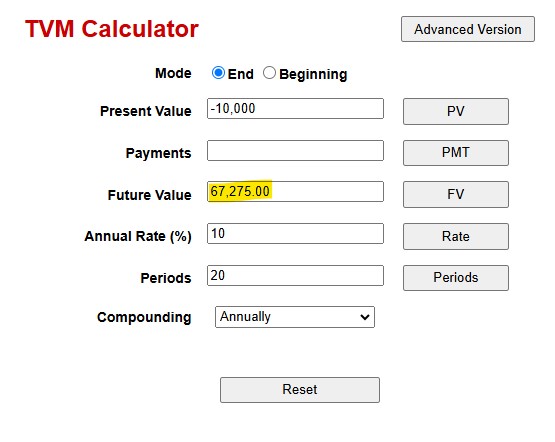
If you invest $10,000 at an average annual return of 10%, it can grow to over $67,000 in 20 years. This growth far exceeds what a regular savings account would offer.
2. Protecting Against Inflation Inflation gradually decreases the purchasing power of money. By investing in assets with higher returns than inflation, you preserve and increase your real wealth. For instance:
If inflation averages 3% annually, a $100 item today will cost approximately $180 in 20 years. Investments in stocks or real estate can help your money keep pace with or surpass inflation.
3. Achieving Financial Goals Investing is a strategic way to reach significant milestones like:
Set Clear Goals Define what you’re investing for—retirement, education, or wealth building—and tailor your strategy accordingly.
Determine Your Risk Tolerance Understand your comfort level with risk. Stocks are riskier but offer higher returns, while bonds and savings accounts are safer but yield lower returns.
Start Small and Be Consistent
Begin with what you can afford. Many brokerage firms allow you to start with as little as $1.
Spread your investments across different asset classes to reduce risk.
The saying, “Don’t put all your eggs in one basket,” applies strongly in investing.
Consult a Financial Advisor If you’re unsure where to start, seek professional advice to create a personalized investment plan.
Overcoming Common Misconceptions
“I need a lot of money to start.” Many brokerage firms allow you to begin investing with minimal amounts.
“Investing is too risky.” Risk varies by asset class. Balancing high-risk investments (stocks) with safer options (bonds) can align with your comfort level.
“I don’t know enough.” Financial literacy tools, seminar/courses, and advisors are available to help you gain confidence.
Key Takeaways
Investing is not just for the wealthy or financially savvy—it’s for anyone with a desire to grow their wealth and secure their future. Here’s why you should start now:
Time is your greatest ally in investing.
Small, consistent contributions lead to significant long-term gains.
Diversifying and understanding your goals reduce risks and improve results.
Remember, investing is like planting a tree: the sooner you plant it, the sooner it bears fruit. Start today and take control of your financial future.
Your Mantra for Success: Save Consistently. Invest Smartly. Retire Richly.
Legal Disclaimer for Build Wealth Retire Rich Blog/Website
The information provided on the “Build Wealth Retire Rich” blog/website is for educational purposes only and should not be construed as financial, investment, or legal advice. While every effort is made to ensure the accuracy and reliability of the information presented, Build Wealth Retire Rich and its contributors, including AI tools used in the creation of some content, do not guarantee its completeness or timeliness. Users are encouraged to consult with a qualified financial advisor or legal professional to discuss their specific financial situation and to obtain advice tailored to their individual circumstances.
Build Wealth Retire Rich is not responsible for any decisions made based on the information provided on this website. All financial products, investment strategies, and other content discussed are presented for informational purposes only, and no guarantees are made regarding the performance or suitability of any particular investment or strategy.
The views and opinions expressed on “Build Wealth Retire Rich” are those of the authors and do not necessarily reflect the views of the website’s owner or any affiliated institutions. “Build Wealth Retire Rich” does not endorse or promote any particular investment, financial product, or institution unless explicitly stated.
Risk Disclosure: Investing involves risk, including the potential loss of principal. Past performance is not indicative of future results. Always do your own research and consider your financial goals and risk tolerance before making any financial decisions.
By using this website, you agree that Build Wealth Retire Rich and its affiliates are not liable for any losses or damages incurred as a result of using the information provided. Users are solely responsible for their financial decisions and should seek independent advice when necessary.
When it comes to building wealth, compound interest is one of the most powerful tools available. Albert Einstein once called it the “eighth wonder of the world,” and for good reason—it can turn small, steady investments into a large amount of money over time. In this post, we’ll explain what compound interest is, how it works, and how you can use it to grow your wealth and secure your financial future.
What is Compound Interest?
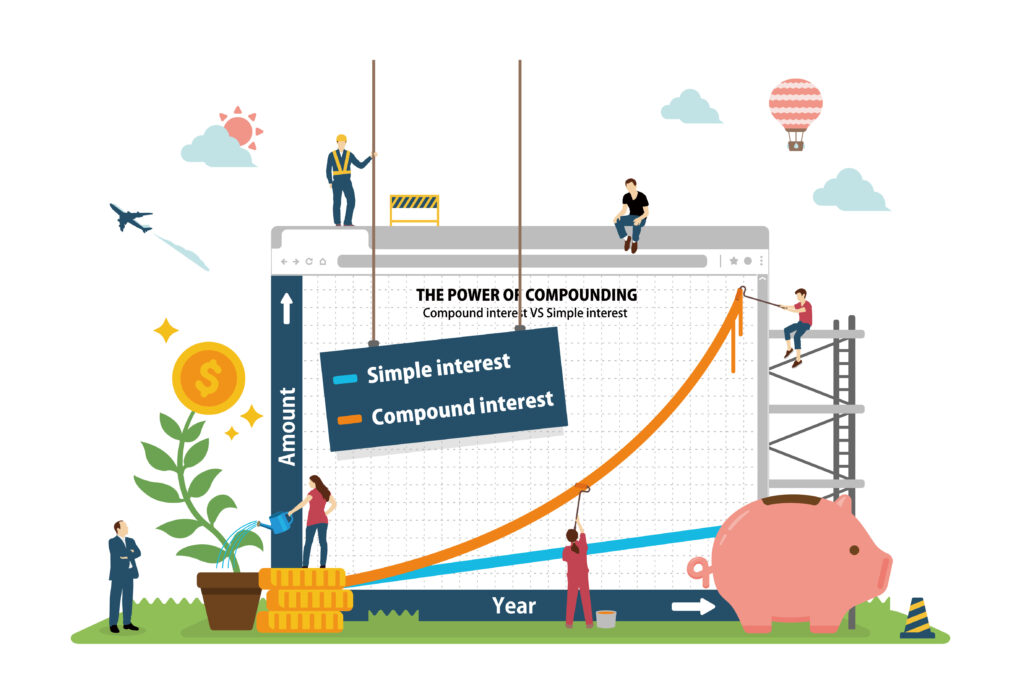
Compound interest means earning interest on your money and then earning interest on that interest. It’s different from simple interest, which only grows based on your original amount (called the principal).
How It Works
Imagine you put $1,000 in a savings account that earns 5% interest per year. At the end of the first year, you earn $50 in interest, so you now have $1,050. In the second year, you earn 5% on $1,050—not just $1,000—so your interest grows to $52.50. Over time, this snowball effect gets bigger and bigger.
Why Compound Interest is So Powerful
1. The Time Factor
Time is the single most important element in maximizing the effects of compound interest. The earlier you start saving or investing, the longer your money has to grow exponentially. Even modest contributions can turn into substantial sums over decades.
Example:
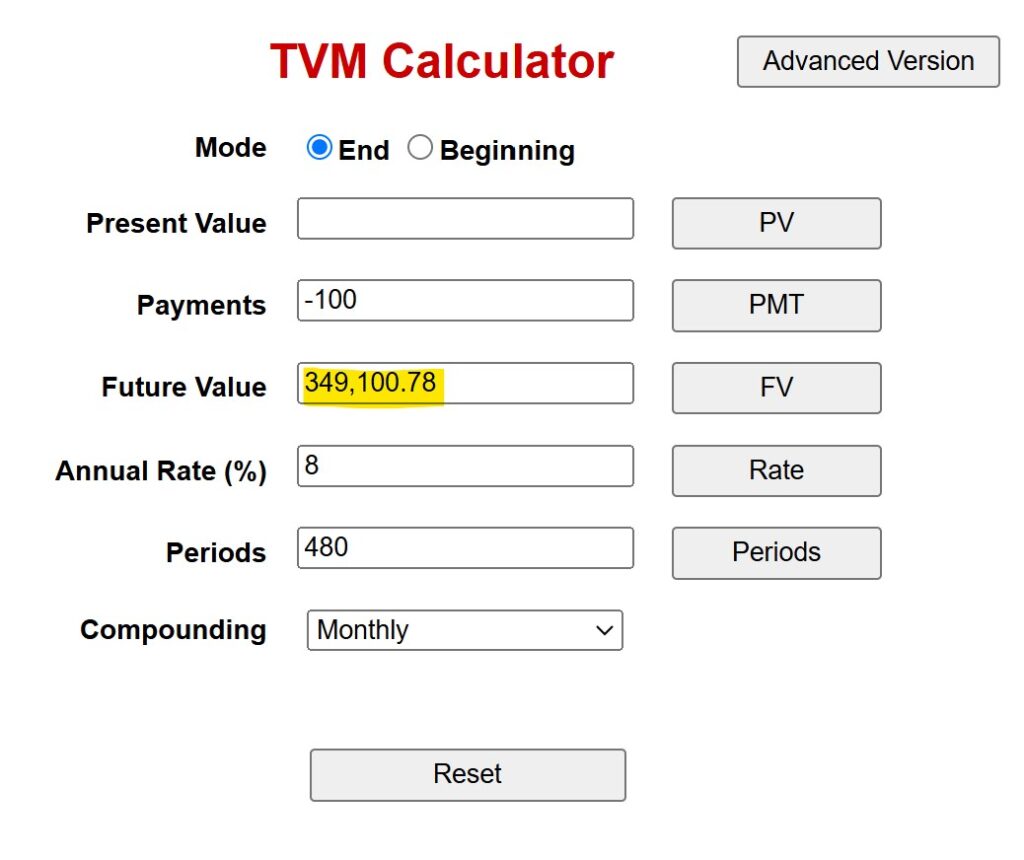
Scenario 1: Sarah starts saving $100 a month at age 25, earning 8% annually. By age 65, she’ll have accumulated nearly $349,000.
Starting early gives Sarah an extra decade for compounding to work its magic, which makes a massive difference.
2. Exponential Growth Over Time
The compounding effect becomes more significant as time passes. In the early years, your growth might seem slow, but over time, the growth accelerates. This is why compound interest is often referred to as “interest on interest.”
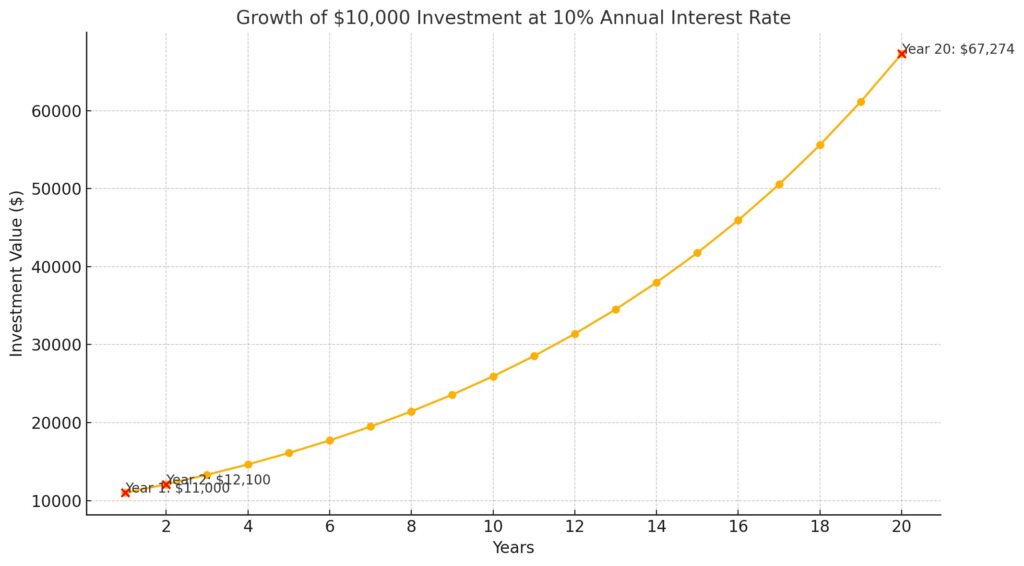
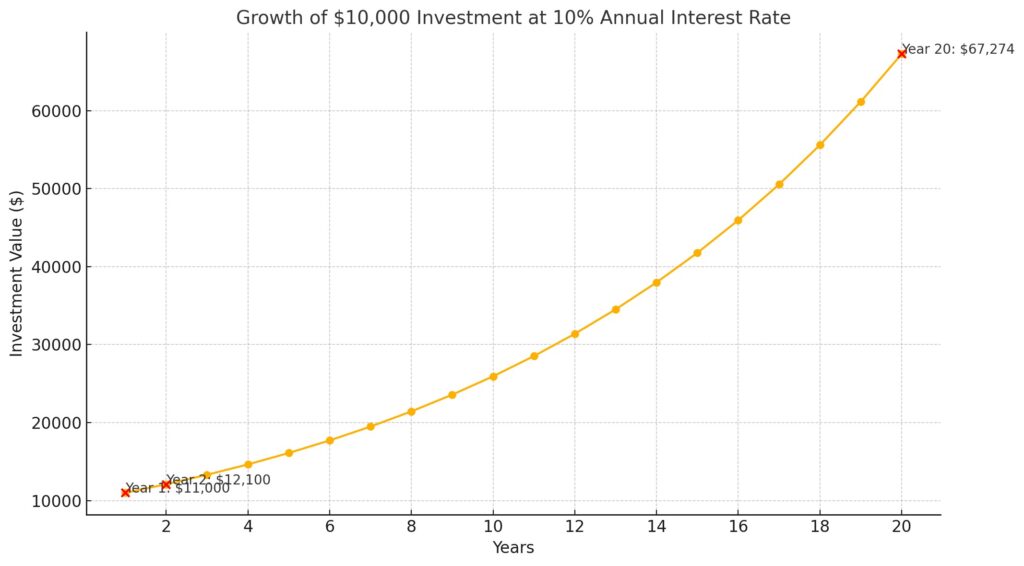
Example: Let’s say you invest $10,000 at a 10% annual interest rate:
Year 1: $11,000
Year 2: $12,100
Year 20: Over $67,000
This demonstrates the power of compound interest over time
Here’s a chart showing the growth of a $10,000 investment at a 10% annual interest rate over 20 years. It highlights key points:
How to Leverage Compound Interest to Build Wealth
1. Start Saving or Investing Early
The earlier you start, the more powerful the compounding effect becomes. Even if you start small, the impact of compounding over decades can be monumental.
Pro Tip: Encourage young adults to save early—even a few years of delay can have a significant impact on long-term growth.
2. Make Regular Contributions
Consistency is key to maximizing the benefits of compounding. Setting up automatic contributions to your savings or investment accounts ensures you’re continuously adding to your principal.
Example:
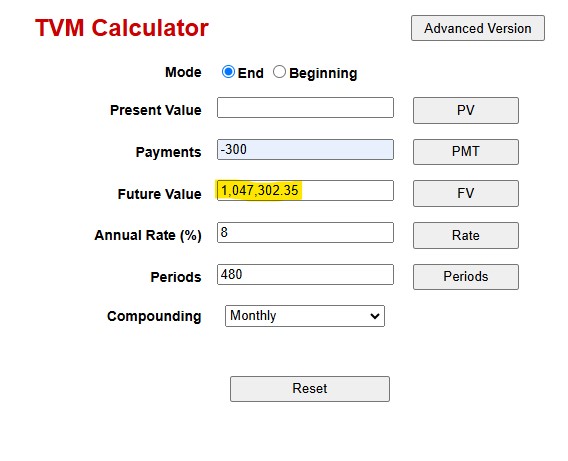
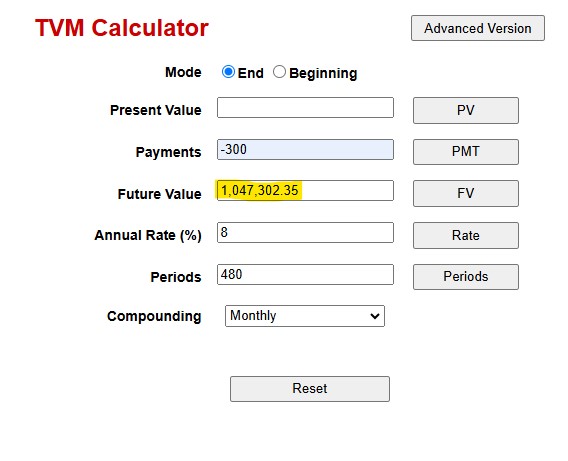
Investing $300 per month at an 8% annual return will grow to $1,047,302.35 in 40 years.
Whether you’re earning dividends from stocks or interest from bonds, reinvesting those earnings allows them to generate additional returns. This reinvestment is crucial to achieving exponential growth.
The stock market can be volatile in the short term, but historically, it has delivered solid long-term returns. By staying invested and avoiding the temptation to withdraw during market downturns, you allow compounding to work uninterrupted.
6. Take Advantage of Employer Contributions
Many employers offer matching contributions for retirement accounts like 401(k)s. This is essentially free money that grows with compound interest. Always contribute enough to maximize your employer match.
7. Be Patient
Compounding takes time, and the biggest rewards come later in the journey. Avoid withdrawing your funds prematurely or chasing short-term gains. Staying disciplined and patient is key to unlocking the full potential of compound interest.
Common Pitfalls to Avoid
Delaying Your Start: Waiting just a few years can drastically reduce your wealth-building potential.
Not Reinvesting Earnings: Spending your earnings prevents them from contributing to future growth.
Ignoring Inflation: Ensure your investments outpace inflation to maintain purchasing power.
High Fees: Investment fees can erode returns over time. Opt for low-cost index funds or ETFs when possible.
Final Thoughts
Compound interest is a true game-changer for building wealth, but it requires three key ingredients: time, consistency, and patience. Whether you’re saving for retirement, your child’s education, or financial independence, starting early and staying consistent can help you achieve your goals.
Remember, building wealth isn’t about overnight success—it’s about leveraging the tools at your disposal to create sustainable, long-term growth. By understanding and using compound interest, you’re setting yourself on the path to financial security and freedom.
Your Mantra for Success: Save Consistently. Invest Smartly. Retire Richly.
Legal Disclaimer for Build Wealth Retire Rich Blog/Website
The information provided on the “Build Wealth Retire Rich” blog/website is for educational purposes only and should not be construed as financial, investment, or legal advice. While every effort is made to ensure the accuracy and reliability of the information presented, Build Wealth Retire Rich and its contributors, including AI tools used in the creation of some content, do not guarantee its completeness or timeliness. Users are encouraged to consult with a qualified financial advisor or legal professional to discuss their specific financial situation and to obtain advice tailored to their individual circumstances.
Build Wealth Retire Rich is not responsible for any decisions made based on the information provided on this website. All financial products, investment strategies, and other content discussed are presented for informational purposes only, and no guarantees are made regarding the performance or suitability of any particular investment or strategy.
The views and opinions expressed on “Build Wealth Retire Rich” are those of the authors and do not necessarily reflect the views of the website’s owner or any affiliated institutions. “Build Wealth Retire Rich” does not endorse or promote any particular investment, financial product, or institution unless explicitly stated.
Risk Disclosure: Investing involves risk, including the potential loss of principal. Past performance is not indicative of future results. Always do your own research and consider your financial goals and risk tolerance before making any financial decisions.
By using this website, you agree that Build Wealth Retire Rich and its affiliates are not liable for any losses or damages incurred as a result of using the information provided. Users are solely responsible for their financial decisions and should seek independent advice when necessary.
It’s easy to think you need a high salary or a glamorous career to retire with a million dollars. But the story of Ronald Read, a Vermont janitor and gas station attendant, proves otherwise. Read quietly amassed an $8 million fortune through disciplined saving, frugal living, and smart investing, surprising even his family and friends upon his death at age 92.
Read’s story is a testament to the idea that anyone, regardless of income, can achieve financial independence with the right approach. By following simple principles like starting early, saving consistently, and investing wisely, you can also build a seven-figure nest egg for retirement.
Here’s how to make it happen.
Start Early: The Magic of Compound Interest
Compound interest is the most powerful force in wealth building. Starting early allows your money to grow exponentially because you’re earning interest not just on your savings but also on the interest already earned.
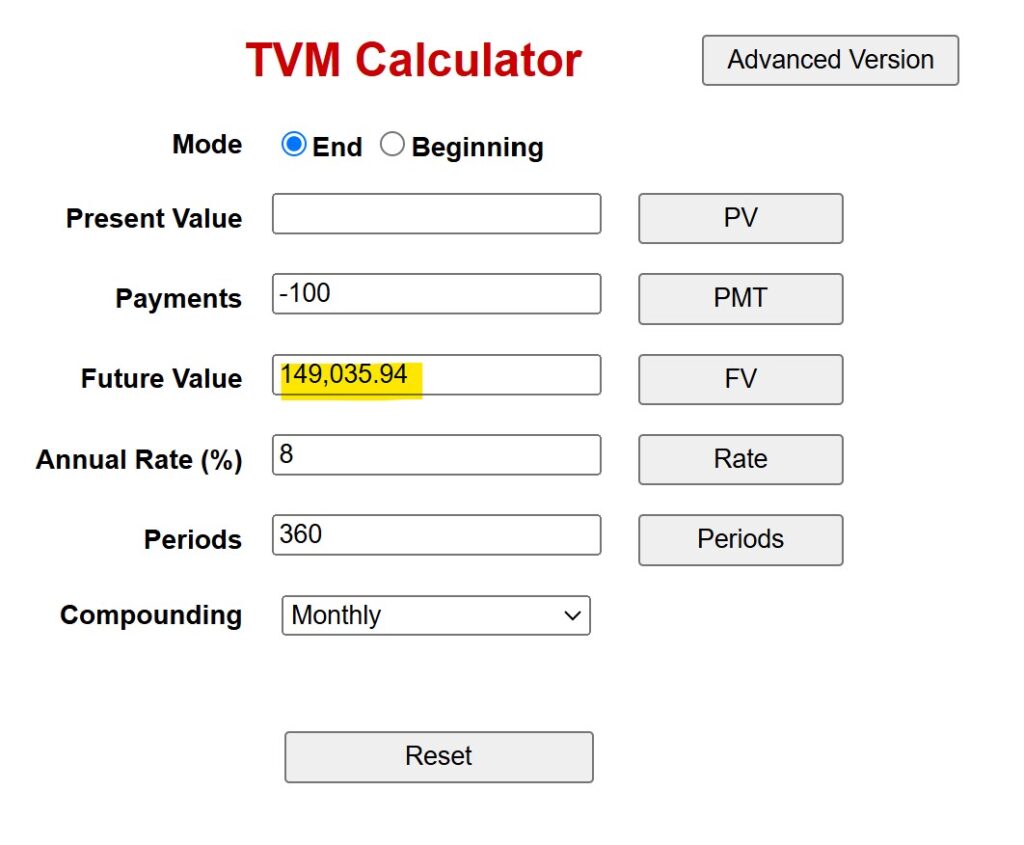
Example 1: Imagine Sarah, a 25-year-old who invests $300 per month in a retirement account with an average annual return of 8%. By age 65, Sarah will have over $1,000,000.
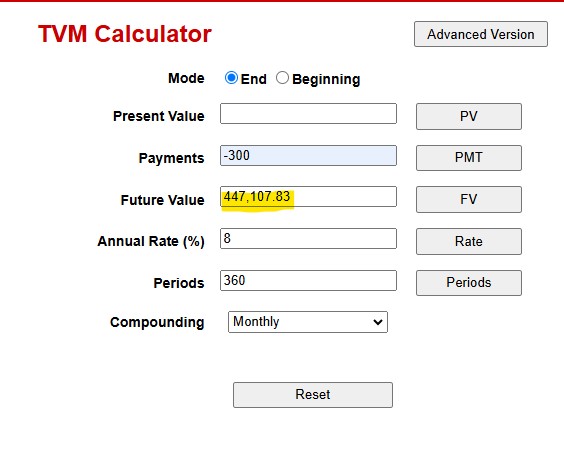
Now consider Jake, who waits until he’s 35 to start saving the same $300 per month. By 65, Jake will only have $447,000, less than half of Sarah’s total—just because he started later.
The takeaway? Starting early is like giving your money extra years to work for you.
Consistency is Key: Automate Your Savings
It’s not about saving big chunks at once—it’s about saving regularly. Automating contributions to your retirement accounts ensures that you’re consistently building wealth without needing to think about it.
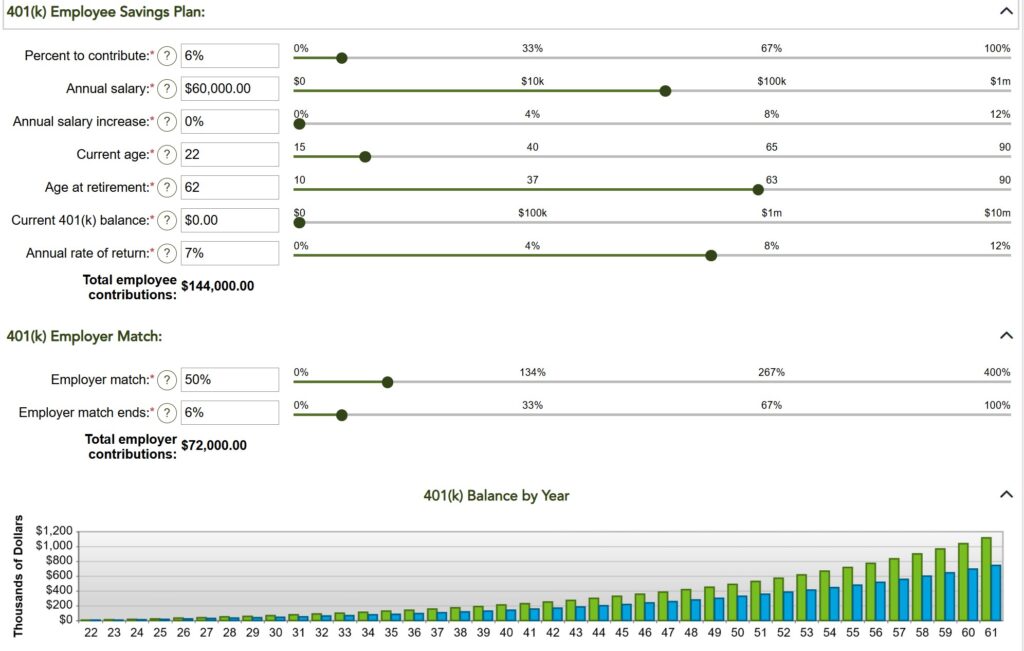
Example 2: David earns $60,000 annually and chooses to save 6% of his salary in his 401(k). Over 40 years, with an assumed annual return of 7%, his retirement savings would grow to $1,118,482.41 if his employer matches 50% of his contributions. Without the employer match, his total savings would be $745,654.94.
Automating his savings made it easier for David to stick to his plan and take advantage of free money through employer matches.
Invest Wisely: Keep Costs Low and Diversify
Choosing the right investments is crucial. Low-cost index funds and ETFs are excellent options because they provide diversification and minimize fees, which can erode your returns.
Avoid the Debt Trap
Debt is a significant barrier to wealth. High-interest debt, such as credit card balances, can overshadow even the best investment returns. Paying off debt early frees up more money for savings.
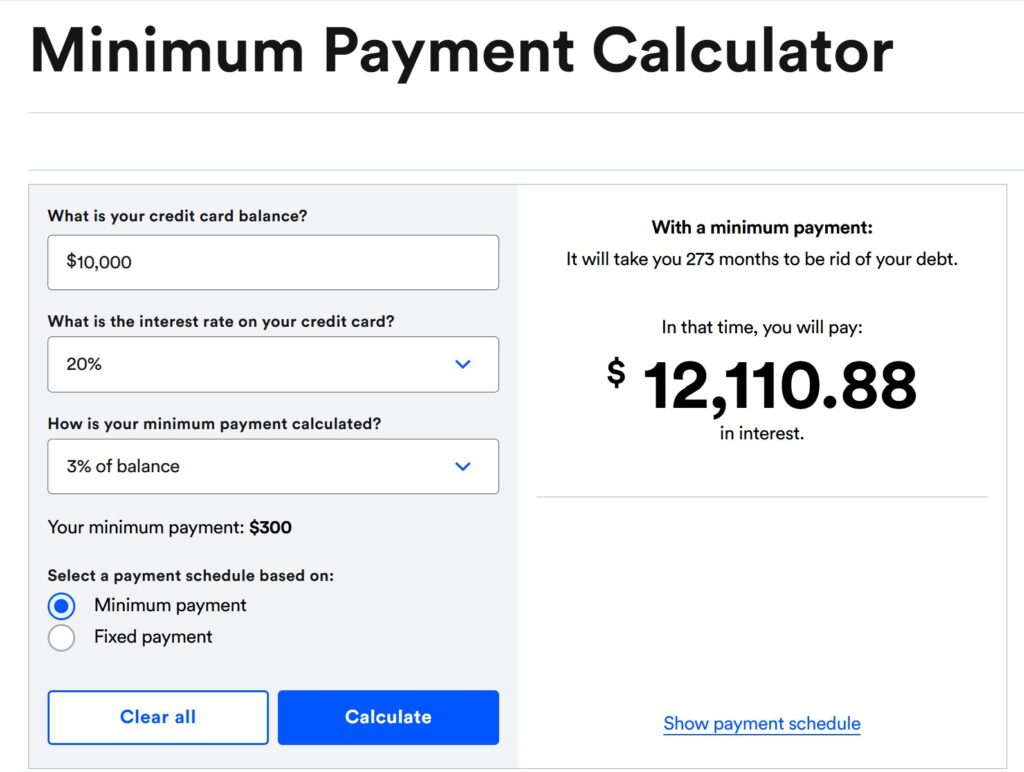
Example 4: Maria has $10,000 in credit card debt with a 20% interest rate. If she only makes the minimum payments, calculated as 3% of the balance, it will take her over 20 years to pay off the debt and cost her more than $12,000 in interest. However, by aggressively paying off the debt, she can save thousands in interest and redirect those savings into her retirement fund.
The “4% rule” is a popular guideline for retirement planning. It suggests you can withdraw 4% of your retirement savings annually without running out of money.
Example 5: If John has $1 million saved, he can withdraw $40,000 annually to cover living expenses. Combined with Social Security benefits, this amount could provide a comfortable lifestyle.
Save More as You Earn More
As your income grows, increase your savings rate. Bonuses, raises, or additional income can help accelerate your journey to $1 million.
Example 6: Emma earns $50,000 and starts saving 10% of her income. After 5 years, her salary increases to $70,000. Instead of sticking to her original contribution of $5,000 per year, Emma raises it to 15%, or $10,500 annually. This simple adjustment significantly boosts her retirement savings over time.
Balance Today and Tomorrow
Saving for the future doesn’t mean sacrificing your quality of life today. The key is prioritizing what brings you joy while minimizing unnecessary expenses.
Example 7: Ryan loves traveling and spends $3,000 a year on trips. To afford this while saving for retirement, he cuts back on dining out, saving $200 per month. This way, Ryan enjoys his travels while still contributing $500 a month to his IRA.
Real-Life Stories of Millionaire Retirees
Recent data from Fidelity shows there are now over 497,000 401(k) millionaires and 418,111 IRA millionaires as of September 30, 2024. These individuals weren’t all earning massive salaries—they simply followed consistent savings habits and invested wisely.
Take Action Today
Here’s a step-by-step roadmap to retiring a millionaire:
Start Saving Now: The earlier, the better. Even small contributions grow significantly over time.
Use Tax-Advantaged Accounts: Maximize your 401(k), IRA, or Roth IRA contributions.
Take Advantage of Matches: Always contribute enough to get your employer’s full match.
Invest Strategically: Opt for low-cost index funds or ETFs for diversification and lower fees.
Increase Contributions Over Time: Save more as you earn more.
Avoid High-Interest Debt: Focus on paying off debt to free up cash for investing.
Find Balance: Save consistently while enjoying life.
Becoming a millionaire isn’t about earning a massive salary; it’s about building wealth one step at a time. Whether you’re earning $40,000 or $400,000, the principles remain the same: save early, save often, and invest smartly. With patience and discipline, your dream of a $1 million retirement fund can become a reality.
Your future self will thank you.
Our Newsletter Can Help You Build Wealth and Retire Rich!
Sign up for our free newsletter!
Want actionable tips and expert advice to grow your wealth, save smarter, and retire comfortably? Sign up for the Build Wealth Retire Rich newsletter to receive weekly updates packed with personal finance strategies and insights—delivered straight to your inbox!Please accept terms and conditions.
By submitting your information, you`re giving us permission to email you. You may unsubscribe at any time.
Thank you for subscribing to our newsletter. You are one step away from financial freedom.
Legal Disclaimer for Build Wealth Retire Rich Blog/Website
The information provided on the “Build Wealth Retire Rich” blog/website is for educational purposes only and should not be construed as financial, investment, or legal advice. While every effort is made to ensure the accuracy and reliability of the information presented, Build Wealth Retire Rich and its contributors, including AI tools used in the creation of some content, do not guarantee its completeness or timeliness. Users are encouraged to consult with a qualified financial advisor or legal professional to discuss their specific financial situation and to obtain advice tailored to their individual circumstances.
Build Wealth Retire Rich is not responsible for any decisions made based on the information provided on this website. All financial products, investment strategies, and other content discussed are presented for informational purposes only, and no guarantees are made regarding the performance or suitability of any particular investment or strategy.
The views and opinions expressed on “Build Wealth Retire Rich” are those of the authors and do not necessarily reflect the views of the website’s owner or any affiliated institutions. “Build Wealth Retire Rich” does not endorse or promote any particular investment, financial product, or institution unless explicitly stated.
Risk Disclosure: Investing involves risk, including the potential loss of principal. Past performance is not indicative of future results. Always do your own research and consider your financial goals and risk tolerance before making any financial decisions.
By using this website, you agree that Build Wealth Retire Rich and its affiliates are not liable for any losses or damages incurred as a result of using the information provided. Users are solely responsible for their financial decisions and should seek independent advice when necessary.
In a world where financial decisions shape our futures, adopting the right habits early on can be the key to long-term security and prosperity. At “Build Wealth Retire Rich“, we believe in simplifying financial wisdom into actionable principles that anyone can follow.
Our guiding mantra is clear and concise: “Spend Wisely, Invest Early.”
1. Spend Wisely
The foundation of financial success begins with smart spending. This mantra emphasizes the importance of mindful consumption and prioritizing needs over wants. Here’s how you can adopt this principle in your daily life:
• Create a Budget: Track your income and expenses to identify where your money is going. Tools like spreadsheets or budgeting apps can help you stay organized.
• Distinguish Needs from Wants: Before making a purchase, ask yourself if it’s a necessity or a luxury.
• Avoid Impulse Buying: Give yourself a cooling-off period for major purchases to ensure they align with your financial goals.
• Seek Value, Not Just Price: Opt for quality over quantity when it comes to products and services. Spending on durable items can save money in the long run.
• Eliminate Debt: High-interest debts like credit cards can erode your wealth. Pay them off systematically and avoid accumulating new ones.
Spending wisely doesn’t mean living a life of deprivation—it’s about making informed choices that bring long-term benefits.
2. Invest Early
If spending wisely is the foundation, investing early is the accelerator of financial success. Time is the most valuable asset in investing, thanks to the power of compounding. Here’s why starting early matters:
• Harness the Power of Compounding: When you invest, your returns generate further returns over time. Starting early gives your money decades to grow exponentially.
• Build Wealth Gradually: Even small contributions add up. A monthly investment of $200 starting at age 25 can grow significantly compared to starting at age 40.
• Reduce Financial Stress: Early investments create a safety net for emergencies, retirement, and life goals, reducing financial anxiety.
• Take More Risks: Younger investors have the luxury of time to recover from market fluctuations, allowing them to take calculated risks for higher returns.
Simple Steps to Start Investing Early
1. Set Financial Goals: Define what you’re saving for—retirement, a home, education, or financial independence.
2. Start Small: Begin with an amount you’re comfortable with, even if it’s just $50 a month.
3. Leverage Tax-Advantaged Accounts: Use accounts like IRAs, 401(k)s, or ABLE accounts (for special needs planning) to maximize tax benefits.
4. Diversify Your Portfolio: Spread your investments across various assets like stocks, bonds, and mutual funds to reduce risk.
5. Automate Contributions: Set up automatic transfers to your investment accounts to ensure consistency.
Why These Mantras Work Together
The beauty of “Spend Wisely” and “Invest Early” lies in their interdependence. Wise spending creates the surplus necessary to invest, while early investments multiply your savings. Together, they form a powerful strategy to achieve financial independence.
For instance:
• By cutting unnecessary expenses (spend wisely), you can contribute more to your retirement accounts or save for a dream vacation.
• Starting investments in your 20s instead of your 30s could potentially double or triple your wealth at retirement age.
Conclusion
The “Build Wealth Retire Rich” mantra—“Spend Wisely, Invest Early”—is more than just advice; it’s a way of life that empowers you to take control of your finances. By adopting these principles today, you’re setting yourself up for a future of financial freedom and security.
Take the first step toward financial success. Evaluate your spending habits, set aside an investment fund, and let the journey begin. Remember, the sooner you start, the better your results will be.