Why You Should Start Investing in Your 20s | The Campus Investor
The Campus Investor
Build Wealth from Day One
📈 Issue No. 07 · Investing Series
Why You Should Start Investing in Your 20s
May 2026 | 7 min read | For College Students
Here is a financial truth that nobody tells you loudly enough: your 20s are the single most powerful investing decade of your entire life. Not your 40s when you have more money. Not your 50s when you’re thinking seriously about retirement. Your 20s — right now — when time is working completely in your favor and every dollar you invest is worth more than any dollar you’ll invest later.
Most people understand this in theory and do nothing about it. They’re waiting for more money, less debt, a better time, more certainty. Every year they wait costs them more than the entire amount they would have invested. This issue is about making that math so clear it becomes impossible to ignore.
What $100/month invested at 20 becomes by 65 at 6.5% return
$160K
What the same $100/month becomes if you start at 30 instead
10 yrs
The gap in start date that cuts your outcome nearly in half
The Math That Makes Your 20s Irreplaceable
Compound interest is the engine of wealth building — and it runs on one fuel: time. The longer money stays invested, the more aggressively it compounds. Each year of growth doesn’t just add to your balance — it multiplies it. And the multiplications in your 20s are the most powerful because they have the most future years to keep compounding.
Here’s the simplest way to see it. A single $1,000 invested at age 20, never touched, grows at 7% average annual return:
Age 20
💰 $1,000 invested
$1,000
Age 30
📈 First decade of growth
~$1,967
Age 40
📈 Two decades of growth
~$3,870
Age 50
📈 Three decades of growth
~$7,612
Age 60
📈 Four decades of growth
~$14,974
Age 65
🏆 45 years compounded
~$21,002
Actively growingOne $1,000 investment · 7% average annual return · no additional contributions
A single $1,000 invested at 20 becomes over $21,000 by 65 — a 21x return — without a single additional dollar contributed. That same $1,000 invested at 40 becomes about $7,600. The money invested in your 20s earns returns for four decades. Money invested at 40 earns them for two and a half. The dollars are identical. The time is not.
📐 The Rule of 72 — Applied to Your 20s
At 7% annual return, money doubles every ~10 years. A dollar invested at 20 doubles four times before retirement — $1 → $2 → $4 → $8 → $16. A dollar invested at 40 doubles twice — $1 → $2 → $4. Same dollar. Same return. The difference is entirely when the clock started.
Two Investors, One Number That Says Everything
The most powerful way to understand early investing isn’t abstract math — it’s a direct comparison. Meet Alex and Jordan. Same age. Same investment return. Dramatically different outcomes.
Jordan invested three times more money every month and contributed $67,200 more overall — yet ended with only about $135,000 more than Alex. Alex invested just $100 per month and still built a portfolio worth nearly $328,000 simply because he started 10 years earlier.
This example highlights one of the most important lessons in investing: time matters more than the amount you invest early on. Starting sooner gives compound growth more years to work, allowing even smaller contributions to grow significantly over time.
Now flip the scenario: what if Alex had also invested $300 per month starting at age 22 instead of $100? By age 65, the balance would grow to approximately $983,000. In comparison, Jordan’s balance would still be around $463,000.
That means delaying investing by 10 years at the same contribution level could reduce potential wealth by more than $500,000. The biggest cost was not poor investing decisions — it was waiting to begin.
“In investing, time does not just help. It is the primary variable. Everything else — the amount, the account type, the specific fund — is secondary to when you start.”
✉ Free Newsletter — Join 5,000+ Students
Something went wrong. Please try again.
Your subscription has been successful.
6 Reasons Your 20s Are the Best Time to Start
The math alone should be enough. But there are six additional reasons your 20s specifically are an extraordinary window for investing — reasons that go beyond just the numbers.
01
You Have the Longest Time Horizon of Your Life
Time horizon is the number of years your investment has to grow before you need it. In your 20s, you have 40+ years of runway. This means you can invest almost entirely in growth assets like stock index funds, ride out every market crash, and benefit from the full power of long-term compounding. As you age, your time horizon shrinks and your portfolio needs to become more conservative. Right now, you have the luxury of maximum growth potential.
02
Your Tax Bracket Is Probably the Lowest It Will Ever Be
Most college students and recent graduates are in the 10% or 12% federal tax bracket. A Roth IRA lets you pay tax on contributions now and withdraw everything — contributions and all growth — completely tax-free in retirement. Paying a low tax rate now to lock in decades of tax-free growth is one of the most effective legal tax strategies available. The older you get, the higher your income — and the worse this deal gets.
03
You Can Afford to Take More Risk — and Benefit From It
Risk in investing largely means volatility — the market goes up and down. In your 20s, a market crash is not a disaster. It’s a buying opportunity. You have decades before you need the money, so short-term losses recover and your continued monthly contributions buy more shares at lower prices. Investors in their 20s who hold through market downturns consistently come out ahead. The same crash is devastating for someone who is 62 and about to retire.
04
You Build the Habit Before Life Gets Complicated
Investing in your 20s isn’t just about the money — it’s about building the habit before the demands of adult life multiply. Before a mortgage, a family, aging parents, medical bills, and career pivots. The students who automate $50 a month at 21 tend to keep investing as their income grows — because it’s already part of how they operate. The ones who wait tend to find that life keeps providing new reasons to delay.
05
Mistakes Cost Less When Stakes Are Lower
If you make an investing mistake in your 20s — buy a stock that drops, choose a slightly wrong fund, invest in the wrong account type — the dollar amounts are small and the recovery window is enormous. The same mistake at 55 with your entire life savings is catastrophic. Your 20s are the cheapest possible time to learn how investing works by actually doing it. Every lesson learned now is paid for with small dollars and long recovery time.
06
You Create Options — Not Just Money
A growing investment portfolio in your 20s and 30s doesn’t just build retirement wealth. It creates options. The option to leave a job you hate. The option to take a pay cut to pursue meaningful work. The option to take a year off. The option to retire earlier than your peers. Financial independence isn’t about being rich — it’s about having enough invested that your choices are no longer controlled by your next paycheck. That freedom starts in your 20s or it starts much later.
Every reason not to invest in your 20s has a direct answer. Here are the most common ones — and what the math actually says:
❌ The Excuse
✓ The Reality
“I don’t have enough money to invest.”
Fidelity and Schwab have zero minimums. $25/month is enough to start. The amount is secondary to starting.
“I need to pay off my student loans first.”
Federal loans at 4–7% interest cost less than the historical 7–10% market return. You can do both. One doesn’t require waiting for the other.
“I’ll start when I get my first real job.”
The average first job starts at 22–23. Each year of delay at that stage costs $20,000–$30,000 in eventual retirement wealth at typical contribution levels.
“The market is too volatile right now.”
The market has always looked scary to someone. Every market high in history once looked like a terrifying new peak before going higher. Time in the market beats timing the market.
“I don’t know enough about investing yet.”
You need to know one thing: open a Roth IRA, buy a total market index fund, automate contributions. That is the entire strategy for most investors under 30.
“I’ll invest seriously in my 30s when I earn more.”
Jordan did this in the comparison above. Invested 3x as much per month starting at 32 — and barely matched Alex who invested $100/month from 22.
The Real Cost of Waiting — Visualized
Still not convinced? Here is what five years of waiting actually costs — not in missed contributions, but in the total wealth difference at retirement. These numbers assume $200/month invested at a 7% average annual return until age 65.
A 15-year delay between starting at 20 vs 35 costs over $500,000 in retirement wealth — on just $200 a month. That is not the cost of bad investing decisions. It is the cost of doing nothing while life happened. The delay feels free. It isn’t.
Mini-Case · The $12 a Day Decision
Sam, Junior — Finance
Sam was a finance major who understood investing theory perfectly — and still hadn’t opened a Roth IRA by junior year. His excuse was that he was “waiting until he understood it better.” He spent about $12 a day on food delivery and coffee shop runs without tracking it.
One afternoon he did the math: $12 a day was $360 a month. He redirected $100 of that — cutting two delivery orders a week — into a Fidelity Roth IRA invested in FSKAX. He didn’t feel the difference in his daily life.
At 7% average return, $100/month started at 21 projects to over $352,000 by age 65 — completely tax-free in his Roth IRA. He’d been walking past that number every day on his way to pick up a delivery order.
The lesson: The money to start investing is almost always already there. It just isn’t labeled “investing” yet. Sam didn’t change his income — he changed where $100 of it went. The rest is compound interest’s job.
What to Do This Week
The gap between knowing this and acting on it is where most people lose. The information is not the barrier. The first step is. So here is the first step, made as small as possible:
Your Action List — This Week, Not Next Month
Open a Roth IRA at Fidelity.com, Vanguard.com, or Schwab.com — free, takes 10 minutes, no minimum balance required
Make your first deposit — any amount. $25 is a real start. $50 is better. The number matters less than the account existing
Buy a total market index fund: FSKAX (Fidelity), VTI (Vanguard), or SWTSX (Schwab)
Set up automatic monthly contributions — even $50 — so it happens without you deciding each month
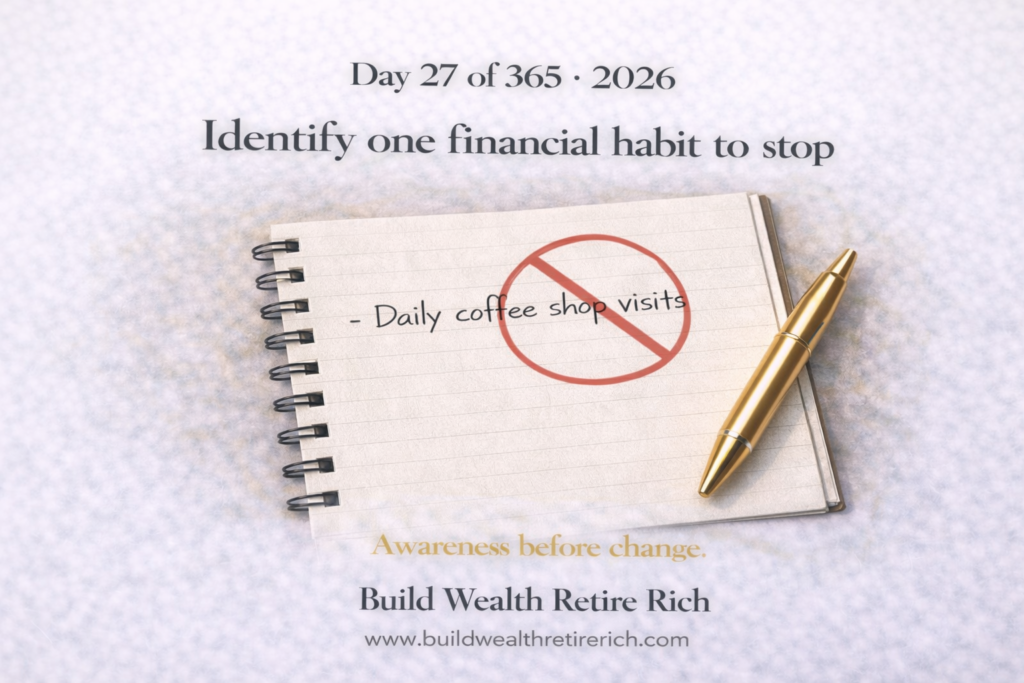
Identify one current spending habit worth $50–$100/month that doesn’t bring proportional value — redirect it
Do not check your balance more than once a month. Do not sell when the market drops. Do nothing except keep contributing
“The best investors aren’t the ones who found the best stocks or timed the market perfectly. They’re the ones who started earliest, stayed consistent the longest, and never let fear or impatience interrupt the process.”
◆ ◆ ◆
Frequently Asked Questions
Why is investing in your 20s so much better than starting later?
Because compound interest is exponential, not linear. Money invested in your 20s has 40+ years to double, redouble, and compound again. The same contribution at 35 has 20 fewer years — meaning it doubles only half as many times. A 10-year delay on a $100/month investment at 7% return reduces your retirement balance by approximately $160,000–$200,000 depending on exact timing.
I have student loans. Should I still invest in my 20s?
Yes, in most cases. If your federal student loan rate is below 7%, the expected market return outpaces your debt cost — meaning you come out ahead investing while making minimum loan payments. If you have high-interest credit card debt (20%+), pay that off first. For federal loans in the 4–7% range, doing both simultaneously is the mathematically sound approach. Don’t use student loans as a reason to delay investing entirely.
What if I can only invest $25 or $50 a month as a student?
Start with exactly that. At 7% return, $25/month started at 20 grows to over $94,000 by 65. $50/month grows to over $189,000. These numbers aren’t impressive in isolation — they’re extraordinary given that a student sacrificed less than the cost of a streaming subscription per week to create them. The habit and the account matter more than the initial amount. Increase contributions as your income grows.
Is it safe to invest as a college student with limited income?
As long as your emergency fund and essential expenses are covered first, yes. Only invest money you won’t need for at least 5 years — ideally decades. Never invest your emergency fund or money you might need for rent or tuition. Roth IRA contributions (not earnings) can be withdrawn penalty-free if absolutely necessary, making it safer than most people realize as a long-term vehicle.
What is the best account for a student who wants to start investing in their 20s?
A Roth IRA is almost always the best starting point. It offers tax-free growth and tax-free withdrawals in retirement — and since most students are in a low tax bracket now, paying tax on contributions today is cheap compared to the decades of tax-free compounding ahead. Open one at Fidelity, Vanguard, or Schwab. Contribute monthly into a total market index fund. That is the complete strategy for most people under 30.
Investing for Students: A Beginner’s Guide | The Campus Investor
The Campus Investor
Build Wealth from Day One
📈 Issue No. 06 · Investing Series
Investing for Students: A Beginner’s Guide
May 2026 | 7 min read | For College Students
Most college students think investing is something you do later — after the real job, after the debt is paid off, after life feels more settled. That thinking is understandable. It’s also one of the most expensive financial mistakes you can make, because investing is the one area of personal finance where time is the single most valuable ingredient — and you can never get it back.
You don’t need thousands of dollars to start. You don’t need a finance degree or a brokerage account with a complicated interface. You need to understand four ideas, open one account, and invest one amount consistently. That’s it. This guide walks you through all of it.
Those numbers are the entire argument for investing in college. Not starting young doesn’t just cost you some growth — it cuts your outcome nearly in half. The decade between 20 and 30 is the most powerful investing decade of your entire life, and most people spend it doing nothing.
Why Investing in College Matters More Than You Think
Investing feels abstract when you’re living on a part-time salary and managing tuition bills. But here’s what most students don’t understand: the stock market doesn’t care how much you invest — it cares how long you invest. A small amount over a long time almost always beats a large amount over a short time.
Priya invests $80 a month starting at age 20. Her roommate Jordan waits until 30 to start and invests $300 a month — nearly four times as much. At 65, who has more? Priya does. By a lot. Because the decade between 20 and 30 compounded her early dollars into something Jordan’s larger contributions can never fully catch up to.
“The best time to start investing was when you got your first paycheck. The second best time is today — not after graduation, not after the raise, not when things settle down. Today.”
Compound interest means your money earns returns — and then those returns earn returns too. It sounds simple but the math over decades is staggering. Here’s what $50 a month looks like invested at a 7% average annual return across different starting ages:
$50/Month Invested at 6.5% Average Annual Return — Balance at Age 65
Start at 20
$161,000+
45 years invested
Start at 25
$114,000+
40 years invested
Start at 30
$80,000+
35 years invested
Start at 35
$55,000+
30 years invested
Start at 40
$37,000+
25 years invested
Same $50 a month. Same 6.5% return. The only variable is when you start. Starting at 20 versus 40 produces more than four times the outcome. Compound interest doesn’t reward effort — it rewards time. College is where that time begins.
📐 The Rule of 72
Divide 72 by your expected annual return to find out how many years it takes your money to double. At 7% return: 72 ÷ 7 = approximately 10 years to double. So $1,000 invested at 20 becomes ~$2,000 at 30, ~$4,000 at 40, ~$8,000 at 50, and ~$16,000 at 60 — without adding a single dollar more.
The Types of Investments Students Should Know About
You don’t need to understand every investment product on the market. You need to understand four — and for most students, only one of them really matters right now.
Investment Type 01
Stocks — Ownership in a Company
When you buy a stock, you own a tiny piece of a company. If the company grows and becomes more valuable, your shares are worth more. Stocks offer the highest long-term returns but also the most short-term volatility — prices go up and down constantly. Beginners should not pick individual stocks. Instead, use index funds (below) to own hundreds of stocks at once.
Investment Type 02
Index Funds — The Smart Beginner’s Choice
An index fund holds a basket of stocks that mirrors a market index — like the S&P 500 (the 500 largest US companies). Instead of picking winners, you own a slice of everything. This instant diversification means one bad company can’t sink your investment. Index funds have low fees, require no expertise, and historically outperform most actively managed funds over the long run. This is where almost every beginner should start.
Investment Type 03
Bonds — Lower Risk, Lower Return
Bonds are loans you make to governments or corporations in exchange for regular interest payments. They’re safer than stocks but grow much more slowly. At your age, bonds should be a very small part — or no part — of your portfolio. You have decades ahead of you, which means you can afford to ride out stock market dips and benefit from higher long-term growth.
Investment Type 04
ETFs — Index Funds You Can Trade Like Stocks
Exchange-traded funds (ETFs) work like index funds but trade on stock exchanges throughout the day like individual stocks. Many popular index funds come in ETF form — like VTI (Vanguard Total Stock Market ETF) or VOO (Vanguard S&P 500 ETF). For beginners they’re functionally identical to index funds. Low cost, diversified, and simple.
For most college students, the entire investing strategy is: open a Roth IRA → buy a total market index fund → contribute monthly → don’t touch it. Four steps. Zero complexity. Maximum time in the market.
Why the Roth IRA Is the Best First Account for Students
There are many types of investment accounts. For college students, one stands above everything else: the Roth IRA. Here’s why it’s extraordinary — and why starting one in college is one of the best financial decisions you can make.
Feature
Roth IRA
Regular Brokerage Account
Traditional IRA
Tax on contributions
After-tax (you pay tax now)
After-tax
Pre-tax (deducted now)
Tax on growth
Tax-Free Forever
Taxed Each Year
Taxed at Withdrawal
Tax on withdrawals
Zero Tax in Retirement
Capital Gains Tax
Taxed as Income
Early withdrawal of contributions
Allowed Penalty-Free
Allowed Anytime
Penalty Before 59½
Best for students?
Yes — Ideal
After Roth is Maxed
Less Ideal in College
The Roth IRA’s superpower is tax-free growth. You pay income tax on the money before it goes in — but everything it earns over decades, and every dollar you take out in retirement, is completely tax-free. Since most college students are in a low tax bracket right now, the tax you pay going in is minimal. The tax-free compound growth over 40+ years is enormous.
📋 Roth IRA Rules to Know
Eligibility: You must have earned income (wages from a job). Investment returns don’t count. | Contribution limit: $7,500 per year (2026). | Income limit: Phases out above $150,000 single filer — not a concern for most students. | Withdrawal of contributions: Can be taken out penalty-free at any time — making it a flexible long-term savings vehicle, not just a retirement account.
✉ Free Newsletter — Join 5,000+ Students
Something went wrong. Please try again.
Your subscription has been successful.
How to Start Investing in 4 Steps
This is the practical part. Here are the four steps to go from zero to invested — most students complete all four in under 30 minutes.
1
Open a Roth IRA
Go to Fidelity.com, Vanguard.com, or Schwab.com. Click “Open an Account,” select Roth IRA, and complete the application. You’ll need your Social Security number, bank account details, and about 10 minutes. All three platforms are free with no account minimums.
2
Fund It — Even $25
Link your checking account and make an initial deposit. There is no minimum. $25, $50, $100 — whatever you can do right now. The amount matters less than starting. You can always increase contributions as your income grows.
3
Buy One Index Fund
Search for a total US market index fund: FSKAX (Fidelity), VTSAX or VTI (Vanguard), or SWTSX (Schwab). These funds hold thousands of companies in one investment, have razor-thin fees (often under 0.05%), and require zero expertise to hold.
4
Automate Monthly Contributions
Set up automatic monthly contributions from your checking account — whatever amount fits your budget. Automation means you never have to decide whether to invest. The money moves before you can spend it. Set it, forget it, and let compound interest do its work.
Mini-Case · Starting Small, Thinking Long
Keiko, Sophomore — Biology
Keiko worked 10 hours a week at the campus bookstore — about $360 a month after taxes. After rent, groceries, and her phone bill, she had around $90 left over. She’d been spending it on miscellaneous things each month without tracking it.
After reading about Roth IRAs, she opened a Fidelity account on a Sunday afternoon. She set up a $60 monthly contribution into FSKAX (Fidelity’s total market index fund) and adjusted her miscellaneous spending down by $60. The whole process took 25 minutes.
She didn’t feel the difference in her daily life. But over 45 years at a 6.5% average return, that $60 a month started at 20 is projected to grow to over $193,000 — entirely tax-free in a Roth IRA.
The lesson: $60 a month doesn’t change your lifestyle. It changes your retirement. Keiko didn’t wait until she had “enough” to invest — she started with what she had, and time did the rest.
Knowing what to do is half the battle. Knowing what to avoid is the other half. These are the four most common investing mistakes college students make:
⚠️ Mistake 1 — Waiting for the “Right Time”
There is no right time. The market will always look scary, uncertain, or overpriced to someone. Students who wait for a perfect entry point almost always wait years — and those years are the most expensive thing they never bought. Time in the market beats timing the market. Always. Start now with whatever you have.
⚠️ Mistake 2 — Picking Individual Stocks
Buying individual stocks feels exciting. It’s also how most beginners lose money. Picking stocks requires significant research, expertise, and tolerance for volatility. Even professional fund managers fail to beat the market index consistently over time. Skip the individual stocks entirely and use index funds instead — you’ll outperform most active investors by doing less.
⚠️ Mistake 3 — Panic-Selling During Market Dips
The stock market drops regularly — by 10%, 20%, sometimes more. Every major dip in history has eventually recovered and gone on to new highs. Students who sell when the market drops lock in their losses permanently. Students who hold (or keep contributing) through downturns end up buying more shares at lower prices. Your job during a market dip is to do absolutely nothing.
⚠️ Mistake 4 — Not Investing Because of Student Loans
If your federal student loan interest rate is below 7%, mathematically you are better off investing in the market (historically 7–10% average annual return) than aggressively paying down low-interest debt. This doesn’t mean ignore your loans — it means don’t sacrifice investing entirely for debt that costs you less than the market returns. Both can happen at once.
◆ ◆ ◆
Investing doesn’t require confidence, a large income, or perfect market knowledge. It requires one account, one fund, one automated contribution, and the patience to leave it alone. Every week you wait is a week of compound growth you can’t get back. Every week you’re invested is a week that works for your future self.
“You don’t build wealth by being the smartest investor in the room. You build it by being the most consistent one — starting earlier than everyone else, and never stopping.”
Your Investing Action List — Do This This Weekend
Open a Roth IRA at Fidelity, Vanguard, or Schwab — free, takes 10 minutes
Make an initial deposit — any amount, no minimum required
Buy a total market index fund: FSKAX, VTI, or SWTSX
Set up an automatic monthly contribution — even $25 or $50
Do not check your balance more than once a month — avoid the temptation to react
Increase your contribution by $10–$25 every time your income increases
Frequently Asked Questions
How much money do I need to start investing as a college student?
You don’t need a minimum amount. Fidelity, Vanguard, and Schwab all offer Roth IRAs with no account minimums and no fees. You can start with $25. The amount matters far less than starting — compound growth needs time, not a large initial deposit. Starting with $25 a month at 20 beats starting with $500 a month at 35.
What is the best investment for a college student?
A total market index fund inside a Roth IRA. The Roth IRA gives you tax-free growth for decades. A total market index fund (like FSKAX, VTI, or SWTSX) gives you instant diversification across thousands of companies with minimal fees. This single combination — available for free at any major brokerage — is the foundation of most successful long-term investment strategies.
Should I pay off student loans or invest first?
If your loan interest rate is below 7%, consider doing both — make your minimum loan payments and invest a small amount simultaneously. If your rate is above 7–8%, paying down debt first makes more mathematical sense since the guaranteed “return” of eliminating high-interest debt beats the uncertain market return. High-interest credit card debt (20%+ APR) should always be paid off before investing.
Is investing risky for college students?
All investing carries risk, but time dramatically reduces it. The stock market has always recovered from every historical downturn and gone on to new highs over long periods. As a college student investing for 40+ years, short-term volatility is largely irrelevant. The real risk is not investing at all — losing decades of compound growth is far more costly than riding out market fluctuations.
Can I withdraw money from a Roth IRA if I need it in an emergency?
Yes — you can withdraw your contributions (the money you put in, not the earnings) from a Roth IRA at any time, for any reason, with no taxes or penalties. This makes it more flexible than most people realize. However, it’s best to treat your Roth IRA as untouchable and build a separate emergency fund for unexpected expenses — so compound growth is never interrupted.
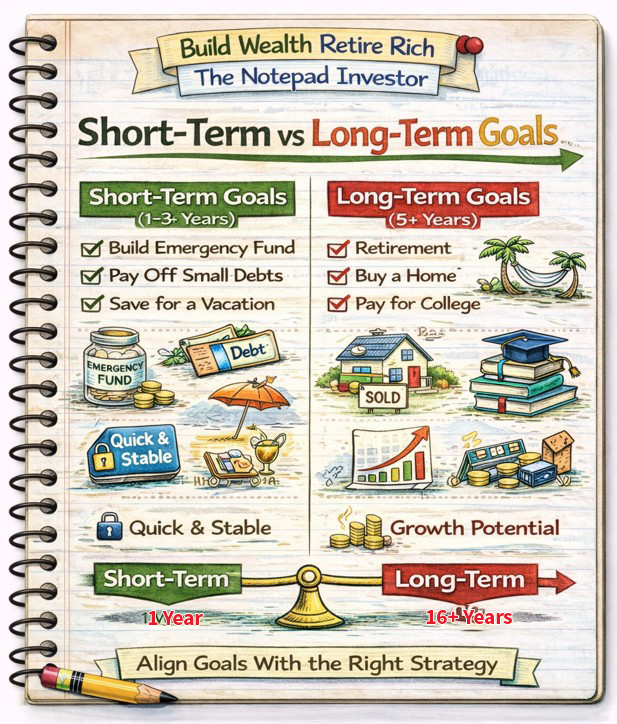
Short-term vs long-term goals distinguish financial objectives by timeframe and approach—short-term goals span days to two years requiring immediate action and liquid savings (emergency funds, vacation savings, small debt payoff), while long-term goals extend 10+ years enabling compound growth through investments (retirement, homeownership, children’s education). Unlike treating all goals identically, understanding timeframe differences guides appropriate saving and investment strategies: short-term money stays accessible in savings accounts avoiding market volatility risk, long-term money invests in stocks accepting temporary fluctuations for superior growth compounding over decades.
This article is designed for anyone balancing multiple financial priorities, individuals uncertain which goals to pursue first, or those making poor strategy choices for goal timeframes. You do not need investment expertise, large incomes, or complex financial knowledge to distinguish goal types—simple awareness that different timeframes require different strategies prevents costly mistakes like investing retirement money too conservatively or keeping down payment savings in volatile stocks.
Understanding short-term versus long-term goals matters because investing emergency fund money risks needing it during market downturns forcing losses, keeping retirement savings in low-return accounts costs hundreds of thousands in forgone compound growth, and treating all goals identically leads to either excessive risk or insufficient returns—yet many people use same approach for three-month and thirty-year goals despite vastly different optimal strategies.
Educational disclaimer: This article provides general educational information about goal timeframes and strategies. Individual circumstances, risk tolerance, and financial situations vary significantly. This is not financial planning or investment advice. Consult qualified financial professionals for personalized guidance.
Defining Goal Timeframes
Short-Term Goals (0-2 Years)
Timeframe: Immediate to 24 months
Characteristics:
Need money accessible within months or year
Cannot afford market volatility risk
Prioritize capital preservation over growth
Little time for compound growth benefit
Liquidity essential—must access quickly without penalty
Example: Investing $300 monthly retirement while paying 20% on $8,000 credit card—losing net 12% annually despite “saving”
Solution: Complete foundation (starter emergency fund, high-interest debt payoff) before aggressive long-term investing
No Medium-Term Goals
Mistake: Only short-term (bills) and long-term (retirement), nothing for 2-10 year goals
Cost: Major life purchases (home, car) require debt or raiding retirement with penalties and taxes
Example: Need $25,000 car at 35, no savings, choose between auto loan (pay interest) or 401k withdrawal (penalty + taxes + retirement setback)
Solution: Balance all three timeframes—maintain short-term security, medium-term flexibility, long-term growth simultaneously
Rigid Timeframe Categories
Mistake: “This is 8-year goal so must stay in bonds” even as goal becomes 2-year goal
Cost: Taking inappropriate risk as goal deadline approaches, potential loss when need stability
Example: Down payment fund stays 70% stocks when only 18 months until home purchase—market drop devastates nearly-complete goal
Solution: Reassess timeframe and risk annually, shift to more conservative as goals approach
Lifestyle Inflation Consuming Long-Term Capacity
Mistake: Every raise goes to short-term lifestyle spending (bigger apartment, nicer car, more dining)
Cost: No increase in long-term savings, perpetual retirement shortfall despite income growth
Example: Income grows from $50,000 to $80,000 over decade, retirement contribution stays $200 monthly—spending grew 60%, retirement 0%
Solution: Direct 50-100% of raises to long-term goals before lifestyle adjusts
Why Understanding Timeframes Matters
Without understanding goal timeframes, people invest emergency funds risking unavailability during actual emergencies, keep retirement money in savings accounts forfeiting hundreds of thousands in compound growth, and create unstable financial foundations by prioritizing long-term over essential short-term needs—while those matching strategies to timeframes build secure foundations, grow wealth through appropriate risk-taking, and achieve both immediate and distant financial objectives.
Understanding short-term versus long-term goals enables individuals to:
Match investment risk to goal timelines appropriately
Maximize compound growth on long-term money through aggressive allocation
Protect short-term money from market volatility ensuring availability
Build balanced financial plans addressing immediate and distant needs
Avoid costly mistakes from timeframe-strategy mismatches
Achieve superior outcomes through timeframe-appropriate approaches
Timeframe awareness transforms financial planning from one-size-fits-all approaches to optimized strategies for each goal’s specific horizon.
Advertisement
Reserved space for in-content ad
Common Misunderstandings
Many people assume market investments are always better than savings accounts because higher returns. In reality, timeframe determines optimal vehicle—stocks superior for 10+ year goals but catastrophic for 6-month goals when market timing risk exists, proving investment returns meaningless if forced to sell during downturns before recovery time available.
Another common misconception is that conservative approaches (keeping everything in savings) protects wealth. In practice, inflation and opportunity cost erode conservative long-term holdings—retirement money in 4% savings versus 8% stocks costs $400,000+ over 30 years on $500 monthly contributions, proving conservative approaches appropriate for short-term protection but devastating for long-term growth.
Some believe they must choose between short-term security and long-term wealth building. However, proper financial planning addresses both simultaneously through prioritized sequencing—foundation first (emergency fund, debt), then balanced allocation across timeframes ensuring both immediate stability and distant prosperity rather than sacrificing one for the other.
How Goal Timeframes Fit Into Financial Success
Goal timeframe understanding provides framework matching strategies to horizons—short-term money protected in liquid accounts, medium-term money balanced between growth and safety, long-term money invested aggressively for maximum compound benefit—creating financial plans that address immediate needs while building substantial future wealth through appropriate risk-taking based on time available.
For example, two 30-year-olds each earning $60,000 with $1,000 monthly available for goals. Person A doesn’t distinguish timeframes—puts all money in savings earning 4% for both emergency fund and retirement. Person B understands timeframes—builds $10,000 emergency fund in savings (short-term), then splits remaining funds: $700 monthly to stocks for retirement (long-term aggressive 8%), $300 monthly to balanced fund for home down payment in 7 years (medium-term moderate 6%). After 30 years: Person A has $693,000 total in savings (emergency fund + retirement). Person B has $10,000 emergency fund, bought home after 7 years, and $1,263,000 retirement portfolio (from $700 monthly at 8%)—plus home equity. Person B’s timeframe-appropriate strategies produced $580,000 additional retirement wealth plus homeownership versus Person A’s one-size-fits-all conservative approach. Same monthly amount, different timeframe understanding, dramatically different outcomes.
Timeframe awareness multiplies wealth by optimizing each goal’s strategy for its specific horizon rather than treating all goals identically.
Recent Updates and Trends
In recent years, high-yield savings accounts reaching 4-5% have made short-term vehicles more attractive—better returns on emergency funds and near-term goals reduce pressure to take inappropriate risks chasing yield.
Target-date funds have simplified long-term investing—automatically adjust from aggressive to conservative as retirement approaches, solving timeframe-shifting challenge for hands-off investors.
FIRE movement emphasis on early retirement has highlighted medium-term goal importance—bridge accounts between current income and traditional retirement age require 5-15 year planning beyond typical short/long dichotomy.
Market volatility awareness has increased—2020 pandemic crash and 2022 bear market reminded investors that short-term money in stocks risks significant losses when needed most, reinforcing timeframe-appropriate positioning.
Fundamental timeframe principles remain timeless: short-term money prioritizes safety and liquidity over returns, long-term money prioritizes growth over stability accepting volatility for compound benefit, medium-term money balances both objectives, and matching strategy to timeframe produces superior outcomes versus one-size-fits-all approaches—regardless of current market conditions, interest rate environment, or economic circumstances, appropriate timeframe strategy optimization separates financial success from preventable failures.
3 Things You Can Do Today
Ready to optimize goal timeframes? Here are three simple steps you can take right now:
1. Categorize all current financial goals by timeframe – List every financial goal: emergency fund, vacation, down payment, retirement, debt payoff, etc. Label each: Short (0-2 years), Medium (2-10 years), Long (10+ years). Review where money is currently held. Example: If emergency fund in stocks or retirement in savings, timeframe mismatch identified. This audit reveals inappropriate placements requiring correction preventing costly mistakes.
2. Verify short-term money in appropriate vehicles – Identify all money needed within 2 years (emergency fund, upcoming large purchases, near-term savings). Check current location. If any in stocks, bonds, or volatile investments, move to high-yield savings account this week. Accept lower returns for guaranteed safety and liquidity. Example: $5,000 emergency fund in stock fund moves to savings earning 4-5%—small return sacrifice prevents devastating loss if market crashes when emergency occurs.
3. Verify long-term money invested for growth – Identify all money not needed for 10+ years (primarily retirement accounts). Check current allocation. If over 50% in savings/bonds/CDs, create plan to shift to stock index funds over next 3-6 months. Use online calculator to see cost of conservative approach. Example: $300 monthly for 25 years at 4% = $184,000 vs 8% = $281,000—$97,000 cost of staying too conservative. Moving to appropriate aggressive allocation captures growth potential.
These actions align financial positioning with goal timeframes eliminating costly mismatches between when money is needed and how it’s invested.
Advertisement
Reserved space for in-content ad
Quick FAQ
How do I know if a goal is short-term or long-term?
Simple rule: Will you need the money within 2 years? Short-term. Between 2-10 years? Medium-term. More than 10 years? Long-term. When uncertain, err conservative—treat 3-year goal as short-term if uncomfortable with any volatility, or as medium-term if can delay 6-12 months if needed. Exact boundaries matter less than matching strategy to approximate horizon.
What if I have multiple goals with different timeframes?
Separate money into different accounts matching each timeframe: Short-term in savings accounts, medium-term in conservative investments or savings depending on exact timeline, long-term in stock-focused investments. Example: $800 monthly split: $200 savings for vacation (short), $200 balanced fund for down payment (medium), $400 stock index for retirement (long). Each goal gets appropriate vehicle.
Can I ever put short-term money in stocks?
Only if you can genuinely delay goal by 3-5 years if market crashes. True emergencies and fixed deadlines require guaranteed-safe vehicles. Flexible short-term goals (vacation you could postpone, home purchase you could delay) might accept limited stock exposure (20-30%) if willing to adjust timing. But classic emergency fund? Never in stocks—defeats purpose.
When should I shift from aggressive to conservative as goals approach?
General guideline: Start shifting from stocks to bonds/savings when 3-5 years from goal deadline. Example: College fund for high schooler ages 14-18, down payment fund within 5 years of anticipated home purchase, retirement at age 60-65 (shift at 55-60). Gradual shift over several years better than sudden change preventing forced selling during temporary downturn.
What about emergency funds—are they really short-term?
Yes, always treat as short-term even though hopefully never needed. Purpose is immediate availability during emergencies which may occur anytime. Cannot risk market being down when job loss or medical emergency strikes. Emergency funds in stocks defeats entire purpose—might need when market down 30%, forced to sell at loss. Keep in high-yield savings regardless of years before potentially needed.
Should all my retirement money be in stocks even if I’m close to retirement?
No. General guideline: Percentage in stocks = 110 minus age. Age 35: 75% stocks. Age 55: 55% stocks. Age 65: 45% stocks. Rationale: Retirement lasts 20-30 years—money needed in year 1 is short-term (bonds/savings), money for year 20 is long-term (stocks). Gradually shift but maintain growth allocation since retirement is multi-decade period, not single event.
This article is provided for educational purposes only and does not constitute financial planning, investment, or professional advice. Individual circumstances, risk tolerance, financial situations, and goals vary significantly. Timeframe categories and strategies are generalizations—specific appropriate approaches depend on personal factors. Investment return examples use historical averages—actual returns vary significantly and are not guaranteed. Risk tolerance varies individually—some may prefer more conservative approaches even for long-term goals. Asset allocation suggestions are general guidelines, not personalized recommendations. Market conditions change affecting optimal strategies. Consult qualified financial planners, investment advisors, and professionals for personalized guidance considering specific situations, timelines, and risk tolerances. Advertisements or sponsored content may appear within or alongside this content. All information is presented independently.
Interactive Quiz: Short-Term vs Long-Term Goals
Choose an answer and click Check Answer to see the explanation.
1. What is the primary difference between short-term and long-term financial goals?
2. Which of the following is typically considered a short-term financial goal?
3. Why are savings accounts typically recommended for short-term financial goals?
4. Which investment approach is generally appropriate for long-term financial goals?
5. What is a common mistake people make when managing goal timeframes?
Some expenses feel fixed simply because they repeat.
Phone and internet bills arrive every month, get paid automatically, and are rarely questioned. Over time, small inefficiencies can quietly add up without being noticed.
Day 22 is about visibility — not negotiation.
Today’s Focus
Review your phone and internet bills.
Read through the charges. Notice what you’re paying for. No calls or changes today.
Why This Step Matters
Recurring bills shape your cash flow more than occasional expenses.
When you understand these costs:
Awareness increases
Future decisions feel easier
Opportunities become visible
Clarity always comes before optimization.
This Is Not About Perfection
You’re not expected to reduce or cancel anything today.
Simply knowing what you pay creates control.
Reflection Question
What surprised you when you reviewed these bills?
What’s Next
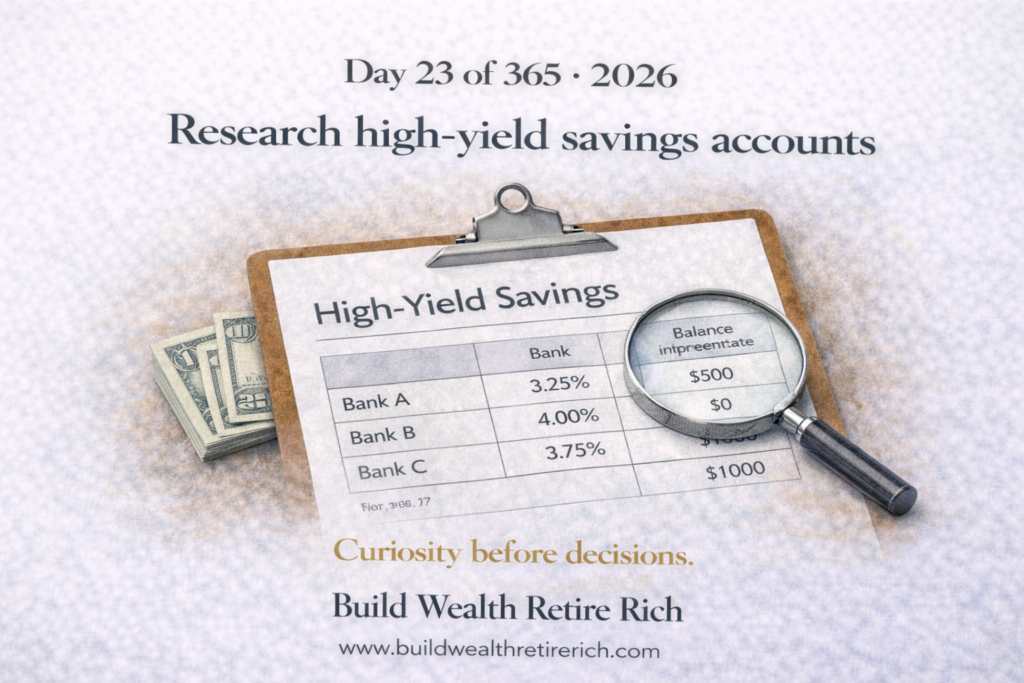
Tomorrow, we’ll explore how your savings could quietly work harder for you.