When financial documents are scattered, even simple tasks can feel heavier than they should. Organization doesn’t require perfection — it just needs a system you trust.
Day 16 is about creating order, not control.
Today’s Focus
Organize your financial documents digitally.
One folder is enough. You don’t need to organize everything. Progress matters more than completeness.
Why This Step Matters
When information is easy to find:
Decisions feel lighter
Tasks take less time
Stress decreases
Order creates confidence before action begins.
This Is Not About Perfection
You’re not building a perfect filing system.
You’re creating a starting point that makes future steps easier.
Reflection Question
What feels easier once your documents are in one place?
What’s Next
Tomorrow, we’ll remove one small source of financial friction. For today, organization is enough.
Taxes often feel stressful because they stay in the background.
Money comes in, deductions happen, and most people never pause to ask whether everything is aligned. That quiet uncertainty can turn into frustration later, even when nothing is technically “wrong.”
Day 15 is about awareness — understanding what’s currently happening before any changes are considered.
Today’s Focus
Check the tax withholding on your paycheck.
This is a review only. No adjustments today. No action required beyond looking.
You’re simply becoming familiar with how taxes are handled right now.
Why This Step Matters
Tax surprises usually don’t come from mistakes. They come from lack of visibility.
When you understand withholding:
Uncertainty decreases
Confidence increases
Future planning becomes easier
Awareness today prevents stress later.
This Is Not About Perfection
You don’t need to understand every detail immediately.
Today is just about noticing what’s there so nothing feels hidden or confusing.
Reflection Question
How does knowing this information change how you feel about your paycheck?
What’s Next
Tomorrow, we’ll organize the information you already have so it’s easier to access when you need it.
Title: What Is Simple Interest? — The Foundation of Financial Growth Meta Description: Learn how simple interest works, how to calculate it, and why it’s the first step toward understanding compound interest and long-term investing.
💡 Definition: What Is Simple Interest?
Simple interest is the most basic form of earning or paying interest. It’s calculated only on your original amount — the principal — not on the interest that builds up along the way.
When you deposit money in a savings account, a bank pays you interest for allowing them to use your funds. When you take a loan, you pay the lender interest for borrowing their money. In both cases, the simple interest formula stays the same:
🧮 Simple Interest = Principal × Rate × Time
This predictable structure makes simple interest a great starting point for understanding how money grows (or costs) over time.
📈 Example: How to Calculate Simple Interest
Let’s say you deposit $1,000 in a short-term savings product that pays 5% per year.
Year 1: 1,000 × 0.05 × 1 = $50
Year 2: Another $50
After 2 years: You’ve earned $100 total interest
Your final balance will be $1,100. Notice that the second year earns the same $50 because you’re not earning interest on the interest — only on the original $1,000.
Simple interest is straightforward: easy to calculate, easy to predict. That’s why it’s commonly used in short-term loans, car financing, and savings certificates.
🧠 Why Simple Interest Matters
Understanding simple interest gives you control and confidence over your money. It helps you:
Estimate returns on fixed-term deposits, CDs, and treasury bills.
Compare loans — to see how much total interest you’ll pay.
Build awareness for how your money grows (or your debt accumulates).
It also prepares you for the next step in wealth building: compound interest — where interest begins earning its own interest, creating exponential growth.
Knowing how simple interest works ensures you don’t get confused when comparing savings accounts or loan terms. It’s your first step in financial literacy.
🚀 How to Use Simple Interest in Real Life
For Saving: Choose short-term simple-interest products if you value predictability.
For Borrowing: Calculate total loan interest upfront — avoid surprises.
For Learning: Use simple interest examples to understand time, rate, and principal relationships before moving to compounding.
For Planning: If your goal is steady, guaranteed growth for a short period, simple interest is ideal.
💡 Money Tip: The more time your money is invested, the more important it becomes to switch from simple interest to compound interest to accelerate your growth.
🌱 Final Thought
Simple interest is the foundation of financial awareness. It teaches you how money grows in its most basic form — steady, transparent, and easy to calculate.
Once you master simple interest, the next step is learning how compound interest builds on it — turning simple growth into exponential wealth over time.
The Time Value of Money (TVM) is one of the most fundamental financial principles. It explains that money today is worth more than the same amount in the future due to its earning potential. Whether you’re saving for retirement, paying off a loan, or planning an investment, our TVM Calculator at Build Wealth Retire Rich makes complex financial calculations easy.
This guide walks you through how to use the calculator to make smarter financial decisions.
TVM Calculator
TVM Calculator
Key Features of the TVM Calculator
Our TVM Calculator is designed for ease of use and allows you to:
✔️ Select whether payments occur at the beginning or end of the period ✔️ Enter a Present Value (PV), Future Value (FV), or solve for either ✔️ Choose a payment frequency (weekly, monthly, annually, etc.) ✔️ Adjust for different compounding periods (annually, monthly, weekly, or daily) ✔️ Automatically compute results based on your inputs
Key Inputs
Present Value (PV): The starting amount of money (investment or loan).
Payment (PMT): The regular contribution or withdrawal per period.
Future Value (FV): The amount accumulated at the end of the given years.
Annual Interest Rate (%): The yearly rate of return or loan interest.
Periods (Number of Years): The total number of years for the investment or loan.
Compounding Frequency: Choose from annually, monthly, weekly, or daily.
Important:
If you deposit or invest money, enter PV and PMT as negative numbers because they represent cash outflows.
If you are taking out a loan, enter PV as a positive number since it represents borrowed money.
How to Use the TVM Calculator for Different Financial Goals
1. Calculate Future Value of an Investment
To find out how much your money will grow over time:
✔️ Enter Present Value (PV): Initial investment amount (negative value). ✔️ Enter Payment (PMT): Recurring contribution (negative value). ✔️ Enter Annual Interest Rate (%): Expected return. ✔️ Enter Periods (Number of Years): Duration of the investment. ✔️ Select Compounding Frequency: Choose how often interest compounds. ✔️ Click “Compute” next to FV to calculate your total future amount.
Example:
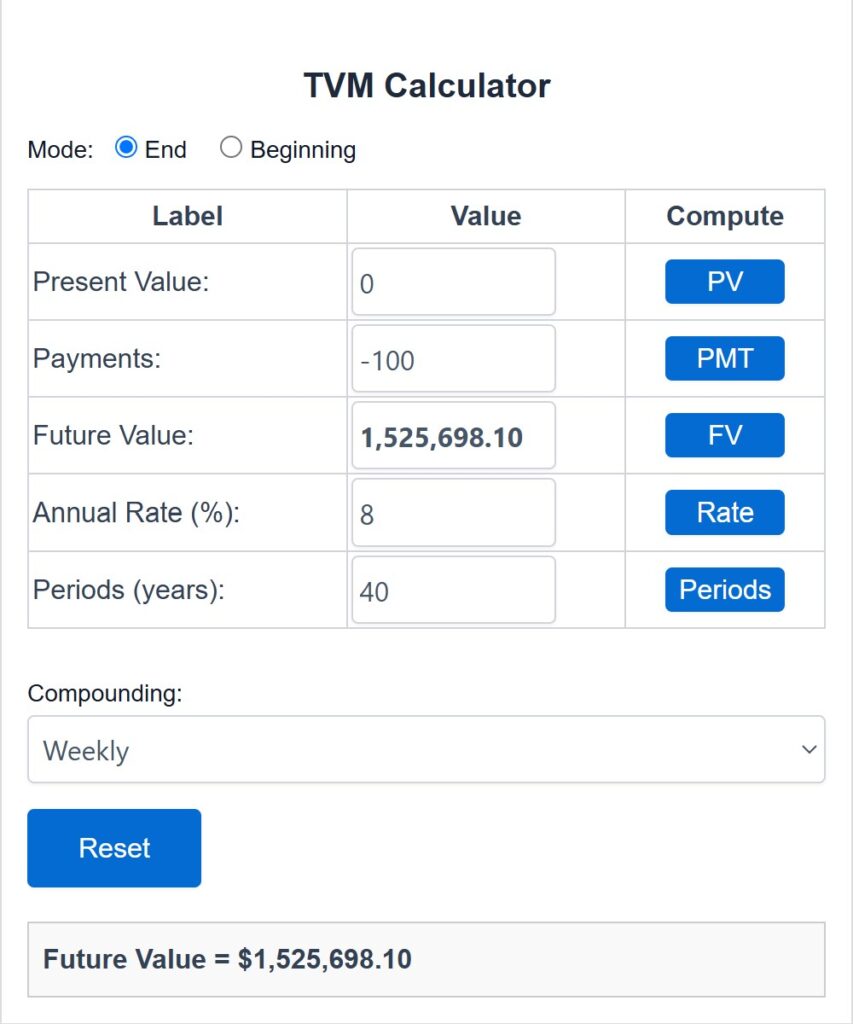
Investment: $100 a week
Annual Interest Rate: 8%
Years: 40
Compounded Weekly
Input:
PV: 0
Payments: -100 (if contributing $100 per week)
Annual Rate: 8
Period Years: 40
Compounding: Weekly
Output:Future Value (FV) = $1,525,698.10
2. Find Out How Much You Need to Save to Reach a Goal
✔️ Enter Future Value (FV): Your desired final amount. ✔️ Enter Present Value (PV): Any initial savings (negative value). ✔️ Enter Annual Interest Rate (I/Y): Expected return. ✔️ Enter Number of Years: Time until your goal. ✔️ Select Compounding Frequency: Choose compounding method. ✔️ Click “Compute” next to PMT to see how much you need to save per period.
Example:
Goal: $500,000
Annual Interest Rate: 7%
Periods (Years): 20
Compounded Monthly
Input:
Present Value: 0
Annual Rate (%): 7
Years: 20
Compounding: Monthly
Compute PMT
Output:
You need to save $959.83 per month
3. Calculate Loan or Mortgage Payments
✔️ Enter Present Value (PV): Loan amount (positive value). ✔️ Enter Annual Interest Rate (I/Y): Loan interest rate. ✔️ Enter Number of Years: Loan duration. ✔️ Select Compounding Frequency: Choose how often interest compounds. ✔️ Click “Compute” next to PMT to see required payment per period.
Example:
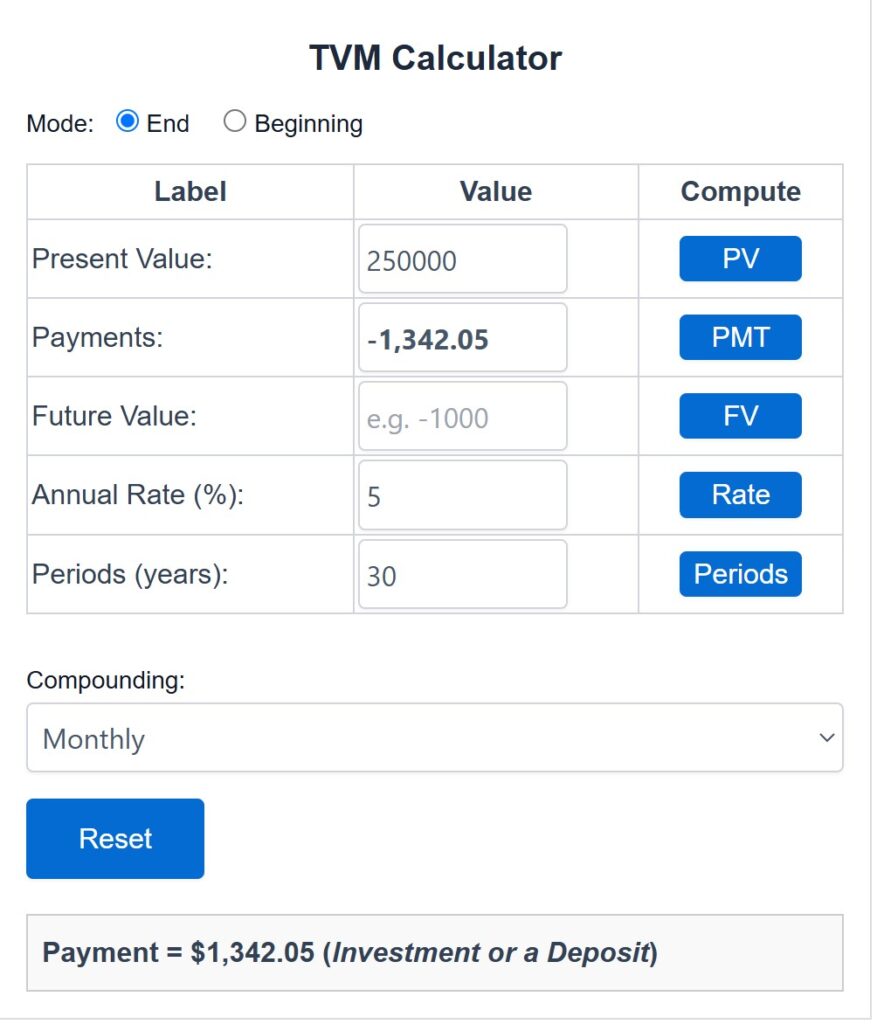
Loan Amount: $250,000
Annual Interest Rate: 5%
Years: 30
Compounded Monthly
Input:
Present Value: 250,000
Annual Rate (%): 5
Periods(Years: 30
Compounding: Monthly
Compute PMT
Output:
Monthly Payment (PMT) = $1,342.05 (Deposit)
Note: The negative sign means this is a payment (cash outflow).
Understanding Mode: End vs. Beginning Payments
The TVM Calculator allows you to choose whether payments occur at the beginning or end of each period.
✔️ End Mode: Most common setting, where payments are made at the end of each period. ✔️ Beginning Mode: Used for cases where payments are made at the start of each period (e.g., rent payments).
Example: If rent is due at the start of the month, use Beginning Mode; if payments are made after a service period, use End Mode.
Why Use This TVM Calculator?
✔️ Simple & Intuitive: Just enter values and hit “Compute”—no manual formulas required! ✔️ Multiple Payment & Compounding Options: Supports annual, monthly, weekly, and daily compounding. ✔️ Accurate Results: Ensures correct calculations without needing Excel or a financial calculator. ✔️ Works for Both Investments & Loans: Helps with retirement planning, wealth building, and debt management.
Start Planning Your Financial Future Today!
The TVM Calculator is an essential tool for financial success. Whether you’re investing, saving, or borrowing, mastering the Time Value of Money will help you maximize wealth and avoid costly financial mistakes.