Tag: Wealth Building

  • Why You Should Start Investing in Your 20s

    Why You Should Start Investing in Your 20s

    Why You Should Start Investing in Your 20s | The Campus Investor
    The Campus Investor
    Build Wealth from Day One
    📈 Issue No. 07  ·  Investing Series

    Why You Should Start Investing in Your 20s

    May 2026 | 7 min read | For College Students

    Here is a financial truth that nobody tells you loudly enough: your 20s are the single most powerful investing decade of your entire life. Not your 40s when you have more money. Not your 50s when you’re thinking seriously about retirement. Your 20s — right now — when time is working completely in your favor and every dollar you invest is worth more than any dollar you’ll invest later.

    Most people understand this in theory and do nothing about it. They’re waiting for more money, less debt, a better time, more certainty. Every year they wait costs them more than the entire amount they would have invested. This issue is about making that math so clear it becomes impossible to ignore.

    ~$323K
    What $100/month invested at 20 becomes by 65 at 6.5% return
    $160K
    What the same $100/month becomes if you start at 30 instead
    10 yrs
    The gap in start date that cuts your outcome nearly in half

    The Math That Makes Your 20s Irreplaceable

    Compound interest is the engine of wealth building — and it runs on one fuel: time. The longer money stays invested, the more aggressively it compounds. Each year of growth doesn’t just add to your balance — it multiplies it. And the multiplications in your 20s are the most powerful because they have the most future years to keep compounding.

    Here’s the simplest way to see it. A single $1,000 invested at age 20, never touched, grows at 7% average annual return:

    Age 20
    💰 $1,000 invested
    $1,000
    Age 30
    📈 First decade of growth
    ~$1,967
    Age 40
    📈 Two decades of growth
    ~$3,870
    Age 50
    📈 Three decades of growth
    ~$7,612
    Age 60
    📈 Four decades of growth
    ~$14,974
    Age 65
    🏆 45 years compounded
    ~$21,002
    Actively growing One $1,000 investment · 7% average annual return · no additional contributions

    A single $1,000 invested at 20 becomes over $21,000 by 65 — a 21x return — without a single additional dollar contributed. That same $1,000 invested at 40 becomes about $7,600. The money invested in your 20s earns returns for four decades. Money invested at 40 earns them for two and a half. The dollars are identical. The time is not.

    📐 The Rule of 72 — Applied to Your 20s

    At 7% annual return, money doubles every ~10 years. A dollar invested at 20 doubles four times before retirement — $1 → $2 → $4 → $8 → $16. A dollar invested at 40 doubles twice — $1 → $2 → $4. Same dollar. Same return. The difference is entirely when the clock started.

    Two Investors, One Number That Says Everything

    The most powerful way to understand early investing isn’t abstract math — it’s a direct comparison. Meet Alex and Jordan. Same age. Same investment return. Dramatically different outcomes.

    Early Investor
    Alex — Starts at 22
    Monthly contribution
    $100/month
    Investing period
    Age 22 to 65 (43 years)
    Total contributed
    $51,600
    Average annual return
    7%
    Balance at 65: ~$328,000
    Late Starter
    Jordan — Starts at 32
    Monthly contribution
    $300/month
    Investing period
    Age 32 to 65 (33 years)
    Total contributed
    $118,800
    Average annual return
    7%
    Balance at 65: ~$463,000
    Open TVM Calculator

    Jordan invested three times more money every month and contributed $67,200 more overall — yet ended with only about $135,000 more than Alex. Alex invested just $100 per month and still built a portfolio worth nearly $328,000 simply because he started 10 years earlier.

    This example highlights one of the most important lessons in investing: time matters more than the amount you invest early on. Starting sooner gives compound growth more years to work, allowing even smaller contributions to grow significantly over time.

    Now flip the scenario: what if Alex had also invested $300 per month starting at age 22 instead of $100? By age 65, the balance would grow to approximately $983,000. In comparison, Jordan’s balance would still be around $463,000.

    That means delaying investing by 10 years at the same contribution level could reduce potential wealth by more than $500,000. The biggest cost was not poor investing decisions — it was waiting to begin.

    “In investing, time does not just help. It is the primary variable. Everything else — the amount, the account type, the specific fund — is secondary to when you start.”

    6 Reasons Your 20s Are the Best Time to Start

    The math alone should be enough. But there are six additional reasons your 20s specifically are an extraordinary window for investing — reasons that go beyond just the numbers.

    01

    You Have the Longest Time Horizon of Your Life

    Time horizon is the number of years your investment has to grow before you need it. In your 20s, you have 40+ years of runway. This means you can invest almost entirely in growth assets like stock index funds, ride out every market crash, and benefit from the full power of long-term compounding. As you age, your time horizon shrinks and your portfolio needs to become more conservative. Right now, you have the luxury of maximum growth potential.

    02

    Your Tax Bracket Is Probably the Lowest It Will Ever Be

    Most college students and recent graduates are in the 10% or 12% federal tax bracket. A Roth IRA lets you pay tax on contributions now and withdraw everything — contributions and all growth — completely tax-free in retirement. Paying a low tax rate now to lock in decades of tax-free growth is one of the most effective legal tax strategies available. The older you get, the higher your income — and the worse this deal gets.

    03

    You Can Afford to Take More Risk — and Benefit From It

    Risk in investing largely means volatility — the market goes up and down. In your 20s, a market crash is not a disaster. It’s a buying opportunity. You have decades before you need the money, so short-term losses recover and your continued monthly contributions buy more shares at lower prices. Investors in their 20s who hold through market downturns consistently come out ahead. The same crash is devastating for someone who is 62 and about to retire.

    04

    You Build the Habit Before Life Gets Complicated

    Investing in your 20s isn’t just about the money — it’s about building the habit before the demands of adult life multiply. Before a mortgage, a family, aging parents, medical bills, and career pivots. The students who automate $50 a month at 21 tend to keep investing as their income grows — because it’s already part of how they operate. The ones who wait tend to find that life keeps providing new reasons to delay.

    05

    Mistakes Cost Less When Stakes Are Lower

    If you make an investing mistake in your 20s — buy a stock that drops, choose a slightly wrong fund, invest in the wrong account type — the dollar amounts are small and the recovery window is enormous. The same mistake at 55 with your entire life savings is catastrophic. Your 20s are the cheapest possible time to learn how investing works by actually doing it. Every lesson learned now is paid for with small dollars and long recovery time.

    06

    You Create Options — Not Just Money

    A growing investment portfolio in your 20s and 30s doesn’t just build retirement wealth. It creates options. The option to leave a job you hate. The option to take a pay cut to pursue meaningful work. The option to take a year off. The option to retire earlier than your peers. Financial independence isn’t about being rich — it’s about having enough invested that your choices are no longer controlled by your next paycheck. That freedom starts in your 20s or it starts much later.

    The Excuses vs The Reality

    Every reason not to invest in your 20s has a direct answer. Here are the most common ones — and what the math actually says:

    ❌ The Excuse ✓ The Reality
    “I don’t have enough money to invest.” Fidelity and Schwab have zero minimums. $25/month is enough to start. The amount is secondary to starting.
    “I need to pay off my student loans first.” Federal loans at 4–7% interest cost less than the historical 7–10% market return. You can do both. One doesn’t require waiting for the other.
    “I’ll start when I get my first real job.” The average first job starts at 22–23. Each year of delay at that stage costs $20,000–$30,000 in eventual retirement wealth at typical contribution levels.
    “The market is too volatile right now.” The market has always looked scary to someone. Every market high in history once looked like a terrifying new peak before going higher. Time in the market beats timing the market.
    “I don’t know enough about investing yet.” You need to know one thing: open a Roth IRA, buy a total market index fund, automate contributions. That is the entire strategy for most investors under 30.
    “I’ll invest seriously in my 30s when I earn more.” Jordan did this in the comparison above. Invested 3x as much per month starting at 32 — and barely matched Alex who invested $100/month from 22.

    The Real Cost of Waiting — Visualized

    Still not convinced? Here is what five years of waiting actually costs — not in missed contributions, but in the total wealth difference at retirement. These numbers assume $200/month invested at a 7% average annual return until age 65.

    The True Cost of Delaying $200/Month at 7% Return

    Start at Age 20
    Total contributed: $108,000
    Balance at 65: ~$758,000
    45 years of compounding
    Start at Age 25
    Total contributed: $96,000
    Balance at 65: ~$524,000
    Cost of 5-year delay: ~$234,000
    Start at Age 30
    Total contributed: $84,000
    Balance at 65: ~$360,000
    Cost of 10-year delay: ~$398,000
    Start at Age 35
    Total contributed: $72,000
    Balance at 65: ~$244,000
    Cost of 15-year delay: ~$514,000
    Open TVM Calculator

    A 15-year delay between starting at 20 vs 35 costs over $500,000 in retirement wealth — on just $200 a month. That is not the cost of bad investing decisions. It is the cost of doing nothing while life happened. The delay feels free. It isn’t.

    Mini-Case · The $12 a Day Decision

    Sam, Junior — Finance

    Sam was a finance major who understood investing theory perfectly — and still hadn’t opened a Roth IRA by junior year. His excuse was that he was “waiting until he understood it better.” He spent about $12 a day on food delivery and coffee shop runs without tracking it.

    One afternoon he did the math: $12 a day was $360 a month. He redirected $100 of that — cutting two delivery orders a week — into a Fidelity Roth IRA invested in FSKAX. He didn’t feel the difference in his daily life.

    At 7% average return, $100/month started at 21 projects to over $352,000 by age 65 — completely tax-free in his Roth IRA. He’d been walking past that number every day on his way to pick up a delivery order.

    The lesson: The money to start investing is almost always already there. It just isn’t labeled “investing” yet. Sam didn’t change his income — he changed where $100 of it went. The rest is compound interest’s job.

    What to Do This Week

    The gap between knowing this and acting on it is where most people lose. The information is not the barrier. The first step is. So here is the first step, made as small as possible:

    Your Action List — This Week, Not Next Month

    • Open a Roth IRA at Fidelity.com, Vanguard.com, or Schwab.com — free, takes 10 minutes, no minimum balance required
    • Make your first deposit — any amount. $25 is a real start. $50 is better. The number matters less than the account existing
    • Buy a total market index fund: FSKAX (Fidelity), VTI (Vanguard), or SWTSX (Schwab)
    • Set up automatic monthly contributions — even $50 — so it happens without you deciding each month
    • Identify one current spending habit worth $50–$100/month that doesn’t bring proportional value — redirect it
    • Do not check your balance more than once a month. Do not sell when the market drops. Do nothing except keep contributing

    “The best investors aren’t the ones who found the best stocks or timed the market perfectly. They’re the ones who started earliest, stayed consistent the longest, and never let fear or impatience interrupt the process.”

    ◆ ◆ ◆

    Frequently Asked Questions

    Why is investing in your 20s so much better than starting later?
    Because compound interest is exponential, not linear. Money invested in your 20s has 40+ years to double, redouble, and compound again. The same contribution at 35 has 20 fewer years — meaning it doubles only half as many times. A 10-year delay on a $100/month investment at 7% return reduces your retirement balance by approximately $160,000–$200,000 depending on exact timing.
    I have student loans. Should I still invest in my 20s?
    Yes, in most cases. If your federal student loan rate is below 7%, the expected market return outpaces your debt cost — meaning you come out ahead investing while making minimum loan payments. If you have high-interest credit card debt (20%+), pay that off first. For federal loans in the 4–7% range, doing both simultaneously is the mathematically sound approach. Don’t use student loans as a reason to delay investing entirely.
    What if I can only invest $25 or $50 a month as a student?
    Start with exactly that. At 7% return, $25/month started at 20 grows to over $94,000 by 65. $50/month grows to over $189,000. These numbers aren’t impressive in isolation — they’re extraordinary given that a student sacrificed less than the cost of a streaming subscription per week to create them. The habit and the account matter more than the initial amount. Increase contributions as your income grows.
    Is it safe to invest as a college student with limited income?
    As long as your emergency fund and essential expenses are covered first, yes. Only invest money you won’t need for at least 5 years — ideally decades. Never invest your emergency fund or money you might need for rent or tuition. Roth IRA contributions (not earnings) can be withdrawn penalty-free if absolutely necessary, making it safer than most people realize as a long-term vehicle.
    What is the best account for a student who wants to start investing in their 20s?
    A Roth IRA is almost always the best starting point. It offers tax-free growth and tax-free withdrawals in retirement — and since most students are in a low tax bracket now, paying tax on contributions today is cheap compared to the decades of tax-free compounding ahead. Open one at Fidelity, Vanguard, or Schwab. Contribute monthly into a total market index fund. That is the complete strategy for most people under 30.

    The Campus Investor  ·  Issue 07  ·  Investing Series

    Written for students who want to graduate smart — and retire rich.

  • Investing for Students: A Beginner’s Guide

    Investing for Students: A Beginner’s Guide

    Investing for Students: A Beginner’s Guide | The Campus Investor
    The Campus Investor
    Build Wealth from Day One
    📈 Issue No. 06  ·  Investing Series

    Investing for Students: A Beginner’s Guide

    May 2026 | 7 min read | For College Students

    Most college students think investing is something you do later — after the real job, after the debt is paid off, after life feels more settled. That thinking is understandable. It’s also one of the most expensive financial mistakes you can make, because investing is the one area of personal finance where time is the single most valuable ingredient — and you can never get it back.

    You don’t need thousands of dollars to start. You don’t need a finance degree or a brokerage account with a complicated interface. You need to understand four ideas, open one account, and invest one amount consistently. That’s it. This guide walks you through all of it.

    $379K
    What $100/month invested at 20 grows to by age 65 at 7% return
    $180K
    What the same $100/month grows to if you start at 30 instead
    $199K
    The cost of waiting just 10 years to start investing
    Open TVM Calculator

    Those numbers are the entire argument for investing in college. Not starting young doesn’t just cost you some growth — it cuts your outcome nearly in half. The decade between 20 and 30 is the most powerful investing decade of your entire life, and most people spend it doing nothing.

    Why Investing in College Matters More Than You Think

    Investing feels abstract when you’re living on a part-time salary and managing tuition bills. But here’s what most students don’t understand: the stock market doesn’t care how much you invest — it cares how long you invest. A small amount over a long time almost always beats a large amount over a short time.

    Priya invests $80 a month starting at age 20. Her roommate Jordan waits until 30 to start and invests $300 a month — nearly four times as much. At 65, who has more? Priya does. By a lot. Because the decade between 20 and 30 compounded her early dollars into something Jordan’s larger contributions can never fully catch up to.

    “The best time to start investing was when you got your first paycheck. The second best time is today — not after graduation, not after the raise, not when things settle down. Today.”

    The Power of Compound Interest — Explained Simply

    Compound interest means your money earns returns — and then those returns earn returns too. It sounds simple but the math over decades is staggering. Here’s what $50 a month looks like invested at a 7% average annual return across different starting ages:

    $50/Month Invested at 6.5% Average Annual Return — Balance at Age 65

    Start at 20
    $161,000+
    45 years invested
    Start at 25
    $114,000+
    40 years invested
    Start at 30
    $80,000+
    35 years invested
    Start at 35
    $55,000+
    30 years invested
    Start at 40
    $37,000+
    25 years invested

    Same $50 a month. Same 6.5% return. The only variable is when you start. Starting at 20 versus 40 produces more than four times the outcome. Compound interest doesn’t reward effort — it rewards time. College is where that time begins.

    📐 The Rule of 72

    Divide 72 by your expected annual return to find out how many years it takes your money to double. At 7% return: 72 ÷ 7 = approximately 10 years to double. So $1,000 invested at 20 becomes ~$2,000 at 30, ~$4,000 at 40, ~$8,000 at 50, and ~$16,000 at 60 — without adding a single dollar more.

    The Types of Investments Students Should Know About

    You don’t need to understand every investment product on the market. You need to understand four — and for most students, only one of them really matters right now.

    Investment Type 01

    Stocks — Ownership in a Company

    When you buy a stock, you own a tiny piece of a company. If the company grows and becomes more valuable, your shares are worth more. Stocks offer the highest long-term returns but also the most short-term volatility — prices go up and down constantly. Beginners should not pick individual stocks. Instead, use index funds (below) to own hundreds of stocks at once.

    Investment Type 02

    Index Funds — The Smart Beginner’s Choice

    An index fund holds a basket of stocks that mirrors a market index — like the S&P 500 (the 500 largest US companies). Instead of picking winners, you own a slice of everything. This instant diversification means one bad company can’t sink your investment. Index funds have low fees, require no expertise, and historically outperform most actively managed funds over the long run. This is where almost every beginner should start.

    Investment Type 03

    Bonds — Lower Risk, Lower Return

    Bonds are loans you make to governments or corporations in exchange for regular interest payments. They’re safer than stocks but grow much more slowly. At your age, bonds should be a very small part — or no part — of your portfolio. You have decades ahead of you, which means you can afford to ride out stock market dips and benefit from higher long-term growth.

    Investment Type 04

    ETFs — Index Funds You Can Trade Like Stocks

    Exchange-traded funds (ETFs) work like index funds but trade on stock exchanges throughout the day like individual stocks. Many popular index funds come in ETF form — like VTI (Vanguard Total Stock Market ETF) or VOO (Vanguard S&P 500 ETF). For beginners they’re functionally identical to index funds. Low cost, diversified, and simple.

    For most college students, the entire investing strategy is: open a Roth IRA → buy a total market index fund → contribute monthly → don’t touch it. Four steps. Zero complexity. Maximum time in the market.

    Why the Roth IRA Is the Best First Account for Students

    There are many types of investment accounts. For college students, one stands above everything else: the Roth IRA. Here’s why it’s extraordinary — and why starting one in college is one of the best financial decisions you can make.

    Feature Roth IRA Regular Brokerage Account Traditional IRA
    Tax on contributions After-tax (you pay tax now) After-tax Pre-tax (deducted now)
    Tax on growth Tax-Free Forever Taxed Each Year Taxed at Withdrawal
    Tax on withdrawals Zero Tax in Retirement Capital Gains Tax Taxed as Income
    Early withdrawal of contributions Allowed Penalty-Free Allowed Anytime Penalty Before 59½
    Best for students? Yes — Ideal After Roth is Maxed Less Ideal in College

    The Roth IRA’s superpower is tax-free growth. You pay income tax on the money before it goes in — but everything it earns over decades, and every dollar you take out in retirement, is completely tax-free. Since most college students are in a low tax bracket right now, the tax you pay going in is minimal. The tax-free compound growth over 40+ years is enormous.

    📋 Roth IRA Rules to Know

    Eligibility: You must have earned income (wages from a job). Investment returns don’t count.  |  Contribution limit: $7,500 per year (2026).  |  Income limit: Phases out above $150,000 single filer — not a concern for most students.  |  Withdrawal of contributions: Can be taken out penalty-free at any time — making it a flexible long-term savings vehicle, not just a retirement account.

    How to Start Investing in 4 Steps

    This is the practical part. Here are the four steps to go from zero to invested — most students complete all four in under 30 minutes.

    1

    Open a Roth IRA

    Go to Fidelity.com, Vanguard.com, or Schwab.com. Click “Open an Account,” select Roth IRA, and complete the application. You’ll need your Social Security number, bank account details, and about 10 minutes. All three platforms are free with no account minimums.

    2

    Fund It — Even $25

    Link your checking account and make an initial deposit. There is no minimum. $25, $50, $100 — whatever you can do right now. The amount matters less than starting. You can always increase contributions as your income grows.

    3

    Buy One Index Fund

    Search for a total US market index fund: FSKAX (Fidelity), VTSAX or VTI (Vanguard), or SWTSX (Schwab). These funds hold thousands of companies in one investment, have razor-thin fees (often under 0.05%), and require zero expertise to hold.

    4

    Automate Monthly Contributions

    Set up automatic monthly contributions from your checking account — whatever amount fits your budget. Automation means you never have to decide whether to invest. The money moves before you can spend it. Set it, forget it, and let compound interest do its work.

    Mini-Case · Starting Small, Thinking Long

    Keiko, Sophomore — Biology

    Keiko worked 10 hours a week at the campus bookstore — about $360 a month after taxes. After rent, groceries, and her phone bill, she had around $90 left over. She’d been spending it on miscellaneous things each month without tracking it.

    After reading about Roth IRAs, she opened a Fidelity account on a Sunday afternoon. She set up a $60 monthly contribution into FSKAX (Fidelity’s total market index fund) and adjusted her miscellaneous spending down by $60. The whole process took 25 minutes.

    She didn’t feel the difference in her daily life. But over 45 years at a 6.5% average return, that $60 a month started at 20 is projected to grow to over $193,000 — entirely tax-free in a Roth IRA.

    The lesson: $60 a month doesn’t change your lifestyle. It changes your retirement. Keiko didn’t wait until she had “enough” to invest — she started with what she had, and time did the rest.

    The Investing Mistakes Students Make Most

    Knowing what to do is half the battle. Knowing what to avoid is the other half. These are the four most common investing mistakes college students make:

    ⚠️ Mistake 1 — Waiting for the “Right Time”

    There is no right time. The market will always look scary, uncertain, or overpriced to someone. Students who wait for a perfect entry point almost always wait years — and those years are the most expensive thing they never bought. Time in the market beats timing the market. Always. Start now with whatever you have.

    ⚠️ Mistake 2 — Picking Individual Stocks

    Buying individual stocks feels exciting. It’s also how most beginners lose money. Picking stocks requires significant research, expertise, and tolerance for volatility. Even professional fund managers fail to beat the market index consistently over time. Skip the individual stocks entirely and use index funds instead — you’ll outperform most active investors by doing less.

    ⚠️ Mistake 3 — Panic-Selling During Market Dips

    The stock market drops regularly — by 10%, 20%, sometimes more. Every major dip in history has eventually recovered and gone on to new highs. Students who sell when the market drops lock in their losses permanently. Students who hold (or keep contributing) through downturns end up buying more shares at lower prices. Your job during a market dip is to do absolutely nothing.

    ⚠️ Mistake 4 — Not Investing Because of Student Loans

    If your federal student loan interest rate is below 7%, mathematically you are better off investing in the market (historically 7–10% average annual return) than aggressively paying down low-interest debt. This doesn’t mean ignore your loans — it means don’t sacrifice investing entirely for debt that costs you less than the market returns. Both can happen at once.

    ◆ ◆ ◆

    Investing doesn’t require confidence, a large income, or perfect market knowledge. It requires one account, one fund, one automated contribution, and the patience to leave it alone. Every week you wait is a week of compound growth you can’t get back. Every week you’re invested is a week that works for your future self.

    “You don’t build wealth by being the smartest investor in the room. You build it by being the most consistent one — starting earlier than everyone else, and never stopping.”

    Your Investing Action List — Do This This Weekend

    • Open a Roth IRA at Fidelity, Vanguard, or Schwab — free, takes 10 minutes
    • Make an initial deposit — any amount, no minimum required
    • Buy a total market index fund: FSKAX, VTI, or SWTSX
    • Set up an automatic monthly contribution — even $25 or $50
    • Do not check your balance more than once a month — avoid the temptation to react
    • Increase your contribution by $10–$25 every time your income increases

    Frequently Asked Questions

    How much money do I need to start investing as a college student?
    You don’t need a minimum amount. Fidelity, Vanguard, and Schwab all offer Roth IRAs with no account minimums and no fees. You can start with $25. The amount matters far less than starting — compound growth needs time, not a large initial deposit. Starting with $25 a month at 20 beats starting with $500 a month at 35.
    What is the best investment for a college student?
    A total market index fund inside a Roth IRA. The Roth IRA gives you tax-free growth for decades. A total market index fund (like FSKAX, VTI, or SWTSX) gives you instant diversification across thousands of companies with minimal fees. This single combination — available for free at any major brokerage — is the foundation of most successful long-term investment strategies.
    Should I pay off student loans or invest first?
    If your loan interest rate is below 7%, consider doing both — make your minimum loan payments and invest a small amount simultaneously. If your rate is above 7–8%, paying down debt first makes more mathematical sense since the guaranteed “return” of eliminating high-interest debt beats the uncertain market return. High-interest credit card debt (20%+ APR) should always be paid off before investing.
    Is investing risky for college students?
    All investing carries risk, but time dramatically reduces it. The stock market has always recovered from every historical downturn and gone on to new highs over long periods. As a college student investing for 40+ years, short-term volatility is largely irrelevant. The real risk is not investing at all — losing decades of compound growth is far more costly than riding out market fluctuations.
    Can I withdraw money from a Roth IRA if I need it in an emergency?
    Yes — you can withdraw your contributions (the money you put in, not the earnings) from a Roth IRA at any time, for any reason, with no taxes or penalties. This makes it more flexible than most people realize. However, it’s best to treat your Roth IRA as untouchable and build a separate emergency fund for unexpected expenses — so compound growth is never interrupted.

    The Campus Investor  ·  Issue 06  ·  Investing Series

    Written for students who want to graduate smart — and retire rich.

  • 6.2 Saving vs Investing: What’s the Difference and When to Do Each

    6.2 Saving vs Investing: What’s the Difference and When to Do Each

    Saving versus investing represents fundamental financial choice determining wealth trajectory over decades—saving preserves money in guaranteed low-return accounts (savings, CDs) earning 0.5-5% annually protecting principal for short-term needs under 5 years, while investing allocates money to growth assets (stocks, bonds, funds) earning 6-12% average accepting volatility and potential temporary losses for long-term goals 5+ years enabling wealth multiplication impossible through savings alone. Representing complementary not competing strategies requiring both for optimal financial health—emergency fund and short-term goal money belongs in savings providing stability and liquidity, while retirement and long-term wealth building requires investing harnessing compound returns outpacing inflation creating prosperity impossible through cash preservation. Understanding appropriate allocation transforms financial outcomes dramatically—$500 monthly over 30 years yields $210,000 in savings at 1% versus $745,000 invested at 8% demonstrating $535,000 wealth differential from strategic choice, proving saving-only approach condemns individuals to inflation-eroded purchasing power and retirement inadequacy while investing-only approach creates emergency vulnerability forcing crisis liquidations destroying long-term wealth, making saving-investing balance essential not optional for financial security requiring honest assessment matching money purpose with appropriate vehicle maximizing both safety and growth impossible when using single strategy exclusively.
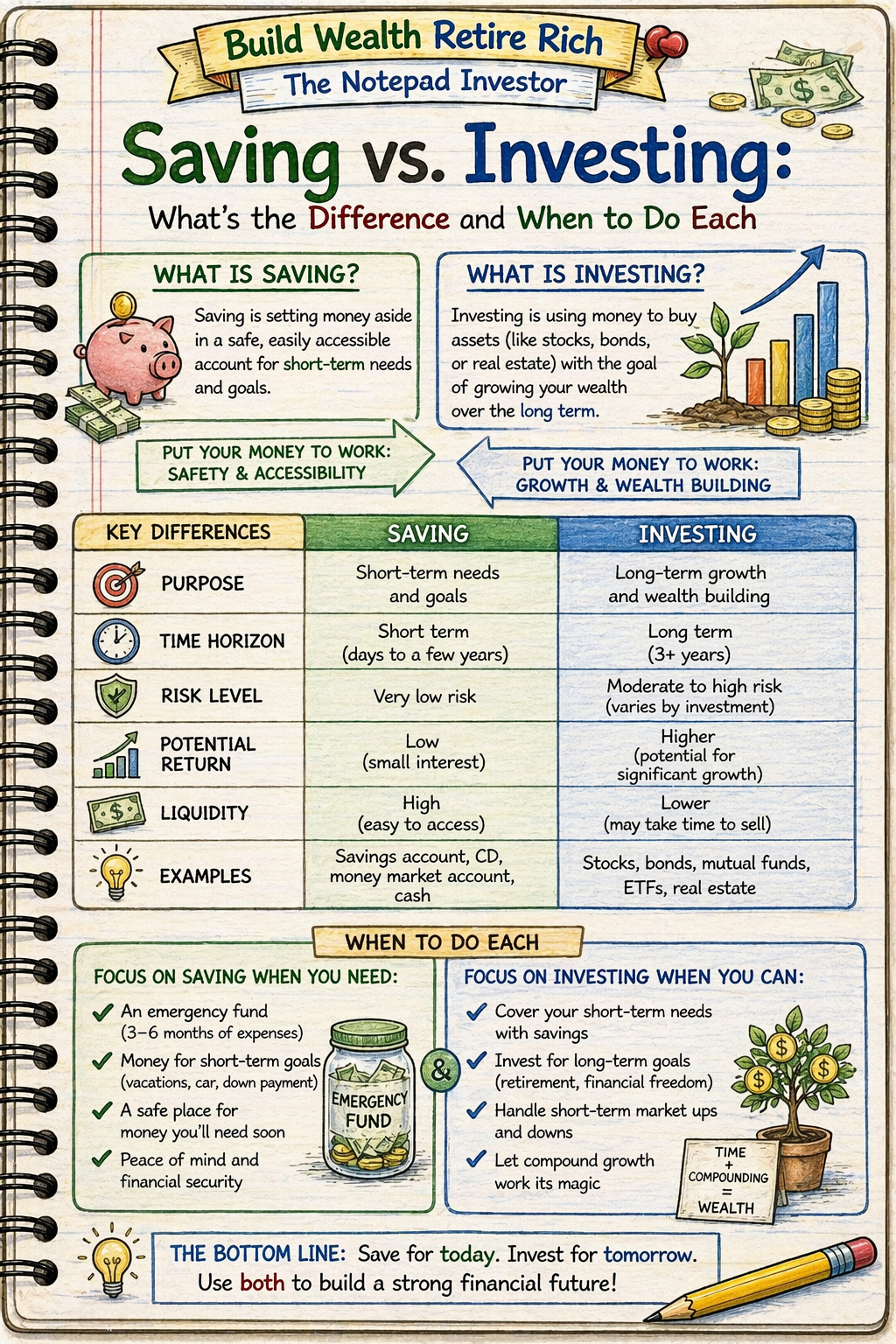
    Notebook sketch explaining personal finance

    This article is designed for anyone confused about saving versus investing distinctions, individuals keeping all money in savings fearing market risk, or investors neglecting emergency funds creating vulnerability. You do not need financial expertise to understand saving-investing differences—fundamental concepts accessible through clear explanations of return expectations, risk profiles, appropriate timelines, and strategic allocation, though requires honest goal assessment determining which money needed short-term (savings) versus long-term (investing), realistic risk tolerance recognizing comfort with volatility versus preference for guarantees, and disciplined execution maintaining both strategies simultaneously not abandoning one for other, making saving-investing literacy requiring both mechanical understanding (returns, vehicles, accounts) and strategic wisdom (appropriate allocation, timeline matching, balanced approach) impossible when viewing as either/or choice versus complementary foundation requiring both for comprehensive financial security.

    Understanding saving versus investing matters because appropriate allocation creates $300,000-700,000 additional lifetime wealth through investing long-term money versus leaving in savings losing purchasing power to inflation, while simultaneous emergency fund maintenance prevents crisis liquidations during market downturns protecting compound growth from forced selling at losses, and strategic balance enables both stability (3-6 months expenses readily accessible) and prosperity (retirement wealth through decades of compound returns)—while financially-literate individuals maintain $15,000-30,000 emergency savings PLUS $500,000-2,000,000 retirement investments creating comprehensive security impossible for savings-only individuals accumulating $200,000-400,000 over lifetime eroded by inflation, or investing-only individuals facing forced liquidations during emergencies destroying years of discipline through single crisis, demonstrating saving-investing balance as essential wealth-building foundation not simplistic choice requiring nuanced strategic allocation impossible without understanding fundamental differences enabling informed purposeful money placement.

    Educational disclaimer: This article provides general educational information about saving and investing strategies. Individual appropriate allocations, timelines, and strategies vary significantly based on circumstances including age, income, goals, risk tolerance, and financial obligations. This is not financial advice or specific recommendation of savings/investment ratios. Investment returns represent historical averages with significant volatility—actual results vary. Emergency fund recommendations represent general guidelines not personalized assessments. Consult qualified financial advisors for guidance matching individual situations.

    Fundamental Differences

    Saving Characteristics

    Purpose and timeline:

    • Emergency fund (3-6 months living expenses)
    • Short-term goals under 3 years (vacation, car down payment, wedding)
    • Irregular expense reserves (property taxes, insurance, home maintenance)
    • Money needed with certainty within 5 years

    Common savings vehicles:

    • High-yield savings accounts: 0.5-5% APY depending on Fed rates
    • Money market accounts: 0.5-5% APY, check-writing capability
    • Certificates of Deposit (CDs): 2-5% APY, fixed terms 3 months-5 years
    • All FDIC insured up to $250,000 per account

    Savings advantages:

    • Principal guaranteed (FDIC insurance prevents loss)
    • Immediate liquidity (access within 0-3 days typical)
    • Zero volatility (balance never decreases)
    • Predictable returns (stated interest rate known upfront)
    • No market knowledge required
    • Peace of mind from stability

    Savings limitations:

    • Low returns barely outpacing or trailing inflation
    • Purchasing power erosion over decades
    • Insufficient for retirement wealth building
    • Opportunity cost of foregone investment gains

    Investing Characteristics

    Purpose and timeline:

    • Retirement (20-40 years away)
    • Long-term goals 5+ years (home down payment, education)
    • Wealth building beyond inflation
    • Financial independence and passive income

    Common investment vehicles:

    • Stock index funds: 8-12% average annual returns historically
    • Bond funds: 3-6% average returns, lower volatility
    • Target-date retirement funds: Age-appropriate stock/bond mix
    • Real estate: 8-10% average returns through appreciation and rents

    Investing advantages:

    • High long-term returns outpacing inflation substantially
    • Compound growth multiplying wealth over decades
    • Passive income potential (dividends, interest)
    • Retirement security through wealth accumulation
    • Purchasing power protection and growth

    Investing limitations:

    • Volatility creating temporary losses (20-50% declines possible)
    • No principal guarantee (can lose money)
    • Requires long timeline for recovery from downturns
    • Liquidity varies (stocks liquid, real estate illiquid)
    • Emotional discipline needed during market crashes

    Side-by-Side Comparison

    Return expectations:

    • Savings: 0.5-5% annually (currently ~4-5% high-yield savings)
    • Investing: 6-12% annually average (stocks ~10%, bonds ~4-6%, balanced ~7-8%)

    Risk profile:

    • Savings: Zero principal loss risk, inflation purchasing power loss
    • Investing: Temporary market loss 20-50%, long-term gain high probability

    Timeline appropriateness:

    • Savings: Under 5 years ideal, essential under 3 years
    • Investing: 5+ years minimum, 10+ years ideal

    Liquidity:

    • Savings: Immediate to 3-day access typical
    • Investing: Varies (stocks 2-3 days, real estate months, retirement accounts penalties before 59½)

    Tax treatment:

    • Savings: Interest taxed as ordinary income annually
    • Investing: Capital gains preferential rates 0-20%, tax-deferred growth in retirement accounts
    Advertisement

    Financial Wellness Planner

    The Wealth Impact Over Time

    30-Year Wealth Comparison

    Scenario: $500 monthly for 30 years

    SAVINGS APPROACH (1% interest):

    • Monthly contribution: $500
    • Total contributed: $180,000
    • Interest earned: $30,000
    • Final value: $210,000
    • Purchasing power adjustment: -25% from 2.5% average inflation = $157,500 in today’s dollars

    INVESTING APPROACH (8% returns):

    • Monthly contribution: $500
    • Total contributed: $180,000
    • Investment gains: $553,000
    • Final value: $733,000
    • Purchasing power: $550,000 in today’s dollars (8% nominal minus 2.5% inflation = 5.5% real)

    WEALTH DIFFERENTIAL: $535,180 from investing versus saving

    Inflation Impact on Savings

    The purchasing power problem:

    • Inflation averages 2-3% annually long-term
    • Savings rates fluctuate but often trail inflation
    • Real return = Nominal return – Inflation

    Example erosion:

    • $100,000 saved at 1% interest
    • Year 10: $110,500 nominal value
    • Inflation at 2.5%: Need $128,000 to maintain purchasing power
    • Real loss: $17,500 purchasing power (13.7% decline)

    Investment protection:

    • $100,000 invested at 8%
    • Year 10: $216,000 nominal value
    • After 2.5% inflation adjustment: $170,814 real value
    • Real gain: $45,186 purchasing power increase

    The Opportunity Cost

    Foregone wealth from savings-only approach:

    Example: Age 30-65 (35 years)

    • Savings-only: $400 monthly at 1% = ~$201,053
    • Investing: $400 monthly at 8% = ~$917,553
    • Opportunity cost: $716,000 lifetime wealth foregone
    • Retirement income impact: $3,058 monthly (4% withdrawal from $917K) versus $700 monthly ($201K)

    The compound difference:

    • First 10 years: Investing ahead $21,000 (modest difference)
    • Years 11-20: Gap widening, investing ahead $175,000
    • Years 21-30: Massive divergence, investing ahead $523,000
    • Final 5 years: Gap explodes to $716,000,000 through compound acceleration

    Appropriate Allocation Strategy

    The Balanced Approach

    Step 1: Build emergency fund in savings (3-6 months expenses)

    • Calculate monthly essential expenses (housing, food, utilities, insurance, minimum debt payments)
    • Multiply by 3-6 months based on job security and family situation
    • Single income household: 6 months
    • Dual income household: 3-4 months
    • Self-employed/commission: 6-12 months

    Example emergency fund calculation:

    • Monthly essentials: $3,500
    • Dual income household target: 4 months
    • Emergency fund goal: $14,000 in high-yield savings

    Step 2: Save for short-term goals (under 3 years)

    • Vacation next year: $3,000
    • Car down payment 2 years: $5,000
    • Wedding 18 months: $8,000
    • Total short-term savings: $16,000

    Step 3: Invest everything else for long-term goals

    • Retirement (20-40 years away)
    • Home down payment (5+ years)
    • Children’s education (10+ years)
    • Financial independence

    Complete Allocation Example

    Household: $5,000 monthly income, $3,500 expenses

    Available for savings/investing: $1,500 monthly

    Phase 1: Emergency fund building (6-12 months)

    • Emergency fund needed: $14,000 (4 months expenses)
    • Current emergency fund: $2,000
    • Gap: $12,000
    • Allocation: $1,200 monthly to savings, $300 to investing (capture employer 401k match)
    • Timeline: 10 months to complete emergency fund

    Phase 2: Balanced savings/investing (ongoing)

    • Emergency fund: Complete at $14,000 (maintain, don’t increase)
    • Short-term goal savings: $300 monthly for upcoming vacation/car
    • Long-term investing: $1,200 monthly to retirement accounts
    • Ratio: 20% savings, 80% investing

    Phase 3: Retirement approaching (age 50+)

    • Emergency fund: Increase to $18,000 (6 months as job loss harder at older age)
    • Short-term reserves: $20,000 for home maintenance, travel
    • Retirement investing: Maximum contributions $2,000+ monthly
    • Gradual shift toward bonds reducing volatility

    Age-Based Allocation Guidelines

    Ages 20-30 (wealth building foundation):

    • Emergency fund: $5,000-15,000 (3-6 months expenses typical at this age)
    • Short-term savings: $2,000-5,000 for immediate goals
    • Investing: 80-90% of available monthly surplus
    • Investment allocation: 100% stocks (aggressive growth, long timeline)

    Ages 30-45 (peak accumulation):

    • Emergency fund: $15,000-30,000 (higher expenses, family obligations)
    • Short-term savings: $5,000-15,000 (kids activities, home repairs)
    • Investing: 70-80% of surplus to retirement and education
    • Investment allocation: 90-100% stocks

    Ages 45-60 (final push):

    • Emergency fund: $20,000-40,000 (job loss harder, healthcare costs)
    • Short-term savings: $10,000-25,000 (major expenses, aging parents)
    • Investing: Maximum 70-85% to catch up on retirement
    • Investment allocation: 70-80% stocks, 20-30% bonds (stability increase)

    Ages 60+ (preservation focus):

    • Emergency fund: $25,000-50,000 (fixed income protection)
    • Short-term reserves: $30,000-60,000 (2-5 years living expenses in cash)
    • Investing: Remainder in balanced portfolio
    • Investment allocation: 40-60% stocks, 40-60% bonds
    Advertisement
    Reserved space for in-content ad

    Common Mistakes and How to Avoid

    Mistake 1: Keeping Everything in Savings

    The savings-only trap:

    • Pattern: $100,000+ in savings earning 1-4%, $0 invested
    • Motivation: Fear of market volatility, “safety” preference
    • Cost: $50,000-200,000+ in foregone returns over 20-30 years

    Example scenario:

    • Age 35: $50,000 in savings, adds $500 monthly for 30 years
    • All in savings at 2%: Age 65 = $278,000
    • If invested at 8%: Age 65 = $783,000
    • Cost of fear: $505,000 lifetime opportunity cost

    Solution:

    • Maintain 3-6 months expenses in savings ($15,000-30,000 typical)
    • Invest everything beyond emergency fund
    • Accept short-term volatility for long-term wealth
    • Remember: 30-year timeline allows multiple market crash recoveries

    Mistake 2: Investing Without Emergency Fund

    The emergency vulnerability:

    • Pattern: $0 savings, 100% income to investing
    • Motivation: Maximize returns, “I’ll just use credit cards for emergencies”
    • Cost: Forced investment liquidation during crisis, debt accumulation, destroyed compound growth

    Example disaster scenario:

    • No emergency fund, $30,000 invested in market
    • Lose job during market crash (portfolio down 30% to $21,000)
    • Need $15,000 for 3 months expenses
    • Forced to sell $15,000 worth (71% of remaining portfolio)
    • Left with $6,000 invested, missed entire market recovery
    • 5 years later: $6,000 would have grown to $21,000 if held
    • Plus reaccumulated $10,000 credit card debt at 18% from emergency expenses

    Solution:

    • Build $1,000 starter emergency fund before aggressive investing
    • Expand to 3-6 months expenses before maximizing investments
    • Accept temporarily lower investment contributions for stability
    • Prevents forced selling and debt creation

    Mistake 3: Using Wrong Vehicle for Timeline

    Common mismatches:

    Mismatch A: Short-term money in stocks

    • Scenario: Need $20,000 for home down payment in 18 months
    • Mistake: Invest in stock market hoping for 10% returns
    • Risk: Market crashes 30% month before purchase, only have $14,000
    • Consequence: Lose dream home or forced to delay years
    • Correction: Keep in high-yield savings guaranteeing $20,000+ availability

    Mismatch B: Long-term retirement money in savings

    • Scenario: Age 30, saving for retirement age 65 (35 years)
    • Mistake: Keep retirement savings in 2% savings account
    • Cost: $400 monthly 35 years = $222,000 saved versus $930,000 invested
    • Consequence: Inadequate retirement forcing continued work or lifestyle reduction
    • Correction: Invest retirement money in stock index funds accepting volatility

    Timeline decision framework:

    • Under 2 years: Savings only (100% safety priority)
    • 2-5 years: Mostly savings, consider conservative investing if can delay goal
    • 5-10 years: Balanced or aggressive investing acceptable
    • 10+ years: Aggressive stock investing optimal

    Mistake 4: Abandoning Savings After Building Emergency Fund

    The ongoing savings need:

    • Pattern: Build $15,000 emergency fund, redirect 100% future savings to investing
    • Problem: Irregular expenses drain emergency fund repeatedly
    • Examples: Annual insurance $2,500, property taxes $3,000, car maintenance $1,500, holiday gifts $1,000
    • Total: $8,000 annually in irregular but predictable expenses
    • Result: Emergency fund constantly depleted, never stable

    Solution: Sinking funds

    • Identify annual irregular expenses: $8,000
    • Divide by 12: $667 monthly sinking fund contribution
    • Separate from emergency fund in dedicated savings
    • Prevents emergency fund depletion from predictable expenses

    Complete savings allocation:

    • Emergency fund: $15,000 maintained (use only for genuine emergencies)
    • Sinking funds: $667 monthly for irregular expenses
    • Short-term goals: Additional as needed (vacation, car replacement)
    • Investing: Remainder after all savings needs covered

    Decision Framework

    Quick Decision Tree

    Question 1: When do I need this money?

    • Under 3 years → SAVINGS (high-yield savings or short-term CDs)
    • 3-5 years → Mostly SAVINGS, conservative investing if flexible
    • 5-10 years → INVESTING (balanced portfolio 60/40 stocks/bonds)
    • 10+ years → INVESTING (aggressive 80-100% stocks)

    Question 2: Can I afford to lose 20-30% temporarily?

    • No, need guaranteed access → SAVINGS
    • Yes, have time to recover → INVESTING

    Question 3: What’s the money’s purpose?

    • Emergency buffer/safety net → SAVINGS
    • Specific purchase soon → SAVINGS
    • Retirement wealth building → INVESTING
    • Long-term goals → INVESTING

    Question 4: Do I already have adequate emergency fund?

    • No → Priority SAVINGS until 3-6 months expenses secured
    • Yes → Shift focus to INVESTING for long-term wealth

    Specific Scenario Guidance

    Scenario: “I have $10,000 windfall, where should it go?”

    Decision process:

    • Step 1: Emergency fund adequate? If under $5,000 → Add to savings
    • Step 2: High-interest debt? If credit cards over 10% → Pay off debt
    • Step 3: Emergency fund complete? Short-term goals funded?
    • Step 4: Everything else → Invest in retirement accounts

    Example allocation:

    • Emergency fund current: $3,000, need $15,000 = $12,000 gap
    • Credit card debt: $0
    • Short-term goals: Funded
    • Windfall allocation: $10,000 to emergency fund (now $13,000), $2,000 remaining gap to fill from monthly income, future windfalls 100% to investing

    Scenario: “Should I pause investing to build bigger emergency fund?”

    Pause investing when:

    • Emergency fund under $1,000 (extreme vulnerability)
    • Job instability or layoff risk (build 6-12 months buffer)
    • Major life change (baby, moving, career change)
    • Income irregular or commission-based needing larger buffer

    Maintain balanced approach when:

    • Emergency fund $3,000+ covering most emergencies
    • Stable employment
    • Dual income household
    • Can split surplus 70/30 investing/savings building both simultaneously

    Scenario: “I’m 50 with $500,000 invested but only $5,000 saved, what now?”

    Action plan:

    • Immediate: Build emergency fund to $25,000 (6 months expenses at this age/income level)
    • Pause retirement contributions temporarily if needed OR
    • Balanced: Continue retirement investing but divert 50% of new contributions to emergency fund building
    • Timeline: 10-12 months to adequate emergency fund
    • Do NOT liquidate investments to build emergency fund (avoid triggering taxes and missing growth)
    • Resume full retirement contributions once emergency fund adequate
    Advertisement
    Reserved space for in-content ad

    Why Understanding Saving vs Investing Matters

    Without understanding saving versus investing differences, individuals either keep all money in savings losing $300,000-700,000 lifetime wealth to inflation and opportunity costs versus investing long-term funds, or invest everything including emergency money forcing crisis liquidations during market downturns destroying years of compound growth through forced selling at losses, missing strategic balance enabling both stability (accessible emergency reserves) and prosperity (retirement wealth through decades of compound returns)—while financially-literate individuals maintain appropriate allocation with $15,000-30,000 emergency savings providing crisis buffer PLUS $500,000-2,000,000 retirement investments creating comprehensive security impossible for extreme-approach users either accumulating inadequate inflation-eroded savings or facing emergency vulnerability requiring debt or liquidations, demonstrating saving-investing balance as essential wealth-building foundation requiring honest assessment matching money purpose with appropriate vehicle maximizing both safety and growth impossible when using single strategy exclusively creating either poverty through excessive caution or crisis through excessive risk.

    Understanding saving versus investing enables individuals to:

    • Match money purpose with appropriate vehicle (short-term savings, long-term investing)
    • Build emergency fund preventing crisis liquidations protecting compound growth
    • Harness investment returns for long-term wealth impossible through savings alone
    • Accept calculated risks understanding volatility temporary with adequate timeline
    • Allocate strategically based on age, goals, and timeline requirements
    • Avoid common mistakes (all savings or all investing extremes)
    • Create balanced financial foundation enabling both stability and prosperity

    Saving-investing knowledge transforms financial strategy from simplistic single-approach into nuanced balanced allocation, enabling both emergency resilience through accessible reserves and retirement security through compound returns, creating comprehensive financial health impossible when viewing as either/or choice versus complementary strategies requiring both for optimal outcomes.

    Common Misunderstandings

    Many people view saving as universally “safe” and investing as universally “risky” making savings always preferable for risk-averse individuals. In reality, long-term savings face certain purchasing power loss through inflation erosion creating guaranteed real loss, while long-term investing faces temporary volatility but provides inflation protection and wealth growth with 95%+ positive return probability over 20+ year periods making investing actually “safer” for long-term money despite short-term volatility—$100,000 saved 30 years loses 25% purchasing power guaranteed through 2.5% inflation versus invested $100,000 growing to $1 million through 8% returns despite temporary 20-50% declines during journey, proving “risk” definition depends on timeline not absolute volatility making savings risky for retirement and investing risky for emergencies requiring timeline-appropriate matching not universal risk rankings.

    Another common misconception is building large emergency fund ($50,000-100,000+) provides superior security justifying keeping substantial money in low-return savings. However, emergency fund over 6-12 months expenses creates massive opportunity cost through foregone investment returns—$50,000 excess emergency fund earning 2% over 20 years = $74,000 versus invested at 8% = $233,000 representing $159,000 opportunity cost for marginally increased security, proving beyond reasonable 3-6 month buffer creates wealth destruction not protection making $15,000-30,000 emergency fund optimal with remainder invested generating actual long-term security through wealth accumulation versus false security from excessive low-return cash holdings preventing prosperity.

    Some believe market timing allows avoiding investing risks through perfect entry and exit timing making volatility avoidable through skillful trading. However, market timing attempts consistently fail with studies showing 80-90% of active timers underperform simple buy-and-hold approaches, missing best 10 market days over 20 years reduces returns 50% yet impossible predicting which days creating missed-recovery risk, and transaction costs plus poor timing decisions destroy wealth faster than volatility acceptance—proving volatility management through long-term holding and continuing contributions during declines produces superior outcomes versus timing attempts creating worse results through missed gains and poor decisions making acceptance not avoidance optimal volatility strategy for long-term investors.

    How Saving-Investing Understanding Fits Into Financial Success

    Saving-investing understanding enables comprehensive financial security through balanced allocation maintaining emergency accessibility PLUS retirement wealth growth, prevents extreme approaches creating either inadequate savings forcing crisis debt or excessive savings creating opportunity cost poverty, and provides strategic framework matching timeline with vehicle optimizing both stability and prosperity—making saving-investing literacy essential requiring 3-6 months emergency savings protecting against crisis liquidations, investing all long-term money harnessing compound returns creating $500,000-2,000,000 retirement wealth impossible through savings alone, and honest assessment determining appropriate allocation based on timeline not fear or greed, transforming financial strategy from simplistic single-approach into nuanced balanced foundation enabling both emergency resilience and long-term prosperity impossible when viewing as either/or choice versus complementary strategies requiring both for optimal comprehensive security.

    Saving-investing understanding separates financially-secure balanced individuals from extreme-approach strugglers, requiring honest timeline assessment, calculated risk acceptance for long-term money, and disciplined emergency fund maintenance creating measurable prosperity differences impossible without strategic allocation literacy.

    Recent Updates and Trends

    In recent years, high-yield savings rates have fluctuated dramatically with Federal Reserve policy changes creating 0.5% rates in 2021 rising to 4-5% by 2023 then declining to 3-4% by 2026, though fundamental saving-investing distinction unchanged with temporary rate increases not altering long-term wealth-building necessity for investing when savings still trail inflation over decades regardless of current attractive short-term rates making strategic allocation unchanged despite rate environment variations.

    Inflation spike 2021-2023 averaging 5-7% annually demonstrated purchasing power erosion vividly when savings accounts earning 0.5-2% created negative 3-5% real returns, though reinforcing investing necessity through inflation protection when stock returns continued outpacing inflation over full period proving investment value during inflationary periods not just low-inflation stability making lessons amplifying fundamental principles not changing strategic approach.

    Online high-yield savings proliferation through Ally, Marcus, CIT offering 4-5% rates created savings opportunity improving emergency fund returns, though not justifying larger emergency funds or long-term savings allocations when even 5% trails historical 8-10% stock returns making savings rate improvements enhancing appropriate emergency fund strategy not changing investing primacy for long-term wealth building regardless of improved savings availability.

    Market volatility 2020-2026 through COVID crash, recovery, and subsequent corrections tested investor discipline with 30-40% drawdowns occurring multiple times, though reinforcing volatility acceptance importance when patient holders recovered and prospered while panic sellers locked in losses proving fundamental principles through real-world test validating long-term approach not changing strategy despite increased short-term turbulence.

    Fundamental saving-investing principles remain timeless: emergency fund 3-6 months in savings provides stability buffer, short-term money under 3 years requires savings protection, long-term money 5+ years demands investing for wealth growth, balanced allocation essential not extreme single-approach, and timeline determines appropriate vehicle not fear or greed—regardless of savings rate fluctuations, inflation spikes, online savings proliferation, or market volatility changes, understanding purpose-based allocation matching timeline with vehicle produces comprehensive security impossible through extreme approaches creating either inadequate wealth from excessive savings or crisis vulnerability from inadequate reserves.

    3 Things You Can Do Today

    Ready to optimize saving-investing balance? Here are three simple steps you can take right now:

    1. Calculate emergency fund target and current gap determining immediate savings priority – Calculate monthly essential expenses: Housing (rent/mortgage, utilities, property taxes, insurance) + Food (groceries only not dining out) + Transportation (car payment, gas, insurance, maintenance minimum) + Insurance (health, life, disability) + Minimum debt payments = total essentials (example: $2,200 housing + $400 food + $450 transport + $300 insurance + $350 debt = $3,700 monthly essentials). Determine target months: Single income household 6 months, dual income 3-4 months, self-employed 6-12 months (example: dual income = 4 months appropriate). Calculate target emergency fund: Essentials × months (example: $3,700 × 4 = $14,800 target). Assess current emergency fund: Current savings readily accessible within 3 days (example: $4,200). Determine gap: Target minus current (example: $14,800 – $4,200 = $10,600 gap). Priority assessment: If gap over $5,000 consider temporarily reducing investment contributions building emergency fund, if gap under $3,000 maintain balanced approach adding $200-400 monthly until complete, if emergency fund adequate (within $1,000 of target) shift focus to investing maximization. Write commitment: “Monthly essentials: $3,700. Emergency fund target: $14,800 (4 months). Current: $4,200. Gap: $10,600. Priority: Build emergency fund $600 monthly plus invest $400 monthly (60/40 split) completing fund in 18 months then shift to 90% investing.” Takes 15 minutes creating concrete emergency fund understanding and action plan impossible when vaguely “should save more” without quantified target and gap assessment.

    2. Audit current money allocation identifying savings-investing mismatches requiring rebalancing – List all current money locations with amounts and purposes: Category 1 Checking account: $2,500 (monthly expenses buffer). Category 2 Savings account: $18,500 (purpose assessment needed). Category 3 Investments: $85,000 in 401k + $12,000 in Roth IRA = $97,000 total. Assess each dollar purpose and timeline: Checking $2,500: Appropriate for monthly flow. Savings $18,500: Break down—$14,000 emergency fund (appropriate), $2,500 vacation next year (appropriate short-term), $2,000 “just in case” excess (opportunity cost – should invest). Investments $97,000: All retirement 25+ years away (appropriate long-term). Identify mismatches: Mismatch 1—Excess savings $2,000 beyond emergency fund and defined short-term goals earning 4% should invest at 8% creating $50,000+ opportunity cost over 20 years. Mismatch 2—Retirement money in savings (none identified, good). Mismatch 3—Short-term goal money invested (none identified, good). Create rebalancing plan: Action 1—Transfer excess $2,000 savings to Roth IRA investing in index fund immediately. Action 2—Adjust future allocation: $14,000 emergency fund maintained, short-term goals funded separately as needed, all remaining surplus to investing. Action 3—Set up automatic monthly allocation preventing future drift: $800 investing automatic, $200 flexible for short-term goals as arise. Expected outcome: Eliminate $2,000 excess low-return savings, optimize 80% monthly surplus to investing with 20% flexibility for goals. Write plan: “Current allocation: $18,500 savings (appropriate $16,500, excess $2,000), $97,000 invested (appropriate). Action: Transfer $2,000 to Roth IRA. Future: $800 automatic investing, $200 flexible, maintain $14,000 emergency fund.” Takes 30 minutes identifying money mismatches creating immediate $2,000 optimization plus ongoing balanced allocation impossible when never auditing current status against purpose-based framework.

    3. Set up optimal allocation automation matching timeline with vehicle permanently – Create accounts structure: Account 1—Emergency fund high-yield savings (Ally, Marcus, CIT) separate from checking preventing casual spending, name “Emergency ONLY – Do Not Touch.” Account 2—Short-term goals savings (same bank or separate), name “Vacation/Car/Goals 2026-2028.” Account 3—Retirement investing Roth IRA at Vanguard/Fidelity/Schwab in total stock market index fund. Account 4—Taxable brokerage for additional investing beyond retirement limits. Set up automatic monthly allocation from paycheck or checking: Emergency fund: $0 once target reached OR $200-500 monthly if building gap. Short-term goals: $100-300 monthly for defined upcoming needs (vacation, car replacement, wedding, etc.). Retirement investing: $500-1,200 monthly to Roth IRA and/or 401k. Taxable investing: Any remaining surplus after above allocations. Example balanced automation age 35: Income $5,000 monthly minus expenses $3,200 = $1,800 surplus. Allocation: $400 emergency fund (building from $3,000 to $14,000 target over 28 months), $200 short-term goals (annual vacation, car maintenance reserve), $1,200 retirement investing (Roth IRA $583 monthly reaching $7,000 annual limit, 401k $617 monthly), $0 taxable (utilizing all surplus through categories above). Review triggers: Quarterly check emergency fund status adjusting allocation when target reached, annual review short-term goals updating amounts for upcoming year needs, automatic investing continues regardless of market conditions without intervention. Protection mechanisms: Emergency fund in separate bank requiring manual transfer preventing accidental spending, investments in retirement accounts with early withdrawal penalties creating barrier against emotional liquidation, all automations “set and forget” removing decision fatigue and temptation deviation. Write automation summary: “Emergency fund: $400/month Ally savings until $14,800 complete. Short-term: $200/month goals savings. Investing: $1,200/month split $583 Roth IRA + $617 401k. Review: Quarterly emergency fund status, annual goals adjustment. Total automated: $1,800/month (100% surplus optimally allocated).” Takes 60-90 minutes initial setup creating permanent strategic allocation preventing drift through automation impossible when manually deciding each month creating inconsistency and poor timing decisions destroying optimal balanced approach.

    These actions create optimal saving-investing foundation within 2-3 hours—calculated specific emergency fund target and gap creating concrete savings priority ($10,600 gap requiring 18 months example), audited current allocation identifying $2,000 excess savings opportunity cost requiring immediate rebalancing, and established automated allocation permanently matching timeline with vehicle preventing future mismatches—transforming from vague “should save and invest” into systematic optimized approach with every dollar purposefully placed impossible when attempting ad-hoc allocation without framework, targets, and automation creating drift toward extreme approaches or inconsistent execution destroying balanced strategy benefits.

    Quick FAQ

    How much should I keep in savings versus investing?
    Keep 3-6 months essential expenses in savings (emergency fund) plus short-term goals under 3 years, invest everything else for long-term wealth building: Emergency fund calculation—Monthly essential expenses (housing, food, transport, insurance, minimum debts) × 3-6 months = emergency fund target. Example: $3,500 essentials × 4 months = $14,000 emergency savings. Short-term goals addition—Specific upcoming needs within 3 years (vacation $3,000, car down payment $5,000, wedding $8,000) = additional $16,000 savings. Total savings target: $30,000 ($14,000 emergency + $16,000 short-term goals). Investment allocation—Everything beyond savings target goes to long-term investing (retirement, education 5+ years away, wealth building). Example complete allocation: $30,000 in savings accounts, $100,000+ in investment accounts, future $1,000 monthly surplus = $200 maintaining/replenishing savings, $800 investing. Age considerations—Ages 20-30: $5,000-15,000 savings typical, ages 30-45: $15,000-30,000 savings, ages 45-60: $20,000-40,000 savings, ages 60+: $25,000-60,000 savings (increased buffer, lower risk tolerance). Common mistake: Keeping $50,000-100,000+ “just in case” in savings creating massive opportunity cost ($50,000 excess over 20 years = $159,000 foregone wealth at 8% versus 2%). Key principle: Adequate emergency fund essential preventing crisis, but beyond reasonable buffer every dollar in savings represents lost investment growth making excess savings expensive false security destroying long-term prosperity.

    Should I invest if I don’t have an emergency fund?
    Build minimum $1,000 emergency fund before aggressive investing, expand to 3-6 months expenses before maximizing investments, though capture employer 401k match even while building emergency fund: Minimum emergency fund—$1,000 starter fund prevents 70-80% of emergency credit card usage (car repairs, medical, minor home issues), achievable in 1-2 months through intense saving making brief delay acceptable before investment focus. Employer match exception—Always contribute minimum for full 401k match even while building emergency fund (50-100% instant return too valuable to sacrifice), example: employer matches 50% up to 6% salary, contribute 6% for match while building emergency fund with remaining surplus. Balanced approach during building phase—Split surplus 60/40 emergency fund/investing example: $1,000 monthly surplus = $600 emergency fund + $400 investing (401k match), complete $14,000 emergency fund in 24 months while simultaneously accumulating $9,600 invested creating both stability and growth versus extreme all-savings or all-investing. Danger of no emergency fund—Without buffer, $800 car repair forces either high-interest debt or investment liquidation during potential market downturn, example: forced to sell $1,000 investments during 30% crash captures only $700, miss recovery to $1,400 in 3 years = $700 permanent loss from forced timing. Full investment acceleration—After emergency fund complete, redirect entire previous emergency fund contribution to investing dramatically increasing accumulation rate, example: $600 emergency fund contribution becomes $1,000 total investing ($400 existing + $600 freed) doubling investment rate. Timeline: Most complete adequate emergency fund in 6-18 months depending on income and expenses making temporary investment reduction worthwhile preventing crisis liquidation risk.

    Can I invest short-term money if I’m comfortable with risk?
    Generally NO for true short-term needs under 3 years regardless of risk comfort due to sequence risk creating potential unavailability exactly when needed: Sequence risk problem—Market crashes unpredictable and can occur exactly before planned use, example: invest $20,000 for home down payment needed in 2 years, market crashes 35% month before purchase leaving only $13,000 forcing either abandoning home purchase, significant delay waiting recovery (unknown timeline), or accepting smaller/different home. “Comfortable with risk” misconception—Risk comfort means accepting temporary losses during long investment timeline allowing recovery, NOT accepting failure achieving specific time-bound goal, example: comfortable with portfolio dropping 30% in retirement account age 30 (35 years to recover), NOT comfortable missing home purchase because down payment insufficient. Exceptions for flexibility—If goal truly flexible with 2-5 year window and can delay if market poor, conservative investing acceptable (60/40 or 70/30 stock/bond allocation), example: “want to buy home sometime 2027-2030, whenever market allows” enables investing versus “must buy August 2027 for job relocation” requires savings. Graduated approach—Money needed 4-5 years can use conservative balanced portfolio (50-60% stocks, 40-50% bonds) reducing volatility, shifting to 100% savings final 12-18 months eliminating sequence risk, example: $30,000 home down payment goal 5 years, invest first 3.5 years, shift to savings final 18 months locking in gains. Key principle: Short-term money in stocks creates binary risk (either have full amount or don’t exactly when needed), while long-term investing creates continuous timeline (poor returns one year compensated by good returns other years over decades) making timeline flexibility essential for any investing not emergency-fund money.

    What if my emergency fund earns less than inflation?
    Accept emergency fund purchasing power erosion as insurance premium for financial stability preventing worse outcomes (debt, investment liquidation) during crisis: Purpose reframe—Emergency fund NOT investment or wealth-building tool, instead insurance creating financial buffer preventing catastrophic decisions during job loss or unexpected expense, modest inflation erosion acceptable cost for protection provided. Real-world benefit—$15,000 emergency fund losing 2% annually to inflation ($300/year purchasing power loss) infinitely preferable to alternatives: (A) No fund forcing $5,000 emergency onto credit card at 18% APR costing $900 annual interest plus stress, (B) Liquidating investments during market crash capturing 30% loss = $1,500 permanent loss plus missed recovery gains worth $3,000+ over subsequent years. Rate optimization within safety—Use high-yield savings (currently 3-5% APY) minimizing inflation gap while maintaining FDIC insurance and liquidity, example: 4% savings versus 2.5% inflation = +1.5% real return current environment (not always available but capture when possible). Appropriate fund size limitation—Keeping exactly 3-6 months expenses not $50,000+ excess minimizes inflation exposure while maintaining adequate protection, example: $18,000 appropriate emergency fund loses $360 annually to 2% real loss versus $50,000 excess losing $1,000 annually making right-sizing critical. Inflation protection portfolio—Long-term invested money at 8% nominal minus 2.5% inflation = 5.5% real return providing purchasing power growth offsetting emergency fund erosion across total portfolio, example: $15,000 emergency fund losing $300 annually acceptable when $200,000 investments gaining $11,000 real annual creating net positive position. Key: Emergency fund sacrifice small guaranteed inflation loss to prevent large uncertain crisis losses making modest erosion acceptable trade-off for essential financial stability buffer enabling investment confidence (knowing won’t need forced liquidation) creating overall superior outcomes despite emergency fund drag.

    Should I stop investing during a recession to build more savings?
    Generally NO—maintain investing especially during recession buying discounted shares while ensuring emergency fund adequate before recession hits: Counter-intuitive optimal strategy—Recessions create best long-term buying opportunities when stock prices 20-40% discounted making continued investing during downturn critical for superior returns, example: $500 monthly invested during 2008-2009 recession bought shares 40-50% cheaper creating 2-3x returns over subsequent decade versus stopping and missing discounted accumulation. Preparation before recession—Build adequate emergency fund during good times (currently) enabling investment confidence during recession without fear of forced liquidation, example: maintain $18,000 emergency fund through 2026-2027 strong economy, when recession hits 2028 have buffer allowing continued $500 monthly investing despite economic uncertainty and potential job risk. Recession investing benefit—Dollar cost averaging through downturn captures declining prices creating lower average cost basis, example: invest $500 monthly during 18-month recession buying shares at $100 → $80 → $60 → $70 → $90 creating $75 average cost versus $100 pre-recession, when recovery to $120 = 60% gain versus 20% if stopped investing. Emergency fund sufficiency during recession—If fund inadequate (under 3 months), acceptable reducing investment contributions temporarily building 6 months buffer given elevated job loss risk, but resume immediately when adequate never stopping completely. Job security consideration—Stable government or essential industry employment can maintain investing, uncertain industries facing layoffs might pause increasing buffer to 6-12 months during recession then resume. Historical pattern—Every recession (2008, 2020, previous cycles) followed by strong recovery punishing those who stopped investing and rewarding those who continued capturing discounted shares proving recession investing optimal despite discomfort. Key: Recession moment of maximum fear exactly when should invest most aggressively not least, making emergency fund pre-preparation essential enabling recession investing confidence creating superior long-term wealth through temporary discomfort discipline.

    Explore More in Investing Basics

    Disclosure

    This article provides general educational information about saving and investing strategies and allocation approaches. Individual appropriate allocations, emergency fund sizes, investment strategies, and outcomes vary significantly based on personal circumstances including age, income, expenses, family situation, job security, risk tolerance, financial goals, and time horizons. This is not financial advice or personalized recommendation of specific savings/investment ratios, account types, or allocation strategies. Investment return examples represent historical averages with significant year-to-year volatility—actual results vary substantially and past performance does not guarantee future results. Savings account rates fluctuate with Federal Reserve policy and economic conditions—current rates may differ from examples. Emergency fund recommendations represent general guidelines not personalized assessments—appropriate amounts vary based on individual risk factors, family size, job stability, industry, and personal comfort levels. Inflation projections and purchasing power calculations use historical averages—actual inflation varies significantly over time affecting real returns. Timeline-based allocation suggestions (savings for under 3 years, investing for 5+ years) represent general frameworks not absolute rules—individual circumstances may warrant different approaches. Tax implications of savings interest and investment gains vary by individual tax situations and account types. FDIC insurance limits and rules subject to change. Employer 401(k) match percentages and vesting schedules vary by company. Some investment strategies and products not suitable for all investors based on risk tolerance and circumstances. Sinking fund recommendations represent general guidance—specific irregular expense amounts vary widely by individual circumstances and geographic location. Market crash recovery timelines based on historical patterns—future market behavior may differ. Sequence risk (investing short-term money) can result in significant losses affecting ability to achieve time-bound goals. Opportunity cost calculations assume specific return rates—actual investment returns vary. Consult qualified financial advisors, certified financial planners, or investment professionals for personalized guidance matching individual circumstances, risk tolerance, and financial goals before making allocation decisions. Financial success requires sustained discipline, appropriate risk management, and regular strategy review beyond basic knowledge. Advertisements or sponsored content may appear within or alongside this content. All information presented independently for educational purposes only.

  • 3.3 Pay Yourself First: The Simple Habit That Builds Wealth Automatically

    3.3 Pay Yourself First: The Simple Habit That Builds Wealth Automatically

    Pay yourself first budgeting is a financial strategy prioritizing savings and investments by allocating money to these goals immediately upon receiving income—before paying bills or discretionary spending—ensuring wealth building occurs automatically rather than depending on leftover money at month’s end. Unlike traditional budgeting where savings come from whatever remains after expenses (typically nothing), pay yourself first treats savings as the first mandatory “bill” paid to yourself, with remaining income covering living expenses, creating forced wealth accumulation through priority reversal making future financial security non-negotiable rather than optional afterthought.

    Notebook sketch explaining personal finance

    This article is designed for chronic under-savers, individuals who intend to save but never do, or anyone wanting guaranteed wealth accumulation regardless of spending discipline. You do not need financial expertise, complex systems, or perfect budgeting to implement pay yourself first—simple automation transferring set percentage or amount to savings immediately upon payday creates systematic wealth building working for imperfect budgeters, busy professionals, and anyone struggling with “save what’s left” approaches that consistently produce zero savings despite good intentions.

    Understanding pay yourself first matters because traditional “income minus expenses equals savings” formula fails for most people leaving nothing to save despite adequate incomes, waiting until month’s end to transfer savings allows unconscious spending consuming available funds, and treating savings as optional produces sporadic inconsistent results preventing wealth accumulation—while pay yourself first practitioners build substantial wealth through forced systematic allocation occurring before spending temptation, achieve savings goals regardless of budget discipline in other areas, and create financial security impossible through leftover-based approaches dependent on perfect restraint sustained indefinitely.

    Educational disclaimer: This article provides general educational information about pay yourself first budgeting methodology. Individual circumstances, income levels, essential expenses, and appropriate savings rates vary significantly. Strategy assumes sufficient income covering both savings allocation and necessary expenses—not suitable for those unable to meet basic needs. This is not financial planning or professional advice. Consult qualified financial professionals for personalized guidance.

    Understanding Pay Yourself First

    What Is Pay Yourself First?

    Core definition: Allocating money to savings and investments before any other spending, treating savings as your first and most important expense

    The formula reversal:

    Traditional approach (fails for most):

    • Income – Expenses = Savings
    • Pay all bills and spending first, save whatever remains
    • Result: Usually nothing remains, minimal sporadic savings

    Pay yourself first approach:

    • Income – Savings = Maximum allowable expenses
    • Save first automatically, live on remainder
    • Result: Guaranteed savings, forced spending constraint

    The Philosophy Behind It

    “You are your most important creditor”

    • Landlord gets paid first every month (rent priority)
    • Bank gets paid (loan/credit card minimums)
    • Utility companies get paid (electric, water)
    • Everyone else gets paid before you pay yourself
    • Pay yourself first reverses this—YOU are the first creditor

    Future you deserves priority:

    • Current discretionary spending serves present you
    • Savings serves future you
    • Traditional approach: Present you always wins, future you gets scraps
    • Pay yourself first: Future you gets priority, present you lives on remainder

    Parkinson’s Law applied to spending:

    • Expenses expand to fill available income
    • If $4,500 available, somehow you’ll spend $4,500
    • If only $3,800 available (saved $700 first), you’ll adapt to $3,800
    • Constraint creates efficiency—removing it creates waste

    Why “Save What’s Left” Fails

    Psychological barriers:

    • Month feels “tight”—saving seems impossible this month
    • Unexpected expenses arise (always do)
    • Procrastination: “I’ll transfer it tomorrow” (never happens)
    • Present bias: Current wants feel more urgent than future needs
    • Decision fatigue: By month’s end, willpower depleted

    Practical reality:

    • Month 1: Intend to save $500, actually save $0 (unexpected car repair)
    • Month 2: Intend to save $500, actually save $150 (felt tight, saved partial)
    • Month 3: Intend to save $500, actually save $0 (birthday gifts, forgot)
    • Month 4: Intend to save $500, actually save $50 (mostly spent, transferred what remained)
    • Annual result: Intended $6,000, saved $200 (3% of goal)

    Versus pay yourself first:

    • Every month: Automatically save $500 on payday before anything else
    • Annual result: Saved $6,000 (100% of goal)

    Origin and Popularity

    Ancient wisdom: Concept appears in “The Richest Man in Babylon” by George Clason (1926)—”A part of all you earn is yours to keep”

    Modern champions:

    • David Bach: “The Automatic Millionaire” emphasizing automation and pay yourself first
    • Robert Kiyosaki: “Rich Dad Poor Dad” advocating assets before liabilities
    • Ramit Sethi: “I Will Teach You To Be Rich” building system around automated savings

    Universal principle: Nearly every financial advisor and wealth expert recommends some version of pay yourself first

    Advertisement

    Financial Wellness Planner

    Implementing Pay Yourself First

    Step 1: Determine Your Savings Target

    Minimum recommended: 10-15% of gross income

    • $50,000 income: Save $5,000-7,500 annually ($417-625 monthly)
    • $75,000 income: Save $7,500-11,250 annually ($625-938 monthly)
    • $100,000 income: Save $10,000-15,000 annually ($833-1,250 monthly)

    Aggressive wealth building: 20-30% of gross income

    • Accelerates financial goals significantly
    • Enables financial independence in 15-25 years
    • Requires lifestyle discipline

    If starting from zero savings:

    • Start with achievable amount: Even 5% better than 0%
    • Build habit first, increase percentage later
    • Example progression: Start 5% (3 months), increase to 10% (6 months), increase to 15% (ongoing)

    Calculate specific dollar amount:

    • Monthly gross income × target percentage = monthly savings amount
    • Example: $5,000 monthly gross × 15% = $750 monthly savings
    • Or match pay frequency: Bi-weekly gross $2,500 × 15% = $375 per paycheck

    Step 2: Set Up Automatic Transfers

    Critical: Automation is non-negotiable

    • Manual transfers reintroduce willpower dependency
    • Automation ensures it happens regardless of motivation or busyness
    • “Set and forget” mentality

    Timing: Align with payday

    • Transfer should occur same day or day after paycheck deposits
    • Before money sits in checking account creating temptation
    • Example: Paid every other Friday, automatic transfer every other Saturday

    Where to send money:

    Priority 1: Emergency fund (until 3-6 months expenses saved)

    • High-yield savings account separate from checking
    • Liquid and accessible but not too convenient
    • Current rates: 4-5% annually

    Priority 2: Retirement accounts (after emergency fund started)

    • 401(k) through payroll deduction (pre-tax, automatic)
    • IRA through automatic monthly transfer
    • Tax advantages amplify savings

    Priority 3: Additional goals

    • Taxable investment accounts
    • Down payment savings
    • Education funds
    • Goal-specific accounts

    Step 3: Live on What Remains

    The forced constraint:

    • Income: $5,000 monthly
    • Automatic savings: $750 (15%)
    • Available for expenses: $4,250
    • This becomes your effective income

    Lifestyle adaptation:

    • First month may feel tight adjusting to reduced available funds
    • By month 2-3, spending naturally adjusts to new constraint
    • After 6 months, feels completely normal
    • Never “miss” the money because never reached checking account

    Budget remaining amount:

    • Pay yourself first doesn’t eliminate need for budget
    • Still allocate remaining $4,250 across expenses thoughtfully
    • But savings already secured—budget focuses only on spending optimization

    Step 4: Increase Savings Rate Over Time

    Automatic escalation:

    • Increase savings percentage annually
    • Start: 10% of income
    • Year 2: 12%
    • Year 3: 15%
    • Year 4: 18%
    • Year 5: 20%+

    Raise allocation:

    • When receiving raise, allocate 50-100% to increased savings immediately
    • Example: 5% raise on $60,000 salary = $3,000 annually ($250 monthly)
    • Increase automatic transfer by $200 monthly, allow $50 lifestyle increase
    • Prevents lifestyle inflation while accelerating wealth building

    Pay Yourself First Variations

    The 10% Rule (Beginner-Friendly)

    Simple starting point: Save exactly 10% of every dollar earned

    Implementation:

    • Set automatic transfer for 10% of gross income
    • Apply to all income sources: Salary, bonuses, side income, gifts
    • Increase later but establish 10% habit first

    Example:

    • Regular paycheck $2,000 gross: Save $200 automatically
    • Bonus $3,000: Save $300
    • Side income $500: Save $50

    The Multiple Buckets Approach

    Diversified automatic allocation:

    • 10% to emergency fund
    • 10% to retirement (401k/IRA)
    • 5% to short-term goals (vacation, car replacement)
    • Total: 25% automatically allocated before expenses

    Flexibility: Adjust percentages based on priorities and life stage

    The Direct Deposit Split

    Payroll-level automation:

    • Many employers allow splitting direct deposit across multiple accounts
    • Designate specific dollar amount or percentage to savings before checking

    Example setup:

    • Bi-weekly gross pay: $2,500
    • 15% ($375) → High-yield savings account
    • 10% ($250) → Investment account
    • Remainder ($1,875) → Checking account

    Advantage: Never see savings money in checking—ultimate “out of sight, out of mind”

    The Percentage Progression Strategy

    Gradual increase over time:

    Year 1: 5% savings rate

    • Build habit and comfort
    • $50,000 income = $2,500 annual savings

    Year 2: 10% savings rate

    • Double commitment
    • $52,000 income = $5,200 annual savings

    Year 3: 15% savings rate

    • Industry recommended minimum
    • $54,000 income = $8,100 annual savings

    Year 4-5: 20-25% savings rate

    • Aggressive wealth building
    • Financial independence acceleration

    The Emergency-First Hybrid

    Staged approach:

    Stage 1 (Months 1-6): 100% to emergency fund

    • All automatic savings builds emergency cushion
    • Target: $5,000-10,000 starter fund

    Stage 2 (Months 7-18): 50% emergency, 50% retirement

    • Split automatic savings between goals
    • Complete 3-6 month emergency fund
    • Begin retirement contributions

    Stage 3 (Month 19+): Diversified allocation

    • Emergency fund complete (minimal maintenance)
    • Majority to retirement and investments
    • Portion to other goals
    Advertisement
    Reserved space for in-content ad

    Pay Yourself First Success Stories

    Real-World Outcomes

    Example 1: The Automatic Millionaire

    • Couple earning combined $55,000
    • Paid themselves first: 12% to retirement automatically
    • Never noticed missing money (payroll deduction)
    • After 30 years: $1.2 million retirement fund through consistent automation
    • Never budgeted obsessively, just automated savings priority

    Example 2: The Recovered Spender

    • Age 30, earning $75,000, zero savings despite “trying” for years
    • Implemented pay yourself first: 15% ($937 monthly) automated
    • First month difficult, adjusted spending
    • After 1 year: $11,244 saved (first time ever saved consistently)
    • After 5 years: $70,000 saved plus growth = $82,000 net worth
    • Previous decade of “save what’s left”: $3,200 total saved

    The Comparison: Two Paths

    Both people earn $60,000 annually, age 25-65 (40 years)

    Person A: “Save what’s left” approach

    • Intends to save 10% ($6,000 annually)
    • Reality: Saves sporadically averaging 3% ($1,800 annually)
    • Some years $0, some years $4,000, inconsistent
    • 40 years at 8% return: $389,000 retirement
    • Not enough for retirement—must work longer or reduce lifestyle dramatically

    Person B: Pay yourself first approach

    • Automates 10% ($6,000 annually) from day one
    • Saves exactly 10% every single year without fail
    • Never depends on willpower or leftover money
    • 40 years at 8% return: $1,295,000 retirement
    • Comfortable retirement secured through systematic discipline

    Difference: $906,000 from identical income and target rate—only difference was execution method

    Common Challenges and Solutions

    Challenge: “I can’t afford to save 10-15%”

    Solutions:

    • Start smaller: Begin with 3-5% establishing habit, increase gradually
    • Optimize expenses: Identify $200-500 monthly waste (subscriptions, dining out, unnecessary spending)
    • Increase income: Side hustle, overtime, raise negotiation
    • Temporary reduction: Save less temporarily (5%) while addressing income/expense issues

    Reality check: Most people can find 10% through expense optimization—paying yourself first reveals this necessity

    Challenge: “What about irregular income?”

    Solutions:

    • Percentage-based: Save 10-20% of every deposit regardless of amount
    • Baseline + bonus: Automate conservative amount ($200) monthly, manually save percentages of variable income
    • Good month banking: Save 30-50% of above-average months for below-average months

    Challenge: “I tried automatic transfers and kept moving money back”

    Root causes and solutions:

    Cause 1: Saving too much too fast

    • Solution: Reduce automatic amount to sustainable level, increase gradually

    Cause 2: Insufficient emergency fund

    • Solution: Build $1,000-2,000 buffer first before aggressive saving

    Cause 3: Unconscious overspending

    • Solution: Combine pay yourself first with basic expense tracking, identify and cut waste

    Cause 4: Too accessible savings account

    • Solution: Save at different bank making transfers take 2-3 days, creates friction preventing impulsive withdrawals

    Challenge: “This feels selfish—I have family obligations”

    Reframe:

    • Financial security serves family better than paycheck-to-paycheck living
    • Retirement savings prevents becoming burden on children later
    • Emergency fund protects family from crisis
    • “Pay yourself first” = pay your family’s future first
    • Oxygen mask principle: Secure your finances before helping others

    Challenge: “I’m already behind—is it too late?”

    Never too late:

    • Starting at 40 with pay yourself first still produces significant retirement funds
    • 15% for 25 years (age 40-65) at 8% = substantial six-figure retirement
    • Better to start late than never start
    • Catch-up contributions available at 50+ ($7,500 additional 401k, $1,000 additional IRA for 2024)

    Why Pay Yourself First Matters

    Without pay yourself first discipline, traditional “save what’s left” approaches fail consistently leaving most people with minimal savings despite adequate incomes and good intentions, willpower-dependent savings produce sporadic inconsistent results preventing wealth accumulation, and treating savings as optional afterthought ensures future insecurity—while pay yourself first practitioners build substantial wealth through forced systematic allocation occurring before spending temptation, achieve financial goals regardless of budget perfection in other areas, and create retirement security impossible through leftover-based approaches dependent on sustained perfect restraint over decades.

    Understanding and implementing pay yourself first enables individuals to:

    • Build wealth systematically regardless of spending discipline in other areas
    • Eliminate willpower dependency through automation before temptation
    • Achieve savings goals consistently through priority reversal
    • Adapt spending naturally to reduced available income without deprivation feeling
    • Create financial security through forced allocation impossible with leftover approaches
    • Accelerate wealth building through increasing savings rates over time

    Pay yourself first transforms savings from hopeful intention into guaranteed execution through simple priority reversal creating systematic wealth impossible with traditional approaches treating savings as optional.

    Advertisement
    Reserved space for in-content ad

    Common Misunderstandings

    Many people assume pay yourself first means saving before paying essential bills like rent and utilities creating impossible situation. In reality, “first” means first allocation decision not necessarily first calendar payment—automation can transfer to savings on payday while bills pay throughout month from remaining checking balance, proving timing flexibility exists within priority framework as long as savings occur before discretionary spending not before essential obligations.

    Another common misconception is that pay yourself first requires specific percentage (often assumes must be 15-20%) making it unachievable for lower incomes or tight budgets. In practice, method works at any percentage even 3-5% starting point—principle is priority and automation not specific amount, with smaller percentages still producing dramatically better results than zero systematic savings, proving universal applicability across income levels when started at appropriate amounts and increased over time.

    Some believe pay yourself first eliminates need for budgeting making remaining spending decisions irrelevant. However, method secures savings but doesn’t optimize spending—still need expense awareness preventing overspending on available funds and ensuring essential expenses covered, proving pay yourself first complements rather than replaces budgeting providing savings guarantee while budgeting optimizes remaining allocation.

    How Pay Yourself First Fits Into Financial Success

    Pay yourself first provides foundational wealth-building mechanism ensuring savings occur regardless of budget perfection or spending discipline, creates automatic systematic accumulation impossible through willpower-dependent approaches, and serves as essential infrastructure supporting all financial goals through priority allocation before discretionary consumption, making principle fundamental for long-term financial success across all income levels and situations when implemented through automation aligned with paydays.

    For example, two roommates both earning $55,000 annually at age 25 with similar lifestyles and expenses. Person A uses traditional budgeting—carefully tracks expenses, creates detailed budget, intends to save $400 monthly ($4,800 annually, 8.7% rate). Reality: Month 1 saves $400, Month 2 unexpected expense saves $100, Month 3 birthday month saves $0, Month 4 “catch up” saves $500, Month 5-6 averages $250. Annual actual savings: $2,900 (60% of goal, 5.3% rate). After 10 years investing at 8%: $44,000 saved. Person B implements pay yourself first—sets up automatic $400 monthly transfer ($4,800 annually, 8.7% rate) to savings occurring day after payday, never thinks about it, lives on remaining $50,200. Months tight? Adjusts spending. Unexpected expenses? Uses remaining checking funds or established buffer. After 10 years investing at 8%: $73,000 saved. Same income, same target rate—Person B has $29,000 more (66% more wealth) simply through automation eliminating execution gap between intention and reality. Person A fell to 5.3% actual rate despite 8.7% goal through inconsistent execution. Person B maintained 8.7% rate automatically through systematic priority allocation.

    Pay yourself first separates successful systematic wealth builders from well-intentioned inconsistent savers through priority automation producing superior outcomes impossible with willpower-dependent manual approaches over extended periods.

    Recent Updates and Trends

    In recent years, employer auto-enrollment in 401(k) plans has made pay yourself first default for millions—automatic 3-6% contribution unless actively opting out, dramatically increasing retirement savings participation though default rates often insufficient requiring conscious increases.

    Banking technology has simplified automation setup—mobile apps enabling one-click recurring transfer creation versus previous web-only complex processes, lowering barrier to pay yourself first adoption especially for younger tech-native generations preferring mobile financial management.

    Micro-saving apps have emerged offering automated rounding and rule-based savings—Acorns rounds purchases to nearest dollar saving difference, Digit analyzes patterns saving optimal amounts, creating “set and forget” pay yourself first for those preferring algorithmic vs fixed-amount approaches though typically producing smaller absolute savings.

    Financial independence movement has popularized aggressive pay yourself first—saving 30-70% of income becoming normalized in FIRE communities versus traditional 10-15% recommendations, though sustainability questions remain for average earners without extreme income or frugality tolerance.

    Fundamental pay yourself first principles remain timeless: savings priority over discretionary spending creates guaranteed accumulation, automation removes willpower dependency enabling consistency, treating savings as first mandatory “bill” ensures wealth building regardless of spending discipline, and starting with any sustainable percentage beats waiting for perfect circumstances that never arrive—regardless of auto-enrollment defaults, app innovations, or FIRE extremes, simple automated priority allocation produces dramatically superior long-term wealth outcomes versus leftover-based approaches dependent on sustained perfect restraint over decades.

    3 Things You Can Do Today

    Ready to implement pay yourself first? Here are three simple steps you can take right now:

    1. Calculate your pay yourself first amount and set target percentage – Determine monthly gross income from recent paystub. Calculate 10% as starting target (or 5% if 10% feels impossible). Example: $4,500 gross monthly income × 10% = $450 monthly savings target. If paid bi-weekly: $2,250 gross per paycheck × 10% = $225 per paycheck. Write this down: “I will pay myself first $X per [month/paycheck].” This creates concrete commitment. If can’t afford 10%, start with achievable amount—even $100 monthly beats $0. Takes 5 minutes establishing target.

    2. Set up automatic transfer to savings for your calculated amount starting with next paycheck – Log into bank account online or mobile app today. Navigate to transfers section. Create recurring automatic transfer: Amount (from step 1), Frequency (match pay schedule—monthly, bi-weekly), Start date (day after next payday), From account (checking), To account (savings—ideally separate high-yield account). Save/confirm automation. This single action implements pay yourself first immediately. Takes 10 minutes setup, benefits for life. Example: Paid bi-weekly Fridays, set automatic $225 transfer every other Saturday starting this week.

    3. Adjust your mental budget to remaining income after savings – Calculate post-savings available income: Monthly income minus new automatic savings. Example: $4,500 gross minus $450 savings = $4,050 available. This becomes your new effective income for expenses. Write this down prominently: “I have $4,050 monthly for all expenses.” Budget your expenses within this constraint. First month may require spending adjustments cutting $200-400 waste (subscriptions, dining, impulse purchases). By month 3 feels completely normal. This mental shift from total income to post-savings income creates forced spending discipline while securing wealth building. Takes 15 minutes creating mindset and initial expense review.

    These actions implement complete pay yourself first system within 30 minutes—concrete savings target, automated execution, and adjusted spending mindset—creating systematic wealth building starting immediately regardless of past savings failures.

    Advertisement
    Reserved space for in-content ad

    Quick FAQ

    What percentage of income should I pay myself first?
    Minimum: 10-15% of gross income for adequate retirement savings. Aggressive: 20-30% for accelerated wealth building and potential early retirement. Starting point: Even 5% if 10% feels impossible—build habit then increase. FIRE enthusiasts: 40-70% for financial independence in 10-20 years. Key: Start with sustainable amount, increase 1-2% annually. Someone consistently saving 5% dramatically outperforms someone intending but failing to save 15%. Start where you can, increase as able.

    Should I pay myself first before paying my rent and bills?
    Not literally—”first” means first priority allocation not first calendar payment. Implementation: Automate savings transfer on payday, pay essential bills throughout month from remaining checking balance. Savings takes priority over discretionary spending, not over housing and utilities. If insufficient income covering both minimum savings and essential expenses, either reduce savings temporarily or increase income urgently—situation unsustainable long-term requiring intervention.

    What if I have high-interest debt—should I still pay myself first?
    Modified approach: Pay yourself first minimum ($1,000-2,000 starter emergency fund), then aggressive debt payoff, then resume pay yourself first. Logic: Without emergency fund, unexpected expenses create new debt negating payoff progress. Once starter fund established, throw everything at high-interest debt (treat debt payoff as “paying future you”). Once debt eliminated, aggressive pay yourself first building wealth. Exception: Always capture employer 401(k) match—free money beats debt payoff math.

    Can I pay myself first if my income varies month to month?
    Yes with adaptations: (1) Percentage method—save fixed percentage (10-20%) of whatever income received each month, automatically adapts to variations. (2) Conservative baseline—automate amount based on minimum monthly income, manually save extra during high months. (3) Annual target—set annual savings goal, save heavily during high months covering lighter months. Irregular income makes pay yourself first MORE important not less—ensures savings during high months rather than spending everything.

    What’s the difference between pay yourself first and zero-based budgeting?
    Pay yourself first: Savings priority automation, flexible on expense details, “set and forget” approach. Zero-based budgeting: Every dollar assigned specific job including savings, detailed monthly planning, active category management. Can combine: Use pay yourself first for automatic savings allocation, use zero-based budgeting for remaining income expenditure planning. Pay yourself first guarantees savings, zero-based optimizes spending—complementary not competing approaches. Pay yourself first = savings mechanism, zero-based = spending optimization framework.

    What if I’m already behind on retirement—can pay yourself first catch me up?
    Partially—can’t fully compensate for lost decades but dramatically improves situation. Starting at 40 saving 15% for 25 years still produces substantial retirement fund. Strategies: (1) Aggressive rate—save 20-30% vs 15%, (2) Catch-up contributions—at 50+ can contribute extra ($7,500 401k, $1,000 IRA for 2024), (3) Extend working years—work until 68-70 vs 65 gives more accumulation and compound time, (4) Optimize expenses—ensure every raise increases savings not spending. Pay yourself first late is infinitely better than never starting. Every year delayed costs compounding growth—start immediately regardless of past.

    Explore More in Money Basics

    Disclosure

    This article is provided for educational purposes only and does not constitute financial planning or professional advice. Pay yourself first strategy assumes sufficient income covering both savings allocation and essential living expenses—not suitable for those unable to meet basic needs requiring different interventions. Appropriate savings rates vary significantly by income level, life stage, existing assets, and goals. Examples use simplified scenarios and consistent 8% investment returns—actual market performance varies significantly. Strategy requires discipline adjusting spending to reduced available income—some may need gradual implementation. Information about automation features depends on specific bank capabilities which vary. Consult qualified financial planners and advisors for personalized guidance. Advertisements or sponsored content may appear within or alongside this content. All information is presented independently.

  • 3.1 Why Saving Money Matters More Than You Think (Even If You Earn Less)

    3.1 Why Saving Money Matters More Than You Think (Even If You Earn Less)

    Saving matters because accumulated money provides financial security protecting against unexpected emergencies, enables achievement of important life goals requiring large purchases, and creates freedom allowing pursuit of opportunities impossible while living paycheck-to-paycheck—transforming individuals from financially fragile and dependent on next paycheck into resilient and empowered through cushion of available funds. Unlike spending that provides temporary satisfaction disappearing immediately, saving builds lasting asset base creating compound benefits over time through emergency protection, goal funding, interest earnings, reduced financial stress, and ultimate freedom from mandatory work dependency when savings reach financial independence levels.

    Notebook sketch explaining personal finance

    This article is designed for anyone questioning whether saving is worth the sacrifice, individuals struggling to find motivation for delayed gratification, or those wanting to understand fundamental importance of accumulating wealth. You do not need financial expertise, high incomes, or perfect circumstances to benefit from saving—the principles and benefits apply universally across all income levels with even modest consistent savings producing transformative life improvements, though obviously higher incomes and savings rates accelerate timeline to achieving benefits.

    Understanding why saving matters transforms it from abstract should-do into compelling priority creating genuine motivation sustaining discipline through temptations, provides clear purpose making temporary spending sacrifices psychologically bearable through vision of future benefits, and demonstrates how present restraint enables future abundance proving delayed gratification rational strategy not pointless deprivation—making comprehension of saving’s importance essential foundation for all wealth-building behaviors and financial success impossible without intrinsic understanding of why accumulation matters beyond vague “it’s good to save” platitudes.

    Educational disclaimer: This article provides general educational information about saving benefits and importance. Individual circumstances, income levels, expenses, and appropriate saving strategies vary significantly. Emergency situations may temporarily require spending savings—article addresses general principles not emergency exceptions. This is not financial planning or professional advice. Consult qualified financial professionals for personalized guidance.

    The Fundamental Benefits of Saving

    1. Emergency Protection and Financial Security

    The emergency fund shield:

    • Car repairs ($500-2,000 typical)
    • Medical emergencies and deductibles ($1,000-5,000+)
    • Job loss (3-6 months expenses needed)
    • Home repairs (HVAC, plumbing, roof issues $1,000-10,000)
    • Unexpected travel (family emergency, funeral)

    Without savings: Crisis becomes catastrophe

    • $800 car repair on credit card at 22% APR
    • Can’t afford minimums, late fees accumulate
    • Snowballs into debt crisis
    • Credit score damage
    • Years recovering from single emergency

    With savings: Crisis stays contained

    • $800 car repair paid from emergency fund
    • No debt, no interest, no late fees
    • Replenish fund over 2-3 months
    • Crisis handled, life continues normally
    • No long-term damage

    The transformation: From financially fragile (any disruption creates disaster) to financially resilient (withstands normal life adversities)

    2. Goal Achievement and Major Purchases

    Large goals requiring accumulated funds:

    • Home down payment ($20,000-60,000+ typical)
    • Vehicle purchase ($5,000-30,000)
    • Education costs ($10,000-100,000+)
    • Wedding ($15,000-35,000 average)
    • Starting business ($5,000-50,000)
    • Major travel experiences ($3,000-15,000)

    Without savings: Goals perpetually deferred or debt-funded

    • Can’t save down payment, stuck renting indefinitely
    • Finance car at high interest, years of payments
    • Graduate with crushing student loan burden
    • Put wedding on credit cards, start marriage in debt
    • Dreams remain dreams, never actualized

    With savings: Goals become achievable realities

    • Save $25,000 over 3 years, buy home
    • Save $8,000, buy reliable used car cash
    • Save for education, graduate debt-free or minimal debt
    • Fund wedding from savings, start marriage financially healthy
    • Dreams become concrete plans with timelines

    The transformation: From perpetual wishing to systematic achievement through accumulated resources

    3. Freedom and Flexibility

    Options savings creates:

    • Career flexibility: Can leave toxic job, negotiate from strength, pursue passion work at lower pay
    • Geographic freedom: Can relocate for opportunity or quality of life
    • Relationship choices: Not trapped in bad relationship for financial survival
    • Opportunity pursuit: Can invest in business, education, or ventures requiring capital
    • Risk tolerance: Can take calculated career or business risks impossible without cushion
    • Negotiation power: Not desperate, can walk away from bad deals

    Without savings: Trapped by necessity

    • Must accept any job offer, no negotiating power
    • Can’t leave abusive employer or relationship
    • Stuck in expensive city despite preferring elsewhere
    • Can’t pursue opportunities requiring upfront investment
    • Every decision driven by immediate financial survival

    With savings: Empowered to choose

    • 6 months expenses saved = can leave bad job finding better fit
    • Down payment saved = can move to preferred location
    • Emergency fund = can leave toxic relationship safely
    • Capital saved = can start business or invest in opportunities
    • Decisions driven by values and goals, not desperation

    The transformation: From trapped and desperate to free and empowered through financial cushion

    4. Compound Growth and Wealth Building

    Money saved earns returns creating exponential growth:

    Example: $500 monthly saved invested at 8% annually

    • Year 5: $36,738 (principal $30,000 + growth $6,738)
    • Year 10: $91,473 (principal $60,000 + growth $31,473)
    • Year 20: $294,510 (principal $120,000 + growth $174,510)
    • Year 30: $745,180 (principal $180,000 + growth $565,180)
    • Year 40: $1,745,503 (principal $240,000 + growth $1,505,503)

    The magic: Saved $240,000 over 40 years, ended with $1.75 million through compound growth

    Without saving and investing: Zero wealth accumulation

    • Spend every dollar earned
    • After 40 years working: Net worth $0
    • Must work until unable, depend on insufficient Social Security
    • No generational wealth transfer

    With consistent saving and investing:

    • Systematic accumulation over decades
    • Compound returns amplify contributions
    • After 30-40 years: Substantial seven-figure wealth
    • Retirement security, potential early retirement
    • Generational wealth possible

    The transformation: From paycheck-dependent worker to wealth owner through time and compounding

    5. Reduced Stress and Improved Mental Health

    Financial stress impacts:

    • Sleep problems and anxiety
    • Relationship conflicts (money fights primary divorce cause)
    • Health problems (stress-related conditions)
    • Reduced work performance
    • Depression and hopelessness

    Research findings:

    • Financial stress stronger predictor of mental health issues than income level
    • Emergency savings more correlated with wellbeing than absolute wealth
    • $2,500 emergency fund significantly reduces anxiety even for high earners
    • Sense of financial control matters more than absolute amounts

    Without savings: Chronic financial anxiety

    • Constant worry about “what if” scenarios
    • Every unexpected expense creates panic
    • Relationship tension from money stress
    • Poor sleep and health from ongoing worry
    • Feeling trapped and hopeless

    With savings: Peace of mind

    • Confidence handling emergencies
    • Reduced anxiety about future
    • Better relationships (fewer money fights)
    • Improved sleep and health
    • Sense of control and optimism

    The transformation: From chronically stressed to mentally calm through financial cushion

    Advertisement

    Financial Wellness Planner

    The Cost of Not Saving

    Immediate Costs

    Debt accumulation from emergencies:

    • $2,000 emergency without savings → credit card debt
    • At 22% APR paying $100 monthly: 24 months to pay off, $400 interest paid
    • Multiple emergencies compound: $8,000 debt spiral common
    • Years trapped in debt cycle from lack of emergency cushion

    High-interest financing:

    • Need $800 for car repair, no savings
    • Payday loan: $800 + $120 fee (15% for 2 weeks) = 390% APR
    • Or credit card cash advance: 29% APR + $40 fee
    • Emergency costs 20-50% more without savings

    Overdraft and late fees:

    • Overdraft fees: $35 per transaction, 3-4 monthly = $105-140
    • Late payment fees: $25-40 each
    • Annual cost: $1,500-2,000+ in preventable fees
    • All eliminated with modest buffer savings

    Opportunity Costs

    Missed compound growth:

    • Not saving $300 monthly from age 25-65 (40 years)
    • Lost potential at 8%: $1,047,302
    • This is wealth never built, opportunities never realized
    • Retirement insecurity, continued work dependency

    Deferred or unachieved goals:

    • Never save down payment → rent forever, build no equity
    • Can’t start business → remain employee, cap income potential
    • Can’t invest in education → limit career advancement
    • Goals perpetually “someday” never becoming reality

    Trapped in suboptimal situations:

    • Can’t leave bad job → endure years of misery and stress
    • Can’t relocate → stuck in undesired location
    • Can’t pursue better opportunities → stagnant life trajectory
    • Decades of constrained choices from lack of financial cushion

    Long-Term Consequences

    Retirement insecurity:

    • Reach 65 with minimal savings
    • Depend on insufficient Social Security ($1,500-2,500 monthly typical)
    • Can’t afford to stop working
    • Reduced quality of life in later years
    • Potential burden on children

    Perpetual paycheck dependency:

    • Work 40+ years, still need paycheck at 70
    • No flexibility or freedom even late in life
    • One crisis away from catastrophe always
    • Never achieve financial independence

    Generational impact:

    • Can’t help children with education
    • No inheritance to transfer
    • Children learn poor financial habits
    • Cycle of financial struggle continues

    Overcoming Barriers to Saving

    Barrier 1: “I can’t afford to save”

    Reality check:

    • Most people can find 5-10% through expense optimization
    • Starting with $25-50 monthly better than $0
    • Automatic transfers before spending prevents “can’t afford” excuse
    • Thousands in unconscious waste typically exists (subscriptions, impulse purchases, convenience spending)

    Solutions:

    • Track spending one month identifying waste
    • Cut lowest-value expenses first
    • Start tiny (even $10 weekly = $520 annually)
    • Increase gradually as income grows or expenses optimize

    Barrier 2: “Life is short, I want to enjoy now”

    The false dichotomy:

    • Saving doesn’t require complete deprivation
    • Balanced approach: Save 15-20%, spend 80-85%
    • Strategic spending on high-value items, cut low-value waste
    • Present enjoyment AND future security both possible

    Long-term perspective:

    • Life potentially 80-90 years total
    • Working years: 40-45 years
    • Retirement: 20-30 years
    • Not saving = enjoyable 40s, miserable 60s-80s
    • Saving = slightly constrained 40s, comfortable 60s-80s
    • Which 30-year period prefer being comfortable?

    Barrier 3: “I’ll save when I earn more”

    The income increase trap:

    • Lifestyle inflation typically consumes raises
    • Earning $40,000: “When I make $60,000 I’ll save”
    • Earning $60,000: “When I make $80,000 I’ll save”
    • Earning $80,000: Still not saving, waiting for $100,000
    • Pattern continues indefinitely, never saving at any income

    The habit imperative:

    • Saving is behavior and habit, not income level
    • Someone saving 10% at $40,000 will save 10% at $80,000
    • Someone saving 0% at $40,000 will save 0% at $80,000
    • Start now at current income building habit
    • Raise savings amounts as income grows

    Barrier 4: “Saving small amounts won’t make a difference”

    The compounding reality:

    • $100 monthly seems trivial
    • But $100 monthly for 30 years at 8% = $149,036
    • $50 monthly for 40 years at 8% = $174,550
    • Small consistent amounts become substantial through time and compound growth

    The emergency fund truth:

    • Even $1,000 saved prevents most emergencies from becoming crises
    • $2,500 covers 80% of unexpected expenses without debt
    • $5,000 emergency fund transforms financial security
    • “Small” amounts create massive psychological and practical benefits
    Advertisement
    Reserved space for in-content ad

    Practical Motivation for Saving

    Milestone Motivation

    Celebrate progress markers:

    • First $100 saved: Proven you can do it
    • First $500: Covers many common emergencies
    • First $1,000: Major psychological milestone, substantial protection
    • First $2,500: Covers 80% of emergencies, rarely need debt
    • First $5,000: Full starter emergency fund, major security achieved
    • 3 months expenses: Significant job loss protection
    • 6 months expenses: Complete emergency fund, ultimate security

    Visual Progress Tracking

    Make savings tangible:

    • Thermometer chart showing progress toward goal
    • Graph of net worth over time trending upward
    • Checklist of milestones checking off achievements
    • Jar or envelope filling with cash (if using cash method)
    • Regular review of account balances watching growth

    Connection to Specific Goals

    Abstract “saving” less motivating than concrete goals:

    • Instead of: “I’m saving money”
    • Reframe as: “I’m saving for down payment on home”
    • Or: “I’m building emergency fund so car repair won’t create crisis”
    • Or: “I’m saving so I can leave this job if better opportunity arises”
    • Specific purpose provides meaning making sacrifice worthwhile

    Calculated Trade-Off Awareness

    Understand what you’re trading:

    • $200 monthly dining out vs $200 monthly savings
    • After 10 years: $0 from dining (all consumed) vs $36,000+ saved (plus growth)
    • Question: Would you rather have $36,000 in 10 years or fancy meals today?
    • Not “can’t have nice meals” but “choosing $36,000 over meals”
    • Conscious choice vs unconscious drift

    Why Understanding Saving’s Importance Matters

    Without genuine comprehension of why saving matters, discipline becomes unsustainable deprivation triggering eventual rebellion and abandonment, abstract “should save” advice lacks motivational power creating sporadic inconsistent efforts, and people fail to prioritize future security when present temptations feel more urgent without clear understanding of long-term consequences—while those deeply understanding saving’s importance maintain consistent discipline through temptations powered by intrinsic motivation, make informed trade-offs consciously choosing future benefits over present consumption, and build substantial wealth impossible for those viewing saving as pointless sacrifice rather than rational investment in security, freedom, and future abundance.

    Understanding why saving matters enables individuals to:

    • Develop genuine intrinsic motivation sustaining discipline through temptations
    • Make conscious informed trade-offs choosing future benefits over present consumption
    • Weather temporary setbacks maintaining long-term commitment
    • Resist lifestyle inflation understanding opportunity costs clearly
    • Build emergency protection preventing financial catastrophes
    • Achieve major life goals impossible through spending-focused approaches
    • Create freedom and options unavailable to paycheck-dependent individuals
    • Experience reduced stress and improved wellbeing through financial security

    Understanding transforms saving from abstract obligation into compelling personal priority creating sustained behavioral change impossible through superficial “you should save” advice lacking deep comprehension of fundamental importance.

    Advertisement
    Reserved space for in-content ad

    Common Misunderstandings

    Many people assume saving only matters for retirement making it irrelevant for young people decades from retirement age. In reality, emergency protection and goal achievement benefits matter immediately regardless of age—25-year-old needs emergency fund preventing debt spiral and down payment enabling home purchase within years not decades, proving saving’s importance spans all life stages with benefits accruing continuously not just in distant retirement.

    Another common misconception is that saving requires earning high income making it impossible for modest earners. In practice, saving is percentage-based behavior not absolute amount—someone earning $35,000 saving 10% ($3,500 annually) builds emergency fund and achieves goals identically to someone earning $100,000 saving 10% ($10,000 annually) just at proportional scale, proving principle universal across income levels when approached as percentage of earnings rather than absolute dollar targets requiring wealth.

    Some believe saving means complete spending deprivation making present life miserable for uncertain future. However, balanced saving (15-20% of income) leaves 80-85% for current living enabling present enjoyment while building future security, and strategic spending on high-value items while cutting low-value waste maintains quality of life without sacrifice feeling, proving saving and present enjoyment compatible through thoughtful allocation versus false deprivation-or-consumption dichotomy.

    How Understanding Saving’s Importance Fits Into Financial Success

    Understanding why saving matters provides essential motivation foundation enabling all subsequent wealth-building behaviors, transforms abstract “should” into compelling “want to” creating sustainable discipline, and connects present actions to future outcomes making temporary sacrifices psychologically bearable through clear vision of benefits, making comprehension of saving’s fundamental importance prerequisite for financial success impossible to achieve through obligation-based approaches lacking intrinsic motivation and deep understanding.

    For example, two college friends both age 25 earning $50,000 hear generic advice “you should save 15%.” Person A never understands why beyond vague “it’s good”—tries saving sporadically, month 1 saves $500 feeling proud, month 2 sees new laptop on sale feels saving pointless for small amounts buys laptop, month 3-6 saves nothing distracted by daily life, month 7 emergency happens has no cushion goes into debt, abandons saving entirely feeling it “doesn’t work.” After 10 years: Saved $8,000 total sporadically, mostly consumed by emergencies, net worth near zero, stressed and paycheck-dependent. Person B deeply internalizes why saving matters reading articles, calculating compound growth ($500 monthly becomes $745,000 in 30 years), understanding emergency protection prevents debt spirals, recognizing freedom that financial cushion provides—develops genuine conviction. Commits to automatic $625 monthly (15%), experiences initial tightness but adjusts spending, sees emergency fund grow providing peace of mind reinforcing behavior, watches compound growth in retirement account providing motivation, maintains discipline through temptations powered by understanding future benefits worth present restraint. After 10 years: Saved $75,000 systematically, invested growing to $109,000 through returns, has substantial emergency fund, on track for millionaire status by 55, experiencing reduced stress and increased options. Identical starting point, same advice—Person B succeeded through deep understanding of WHY creating intrinsic motivation and sustained discipline while Person A failed through superficial compliance lacking genuine comprehension of importance.

    Understanding why saving matters separates successful disciplined wealth builders from failed sporadic attempters through intrinsic motivation and clear purpose impossible to sustain through obligation-based approaches lacking fundamental comprehension of saving’s transformative importance.

    Recent Updates and Trends

    In recent years, financial independence movement has popularized extreme saving (50-70% rates) demonstrating aggressive saving enables early retirement in 10-20 years not just comfortable traditional retirement at 65, making saving’s importance more visible and aspirational for younger generations seeing peers achieving freedom through discipline.

    Economic volatility has reinforced emergency savings importance—job market disruptions, inflation spikes, and economic uncertainty making clear those with savings weather storms while those without experience catastrophic setbacks, validating emergency fund’s critical protective role previously dismissed by some as unnecessary during stable periods.

    Rising costs of housing, education, and healthcare have increased major goal savings requirements—down payments, college funds, and medical reserves needing larger amounts than historical norms, making systematic saving more important than ever for achieving life milestones previously more accessible.

    Social Security concerns have heightened retirement savings urgency—program’s long-term funding questions making clear younger generations cannot depend solely on government benefits requiring personal savings for security, increasing individual responsibility for retirement funding through personal accumulation.

    Fundamental saving importance remains timeless: emergency protection prevents financial catastrophes, goal funding enables life milestones, compound growth builds substantial wealth over time, financial cushion creates freedom and reduces stress, and systematic accumulation separates financially secure from perpetually struggling—regardless of FIRE trends, economic conditions, cost increases, or Social Security uncertainties, consistent saving produces security, freedom, and opportunity impossible through consumption-focused approaches leaving individuals vulnerable and dependent regardless of income earned over lifetimes.

    3 Things You Can Do Today

    Ready to embrace saving’s importance? Here are three simple steps you can take right now:

    1. Calculate your specific “why” for saving with concrete goals and timelines – Write down three specific reasons you need savings: Emergency fund ($X amount by Y date preventing debt), Major goal (down payment, vehicle, education—$X by Y), Long-term security (retirement fund reaching $X by age Y). Make these concrete and personal. Example: “I need $5,000 emergency fund by December 2027 so car repair won’t force credit card debt. I want $25,000 down payment by 2030 enabling home purchase. I need $500,000 retirement by age 55 enabling potential early retirement.” This transforms abstract “should save” into personal compelling purposes. Takes 15 minutes creating genuine motivation. Revisit when tempted to skip saving remembering specific purposes.

    2. Calculate compound growth of your potential savings showing long-term outcome – Use online compound interest calculator or simple math. Determine monthly saving amount you can commit to (even $100-200). Calculate growth at 8% annual return over 20, 30, 40 years. Example: $200 monthly for 30 years = $298,072. $500 monthly for 40 years = $1,745,503. Seeing that $200 monthly becomes nearly $300,000 in 30 years makes sacrifice tangible and worthwhile. Calculate your specific numbers. Write them prominently: “$X monthly today becomes $Y in Z years.” This makes future abundance visible justifying present restraint. Takes 10 minutes creating concrete vision. Reference when questioning if small amounts matter—they compound into life-changing sums.

    3. Identify one specific financial disaster savings would have prevented in your past – Reflect on previous 5 years. Recall emergency or unexpected expense that created financial stress, debt, or crisis. Example: Car repair $1,200 went on credit card at 22% APR taking 18 months to pay off with $200 interest paid. Or: Job loss with no emergency fund forced desperate scrambling and suboptimal rushed decisions. Or: Couldn’t pursue opportunity requiring upfront investment missing life-changing chance. Write specific example and emotional impact. This creates visceral understanding of saving’s protective value through personal experience. Knowing you never want to repeat that crisis provides powerful motivation maintaining emergency fund. Takes 5 minutes connecting abstract concept to concrete personal cost of not having savings.

    These actions create genuine internalized understanding of saving’s importance through personal concrete goals, visible long-term compounding outcomes, and emotional connection to past consequences of lacking savings—transforming abstract obligation into compelling personal priority.

    Advertisement
    Reserved space for in-content ad

    Quick FAQ

    How much should I save and is there a minimum that actually matters?
    Minimum: 10-15% of gross income for adequate retirement savings. Emergency fund: $1,000 starter, ultimately 3-6 months expenses. Even “small” amounts matter enormously: $1,000 emergency fund prevents 60% of emergencies becoming debt crises. $100 monthly for 30 years becomes $149,000 through compounding. Start with what’s possible even $25-50 monthly—building habit and proving you can matters more than perfect amount. Increase percentage as income grows or expenses optimize.

    Should I save for emergencies or pay off debt first?
    Both but staged: (1) Save $1,000-2,000 starter emergency fund first preventing new debt from small emergencies, (2) Attack high-interest debt aggressively (credit cards over 15% APR), (3) After debt eliminated, build full 3-6 month emergency fund, (4) Then maximize retirement and other savings. Exception: Always capture employer 401(k) match—free money beats debt payoff math. Starter emergency fund critical—without it unexpected expenses create new debt negating payoff progress creating perpetual cycle.

    What if I’m already behind on retirement—does saving still matter?
    Absolutely—starting late still produces substantial results. Age 40 saving 15% for 25 years produces significant six-figure retirement fund. Age 50 saving 20% for 15 years still builds meaningful security. Strategies: Aggressive rate (20-30% vs 15%), catch-up contributions at 50+ ($7,500 extra 401k, $1,000 extra IRA for 2024), extend working years to 68-70 giving more accumulation time. Every year matters—starting today at any age dramatically better than never starting. Past doesn’t matter, future trajectory from now forward matters.

    How do I stay motivated to save when results seem so far away?
    Five strategies: (1) Milestone celebration—track and reward hitting $1,000, $5,000, $10,000 markers, (2) Visual progress—graph or chart showing growth over time, (3) Connect to specific goals—”down payment fund” more motivating than abstract “savings”, (4) Calculate trade-offs—$200 dining out monthly vs $36,000 in 10 years makes choice clear, (5) Automate completely—remove temptation and decision fatigue through set-and-forget transfers. Also: Emergency fund provides immediate peace of mind benefit—not distant, felt within weeks of building cushion.

    Can I save too much—when should I enjoy life versus save?
    Balance is key: 15-20% savings leaves 80-85% for current living enabling present enjoyment. “Too much” saving (70%+ rates) requires extreme frugality most find unsustainable unless pursuing specific early retirement goal. Evaluate: If current lifestyle genuinely satisfying and savings on track for goals, probably balanced. If miserable from deprivation or falling behind on retirement, adjust. Also consider: Spend strategically on high-value items bringing joy, cut ruthlessly on low-value waste. Quality of life from experiences and relationships more than consumption level—can save aggressively while maintaining meaningful satisfying life through values-aligned spending.

    What’s the difference between saving and investing—which matters more?
    Saving = setting money aside. Investing = putting saved money into assets earning returns. Both critical: Save first (accumulation), invest second (growth). Emergency fund: Save in savings account (liquid, safe). Retirement and long-term goals: Save then invest in stocks (growth potential). Matter equally—saving without investing loses to inflation, investing without saving never builds wealth. Think: Savings rate determines accumulation, investment returns amplify it. Someone saving 0% but getting 10% returns still has $0. Someone saving 15% earning 2% builds wealth slowly. Someone saving 15% earning 8% builds substantial wealth—both required.

    Explore More in Money Basics

    Disclosure

    This article is provided for educational purposes only and does not constitute financial planning or investment advice. Saving benefits and strategies discussed are general principles—individual circumstances vary significantly. Investment return examples use historical average 8% returns—actual market performance varies and is not guaranteed. Emergency situations may temporarily require spending savings—article addresses general principles not emergency exceptions. Appropriate savings rates depend on income, expenses, goals, and life stage. Examples use simplified scenarios—actual situations more complex. Compound growth calculations assume consistent contributions and returns—reality includes market volatility and life disruptions. Consult qualified financial planners and advisors for personalized guidance. Advertisements or sponsored content may appear within or alongside this content. All information is presented independently.

  • 2.9 Lifestyle Inflation: Why You Feel Broke Even When You Earn More

    2.9 Lifestyle Inflation: Why You Feel Broke Even When You Earn More

    Lifestyle inflation, also called lifestyle creep, is the tendency to increase spending when income rises—upgrading living standards, purchasing premium versions of previously basic items, and adding new expenses that become normalized as income grows, resulting in minimal savings improvement despite earning substantially more. Unlike proportional income growth where raises translate to increased savings maintaining consistent lifestyle, lifestyle inflation consumes income increases through expanded spending leaving savings rates unchanged or decreased, with someone earning $100,000 living paycheck-to-paycheck identically to when earning $60,000 through unconscious spending expansion matching every raise.

    Notebook sketch explaining personal finance

    This article is designed for anyone receiving raises or promotions, professionals experiencing income growth, or individuals wondering why earning more doesn’t improve financial position. You do not need financial expertise, budgeting experience, or advanced knowledge to recognize and prevent lifestyle inflation—simple awareness of spending expansion tendencies combined with intentional allocation of raises to savings rather than automatic spending increases creates wealth accumulation impossible when income growth fuels proportional expense growth regardless of income level.

    Understanding lifestyle inflation matters because most people assume earning more automatically improves financial position when reality shows spending rises matching income leaving no improvement, professionals making six-figure incomes live paycheck-to-paycheck through unconscious lifestyle expansion consuming raises, and lack of awareness about spending creep prevents wealth accumulation despite decades of income growth—while those consciously resisting lifestyle inflation build substantial wealth through maintaining stable expenses while directing income growth toward savings and investments creating compound wealth impossible for lifestyle inflators earning identical amounts.

    Educational disclaimer: This article provides general educational information about lifestyle inflation concepts. Individual circumstances, income levels, life stages, and appropriate spending levels vary significantly. Some lifestyle increases represent legitimate needs or values-aligned spending rather than wasteful inflation. This is not financial planning or professional advice. Consult qualified financial professionals for personalized guidance.

    Understanding Lifestyle Inflation

    What Is Lifestyle Inflation?

    Core definition: Increasing spending in proportion to (or exceeding) income growth rather than maintaining baseline expenses and saving the difference

    Common pattern:

    • Year 1: Earn $50,000, spend $45,000, save $5,000 (10% savings rate)
    • Year 5: Earn $75,000, spend $70,000, save $5,000 (7% savings rate—worse despite 50% income increase)
    • Year 10: Earn $100,000, spend $95,000, save $5,000 (5% savings rate—even worse)

    Result: Income doubled, but savings stayed flat and savings rate declined—lifestyle inflation consumed all raises

    How Lifestyle Inflation Happens

    Psychological mechanisms:

    1. Hedonic adaptation (hedonic treadmill):

    • Humans quickly adapt to improved circumstances
    • New car thrilling initially, becomes normal within months
    • Upgraded apartment exciting briefly, then baseline expectation
    • Yesterday’s luxuries become today’s necessities psychologically

    2. Social comparison and keeping up:

    • Income increases often accompany promotions and new peer groups
    • Higher-earning colleagues drive nicer cars, live in better neighborhoods
    • Unconscious pressure to match peer spending patterns
    • “I make as much as them, I should live like them”

    3. Mental accounting errors:

    • Raise feels like “found money” or bonus rather than income increase
    • Treated differently than original salary (“I can afford this now”)
    • Fails to maintain previous savings discipline with increased income

    4. Entitlement thinking:

    • “I work hard, I deserve nice things”
    • “I’ve earned the right to upgrade my lifestyle”
    • Reward mindset justifying consumption increases

    5. Gradual unconscious drift:

    • No single dramatic decision to inflate lifestyle
    • Series of small upgrades feeling individually minor
    • Premium coffee ($5 vs $3), nicer restaurants, better wine, upgraded subscriptions
    • Accumulates to hundreds monthly without conscious awareness

    Common Lifestyle Inflation Examples

    Housing:

    • $800 apartment → $1,500 apartment when income increases
    • Roommate → living alone “because I can afford it now”
    • Starter home → luxury home far exceeding needs

    Transportation:

    • Used reliable car → new luxury vehicle with $600 payment
    • Paid-off car → leasing cycle ($400-800 monthly perpetually)
    • Economy → premium gas and high-end maintenance

    Food and dining:

    • Cooking at home → frequent dining out “for convenience”
    • Regular groceries → organic/premium everything
    • $15 lunches → $25 lunches without thought
    • Casual restaurants → upscale dining regularly

    Subscriptions and services:

    • One streaming service → five streaming services
    • Basic gym → premium fitness club + personal training
    • DIY → outsourcing (cleaning, lawn care, meal kits)

    Shopping and personal care:

    • Target clothing → designer brands
    • $30 haircut → $80 salon appointments
    • Drugstore products → premium cosmetics and skincare

    Travel and entertainment:

    • Road trips → international flights
    • Budget hotels → luxury resorts
    • Free activities → expensive hobbies and experiences
    Advertisement

    Financial Wellness Planner

    The Cost of Lifestyle Inflation

    Wealth Accumulation Comparison

    Scenario: Two people same income progression, different lifestyle choices

    Person A (Lifestyle Inflator):

    • Age 25: Earn $50,000, spend $45,000, save $5,000 (10% rate)
    • Age 30: Earn $70,000, spend $65,000, save $5,000 (7% rate)
    • Age 35: Earn $90,000, spend $85,000, save $5,000 (5.5% rate)
    • Age 40: Earn $110,000, spend $105,000, save $5,000 (4.5% rate)
    • Total 15 years: Saved $75,000 ($5,000 × 15), invested at 8% = $135,000

    Person B (Lifestyle Stabilizer):

    • Age 25: Earn $50,000, spend $45,000, save $5,000 (10% rate)
    • Age 30: Earn $70,000, spend $45,000, save $25,000 (36% rate—maintains baseline spending)
    • Age 35: Earn $90,000, spend $45,000, save $45,000 (50% rate)
    • Age 40: Earn $110,000, spend $45,000, save $65,000 (59% rate)
    • Total 15 years: Saved $525,000, invested at 8% = $975,000

    Difference: $840,000 wealth gap from identical income—Person B has 7x more wealth through resisting lifestyle inflation

    Retirement Impact

    Lifestyle inflator challenge:

    • Earning $110,000, spending $105,000 requires $2.6 million retirement fund (25x expenses)
    • But only saved $135,000 by age 40—catastrophically behind
    • Needs $50,000+ annual savings for 20 more years catching up
    • Or dramatic lifestyle reduction in retirement (psychological difficulty after decades of inflation)

    Lifestyle stabilizer advantage:

    • Spending $45,000 requires $1.1 million retirement fund
    • Already has $975,000 at age 40—nearly there at 40!
    • Can coast to retirement or continue building surplus
    • Financial independence achievable in 40s not 60s

    The “Golden Handcuffs” Problem

    High spending creates job dependency:

    • Someone spending $95,000 of $100,000 income cannot tolerate income reduction
    • Trapped in job even if unsatisfying (need income maintaining lifestyle)
    • Cannot take career risks, pursue passion work, negotiate from strength
    • Lifestyle inflation creates financial fragility despite high income

    Versus low spending creates freedom:

    • Someone spending $45,000 of $100,000 income has massive flexibility
    • Can accept lower-paying fulfilling work
    • Weather job loss or career change without crisis
    • Negotiate powerfully knowing alternatives exist

    Preventing Lifestyle Inflation

    Strategy 1: Automate Raises to Savings

    The rule: When receiving raise, immediately allocate 50-100% to savings before lifestyle adjusts

    Implementation:

    • Receive 5% raise ($3,000 annual increase on $60,000 salary)
    • Immediately increase automated savings by $2,500 annually ($208 monthly)
    • Allow $500 annual increase to lifestyle ($42 monthly)
    • Result: 83% of raise saved, minimal lifestyle inflation

    Why this works:

    • Happens before money hits checking account and spending adjusts
    • Never feels like reduction (didn’t have it before)
    • Small lifestyle increase satisfies reward feeling
    • Builds wealth dramatically over career

    Strategy 2: Maintain Baseline Expenses

    The rule: Identify current acceptable living standard, commit to maintaining it despite income growth

    Baseline establishment:

    • Current expenses: $4,000 monthly covering all needs and reasonable wants
    • Commitment: Maintain this spending level for next 5 years regardless of raises
    • All income growth flows to savings and goals

    Allowable adjustments:

    • Inflation: Increase baseline 3% annually for cost-of-living
    • Life changes: Marriage, children, location moves (genuine need increases)
    • Values-aligned upgrades: Spending increases on high-priority values (not everything)

    Off-limits:

    • Upgrade just because income increased
    • Premium versions of everything
    • Matching colleague spending patterns

    Strategy 3: One-Year Delay Rule

    The rule: Live on old income for one year after raise before considering lifestyle changes

    Process:

    • Get promoted from $65,000 to $80,000
    • Continue living on $65,000 budget entire first year
    • Save 100% of $15,000 increase first year ($1,250 monthly)
    • After one year, reassess—often realize you don’t need/want the increase

    Benefits:

    • Prevents instant gratification lifestyle inflation
    • Tests whether current lifestyle actually insufficient
    • Builds substantial savings buffer
    • Creates time for thoughtful values-aligned decisions

    Strategy 4: Conscious Upgrade Decisions

    The rule: Make lifestyle increases deliberately and values-aligned, not automatically

    Question framework before upgrading:

    1. Is current version actually problematic? Or just “fine” while upgrade feels nicer?
    2. Does this align with core values? Or just keeping up with peers?
    3. What’s the ongoing cost? One-time upgrade vs permanent expense increase?
    4. What’s the opportunity cost? What financial goals does this delay?
    5. Will this provide lasting satisfaction? Or brief hedonic adaptation?

    Example application:

    • Upgrade consideration: $800 → $1,400 apartment ($600 increase)
    • Question 1: Current apartment actually problematic? “No, just smaller and older”
    • Question 2: Aligns with values? “Honestly no—I value experiences over housing”
    • Question 3: Ongoing cost? “$600 × 12 = $7,200 annually forever”
    • Question 4: Opportunity cost? “Delays financial independence 2 years”
    • Question 5: Lasting satisfaction? “Probably adapt within 3 months”
    • Decision: Don’t upgrade, save the $600 monthly instead

    Strategy 5: The Big Three Focus

    The rule: Prevent inflation in big three expense categories (housing, transportation, food)—allow minor inflation elsewhere

    Big three = 70-80% of typical budgets:

    • Housing: 25-35%
    • Transportation: 15-20%
    • Food: 10-15%

    Strategy:

    • Strict discipline on big three—no upgrades despite income growth
    • Allow some lifestyle increase in smaller categories (entertainment, clothing, personal care)
    • Control 70% of spending, enjoy flexibility in 30%

    Example:

    • Housing: Keep $1,200 rent (no upgrade)
    • Transportation: Keep paid-off car (no new purchase)
    • Food: Keep $500 groceries budget (no premium everything)
    • But allow: Entertainment $150 → $250, dining out $100 → $180, clothing $75 → $125
    • Result: Big three stable, modest increases in discretionary = minimal overall inflation

    Strategy 6: Percentage-Based Allocation

    The rule: Maintain or improve savings rate percentage regardless of absolute income

    Target progression:

    • Early career: 15% savings rate minimum
    • Mid-career: 20-25% as income grows
    • Peak earning: 30-50% as expenses stabilize but income continues rising

    Implementation:

    • $50,000 income: Save 15% = $7,500, spend $42,500
    • $75,000 income: Save 25% = $18,750, spend $56,250 (modest lifestyle increase allowed)
    • $100,000 income: Save 35% = $35,000, spend $65,000
    • Result: Savings grow faster than spending, wealth accelerates
    Advertisement
    Reserved space for in-content ad

    Legitimate vs Wasteful Lifestyle Changes

    Legitimate Need-Based Increases

    Justified lifestyle changes:

    • Family expansion: Larger housing, childcare costs (genuine need increase)
    • Health requirements: Better mattress for back pain, ergonomic furniture for medical condition
    • Safety improvements: Moving from dangerous neighborhood, reliable vehicle replacing breakdown-prone car
    • Commute reduction: Living closer to work saving time and stress (if analyzed thoughtfully)
    • Values-aligned spending: Organic food for health-conscious family, charitable giving matching beliefs

    Wasteful Inflation Spending

    Unjustified automatic upgrades:

    • Status signaling: Luxury car just to match peers, designer everything for appearance
    • Convenience creep: Outsourcing everything previously doing yourself without genuine time value
    • Premium everything: Upgrading all consumption to premium versions unconsciously
    • Subscription accumulation: Adding services without eliminating others (10+ streaming services)
    • Hedonic treadmill: Upgrading for novelty knowing satisfaction temporary

    The Values-Alignment Test

    Helpful question: “If my income decreased 25% tomorrow, what would I cut immediately?”

    Reveals:

    • Items cut immediately = lifestyle inflation fat (not genuine priorities)
    • Items you’d protect = true values-aligned spending

    Example responses:

    • “I’d immediately cancel $200 in subscriptions I barely use” → wasteful inflation
    • “I’d cut $400 dining out without missing it” → wasteful inflation
    • “I’d protect my $100 gym membership—critical for mental health” → values-aligned
    • “I’d keep therapy even if income dropped 50%” → genuine priority

    Why Understanding Lifestyle Inflation Matters

    Without awareness of lifestyle inflation, people assume earning more automatically improves financial position when spending rises matching income leaving no improvement, professionals making six-figure incomes live paycheck-to-paycheck through unconscious expense expansion consuming every raise, and decades of income growth produce minimal wealth accumulation despite substantial earning increases—while those consciously resisting lifestyle inflation build extraordinary wealth through maintaining baseline expenses while directing income growth toward savings creating compound accumulation impossible for lifestyle inflators earning identical amounts over identical timeframes.

    Understanding and preventing lifestyle inflation enables individuals to:

    • Convert income growth into wealth accumulation rather than spending increases
    • Achieve financial independence decades earlier through controlled spending
    • Maintain career flexibility avoiding golden handcuffs from inflated lifestyles
    • Build substantial wealth on moderate incomes through discipline
    • Escape hedonic treadmill through conscious spending decisions
    • Create financial security impossible through unconscious lifestyle expansion

    Lifestyle inflation awareness transforms income growth from spending fuel into wealth-building opportunity producing extraordinary long-term outcomes through modest ongoing discipline.

    Advertisement
    Reserved space for in-content ad

    Common Misunderstandings

    Many people assume preventing lifestyle inflation means never improving quality of life or enjoying earning more. In reality, strategic approach allows modest thoughtful lifestyle improvements while directing majority of income growth toward wealth building—someone can upgrade from $800 to $1,000 apartment and increase entertainment budget while still saving 70% of raise, proving lifestyle stability doesn’t mean lifestyle stagnation when approached intentionally versus automatically.

    Another common misconception is that lifestyle inflation only affects high earners making it irrelevant for modest incomes. In practice, inflation patterns occur at all income levels—someone progressing from $35,000 to $55,000 faces identical psychological pressures as someone going from $80,000 to $120,000, proving principle applies universally across income spectrum with proportional impacts on wealth accumulation regardless of absolute amounts.

    Some believe combating lifestyle inflation requires deprivation and extreme frugality making current life miserable for uncertain future. However, effective prevention maintains already-acceptable baseline lifestyle without reduction while saving income increases—not cutting current spending but preventing future expansion, proving approach preserves present quality of life while building future security through stability not sacrifice.

    How Lifestyle Inflation Awareness Fits Into Financial Success

    Lifestyle inflation awareness provides critical lens for income allocation decisions during career progression, prevents unconscious spending expansion that consumes wealth-building capacity, and creates intentional framework for converting income growth into accelerated financial independence rather than perpetual treadmill of earning more while achieving less, making inflation consciousness essential for translating career success into financial success rather than just temporary consumption increases leaving no lasting wealth.

    For example, two college friends become software engineers earning $70,000 at age 25. Both receive identical raises reaching $140,000 by age 40 (15-year progression). Person A unconsciously inflates lifestyle with each raise—$70,000: lives with roommate, used car, cooks mostly, saves $7,000 (10%). $90,000: lives alone nicer apartment ($1,800 vs $800), saves $9,000 (10%). $110,000: buys $40,000 car (payment $600), frequent dining, saves $11,000 (10%). $140,000: luxury apartment $2,800, new car every 5 years, premium everything, saves $14,000 (10%). After 15 years earning $1.65 million cumulative: saved $165,000, invested at 8% = $305,000 net worth. Spending $126,000 annually age 40 requiring $3.15 million retirement fund—catastrophically behind. Person B consciously maintains baseline—$70,000: same baseline lifestyle, saves $7,000 (10%). $90,000: maintains $63,000 spending (roommate, used car, cooking), saves $27,000 (30%). $110,000: still maintains baseline, saves $47,000 (43%). $140,000: same lifestyle (maybe small improvements), saves $77,000 (55%). After 15 years earning $1.65 million cumulative: saved $645,000, invested at 8% = $1,195,000 net worth. Spending $63,000 annually requiring $1.58 million retirement—nearly achieved at 40! Person B built $890,000 more wealth ($1.195M vs $305K) from identical income simply through lifestyle discipline. Person A trapped in golden handcuffs needing high income maintaining inflated lifestyle. Person B financially independent or nearly so at 40 through resistance to inflation.

    Lifestyle inflation awareness separates wealth builders from consumption treadmill runners through conscious allocation of income growth toward lasting financial security versus temporary lifestyle upgrades producing no enduring value.

    Recent Updates and Trends

    In recent years, subscription economy proliferation has accelerated lifestyle inflation—easy one-click additions of $10-20 monthly services accumulating to hundreds without conscious awareness, making subscription audit critical preventing unconscious creep.

    Social media comparison pressure has intensified inflation drivers—constant exposure to curated lifestyles creating unrealistic benchmarks and FOMO-driven spending, particularly affecting younger generations seeing highlight reels driving consumption without context.

    Remote work has created mixed effects—some experiencing inflation through home office upgrades and relocated to expensive cities, others reducing expenses through geographic arbitrage and eliminated commuting, proving life changes can either fuel or prevent inflation depending on consciousness.

    FIRE movement awareness has created counter-culture—growing community explicitly resisting lifestyle inflation pursuing financial independence, normalizing frugality and conscious spending among high earners previously facing universal inflation pressure.

    Fundamental lifestyle inflation principles remain timeless: unconscious spending expansion consumes income growth preventing wealth accumulation, social comparison and hedonic adaptation drive perpetual dissatisfaction regardless of spending level, maintaining baseline expenses while saving raises produces extraordinary wealth over careers, and conscious values-aligned spending decisions prevent automatic inflation creating financial freedom impossible through unconscious drift—regardless of subscription trends, social media pressures, or work arrangements, disciplined resistance to lifestyle inflation separates wealth builders from perpetual treadmill runners across all income levels and timeframes.

    3 Things You Can Do Today

    Ready to prevent lifestyle inflation? Here are three simple steps you can take right now:

    1. Calculate your lifestyle inflation over last 5 years – Find old pay stub or tax return from 5 years ago noting income. Find current income. Calculate percentage increase. Example: $55,000 five years ago, $75,000 now = 36% increase. Now review current spending—has it increased proportionally? If earning 36% more but savings rate unchanged or decreased, you’ve experienced lifestyle inflation. Specific exercise: What did you spend on housing, car, dining out 5 years ago vs now? Often reveals $500-1,500 monthly inflation across categories. Takes 15 minutes creating baseline awareness. Write down: “My income increased X%, my spending increased Y%, my savings increased Z%”—reveals inflation magnitude.

    2. Commit next raise 50-100% to savings before receiving it – If raise pending or expected within 6 months, commit NOW to allocation plan before money arrives. Example: Expecting 5% raise = $3,000 annually on $60,000 salary. Commitment: “I will immediately increase automated savings by $2,500 annually ($208 monthly), allow $500 lifestyle increase.” Write this commitment down. When raise happens, execute immediately—increase automated transfer before first inflated paycheck. If no immediate raise expected, commit to formula for next one whenever it occurs. Takes 5 minutes creating commitment preventing future inflation. Without advance commitment, 90% of raise unconsciously consumed by spending expansion.

    3. Identify three potential lifestyle inflations you’ll consciously reject – Review common inflation areas: housing upgrade temptation, new car desire, subscription additions, dining out increases, premium product upgrades, outsourcing conveniences. Choose three specific upgrades you might be tempted by as income grows. Write commitment: “Even when I can afford it, I will NOT: (1) Upgrade apartment beyond $X, (2) Buy new car until current paid-off car truly unreliable, (3) Add subscriptions beyond current 3 without eliminating equal amount.” This creates conscious guardrails preventing unconscious drift. Specific rejections more powerful than vague “I’ll be careful”—defines boundaries before temptation arises. Takes 10 minutes establishing discipline framework.

    These actions create lifestyle inflation awareness with concrete historical analysis, future commitment preventing next raise’s unconscious consumption, and specific rejection decisions protecting against common inflation patterns—transforming unconscious drift into conscious wealth-building discipline.

    Advertisement
    Reserved space for in-content ad

    Quick FAQ

    Is preventing lifestyle inflation the same as never improving my quality of life?
    No—preventing inflation means making deliberate values-aligned improvements, not automatic unconscious upgrades matching every raise. You can improve quality of life strategically: upgrade one high-value area while maintaining baseline elsewhere, allow modest lifestyle increase (20-30% of raise) while saving majority, improve aspects genuinely important while resisting peer pressure upgrades. Key: Conscious intentional decisions based on values, not automatic spending expansion. Quality of life improves through intentional allocation, not unconscious inflation.

    What if my current lifestyle is genuinely insufficient—shouldn’t I upgrade when I can afford it?
    Distinguish genuine insufficiency from hedonic adaptation. Genuinely insufficient: apartment truly too small for needs, car breaking down creating problems, inadequate nutrition budget. These warrant upgrading. But most “insufficiency” feelings actually adaptation: apartment fine but older model seems lesser, car works perfectly but feels basic compared to peers, food adequate but premium versions more appealing. Test: Would you maintain current if income dropped 20%? If yes, current level adequate—feelings are adaptation not genuine need. Upgrade genuine insufficiencies, resist adaptation-driven desires.

    How do I handle lifestyle inflation when my peers are all upgrading?
    Four strategies: (1) Find like-minded community—FIRE groups, frugal friends creating different peer comparison, (2) Focus on net worth comparison not lifestyle comparison—wealth accumulation vs consumption, (3) Remember invisible finances—peers might be broke despite appearances, (4) Clarify personal values—if you value financial independence over luxury apartment, peer pressure irrelevant. Also helpful: Spend meaningfully on values-aligned items giving you permission to ignore peer spending on non-values areas. Financial independence beats keeping up with lifestyle inflators.

    Should I never upgrade housing or transportation even as my income doubles or triples?
    Not never—but rarely and thoughtfully. Legitimate upgrades: Genuinely outgrown space (family expansion), unsafe neighborhood, unreliable vehicle creating problems, extremely long commute impacting life quality. Unjustified upgrades: Newer/nicer just because affordable, matching peers, status signaling, hedonic adaptation. Many people earning $150,000 happily live in housing affordable at $60,000 because it genuinely meets needs. Others “need” mansion. Difference: conscious values-alignment vs unconscious inflation. Upgrade when genuine need emerges, resist automatic upgrades from income increases alone.

    What if resisting lifestyle inflation makes me feel like I’m “wasting” my career success?
    Reframe success metrics: Career success = wealth accumulation and freedom, not consumption level. Someone earning $100,000, spending $50,000, saving $50,000 annually achieving financial independence by 45 is MORE successful than someone earning $200,000, spending $190,000, living paycheck-to-paycheck at 65. Success = options, flexibility, security, freedom to pursue meaning—not luxury apartment and new car. Your raises ARE being used—building wealth, creating freedom, enabling future choices. That’s not waste, that’s wisdom. Consumption provides temporary satisfaction, wealth provides lasting security and opportunity.

    How do I balance enjoying life now versus saving for uncertain future?
    Not binary choice—balanced approach: Save majority of raises (50-75%) while allowing modest lifestyle improvements (25-50%). This builds wealth rapidly while preventing deprivation. Also: Spend meaningfully on high-value items, cut ruthlessly on low-value—maybe splurge on annual amazing vacation (high satisfaction) while maintaining budget housing and car (low marginal satisfaction). Quality of life comes more from experiences and time freedom than consumption level. Financial security eventually provides ultimate life enjoyment: choice and flexibility. Balanced approach allows present enjoyment AND future freedom versus all-consumption leaving future constrained.

    Explore More in Money Basics

    Disclosure

    This article is provided for educational purposes only and does not constitute financial planning or professional advice. Appropriate spending levels vary significantly by individual circumstances, life stages, locations, and personal values. Some lifestyle increases represent legitimate needs or values-aligned choices rather than wasteful inflation—judgment required. Examples use simplified scenarios—actual income progressions, spending patterns, and investment returns vary. Wealth accumulation calculations assume consistent investment returns—actual market performance varies significantly. Advice to maintain spending levels assumes current lifestyle adequate—those in genuinely insufficient situations may need increases. Consult qualified financial planners and advisors for personalized guidance. Advertisements or sponsored content may appear within or alongside this content. All information is presented independently.

  • 1.9 What Is Financial Independence? The Step-by-Step Path to Freedom

    1.9 What Is Financial Independence? The Step-by-Step Path to Freedom

    Financial independence is the state of having sufficient wealth and passive income to cover living expenses indefinitely without requiring active employment—achieved when investment returns, rental income, business profits, or other passive sources generate enough to fund desired lifestyle without trading time for money. Unlike retirement requiring reaching age 65 and depending on limited savings, financial independence means work becomes optional at any age, with typical targets ranging from $1-3 million in invested assets producing $40,000-$120,000+ annually through 4% withdrawal rule, though exact amounts vary dramatically based on lifestyle costs and income expectations.

    Notebook sketch explaining personal finance

    This article is designed for anyone seeking work flexibility, individuals tired of mandatory employment, or those wanting to understand wealth building beyond traditional retirement. You do not need high incomes, inheritance, or business ownership to achieve financial independence—systematic saving (30-50%+ of income), strategic investing, and lifestyle optimization enable financial independence in 10-20 years for dedicated practitioners regardless of starting salary, though higher incomes and lower expenses dramatically accelerate timelines.

    Understanding financial independence matters because most people work 40+ years trading time for money until age 65, financial independence enables career changes without income pressure, geographic flexibility, extended travel, entrepreneurship risk-taking, caregiving time, or early retirement impossible while dependent on paychecks—yet many people assume wealth building requires decades of slow accumulation when aggressive saving and investing can achieve financial independence in 10-15 years for those willing to optimize spending and maximize savings rates.

    Educational disclaimer: This article provides general educational information about financial independence concepts. Individual circumstances, income levels, expenses, and timelines vary dramatically. Investment return assumptions use historical averages—actual returns vary and are not guaranteed. This is not financial, investment, or retirement advice. Consult qualified financial professionals for personalized guidance.

    Understanding Financial Independence

    What Is Financial Independence?

    Core definition: Passive income covers all living expenses without requiring employment

    Key characteristics:

    • Work becomes optional, not required
    • Investment income sustains desired lifestyle
    • Freedom from paycheck dependency
    • Time autonomy for pursuits beyond earning
    • Financial security through asset ownership

    What financial independence is NOT:

    • Not necessarily retirement (can choose to work)
    • Not unlimited wealth (specific to your expenses)
    • Not passive—requires active management and discipline
    • Not guaranteed—markets fluctuate, plans adjust
    • Not one-size-fits-all (highly personalized to lifestyle)

    Financial Independence vs Traditional Retirement

    Traditional retirement:

    • Work until age 65-67
    • Rely on Social Security + modest savings
    • Often insufficient funds
    • 40+ years of mandatory employment
    • Limited flexibility before retirement age

    Financial independence:

    • Achievable at any age (30s, 40s, 50s possible)
    • Self-funded through investments
    • Sufficient assets for complete lifestyle funding
    • 10-20 years possible with aggressive saving
    • Work flexibility at any point

    The FIRE Movement

    FIRE = Financial Independence, Retire Early

    Core principles:

    • Aggressive saving (50-70% of income)
    • Frugal living and lifestyle optimization
    • Low-cost index fund investing
    • Early retirement (30s-50s typical)
    • Focus on time freedom over material consumption

    FIRE variations:

    Lean FIRE:

    • Minimal expenses ($25,000-$40,000 annually)
    • Target: $625,000-$1,000,000 invested
    • Extreme frugality, geographic optimization
    • Fastest path to independence

    Regular FIRE:

    • Moderate expenses ($40,000-$60,000 annually)
    • Target: $1,000,000-$1,500,000 invested
    • Comfortable lifestyle, selective spending
    • Balanced approach

    Fat FIRE:

    • Higher expenses ($75,000-$150,000+ annually)
    • Target: $2,000,000-$4,000,000+ invested
    • Luxury lifestyle maintained
    • Requires high income or longer timeline

    Barista FIRE:

    • Partial financial independence
    • Part-time work covers expenses, investments preserve/grow
    • Reduced work stress, maintained engagement
    • Hybrid approach

    Coast FIRE:

    • Retirement savings sufficient, no additional contributions needed
    • Current work covers only current expenses
    • Investments grow to retirement through compounding
    • Pressure-free working years

    The 4% Rule

    Safe withdrawal rate principle: Can withdraw 4% of portfolio annually with high confidence money lasts 30+ years

    How it works:

    • $1,000,000 portfolio → $40,000 annual withdrawal
    • Adjust withdrawals annually for inflation
    • Portfolio continues growing despite withdrawals
    • Based on Trinity Study and historical market returns

    Calculating FI number:

    • Annual expenses × 25 = FI target
    • $40,000 expenses × 25 = $1,000,000 needed
    • $60,000 expenses × 25 = $1,500,000 needed
    • $100,000 expenses × 25 = $2,500,000 needed

    Why 25x expenses:

    • 4% withdrawal rate = 1/25 of portfolio
    • Diversified portfolio historically returns 7%+ after inflation
    • 4% withdrawals + 3%+ growth = sustainable indefinitely

    Conservative adjustments:

    • 3.5% rule: Annual expenses × 28.5
    • 3% rule: Annual expenses × 33
    • Used for early retirement (40+ year time horizon)
    • Extra buffer against sequence of returns risk
    Advertisement
    Reserved space for in-content ad

    The Path to Financial Independence

    Step 1: Calculate Your FI Number

    Determine annual expenses:

    • Track spending for 3-6 months
    • Calculate average monthly expenses
    • Multiply by 12 for annual total
    • Include all categories: housing, food, transportation, insurance, healthcare, discretionary

    Project future expenses:

    • Current: $50,000 annually
    • Post-FI adjustments: No work commute (-$3,000), no work wardrobe (-$1,000), no retirement savings (-$7,500), healthier lifestyle (-$2,000)
    • Adjusted expenses: $36,500 annually

    Calculate target:

    • $36,500 × 25 = $912,500 (4% rule)
    • $36,500 × 28.5 = $1,040,250 (3.5% conservative)
    • $36,500 × 33 = $1,204,500 (3% very conservative)

    Step 2: Assess Current Position

    Calculate net worth:

    • Assets: Retirement accounts, taxable investments, real estate equity, business value, cash
    • Liabilities: Mortgage, student loans, credit cards, auto loans, other debt
    • Net worth = Assets – Liabilities

    Determine FI progress:

    • Current net worth ÷ FI number = % to FI
    • Example: $250,000 net worth ÷ $1,000,000 target = 25% to FI

    Step 3: Maximize Savings Rate

    Savings rate formula: (Income – Expenses) ÷ Income × 100

    Savings rate and time to FI:

    • 10% savings rate: 51 years to FI
    • 20% savings rate: 37 years to FI
    • 30% savings rate: 28 years to FI
    • 40% savings rate: 22 years to FI
    • 50% savings rate: 17 years to FI
    • 60% savings rate: 12.5 years to FI
    • 70% savings rate: 8.5 years to FI

    Why higher savings rates dramatically accelerate FI:

    • Save more money (obvious benefit)
    • Need less total (lower lifestyle needs lower FI number)
    • Double benefit compounds: More saved + less needed = exponential timeline reduction

    Example comparison:

    Person A: $80,000 income, 15% savings rate

    • Saves: $12,000 annually
    • Spends: $68,000 annually
    • FI target: $1,700,000 (25 × $68,000)
    • Years to FI: ~35 years

    Person B: $80,000 income, 50% savings rate

    • Saves: $40,000 annually
    • Spends: $40,000 annually
    • FI target: $1,000,000 (25 × $40,000)
    • Years to FI: ~17 years

    Result: Same income, different savings rate = 18-year difference to FI

    Step 4: Increase Income

    Career advancement strategies:

    • Negotiate raises (target 5-10% annually vs typical 3%)
    • Strategic job changes (often 10-20% increases)
    • Skill development increasing market value
    • Performance exceeding expectations

    Side income development:

    • Freelance work leveraging existing skills
    • Consulting or coaching
    • Online businesses or digital products
    • Rental property income
    • Part-time work or gig economy

    Income increases + maintained expenses = accelerated FI:

    • $60,000 → $90,000 salary (50% increase)
    • Maintain $40,000 expenses (avoid lifestyle inflation)
    • Savings: $20,000 → $50,000 annually (150% increase)
    • FI timeline: Cut in half

    Step 5: Optimize Expenses

    Big three expenses (70-80% of budgets):

    Housing (25-35% of income typically):

    • Downsize to smaller/cheaper location
    • Geographic arbitrage (move to lower cost-of-living area)
    • House hacking (rent rooms, duplex living)
    • Potential savings: $500-$2,000+ monthly

    Transportation (15-20% typically):

    • Drive used vehicles 10+ years
    • One car instead of two for couples
    • Bike, walk, or public transit when possible
    • Potential savings: $300-$800+ monthly

    Food (10-15% typically):

    • Cook at home consistently
    • Meal planning reducing waste
    • Strategic grocery shopping
    • Limit dining out to special occasions
    • Potential savings: $200-$600+ monthly

    Total big three optimization: $1,000-$3,400+ monthly = $12,000-$40,800+ annually

    Step 6: Invest Strategically

    Asset allocation for FI accumulation:

    • 10+ years to FI: 90-100% stocks (maximum growth)
    • 5-10 years to FI: 80-90% stocks
    • 3-5 years to FI: Begin gradual shift to 70-80% stocks
    • Under 3 years: Accelerate to 60% stocks at FI (provides stability)

    Investment vehicles:

    • Tax-advantaged accounts first: 401k, IRA, HSA (maximize before taxable)
    • Low-cost index funds (total market, S&P 500)
    • International diversification (20-30% international stocks)
    • Minimize fees (under 0.20% expense ratios)
    • Taxable brokerage for amounts exceeding retirement limits

    Tax optimization:

    • Max 401k ($23,000 limit for 2024)
    • Max IRA ($7,000 limit for 2024)
    • Max HSA if eligible ($4,150 individual, $8,300 family for 2024)
    • Backdoor Roth conversions if income limits apply
    • Tax-loss harvesting in taxable accounts

    Financial Independence Timelines

    Scenario Examples

    Aggressive FI (10-year timeline):

    • Income: $100,000 (after-tax $75,000)
    • Expenses: $30,000 (60% savings rate)
    • Annual savings: $45,000
    • Starting net worth: $50,000
    • FI target: $750,000 (25 × $30,000)
    • Timeline: ~10 years at 8% returns

    Moderate FI (15-year timeline):

    • Income: $75,000 (after-tax $56,000)
    • Expenses: $35,000 (37.5% savings rate)
    • Annual savings: $21,000
    • Starting net worth: $20,000
    • FI target: $875,000 (25 × $35,000)
    • Timeline: ~15 years at 8% returns

    Steady FI (20-year timeline):

    • Income: $60,000 (after-tax $48,000)
    • Expenses: $36,000 (25% savings rate)
    • Annual savings: $12,000
    • Starting net worth: $10,000
    • FI target: $900,000 (25 × $36,000)
    • Timeline: ~20 years at 8% returns

    Accelerating Your Timeline

    Combined strategies:

    • Increase income 30% over 5 years: -3 years to FI
    • Reduce expenses 20%: -4 years to FI
    • Start with $100,000 instead of $0: -5 years to FI
    • Combined effect: 20-year timeline → 8-year timeline

    The power of early starts:

    • Start at 25: Achieve FI by 40-45
    • Start at 35: Achieve FI by 50-55
    • Start at 45: Achieve FI by 60-65 (traditional retirement age)
    • Every year delayed costs 1-2 years on backend
    Advertisement
    Reserved space for in-content ad

    Life After Financial Independence

    Common Post-FI Paths

    Traditional retirement:

    • Stop working completely
    • Travel, hobbies, family time
    • Leisure-focused lifestyle

    Passion work:

    • Pursue work you love without income pressure
    • Teaching, volunteering, creative pursuits
    • Purpose over profit

    Entrepreneurship:

    • Start business without financial risk
    • Experiment with ideas freely
    • FI provides safety net for calculated risks

    Semi-retirement:

    • Part-time or consulting work
    • Portfolio income + modest earnings
    • Maintain engagement while reducing stress

    Geographic freedom:

    • Extended travel or nomadic lifestyle
    • Living abroad in lower cost countries
    • Location independence

    Withdrawal Strategies

    4% rule withdrawal:

    • Year 1: Withdraw 4% of portfolio
    • Subsequent years: Adjust for inflation
    • Example: $1M portfolio → $40,000 year 1, $41,200 year 2 (3% inflation)

    Variable withdrawal:

    • Adjust withdrawals based on market performance
    • Good years: Withdraw 4.5-5%
    • Down years: Withdraw 3-3.5%
    • Reduces sequence of returns risk

    Income floor + upside:

    • Guaranteed income (Social Security, pension, annuity) covers essentials
    • Portfolio withdrawals for discretionary
    • Most secure approach

    Healthcare Considerations

    Before Medicare (under 65):

    • ACA marketplace insurance
    • Healthcare sharing ministries
    • High-deductible plan + HSA
    • Part-time work maintaining benefits
    • Spouse’s employer coverage

    Budget estimate:

    • $500-$1,500+ monthly for individuals
    • $1,000-$3,000+ monthly for families
    • Significant expense in early FI years

    Common Financial Independence Mistakes

    Underestimating Expenses

    Mistake: Calculating FI number based on current expenses without considering future needs

    Risk: Running out of money, forced return to work

    Solution: Add 20% buffer, account for healthcare, housing maintenance, travel desires

    Neglecting Tax Planning

    Mistake: Ignoring tax implications of withdrawals and conversions

    Cost: Unnecessarily high tax bills reducing available income

    Solution: Roth conversion ladder, strategic withdrawal sequencing, tax-bracket management

    All-or-Nothing Thinking

    Mistake: “If I can’t retire at 35, FI is useless”

    Reality: Partial FI provides freedom and security at any level

    Solution: Celebrate milestones—25% FI, 50% FI, Coast FI all valuable achievements

    Extreme Deprivation

    Mistake: Cutting expenses to bone creating miserable present for uncertain future

    Cost: Burnout, relationship strain, abandoning FI pursuit

    Solution: Sustainable lifestyle optimization, not punishment—cut low-value spending, maintain high-value expenses

    Ignoring Sequence of Returns Risk

    Mistake: Retiring into market crash depleting portfolio early

    Risk: Portfolio damaged beyond recovery

    Solution: 2-3 years expenses in bonds/cash, flexible withdrawals, willingness to reduce spending temporarily

    No Plan for Purpose

    Mistake: Achieving FI without plan for meaningful life

    Result: Depression, lack of fulfillment despite financial success

    Solution: Develop interests, relationships, purpose alongside wealth building—FI enables life, doesn’t create it

    Why Financial Independence Understanding Matters

    Without understanding financial independence, people assume 40-year careers are inevitable accepting limited control over time and choices, miss opportunities for aggressive wealth building enabling work optionality within 10-20 years, and settle for traditional retirement timelines when strategic saving and investing could provide freedom decades earlier—while those pursuing FI systematically build wealth enabling life design impossible through conventional approaches.

    Understanding financial independence enables individuals to:

    • Achieve work optionality at ages far younger than traditional retirement
    • Pursue careers and opportunities without financial pressure
    • Build substantial wealth through systematic high-savings strategies
    • Design lives around values and priorities rather than financial necessity
    • Create security through asset ownership and passive income
    • Gain time freedom for family, health, passions, and purposes beyond earning

    Financial independence awareness transforms resignation to 40-year work sentences into strategic paths to freedom achievable within 10-20 years through disciplined execution.

    Advertisement
    Reserved space for in-content ad

    Common Misunderstandings

    Many people assume financial independence requires high six-figure incomes or inheritance. In reality, FI depends more on savings rate than absolute income—someone earning $60,000 saving 50% ($30,000 annually, living on $30,000) achieves FI faster than someone earning $150,000 saving 10% ($15,000 annually, living on $135,000) because lower expenses reduce FI target while higher savings accelerate accumulation, proving discipline trumps income level.

    Another common misconception is that financial independence means never working again. In practice, FI means work becomes optional not forbidden—many FI achievers continue working in passion careers, part-time roles, entrepreneurship, or volunteering, but without financial pressure transforming work from necessity into choice, proving FI provides freedom to work meaningfully rather than mandatory retirement.

    Some believe pursuing FI requires extreme sacrifice making present life miserable. However, successful FI practitioners optimize spending cutting low-value expenses while maintaining high-value spending aligned with personal values—strategic lifestyle design rather than deprivation, proving FI pursuit can increase present life satisfaction while building future freedom when approached thoughtfully versus rigidly.

    How Financial Independence Fits Into Financial Success

    Financial independence provides ultimate goal organizing all financial decisions—every spending choice evaluated against FI timeline impact, career moves assessed for FI acceleration potential, and investment strategies optimized for FI accumulation, creating comprehensive framework transforming reactive money management into systematic wealth building with clear purpose and measurable progress toward complete financial autonomy.

    For example, two people earn $70,000 annually at age 30. Person A never considers FI—spends $65,000, saves $5,000 annually (7% savings rate), lives comfortably but paycheck to paycheck. After 30 years: $285,000 saved at 8% return, still working at 60, requiring continued employment into 70s. Person B discovers FI at 30—optimizes spending to $42,000 (cuts housing 30%, transportation 40%, eliminates unconscious spending), saves $28,000 annually (40% savings rate). After 17 years at 8% return: $850,000 saved, reaches FI at age 47 ($42,000 × 25 = $1,050,000 target nearly achieved). At 47: Person A still has 18 years until retirement, dependent on paycheck. Person B has work optionality—can retire, pursue passion work, travel extensively, or continue career by choice not necessity. Same starting income, different FI awareness and execution, one achieves freedom at 47 while other remains dependent at 60+.

    Financial independence understanding separates those achieving time freedom in 40s-50s from those working into 60s-70s by necessity through strategic wealth building enabling optional work versus mandatory employment.

    Recent Updates and Trends

    In recent years, FIRE movement has exploded—blogs, podcasts, communities proliferating sharing strategies and accountability, though some criticism emerged about sustainability, flexibility, and life balance requiring thoughtful adaptation versus dogmatic following.

    Remote work revolution has accelerated FI pursuit—geographic arbitrage easier (work in high-wage area remotely while living in low-cost area), reduced commuting expenses, and flexibility enabling side hustles, all accelerating savings and wealth accumulation.

    Market volatility has reinforced importance of conservative FI numbers—3.5% or 3% rules gaining traction versus 4% as sequence of returns risk becomes more appreciated, especially for very early retirement (40+ year timeframes).

    Healthcare costs have become major FI planning focus—ACA marketplace providing pre-Medicare coverage option, though costs significant ($500-$2,000+ monthly), making healthcare a major FI expense requiring careful planning especially for early retirees.

    Fundamental FI principles remain timeless: aggressive saving (40-70% of income) dramatically accelerates wealth accumulation, expense optimization reduces both savings required and FI target simultaneously, index fund investing provides simple effective growth strategy, and living below means while investing difference enables financial freedom within 10-20 years for dedicated practitioners—regardless of market conditions, economic cycles, or income levels, systematic high-savings execution produces financial independence for those willing to optimize lifestyle and prioritize time freedom over consumption.

    3 Things You Can Do Today

    Ready to pursue financial independence? Here are three simple steps you can take right now:

    1. Calculate your FI number and current progress – Track expenses for last 3 months, average monthly, multiply by 12 for annual. Multiply annual expenses by 25 (4% rule). Example: $45,000 annual expenses × 25 = $1,125,000 FI target. Calculate current net worth (assets minus debts). Divide net worth by FI number for % to FI. Example: $180,000 net worth ÷ $1,125,000 = 16% to FI. This creates concrete target and baseline measuring progress.

    2. Calculate current savings rate and FI timeline – Formula: (Annual income – Annual expenses) ÷ Annual income × 100. Example: ($75,000 – $60,000) ÷ $75,000 = 20% savings rate. Use online FI calculator (search “FI calculator” or “time to FI calculator”) inputting savings rate, current net worth, FI target, expected returns (8%). Result shows estimated years to FI. This reveals whether current trajectory achieves FI and when, enabling informed decisions about acceleration strategies.

    3. Identify three expense optimizations increasing savings rate 5-10% – Review last month’s spending. Find three areas with low value-to-cost ratio: expensive housing for rarely-used space, vehicle payments on depreciating assets, subscriptions barely used, dining out from convenience not enjoyment. Calculate savings if optimized. Example: Downsize apartment (-$300), sell financed car for paid-off used (-$250), cancel unused subscriptions (-$75), reduce dining out 50% (-$200) = $825 monthly = $9,900 annually. On $75,000 income with 20% savings ($15,000), this increases to 33% ($24,900), cutting FI timeline from 37 years to 25 years—12-year acceleration from expense optimization alone.

    These actions create FI awareness with concrete numbers transforming vague retirement hopes into actionable wealth-building plans with measurable timelines and specific strategies.

    Advertisement
    Reserved space for in-content ad

    Quick FAQ

    How much money do I need to be financially independent?
    Annual expenses × 25 using 4% rule. Example: $40,000 expenses = $1,000,000 needed. $60,000 expenses = $1,500,000. $100,000 expenses = $2,500,000. Conservative: Use 30-33x for 3-3.5% withdrawal rates if retiring very early (40+ year horizon). Amount depends entirely on YOUR spending—no universal number. Lower expenses = lower target = faster FI.

    Can I achieve FI on a modest income?
    Yes, but requires high savings rate. $50,000 income saving 50% ($25,000 annually, living on $25,000) needs $625,000 and can achieve in ~17 years at 8% returns. $100,000 income saving 20% ($20,000 annually, living on $80,000) needs $2,000,000 and requires ~35 years. Lower income with high savings rate beats high income with low savings rate. Savings rate matters most.

    What if the 4% rule fails or markets crash?
    Multiple safeguards: (1) Conservative 3-3.5% rule instead, (2) Flexible spending reducing withdrawals in down years, (3) 2-3 years expenses in bonds/cash weathering crashes, (4) Part-time work option if needed, (5) Social Security safety net eventually. 4% rule has 95%+ historical success rate—not guaranteed but highly probable. Diversification, flexibility, and buffers manage risk.

    Do I have to retire if I reach FI?
    No—FI means work becomes optional, not forbidden. Many continue careers they enjoy without financial pressure, pursue passion work, consult part-time, or start businesses. FI provides freedom to choose work for fulfillment rather than necessity. “Retire Early” in FIRE is option not requirement. Work on your terms when and how you want.

    What about inflation eroding my FI number over time?
    4% rule accounts for inflation—withdraw 4% year one, then adjust upward for inflation annually. $40,000 year 1 becomes $41,200 year 2 at 3% inflation. Portfolio continues growing despite withdrawals (historically 7%+ real returns after inflation). Real returns exceed withdrawals maintaining purchasing power. Inflation addressed in withdrawal strategy design.

    Is pursuing FI selfish or irresponsible with family obligations?
    Opposite—FI provides family security and time availability. Financial independence enables: being present for children, caregiving for aging parents, supporting spouse’s career flexibility, weathering job losses without crisis, pursuing meaningful family time versus mandatory overtime. FI pursuit through saving and investing demonstrates responsibility. Balance aggressive FI with present family needs, but FI and family obligations align more than conflict when approached thoughtfully.

    Explore More in Money Basics

    Disclosure

    This article is provided for educational purposes only and does not constitute financial, investment, retirement, or tax advice. Financial independence strategies involve significant lifestyle changes and investment risk. Investment return assumptions use historical averages—actual returns vary significantly and are not guaranteed. 4% rule and variations based on historical studies—past performance does not guarantee future results. Individual circumstances, income levels, expenses, risk tolerances, and timelines vary dramatically affecting appropriate strategies and achievable timelines. Healthcare costs, tax implications, and withdrawal strategies require personalized planning. Examples are illustrative using simplified assumptions—actual results depend on individual factors, market conditions, and execution quality. FI pursuit requires sustained discipline over many years—not suitable for everyone. Consult qualified financial planners, tax professionals, and investment advisors for personalized guidance considering specific situations. Advertisements or sponsored content may appear within or alongside this content. All information is presented independently.

    Interactive Quiz: Financial Independence

    Choose an answer and click Check Answer to learn why it is correct or incorrect.

    1. What best describes financial independence?

    2. What does the 4% rule suggest?

    3. How is a financial independence target commonly calculated?

    4. Which factor most strongly affects how quickly someone reaches financial independence?

    5. Which is a common mistake when planning for financial independence?

    Quiz Score

    0 / 5
  • Day 27: Identify One Financial Habit to Stop

    Growth doesn’t always mean adding more.

    Sometimes progress comes from letting go of patterns that quietly hold you back. Awareness weakens old habits.

    Day 27 is about honesty.


    Today’s Focus

    Identify one financial habit you want to stop.

    No fixing today.
    Just naming it.


    Why This Step Matters

    Naming a habit reduces its power.

    Awareness creates choice.


    This Is Not About Perfection

    You don’t need to eliminate the habit today.

    Recognition is the first step.


    Reflection Question

    How does acknowledging this habit make you feel?


    What’s Next

    Tomorrow, we’ll set a simple spending boundary.

    For today, awareness is enough.

  • Day 26: Identify One Financial Habit to Build

    Change becomes sustainable when it’s focused.

    Trying to improve everything at once creates resistance. One habit, chosen intentionally, builds momentum.

    Day 26 is about choosing wisely.


    Today’s Focus

    Identify one financial habit you want to build.

    Keep it small.
    Make it realistic.


    Why This Step Matters

    Habits shape outcomes more than motivation.

    One clear habit:

    • Improves follow-through
    • Reduces overwhelm
    • Builds consistency

    Focus creates progress.


    This Is Not About Perfection

    You’re not committing forever.

    You’re experimenting intentionally.


    Reflection Question

    Why does this habit matter to you right now?


    What’s Next

    Tomorrow, we’ll identify one habit to release.

    For today, intention is enough.

  • Day 24: Read One Article About Compound Interest

    Compound interest works quietly in the background.

    Whether you understand it or not, it influences savings, investing, and debt. Learning the basics changes how you think about time and patience.

    Day 24 is about perspective.


    Today’s Focus

    Read one article about compound interest.

    No math required.
    Just understanding the concept.


    Why This Step Matters

    Perspective shapes behavior.

    When you understand compounding:

    • Consistency feels more meaningful
    • Time becomes an ally
    • Patience feels purposeful

    Knowledge builds confidence.


    This Is Not About Perfection

    You don’t need to master the topic today.

    One article is enough.


    Reflection Question

    What stood out most about how compound interest works?


    What’s Next

    Tomorrow, we’ll turn inward and reflect on your own money experience.

    For today, perspective is enough.