When financial documents are scattered, even simple tasks can feel heavier than they should. Organization doesn’t require perfection — it just needs a system you trust.
Day 16 is about creating order, not control.
Today’s Focus
Organize your financial documents digitally.
One folder is enough. You don’t need to organize everything. Progress matters more than completeness.
Why This Step Matters
When information is easy to find:
Decisions feel lighter
Tasks take less time
Stress decreases
Order creates confidence before action begins.
This Is Not About Perfection
You’re not building a perfect filing system.
You’re creating a starting point that makes future steps easier.
Reflection Question
What feels easier once your documents are in one place?
What’s Next
Tomorrow, we’ll remove one small source of financial friction. For today, organization is enough.
Taxes often feel stressful because they stay in the background.
Money comes in, deductions happen, and most people never pause to ask whether everything is aligned. That quiet uncertainty can turn into frustration later, even when nothing is technically “wrong.”
Day 15 is about awareness — understanding what’s currently happening before any changes are considered.
Today’s Focus
Check the tax withholding on your paycheck.
This is a review only. No adjustments today. No action required beyond looking.
You’re simply becoming familiar with how taxes are handled right now.
Why This Step Matters
Tax surprises usually don’t come from mistakes. They come from lack of visibility.
When you understand withholding:
Uncertainty decreases
Confidence increases
Future planning becomes easier
Awareness today prevents stress later.
This Is Not About Perfection
You don’t need to understand every detail immediately.
Today is just about noticing what’s there so nothing feels hidden or confusing.
Reflection Question
How does knowing this information change how you feel about your paycheck?
What’s Next
Tomorrow, we’ll organize the information you already have so it’s easier to access when you need it.
Title: What Is Simple Interest? — The Foundation of Financial Growth Meta Description: Learn how simple interest works, how to calculate it, and why it’s the first step toward understanding compound interest and long-term investing.
💡 Definition: What Is Simple Interest?
Simple interest is the most basic form of earning or paying interest. It’s calculated only on your original amount — the principal — not on the interest that builds up along the way.
When you deposit money in a savings account, a bank pays you interest for allowing them to use your funds. When you take a loan, you pay the lender interest for borrowing their money. In both cases, the simple interest formula stays the same:
🧮 Simple Interest = Principal × Rate × Time
This predictable structure makes simple interest a great starting point for understanding how money grows (or costs) over time.
📈 Example: How to Calculate Simple Interest
Let’s say you deposit $1,000 in a short-term savings product that pays 5% per year.
Year 1: 1,000 × 0.05 × 1 = $50
Year 2: Another $50
After 2 years: You’ve earned $100 total interest
Your final balance will be $1,100. Notice that the second year earns the same $50 because you’re not earning interest on the interest — only on the original $1,000.
Simple interest is straightforward: easy to calculate, easy to predict. That’s why it’s commonly used in short-term loans, car financing, and savings certificates.
🧠 Why Simple Interest Matters
Understanding simple interest gives you control and confidence over your money. It helps you:
Estimate returns on fixed-term deposits, CDs, and treasury bills.
Compare loans — to see how much total interest you’ll pay.
Build awareness for how your money grows (or your debt accumulates).
It also prepares you for the next step in wealth building: compound interest — where interest begins earning its own interest, creating exponential growth.
Knowing how simple interest works ensures you don’t get confused when comparing savings accounts or loan terms. It’s your first step in financial literacy.
🚀 How to Use Simple Interest in Real Life
For Saving: Choose short-term simple-interest products if you value predictability.
For Borrowing: Calculate total loan interest upfront — avoid surprises.
For Learning: Use simple interest examples to understand time, rate, and principal relationships before moving to compounding.
For Planning: If your goal is steady, guaranteed growth for a short period, simple interest is ideal.
💡 Money Tip: The more time your money is invested, the more important it becomes to switch from simple interest to compound interest to accelerate your growth.
🌱 Final Thought
Simple interest is the foundation of financial awareness. It teaches you how money grows in its most basic form — steady, transparent, and easy to calculate.
Once you master simple interest, the next step is learning how compound interest builds on it — turning simple growth into exponential wealth over time.
The Time Value of Money (TVM) is one of the most fundamental financial principles. It explains that money today is worth more than the same amount in the future due to its earning potential. Whether you’re saving for retirement, paying off a loan, or planning an investment, our TVM Calculator at Build Wealth Retire Rich makes complex financial calculations easy.
This guide walks you through how to use the calculator to make smarter financial decisions.
TVM Calculator
TVM Calculator
Key Features of the TVM Calculator
Our TVM Calculator is designed for ease of use and allows you to:
✔️ Select whether payments occur at the beginning or end of the period ✔️ Enter a Present Value (PV), Future Value (FV), or solve for either ✔️ Choose a payment frequency (weekly, monthly, annually, etc.) ✔️ Adjust for different compounding periods (annually, monthly, weekly, or daily) ✔️ Automatically compute results based on your inputs
Key Inputs
Present Value (PV): The starting amount of money (investment or loan).
Payment (PMT): The regular contribution or withdrawal per period.
Future Value (FV): The amount accumulated at the end of the given years.
Annual Interest Rate (%): The yearly rate of return or loan interest.
Periods (Number of Years): The total number of years for the investment or loan.
Compounding Frequency: Choose from annually, monthly, weekly, or daily.
Important:
If you deposit or invest money, enter PV and PMT as negative numbers because they represent cash outflows.
If you are taking out a loan, enter PV as a positive number since it represents borrowed money.
How to Use the TVM Calculator for Different Financial Goals
1. Calculate Future Value of an Investment
To find out how much your money will grow over time:
✔️ Enter Present Value (PV): Initial investment amount (negative value). ✔️ Enter Payment (PMT): Recurring contribution (negative value). ✔️ Enter Annual Interest Rate (%): Expected return. ✔️ Enter Periods (Number of Years): Duration of the investment. ✔️ Select Compounding Frequency: Choose how often interest compounds. ✔️ Click “Compute” next to FV to calculate your total future amount.
Example:
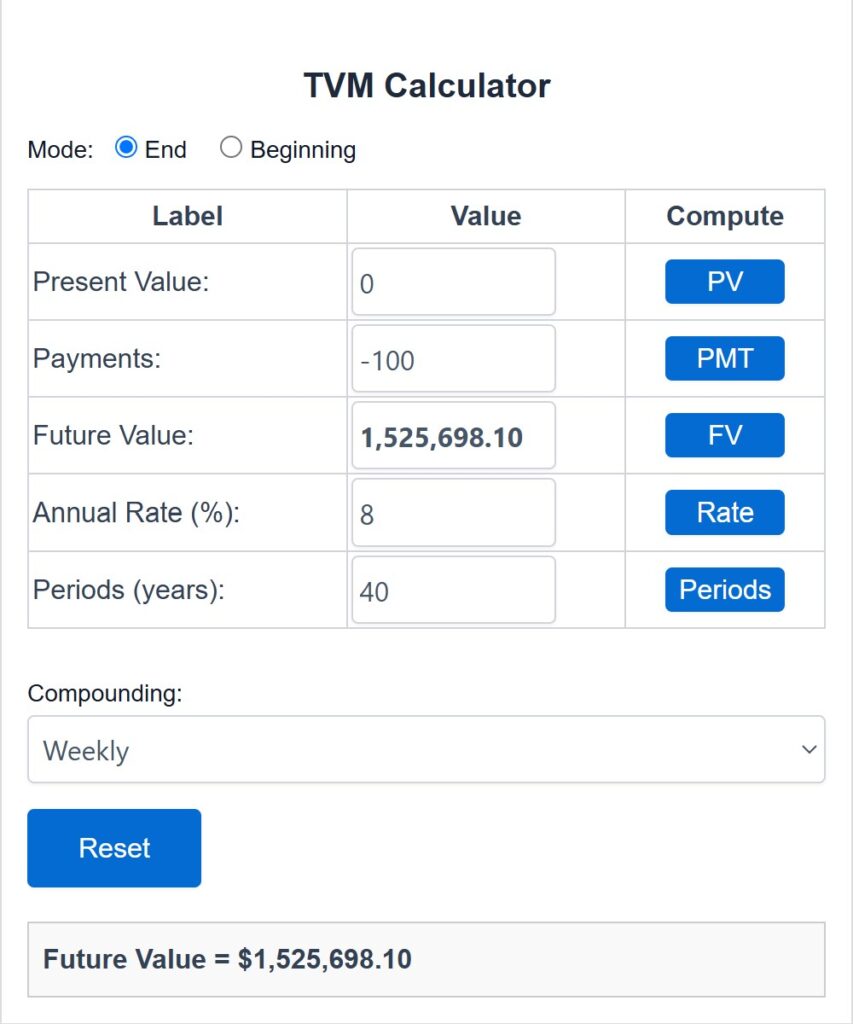
Investment: $100 a week
Annual Interest Rate: 8%
Years: 40
Compounded Weekly
Input:
PV: 0
Payments: -100 (if contributing $100 per week)
Annual Rate: 8
Period Years: 40
Compounding: Weekly
Output:Future Value (FV) = $1,525,698.10
2. Find Out How Much You Need to Save to Reach a Goal
✔️ Enter Future Value (FV): Your desired final amount. ✔️ Enter Present Value (PV): Any initial savings (negative value). ✔️ Enter Annual Interest Rate (I/Y): Expected return. ✔️ Enter Number of Years: Time until your goal. ✔️ Select Compounding Frequency: Choose compounding method. ✔️ Click “Compute” next to PMT to see how much you need to save per period.
Example:
Goal: $500,000
Annual Interest Rate: 7%
Periods (Years): 20
Compounded Monthly
Input:
Present Value: 0
Annual Rate (%): 7
Years: 20
Compounding: Monthly
Compute PMT
Output:
You need to save $959.83 per month
3. Calculate Loan or Mortgage Payments
✔️ Enter Present Value (PV): Loan amount (positive value). ✔️ Enter Annual Interest Rate (I/Y): Loan interest rate. ✔️ Enter Number of Years: Loan duration. ✔️ Select Compounding Frequency: Choose how often interest compounds. ✔️ Click “Compute” next to PMT to see required payment per period.
Example:
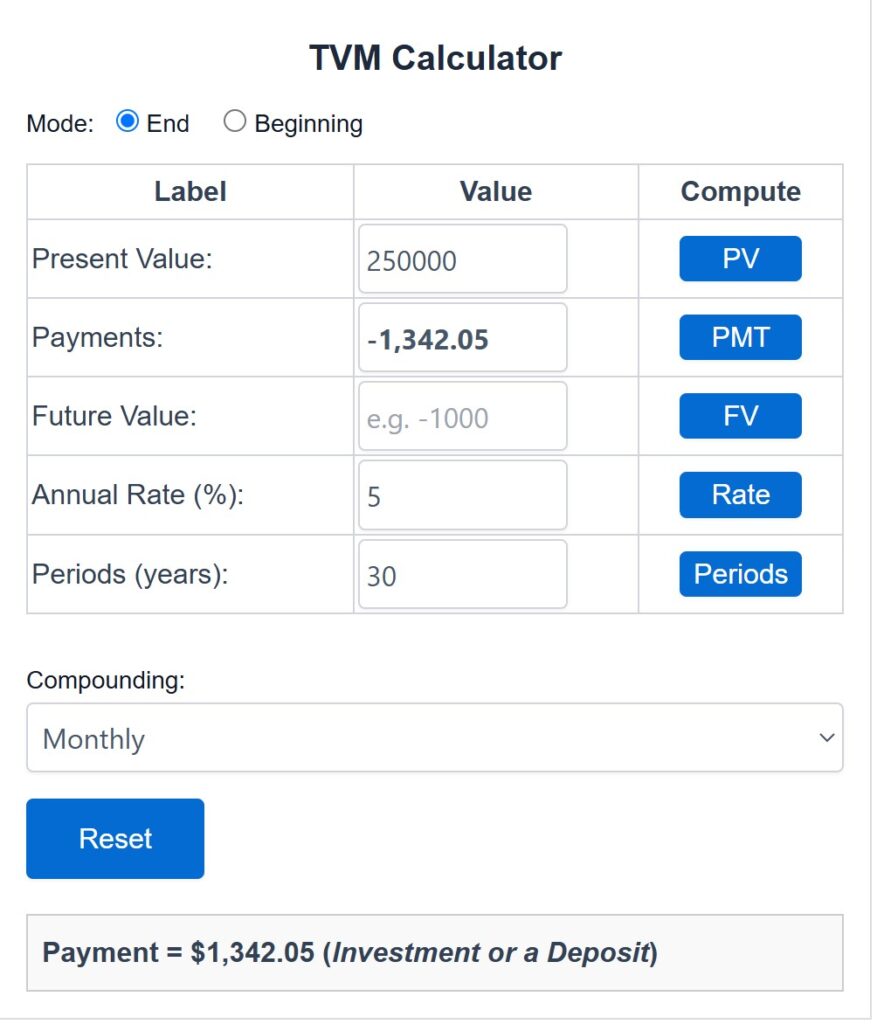
Loan Amount: $250,000
Annual Interest Rate: 5%
Years: 30
Compounded Monthly
Input:
Present Value: 250,000
Annual Rate (%): 5
Periods(Years: 30
Compounding: Monthly
Compute PMT
Output:
Monthly Payment (PMT) = $1,342.05 (Deposit)
Note: The negative sign means this is a payment (cash outflow).
Understanding Mode: End vs. Beginning Payments
The TVM Calculator allows you to choose whether payments occur at the beginning or end of each period.
✔️ End Mode: Most common setting, where payments are made at the end of each period. ✔️ Beginning Mode: Used for cases where payments are made at the start of each period (e.g., rent payments).
Example: If rent is due at the start of the month, use Beginning Mode; if payments are made after a service period, use End Mode.
Why Use This TVM Calculator?
✔️ Simple & Intuitive: Just enter values and hit “Compute”—no manual formulas required! ✔️ Multiple Payment & Compounding Options: Supports annual, monthly, weekly, and daily compounding. ✔️ Accurate Results: Ensures correct calculations without needing Excel or a financial calculator. ✔️ Works for Both Investments & Loans: Helps with retirement planning, wealth building, and debt management.
Start Planning Your Financial Future Today!
The TVM Calculator is an essential tool for financial success. Whether you’re investing, saving, or borrowing, mastering the Time Value of Money will help you maximize wealth and avoid costly financial mistakes.
Investing in the stock market can be overwhelming, especially with the wide range of choices available. Index funds have emerged as one of the simplest yet most effective investment strategies for building long-term wealth. These funds offer a low-cost, diversified, and hassle-free way to participate in market growth. In this guide, we’ll explore what index funds are, why they’re popular among investors, and how they can fit into your financial strategy.
What Are Index Funds?
An index fund is a type of mutual fund or exchange-traded fund (ETF) that aims to replicate the performance of a specific stock market index, such as:
S&P 500 Index (SPY, VOO, IVV) – Tracks the 500 largest U.S. companies.
Dow Jones Industrial Average (DIA) – Follows 30 blue-chip U.S. stocks.
NASDAQ 100 (QQQ) – Focuses on the largest non-financial companies listed on NASDAQ.
Total Stock Market Index (VTI, FZROX) – Invests in the entire U.S. stock market.
Unlike actively managed funds, index funds do not attempt to outperform the market; instead, they simply mirror its performance.
Why Choose Index Funds?
Index funds have gained massive popularity for several reasons:
Low fees: Index funds have lower expense ratios than actively managed funds.
Diversification: They spread investments across hundreds or thousands of stocks, reducing risk compared to picking individual stocks.
Market performance over time: Historically, index funds outperform most actively managed funds.
Simplicity and passive growth: No need to monitor the market daily, making them ideal for investors who prefer a “set-it-and-forget-it” approach.
Index Funds vs. Actively Managed Funds
Feature
Index Funds
Actively Managed Funds
Goal
Match market performance
Beat the market
Management Style
Passive
Active
Expense Ratios
Low (0.03%–0.20%)
Higher (0.50%–2.00%)
Tax Efficiency
High (low turnover)
Lower (frequent buying/selling)
Performance
Often exceeds active funds over time
Inconsistent returns
How to Invest in Index Funds
Step 1: Choose Your Investment Account
401(k) or IRA: Great for retirement tax benefits.
Taxable Brokerage Account: Ideal for general investing.
Step 2: Pick an Index Fund
Look for funds with low expense ratios (e.g., Vanguard, Fidelity, Schwab).
Consider what index you want to track (S&P 500, Total Stock Market, International, etc.).
Step 3: Decide on a Contribution Plan
Invest consistently using dollar-cost averaging (DCA).
Automate contributions to grow your portfolio over time.
Step 4: Hold for the Long Term
Avoid market timing and short-term trading.
Let compounding work in your favor.
Latest Trends in ETFs and Index Funds
As of 2024, assets under management (AUM) in ETFs worldwide have surpassed $10 trillion, with the U.S. market accounting for the majority of these assets. Some of the largest index ETFs by AUM include:
SPDR S&P 500 ETF (SPY) – Over $500 billion in assets
Vanguard Total Stock Market ETF (VTI) – Over $300 billion in assets
iShares Core S&P 500 ETF (IVV) – Over $400 billion in assets
The popularity of ETFs continues to grow, driven by increasing demand for low-cost, passive investing options. Investors are shifting away from high-fee active management in favor of index funds that provide diversified exposure with minimal costs.
Common Myths About Index Funds
“Index funds are boring.” True wealth-building is about long-term growth, not excitement.
“I can beat the market by picking stocks.” Studies show that most investors underperform the market over time.
“They’re only for beginners.” Even professional investors allocate significant portions of their portfolios to index funds.
Real-World Example: The Power of Passive Investing
If you invested $10,000 in an S&P 500 index fund in 1980, it would be worth over $1.3 million today, assuming dividends were reinvested. This demonstrates the power of long-term investing and compounding growth.
Who Should Invest in Index Funds?
Beginners: Ideal for those new to investing.
Busy professionals: Great for those who don’t have time to research stocks.
Long-term investors: Perfect for retirement and wealth-building.
Anyone who wants low-cost, market-tracking returns.
Conclusion: A Simple Yet Powerful Strategy
Index funds are one of the easiest and most effective ways to build wealth over time. With low costs, diversification, and market-beating performance, they are a go-to investment for both beginners and experienced investors.
Key Takeaways:
Index funds track market performance and outperform most actively managed funds.
They offer low fees, diversification, and tax efficiency.
The best approach is to invest consistently and hold for the long term.
Your Mantra for Success: “Keep it simple. Invest passively. Build long-term wealth.”
Legal Disclaimer for Build Wealth Retire Rich Blog/Website
The information provided on the “Build Wealth Retire Rich” blog/website is for educational purposes only and should not be construed as financial, investment, or legal advice. While every effort is made to ensure the accuracy and reliability of the information presented, Build Wealth Retire Rich and its contributors, including AI tools used in the creation of some content, do not guarantee its completeness or timeliness. Users are encouraged to consult with a qualified financial advisor or legal professional to discuss their specific financial situation and to obtain advice tailored to their individual circumstances.
Build Wealth Retire Rich is not responsible for any decisions made based on the information provided on this website. All financial products, investment strategies, and other content discussed are presented for informational purposes only, and no guarantees are made regarding the performance or suitability of any particular investment or strategy.
The views and opinions expressed on “Build Wealth Retire Rich” are those of the authors and do not necessarily reflect the views of the website’s owner or any affiliated institutions. “Build Wealth Retire Rich” does not endorse or promote any particular investment, financial product, or institution unless explicitly stated.
Risk Disclosure: Investing involves risk, including the potential loss of principal. Past performance is not indicative of future results. Always do your own research and consider your financial goals and risk tolerance before making any financial decisions.
By using this website, you agree that Build Wealth Retire Rich and its affiliates are not liable for any losses or damages incurred as a result of using the information provided. Users are solely responsible for their financial decisions and should seek independent advice when necessary.
Investing is more than just a financial activity—it’s a gateway to achieving long-term financial goals, building wealth, and ensuring a secure future. While saving provides a foundation, investing takes your money to the next level by putting it to work and allowing it to grow.
Why Is Investing Important?
Wealth Accumulation Through Growth Investing allows your money to grow significantly over time, thanks to the magic of compounding. When you earn returns on your investments, those returns are reinvested, creating a snowball effect. For example:
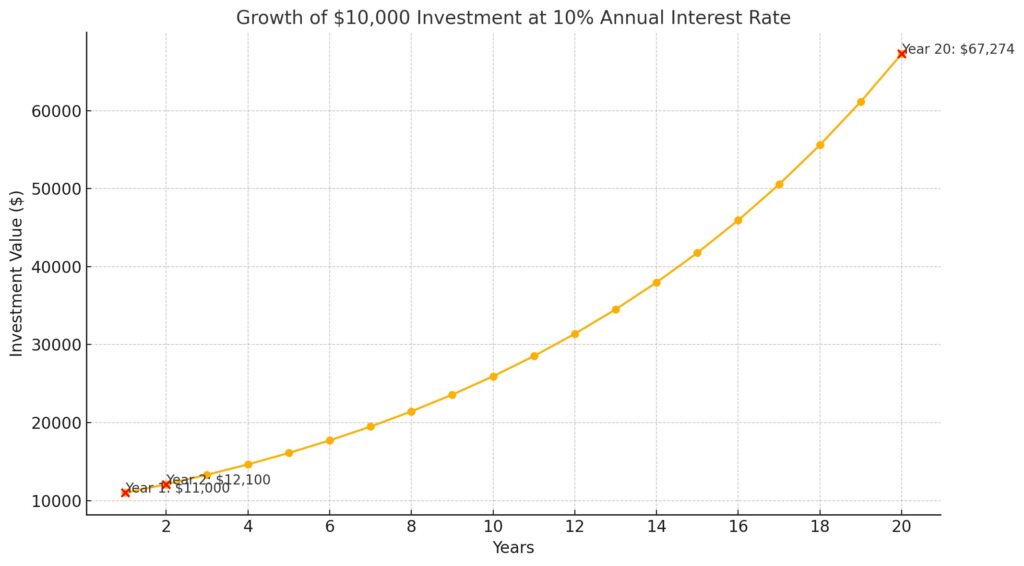
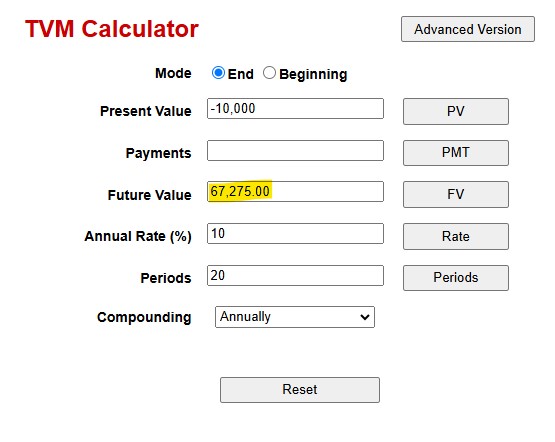
If you invest $10,000 at an average annual return of 10%, it can grow to over $67,000 in 20 years. This growth far exceeds what a regular savings account would offer.
2. Protecting Against Inflation Inflation gradually decreases the purchasing power of money. By investing in assets with higher returns than inflation, you preserve and increase your real wealth. For instance:
If inflation averages 3% annually, a $100 item today will cost approximately $180 in 20 years. Investments in stocks or real estate can help your money keep pace with or surpass inflation.
3. Achieving Financial Goals Investing is a strategic way to reach significant milestones like:
Set Clear Goals Define what you’re investing for—retirement, education, or wealth building—and tailor your strategy accordingly.
Determine Your Risk Tolerance Understand your comfort level with risk. Stocks are riskier but offer higher returns, while bonds and savings accounts are safer but yield lower returns.
Start Small and Be Consistent
Begin with what you can afford. Many brokerage firms allow you to start with as little as $1.
Spread your investments across different asset classes to reduce risk.
The saying, “Don’t put all your eggs in one basket,” applies strongly in investing.
Consult a Financial Advisor If you’re unsure where to start, seek professional advice to create a personalized investment plan.
Overcoming Common Misconceptions
“I need a lot of money to start.” Many brokerage firms allow you to begin investing with minimal amounts.
“Investing is too risky.” Risk varies by asset class. Balancing high-risk investments (stocks) with safer options (bonds) can align with your comfort level.
“I don’t know enough.” Financial literacy tools, seminar/courses, and advisors are available to help you gain confidence.
Key Takeaways
Investing is not just for the wealthy or financially savvy—it’s for anyone with a desire to grow their wealth and secure their future. Here’s why you should start now:
Time is your greatest ally in investing.
Small, consistent contributions lead to significant long-term gains.
Diversifying and understanding your goals reduce risks and improve results.
Remember, investing is like planting a tree: the sooner you plant it, the sooner it bears fruit. Start today and take control of your financial future.
Your Mantra for Success: Save Consistently. Invest Smartly. Retire Richly.
Legal Disclaimer for Build Wealth Retire Rich Blog/Website
The information provided on the “Build Wealth Retire Rich” blog/website is for educational purposes only and should not be construed as financial, investment, or legal advice. While every effort is made to ensure the accuracy and reliability of the information presented, Build Wealth Retire Rich and its contributors, including AI tools used in the creation of some content, do not guarantee its completeness or timeliness. Users are encouraged to consult with a qualified financial advisor or legal professional to discuss their specific financial situation and to obtain advice tailored to their individual circumstances.
Build Wealth Retire Rich is not responsible for any decisions made based on the information provided on this website. All financial products, investment strategies, and other content discussed are presented for informational purposes only, and no guarantees are made regarding the performance or suitability of any particular investment or strategy.
The views and opinions expressed on “Build Wealth Retire Rich” are those of the authors and do not necessarily reflect the views of the website’s owner or any affiliated institutions. “Build Wealth Retire Rich” does not endorse or promote any particular investment, financial product, or institution unless explicitly stated.
Risk Disclosure: Investing involves risk, including the potential loss of principal. Past performance is not indicative of future results. Always do your own research and consider your financial goals and risk tolerance before making any financial decisions.
By using this website, you agree that Build Wealth Retire Rich and its affiliates are not liable for any losses or damages incurred as a result of using the information provided. Users are solely responsible for their financial decisions and should seek independent advice when necessary.