Tag: financial planning

  • How to Set Financial Goals as a Student (Step-by-Step)

    How to Set Financial Goals as a Student (Step-by-Step)

    How to Set Financial Goals as a Student (Step-by-Step) | The Campus Investor
    The Campus Investor
    Money Smarts for Real Life
    🎯 Issue No. 04  ·  Financial Literacy Series

    How to Set Financial Goals as a Student (Step-by-Step)

    May 2026 | 6 min read | For College Students

    Most students don’t lack motivation when it comes to money. They lack direction. They want to save more, spend less, get out of debt — but without a concrete goal attached to a concrete plan, “wanting” never becomes “doing.”

    Financial goals are the bridge between where you are and where you want to be. Set them well and money suddenly has purpose. Skip them and you’ll spend four years reacting to your bank account instead of directing it.

    This guide walks you through exactly how to set financial goals that are realistic, motivating, and built for a student life — step by step.

    78%
    of students have no written financial goals
    2x
    more likely to achieve goals when written down vs. kept in your head
    $0
    average savings of students with no savings goal

    Why Most Students Skip Financial Goals — And Pay For It

    Setting financial goals sounds like something responsible adults do — not something relevant to a student living on dining hall food and a part-time barista salary. That’s the first misconception. Goals aren’t about how much money you have. They’re about telling the money you do have where to go.

    Without a goal, every financial decision gets made in the moment — based on mood, peer pressure, or whatever sale just hit your inbox. That’s how students end up $800 into a semester with no memory of where it went.

    Mini-Case · No Goal, No Direction

    Ryan, Sophomore — Marketing

    Ryan worked 12 hours a week at a campus coffee shop, bringing in around $480 a month after taxes. He wasn’t spending recklessly — a dinner here, a concert ticket there, some new clothes in October. By November he had $14 in his account and no idea what happened.

    When his car needed a $380 repair, he had no choice but to call his parents. The embarrassment led him to finally sit down and write out three specific goals. Within six months he had a $600 emergency fund and was making progress on his credit card balance for the first time.

    The lesson: Ryan didn’t have an income problem. He had a direction problem. Three written goals changed everything — not because he earned more, but because he finally told his money where to go.

    The Three Types of Financial Goals Every Student Needs

    Not all goals are created equal. A strong personal finance plan includes goals across three time horizons — short, mid, and long-term. Each serves a different purpose and keeps you motivated at different stages of your financial journey.

    Short-Term

    1–12 Months

    • Build a $500 emergency fund
    • Pay off one credit card
    • Set up a monthly budget
    • Save $50/month consistently
    • Cancel unused subscriptions
    Mid-Term

    1–4 Years

    • Graduate with under $X in debt
    • Build a 700+ credit score
    • Save 3 months of expenses
    • Open and fund a Roth IRA
    • Pay off all credit card debt
    Long-Term

    5+ Years

    • Be debt-free by age 30
    • Save first home down payment
    • Reach $50K invested by 28
    • Build a 6-month emergency fund
    • Achieve financial independence

    You don’t need goals in all three categories right now. But having at least one goal from each tier gives you something to work toward today, something to build toward this year, and something to stay motivated about for the long haul.

    “A goal without a deadline is just a wish. A goal without a number is just a dream. A real financial goal has both — and a plan attached.”

    Money Management Basics Book Cover
    Explore the Easy Learning Series

    Money Management Basics

    Simple steps to take control of your finances — learn how to track spending, build savings, and reduce debt with clear, practical guidance.

    View on Amazon →

    How to Make Your Goals SMART

    You’ve probably heard of SMART goals in an academic context. The framework works just as well — actually better — for personal finance. Vague goals produce vague results. SMART goals produce specific ones.

    Here’s how it breaks down for a financial goal:

    Letter What It Means Financial Example
    S Specific — Exactly what do you want to achieve? “Save $600 in an emergency fund” not “save more money”
    M Measurable — How will you know you’ve hit it? A dollar amount, a balance, a date — something you can check
    A Achievable — Is this realistic for your income? Saving $75/month is achievable on $900/month income
    R Relevant — Does this goal matter to your life? An emergency fund matters if your car is your only transport
    T Time-bound — When will you reach this goal? “By December 31” beats “eventually” every single time
    💡 Before vs. After SMART

    Before: “I want to save money this semester.”  |  After: “I will save $75 per month for 8 months to build a $600 emergency fund by December 31.” The second version is a goal. The first is a wish.

    The 5-Step Process for Setting Your Goals

    Here is the exact process — five steps, done once at the start of each semester, reviewed once a month. It takes about 45 minutes the first time and 10 minutes each month after that.

    1
    Step One
    Know Your Current Financial Position

    You can’t set a destination if you don’t know where you’re starting. Before writing a single goal, spend 15 minutes getting a clear snapshot of your finances: total monthly income from all sources, total monthly fixed expenses, current bank balance, total debt owed (loans, credit cards), and current savings balance.

    Write these numbers down. Don’t estimate — look them up. This is your financial baseline, and every goal you set will be built on it.

    2
    Step Two
    Identify What Matters Most to You Right Now

    Not every financial goal is equally urgent. A freshman with $1,200 in credit card debt should prioritize paying that off before thinking about long-term investing. A senior with no emergency fund and graduation three months away has a different priority than a sophomore who’s debt-free.

    Ask yourself: what financial problem is causing me the most stress right now? That’s usually where your first goal should live. Solving your biggest pain point first creates momentum for everything else.

    3
    Step Three
    Write One Goal Per Category Using the SMART Framework

    Pick one goal from the short-term, mid-term, and long-term categories. Write each one as a complete SMART goal — specific, measurable, achievable, relevant, and time-bound. Resist the urge to write ten goals. One per category means three total. Three focused goals beat ten vague ones every time.

    Keep them somewhere visible — your phone notes, a sticky note on your laptop, a whiteboard. Out of sight means out of mind.

    4
    Step Four
    Break Each Goal Into Monthly Actions

    A goal without a monthly action is just a wish with a deadline. Once you’ve written your goals, work backward: if you want to save $600 by December and it’s May, that’s 7 months — you need to save $86 a month. Put that $86 in your budget as a fixed line item, not an afterthought.

    This step turns your goals from aspirational to operational. Every goal becomes a monthly number. Every monthly number goes into your budget. Your budget runs on autopilot from there.

    5
    Step Five
    Schedule a Monthly 10-Minute Review

    Set a recurring calendar reminder — first Sunday of every month, 10 minutes. Pull up your goals, check your progress, and adjust if needed. Did you hit your savings target? Did an unexpected expense knock you off course? What needs to change next month?

    The review is what separates students who achieve goals from students who set them and forget them. Ten minutes a month is the entire maintenance cost of a working financial plan.

    How to Track Progress and Stay on Course

    Tracking doesn’t need to be complicated. The simplest system that works is better than the perfect system you abandon after two weeks. Here’s a fill-in template you can copy into your notes app or a notebook right now:

    📋 My Financial Goal Template

    e.g. Short-term / Mid-term / Long-term
    e.g. Save $600 emergency fund
    e.g. $600
    e.g. December 31, 2026
    e.g. Transfer $86 to savings on the 1st
    e.g. $172 saved (Month 2 of 7)
    🔁 Monthly Review Prompt

    Every first Sunday of the month, ask yourself three questions: (1) Did I hit my monthly action this month? (2) What got in the way? (3) What’s one thing I’ll do differently next month? That’s the entire review. Three questions, ten minutes, consistent momentum.

    Real Goal Examples by Year in College

    Not sure where to start? Here are realistic financial goals matched to where you likely are in your college journey:

    Freshman Year

    Just Getting Started

    Short-term: Build a $300 emergency fund by end of first semester. Mid-term: Graduate with a credit score above 680. Long-term: Understand how your student loans work and what you’ll owe at graduation.

    Focus: Build the habit of tracking your money, open a student credit card and use it responsibly, and never borrow more in loans than you’ve looked up and acknowledged.
    Sophomore Year

    Building Momentum

    Short-term: Save $50/month consistently for 6 months. Mid-term: Pay off any credit card balance — zero balance by end of year. Long-term: Open a Roth IRA even if you only contribute $25/month.

    Focus: Lock in the savings habit, get debt-free on revolving credit, and plant the first seed of long-term investing. Small numbers right now, massive impact later.
    Junior Year

    Picking Up Speed

    Short-term: Build a full $1,000 emergency fund. Mid-term: Increase Roth IRA contributions to $50–$100/month. Long-term: Research income-driven repayment options for your student loans.

    Focus: Strengthen your financial cushion, accelerate investing, and get ahead of the student loan reality so graduation doesn’t catch you off guard.
    Senior Year

    Preparing for Launch

    Short-term: Know your exact total loan balance and monthly payment before you graduate. Mid-term: Have 1 month of post-graduation living expenses saved before your last day. Long-term: Draft a post-graduation budget based on your starting salary before you accept a job offer.

    Focus: Transition planning. The students who thrive financially after graduation are the ones who treated the last semester as a financial prep period, not just a finish line.
    ◆ ◆ ◆

    Financial goals aren’t about being perfect with money. They’re about being intentional. One well-written goal, reviewed monthly, acted on consistently, will do more for your financial future than ten vague intentions that never left your head.

    “You don’t need a perfect financial situation to set financial goals. You need a piece of paper, a number, and a date. Everything else follows from that.”

    Your Goal-Setting Action List — Do This Today

    • Write down your current income, expenses, savings balance, and total debt — your financial baseline
    • Identify your single biggest financial stress right now — that’s your first goal
    • Write one SMART goal for short-term, mid-term, and long-term
    • Break each goal into a monthly dollar action and add it to your budget
    • Set a recurring calendar reminder for a 10-minute monthly review
    • Tell one person your most important goal — accountability doubles your chances of success

    Frequently Asked Questions

    What financial goals should a college student set first?
    Start with your biggest pain point — usually the financial stress causing you the most anxiety right now. For most students that’s either building a $500 emergency fund, paying off a credit card balance, or understanding their student loan total. Solve that first. Once you have one win, momentum builds naturally toward mid and long-term goals.
    What are SMART financial goals for students?
    A SMART financial goal is Specific, Measurable, Achievable, Relevant, and Time-bound. Instead of “save more money,” a SMART version is “save $75 per month for 8 months to build a $600 emergency fund by December 31.” The difference is a clear number, a clear deadline, and a monthly action that turns the goal from aspirational to operational.
    How many financial goals should a student have at once?
    Three is the ideal number — one short-term (1–12 months), one mid-term (1–4 years), and one long-term (5+ years). More than three goals at once usually means none get the focused attention they need. Write them down, break each into a monthly dollar action, and review all three once a month. Simple, consistent, and visible beats complex and forgotten every time.
    What is a realistic financial goal for a college freshman?
    Three realistic freshman goals: build a $300–$500 emergency fund by end of the first semester, open a student credit card and pay it in full every month, and log into StudentAid.gov to know your loan balance. These three actions take minimal income and minimal time, but they set you up for every financial decision you’ll make over the next four years.
    How do you stay on track with financial goals in college?
    Schedule a 10-minute monthly review — first Sunday of every month. Check your progress on each goal, ask what worked and what didn’t, and adjust next month’s actions accordingly. Automate whatever you can — automatic savings transfers, automatic credit card payments, automatic investment contributions. Automation removes willpower from the equation entirely, which is the single most effective habit in personal finance.

    The Campus Investor  ·  Issue 04  ·  Financial Literacy Series

    Written for students who want to graduate smart — in every sense of the word.

  • 6.2 Saving vs Investing: What’s the Difference and When to Do Each

    6.2 Saving vs Investing: What’s the Difference and When to Do Each

    Saving versus investing represents fundamental financial choice determining wealth trajectory over decades—saving preserves money in guaranteed low-return accounts (savings, CDs) earning 0.5-5% annually protecting principal for short-term needs under 5 years, while investing allocates money to growth assets (stocks, bonds, funds) earning 6-12% average accepting volatility and potential temporary losses for long-term goals 5+ years enabling wealth multiplication impossible through savings alone. Representing complementary not competing strategies requiring both for optimal financial health—emergency fund and short-term goal money belongs in savings providing stability and liquidity, while retirement and long-term wealth building requires investing harnessing compound returns outpacing inflation creating prosperity impossible through cash preservation. Understanding appropriate allocation transforms financial outcomes dramatically—$500 monthly over 30 years yields $210,000 in savings at 1% versus $745,000 invested at 8% demonstrating $535,000 wealth differential from strategic choice, proving saving-only approach condemns individuals to inflation-eroded purchasing power and retirement inadequacy while investing-only approach creates emergency vulnerability forcing crisis liquidations destroying long-term wealth, making saving-investing balance essential not optional for financial security requiring honest assessment matching money purpose with appropriate vehicle maximizing both safety and growth impossible when using single strategy exclusively.
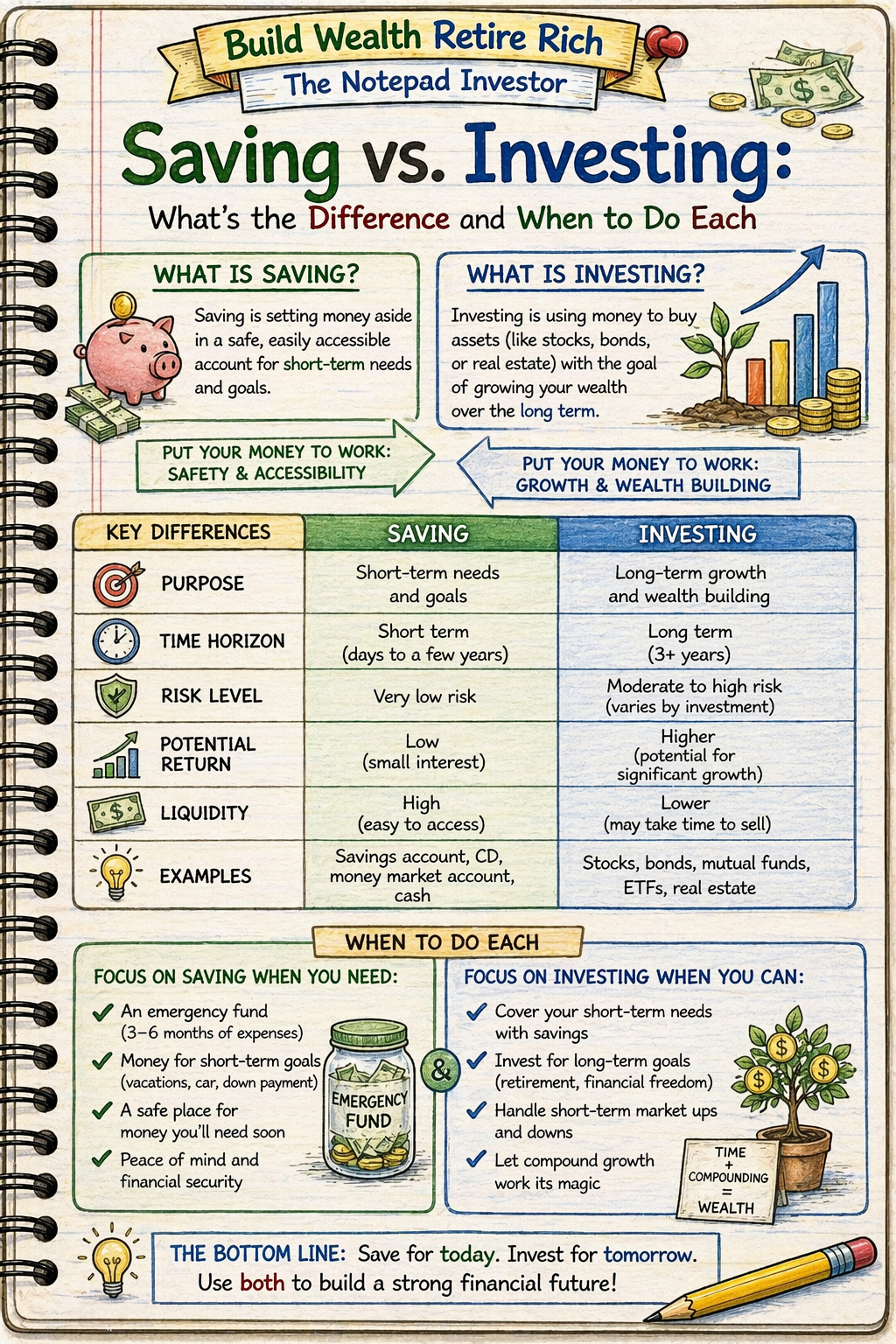
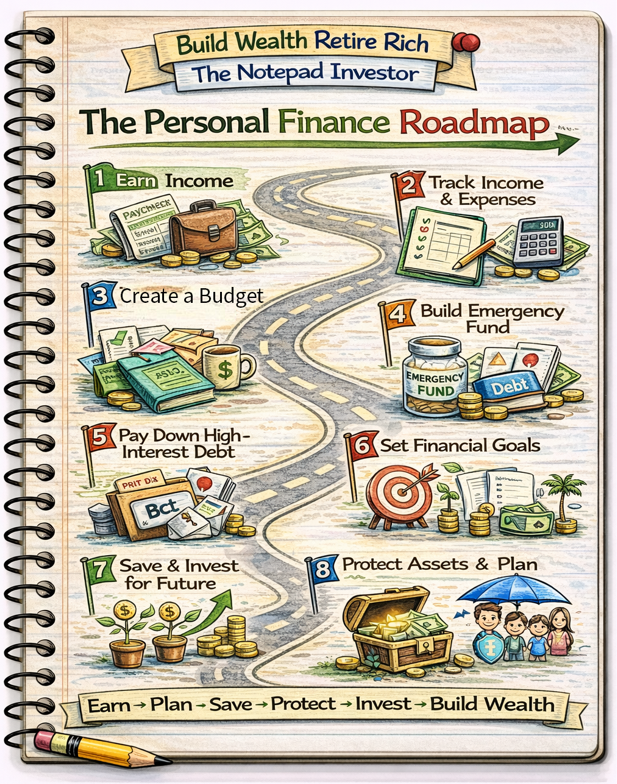
    Notebook sketch explaining personal finance

    This article is designed for anyone confused about saving versus investing distinctions, individuals keeping all money in savings fearing market risk, or investors neglecting emergency funds creating vulnerability. You do not need financial expertise to understand saving-investing differences—fundamental concepts accessible through clear explanations of return expectations, risk profiles, appropriate timelines, and strategic allocation, though requires honest goal assessment determining which money needed short-term (savings) versus long-term (investing), realistic risk tolerance recognizing comfort with volatility versus preference for guarantees, and disciplined execution maintaining both strategies simultaneously not abandoning one for other, making saving-investing literacy requiring both mechanical understanding (returns, vehicles, accounts) and strategic wisdom (appropriate allocation, timeline matching, balanced approach) impossible when viewing as either/or choice versus complementary foundation requiring both for comprehensive financial security.

    Understanding saving versus investing matters because appropriate allocation creates $300,000-700,000 additional lifetime wealth through investing long-term money versus leaving in savings losing purchasing power to inflation, while simultaneous emergency fund maintenance prevents crisis liquidations during market downturns protecting compound growth from forced selling at losses, and strategic balance enables both stability (3-6 months expenses readily accessible) and prosperity (retirement wealth through decades of compound returns)—while financially-literate individuals maintain $15,000-30,000 emergency savings PLUS $500,000-2,000,000 retirement investments creating comprehensive security impossible for savings-only individuals accumulating $200,000-400,000 over lifetime eroded by inflation, or investing-only individuals facing forced liquidations during emergencies destroying years of discipline through single crisis, demonstrating saving-investing balance as essential wealth-building foundation not simplistic choice requiring nuanced strategic allocation impossible without understanding fundamental differences enabling informed purposeful money placement.

    Educational disclaimer: This article provides general educational information about saving and investing strategies. Individual appropriate allocations, timelines, and strategies vary significantly based on circumstances including age, income, goals, risk tolerance, and financial obligations. This is not financial advice or specific recommendation of savings/investment ratios. Investment returns represent historical averages with significant volatility—actual results vary. Emergency fund recommendations represent general guidelines not personalized assessments. Consult qualified financial advisors for guidance matching individual situations.

    Fundamental Differences

    Saving Characteristics

    Purpose and timeline:

    • Emergency fund (3-6 months living expenses)
    • Short-term goals under 3 years (vacation, car down payment, wedding)
    • Irregular expense reserves (property taxes, insurance, home maintenance)
    • Money needed with certainty within 5 years

    Common savings vehicles:

    • High-yield savings accounts: 0.5-5% APY depending on Fed rates
    • Money market accounts: 0.5-5% APY, check-writing capability
    • Certificates of Deposit (CDs): 2-5% APY, fixed terms 3 months-5 years
    • All FDIC insured up to $250,000 per account

    Savings advantages:

    • Principal guaranteed (FDIC insurance prevents loss)
    • Immediate liquidity (access within 0-3 days typical)
    • Zero volatility (balance never decreases)
    • Predictable returns (stated interest rate known upfront)
    • No market knowledge required
    • Peace of mind from stability

    Savings limitations:

    • Low returns barely outpacing or trailing inflation
    • Purchasing power erosion over decades
    • Insufficient for retirement wealth building
    • Opportunity cost of foregone investment gains

    Investing Characteristics

    Purpose and timeline:

    • Retirement (20-40 years away)
    • Long-term goals 5+ years (home down payment, education)
    • Wealth building beyond inflation
    • Financial independence and passive income

    Common investment vehicles:

    • Stock index funds: 8-12% average annual returns historically
    • Bond funds: 3-6% average returns, lower volatility
    • Target-date retirement funds: Age-appropriate stock/bond mix
    • Real estate: 8-10% average returns through appreciation and rents

    Investing advantages:

    • High long-term returns outpacing inflation substantially
    • Compound growth multiplying wealth over decades
    • Passive income potential (dividends, interest)
    • Retirement security through wealth accumulation
    • Purchasing power protection and growth

    Investing limitations:

    • Volatility creating temporary losses (20-50% declines possible)
    • No principal guarantee (can lose money)
    • Requires long timeline for recovery from downturns
    • Liquidity varies (stocks liquid, real estate illiquid)
    • Emotional discipline needed during market crashes

    Side-by-Side Comparison

    Return expectations:

    • Savings: 0.5-5% annually (currently ~4-5% high-yield savings)
    • Investing: 6-12% annually average (stocks ~10%, bonds ~4-6%, balanced ~7-8%)

    Risk profile:

    • Savings: Zero principal loss risk, inflation purchasing power loss
    • Investing: Temporary market loss 20-50%, long-term gain high probability

    Timeline appropriateness:

    • Savings: Under 5 years ideal, essential under 3 years
    • Investing: 5+ years minimum, 10+ years ideal

    Liquidity:

    • Savings: Immediate to 3-day access typical
    • Investing: Varies (stocks 2-3 days, real estate months, retirement accounts penalties before 59½)

    Tax treatment:

    • Savings: Interest taxed as ordinary income annually
    • Investing: Capital gains preferential rates 0-20%, tax-deferred growth in retirement accounts
    Advertisement

    Financial Wellness Planner

    The Wealth Impact Over Time

    30-Year Wealth Comparison

    Scenario: $500 monthly for 30 years

    SAVINGS APPROACH (1% interest):

    • Monthly contribution: $500
    • Total contributed: $180,000
    • Interest earned: $30,000
    • Final value: $210,000
    • Purchasing power adjustment: -25% from 2.5% average inflation = $157,500 in today’s dollars

    INVESTING APPROACH (8% returns):

    • Monthly contribution: $500
    • Total contributed: $180,000
    • Investment gains: $553,000
    • Final value: $733,000
    • Purchasing power: $550,000 in today’s dollars (8% nominal minus 2.5% inflation = 5.5% real)

    WEALTH DIFFERENTIAL: $535,180 from investing versus saving

    Inflation Impact on Savings

    The purchasing power problem:

    • Inflation averages 2-3% annually long-term
    • Savings rates fluctuate but often trail inflation
    • Real return = Nominal return – Inflation

    Example erosion:

    • $100,000 saved at 1% interest
    • Year 10: $110,500 nominal value
    • Inflation at 2.5%: Need $128,000 to maintain purchasing power
    • Real loss: $17,500 purchasing power (13.7% decline)

    Investment protection:

    • $100,000 invested at 8%
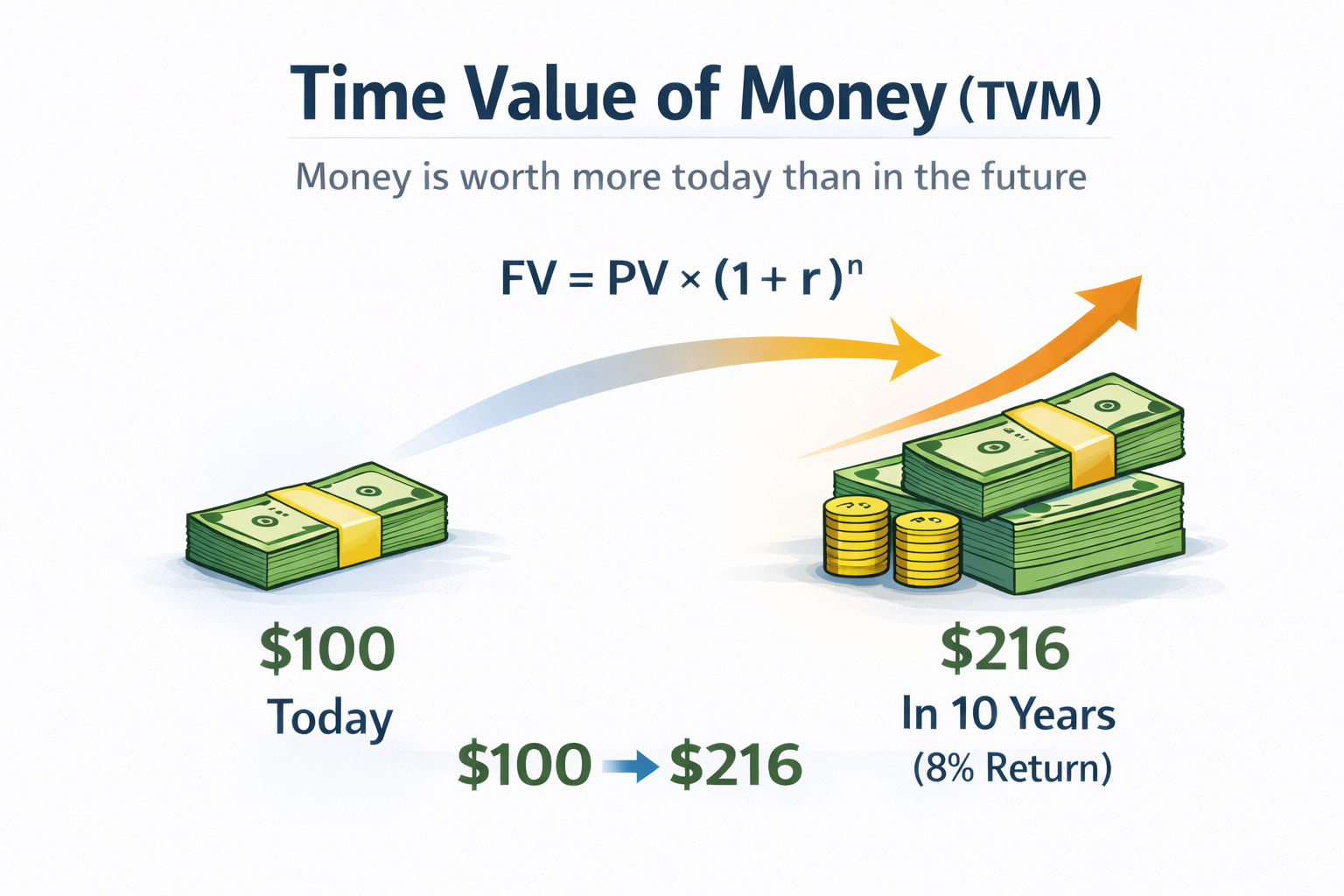
    • Year 10: $216,000 nominal value
    • After 2.5% inflation adjustment: $170,814 real value
    • Real gain: $45,186 purchasing power increase

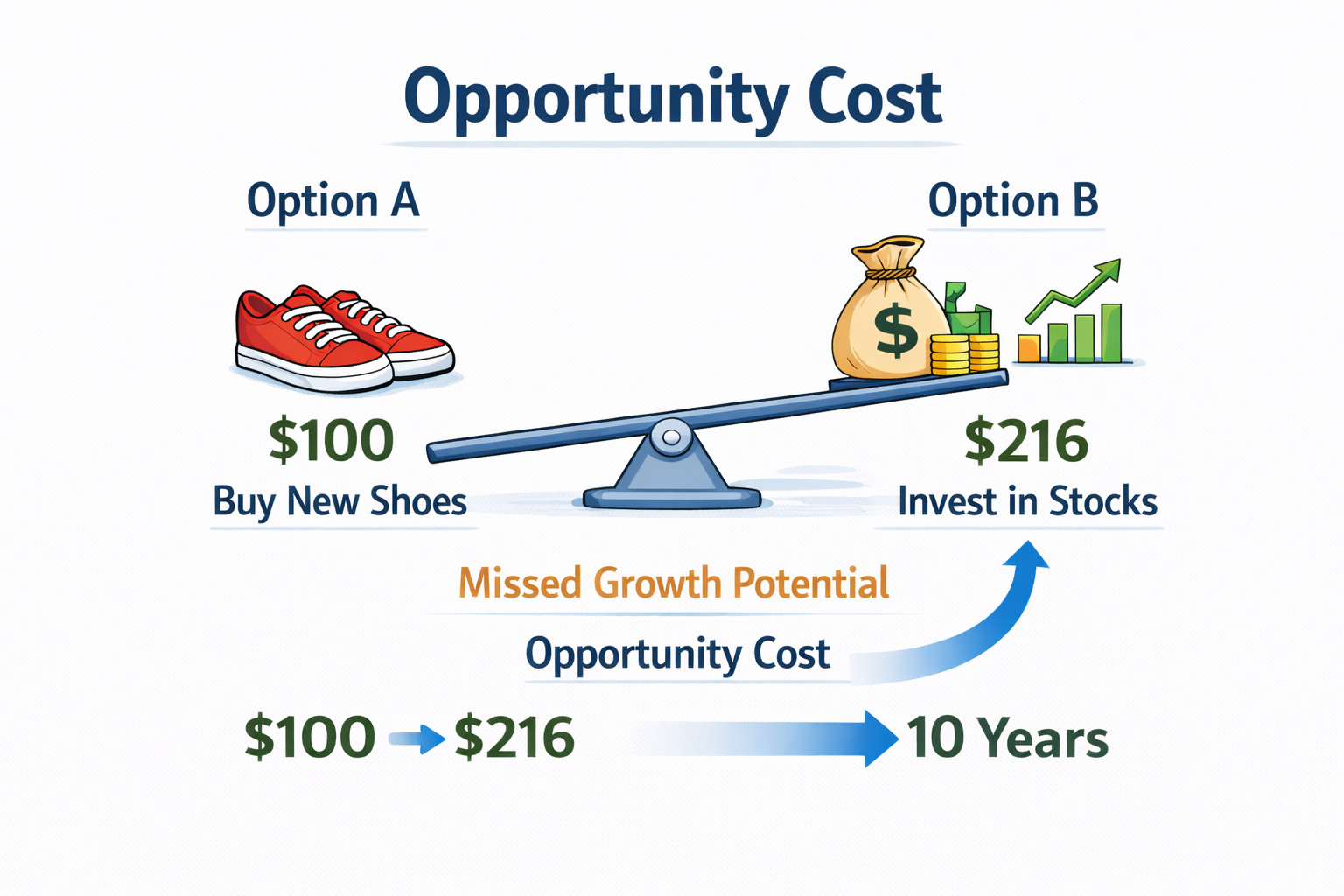
    The Opportunity Cost

    Foregone wealth from savings-only approach:

    Example: Age 30-65 (35 years)

    • Savings-only: $400 monthly at 1% = ~$201,053
    • Investing: $400 monthly at 8% = ~$917,553
    • Opportunity cost: $716,000 lifetime wealth foregone
    • Retirement income impact: $3,058 monthly (4% withdrawal from $917K) versus $700 monthly ($201K)

    The compound difference:

    • First 10 years: Investing ahead $21,000 (modest difference)
    • Years 11-20: Gap widening, investing ahead $175,000
    • Years 21-30: Massive divergence, investing ahead $523,000
    • Final 5 years: Gap explodes to $716,000,000 through compound acceleration

    Appropriate Allocation Strategy

    The Balanced Approach

    Step 1: Build emergency fund in savings (3-6 months expenses)

    • Calculate monthly essential expenses (housing, food, utilities, insurance, minimum debt payments)
    • Multiply by 3-6 months based on job security and family situation
    • Single income household: 6 months
    • Dual income household: 3-4 months
    • Self-employed/commission: 6-12 months

    Example emergency fund calculation:

    • Monthly essentials: $3,500
    • Dual income household target: 4 months
    • Emergency fund goal: $14,000 in high-yield savings

    Step 2: Save for short-term goals (under 3 years)

    • Vacation next year: $3,000
    • Car down payment 2 years: $5,000
    • Wedding 18 months: $8,000
    • Total short-term savings: $16,000

    Step 3: Invest everything else for long-term goals

    • Retirement (20-40 years away)
    • Home down payment (5+ years)
    • Children’s education (10+ years)
    • Financial independence

    Complete Allocation Example

    Household: $5,000 monthly income, $3,500 expenses

    Available for savings/investing: $1,500 monthly

    Phase 1: Emergency fund building (6-12 months)

    • Emergency fund needed: $14,000 (4 months expenses)
    • Current emergency fund: $2,000
    • Gap: $12,000
    • Allocation: $1,200 monthly to savings, $300 to investing (capture employer 401k match)
    • Timeline: 10 months to complete emergency fund

    Phase 2: Balanced savings/investing (ongoing)

    • Emergency fund: Complete at $14,000 (maintain, don’t increase)
    • Short-term goal savings: $300 monthly for upcoming vacation/car
    • Long-term investing: $1,200 monthly to retirement accounts
    • Ratio: 20% savings, 80% investing

    Phase 3: Retirement approaching (age 50+)

    • Emergency fund: Increase to $18,000 (6 months as job loss harder at older age)
    • Short-term reserves: $20,000 for home maintenance, travel
    • Retirement investing: Maximum contributions $2,000+ monthly
    • Gradual shift toward bonds reducing volatility

    Age-Based Allocation Guidelines

    Ages 20-30 (wealth building foundation):

    • Emergency fund: $5,000-15,000 (3-6 months expenses typical at this age)
    • Short-term savings: $2,000-5,000 for immediate goals
    • Investing: 80-90% of available monthly surplus
    • Investment allocation: 100% stocks (aggressive growth, long timeline)

    Ages 30-45 (peak accumulation):

    • Emergency fund: $15,000-30,000 (higher expenses, family obligations)
    • Short-term savings: $5,000-15,000 (kids activities, home repairs)
    • Investing: 70-80% of surplus to retirement and education
    • Investment allocation: 90-100% stocks

    Ages 45-60 (final push):

    • Emergency fund: $20,000-40,000 (job loss harder, healthcare costs)
    • Short-term savings: $10,000-25,000 (major expenses, aging parents)
    • Investing: Maximum 70-85% to catch up on retirement
    • Investment allocation: 70-80% stocks, 20-30% bonds (stability increase)

    Ages 60+ (preservation focus):

    • Emergency fund: $25,000-50,000 (fixed income protection)
    • Short-term reserves: $30,000-60,000 (2-5 years living expenses in cash)
    • Investing: Remainder in balanced portfolio
    • Investment allocation: 40-60% stocks, 40-60% bonds
    Advertisement
    Reserved space for in-content ad

    Common Mistakes and How to Avoid

    Mistake 1: Keeping Everything in Savings

    The savings-only trap:

    • Pattern: $100,000+ in savings earning 1-4%, $0 invested
    • Motivation: Fear of market volatility, “safety” preference
    • Cost: $50,000-200,000+ in foregone returns over 20-30 years

    Example scenario:

    • Age 35: $50,000 in savings, adds $500 monthly for 30 years
    • All in savings at 2%: Age 65 = $278,000
    • If invested at 8%: Age 65 = $783,000
    • Cost of fear: $505,000 lifetime opportunity cost

    Solution:

    • Maintain 3-6 months expenses in savings ($15,000-30,000 typical)
    • Invest everything beyond emergency fund
    • Accept short-term volatility for long-term wealth
    • Remember: 30-year timeline allows multiple market crash recoveries

    Mistake 2: Investing Without Emergency Fund

    The emergency vulnerability:

    • Pattern: $0 savings, 100% income to investing
    • Motivation: Maximize returns, “I’ll just use credit cards for emergencies”
    • Cost: Forced investment liquidation during crisis, debt accumulation, destroyed compound growth

    Example disaster scenario:

    • No emergency fund, $30,000 invested in market
    • Lose job during market crash (portfolio down 30% to $21,000)
    • Need $15,000 for 3 months expenses
    • Forced to sell $15,000 worth (71% of remaining portfolio)
    • Left with $6,000 invested, missed entire market recovery
    • 5 years later: $6,000 would have grown to $21,000 if held
    • Plus reaccumulated $10,000 credit card debt at 18% from emergency expenses

    Solution:

    • Build $1,000 starter emergency fund before aggressive investing
    • Expand to 3-6 months expenses before maximizing investments
    • Accept temporarily lower investment contributions for stability
    • Prevents forced selling and debt creation

    Mistake 3: Using Wrong Vehicle for Timeline

    Common mismatches:

    Mismatch A: Short-term money in stocks

    • Scenario: Need $20,000 for home down payment in 18 months
    • Mistake: Invest in stock market hoping for 10% returns
    • Risk: Market crashes 30% month before purchase, only have $14,000
    • Consequence: Lose dream home or forced to delay years
    • Correction: Keep in high-yield savings guaranteeing $20,000+ availability

    Mismatch B: Long-term retirement money in savings

    • Scenario: Age 30, saving for retirement age 65 (35 years)
    • Mistake: Keep retirement savings in 2% savings account
    • Cost: $400 monthly 35 years = $222,000 saved versus $930,000 invested
    • Consequence: Inadequate retirement forcing continued work or lifestyle reduction
    • Correction: Invest retirement money in stock index funds accepting volatility

    Timeline decision framework:

    • Under 2 years: Savings only (100% safety priority)
    • 2-5 years: Mostly savings, consider conservative investing if can delay goal
    • 5-10 years: Balanced or aggressive investing acceptable
    • 10+ years: Aggressive stock investing optimal

    Mistake 4: Abandoning Savings After Building Emergency Fund

    The ongoing savings need:

    • Pattern: Build $15,000 emergency fund, redirect 100% future savings to investing
    • Problem: Irregular expenses drain emergency fund repeatedly
    • Examples: Annual insurance $2,500, property taxes $3,000, car maintenance $1,500, holiday gifts $1,000
    • Total: $8,000 annually in irregular but predictable expenses
    • Result: Emergency fund constantly depleted, never stable

    Solution: Sinking funds

    • Identify annual irregular expenses: $8,000
    • Divide by 12: $667 monthly sinking fund contribution
    • Separate from emergency fund in dedicated savings
    • Prevents emergency fund depletion from predictable expenses

    Complete savings allocation:

    • Emergency fund: $15,000 maintained (use only for genuine emergencies)
    • Sinking funds: $667 monthly for irregular expenses
    • Short-term goals: Additional as needed (vacation, car replacement)
    • Investing: Remainder after all savings needs covered

    Decision Framework

    Quick Decision Tree

    Question 1: When do I need this money?

    • Under 3 years → SAVINGS (high-yield savings or short-term CDs)
    • 3-5 years → Mostly SAVINGS, conservative investing if flexible
    • 5-10 years → INVESTING (balanced portfolio 60/40 stocks/bonds)
    • 10+ years → INVESTING (aggressive 80-100% stocks)

    Question 2: Can I afford to lose 20-30% temporarily?

    • No, need guaranteed access → SAVINGS
    • Yes, have time to recover → INVESTING

    Question 3: What’s the money’s purpose?

    • Emergency buffer/safety net → SAVINGS
    • Specific purchase soon → SAVINGS
    • Retirement wealth building → INVESTING
    • Long-term goals → INVESTING

    Question 4: Do I already have adequate emergency fund?

    • No → Priority SAVINGS until 3-6 months expenses secured
    • Yes → Shift focus to INVESTING for long-term wealth

    Specific Scenario Guidance

    Scenario: “I have $10,000 windfall, where should it go?”

    Decision process:

    • Step 1: Emergency fund adequate? If under $5,000 → Add to savings
    • Step 2: High-interest debt? If credit cards over 10% → Pay off debt
    • Step 3: Emergency fund complete? Short-term goals funded?
    • Step 4: Everything else → Invest in retirement accounts

    Example allocation:

    • Emergency fund current: $3,000, need $15,000 = $12,000 gap
    • Credit card debt: $0
    • Short-term goals: Funded
    • Windfall allocation: $10,000 to emergency fund (now $13,000), $2,000 remaining gap to fill from monthly income, future windfalls 100% to investing

    Scenario: “Should I pause investing to build bigger emergency fund?”

    Pause investing when:

    • Emergency fund under $1,000 (extreme vulnerability)
    • Job instability or layoff risk (build 6-12 months buffer)
    • Major life change (baby, moving, career change)
    • Income irregular or commission-based needing larger buffer

    Maintain balanced approach when:

    • Emergency fund $3,000+ covering most emergencies
    • Stable employment
    • Dual income household
    • Can split surplus 70/30 investing/savings building both simultaneously

    Scenario: “I’m 50 with $500,000 invested but only $5,000 saved, what now?”

    Action plan:

    • Immediate: Build emergency fund to $25,000 (6 months expenses at this age/income level)
    • Pause retirement contributions temporarily if needed OR
    • Balanced: Continue retirement investing but divert 50% of new contributions to emergency fund building
    • Timeline: 10-12 months to adequate emergency fund
    • Do NOT liquidate investments to build emergency fund (avoid triggering taxes and missing growth)
    • Resume full retirement contributions once emergency fund adequate
    Advertisement
    Reserved space for in-content ad

    Why Understanding Saving vs Investing Matters

    Without understanding saving versus investing differences, individuals either keep all money in savings losing $300,000-700,000 lifetime wealth to inflation and opportunity costs versus investing long-term funds, or invest everything including emergency money forcing crisis liquidations during market downturns destroying years of compound growth through forced selling at losses, missing strategic balance enabling both stability (accessible emergency reserves) and prosperity (retirement wealth through decades of compound returns)—while financially-literate individuals maintain appropriate allocation with $15,000-30,000 emergency savings providing crisis buffer PLUS $500,000-2,000,000 retirement investments creating comprehensive security impossible for extreme-approach users either accumulating inadequate inflation-eroded savings or facing emergency vulnerability requiring debt or liquidations, demonstrating saving-investing balance as essential wealth-building foundation requiring honest assessment matching money purpose with appropriate vehicle maximizing both safety and growth impossible when using single strategy exclusively creating either poverty through excessive caution or crisis through excessive risk.

    Understanding saving versus investing enables individuals to:

    • Match money purpose with appropriate vehicle (short-term savings, long-term investing)
    • Build emergency fund preventing crisis liquidations protecting compound growth
    • Harness investment returns for long-term wealth impossible through savings alone
    • Accept calculated risks understanding volatility temporary with adequate timeline
    • Allocate strategically based on age, goals, and timeline requirements
    • Avoid common mistakes (all savings or all investing extremes)
    • Create balanced financial foundation enabling both stability and prosperity

    Saving-investing knowledge transforms financial strategy from simplistic single-approach into nuanced balanced allocation, enabling both emergency resilience through accessible reserves and retirement security through compound returns, creating comprehensive financial health impossible when viewing as either/or choice versus complementary strategies requiring both for optimal outcomes.

    Common Misunderstandings

    Many people view saving as universally “safe” and investing as universally “risky” making savings always preferable for risk-averse individuals. In reality, long-term savings face certain purchasing power loss through inflation erosion creating guaranteed real loss, while long-term investing faces temporary volatility but provides inflation protection and wealth growth with 95%+ positive return probability over 20+ year periods making investing actually “safer” for long-term money despite short-term volatility—$100,000 saved 30 years loses 25% purchasing power guaranteed through 2.5% inflation versus invested $100,000 growing to $1 million through 8% returns despite temporary 20-50% declines during journey, proving “risk” definition depends on timeline not absolute volatility making savings risky for retirement and investing risky for emergencies requiring timeline-appropriate matching not universal risk rankings.

    Another common misconception is building large emergency fund ($50,000-100,000+) provides superior security justifying keeping substantial money in low-return savings. However, emergency fund over 6-12 months expenses creates massive opportunity cost through foregone investment returns—$50,000 excess emergency fund earning 2% over 20 years = $74,000 versus invested at 8% = $233,000 representing $159,000 opportunity cost for marginally increased security, proving beyond reasonable 3-6 month buffer creates wealth destruction not protection making $15,000-30,000 emergency fund optimal with remainder invested generating actual long-term security through wealth accumulation versus false security from excessive low-return cash holdings preventing prosperity.

    Some believe market timing allows avoiding investing risks through perfect entry and exit timing making volatility avoidable through skillful trading. However, market timing attempts consistently fail with studies showing 80-90% of active timers underperform simple buy-and-hold approaches, missing best 10 market days over 20 years reduces returns 50% yet impossible predicting which days creating missed-recovery risk, and transaction costs plus poor timing decisions destroy wealth faster than volatility acceptance—proving volatility management through long-term holding and continuing contributions during declines produces superior outcomes versus timing attempts creating worse results through missed gains and poor decisions making acceptance not avoidance optimal volatility strategy for long-term investors.

    How Saving-Investing Understanding Fits Into Financial Success

    Saving-investing understanding enables comprehensive financial security through balanced allocation maintaining emergency accessibility PLUS retirement wealth growth, prevents extreme approaches creating either inadequate savings forcing crisis debt or excessive savings creating opportunity cost poverty, and provides strategic framework matching timeline with vehicle optimizing both stability and prosperity—making saving-investing literacy essential requiring 3-6 months emergency savings protecting against crisis liquidations, investing all long-term money harnessing compound returns creating $500,000-2,000,000 retirement wealth impossible through savings alone, and honest assessment determining appropriate allocation based on timeline not fear or greed, transforming financial strategy from simplistic single-approach into nuanced balanced foundation enabling both emergency resilience and long-term prosperity impossible when viewing as either/or choice versus complementary strategies requiring both for optimal comprehensive security.

    Saving-investing understanding separates financially-secure balanced individuals from extreme-approach strugglers, requiring honest timeline assessment, calculated risk acceptance for long-term money, and disciplined emergency fund maintenance creating measurable prosperity differences impossible without strategic allocation literacy.

    Recent Updates and Trends

    In recent years, high-yield savings rates have fluctuated dramatically with Federal Reserve policy changes creating 0.5% rates in 2021 rising to 4-5% by 2023 then declining to 3-4% by 2026, though fundamental saving-investing distinction unchanged with temporary rate increases not altering long-term wealth-building necessity for investing when savings still trail inflation over decades regardless of current attractive short-term rates making strategic allocation unchanged despite rate environment variations.

    Inflation spike 2021-2023 averaging 5-7% annually demonstrated purchasing power erosion vividly when savings accounts earning 0.5-2% created negative 3-5% real returns, though reinforcing investing necessity through inflation protection when stock returns continued outpacing inflation over full period proving investment value during inflationary periods not just low-inflation stability making lessons amplifying fundamental principles not changing strategic approach.

    Online high-yield savings proliferation through Ally, Marcus, CIT offering 4-5% rates created savings opportunity improving emergency fund returns, though not justifying larger emergency funds or long-term savings allocations when even 5% trails historical 8-10% stock returns making savings rate improvements enhancing appropriate emergency fund strategy not changing investing primacy for long-term wealth building regardless of improved savings availability.

    Market volatility 2020-2026 through COVID crash, recovery, and subsequent corrections tested investor discipline with 30-40% drawdowns occurring multiple times, though reinforcing volatility acceptance importance when patient holders recovered and prospered while panic sellers locked in losses proving fundamental principles through real-world test validating long-term approach not changing strategy despite increased short-term turbulence.

    Fundamental saving-investing principles remain timeless: emergency fund 3-6 months in savings provides stability buffer, short-term money under 3 years requires savings protection, long-term money 5+ years demands investing for wealth growth, balanced allocation essential not extreme single-approach, and timeline determines appropriate vehicle not fear or greed—regardless of savings rate fluctuations, inflation spikes, online savings proliferation, or market volatility changes, understanding purpose-based allocation matching timeline with vehicle produces comprehensive security impossible through extreme approaches creating either inadequate wealth from excessive savings or crisis vulnerability from inadequate reserves.

    3 Things You Can Do Today

    Ready to optimize saving-investing balance? Here are three simple steps you can take right now:

    1. Calculate emergency fund target and current gap determining immediate savings priority – Calculate monthly essential expenses: Housing (rent/mortgage, utilities, property taxes, insurance) + Food (groceries only not dining out) + Transportation (car payment, gas, insurance, maintenance minimum) + Insurance (health, life, disability) + Minimum debt payments = total essentials (example: $2,200 housing + $400 food + $450 transport + $300 insurance + $350 debt = $3,700 monthly essentials). Determine target months: Single income household 6 months, dual income 3-4 months, self-employed 6-12 months (example: dual income = 4 months appropriate). Calculate target emergency fund: Essentials × months (example: $3,700 × 4 = $14,800 target). Assess current emergency fund: Current savings readily accessible within 3 days (example: $4,200). Determine gap: Target minus current (example: $14,800 – $4,200 = $10,600 gap). Priority assessment: If gap over $5,000 consider temporarily reducing investment contributions building emergency fund, if gap under $3,000 maintain balanced approach adding $200-400 monthly until complete, if emergency fund adequate (within $1,000 of target) shift focus to investing maximization. Write commitment: “Monthly essentials: $3,700. Emergency fund target: $14,800 (4 months). Current: $4,200. Gap: $10,600. Priority: Build emergency fund $600 monthly plus invest $400 monthly (60/40 split) completing fund in 18 months then shift to 90% investing.” Takes 15 minutes creating concrete emergency fund understanding and action plan impossible when vaguely “should save more” without quantified target and gap assessment.

    2. Audit current money allocation identifying savings-investing mismatches requiring rebalancing – List all current money locations with amounts and purposes: Category 1 Checking account: $2,500 (monthly expenses buffer). Category 2 Savings account: $18,500 (purpose assessment needed). Category 3 Investments: $85,000 in 401k + $12,000 in Roth IRA = $97,000 total. Assess each dollar purpose and timeline: Checking $2,500: Appropriate for monthly flow. Savings $18,500: Break down—$14,000 emergency fund (appropriate), $2,500 vacation next year (appropriate short-term), $2,000 “just in case” excess (opportunity cost – should invest). Investments $97,000: All retirement 25+ years away (appropriate long-term). Identify mismatches: Mismatch 1—Excess savings $2,000 beyond emergency fund and defined short-term goals earning 4% should invest at 8% creating $50,000+ opportunity cost over 20 years. Mismatch 2—Retirement money in savings (none identified, good). Mismatch 3—Short-term goal money invested (none identified, good). Create rebalancing plan: Action 1—Transfer excess $2,000 savings to Roth IRA investing in index fund immediately. Action 2—Adjust future allocation: $14,000 emergency fund maintained, short-term goals funded separately as needed, all remaining surplus to investing. Action 3—Set up automatic monthly allocation preventing future drift: $800 investing automatic, $200 flexible for short-term goals as arise. Expected outcome: Eliminate $2,000 excess low-return savings, optimize 80% monthly surplus to investing with 20% flexibility for goals. Write plan: “Current allocation: $18,500 savings (appropriate $16,500, excess $2,000), $97,000 invested (appropriate). Action: Transfer $2,000 to Roth IRA. Future: $800 automatic investing, $200 flexible, maintain $14,000 emergency fund.” Takes 30 minutes identifying money mismatches creating immediate $2,000 optimization plus ongoing balanced allocation impossible when never auditing current status against purpose-based framework.

    3. Set up optimal allocation automation matching timeline with vehicle permanently – Create accounts structure: Account 1—Emergency fund high-yield savings (Ally, Marcus, CIT) separate from checking preventing casual spending, name “Emergency ONLY – Do Not Touch.” Account 2—Short-term goals savings (same bank or separate), name “Vacation/Car/Goals 2026-2028.” Account 3—Retirement investing Roth IRA at Vanguard/Fidelity/Schwab in total stock market index fund. Account 4—Taxable brokerage for additional investing beyond retirement limits. Set up automatic monthly allocation from paycheck or checking: Emergency fund: $0 once target reached OR $200-500 monthly if building gap. Short-term goals: $100-300 monthly for defined upcoming needs (vacation, car replacement, wedding, etc.). Retirement investing: $500-1,200 monthly to Roth IRA and/or 401k. Taxable investing: Any remaining surplus after above allocations. Example balanced automation age 35: Income $5,000 monthly minus expenses $3,200 = $1,800 surplus. Allocation: $400 emergency fund (building from $3,000 to $14,000 target over 28 months), $200 short-term goals (annual vacation, car maintenance reserve), $1,200 retirement investing (Roth IRA $583 monthly reaching $7,000 annual limit, 401k $617 monthly), $0 taxable (utilizing all surplus through categories above). Review triggers: Quarterly check emergency fund status adjusting allocation when target reached, annual review short-term goals updating amounts for upcoming year needs, automatic investing continues regardless of market conditions without intervention. Protection mechanisms: Emergency fund in separate bank requiring manual transfer preventing accidental spending, investments in retirement accounts with early withdrawal penalties creating barrier against emotional liquidation, all automations “set and forget” removing decision fatigue and temptation deviation. Write automation summary: “Emergency fund: $400/month Ally savings until $14,800 complete. Short-term: $200/month goals savings. Investing: $1,200/month split $583 Roth IRA + $617 401k. Review: Quarterly emergency fund status, annual goals adjustment. Total automated: $1,800/month (100% surplus optimally allocated).” Takes 60-90 minutes initial setup creating permanent strategic allocation preventing drift through automation impossible when manually deciding each month creating inconsistency and poor timing decisions destroying optimal balanced approach.

    These actions create optimal saving-investing foundation within 2-3 hours—calculated specific emergency fund target and gap creating concrete savings priority ($10,600 gap requiring 18 months example), audited current allocation identifying $2,000 excess savings opportunity cost requiring immediate rebalancing, and established automated allocation permanently matching timeline with vehicle preventing future mismatches—transforming from vague “should save and invest” into systematic optimized approach with every dollar purposefully placed impossible when attempting ad-hoc allocation without framework, targets, and automation creating drift toward extreme approaches or inconsistent execution destroying balanced strategy benefits.

    Quick FAQ

    How much should I keep in savings versus investing?
    Keep 3-6 months essential expenses in savings (emergency fund) plus short-term goals under 3 years, invest everything else for long-term wealth building: Emergency fund calculation—Monthly essential expenses (housing, food, transport, insurance, minimum debts) × 3-6 months = emergency fund target. Example: $3,500 essentials × 4 months = $14,000 emergency savings. Short-term goals addition—Specific upcoming needs within 3 years (vacation $3,000, car down payment $5,000, wedding $8,000) = additional $16,000 savings. Total savings target: $30,000 ($14,000 emergency + $16,000 short-term goals). Investment allocation—Everything beyond savings target goes to long-term investing (retirement, education 5+ years away, wealth building). Example complete allocation: $30,000 in savings accounts, $100,000+ in investment accounts, future $1,000 monthly surplus = $200 maintaining/replenishing savings, $800 investing. Age considerations—Ages 20-30: $5,000-15,000 savings typical, ages 30-45: $15,000-30,000 savings, ages 45-60: $20,000-40,000 savings, ages 60+: $25,000-60,000 savings (increased buffer, lower risk tolerance). Common mistake: Keeping $50,000-100,000+ “just in case” in savings creating massive opportunity cost ($50,000 excess over 20 years = $159,000 foregone wealth at 8% versus 2%). Key principle: Adequate emergency fund essential preventing crisis, but beyond reasonable buffer every dollar in savings represents lost investment growth making excess savings expensive false security destroying long-term prosperity.

    Should I invest if I don’t have an emergency fund?
    Build minimum $1,000 emergency fund before aggressive investing, expand to 3-6 months expenses before maximizing investments, though capture employer 401k match even while building emergency fund: Minimum emergency fund—$1,000 starter fund prevents 70-80% of emergency credit card usage (car repairs, medical, minor home issues), achievable in 1-2 months through intense saving making brief delay acceptable before investment focus. Employer match exception—Always contribute minimum for full 401k match even while building emergency fund (50-100% instant return too valuable to sacrifice), example: employer matches 50% up to 6% salary, contribute 6% for match while building emergency fund with remaining surplus. Balanced approach during building phase—Split surplus 60/40 emergency fund/investing example: $1,000 monthly surplus = $600 emergency fund + $400 investing (401k match), complete $14,000 emergency fund in 24 months while simultaneously accumulating $9,600 invested creating both stability and growth versus extreme all-savings or all-investing. Danger of no emergency fund—Without buffer, $800 car repair forces either high-interest debt or investment liquidation during potential market downturn, example: forced to sell $1,000 investments during 30% crash captures only $700, miss recovery to $1,400 in 3 years = $700 permanent loss from forced timing. Full investment acceleration—After emergency fund complete, redirect entire previous emergency fund contribution to investing dramatically increasing accumulation rate, example: $600 emergency fund contribution becomes $1,000 total investing ($400 existing + $600 freed) doubling investment rate. Timeline: Most complete adequate emergency fund in 6-18 months depending on income and expenses making temporary investment reduction worthwhile preventing crisis liquidation risk.

    Can I invest short-term money if I’m comfortable with risk?
    Generally NO for true short-term needs under 3 years regardless of risk comfort due to sequence risk creating potential unavailability exactly when needed: Sequence risk problem—Market crashes unpredictable and can occur exactly before planned use, example: invest $20,000 for home down payment needed in 2 years, market crashes 35% month before purchase leaving only $13,000 forcing either abandoning home purchase, significant delay waiting recovery (unknown timeline), or accepting smaller/different home. “Comfortable with risk” misconception—Risk comfort means accepting temporary losses during long investment timeline allowing recovery, NOT accepting failure achieving specific time-bound goal, example: comfortable with portfolio dropping 30% in retirement account age 30 (35 years to recover), NOT comfortable missing home purchase because down payment insufficient. Exceptions for flexibility—If goal truly flexible with 2-5 year window and can delay if market poor, conservative investing acceptable (60/40 or 70/30 stock/bond allocation), example: “want to buy home sometime 2027-2030, whenever market allows” enables investing versus “must buy August 2027 for job relocation” requires savings. Graduated approach—Money needed 4-5 years can use conservative balanced portfolio (50-60% stocks, 40-50% bonds) reducing volatility, shifting to 100% savings final 12-18 months eliminating sequence risk, example: $30,000 home down payment goal 5 years, invest first 3.5 years, shift to savings final 18 months locking in gains. Key principle: Short-term money in stocks creates binary risk (either have full amount or don’t exactly when needed), while long-term investing creates continuous timeline (poor returns one year compensated by good returns other years over decades) making timeline flexibility essential for any investing not emergency-fund money.

    What if my emergency fund earns less than inflation?
    Accept emergency fund purchasing power erosion as insurance premium for financial stability preventing worse outcomes (debt, investment liquidation) during crisis: Purpose reframe—Emergency fund NOT investment or wealth-building tool, instead insurance creating financial buffer preventing catastrophic decisions during job loss or unexpected expense, modest inflation erosion acceptable cost for protection provided. Real-world benefit—$15,000 emergency fund losing 2% annually to inflation ($300/year purchasing power loss) infinitely preferable to alternatives: (A) No fund forcing $5,000 emergency onto credit card at 18% APR costing $900 annual interest plus stress, (B) Liquidating investments during market crash capturing 30% loss = $1,500 permanent loss plus missed recovery gains worth $3,000+ over subsequent years. Rate optimization within safety—Use high-yield savings (currently 3-5% APY) minimizing inflation gap while maintaining FDIC insurance and liquidity, example: 4% savings versus 2.5% inflation = +1.5% real return current environment (not always available but capture when possible). Appropriate fund size limitation—Keeping exactly 3-6 months expenses not $50,000+ excess minimizes inflation exposure while maintaining adequate protection, example: $18,000 appropriate emergency fund loses $360 annually to 2% real loss versus $50,000 excess losing $1,000 annually making right-sizing critical. Inflation protection portfolio—Long-term invested money at 8% nominal minus 2.5% inflation = 5.5% real return providing purchasing power growth offsetting emergency fund erosion across total portfolio, example: $15,000 emergency fund losing $300 annually acceptable when $200,000 investments gaining $11,000 real annual creating net positive position. Key: Emergency fund sacrifice small guaranteed inflation loss to prevent large uncertain crisis losses making modest erosion acceptable trade-off for essential financial stability buffer enabling investment confidence (knowing won’t need forced liquidation) creating overall superior outcomes despite emergency fund drag.

    Should I stop investing during a recession to build more savings?
    Generally NO—maintain investing especially during recession buying discounted shares while ensuring emergency fund adequate before recession hits: Counter-intuitive optimal strategy—Recessions create best long-term buying opportunities when stock prices 20-40% discounted making continued investing during downturn critical for superior returns, example: $500 monthly invested during 2008-2009 recession bought shares 40-50% cheaper creating 2-3x returns over subsequent decade versus stopping and missing discounted accumulation. Preparation before recession—Build adequate emergency fund during good times (currently) enabling investment confidence during recession without fear of forced liquidation, example: maintain $18,000 emergency fund through 2026-2027 strong economy, when recession hits 2028 have buffer allowing continued $500 monthly investing despite economic uncertainty and potential job risk. Recession investing benefit—Dollar cost averaging through downturn captures declining prices creating lower average cost basis, example: invest $500 monthly during 18-month recession buying shares at $100 → $80 → $60 → $70 → $90 creating $75 average cost versus $100 pre-recession, when recovery to $120 = 60% gain versus 20% if stopped investing. Emergency fund sufficiency during recession—If fund inadequate (under 3 months), acceptable reducing investment contributions temporarily building 6 months buffer given elevated job loss risk, but resume immediately when adequate never stopping completely. Job security consideration—Stable government or essential industry employment can maintain investing, uncertain industries facing layoffs might pause increasing buffer to 6-12 months during recession then resume. Historical pattern—Every recession (2008, 2020, previous cycles) followed by strong recovery punishing those who stopped investing and rewarding those who continued capturing discounted shares proving recession investing optimal despite discomfort. Key: Recession moment of maximum fear exactly when should invest most aggressively not least, making emergency fund pre-preparation essential enabling recession investing confidence creating superior long-term wealth through temporary discomfort discipline.

    Explore More in Investing Basics

    Disclosure

    This article provides general educational information about saving and investing strategies and allocation approaches. Individual appropriate allocations, emergency fund sizes, investment strategies, and outcomes vary significantly based on personal circumstances including age, income, expenses, family situation, job security, risk tolerance, financial goals, and time horizons. This is not financial advice or personalized recommendation of specific savings/investment ratios, account types, or allocation strategies. Investment return examples represent historical averages with significant year-to-year volatility—actual results vary substantially and past performance does not guarantee future results. Savings account rates fluctuate with Federal Reserve policy and economic conditions—current rates may differ from examples. Emergency fund recommendations represent general guidelines not personalized assessments—appropriate amounts vary based on individual risk factors, family size, job stability, industry, and personal comfort levels. Inflation projections and purchasing power calculations use historical averages—actual inflation varies significantly over time affecting real returns. Timeline-based allocation suggestions (savings for under 3 years, investing for 5+ years) represent general frameworks not absolute rules—individual circumstances may warrant different approaches. Tax implications of savings interest and investment gains vary by individual tax situations and account types. FDIC insurance limits and rules subject to change. Employer 401(k) match percentages and vesting schedules vary by company. Some investment strategies and products not suitable for all investors based on risk tolerance and circumstances. Sinking fund recommendations represent general guidance—specific irregular expense amounts vary widely by individual circumstances and geographic location. Market crash recovery timelines based on historical patterns—future market behavior may differ. Sequence risk (investing short-term money) can result in significant losses affecting ability to achieve time-bound goals. Opportunity cost calculations assume specific return rates—actual investment returns vary. Consult qualified financial advisors, certified financial planners, or investment professionals for personalized guidance matching individual circumstances, risk tolerance, and financial goals before making allocation decisions. Financial success requires sustained discipline, appropriate risk management, and regular strategy review beyond basic knowledge. Advertisements or sponsored content may appear within or alongside this content. All information presented independently for educational purposes only.

  • 3.4 Short-Term Savings Goals: How to Save for What You Need Quickly

    3.4 Short-Term Savings Goals: How to Save for What You Need Quickly

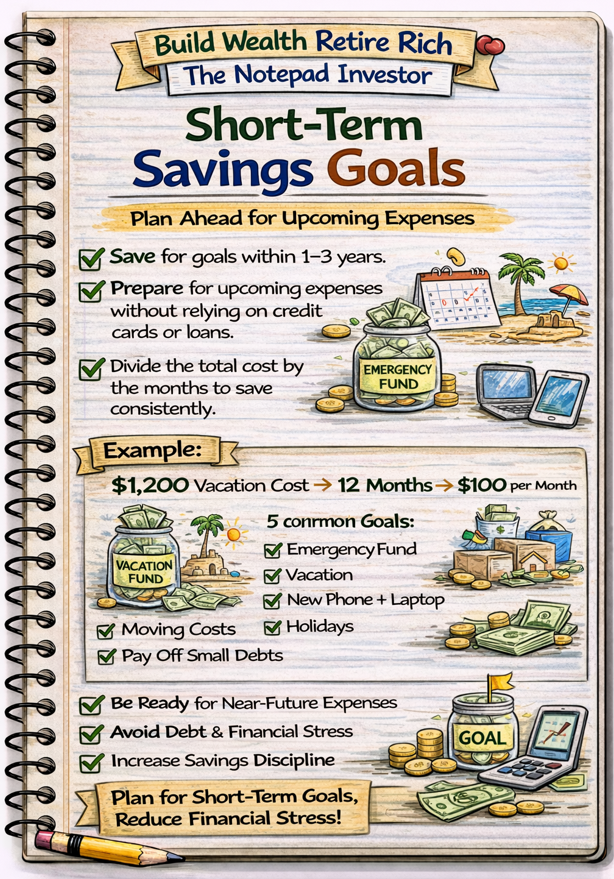
    Short-term savings goals are specific financial targets achievable within 1-5 years requiring dedicated systematic savings—vacations, vehicle down payments, home repairs, wedding expenses, emergency fund building, and major purchases too expensive for single paycheck but needed sooner than retirement timeline. Unlike long-term retirement investing spanning decades or emergency funds reserved for crises only, short-term goal savings bridge immediate needs and distant future through dedicated accounts funding specific upcoming objectives, transforming vague spending intentions into concrete achievable targets through planned accumulation preventing debt-financed purchases and enabling strategic timing of major expenditures impossible through hoping money somehow appears when needed.

    Notebook sketch explaining personal finance

    This article is designed for anyone with upcoming expensive purchases, individuals planning major life events requiring funds, or those wanting systematic approach achieving goals without debt. You do not need financial expertise, high income, or perfect circumstances to save for short-term goals—simple dedicated account allocation with timeline-based contributions creates achievable path to targets regardless of income level, though obviously higher incomes enable larger goals or faster achievement while lower incomes require proportional adjustment of goal scope or timeline extending realistic expectations.

    Understanding short-term savings goals matters because major purchases financed through debt create years of payments with substantial interest costs versus saving enabling cash purchases, vague “someday” desires without concrete plans rarely materialize while specific targets with timelines create accountability driving systematic progress, and achieving visible short-term wins provides motivation sustaining long-term financial discipline impossible through delayed-gratification-only approaches lacking intermediate victories—making short-term goal setting essential for both practical achievement of upcoming needs and psychological reinforcement enabling sustained wealth-building behaviors through tangible progress markers.

    Educational disclaimer: This article provides general educational information about short-term savings goal strategies. Individual circumstances, income levels, expenses, goal priorities, and appropriate timelines vary significantly. Short-term goal recommendations represent general approaches—specific situations require personalized planning. This is not financial planning or professional advice. Consult qualified financial professionals for personalized guidance.

    Understanding Short-Term Savings Goals

    What Are Short-Term Savings Goals?

    Core definition: Specific financial targets achievable within 1-5 years requiring dedicated systematic savings

    Time horizon:

    • Very short-term: 1-12 months (holiday expenses, minor home improvements, small purchases)
    • Short-term: 1-3 years (vacation, appliance replacement, car down payment, wedding)
    • Medium-term: 3-5 years (home down payment, vehicle purchase, major home renovation)

    Distinguishing characteristics:

    • Specific dollar amount and target date
    • Too expensive for single paycheck ($1,000-50,000 typical range)
    • Too soon for long-term investing (need money within 5 years)
    • Not emergency fund (planned expense, specific purpose)
    • Dedicated savings approach rather than general accumulation

    Common Short-Term Savings Goals

    Major purchases:

    • Vehicle down payment or cash purchase ($5,000-25,000)
    • Home down payment ($15,000-60,000+)
    • Furniture and appliances ($2,000-10,000)
    • Electronics and technology ($1,000-5,000)

    Life events:

    • Wedding ($15,000-35,000 average)
    • Honeymoon or major vacation ($3,000-15,000)
    • Baby preparation and nursery ($2,000-8,000)
    • Moving and relocation costs ($3,000-10,000)

    Home and property:

    • Home maintenance and repairs ($5,000-20,000)
    • Renovations and upgrades ($10,000-50,000)
    • Property improvements ($5,000-30,000)

    Education and career:

    • Professional certifications and courses ($1,000-10,000)
    • Career transition expenses ($3,000-15,000)
    • Business startup costs ($5,000-30,000)

    Annual and periodic expenses (sinking funds):

    • Holiday gifts and celebrations ($800-3,000 annually)
    • Property taxes if not escrowed ($2,000-8,000 annually)
    • Insurance premiums paid annually ($1,000-5,000)
    • Vehicle registration and maintenance ($500-2,000 annually)

    Why Short-Term Goal Saving Matters

    Debt avoidance benefits:

    • $15,000 wedding financed on credit card at 20% APR
    • Paying $400 monthly takes 48 months, total paid $19,200 ($4,200 interest)
    • Versus saving $400 monthly for 38 months, pay cash $15,000, zero interest
    • 10 months faster payoff plus $4,200 saved

    Strategic timing and negotiation:

    • Cash buyer negotiates better prices (10-15% discounts possible)
    • Can wait for optimal timing (sales, market conditions)
    • Not desperate, can walk away from bad deals
    • Versus financed purchase: Pressure to buy now, less negotiating power

    Psychological benefits:

    • Concrete progress toward visible goals maintains motivation
    • Achieving short-term wins reinforces long-term discipline
    • Reduces stress from knowing major expenses planned and funded
    • Pride and satisfaction from achieving goals independently
    Advertisement

    Financial Wellness Planner

    Setting and Prioritizing Short-Term Goals

    Step 1: Identify All Potential Short-Term Goals

    Brainstorm exercise:

    • List everything requiring savings within next 5 years
    • Include both wants (vacation) and needs (car replacement)
    • Estimate cost for each item
    • Estimate ideal timeframe for each

    Example comprehensive list:

    • Vacation to Europe: $6,000, desired in 18 months
    • Vehicle replacement: $20,000, needed in 3 years (current car aging)
    • Home down payment: $30,000, desired in 4 years
    • Wedding: $25,000, planned in 2 years
    • Emergency fund: $15,000, needed ASAP
    • Furniture replacement: $4,000, desired in 1 year
    • Holiday expenses: $1,500 annually

    Step 2: Prioritize Based on Need and Timeline

    Priority framework:

    Tier 1 – Essential and urgent:

    • Emergency fund (if not yet established)
    • Necessary items with deadline (car replacement if current unreliable)
    • Non-negotiable upcoming events (committed wedding date)

    Tier 2 – Important but flexible timing:

    • Major quality-of-life improvements (home down payment)
    • Significant planned events (vacation, home renovation)
    • Career investments (education, certification)

    Tier 3 – Desirable but optional:

    • Upgrades and nice-to-haves (furniture, electronics)
    • Discretionary experiences (additional vacations)
    • Luxury purchases

    Step 3: Calculate Required Monthly Savings

    Formula: Goal amount ÷ months until target date = monthly savings needed

    Example calculations:

    • Europe vacation $6,000 in 18 months: $6,000 ÷ 18 = $333/month
    • Vehicle $20,000 in 36 months: $20,000 ÷ 36 = $556/month
    • Wedding $25,000 in 24 months: $25,000 ÷ 24 = $1,042/month
    • Furniture $4,000 in 12 months: $4,000 ÷ 12 = $333/month

    Total if pursuing all simultaneously: $333 + $556 + $1,042 + $333 = $2,264/month

    Step 4: Reality Check Against Income

    Assess feasibility:

    • Calculate total available for goals after essentials and retirement
    • Example: $5,000 monthly income, $3,500 expenses, $500 retirement = $1,000 available
    • But goals need $2,264 monthly—not feasible

    Adjustment options:

    • Extend timelines: Wedding in 36 months not 24 ($694/month vs $1,042)
    • Reduce scope: Wedding $15,000 not $25,000 ($625/month vs $1,042)
    • Defer some goals: Furniture delayed until after wedding
    • Sequential approach: Focus on one goal at a time versus simultaneous
    • Increase income: Side hustle, overtime, raises to expand capacity

    Revised realistic plan:

    • Emergency fund: $300/month (priority, building to $15,000)
    • Wedding: $625/month (reduced scope to $15,000 in 24 months)
    • Holiday sinking fund: $75/month ($900 annually)
    • Total: $1,000/month within budget
    • Vehicle and home down payment: Addressed after wedding through saved wedding allocation

    Implementing Short-Term Savings Strategy

    Opening Dedicated Accounts

    Separate account per major goal:

    • Wedding savings account
    • Vacation savings account
    • Vehicle down payment account
    • Home down payment account

    Benefits of separation:

    • Clear progress tracking per goal
    • Prevents robbing one goal to fund another unconsciously
    • Psychological satisfaction seeing specific goals grow
    • Mental accounting reducing temptation to spend

    Practical implementation:

    • Many online banks allow multiple free savings accounts
    • Name each account clearly for its purpose
    • Or use single account with manual tracking spreadsheet if multiple accounts unavailable

    Where to Keep Short-Term Savings

    Timeline-based allocation:

    0-12 months goals: High-yield savings account

    • Currently 4-5% APY at online banks
    • Completely liquid and safe
    • No market risk when money needed soon
    • FDIC insured

    1-3 year goals: High-yield savings or short-term CDs

    • Primarily high-yield savings for flexibility
    • Optional: 6-12 month CD ladder for portion if timeline certain
    • Slightly higher rates but less flexible

    3-5 year goals: Conservative investment mix (optional)

    • If timeline flexible and comfortable with minimal risk
    • 60% bonds, 40% stocks typical conservative allocation
    • Potential for higher returns but some volatility risk
    • Only if can tolerate 10-20% temporary decline without disrupting goal
    • Many prefer keeping even 5-year goals in savings avoiding all market risk

    NOT recommended for short-term goals:

    • Aggressive stock investments (too volatile for near-term needs)
    • Crypto (extreme volatility inappropriate)
    • Long-term CDs (inflexibility if timeline changes)

    Automating Goal Contributions

    Set up automatic transfers:

    • Day after payday
    • Specific amount to each goal account
    • Pay yourself first for goals like you do for retirement

    Example automation:

    • Paycheck deposits: 1st and 15th monthly
    • Automatic transfers on 2nd and 16th:
    • $312.50 → Wedding savings (total $625/month)
    • $150 → Emergency fund (total $300/month)
    • $37.50 → Holiday fund (total $75/month)

    Tracking Progress and Staying Motivated

    Visual progress tools:

    • Thermometer chart showing progress toward goal
    • Percentage complete calculations
    • Countdown to target date
    • Milestone celebrations (25%, 50%, 75%, 100%)

    Regular review schedule:

    • Monthly: Check all goal account balances
    • Quarterly: Assess if on track or adjustments needed
    • Annually: Reassess priorities and timelines

    Motivation maintenance:

    • Keep visual reminder of goal (picture of destination, house, car)
    • Calculate and celebrate milestones achieved
    • Share progress with accountability partner
    • Remind yourself of debt avoided and interest saved
    Advertisement
    Reserved space for in-content ad

    Balancing Short-Term and Long-Term Savings

    The Complete Savings Allocation

    Total savings capacity: 20% of gross income example

    Recommended allocation framework:

    • Retirement (long-term): 10-15% – Non-negotiable foundation
    • Emergency fund: Until 3-6 months saved – Priority before other goals
    • Short-term goals: 5-10% – After emergency fund established

    Example allocation at $5,000 monthly gross income:

    • 20% savings capacity = $1,000 monthly total
    • Retirement 401(k): $500 (10%)
    • Emergency fund: $300 (6%, until complete)
    • Short-term goals: $200 (4%)

    After emergency fund complete:

    • Retirement: $500 (10%)
    • Short-term goals: $500 (10%, increased from $200)
    • Emergency fund: $0 (complete, only replenish if used)

    Prioritization Sequencing

    Standard recommended order:

    1. Employer 401(k) match (free money, always capture)
    2. Starter emergency fund $1,000-2,000
    3. High-interest debt payoff (credit cards over 15% APR)
    4. Full emergency fund 3-6 months expenses
    5. Retirement savings to 15% of gross income
    6. Short-term goal savings
    7. Extra retirement or additional goals

    Exception for time-sensitive goals:

    • Wedding in 12 months may take temporary priority over aggressive retirement
    • Maintain minimum 401(k) match capture
    • Temporarily reduce retirement to 5-10% while funding urgent short-term goal
    • Resume normal retirement savings after goal achieved
    • Acceptable deviation for specific limited-time circumstances

    When to Adjust or Abandon Goals

    Signs goal needs revision:

    • Consistently unable to maintain planned contributions
    • Timeline unrealistic given actual saving capacity
    • Priorities shifted (more important goal emerged)
    • Income reduction making goal unaffordable

    Adjustment options:

    • Extend timeline giving more time to save
    • Reduce scope making goal more affordable
    • Pause temporarily focusing on higher priority
    • Abandon entirely if no longer aligned with values

    Example adjustment:

    • Original: $30,000 home down payment in 3 years ($833/month)
    • Reality: Can only save $400/month realistically
    • Adjustment options:
    • Option 1: Extend to 6 years at $400/month
    • Option 2: Reduce to $15,000 in 3 years at $417/month
    • Option 3: Save $400/month for 3 years = $14,400, accept smaller down payment

    Advanced Short-Term Savings Strategies

    Sinking Funds for Recurring Expenses

    Concept: Convert irregular annual expenses to smooth monthly savings

    Common sinking fund categories:

    • Holiday gifts: $1,200 annually ÷ 12 = $100 monthly
    • Car insurance: $1,800 annually ÷ 12 = $150 monthly
    • Property taxes: $3,600 annually ÷ 12 = $300 monthly
    • Car maintenance: $1,200 annually ÷ 12 = $100 monthly
    • Home maintenance: $2,400 annually ÷ 12 = $200 monthly

    Benefit: Large lump sums don’t disrupt monthly budget when due

    Opportunity Fund Strategy

    Purpose: Savings reserved for unexpected opportunities not emergencies

    Examples:

    • Limited-time investment opportunities
    • Discounted bulk purchases of needed items
    • Unexpected travel deals aligned with goals
    • Career opportunities requiring upfront investment

    Distinction from emergency fund:

    • Emergency fund: Cover unexpected problems (job loss, repairs)
    • Opportunity fund: Seize unexpected positive chances
    • Keeps emergency fund preserved while enabling strategic opportunism

    Goal Laddering

    Sequential achievement approach:

    • Focus full short-term goal allocation on single highest priority
    • Achieve faster through concentrated effort
    • After completion, redirect full allocation to next priority

    Example ladder:

    • Phase 1 (Months 1-5): $1,000/month → Emergency fund to $5,000
    • Phase 2 (Months 6-11): $1,000/month → Vacation $6,000
    • Phase 3 (Months 12-31): $1,000/month → Vehicle down payment $20,000
    • Total 31 months achieving three goals versus spreading $333 each taking much longer

    Pros: Faster achievement, maintained motivation through frequent wins

    Cons: Other goals delayed, requires discipline not accessing funds for other goals

    Windfall Allocation

    Strategic use of irregular income:

    • Tax refunds
    • Work bonuses
    • Gifts
    • Inheritances
    • Side income

    Recommended allocation:

    • 50% to short-term goals (accelerate progress)
    • 30% to long-term savings/investments
    • 20% to guilt-free spending

    Example: $4,000 tax refund

    • $2,000 → Wedding savings (major boost)
    • $1,200 → Roth IRA contribution
    • $800 → Enjoy guilt-free

    Why Short-Term Savings Goals Matter

    Without dedicated short-term goal savings, major purchases get financed through debt creating years of interest payments and financial burden versus cash purchases, vague “someday” desires without concrete plans rarely materialize lacking accountability and systematic approach, and absence of visible intermediate wins makes sustained long-term discipline psychologically difficult without tangible progress markers—while short-term goal savers avoid debt on major purchases saving thousands in interest, achieve concrete objectives through systematic planning and execution impossible with vague intentions, and maintain motivation for broader financial discipline through regular achievement of visible milestones reinforcing behaviors essential for ultimate financial success.

    Understanding and implementing short-term savings goals enables individuals to:

    • Achieve major life milestones debt-free through planned accumulation
    • Avoid thousands in interest costs from financing large purchases
    • Negotiate better prices through cash purchasing power
    • Maintain psychological motivation through visible concrete progress
    • Coordinate multiple goals through systematic prioritization and allocation
    • Reduce financial stress through knowing major expenses planned and funded
    • Build discipline and habits supporting broader long-term wealth building

    Short-term savings goals transform vague aspirations into concrete achievements through systematic planning creating both practical financial benefits and psychological reinforcement essential for sustained wealth-building success.

    Advertisement
    Reserved space for in-content ad

    Common Misunderstandings

    Many people assume retirement savings must reach maximum before saving for any short-term goals making near-term objectives inaccessible. In reality, balanced approach saving 10-15% for retirement while simultaneously allocating 5-10% for short-term goals creates comprehensive strategy addressing both future security and present life milestones, proving retirement and short-term goal saving compatible through proportional allocation not either-or proposition requiring complete focus on one timeframe exclusively.

    Another common misconception is that short-term goals under $5,000 don’t need dedicated accounts making simple spending from regular savings adequate. In practice, dedicated separate accounts create psychological commitment and tracking clarity dramatically improving achievement rates—even $2,000 vacation fund benefits from separation preventing unconscious spending and enabling progress monitoring, proving account separation valuable regardless of absolute goal size through mental accounting and commitment device effects.

    Some believe investing short-term goal money in stocks provides growth opportunity justifying market risk for 2-3 year timelines. However, market volatility means needing funds during 20-30% decline forces selling at loss potentially destroying substantial portion of goal savings, proving safe liquid savings appropriate for short-term goals despite lower returns than stocks—purpose is preservation and availability when needed not growth maximization risking goal achievement through inappropriate risk exposure.

    How Short-Term Savings Goals Fit Into Financial Success

    Short-term savings goals provide essential bridge between immediate needs and long-term wealth building through systematic achievement of life milestones, create psychological reinforcement maintaining discipline through visible tangible progress markers impossible with delayed-gratification-only approaches, and enable debt-free major purchases avoiding interest costs while building saving habits transferable to all financial domains, making short-term goal setting critical component of complete financial success strategy impossible to achieve through exclusive focus on either present consumption or distant retirement without systematic middle-ground planning.

    For example, two couples both age 28 planning weddings and eventually home purchases. Couple A focuses exclusively on retirement maxing 401(k)s contributing 15% income ($750 monthly each, $1,500 total) building long-term wealth—admirable retirement focus. But wedding in 18 months, no wedding savings, finances $20,000 on credit cards at 18% APR paying $500 monthly for 54 months, total paid $27,000 ($7,000 interest). Home down payment needed in 5 years, no savings, continues renting building no equity. After 10 years: Strong retirement accounts ($220,000 combined), but still renting, spent 5 years paying wedding debt, frustrated by lack of progress on life goals despite aggressive retirement saving. Couple B balanced approach: 10% retirement ($500 monthly each, $1,000 total), 10% short-term goals ($500 each, $1,000 total). Wedding fund: Saves $18,000 over 18 months paying cash. Home fund: Saves $60,000 over 5 years buying home. After 10 years: Solid retirement accounts ($147,000 combined), owns home building equity, achieved wedding debt-free, life progressing on all fronts. Couple A has $73,000 more retirement wealth but rents, endured years of debt payments, life goals perpetually deferred creating frustration. Couple B achieved balanced success—home ownership, debt-free wedding, retirement on track, life milestones accomplished systematically. Difference: Couple B recognized short-term goals matter for quality of life and psychology, creating comprehensive approach versus Couple A’s exclusive long-term focus leaving present life perpetually waiting for distant future.

    Short-term savings goals separate balanced comprehensive financial success from narrow delayed-gratification approaches achieving retirement security but deferring all present life progress creating frustration undermining sustained discipline impossible to maintain indefinitely without intermediate rewards and tangible achievements.

    Recent Updates and Trends

    In recent years, high-yield savings rates improving to 4-5% have made short-term goal savings more attractive—meaningful returns while maintaining safety and liquidity, reducing opportunity cost of keeping funds accessible versus investing making conservative approach more appealing.

    Multiple savings account availability has expanded—online banks offering unlimited free sub-accounts enabling dedicated account per goal without fees, dramatically simplifying goal separation and tracking previously requiring manual spreadsheets or physical envelope systems.

    Wedding and home costs have increased substantially—average wedding rising from $20,000 to $30,000+ and down payments requiring larger absolute amounts due to housing appreciation, making systematic goal saving more critical than historical periods when absolute amounts smaller and more achievable through shorter-term saving.

    Experience economy emphasis has shifted goals—younger generations prioritizing travel and experiences over material purchases, changing typical short-term goal mix toward experience-based objectives requiring different planning (timing-dependent, non-refundable deposits) versus traditional purchase goals offering more flexibility.

    Fundamental short-term savings goal principles remain timeless: specific targets with timelines create accountability driving systematic progress, dedicated separation improves achievement through psychological commitment, balanced allocation addressing both long-term security and near-term life milestones produces comprehensive success, and visible achievement of concrete goals provides motivation essential for sustained broader financial discipline—regardless of interest rates, account availability, cost trends, or goal type preferences, systematic short-term goal planning produces debt-free achievement of life milestones while building financial habits supporting ultimate long-term wealth building success.

    3 Things You Can Do Today

    Ready to implement short-term savings goals? Here are three simple steps you can take right now:

    1. Identify and prioritize your top 3 short-term goals with specific amounts and timelines – Make list of everything requiring savings within 5 years. For each item: estimate cost, determine target date. Examples: Vacation $4,000 in 12 months, vehicle down payment $8,000 in 30 months, home improvement $6,000 in 18 months. Choose top 3 priorities based on: necessity (need vs want), timeline urgency (soonest first), importance to quality of life. Write these clearly: “Goal 1: [Name] $[Amount] by [Date].” This transforms vague intentions into concrete targets. Takes 20 minutes creating clarity from ambiguous “someday” desires into specific measurable objectives with deadlines creating accountability.

    2. Calculate required monthly savings for each goal and reality-check against budget – For each priority goal: Amount ÷ months until date = monthly savings needed. Example: $4,000 vacation in 12 months = $333/month. $8,000 vehicle in 30 months = $267/month. Total all goals: $333 + $267 = $600/month. Compare to available savings capacity after essential expenses and retirement. If total exceeds capacity, adjust: extend timelines (vehicle in 36 months = $222/month), reduce scope (vacation $3,000 = $250/month), or sequential approach (one at a time not simultaneous). Final realistic plan should fit budget. Takes 15 minutes ensuring goals achievable not fantasy creating guaranteed failure and discouragement.

    3. Open one dedicated high-yield savings account for your #1 priority goal and automate first contribution – Choose highest priority goal from step 1. Open high-yield savings account at online bank (Marcus, Ally, Capital One 360) earning 4-5% APY. Application takes 15 minutes online. Name account clearly for goal: “Europe Vacation Fund” or “Vehicle Down Payment.” Set up automatic transfer from checking: calculated monthly amount (from step 2) scheduled day after payday. This implements pay-yourself-first for goal—happens automatically requiring no further action. Initial transfer if possible starting account with $50-100. Takes 30 minutes total creating systematic building. Without automation, good intentions rarely produce actual saving—automatic transfer ensures consistent progress regardless of motivation or busy life.

    These actions create complete short-term goal system within one day—identified priorities with concrete targets, calculated realistic achievement path fitting budget, and automated execution removing willpower dependency—transforming vague future desires into systematic present accumulation producing guaranteed achievement impossible through hoping and waiting.

    Advertisement
    Reserved space for in-content ad

    Quick FAQ

    Should I save for short-term goals or maximize retirement contributions first?
    Balanced approach: Minimum 10-15% retirement (including employer match), then 5-10% short-term goals. Not either-or—both matter. Retirement provides long-term security, short-term goals enable present life progress and psychological motivation through visible wins. Exception: Time-sensitive urgent goal (wedding in 6 months) may temporarily reduce retirement to minimum match while funding goal, resuming normal retirement after achievement. Complete neglect of either timeframe creates problems—only retirement focus defers all present life indefinitely, only short-term focus sacrifices future security. Balance produces comprehensive success.

    Where should I keep money for goals 2-3 years away?
    High-yield savings account (4-5% APY) recommended for most people—safe, liquid, no market risk when money needed. Conservative alternative if comfortable with minimal volatility: 60% bonds/40% stocks but only if timeline flexible and can tolerate potential 10-15% temporary decline without derailing goal. Most financial advisors recommend savings accounts for anything under 5 years avoiding market risk when timeline certain. Returns difference (maybe 2-3% higher in conservative investments) usually not worth risk of needing money during market decline destroying substantial portion of goal savings.

    How many separate savings accounts should I have for different goals?
    Ideal: One account per major goal (wedding, vacation, vehicle, home) if bank allows free unlimited sub-accounts. Minimum: Separate account for largest goal plus spreadsheet tracking other goals if multiple accounts unavailable or too complex. Maximum: Whatever number you can track without confusion (typically 5-7 max). Benefits of separation: Clear progress tracking, psychological commitment, prevents unconscious transfers between goals. But don’t let perfect be enemy of good—single savings account with manual tracking still far better than no goal saving at all.

    What if I need money from short-term goal savings before reaching target?
    Assess: Genuine emergency (use emergency fund not goal savings) or competing priority? If genuine higher priority emerged: Okay to redirect but do consciously—explicitly decide new priority worth sacrificing original goal. If temptation not genuine need: Resist by reminding yourself of original goal importance, visualizing disappointment if goal abandoned, calculating how long rebuilding takes. Create friction: Separate bank requiring 2-3 days transfer prevents impulsive withdrawals. Remember: Every withdrawal delays goal—$1,000 taken from $6,000 vacation fund sets achievement back 3 months at $333/month saving rate.

    Should sinking funds for annual expenses count as short-term goals?
    Separate category though mechanically similar. Sinking funds = predictable recurring expenses (property taxes, insurance premiums, holiday gifts) converted to monthly savings preventing budget disruption when due. Short-term goals = new purchases or experiences. Both use dedicated savings but different purposes: Sinking funds maintain current lifestyle smoothly, short-term goals enable new additions to lifestyle. Budget both: Sinking funds in “essential” category since recurring obligations, short-term goals in “discretionary savings” category since optional objectives. Together they prevent: (1) Surprises from predictable expenses, (2) Debt from major planned purchases.

    How do I stay motivated when short-term goals take years to achieve?
    Six strategies: (1) Visual tracking—thermometer chart showing progress, (2) Milestone celebrations—celebrate 25%, 50%, 75% achievement not just 100%, (3) Regular review—monthly balance checks showing growth, (4) Opportunity cost reminders—calculate interest saved by avoiding debt financing, (5) Goal imagery—pictures of destination, house, car reinforcing motivation, (6) Partial wins—consider smaller related achievements while building (weekend getaway while saving for Europe trip). Also: Front-load wins through goal laddering—achieve smaller goals first (6-month goals before 3-year goals) creating momentum through frequent victories maintaining motivation for longer-term objectives.

    Explore More in Money Basics

    Disclosure

    This article is provided for educational purposes only and does not constitute financial planning or investment advice. Short-term savings goal strategies represent general approaches—individual circumstances, priorities, income levels, and timelines vary significantly. High-yield savings rates fluctuate with market conditions—rates mentioned may change. Conservative investment approaches for 3-5 year goals carry market risk—principal loss possible despite conservative allocation. Examples use simplified scenarios—actual situations more complex. Timeline recommendations represent general guidelines—specific needs differ. Account features and capabilities vary by institution. Building timelines assume consistent contributions—reality includes interruptions and adjustments. Consult qualified financial planners and advisors for personalized guidance tailored to specific circumstances. Advertisements or sponsored content may appear within or alongside this content. All information is presented independently.

  • 1.10 The Ultimate Personal Finance Roadmap: From Broke to Financially Free

    1.10 The Ultimate Personal Finance Roadmap: From Broke to Financially Free

    The personal finance roadmap is a sequential framework outlining essential financial steps from foundational stability through wealth building to financial independence—progressing systematically from emergency fund establishment ($1,000-$2,000 starter), high-interest debt elimination, full emergency fund (3-6 months expenses), retirement savings (15%+ of income), goal funding, debt payoff, and wealth accumulation. Unlike approaching finances chaotically or pursuing everything simultaneously, following a structured roadmap ensures foundation before growth, eliminates wasteful debt interest while building assets, and creates sustainable path from financial fragility to security to independence through prioritized sequential actions rather than overwhelming parallel efforts.

    Notebook sketch explaining personal finance

    This article is designed for anyone seeking financial clarity, individuals overwhelmed by competing priorities, or those wanting systematic improvement plans. You do not need financial expertise, high incomes, or perfect situations to follow the roadmap—principles apply at all income levels and starting points, providing clear next steps regardless of current position from deep debt through comfortable wealth, transforming financial confusion into actionable direction.

    Understanding the personal finance roadmap matters because pursuing goals in wrong order wastes resources (investing while carrying 20% APR credit card debt loses 15%+ annually), skipping foundation creates fragility (no emergency fund means job loss triggers catastrophic debt spiral), and paralysis from competing priorities prevents all progress—while roadmap followers systematically build financial security achieving milestones impossible through chaotic approaches, with each step strengthening foundation for subsequent advancement.

    Educational disclaimer: This article provides general educational framework for financial planning. Individual circumstances, priorities, incomes, and timelines vary significantly. Roadmap represents common optimized sequence—personal situations may warrant modifications. This is not financial, investment, or planning advice. Consult qualified financial professionals for personalized guidance.

    Understanding the Roadmap Concept

    Why Sequential Steps Matter

    Foundation before growth principle:

    • Can’t build wealth without financial stability
    • Can’t optimize without covering basics
    • Each step enables and protects subsequent steps
    • Skipping foundation creates collapse risk

    Common wrong-order mistakes:

    • Investing aggressively while carrying credit card debt (paying 20% to earn 8%)
    • Buying investment property without emergency fund (forced to sell during crisis)
    • Saving for home down payment while minimum-paying 18% credit cards (losing thousands in interest)
    • Maxing retirement accounts while living paycheck to paycheck (no flexibility for emergencies)

    Why roadmap sequence works:

    • Emergency fund prevents debt accumulation during setbacks
    • Debt elimination frees cash flow for wealth building
    • Foundation creates stability enabling aggressive growth
    • Each achievement builds momentum and confidence
    • Clear priorities eliminate decision paralysis

    Roadmap Flexibility

    The roadmap is guide, not rigid law:

    • Core sequence optimizes for most people most situations
    • Personal circumstances may warrant modifications
    • Life changes require roadmap adjustments
    • Some steps can run simultaneously (retirement + goals)
    • Understand principles to make informed adjustments

    When to modify:

    • Employer match: Always capture even during debt payoff (free money trumps optimization)
    • Extremely low-interest debt: May invest simultaneously with payoff (mortgage 3% vs 8% expected returns)
    • Time-sensitive opportunities: House purchase, education deadlines may justify temporary priority shifts
    • Health/family emergencies: Pause wealth building, address crisis, resume roadmap
    Advertisement
    Reserved space for in-content ad

    The Complete Personal Finance Roadmap

    Step 1: Create Budget and Track Spending

    Why this comes first: Can’t manage what you don’t measure

    Actions:

    • Track all spending for 1-3 months (apps, spreadsheet, or manual)
    • Categorize expenses: housing, transportation, food, insurance, debt, discretionary, savings
    • Calculate total monthly income (after-tax take-home)
    • Create budget: Income = Expenses + Savings (prioritize savings, adjust expenses to fit)
    • Identify spending leaks and optimization opportunities

    Target outcome:

    • Know exactly where money goes each month
    • Positive cash flow (income exceeds expenses)
    • Written budget allocating every dollar
    • Foundation for all subsequent steps

    Resources needed: Free budgeting app (Mint, YNAB, EveryDollar) or spreadsheet, 2-3 hours initial setup, 30 minutes monthly maintenance

    Step 2: Build $1,000-$2,000 Starter Emergency Fund

    Why this comes second: Prevents small emergencies from becoming debt crises

    Actions:

    • Save $1,000-$2,000 in high-yield savings account
    • Keep separate from regular checking (reduce spending temptation)
    • Use only for true emergencies (car repair, medical, unexpected essential expense)
    • Replenish immediately if used

    Typical timeline: 2-6 months saving $200-500 monthly

    Why not invest starter emergency fund: Need immediate access without market risk—stocks too volatile for short-term emergency money

    Step 3: Employer 401(k) Match (If Available)

    Why this comes third: Free money—100% instant return beats debt payoff math

    Actions:

    • Contribute minimum percentage capturing full employer match
    • Typical match: 50% or 100% of contributions up to 3-6% of salary
    • Example: $60,000 salary, 50% match on 6% = Contribute $3,600, receive $1,800 match = $5,400 annual retirement savings
    • Select low-cost target-date fund or total market index fund

    Target outcome: Capture all free employer money while building retirement habit

    Exception: If no employer match available, skip to Step 4

    Step 4: Eliminate High-Interest Debt

    Why this comes fourth: High-interest debt (15%+ APR) destroys wealth faster than investments build it

    Target debts:

    • Credit cards (typically 15-25% APR)
    • Payday loans (400%+ APR—eliminate immediately)
    • Personal loans over 10% APR
    • Any debt above 8-10% interest rate

    Payoff methods:

    Debt avalanche (mathematically optimal):

    • List debts highest to lowest interest rate
    • Minimum payments on all debts
    • Extra money to highest interest debt
    • When paid off, move to next highest
    • Saves most interest, fastest payoff

    Debt snowball (psychological wins):

    • List debts smallest to largest balance
    • Minimum payments on all debts
    • Extra money to smallest debt
    • Quick wins create momentum and motivation
    • Costs slightly more interest but higher completion rate

    Intensity matters:

    • Find extra $300-$1,000+ monthly through expense cuts and income increases
    • Pause non-essential spending temporarily
    • Aggressive focus: $15,000 debt paid in 12-18 months beats 5+ years of minimum payments

    Typical timeline: 12-36 months depending on debt amount and payment intensity

    Step 5: Build Full Emergency Fund (3-6 Months Expenses)

    Why this comes fifth: With high-interest debt eliminated, build complete financial protection

    Target amount:

    • Single income household: 6 months expenses
    • Dual income household: 3-4 months expenses
    • Self-employed or unstable income: 6-12 months expenses
    • Stable government job: 3 months expenses sufficient

    Calculation example:

    • Monthly expenses: $3,500
    • Target: 6 months = $21,000
    • Already have: $2,000 starter fund
    • Need to save: $19,000
    • At $500/month: 38 months
    • At $1,000/month: 19 months

    Where to keep emergency fund:

    • High-yield savings account (4-5% currently)
    • Money market account
    • Liquid and safe, never invested in stocks
    • Separate from checking to reduce spending temptation

    Typical timeline: 12-24 months

    Milestone achievement: Completing full emergency fund = financial stability achieved, foundation complete

    Step 6: Retirement Savings (15% of Income)

    Why this comes sixth: With stability secured, aggressively build long-term wealth

    Target contribution: 15% of gross income minimum

    Account priority order:

    1. 401(k) to employer match (already doing from Step 3)
    2. Max Roth IRA ($7,000 for 2024, $8,000 if 50+)
    3. Return to 401(k) increasing to 15% total
    4. If 15% maxes accounts, add to taxable brokerage

    Example: $75,000 salary

    • 15% target = $11,250 annually = $938 monthly
    • $4,500 to 401(k) capturing full match (6% of salary)
    • $7,000 to Roth IRA (max contribution)
    • If available funds exceed $11,250, increase 401(k) contributions

    Investment allocation:

    • 10+ years to retirement: 80-100% stocks (total market index funds)
    • Target-date funds appropriate for hands-off approach
    • Low-cost index funds (expense ratios under 0.20%)

    Why 15% minimum: Ensures comfortable retirement replacing 70-80% of pre-retirement income over 30-40 year career

    Step 7: Save for Medium-Term Goals

    Why this comes seventh: Foundation and retirement secured, fund 3-10 year objectives

    Common medium-term goals:

    • Home down payment (20% to avoid PMI)
    • Vehicle replacement fund
    • Major home renovations
    • Children’s college savings (529 plans)
    • Wedding or major life events
    • Sabbatical or extended travel

    Allocation by timeline:

    • 3-5 years: 30% stocks, 70% bonds or high-yield savings
    • 5-7 years: 50% stocks, 50% bonds
    • 7-10 years: 60-70% stocks, 30-40% bonds

    Parallel with retirement: Can pursue medium-term goals while maintaining 15% retirement contributions—both run simultaneously

    Step 8: Pay Off Low-Interest Debt

    Why this comes eighth: Eliminate remaining debt achieving complete debt freedom

    Target debts:

    • Mortgage (accelerated payoff optional)
    • Student loans (especially higher than 4-5%)
    • Auto loans remaining
    • Any debt under 8% not yet eliminated

    Acceleration strategies:

    • Extra principal payments (specify “principal only”)
    • Bi-weekly payments (26 half-payments = 13 full payments annually)
    • Lump sum payments from bonuses, raises, windfalls

    Mortgage payoff consideration:

    • Guaranteed return = interest rate saved (3-5% typical)
    • Vs investing: Expected 8%+ stock returns
    • Math favors investing over low-rate mortgage payoff
    • Emotional peace of debt-freedom has value beyond math
    • Personal preference—both approaches valid

    Typical timeline: 5-15 years depending on debt amounts and intensity

    Step 9: Build Wealth and Additional Savings

    Why this comes ninth: Debt-free with strong retirement savings, maximize wealth building

    Actions:

    • Increase retirement savings beyond 15% (20-30%+ of income)
    • Taxable investment accounts for additional wealth
    • Real estate investment if desired
    • Business ownership or side income development
    • 529 maximization for children’s education

    Investment allocation:

    • Diversified portfolio: US stocks, international stocks, bonds
    • Asset allocation matching risk tolerance
    • Regular rebalancing maintaining target allocation
    • Tax optimization: Strategic asset location, tax-loss harvesting

    Step 10: Financial Independence and Legacy Planning

    Why this comes tenth: Ultimate financial goals and generational wealth

    Financial independence:

    • Calculate FI number: Annual expenses × 25-33
    • Build investment portfolio supporting 3-4% withdrawal rate
    • Achieve work optionality at any age
    • Pursue FI through continued aggressive saving and investing

    Estate planning:

    • Will specifying asset distribution
    • Beneficiary designations on all accounts
    • Power of attorney (financial and medical)
    • Healthcare directive/living will
    • Trusts if estate over $13+ million (estate tax threshold)

    Legacy goals:

    • Generational wealth transfer
    • Charitable giving strategies
    • Family financial education
    • Values-based wealth management
    Advertisement
    Reserved space for in-content ad

    Roadmap Timeline Examples

    Aggressive Path (High Income, Low Expenses)

    Starting point: Age 25, $80,000 income, $45,000 expenses, $10,000 debt, $5,000 net worth

    Step 1-2: Budget + Starter Emergency Fund (Months 1-4)

    • Save $2,000 emergency fund
    • Net worth: $7,000

    Step 3: Employer Match (Month 5+)

    • Begin 6% 401(k) contributions ($400/month)
    • Employer adds $200/month match

    Step 4: Eliminate Debt (Months 5-16)

    • $10,000 debt paid off in 12 months ($833/month)
    • Net worth: $15,000 (includes 401k growth)

    Step 5: Full Emergency Fund (Months 17-28)

    • Build $22,500 emergency fund (6 months × $3,750)
    • Net worth: $40,000

    Step 6: Increase Retirement to 15% (Month 29+)

    • Add Roth IRA $583/month ($7,000 annually)
    • Increase 401k to $417/month ($5,000 annually)
    • Total retirement: $1,000/month ($12,000 annually = 15%)

    Step 7-10: Wealth Building (Years 3-15)

    • Continue 15%+ retirement savings
    • Save home down payment
    • Build taxable investment portfolio
    • Age 40: Net worth $800,000+, approaching FI

    Moderate Path (Average Income, Average Expenses)

    Starting point: Age 35, $65,000 income, $52,000 expenses, $25,000 debt, $8,000 net worth

    Steps 1-2: 6 months, emergency fund $2,000

    Step 3: Month 7+, capture employer match

    Step 4: 30 months eliminating $25,000 debt ($833/month)

    Step 5: 24 months building $26,000 emergency fund (6 months expenses)

    Step 6+: Year 6+, increase retirement to 15%, pursue medium-term goals

    Age 55: Net worth $500,000+, traditional retirement on track

    Recovery Path (Low Income, High Debt)

    Starting point: Age 30, $45,000 income, $43,000 expenses, $35,000 debt, -$10,000 net worth

    Phase 1: Stabilization (Year 1)

    • Create budget, reduce expenses $43,000 → $38,000
    • Build starter emergency fund $1,000
    • Begin employer match contributions

    Phase 2: Debt Elimination (Years 2-6)

    • Aggressive debt payoff $600/month
    • Increase income through raises, side hustles
    • Eliminate $35,000 debt in 5 years

    Phase 3: Foundation Building (Years 7-9)

    • Build full emergency fund
    • Increase retirement contributions
    • Net worth positive, gaining momentum

    Phase 4: Wealth Building (Years 10+)

    • Continue roadmap Steps 6-10
    • Age 50+: Retirement on track, financial stability achieved

    Common Roadmap Questions and Challenges

    “Should I invest or pay off my mortgage?”

    After Step 6 (retirement funded 15%+), two valid approaches:

    Option A: Invest (mathematically optimal)

    • Mortgage 3-4% cost vs 8%+ expected investment returns
    • 4-5% annual advantage compounds to hundreds of thousands over decades
    • Mortgage interest tax-deductible (though limited post-2018 tax reform)
    • Best mathematical outcome

    Option B: Pay off mortgage (psychological peace)

    • Guaranteed 3-4% return (interest saved)
    • Debt-free living reduces stress and risk
    • No payment = ultimate flexibility and security
    • Emotional value beyond math for many

    Hybrid approach: Split difference—extra $500 monthly: $250 to mortgage, $250 to investments

    “Can I save for a house while building emergency fund?”

    Short answer: Yes, but prioritize emergency fund first

    Approach:

    • Build starter $1,000-$2,000 emergency fund (Step 2)
    • Eliminate high-interest debt (Step 4)
    • Then split savings: 60-70% emergency fund, 30-40% home down payment
    • Complete emergency fund before aggressive home saving
    • Or extend timeline: Build full emergency fund, then save for home

    Reasoning: Home buying without emergency fund = forced home sale or debt accumulation during crisis, risking everything

    “What if I’m behind on retirement in my 40s-50s?”

    Modified roadmap:

    • Complete Steps 1-5 quickly (foundation essential)
    • Increase retirement savings beyond 15%—aim for 20-30%+
    • Catch-up contributions at 50+ ($7,500 additional 401k, $1,000 additional IRA for 2024)
    • Extend working years 3-5 years if needed
    • Delay Social Security to 70 (maximizes benefit 24%+ vs 67)
    • Geographic arbitrage in retirement (lower cost-of-living area)

    Reality: Starting late costs more but still achievable—10-15 years of aggressive saving at 50+ produces substantial retirement funds

    “Should I stop retirement to pay off debt faster?”

    General answer: Maintain employer match minimum, pause additional retirement for high-interest debt payoff

    Exception: Never stop employer match contributions—100% return beats debt payoff math even at 20% APR

    After capturing match: Pause additional retirement contributions, attack high-interest debt aggressively, resume retirement increases after debt-free

    “What about kids’ college vs my retirement?”

    Priority: Your retirement over children’s college

    Reasoning:

    • Can borrow for college, cannot borrow for retirement
    • Scholarships, grants, work-study available for college
    • Underfunded retirement becomes children’s burden
    • Airplane oxygen mask principle: secure yourself before helping others

    Balanced approach:

    • Step 6: Fund retirement 15%
    • Step 7: Add college savings (529 plans) if budget allows
    • Don’t sacrifice retirement for college—both possible with planning

    Why Following the Roadmap Matters

    Without structured roadmap, people pursue competing priorities simultaneously achieving minimal progress on any, invest while carrying high-interest debt losing thousands annually, or skip emergency funds experiencing catastrophic setbacks during inevitable crises—while roadmap followers systematically build from stability to wealth achieving financial milestones impossible through chaotic approaches, with each completed step creating foundation enabling sustainable advancement toward financial independence.

    Following the personal finance roadmap enables individuals to:

    • Build financial stability through systematic foundation establishment
    • Eliminate wasteful debt interest freeing cash flow for wealth building
    • Achieve clear milestones creating motivation and momentum
    • Make informed trade-off decisions through prioritization framework
    • Progress from financial fragility to security to independence systematically
    • Avoid common mistakes derailing financial progress through proper sequencing

    The roadmap transforms overwhelming financial complexity into clear sequential steps building sustainable wealth through prioritized execution.

    Advertisement
    Reserved space for in-content ad

    Common Misunderstandings

    Many people assume they must complete entire roadmap before financial success happens. In reality, each step represents meaningful achievement improving financial position—completing emergency fund provides stability, debt elimination frees cash flow, retirement funding creates future security, with progress measurable and valuable at every stage proving incremental advancement beats waiting for complete transformation.

    Another common misconception is that roadmap rigidity prevents individual circumstances accommodation. In practice, roadmap provides optimized framework for common situations while allowing informed modifications—understanding principles enables strategic adjustments when personal circumstances warrant deviation, proving structure and flexibility coexist when foundation principles guide decisions.

    Some believe following roadmap requires extreme sacrifice making present life miserable. However, roadmap emphasizes sustainable progress over unsustainable extremes—completing steps over years through consistent moderate effort beats attempting everything simultaneously burning out quickly, proving steady systematic execution produces better outcomes than sporadic extreme efforts inevitably abandoned.

    How the Roadmap Fits Into Financial Success

    Personal finance roadmap provides comprehensive framework organizing all financial decisions and priorities, eliminating paralysis from competing objectives through clear sequential steps, creating measurable progress from financial fragility through stability to wealth, and enabling systematic advancement toward financial independence through prioritized execution building sustainable foundation before pursuing growth.

    For example, two people age 28 earn $70,000 annually with $15,000 credit card debt. Person A pursues everything simultaneously—contributes 5% to 401k, makes minimum debt payments, invests $200 monthly in taxable account, occasionally saves for home down payment, has no emergency fund. After 10 years: Credit card debt still $8,000 (barely decreased through minimum payments), 401k $42,000, taxable account $31,000, no emergency fund, net worth $65,000. Person B follows roadmap—builds $2,000 emergency fund (3 months), captures employer match only during debt payoff, eliminates debt completely (18 months paying $833/month), builds $18,000 emergency fund (12 months), increases retirement to 15% ($875/month), adds $400 monthly taxable investments. After 10 years: Zero debt, $22,000 emergency fund, 401k $94,000, taxable account $52,000, net worth $168,000. Same income and timeframe, different approach—roadmap follower accumulated 2.5x more wealth through systematic prioritization versus chaotic parallel pursuits.

    The roadmap separates systematic wealth builders from perpetual strugglers through structured sequential advancement creating compounding benefits impossible through unfocused efforts.

    Recent Updates and Trends

    In recent years, high-interest rates have affected roadmap priorities—mortgage rates 6-7% versus historical 3-4% makes accelerated payoff more attractive mathematically, while savings account rates 4-5% make emergency funds less costly in opportunity cost terms versus historical 1-2%.

    Student loan payment pauses and forgiveness discussions have complicated debt prioritization—some people paused aggressive student loan payoff awaiting policy changes, though most experts still recommend systematic elimination following roadmap principles.

    Rising healthcare costs have increased emergency fund requirements—many financial advisors now recommend 6-12 months expenses versus traditional 3-6 months, especially for families and self-employed individuals given healthcare expense unpredictability.

    FIRE movement has popularized aggressive early roadmap steps—focus on Steps 1-6 completion in compressed timelines (3-5 years versus 10-15 years traditionally), enabling faster advancement to wealth building and FI pursuit through extreme optimization.

    Fundamental roadmap principles remain timeless: build foundation before growth, eliminate high-interest debt before investing, create emergency cushion preventing debt accumulation during setbacks, fund retirement consistently, balance competing priorities through sequential focus, and progress systematically from stability to wealth to independence—regardless of interest rate environments, economic conditions, or policy changes, structured prioritized execution produces superior outcomes versus chaotic simultaneous pursuit of competing objectives.

    3 Things You Can Do Today

    Ready to start your roadmap journey? Here are three simple steps you can take right now:

    1. Identify your current roadmap position – Review the 10-step roadmap. Which step are you currently on? Completed: Track spending, have budget, emergency fund exists, employer match captured, high-interest debt eliminated? Not completed: No budget, no emergency fund, carrying credit card debt? Write down: “I am currently on Step [X]” and “Next milestone: [specific goal with amount and timeline].” This creates clarity on current position and next priority. Most people discover they’re attempting Steps 6-7 while Steps 2-5 incomplete—explaining financial stress and lack of progress.

    2. Calculate your next milestone target and timeline – Based on current step, calculate specific next goal. Step 2: Build $1,500 emergency fund. Step 4: Eliminate $8,000 credit card debt. Step 5: Build $18,000 full emergency fund (6 months × $3,000 expenses). Step 6: Increase retirement to 15% of income. Then calculate monthly amount needed and timeline. Example: $8,000 debt ÷ 12 months = $667 monthly payment. Or extend to 18 months = $445 monthly. Choose realistic aggressive timeline creating urgency without impossible burden. Write this down: “Save/pay $[X] monthly for [Y] months to complete Step [Z].”

    3. Automate funding for your next milestone starting this week – Set up automatic transfer or payment for calculated monthly amount. Emergency fund: Auto-transfer to savings on payday. Debt payoff: Schedule extra payment beyond minimum. Retirement increase: Update 401k contribution percentage. Automation removes willpower requirement and ensures progress. Even if can’t fund full amount immediately, start with what’s possible—$200 monthly beats $0 monthly waiting for perfect conditions. Action today matters more than perfect planning tomorrow that never comes.

    These actions transform roadmap from abstract concept into personal plan with clear current position, specific next milestone, and automated progress toward systematic financial advancement.

    Advertisement
    Reserved space for in-content ad

    Quick FAQ

    Do I really need to follow the exact order, or can I do steps simultaneously?
    Core sequence (Steps 1-6) should generally follow order—foundation before growth prevents costly mistakes. However, some parallel work acceptable: employer match (Step 3) runs during debt payoff (Step 4), retirement savings (Step 6) continues while pursuing medium-term goals (Step 7). Key: Don’t skip foundation steps (1-5) to jump to growth steps (6-10). Understand why sequence exists, then make informed modifications if circumstances warrant.

    What if I have low-interest student loans—should I pay those off before investing?
    Depends on interest rate. Over 6-7%: Pay off in Step 4 with high-interest debt. 4-6%: Personal choice—math slightly favors investing but guaranteed return of payoff valuable. Under 4%: Generally continue minimum payments, invest instead (Step 6+). Also consider: loan forgiveness eligibility, payment flexibility, emotional value of debt-freedom. No universal answer—understand tradeoffs, choose based on priorities and math.

    How long should completing the roadmap take?
    Highly variable: Aggressive high-income low-debt: 3-5 years to Step 6, 10-15 years to Step 10. Moderate income average debt: 5-8 years to Step 6, 20-30 years to Step 10. Low income high debt: 7-10 years to Step 6, 30-40 years to Step 10. Timelines compress with income increases and expense optimization. Focus on steady progress, not comparison—your pace is your pace. Completing roadmap beats never starting.

    What if I’m already in my 50s and haven’t started—is it too late?
    Not too late but requires intensity. Compress Steps 1-5 into 2-3 years maximum (foundation essential), then aggressive retirement saving (Step 6) at 20-30%+ of income using catch-up contributions. May require: extending working years to 70, geographic arbitrage in retirement, part-time work early retirement years, aggressive expense optimization. 15-20 years of disciplined execution still produces substantial retirement funds. Starting today beats continuing delay—every year matters.

    Should I save for my kid’s college before maxing my retirement?
    No—Step 6 (your retirement 15%) before Step 7 (college savings). Can borrow for college, cannot borrow for retirement. Underfunded retirement becomes children’s burden eventually. After securing your retirement, add college savings. Many successfully fund both—but priority order matters. Kids have scholarships, grants, work-study, student loans as options. You have none of these for retirement. Secure your oxygen mask first.

    What’s the most common roadmap mistake people make?
    Skipping emergency fund (Step 5) to invest or pursue goals. Without emergency buffer, unexpected expenses trigger debt accumulation negating investment gains and derailing progress. Close second: investing while carrying high-interest debt—paying 18% to earn 8% loses 10% annually. Foundation steps exist for crucial reasons—skipping creates fragility leading to failure during inevitable setbacks. Complete boring foundation before exciting growth.

    Explore More in Money Basics

    Disclosure

    This article is provided for educational purposes only and does not constitute financial planning, investment, or professional advice. The personal finance roadmap represents optimized sequence for common situations—individual circumstances may warrant modifications. Timeline estimates are generalizations—actual progress varies based on income, expenses, debt levels, and execution consistency. Investment return assumptions use historical averages—actual returns vary and are not guaranteed. Debt payoff priorities depend on interest rates and personal circumstances. Step sequence flexible based on informed decision-making understanding tradeoffs. Examples are illustrative using simplified scenarios—actual situations vary significantly. Consult qualified financial planners, advisors, and professionals for personalized guidance considering specific circumstances, goals, and constraints. Information current as of publication but financial products, tax laws, and best practices evolve. Advertisements or sponsored content may appear within or alongside this content. All information is presented independently.

    Interactive Quiz: The Personal Finance Roadmap

    Test your understanding of the personal finance roadmap.

    1. What is the main purpose of a personal finance roadmap?

    2. Why should a starter emergency fund be built early in the roadmap?

    3. Which step usually comes before aggressive investing?

    4. Why is capturing an employer 401(k) match important?

    5. What is the long-term goal of following the personal finance roadmap?

    Quiz Score

    0 / 5
  • 1.8 Short-Term vs Long-Term Financial Goals: What You Should Focus on First

    1.8 Short-Term vs Long-Term Financial Goals: What You Should Focus on First

    Short-term vs long-term goals distinguish financial objectives by timeframe and approach—short-term goals span days to two years requiring immediate action and liquid savings (emergency funds, vacation savings, small debt payoff), while long-term goals extend 10+ years enabling compound growth through investments (retirement, homeownership, children’s education). Unlike treating all goals identically, understanding timeframe differences guides appropriate saving and investment strategies: short-term money stays accessible in savings accounts avoiding market volatility risk, long-term money invests in stocks accepting temporary fluctuations for superior growth compounding over decades.

    Notebook sketch explaining personal finance

    This article is designed for anyone balancing multiple financial priorities, individuals uncertain which goals to pursue first, or those making poor strategy choices for goal timeframes. You do not need investment expertise, large incomes, or complex financial knowledge to distinguish goal types—simple awareness that different timeframes require different strategies prevents costly mistakes like investing retirement money too conservatively or keeping down payment savings in volatile stocks.

    Understanding short-term versus long-term goals matters because investing emergency fund money risks needing it during market downturns forcing losses, keeping retirement savings in low-return accounts costs hundreds of thousands in forgone compound growth, and treating all goals identically leads to either excessive risk or insufficient returns—yet many people use same approach for three-month and thirty-year goals despite vastly different optimal strategies.

    Educational disclaimer: This article provides general educational information about goal timeframes and strategies. Individual circumstances, risk tolerance, and financial situations vary significantly. This is not financial planning or investment advice. Consult qualified financial professionals for personalized guidance.

    Defining Goal Timeframes

    Short-Term Goals (0-2 Years)

    Timeframe: Immediate to 24 months

    Characteristics:

    • Need money accessible within months or year
    • Cannot afford market volatility risk
    • Prioritize capital preservation over growth
    • Little time for compound growth benefit
    • Liquidity essential—must access quickly without penalty

    Common short-term goals:

    • Emergency fund building ($1,000-$10,000+)
    • Holiday shopping or gift budget
    • Vacation savings ($2,000-$5,000)
    • Minor home repairs or car maintenance fund
    • Small debt payoff ($2,000-$5,000 credit card)
    • Upcoming large purchase (furniture, electronics)
    • Tax payment savings
    • Wedding or event planning (12-18 months out)

    Appropriate vehicles:

    • High-yield savings accounts (4-5% currently)
    • Money market accounts
    • Short-term CDs (3-12 months)
    • Checking account for immediate needs

    Medium-Term Goals (2-10 Years)

    Timeframe: 2-10 years

    Characteristics:

    • More time allows modest growth pursuit
    • Can accept limited volatility but not major risk
    • Balance between safety and returns
    • Some compound growth potential
    • Moderate liquidity needs

    Common medium-term goals:

    • Home down payment ($20,000-$60,000+)
    • Vehicle replacement ($15,000-$35,000)
    • Major home renovation ($30,000-$100,000+)
    • Business startup capital
    • Career transition fund
    • Substantial debt payoff (student loans, mortgage acceleration)
    • Child’s upcoming college expenses (5-10 years away)

    Appropriate vehicles:

    • High-yield savings for conservative approach (2-5 year goals)
    • Conservative bond funds or balanced funds (5-10 year goals)
    • 60/40 stock/bond portfolio (7-10 year goals with moderate risk tolerance)
    • CDs laddered at different maturities
    • I Bonds (inflation-protected, 1-year minimum holding)

    Long-Term Goals (10+ Years)

    Timeframe: 10 years to several decades

    Characteristics:

    • Decades enable aggressive growth pursuit
    • Can weather market volatility—time to recover from downturns
    • Compound growth creates dramatic wealth multiplication
    • Growth prioritized over safety
    • Liquidity not required—can lock up funds long-term

    Common long-term goals:

    • Retirement savings (20-40+ years for young investors)
    • Children’s college fund (newborn to 18 years)
    • Financial independence/early retirement
    • Generational wealth building
    • Legacy and estate planning
    • Long-term real estate investment

    Appropriate vehicles:

    • Stock index funds (diversified equity exposure)
    • Target-date retirement funds
    • Individual stocks (for experienced investors)
    • Real estate investment
    • 401(k), IRA, Roth IRA, HSA (tax-advantaged accounts)
    • 529 college savings plans
    • 80/20 or 90/10 stock/bond allocation (aggressive growth)
    Advertisement
    Reserved space for in-content ad

    Key Differences in Strategy

    Risk Tolerance by Timeframe

    Short-term (0-2 years): Zero risk acceptable

    • Cannot afford losses—need full amount available on schedule
    • Market drop of 20% weeks before goal deadline catastrophic
    • Example: Need $10,000 for home repair in 6 months—cannot risk $8,000 remaining after market decline
    • Strategy: Guaranteed return vehicles only (savings, CDs, money market)

    Medium-term (2-10 years): Limited risk acceptable

    • Can accept modest volatility but not severe downturns
    • 5-10 years provides some recovery time from moderate declines
    • Example: Down payment in 7 years—can handle 10-15% temporary decline but not 40% crash
    • Strategy: Conservative investments with 20-40% stocks maximum, majority bonds/savings

    Long-term (10+ years): Significant risk acceptable and advisable

    • Decades to recover from market downturns
    • Historical evidence: Stocks always positive over 20+ year periods
    • Example: Retirement in 30 years—can endure multiple market crashes knowing long-term growth
    • Strategy: Aggressive stock allocation (80-100%) maximizing growth potential

    Expected Returns by Timeframe

    Short-term vehicles: 1-5% annually

    • High-yield savings: 4-5% (varies with interest rates)
    • Money market: 3-5%
    • Short CDs: 3-5%
    • Checking: 0-1%
    • Low returns but guaranteed safety

    Medium-term vehicles: 3-6% annually

    • Bond funds: 3-5%
    • Balanced funds (60/40): 5-7%
    • Conservative allocation: 4-6%
    • Moderate returns with moderate risk

    Long-term vehicles: 8-10%+ annually

    • Stock market historical average: 8-10%
    • Index funds: 8-10%
    • Aggressive growth funds: 9-12% (higher volatility)
    • Real estate: 8-12% (including appreciation and income)
    • High returns with high short-term volatility

    Compound Growth Impact

    $10,000 invested at different returns:

    Short-term (2 years at 4%):

    • Ending value: $10,816
    • Growth: $816 (8.2%)

    Medium-term (7 years at 6%):

    • Ending value: $15,036
    • Growth: $5,036 (50.4%)

    Long-term (30 years at 8%):

    • Ending value: $100,627
    • Growth: $90,627 (906%!)

    Insight: Time dramatically amplifies return differences—1-2% return difference negligible over 2 years but worth tens of thousands over decades

    Liquidity Needs

    Short-term: High liquidity essential

    • May need money within days or weeks
    • Cannot lock into long-term investments with penalties
    • Must access quickly without selling at loss
    • Example: Emergency fund must be instantly available

    Medium-term: Moderate liquidity

    • Know approximately when money needed
    • Can accept modest access delays or small penalties if necessary
    • Some flexibility in timing (can delay 3-6 months if needed)
    • Example: Down payment—if find house earlier than planned, can liquidate investments accepting small loss or delay home search

    Long-term: Liquidity not required

    • Decades before needing money
    • Can lock into retirement accounts with penalties for early withdrawal
    • Market timing irrelevant—withdraw on your schedule not market’s
    • Example: Retirement account—don’t need until 65, ignore market fluctuations before then

    Balancing Short and Long-Term Goals

    The Priority Hierarchy

    Level 1: Essential short-term (complete first)

    1. $1,000-$2,000 starter emergency fund
    2. Employer 401(k) match (technically long-term but priority due to free money)
    3. High-interest debt payoff (credit cards over 10%)

    Level 2: Foundation completion

    1. Full emergency fund (3-6 months expenses)
    2. Essential insurance (health, auto, life if dependents)

    Level 3: Balanced approach

    • 15%+ income to long-term retirement
    • Medium-term goals (home down payment, etc.)
    • Remaining debt payoff (student loans, mortgage)
    • Short-term lifestyle goals (vacation, etc.)

    Level 4: Wealth building

    • Maximize retirement contributions
    • Taxable investment accounts
    • Additional real estate
    • Business investments

    Simultaneous vs Sequential Goals

    Sequential approach (focused intensity):

    • Complete one goal before starting next
    • Fastest progress on individual goals
    • Best for: Debt payoff, emergency fund building
    • Example: Put all available money toward emergency fund until complete, then shift to next goal

    Simultaneous approach (balanced progress):

    • Fund multiple goals concurrently
    • Slower progress per goal but diversified effort
    • Best for: Balancing retirement + medium-term + short-term goals
    • Example: $500 monthly retirement, $300 monthly down payment, $200 monthly vacation fund

    Hybrid approach (recommended for most):

    • Sequential for foundation (emergency fund, debt)
    • Simultaneous after foundation complete
    • Example: Build emergency fund intensely, then split among retirement (15%), down payment (10%), other goals (5%)

    Time Horizon Shifting

    Goals transition between categories as time passes:

    Example: College savings for newborn

    • Age 0-8 (18-10 years remaining): Long-term → Aggressive 90% stock allocation
    • Age 9-13 (9-5 years remaining): Medium-term → Shift to 70% stocks, 30% bonds
    • Age 14-17 (4-1 years remaining): Short-term → Move to 50% stocks, 50% bonds/savings
    • Age 18 (immediate need): Cash → High-yield savings for upcoming tuition payments

    Strategy adjustment principle: As goals approach deadline, reduce risk protecting accumulated value

    Resource Allocation

    Sample balanced allocation on $5,000 monthly income ($4,000 after taxes):

    Assuming foundation complete (emergency fund + no high-interest debt):

    • Essential expenses: $2,400 (60%)
    • Long-term retirement: $600 (15%)
    • Medium-term down payment: $400 (10%)
    • Short-term vacation/gifts: $200 (5%)
    • Discretionary spending: $400 (10%)
    • Total: $4,000

    Adjustment as income grows: Increase long-term percentage first (retirement), then medium-term, finally short-term lifestyle

    Advertisement
    Reserved space for in-content ad

    Common Mistakes in Goal Timeframes

    Investing Short-Term Money

    Mistake: Putting emergency fund or 6-month-away down payment in stock market

    Cost: Market drops 20% weeks before needing money, forced to sell at loss, goal delayed or abandoned

    Example: $20,000 down payment in stocks for home purchase in 8 months—market crashes, value drops to $16,000, cannot afford home

    Solution: Money needed within 2 years stays in savings accounts regardless of potential returns forgone

    Keeping Long-Term Money Too Conservative

    Mistake: Keeping 30-year retirement money in savings accounts earning 4%

    Cost: Missing 8-10% stock market returns—difference compounds to hundreds of thousands over decades

    Example: $500 monthly for 30 years at 4% = $347,000 vs 8% = $745,000—conservative approach costs $398,000

    Solution: Money not needed for 10+ years invests aggressively in stocks accepting volatility for superior growth

    Prioritizing Long-Term Over Short-Term Foundation

    Mistake: Contributing to retirement while carrying credit card debt and no emergency fund

    Cost: Emergency requires debt, 20% credit card interest negates 8% investment returns, debt spiral destroys wealth

    Example: Investing $300 monthly retirement while paying 20% on $8,000 credit card—losing net 12% annually despite “saving”

    Solution: Complete foundation (starter emergency fund, high-interest debt payoff) before aggressive long-term investing

    No Medium-Term Goals

    Mistake: Only short-term (bills) and long-term (retirement), nothing for 2-10 year goals

    Cost: Major life purchases (home, car) require debt or raiding retirement with penalties and taxes

    Example: Need $25,000 car at 35, no savings, choose between auto loan (pay interest) or 401k withdrawal (penalty + taxes + retirement setback)

    Solution: Balance all three timeframes—maintain short-term security, medium-term flexibility, long-term growth simultaneously

    Rigid Timeframe Categories

    Mistake: “This is 8-year goal so must stay in bonds” even as goal becomes 2-year goal

    Cost: Taking inappropriate risk as goal deadline approaches, potential loss when need stability

    Example: Down payment fund stays 70% stocks when only 18 months until home purchase—market drop devastates nearly-complete goal

    Solution: Reassess timeframe and risk annually, shift to more conservative as goals approach

    Lifestyle Inflation Consuming Long-Term Capacity

    Mistake: Every raise goes to short-term lifestyle spending (bigger apartment, nicer car, more dining)

    Cost: No increase in long-term savings, perpetual retirement shortfall despite income growth

    Example: Income grows from $50,000 to $80,000 over decade, retirement contribution stays $200 monthly—spending grew 60%, retirement 0%

    Solution: Direct 50-100% of raises to long-term goals before lifestyle adjusts

    Why Understanding Timeframes Matters

    Without understanding goal timeframes, people invest emergency funds risking unavailability during actual emergencies, keep retirement money in savings accounts forfeiting hundreds of thousands in compound growth, and create unstable financial foundations by prioritizing long-term over essential short-term needs—while those matching strategies to timeframes build secure foundations, grow wealth through appropriate risk-taking, and achieve both immediate and distant financial objectives.

    Understanding short-term versus long-term goals enables individuals to:

    • Match investment risk to goal timelines appropriately
    • Maximize compound growth on long-term money through aggressive allocation
    • Protect short-term money from market volatility ensuring availability
    • Build balanced financial plans addressing immediate and distant needs
    • Avoid costly mistakes from timeframe-strategy mismatches
    • Achieve superior outcomes through timeframe-appropriate approaches

    Timeframe awareness transforms financial planning from one-size-fits-all approaches to optimized strategies for each goal’s specific horizon.

    Advertisement
    Reserved space for in-content ad

    Common Misunderstandings

    Many people assume market investments are always better than savings accounts because higher returns. In reality, timeframe determines optimal vehicle—stocks superior for 10+ year goals but catastrophic for 6-month goals when market timing risk exists, proving investment returns meaningless if forced to sell during downturns before recovery time available.

    Another common misconception is that conservative approaches (keeping everything in savings) protects wealth. In practice, inflation and opportunity cost erode conservative long-term holdings—retirement money in 4% savings versus 8% stocks costs $400,000+ over 30 years on $500 monthly contributions, proving conservative approaches appropriate for short-term protection but devastating for long-term growth.

    Some believe they must choose between short-term security and long-term wealth building. However, proper financial planning addresses both simultaneously through prioritized sequencing—foundation first (emergency fund, debt), then balanced allocation across timeframes ensuring both immediate stability and distant prosperity rather than sacrificing one for the other.

    How Goal Timeframes Fit Into Financial Success

    Goal timeframe understanding provides framework matching strategies to horizons—short-term money protected in liquid accounts, medium-term money balanced between growth and safety, long-term money invested aggressively for maximum compound benefit—creating financial plans that address immediate needs while building substantial future wealth through appropriate risk-taking based on time available.

    For example, two 30-year-olds each earning $60,000 with $1,000 monthly available for goals. Person A doesn’t distinguish timeframes—puts all money in savings earning 4% for both emergency fund and retirement. Person B understands timeframes—builds $10,000 emergency fund in savings (short-term), then splits remaining funds: $700 monthly to stocks for retirement (long-term aggressive 8%), $300 monthly to balanced fund for home down payment in 7 years (medium-term moderate 6%). After 30 years: Person A has $693,000 total in savings (emergency fund + retirement). Person B has $10,000 emergency fund, bought home after 7 years, and $1,263,000 retirement portfolio (from $700 monthly at 8%)—plus home equity. Person B’s timeframe-appropriate strategies produced $580,000 additional retirement wealth plus homeownership versus Person A’s one-size-fits-all conservative approach. Same monthly amount, different timeframe understanding, dramatically different outcomes.

    Timeframe awareness multiplies wealth by optimizing each goal’s strategy for its specific horizon rather than treating all goals identically.

    Recent Updates and Trends

    In recent years, high-yield savings accounts reaching 4-5% have made short-term vehicles more attractive—better returns on emergency funds and near-term goals reduce pressure to take inappropriate risks chasing yield.

    Target-date funds have simplified long-term investing—automatically adjust from aggressive to conservative as retirement approaches, solving timeframe-shifting challenge for hands-off investors.

    FIRE movement emphasis on early retirement has highlighted medium-term goal importance—bridge accounts between current income and traditional retirement age require 5-15 year planning beyond typical short/long dichotomy.

    Market volatility awareness has increased—2020 pandemic crash and 2022 bear market reminded investors that short-term money in stocks risks significant losses when needed most, reinforcing timeframe-appropriate positioning.

    Fundamental timeframe principles remain timeless: short-term money prioritizes safety and liquidity over returns, long-term money prioritizes growth over stability accepting volatility for compound benefit, medium-term money balances both objectives, and matching strategy to timeframe produces superior outcomes versus one-size-fits-all approaches—regardless of current market conditions, interest rate environment, or economic circumstances, appropriate timeframe strategy optimization separates financial success from preventable failures.

    3 Things You Can Do Today

    Ready to optimize goal timeframes? Here are three simple steps you can take right now:

    1. Categorize all current financial goals by timeframe – List every financial goal: emergency fund, vacation, down payment, retirement, debt payoff, etc. Label each: Short (0-2 years), Medium (2-10 years), Long (10+ years). Review where money is currently held. Example: If emergency fund in stocks or retirement in savings, timeframe mismatch identified. This audit reveals inappropriate placements requiring correction preventing costly mistakes.

    2. Verify short-term money in appropriate vehicles – Identify all money needed within 2 years (emergency fund, upcoming large purchases, near-term savings). Check current location. If any in stocks, bonds, or volatile investments, move to high-yield savings account this week. Accept lower returns for guaranteed safety and liquidity. Example: $5,000 emergency fund in stock fund moves to savings earning 4-5%—small return sacrifice prevents devastating loss if market crashes when emergency occurs.

    3. Verify long-term money invested for growth – Identify all money not needed for 10+ years (primarily retirement accounts). Check current allocation. If over 50% in savings/bonds/CDs, create plan to shift to stock index funds over next 3-6 months. Use online calculator to see cost of conservative approach. Example: $300 monthly for 25 years at 4% = $184,000 vs 8% = $281,000—$97,000 cost of staying too conservative. Moving to appropriate aggressive allocation captures growth potential.

    These actions align financial positioning with goal timeframes eliminating costly mismatches between when money is needed and how it’s invested.

    Advertisement
    Reserved space for in-content ad

    Quick FAQ

    How do I know if a goal is short-term or long-term?
    Simple rule: Will you need the money within 2 years? Short-term. Between 2-10 years? Medium-term. More than 10 years? Long-term. When uncertain, err conservative—treat 3-year goal as short-term if uncomfortable with any volatility, or as medium-term if can delay 6-12 months if needed. Exact boundaries matter less than matching strategy to approximate horizon.

    What if I have multiple goals with different timeframes?
    Separate money into different accounts matching each timeframe: Short-term in savings accounts, medium-term in conservative investments or savings depending on exact timeline, long-term in stock-focused investments. Example: $800 monthly split: $200 savings for vacation (short), $200 balanced fund for down payment (medium), $400 stock index for retirement (long). Each goal gets appropriate vehicle.

    Can I ever put short-term money in stocks?
    Only if you can genuinely delay goal by 3-5 years if market crashes. True emergencies and fixed deadlines require guaranteed-safe vehicles. Flexible short-term goals (vacation you could postpone, home purchase you could delay) might accept limited stock exposure (20-30%) if willing to adjust timing. But classic emergency fund? Never in stocks—defeats purpose.

    When should I shift from aggressive to conservative as goals approach?
    General guideline: Start shifting from stocks to bonds/savings when 3-5 years from goal deadline. Example: College fund for high schooler ages 14-18, down payment fund within 5 years of anticipated home purchase, retirement at age 60-65 (shift at 55-60). Gradual shift over several years better than sudden change preventing forced selling during temporary downturn.

    What about emergency funds—are they really short-term?
    Yes, always treat as short-term even though hopefully never needed. Purpose is immediate availability during emergencies which may occur anytime. Cannot risk market being down when job loss or medical emergency strikes. Emergency funds in stocks defeats entire purpose—might need when market down 30%, forced to sell at loss. Keep in high-yield savings regardless of years before potentially needed.

    Should all my retirement money be in stocks even if I’m close to retirement?
    No. General guideline: Percentage in stocks = 110 minus age. Age 35: 75% stocks. Age 55: 55% stocks. Age 65: 45% stocks. Rationale: Retirement lasts 20-30 years—money needed in year 1 is short-term (bonds/savings), money for year 20 is long-term (stocks). Gradually shift but maintain growth allocation since retirement is multi-decade period, not single event.

    Explore More in Money Basics

    Disclosure

    This article is provided for educational purposes only and does not constitute financial planning, investment, or professional advice. Individual circumstances, risk tolerance, financial situations, and goals vary significantly. Timeframe categories and strategies are generalizations—specific appropriate approaches depend on personal factors. Investment return examples use historical averages—actual returns vary significantly and are not guaranteed. Risk tolerance varies individually—some may prefer more conservative approaches even for long-term goals. Asset allocation suggestions are general guidelines, not personalized recommendations. Market conditions change affecting optimal strategies. Consult qualified financial planners, investment advisors, and professionals for personalized guidance considering specific situations, timelines, and risk tolerances. Advertisements or sponsored content may appear within or alongside this content. All information is presented independently.

    Interactive Quiz: Short-Term vs Long-Term Goals

    Choose an answer and click Check Answer to see the explanation.

    1. What is the primary difference between short-term and long-term financial goals?

    2. Which of the following is typically considered a short-term financial goal?

    3. Why are savings accounts typically recommended for short-term financial goals?

    4. Which investment approach is generally appropriate for long-term financial goals?

    5. What is a common mistake people make when managing goal timeframes?

    Quiz Score

    0 / 5
  • 1.7 How to Set Financial Goals That Actually Work (Step-by-Step Guide)

    1.7 How to Set Financial Goals That Actually Work (Step-by-Step Guide)

    Financial goals are specific, measurable targets for achieving desired financial outcomes within defined timeframes—ranging from building a $5,000 emergency fund within 12 months to accumulating $1 million for retirement over 30 years. Unlike vague wishes like “save more money” or “get out of debt,” effective financial goals include concrete amounts, clear deadlines, and actionable plans transforming aspirations into systematic progress through budgeting, saving, investing, and strategic decision-making aligned with priorities.

    Notebook sketch explaining personal finance

    This article is designed for anyone wanting to improve financial situations, individuals feeling financially directionless, or those with money but unclear purposes for it. You do not need wealth, financial expertise, or perfect credit to set financial goals—goals work at all income levels and financial situations, providing direction transforming reactive money management into intentional wealth building regardless of starting point.

    Understanding financial goals matters because people without clear targets save inconsistently achieving minimal progress, those with vague aspirations lack motivation and accountability making poor trade-off decisions, and individuals without prioritized goals pursue everything simultaneously accomplishing nothing—while goal-setters systematically build emergency funds, eliminate debt, buy homes, and retire comfortably through focused effort toward specific targets rather than diffuse hoping.

    Educational disclaimer: This article provides general educational information about setting financial goals. Individual circumstances, priorities, and timelines vary significantly. This is not financial planning or investment advice. Consult qualified financial professionals for personalized guidance based on specific situations.

    What Are Financial Goals?

    Definition and Purpose

    Financial goal: A specific financial outcome you want to achieve within a defined timeframe

    Components of effective financial goals:

    • Specific target (dollar amount, outcome, milestone)
    • Measurable progress markers
    • Realistic given income and timeline
    • Time-bound with clear deadline
    • Aligned with personal values and priorities

    Why financial goals matter:

    • Provide direction for financial decisions
    • Create motivation and accountability
    • Enable measurement of progress
    • Facilitate prioritization and trade-offs
    • Transform wishes into actionable plans
    • Reduce financial stress through clarity and control

    Vague Wishes vs Clear Goals

    Vague wish examples (ineffective):

    • “I want to save more money”
    • “I need to get out of debt”
    • “I should invest for retirement”
    • “I’d like to buy a house someday”

    Clear goal examples (effective):

    • “Save $6,000 emergency fund by December 31, 2026 ($500/month)”
    • “Pay off $8,000 credit card debt by June 2027 (18 months, $445/month)”
    • “Contribute $6,000 to Roth IRA in 2026 ($500/month)”
    • “Save $40,000 home down payment by January 2028 (24 months, $1,667/month)”

    Difference: Specific amounts, deadlines, and implied monthly action plans enable tracking progress and maintaining motivation versus vague intentions creating no accountability

    SMART Goal Framework

    Specific: Precisely defined outcome, not general aspiration

    • Bad: “Save money for retirement”
    • Good: “Accumulate $500,000 in retirement accounts by age 60”

    Measurable: Quantifiable progress tracking

    • Bad: “Pay down debt”
    • Good: “Reduce credit card balance from $12,000 to $6,000 this year”

    Achievable: Realistic given income, expenses, and timeline

    • Bad: “Save $50,000 on $40,000 salary in one year” (impossible)
    • Good: “Save $6,000 on $40,000 salary in one year” (15% savings rate, challenging but possible)

    Relevant: Aligned with values, priorities, and life circumstances

    • Bad: “Buy sports car” (when need family vehicle and have kids)
    • Good: “Buy reliable minivan for growing family”

    Time-bound: Clear deadline creating urgency

    • Bad: “Eventually pay off student loans”
    • Good: “Pay off $25,000 student loans by December 2028 (36 months)”
    Advertisement
    Reserved space for in-content ad

    Types of Financial Goals

    By Timeline

    Short-term goals (0-2 years):

    • Build starter emergency fund ($1,000-$2,000)
    • Pay off small credit card balances
    • Save for vacation or holiday gifts
    • Build full emergency fund (3-6 months expenses)
    • Save for minor home repairs or car maintenance

    Medium-term goals (2-10 years):

    • Save home down payment
    • Pay off car loan or student loans
    • Save for vehicle replacement
    • Fund major home renovations
    • Save for child’s education or wedding
    • Build substantial investment portfolio

    Long-term goals (10+ years):

    • Retirement savings and preparation
    • Pay off mortgage
    • Achieve financial independence
    • Fund children’s college education
    • Build generational wealth
    • Major lifestyle transitions (career change, early retirement)

    By Category

    Foundation goals (priority):

    • Emergency fund establishment
    • High-interest debt elimination
    • Basic insurance coverage
    • Positive monthly cash flow creation

    Growth goals:

    • Retirement account contributions
    • Investment portfolio building
    • Real estate acquisition
    • Business ownership or side income development

    Lifestyle goals:

    • Home purchase or upgrade
    • Vehicle purchase
    • Travel and experiences
    • Hobbies and recreation funding

    Legacy goals:

    • Children’s education funding
    • Estate planning and wealth transfer
    • Charitable giving
    • Family financial security beyond own lifetime

    Common Financial Goals Examples

    Emergency fund:

    • “Save $1,500 starter emergency fund within 6 months”
    • “Build $15,000 emergency fund (6 months expenses) within 24 months”

    Debt elimination:

    • “Pay off $5,000 credit card balance in 12 months”
    • “Eliminate all consumer debt ($18,000) by December 2027”
    • “Pay off mortgage 10 years early by age 50”

    Retirement:

    • “Contribute $7,000 to IRA annually (max contribution)”
    • “Increase 401k contribution from 5% to 15% of salary over 2 years”
    • “Accumulate $1 million retirement savings by age 65”
    • “Achieve financial independence by age 55”

    Home ownership:

    • “Save $30,000 down payment (10% on $300k home) in 36 months”
    • “Save $60,000 for 20% down payment avoiding PMI in 48 months”

    Education:

    • “Save $50,000 in 529 plan by child’s 18th birthday (starting at birth)”
    • “Fund certification program ($5,000) within 6 months for career advancement”

    Income increase:

    • “Develop skills enabling $10,000 salary increase within 18 months”
    • “Launch side hustle generating $500 monthly by end of year”

    Setting Effective Financial Goals

    Step 1: Assess Current Financial Situation

    Calculate net worth:

    • List all assets (cash, investments, home equity, vehicles)
    • List all debts (credit cards, loans, mortgage)
    • Net worth = Assets – Debts
    • Provides baseline snapshot

    Determine monthly cash flow:

    • Total monthly income (after taxes)
    • Total monthly expenses (all categories)
    • Cash flow = Income – Expenses
    • Reveals available funds for goals

    Identify financial strengths and weaknesses:

    • Adequate emergency fund? (strength/weakness)
    • High-interest debt? (weakness requiring priority)
    • Retirement on track? (strength/weakness)
    • Insurance coverage adequate? (strength/weakness)

    Step 2: Clarify Values and Priorities

    Ask key questions:

    • What matters most in life? (family, freedom, security, experiences, legacy)
    • What financial stresses need addressing urgently?
    • What future lifestyle do you envision?
    • What would financial success look like in 5, 10, 20 years?

    Common value-goal alignments:

    • Value security → Prioritize emergency fund and insurance
    • Value freedom → Focus on debt elimination and passive income
    • Value family → Children’s education and family home
    • Value experiences → Travel fund and adventure savings
    • Value independence → Early retirement and financial independence

    Step 3: Set Specific Goals

    Start with foundation goals (non-negotiable):

    1. $1,000-$2,000 starter emergency fund
    2. Eliminate high-interest debt (credit cards over 15% APR)
    3. Build 3-6 month emergency fund
    4. Start retirement savings (minimum employer match)

    Then add priority goals based on values:

    • Select 2-3 major goals per timeframe (short/medium/long)
    • Make each goal SMART (specific, measurable, achievable, relevant, time-bound)
    • Write goals down with exact amounts and deadlines

    Example goal set:

    • Short-term (12 months): Build $9,000 emergency fund ($750/month)
    • Medium-term (36 months): Save $36,000 home down payment ($1,000/month)
    • Long-term (ongoing): Max out Roth IRA annually ($7,000/year = $583/month)
    • Total monthly commitment: $2,333 (requires income supporting this)

    Step 4: Calculate Required Actions

    Work backward from goal to monthly amount:

    • Goal: $10,000 in 20 months
    • Required: $10,000 ÷ 20 = $500/month

    Account for investment returns when applicable:

    • Goal: $100,000 in 15 years
    • At 8% annual return: Requires $318/month
    • Without returns: Would require $556/month
    • Investment growth reduces required contributions

    Identify funding sources:

    • Reduce current expenses by $X
    • Allocate existing surplus of $Y
    • Increase income by $Z through raise/side hustle
    • Total = Monthly goal funding

    Step 5: Create Action Plan

    Automate when possible:

    • Automatic transfers to savings/investment accounts on payday
    • Automatic retirement contributions through payroll
    • Automatic extra debt payments
    • Removes willpower requirement

    Set up tracking system:

    • Spreadsheet with target amounts and current balances
    • Budgeting app showing goal progress
    • Monthly review of goal status
    • Adjust as needed based on income/expense changes

    Build accountability:

    • Share goals with spouse/partner
    • Join online community with similar goals
    • Work with financial advisor or coach
    • Schedule quarterly goal reviews

    Step 6: Prioritize and Sequence Goals

    Recommended priority order:

    1. Starter emergency fund ($1,000-$2,000)
    2. Employer 401k match (free money, immediate priority)
    3. High-interest debt payoff (over 8-10% interest)
    4. Full emergency fund (3-6 months expenses)
    5. Retirement savings increase (15%+ of income)
    6. Medium/low-interest debt payoff and other goals
    7. Additional wealth building and lifestyle goals

    Balancing multiple goals:

    • Some goals require sequential focus (emergency fund before investing)
    • Some goals can run simultaneously (retirement + home down payment)
    • Limited resources require prioritization—can’t pursue everything at once
    • Life stages affect priorities (young: retirement, mid-career: home/education, pre-retirement: maximize retirement)
    Advertisement
    Reserved space for in-content ad

    Common Financial Goal Mistakes

    Setting Too Many Goals Simultaneously

    Mistake: Pursuing 10+ goals at once with minimal progress on any

    Cost: Diffuse effort produces minimal results, creates frustration, leads to abandoning all goals

    Solution: Focus on 2-4 major goals at a time, complete sequentially, then move to next priorities

    Unrealistic Timelines or Amounts

    Mistake: “Save $50,000 in 12 months on $45,000 salary”

    Cost: Immediate failure and discouragement, abandoning goal-setting entirely

    Solution: Calculate required monthly amount, ensure it’s 30% or less of income, extend timeline if needed

    No Specific Numbers or Deadlines

    Mistake: “Save more for retirement” or “pay down debt”

    Cost: No accountability, no progress tracking, no motivation

    Solution: Always include exact dollar amount and specific completion date

    Ignoring Foundation Before Aspirational Goals

    Mistake: Saving for vacation while carrying credit card debt and no emergency fund

    Cost: Financial fragility—emergency creates debt spiral negating all progress

    Solution: Complete foundation (emergency fund, high-interest debt payoff) before discretionary goals

    Not Adjusting Goals to Life Changes

    Mistake: Maintaining aggressive goals through job loss, medical emergency, or major life transition

    Cost: Unnecessary stress, potential failure, feeling inadequate

    Solution: Review goals quarterly, adjust to current reality, temporary goal pausing acceptable during crisis

    Comparing to Others’ Goals

    Mistake: Setting goals based on peers’ achievements or social media rather than personal values

    Cost: Pursuing wrong priorities, financial stress, dissatisfaction even with success

    Solution: Align goals with YOUR values, circumstances, and priorities—ignore others’ timelines and choices

    Tracking and Adjusting Goals

    Monthly Review Process

    Review each goal:

    • Current balance or progress
    • Target amount for this month
    • Actual contribution or progress
    • Ahead/behind/on-track assessment

    Identify obstacles:

    • Income lower than expected?
    • Unexpected expenses derailing savings?
    • Motivation declining?
    • Goal unrealistic given current reality?

    Make adjustments:

    • Increase/decrease monthly amounts
    • Extend/shorten timelines
    • Reprioritize goals
    • Add/remove goals based on changes

    Celebrating Milestones

    Recognize progress:

    • 25%, 50%, 75% completion markers
    • Celebrate without derailing (free or minimal-cost rewards)
    • Share achievements with accountability partners
    • Reflect on effort and discipline demonstrated

    Completion celebrations:

    • Acknowledge goal achievement
    • Analyze what worked well for future goals
    • Set next goal in sequence
    • Small celebration reward (dinner out, small purchase) without negating achievement

    Handling Setbacks

    Common setbacks:

    • Job loss or income reduction
    • Medical emergency or major unexpected expense
    • Life changes (marriage, divorce, children, relocation)
    • Economic changes (recession, inflation, market crash)

    Response strategies:

    • Pause aggressive goals temporarily if necessary
    • Maintain foundation goals (basic emergency fund, minimum retirement)
    • Extend timelines rather than abandoning goals
    • Resume full effort when circumstances stabilize
    • Remember: Temporary pause not permanent failure

    Why Financial Goals Matter

    Without financial goals, people save sporadically accumulating minimal wealth, make impulsive financial decisions lacking direction, and reach retirement unprepared discovering decades of earnings produced inadequate security—while goal-setters systematically build emergency funds, eliminate debt, accumulate investment portfolios, and achieve financial milestones through focused sustained effort toward specific targets.

    Understanding and implementing financial goals enables individuals to:

    • Transform vague aspirations into concrete measurable progress
    • Make informed trade-off decisions aligned with priorities
    • Maintain motivation through visible progress tracking
    • Achieve financial milestones impossible through unfocused effort
    • Reduce financial stress through clarity and control
    • Build wealth systematically regardless of income level

    Financial goals transform reactive money management into intentional wealth building through sustained focused action.

    Advertisement
    Reserved space for in-content ad

    Common Misunderstandings

    Many people assume financial goals only work for high earners with surplus income. In reality, goals work at all income levels—someone earning $35,000 setting goal to save $100 monthly builds $1,200 emergency fund in one year plus investment growth, proving modest systematic effort achieves meaningful results regardless of income when goals create focus and accountability.

    Another common misconception is that setting goals creates rigidity eliminating life enjoyment. In practice, goals enable better enjoyment by clarifying priorities—knowing you’re on track for important goals allows guilt-free spending on values-aligned wants, while lack of goals creates constant uncertainty whether spending is responsible, proving structure increases rather than decreases satisfaction.

    Some believe once goals are set they must be achieved exactly as planned or they’ve failed. However, goals serve as direction and motivation tools, not rigid contracts—adjusting timelines, amounts, or priorities based on life changes represents healthy adaptation not failure, with modified goals still producing dramatically better outcomes than no goals at all.

    How Financial Goals Fit Into Financial Success

    Financial goals provide roadmap transforming income into wealth—each dollar earned gets assigned purpose through goals rather than disappearing into unconscious spending, creating systematic progress toward emergency funds, debt elimination, homeownership, and retirement rather than perpetual paycheck-to-paycheck living despite adequate incomes.

    For example, two people earn identical $65,000 salaries. Person A never sets specific goals—saves when feeling motivated, spends remainder, vaguely worries about future but takes no focused action. After 10 years: minimal savings, still renting, retirement account under $30,000, financially fragile. Person B sets clear goals at 25: (1) $10,000 emergency fund in 18 months, (2) $50,000 home down payment in 5 years, (3) 15% retirement contributions ongoing. Creates budget allocating $500 monthly emergency fund (completed in 20 months), $800 monthly home savings (completed in 64 months), $812 monthly retirement. After 10 years: $10,000 emergency fund maintained, owns home with growing equity, retirement account $147,000+ through consistent contributions and growth. Same income, different goal-setting discipline, dramatically different financial positions. Goals transformed identical earnings into substantial wealth through focused sustained action toward specific targets.

    Financial goals convert aspirations into achievements through systematic intentional progress toward defined targets.

    Recent Updates and Trends

    In recent years, FIRE movement (Financial Independence Retire Early) has popularized extreme goal-setting—followers set aggressive targets like saving 50-70% of income enabling retirement in 10-15 years through hyper-focused goals and spending discipline.

    Goal-tracking apps and tools have proliferated—platforms like YNAB, Mint, Personal Capital visualize goal progress automatically making tracking effortless versus manual spreadsheets, increasing goal achievement rates through visible accountability.

    Social goal-sharing has increased—online communities, social media accountability, and shared goals with friends/family normalize goal discussion previously considered private or taboo, creating external motivation supporting achievement.

    Economic uncertainty has shifted goal priorities—more people prioritizing emergency funds and debt elimination over aggressive investing or lifestyle upgrades, recognizing foundation importance during volatile periods.

    Fundamental goal-setting principles remain timeless: specific measurable targets outperform vague wishes, written goals with deadlines create accountability, foundation goals precede aspirational goals, focused sequential progress beats diffuse simultaneous pursuit, and regular review with adjustment produces better outcomes than rigid adherence to outdated plans—regardless of economic conditions, technological tools, or social trends, goal-setting discipline separates financial success from perpetual struggle.

    3 Things You Can Do Today

    Ready to set financial goals? Here are three simple steps you can take right now:

    1. Write down three specific financial goals with exact amounts and deadlines – Choose one short-term (under 2 years), one medium-term (2-10 years), one long-term (10+ years). Make each SMART: specific dollar amount, measurable, achievable given income, relevant to values, time-bound with deadline. Example: “Save $5,000 emergency fund by December 31, 2026,” “Save $30,000 home down payment by January 2029,” “Accumulate $750,000 retirement by age 65 (current age 35).” Writing creates commitment and clarity transforming wishes into targets.

    2. Calculate required monthly action for each goal – For each goal, work backward: divide target amount by months remaining. Adjust for investment returns if applicable (use online calculator for long-term goals). Example: $5,000 in 10 months = $500/month. $30,000 in 36 months = $833/month. $750,000 in 30 years at 8% return = $730/month. Total these. If total exceeds available income, prioritize foundation goal first (emergency fund), extend other timelines, or increase income. This reveals exact actions required making goals concrete and actionable.

    3. Automate funding for highest priority goal starting this week – Choose most important goal (likely emergency fund if none exists). Set up automatic transfer from checking to dedicated savings account on payday for calculated monthly amount. Even if can’t fund all goals immediately, automating one creates momentum and demonstrates commitment. First automated goal success builds confidence and systems for additional goals. Action today matters more than perfect planning—start even imperfectly rather than waiting for ideal conditions never arriving.

    These actions transform financial goal-setting from abstract concept into concrete commitments with visible progress toward specific achievements.

    Advertisement
    Reserved space for in-content ad

    Quick FAQ

    How many financial goals should I have at once?
    Focus on 2-4 major goals simultaneously—one from each timeframe (short/medium/long) works well. Example: emergency fund (short), home down payment (medium), retirement (long). More than 5-6 goals dilutes focus creating minimal progress on any. Complete foundation goals (emergency fund, high-interest debt) before adding others. Quality execution of few goals beats poor execution of many.

    What if I can’t afford to fund all my goals?
    Prioritize sequentially rather than simultaneously. Complete foundation (emergency fund, debt payoff) first, then move to next priority. Alternatively, extend timelines making monthly amounts achievable. Example: Can’t save $1,000/month for home? Extend from 3 years to 5 years reducing to $600/month. Better to achieve goals slowly than abandon them entirely. Increase income through raises/side hustles expanding capacity over time.

    Should I pay off debt or save for goals first?
    Standard priority: (1) $1,000 starter emergency fund, (2) pay off high-interest debt over 8-10% APR, (3) build full 3-6 month emergency fund, (4) pursue other goals while making minimum payments on remaining low-interest debt. High-interest debt (credit cards) destroys wealth—eliminate before other goals. Low-interest debt (mortgage 4%) can continue while building wealth through investments.

    How often should I review and adjust goals?
    Monthly: Quick progress check—are you on track? Quarterly: Deeper review—adjust amounts/timelines if needed. Annually: Major review—reassess priorities, add new goals, remove completed ones. Also review after major life changes (job change, marriage, children, health issues, economic shifts). Goals should evolve with circumstances—rigid adherence to outdated goals counterproductive.

    What if I keep failing to achieve my goals?
    Diagnose why: (1) Unrealistic amounts/timelines? Adjust to achievable levels. (2) Lack of automation? Set up automatic transfers removing willpower requirement. (3) Wrong priorities? Ensure goals align with actual values not “shoulds.” (4) Life circumstances changed? Adjust or pause temporarily. (5) Need accountability? Share goals with partner/friend/advisor. Repeated failure usually indicates goal mismatch with reality—adjust goals rather than continuing same approach expecting different results.

    Is it okay to have fun/lifestyle goals or should all goals be practical?
    Include lifestyle goals aligned with values AFTER foundation established. Emergency fund + no high-interest debt + basic retirement = foundation complete, then add lifestyle goals guilt-free. Example: After foundation, setting goal to save $5,000 for dream vacation over 10 months is perfectly appropriate. Balance practical (security/retirement) with experiential (travel/hobbies) reflecting whole life priorities. All-practical goals create joyless deprivation; all-lifestyle goals create financial fragility. Balance both.

    Explore More in Money Basics

    Disclosure

    This article is provided for educational purposes only and does not constitute financial planning, investment, or professional advice. Individual financial situations, priorities, income levels, and goals vary significantly. Goal examples are illustrative—appropriate goals depend on personal circumstances, values, timeline, and resources. Calculation examples use simplified assumptions—actual investment returns vary and are not guaranteed. Timeline and amount recommendations are generalizations—specific appropriate goals require personalized assessment. No judgment implied about any financial priorities or goal choices—article aims to provide framework for informed goal-setting based on individual values. Consult qualified financial planners, advisors, and professionals for personalized guidance considering specific situations. Advertisements or sponsored content may appear within or alongside this content. All information is presented independently.

    Interactive Quiz: Financial Goals

    Choose an answer and click Check Answer to see the explanation.

    1. What best defines a financial goal?

    2. Which of the following is an example of a clear financial goal?

    3. According to the SMART goal framework, what does the “M” represent?

    4. Which of the following is considered a foundation financial goal?

    5. What is a common mistake when setting financial goals?

    Quiz Score

    0 / 5
  • 1.5 Time Value of Money Explained: Why $100 Today Is Worth More Than Tomorrow

    1.5 Time Value of Money Explained: Why $100 Today Is Worth More Than Tomorrow

    Time value of money is the financial principle stating that money available now is worth more than the same amount in the future due to its earning potential—$1,000 today can be invested to grow into $2,000+ over a decade while $1,000 received in ten years remains static, making present money more valuable. Unlike treating all dollars equally regardless of when received, time value of money recognizes that money can earn returns through investment, inflation erodes purchasing power over time, and earlier access to funds provides flexibility and opportunity unavailable with delayed receipt.

    Notebook sketch explaining personal finance

    This article is designed for anyone making financial decisions involving time, individuals evaluating investment opportunities, or those planning retirement and long-term financial goals. You do not need mathematics expertise, finance degrees, or complex calculations to understand time value of money—grasping this fundamental concept transforms how you view savings, debt, investment timing, and major life decisions involving money and time trade-offs.

    Understanding time value of money matters because starting retirement savings at 25 versus 35 creates hundreds of thousands in wealth difference through compound growth, paying extra on mortgages saves tens of thousands in interest through time value principles, and ignoring time value leads to poor financial decisions undervaluing future outcomes or overvaluing present consumption—yet most people make financial choices without considering how time affects money’s worth.

    Educational disclaimer: This article provides general educational information about time value of money concepts. Calculations use simplified assumptions—actual investment returns vary and are not guaranteed. Individual circumstances differ significantly. This is not financial, investment, or tax advice. Consult qualified financial professionals for personalized guidance based on specific situations.

    Understanding Time Value of Money

    The Core Principle

    Fundamental concept: A dollar today is worth more than a dollar tomorrow

    Three reasons why:

    1. Earning potential (opportunity to invest):

    • Money received today can be invested immediately
    • Investments generate returns (interest, dividends, appreciation)
    • Earlier investment means longer compounding period
    • $1,000 today invested at 8% becomes $2,159 in 10 years
    • $1,000 received in 10 years remains $1,000

    2. Inflation (purchasing power erosion):

    • Prices increase over time
    • Same dollars buy less in future
    • 3% annual inflation means $1,000 today buys what $744 buys in 10 years
    • Future money worth less in real purchasing power

    3. Risk and uncertainty:

    • Future payment involves uncertainty
    • Circumstances change (bankruptcy, death, default)
    • Money in hand eliminates future receipt risk
    • Guaranteed present value preferred over uncertain future value

    Present Value vs Future Value

    Present Value (PV):

    • Current worth of future money
    • Discounts future amounts to today’s equivalent
    • Question: “How much is $1,000 in 10 years worth today?”
    • Answer depends on discount rate (opportunity cost of capital)

    Future Value (FV):

    • Amount current money will grow to over time
    • Projects today’s amounts to future equivalent
    • Question: “How much will $1,000 today be worth in 10 years?”
    • Answer depends on investment return rate

    The relationship:

    • Present and future values are reciprocals through time and interest rates
    • Higher interest rates = lower present values of future money
    • Longer time periods = lower present values, higher future values

    Simple Example

    Scenario: Win $1,000 today or $1,100 in one year?

    Analysis:

    • If you can invest at 8% annual return:
    • $1,000 today grows to $1,080 in one year
    • $1,100 in one year worth $1,019 today (discounting at 8%)
    • Decision: Take $1,100 in one year (better value)

    If you can invest at 12% annual return:

    • $1,000 today grows to $1,120 in one year
    • $1,100 in one year worth $982 today (discounting at 12%)
    • Decision: Take $1,000 today (better value)

    Key insight: Time value calculations depend on your opportunity cost (what you could earn on money)

    Advertisement
    Reserved space for in-content ad

    Compound Interest: Time Value’s Power

    What Is Compound Interest?

    Definition: Earning returns on both initial investment and accumulated returns

    Simple interest vs compound interest:

    Simple interest (rare in practice):

    • Earn only on initial principal
    • $1,000 at 8% simple: Earn $80 annually forever
    • 10 years: $1,000 + ($80 × 10) = $1,800

    Compound interest (standard for investments):

    • Earn on principal plus accumulated interest
    • $1,000 at 8% compound: Earn $80 year 1, $86.40 year 2, $93.31 year 3, etc.
    • 10 years: $2,159
    • Difference: $359 additional through compounding

    The Rule of 72

    Quick estimation tool: How long to double money at given return rate

    Formula: Years to double = 72 ÷ Annual return rate

    Examples:

    • 6% return: 72 ÷ 6 = 12 years to double
    • 8% return: 72 ÷ 8 = 9 years to double
    • 10% return: 72 ÷ 10 = 7.2 years to double
    • 12% return: 72 ÷ 12 = 6 years to double

    Application: $10,000 invested at 8% doubles every 9 years: $20K (year 9), $40K (year 18), $80K (year 27), $160K (year 36)

    Compound Growth Examples

    $10,000 invested at different rates over time:

    At 6% annual return:

    • 10 years: $17,908
    • 20 years: $32,071
    • 30 years: $57,435
    • 40 years: $102,857

    At 8% annual return:

    • 10 years: $21,589
    • 20 years: $46,610
    • 30 years: $100,627
    • 40 years: $217,245

    At 10% annual return:

    • 10 years: $25,937
    • 20 years: $67,275
    • 30 years: $174,494
    • 40 years: $452,593

    Key observation: Small return rate differences create enormous long-term value differences through compounding

    Monthly Contributions Amplify Growth

    $500 monthly investment at 8% annual return:

    • 10 years: $91,473 (contributed $60,000, earned $31,473)
    • 20 years: $294,510 (contributed $120,000, earned $174,510)
    • 30 years: $745,180 (contributed $180,000, earned $565,180)
    • 40 years: $1,745,503 (contributed $240,000, earned $1,505,503)

    Insight: Contributions of $240,000 over 40 years grow to $1.7+ million through time value and compounding—more than 7x return

    Starting Early: The Ultimate Time Value Advantage

    Scenario: $500 monthly at 8% return

    Starting at age 25, saving until 65 (40 years):

    • Total contributions: $240,000
    • Account value at 65: $1,745,503

    Starting at age 35, saving until 65 (30 years):

    • Total contributions: $180,000
    • Account value at 65: $745,180

    Cost of 10-year delay:

    • Contributed $60,000 less
    • Account value $1,000,000+ less
    • 10-year delay cost: $1 million in lost wealth

    Starting at age 45, saving until 65 (20 years):

    • Total contributions: $120,000
    • Account value at 65: $294,510

    Cost of 20-year delay:

    • Contributed $120,000 less
    • Account value $1,450,000+ less
    • 20-year delay cost: $1.45 million in lost wealth

    Critical lesson: Starting early is most powerful wealth-building tool through time value of money

    Practical Applications

    Retirement Planning

    Question: How much to save for retirement?

    Time value analysis:

    • Need $50,000 annually in retirement (today’s dollars)
    • Retire at 65, life expectancy 90 (25 years retirement)
    • 4% withdrawal rule suggests need $1.25 million ($50K ÷ 4%)
    • Currently age 30 (35 years to retirement)
    • Expected 8% annual return

    Options:

    • Lump sum today: $86,200 grows to $1.25M in 35 years
    • Monthly contributions: $430 monthly grows to $1.25M in 35 years
    • Wait 10 years, start at 40: $1,034 monthly required (2.4x more per month)

    Insight: Earlier start requires dramatically less monthly contribution due to time value

    Debt Payoff Decisions

    Scenario: $10,000 windfall—invest or pay extra on mortgage?

    Option A: Pay extra on 4% mortgage

    • Saves 4% interest guaranteed
    • $10,000 payment reduces interest by ~$6,500 over 15 remaining years
    • Equivalent to 4% guaranteed return

    Option B: Invest in stock market (expected 8% return)

    • $10,000 grows to $31,722 in 15 years at 8%
    • Gain after mortgage savings: $31,722 – $16,500 = $15,222 advantage to investing

    Decision framework:

    • Debt interest rate < expected investment return: Invest instead of extra payments
    • Debt interest rate > expected investment return: Pay debt instead
    • Consider risk tolerance and guaranteed vs uncertain returns

    Large Purchase Timing

    Scenario: Buy $30,000 car now or wait 3 years?

    Option A: Buy now with loan

    • $30,000 at 6% for 5 years
    • Monthly payment: $580
    • Total paid: $34,800
    • Interest cost: $4,800

    Option B: Save and buy in 3 years

    • Invest $500 monthly for 36 months at 8% return
    • Accumulate: $20,097
    • Need additional $9,903 to buy $30,000 car
    • If car depreciates to $24,000 by year 3, only need $3,903 additional

    Time value insight: Delaying purchase while saving produces better outcome through investment returns and depreciation

    Education Funding

    Child born today, college in 18 years

    • Current college cost: $100,000 total
    • Projected cost in 18 years (5% annual increase): $241,000

    Saving strategies:

    Start immediately:

    • $445 monthly at 8% return = $241,000 in 18 years

    Wait 10 years:

    • $1,473 monthly at 8% return = $241,000 in 8 years
    • 3.3x more per month required

    Time value advantage: Early start reduces monthly burden dramatically

    Salary Negotiation and Career Decisions

    Scenario: Job A offers $70,000, Job B offers $75,000

    Simple view: $5,000 annual difference

    Time value view (30-year career):

    • $5,000 difference annually
    • Assume 3% annual raises on base salary
    • Total additional earnings over 30 years: $238,000+
    • If investing 10% of difference: $23,800 invested
    • $23,800 growing at 8% over 30 years: $239,000

    Insight: $5,000 salary difference compounds to ~$500,000 additional lifetime value through time value of money

    Advertisement
    Reserved space for in-content ad

    Common Time Value Mistakes

    Delaying Retirement Savings

    Mistake: “I’ll start saving seriously in my 40s when I earn more”

    Cost: Missing decades of compound growth—10-year delay costs $1+ million in lost wealth

    Solution: Start immediately even with small amounts. $100 monthly starting at 25 beats $500 monthly starting at 45

    Ignoring Inflation in Long-Term Planning

    Mistake: Planning to retire on $50,000 annually without adjusting for inflation

    Cost: $50,000 in 30 years buys what ~$21,000 buys today at 3% inflation

    Solution: Plan retirement needs in today’s dollars but project future costs with inflation

    Paying Only Minimum on High-Interest Debt

    Mistake: Minimum payments on 20% APR credit card while money sits in 1% savings

    Cost: Losing 19% annually (20% debt cost minus 1% savings return)

    Solution: Accelerate high-interest debt payoff—guaranteed 20% “return” beats uncertain investment returns

    Keeping Emergency Fund Too Large

    Mistake: $50,000 emergency fund earning 1% when only need $15,000

    Cost: $35,000 not invested at 8% = $75,000 in 10 years, $240,000 in 20 years

    Solution: Right-size emergency fund (3-6 months expenses), invest excess

    Lifestyle Inflation Preventing Investment

    Mistake: Spending every raise instead of increasing savings

    Cost: $5,000 annual raise spent vs invested at 8% = $575,000 over 30 years

    Solution: Direct 50-100% of raises to savings and investment before lifestyle adjusts

    Analysis Paralysis Delaying Investment

    Mistake: Waiting for “perfect” market timing or investment selection

    Cost: Every year delayed waiting costs 8%+ growth plus compounds over remaining years

    Solution: Start immediately with simple index funds. Imperfect action beats perfect planning.

    Time Value Formulas (Simplified)

    Future Value of Lump Sum

    Formula: FV = PV × (1 + r)^n

    • FV = Future Value
    • PV = Present Value (amount today)
    • r = Annual interest rate (as decimal)
    • n = Number of years

    Example: $10,000 at 8% for 10 years

    • FV = $10,000 × (1.08)^10
    • FV = $10,000 × 2.159
    • FV = $21,590

    Present Value of Future Sum

    Formula: PV = FV ÷ (1 + r)^n

    Example: $50,000 in 20 years, discounted at 8%

    • PV = $50,000 ÷ (1.08)^20
    • PV = $50,000 ÷ 4.661
    • PV = $10,727

    Interpretation: $50,000 in 20 years equals $10,727 today at 8% discount rate

    Note on Calculations

    While formulas provide precision, understanding concepts matters more than calculations. Online calculators and financial tools handle complex math. Focus on principles: time multiplies money through compound growth, earlier investment beats later investment, and small rate differences create enormous long-term value differences.

    Why Time Value of Money Matters

    Without understanding time value of money, people delay retirement savings costing hundreds of thousands in lost compound growth, ignore investment opportunities while keeping cash in low-return accounts, and make poor financial decisions treating present and future money as equivalent when time dramatically affects value—while those understanding time value strategically position investments maximizing compounding periods and returns.

    Understanding time value of money enables individuals to:

    • Start investing early maximizing compound growth benefits
    • Make informed decisions comparing present and future values
    • Evaluate debt payoff versus investment alternatives rationally
    • Plan retirement and long-term goals with realistic projections
    • Negotiate salaries understanding lifetime value implications
    • Allocate resources strategically to highest time-adjusted returns

    Time value awareness transforms financial decision-making from short-term focus to long-term wealth optimization through strategic timing and compounding.

    Advertisement
    Reserved space for in-content ad

    Common Misunderstandings

    Many people assume time value of money only matters for large sums or wealthy individuals. In reality, time value affects all financial decisions regardless of amount—$50 monthly invested over 40 years creates more wealth than $500 monthly invested over 10 years through time value principles, proving timing matters more than amount for building wealth.

    Another common misconception is that waiting to invest until you “have enough money” is prudent. In practice, delaying investment while accumulating lump sum costs more through lost compound growth than starting immediately with small regular contributions—time in market beats timing market, and earlier small investments compound into larger values than later large investments.

    Some believe time value calculations are too complex for practical use. However, understanding basic principles—money grows over time, earlier investment beats later investment, compound growth accelerates with time—enables better financial decisions without mathematical expertise. Simple awareness of time value transforms decision quality dramatically without requiring precise calculations.

    How Time Value Fits Into Financial Success

    Time value of money provides mathematical foundation explaining why starting retirement savings early matters more than contribution amounts, why carrying high-interest debt destroys wealth systematically, and why delaying financial decisions costs exponentially more than immediate action—creating framework for evaluating all financial choices involving time dimensions.

    For example, two people commit to saving $100,000 for retirement. Person A starts at 25 investing $200 monthly at 8% return, reaching $100,000 by age 44 (19 years). Continues until 65 accumulating $351,428 total. Person B waits until 35, needs $380 monthly to reach $100,000 by age 54 (19 years, same timeframe). Continues until 65 accumulating only $265,180 total. Both “saved” for 19 years but Person A started 10 years earlier, resulting in $86,248 additional wealth ($351,428 vs $265,180) despite identical saving periods. Time value advantage from earlier start created $86,000+ difference through compound growth—decade of time worth nearly as much as two decades of contributions through time value principles.

    Time value understanding transforms “I’ll start later” into “I must start now” enabling wealth accumulation impossible through procrastination.

    Recent Updates and Trends

    In recent years, inflation has increased highlighting time value importance—money losing purchasing power at 3-8% annually makes time value considerations more critical for maintaining real wealth versus nominal values.

    Compound interest calculators and visualization tools have made time value concepts more accessible—interactive tools showing growth curves and comparing scenarios make abstract principles concrete and emotionally resonant.

    Low interest rates on savings (1-2%) versus historical market returns (8-10%) have widened opportunity cost of holding excess cash, making time value optimization through proper investment more valuable.

    Retirement age uncertainty and longevity increases have lengthened required investment timeframes—30-40 year horizons make time value of early investment even more dramatic through extended compound periods.

    Fundamental time value principles remain timeless: money can earn returns making present money more valuable than future money, compound growth accelerates over time making early investment disproportionately powerful, and inflation erodes purchasing power making future money worth less in real terms—understanding time value enables strategic positioning maximizing wealth accumulation regardless of market conditions or economic environment.

    3 Things You Can Do Today

    Ready to apply time value of money? Here are three simple steps you can take right now:

    1. Calculate your retirement savings trajectory – Use free compound interest calculator (search “compound interest calculator”). Input: current savings, monthly contribution, years until retirement, expected 8% return. Compare result to retirement needs. If insufficient, calculate what monthly contribution reaches goal. This visualization makes time value concrete—seeing $500 monthly grow to $1+ million over 35 years transforms abstract concept into motivating reality.

    2. Start or increase retirement contribution today—even $50 monthly – If not contributing to retirement account, start with minimum amount today (even $50-100 monthly). If already contributing, increase by $50-100 monthly. $50 monthly at 8% over 30 years = $75,000. Small amounts matter through time value—starting today is more valuable than waiting to contribute larger amounts later. Time in market beats timing market.

    3. Calculate time value cost of one current expense – Choose one regular expense: $150 monthly subscription, $200 dining out, $100 shopping. Calculate 30-year future value at 8% if invested instead (use calculator from step 1). Example: $150 monthly = $224,000 in 30 years. Seeing this single expense’s opportunity cost makes time value personal and actionable. May or may not change spending choice, but creates awareness enabling conscious decisions.

    These actions transform abstract time value concepts into personal financial decisions improving wealth accumulation through compound awareness and strategic timing.

    Advertisement
    Reserved space for in-content ad

    Quick FAQ

    What’s more important: how much I save or when I start?
    When you start matters more initially. $200 monthly from 25-65 (40 years) at 8% = $622,000. $400 monthly from 45-65 (20 years) at 8% = $246,000. Half the monthly amount for double the time creates 2.5x more wealth through time value. However, both timing AND amount matter—ideal: start early AND save aggressively.

    Should I pay off low-interest debt or invest?
    Compare debt interest rate to expected investment return. Debt under 5%: Generally invest instead (expected 8%+ market return). Debt 5-7%: Personal preference balancing guaranteed return (debt payoff) versus potential return (investment). Debt over 8%: Pay off before investing—guaranteed return exceeds uncertain investment returns. Consider risk tolerance and behavior—some prefer debt-free peace of mind.

    How do I account for inflation in time value calculations?
    Use “real return” instead of nominal return. Real return = nominal return – inflation rate. Example: 8% investment return minus 3% inflation = 5% real return. Plan retirement needs in today’s dollars for mental clarity, then calculate using real returns. Alternatively, project future costs with inflation then calculate needed savings with nominal returns.

    Is it ever too late to start investing?
    Never too late—time value still works over any period. Starting at 50 with 15 years to 65: $1,000 monthly at 8% = $348,000. Not millions but substantial. Also, retirement may last 20-30 years providing additional time for growth. Best time to start was 20 years ago; second best time is today. Every year delayed reduces final wealth—start immediately regardless of age.

    What return rate should I use in time value calculations?
    Conservative planning: 6-7% (below historical 8-10% stock market average). Moderate: 8% (historical long-term stock average). Aggressive: 9-10% (optimistic). Bonds: 3-5%. Savings accounts: 1-4%. Use conservative estimates for critical goals like retirement. Actual returns vary—estimates provide planning framework, not guarantees. Adjust plans as actual results differ from projections.

    How does time value of money relate to opportunity cost?
    Time value is specific type of opportunity cost—money spent today costs not just the amount but also the investment returns forgone. Spending $1,000 costs $1,000 plus $9,000 it could have grown to in 30 years at 8% = $10,000 total opportunity cost. Time value quantifies opportunity cost of consumption versus investment through compound growth calculations.

    Explore More in Money Basics

    Disclosure

    This article is provided for educational purposes only and does not constitute financial, investment, or tax advice. Time value calculations use simplified assumptions and hypothetical examples—actual investment returns vary significantly and are not guaranteed. Historical returns do not guarantee future performance. Individual circumstances differ based on age, risk tolerance, financial situation, and goals. Examples use assumed rates of return for illustration—actual returns may be higher or lower affecting outcomes substantially. Inflation rates vary and are unpredictable. Consult qualified financial professionals for personalized guidance considering specific situations, investment horizons, and risk tolerances. Information current as of publication but financial products, market conditions, and tax laws change. Advertisements or sponsored content may appear within or alongside this content. All information is presented independently.

    Interactive Quiz: Time Value of Money

    Choose an answer for each question and click Check Answer to learn why it is right or wrong.

    1. What is the core principle of time value of money?

    2. Which is NOT one of the three main reasons money today is worth more than money later?

    3. What does future value mean?

    4. According to the article, what is a major cost of delaying retirement savings by 10 years?

    5. What does the Rule of 72 help estimate?

    Quiz Score

    0 / 5
  • 1.4 Opportunity Cost Explained: The Hidden Cost of Every Money Decision

    1.4 Opportunity Cost Explained: The Hidden Cost of Every Money Decision

    Opportunity cost is the value of the next best alternative you give up when making a choice—representing benefits, experiences, or financial gains sacrificed when selecting one option over another. Unlike focusing solely on what you gain from decisions, opportunity cost acknowledges that every choice involves trade-offs, with spending $100 on dining out meaning $100 not invested potentially growing to $200+ over a decade, taking a vacation meaning time not spent on side hustles earning income, or buying a luxury car meaning money not available for home down payment or retirement savings.

    Notebook sketch explaining personal finance

    This article is designed for anyone making financial decisions, individuals seeking to improve money management, or those wanting to understand true costs of choices beyond price tags. You do not need economics degrees, complex calculations, or advanced financial knowledge to apply opportunity cost thinking—simple awareness that every choice excludes alternatives transforms decision-making from impulsive to strategic, from short-term focused to long-term oriented.

    Understanding opportunity cost matters because ignoring forgone alternatives leads to poor financial decisions focusing only on immediate satisfaction, unconscious spending patterns waste resources on low-value choices when higher-value alternatives exist, and failure to consider long-term investment opportunities costs hundreds of thousands in wealth accumulation over lifetimes—yet most people make financial decisions considering only direct costs, not what they’re sacrificing by choosing one option over another.

    Educational disclaimer: This article provides general educational information about opportunity cost concepts. Individual circumstances, priorities, and values vary significantly affecting optimal choices. This is not financial, investment, or life advice. Consult qualified financial professionals for personalized guidance based on specific situations.

    Understanding Opportunity Cost

    What Is Opportunity Cost?

    Definition: The value of the best alternative forgone when making a choice—what you give up to get something else

    Key principle: Every decision involves trade-offs. Resources (money, time, energy) are limited. Choosing one option means not choosing others.

    Formal economics definition: The loss of potential gain from other alternatives when one alternative is chosen

    Simplified: What you could have done instead with the same resources

    Why Opportunity Cost Matters

    Resources are finite:

    • Limited money available for spending, saving, investing
    • Limited time in days, weeks, years, lifetimes
    • Limited energy and attention
    • Every choice directs resources to one path, excluding others

    True cost includes what’s sacrificed:

    • Direct cost: Price tag or visible expense
    • Opportunity cost: Value of alternative not chosen
    • Total cost = Direct cost + Opportunity cost

    Example:

    • Buy $30,000 luxury car vs $15,000 reliable car
    • Direct cost difference: $15,000
    • Opportunity cost: $15,000 not invested at 8% annual return = $32,383.87 in 10 years, $69,914.36 in 20 years
    • True cost of luxury upgrade: $15,000 plus $32,000-$70,000 in forgone investment growth

    Visible Costs vs Hidden Opportunity Costs

    Visible costs (what people naturally consider):

    • Purchase price of items
    • Monthly subscription fees
    • Explicit expenses
    • Immediate sacrifices

    Hidden opportunity costs (often ignored):

    • Investment returns not earned
    • Debt interest accumulated instead of savings interest earned
    • Time spent that could generate income
    • Skills not developed while pursuing other activities
    • Relationships not built while focused elsewhere

    Why opportunity costs are overlooked:

    • Invisible and abstract vs concrete prices
    • Require imagination of alternatives
    • Long-term vs immediate
    • Psychological easier to ignore what you don’t see
    Advertisement
    Reserved space for in-content ad

    Financial Opportunity Cost Examples

    Spending vs Investing

    Scenario: Daily $5 coffee

    • Direct cost: $5 × 250 workdays = $1,250 annually
    • Opportunity cost (if invested instead at 8% annual return):
      • 10 years: $18,000+
      • 20 years: $57,000+
      • 30 years: $140,000+
      • 40 years: $323,000+
    • Choice: $5 daily enjoyment now vs $323,000+ wealth later

    Scenario: New car vs used car

    • New car: $35,000
    • Reliable used car: $15,000
    • Direct savings: $20,000
    • Opportunity cost of new car: $20,000 not invested
      • 10 years at 8%: $43,000+
      • 20 years at 8%: $93,000+
      • 30 years at 8%: $201,000+
    • True cost of “treating yourself” to new car: $20,000 plus $43,000-$201,000 in forgone wealth

    Scenario: Carrying credit card balance

    • $5,000 credit card balance at 20% APR
    • Minimum payments extending 13+ years
    • Total interest paid: $6,000+
    • Direct cost: $6,000 in interest
    • Opportunity cost: $6,000 not earning investment returns (could have grown to $13,000+ over same period)
    • Total cost: $5,000 + $6,000 interest + $13,000 opportunity cost = $24,000 true cost

    Time Opportunity Costs

    Scenario: Watching TV vs side hustle

    • Choice: 2 hours daily watching TV
    • Alternative: 2 hours daily freelancing at $25/hour
    • Opportunity cost: $50 daily = $18,000+ annually not earned
    • Compounded over 10 years invested: $260,000+

    Scenario: Long commute

    • Job A: 60-minute commute each way, $70,000 salary
    • Job B: 20-minute commute each way, $65,000 salary
    • Time difference: 80 minutes daily = 333 hours annually
    • Analysis: Is $5,000 more worth 333 hours? ($15/hour effective rate for commute time)
    • Opportunity cost: 333 hours could be spent with family, exercising, side hustle ($8,000+ at $25/hour), or sleeping (health value)

    Scenario: DIY vs hiring professionals

    • Home repair: 10 hours DIY saving $300 vs hiring professional
    • Effective rate: $30/hour saved
    • Opportunity cost: If your skills earn $50+/hour, economically better to work and hire
    • Non-financial factors: Enjoyment of DIY, learning value, quality differences

    Career and Education Opportunity Costs

    Scenario: College vs immediate work

    • College: 4 years, $100,000 total cost (tuition, room, board)
    • Opportunity cost: 4 years not working (forgone income ~$120,000 at $30K/year)
    • Total investment: $220,000 (direct cost + opportunity cost)
    • Return: Higher lifetime earnings (average $1M+ more over career)
    • Break-even: Typically 10-15 years post-graduation

    Scenario: Job change for passion vs income

    • Current job: $90,000, unfulfilling
    • Dream job: $60,000, passion work
    • Opportunity cost: $30,000 annually = $600,000 over 20 years (not including raises)
    • Trade-off: Life satisfaction and happiness vs financial security
    • No “right” answer—values-dependent decision requiring conscious choice

    Lifestyle Opportunity Costs

    Scenario: Housing choices

    • Option A: $2,000 rent downtown, walkable, social
    • Option B: $1,200 rent suburbs, 30-minute commute
    • Direct savings: $800 monthly = $9,600 annually
    • Opportunity cost of downtown: $9,600 not saved/invested = $440,000+ over 30 years
    • Counter-opportunity cost of suburbs: Time commuting, reduced social connections, gas costs
    • Balance: Quality of life considerations with financial impact

    Scenario: Wedding expenses

    • Average wedding: $30,000
    • Simple wedding: $5,000
    • Difference: $25,000
    • Opportunity cost: $25,000 toward home down payment (reduces mortgage interest by $50,000+ over 30 years) OR invested grows to $172,000 over 30 years
    • Choice: One-day event vs lifetime financial impact

    Scenario: Children

    • Average cost raising child to 18: $300,000+
    • Opportunity cost: $300,000 not invested grows to $1,500,000+ over 30 years
    • Income opportunity cost: Career interruptions, reduced earning years
    • Note: Children provide non-financial value impossible to quantify—this example illustrates concept, not recommendation

    Calculating Opportunity Cost

    Basic Formula

    Opportunity Cost = Value of Next Best Alternative – Value of Chosen Option

    Simplified approach: What could you do instead with the same resources that would provide value?

    Step-by-Step Process

    Step 1: Identify the choice

    • What decision are you making?
    • What resources are involved? (money, time, energy)

    Step 2: List viable alternatives

    • What else could you do with same resources?
    • Be realistic—focus on likely alternatives, not fantasies

    Step 3: Identify the next best alternative

    • Of alternatives listed, which provides most value?
    • This is your opportunity cost comparison point

    Step 4: Compare benefits

    • What do you gain from chosen option?
    • What would you gain from next best alternative?
    • Consider financial returns, time savings, satisfaction, long-term impacts

    Step 5: Make informed decision

    • Choose option providing greatest value relative to your priorities
    • Consciously accept trade-offs involved

    Practical Example Walkthrough

    Decision: Buy $1,000 designer handbag

    Step 1: Identify choice

    • Resource: $1,000 cash

    Step 2: List alternatives

    • Buy functional $100 handbag, invest $900
    • Take weekend trip
    • Pay extra $1,000 toward debt
    • Emergency fund contribution
    • Purchase course developing career skills

    Step 3: Next best alternative

    • Assume: Invest $900 (after $100 functional bag) is highest value alternative

    Step 4: Compare benefits

    • Designer bag: Status, aesthetic enjoyment, quality
    • Investment: $900 at 8% grows to $1,940 in 10 years, $4,200 in 20 years, $9,000 in 30 years

    Step 5: Decision

    • If status and enjoyment worth more than $9,000 in 30 years, buy bag
    • If long-term wealth more valuable, invest
    • No “right” answer—depends on values and circumstances
    • Critical: Make conscious choice understanding trade-offs, not impulse purchase
    Advertisement
    Reserved space for in-content ad

    Common Opportunity Cost Traps

    Sunk Cost Fallacy

    Mistake: Continuing investment in something because of money/time already spent

    Examples:

    • Staying in bad relationship because “invested 5 years already”
    • Continuing failed business because “already spent $50,000”
    • Finishing unenjoyable movie because “already watched 90 minutes”

    Reality: Sunk costs are gone regardless. Future decisions should consider only future costs and benefits, not past investments.

    Correct thinking: “Given where I am now, what’s the best use of my next dollar/hour/year?”

    Focusing Only on Direct Costs

    Mistake: Considering only price tags, ignoring forgone alternatives

    Example:

    • Thinking: “This $200 purchase is affordable”
    • Missing: $200 not saved = $800+ in 20 years invested

    Solution: Ask “What else could I do with this money/time that would provide value?”

    Present Bias (Hyperbolic Discounting)

    Mistake: Overvaluing immediate gratification, undervaluing future benefits

    Example:

    • Choosing $100 spending now over $10,000 wealth in 20 years
    • Psychologically, immediate pleasure feels more real than distant future gains

    Solution: Visualize future self. Would 65-year-old you prefer you enjoyed $100 now or had $10,000 then?

    “Free” Illusion

    Mistake: Assuming free things have no opportunity cost

    Example:

    • Free concert: No money cost
    • Opportunity cost: 4 hours not working side hustle ($100 potential), not studying for certification (career advancement), not exercising (health), not spending with family (relationships)

    Reality: Time always has opportunity cost even when money doesn’t

    Analysis Paralysis

    Mistake: Overthinking every small decision calculating infinite opportunity costs

    Balance needed:

    • Small decisions ($10-50): Quick intuitive assessment
    • Medium decisions ($50-500): Brief opportunity cost consideration
    • Large decisions ($500+): Thorough opportunity cost analysis
    • Life-changing decisions (career, relationships, major purchases): Extensive evaluation

    Rule of thumb: Analysis effort should match decision importance

    Ignoring Non-Financial Costs and Benefits

    Mistake: Calculating only financial opportunity costs, ignoring quality of life impacts

    Reality: Some opportunity costs and benefits are non-financial but valuable:

    • Health and longevity
    • Relationships and social connections
    • Personal growth and learning
    • Happiness and life satisfaction
    • Purpose and meaning

    Solution: Consider both financial and life-quality factors in decisions

    Applying Opportunity Cost Thinking

    Before Major Purchases

    Ask:

    • What else could I do with this money?
    • If invested, what would it grow to over 10, 20, 30 years?
    • What future goal am I delaying by spending now?
    • Will I remember/value this purchase in 5 years?
    • Is immediate gratification worth long-term sacrifice?

    Career Decisions

    Consider:

    • Income differences compounded over career span
    • Work-life balance and time with family
    • Skill development opportunities affecting future earning
    • Job satisfaction and mental health
    • Growth potential vs current compensation

    Time Management

    Evaluate:

    • Highest-value use of next hour
    • Activities providing most satisfaction per time unit
    • Time investments generating future returns (education, networking, health)
    • Balance between present enjoyment and future benefit

    Investment Decisions

    Compare:

    • Expected returns of different investment options
    • Paying off debt vs investing (guaranteed return vs potential return)
    • Tax-advantaged accounts vs taxable accounts
    • Real estate vs stock market vs business ownership

    Building Wealth Through Opportunity Cost Awareness

    The compound effect:

    • Small opportunity cost decisions compound dramatically over time
    • $200 monthly dining out reduction = $2,400 annually = $110,000+ in 30 years invested
    • Conscious opportunity cost thinking = hundreds of thousands in additional lifetime wealth

    Strategic approach:

    • Not about deprivation—about conscious choice
    • Spend on high-value items bringing genuine satisfaction
    • Cut low-value spending where opportunity cost exceeds enjoyment
    • Direct savings to investments multiplying over time

    Why Opportunity Cost Understanding Matters

    Without understanding opportunity cost, people make decisions considering only immediate direct costs missing long-term wealth implications, spend unconsciously on low-value items when high-value alternatives exist, and accumulate small poor decisions that compound into hundreds of thousands in forgone wealth over lifetimes—while those understanding opportunity costs make strategic choices building substantial assets through conscious trade-offs.

    Understanding opportunity cost enables individuals to:

    • Make informed decisions considering full costs including forgone alternatives
    • Build wealth through strategic spending and investing choices
    • Allocate limited resources (money, time, energy) to highest-value uses
    • Avoid impulse decisions by visualizing what’s sacrificed
    • Achieve long-term goals by accepting short-term trade-offs consciously
    • Create life satisfaction through intentional rather than unconscious choices

    Opportunity cost awareness transforms decision-making from reactive to strategic, from short-term to long-term, from unconscious to intentional.

    Advertisement
    Reserved space for in-content ad

    Common Misunderstandings

    Many people assume opportunity cost thinking requires calculating exact future values for every decision. In reality, awareness of trade-offs without precise calculations transforms decision quality—simply asking “what else could I do with this money/time?” prevents poor choices even without spreadsheets or complex math.

    Another common misconception is that opportunity cost thinking means never spending on wants or enjoyment. In practice, opportunity cost awareness enables better spending on things genuinely valued—by eliminating unconscious low-value spending, more resources become available for high-value wants while simultaneously building wealth, proving deliberate spending more satisfying than unconscious consumption.

    Some believe focusing on opportunity costs creates regret about past decisions. However, opportunity cost thinking applies to future decisions only—past choices are sunk costs unchangeable now. Understanding opportunity costs improves future decision-making without dwelling on past, though past patterns may inform better future choices through learning.

    How Opportunity Cost Fits Into Financial Success

    Opportunity cost awareness provides decision framework for all resource allocation—every spending choice becomes conscious trade-off between immediate gratification and future wealth, time investments balance present enjoyment with future returns, and career decisions weigh income differences against quality of life considerations, enabling systematic optimization toward financial and life goals.

    For example, two people earn identical $75,000 salaries. Person A never considers opportunity costs—spends $200 weekly dining out ($10,400 annually), buys new car every 5 years instead of driving reliable used, takes expensive vacations, lives entirely in present. Person B understands opportunity costs—reduces dining to $75 weekly (half), saves $5,200 annually, drives used cars saving $15,000 per purchase cycle, takes budget-conscious trips. Over 30 years: Person A has minimal savings, dependent on continued employment, accumulated no investable assets. Person B invested the differences ($15,000+ annually) growing to $1,700,000+ at 8% return, achieving financial independence enabling early retirement or work flexibility. Same incomes, different opportunity cost awareness, dramatically different outcomes. Understanding forgone alternatives transformed accumulating small conscious choices into life-changing wealth.

    Opportunity cost awareness multiplies lifetime wealth through compound effect of strategic decision-making.

    Recent Updates and Trends

    In recent years, FIRE movement (Financial Independence Retire Early) has popularized extreme opportunity cost awareness—followers rigorously evaluate spending against investment alternatives, achieving 50-70% savings rates enabling retirement in 10-15 years through compound opportunity cost optimization.

    Compound interest calculators and visualization tools have made opportunity costs more tangible—apps showing “this $100 purchase costs you $800 in 20 years” make abstract future values concrete and emotionally resonant.

    Minimalism and intentional living movements emphasize opportunity cost thinking beyond finances—time and energy opportunity costs receive attention alongside financial considerations in life design decisions.

    Economic uncertainty has increased opportunity cost awareness—more people evaluating present spending against future security needs as retirement concerns and economic volatility highlight long-term planning importance.

    Fundamental opportunity cost principles remain timeless: every choice involves trade-offs, resources directed to one use cannot serve alternatives simultaneously, long-term compounding makes today’s small decisions tomorrow’s large outcomes, and conscious awareness of forgone alternatives improves decision quality across all life domains regardless of economic conditions or personal circumstances.

    3 Things You Can Do Today

    Ready to apply opportunity cost thinking? Here are three simple steps you can take right now:

    1. Calculate one recurring expense’s 30-year opportunity cost – Choose one regular expense: daily coffee, monthly subscription, weekly dining out. Calculate annual cost. Use online compound interest calculator to see growth over 30 years at 8% return. Example: $150 monthly subscription = $1,800 annually = $204,000 in 30 years. This single calculation makes abstract opportunity costs concrete and motivating. Do this visualization exercise changes perspective on “small” recurring expenses.

    2. Pause before next non-essential purchase and ask the opportunity cost question – Before buying anything over $50, stop and ask: “What else could I do with this money that would provide value?” List 3-5 specific alternatives. Compare value received from purchase against best alternative. If purchase still wins, buy guilt-free knowing you made conscious choice. If alternative provides more value, choose that instead. This habit prevents impulse purchases costing thousands annually.

    3. Evaluate one upcoming major decision through opportunity cost lens – Identify significant pending decision: job change, major purchase, investment, time commitment. List all viable alternatives. For each alternative, write potential benefits (financial and life quality). Compare honestly. Choose option providing greatest total value aligned with your priorities. Document reasoning. This structured approach improves high-stakes decisions dramatically preventing expensive mistakes.

    These actions build opportunity cost awareness muscle transforming unconscious decisions into strategic choices compounding into substantial lifetime benefits.

    Advertisement
    Reserved space for in-content ad

    Quick FAQ

    How do I calculate opportunity cost for everyday decisions?
    Simple approach: For spending decisions, ask “If I invested this money at 8% annual return, what would it grow to in 20-30 years?” For time decisions, ask “What’s the next best use of this time?” Don’t need exact calculations—awareness of trade-offs is most important. Online compound interest calculators make financial opportunity costs quick to estimate.

    Does opportunity cost thinking mean I should never spend money?
    No. Opportunity cost awareness enables better spending on things you genuinely value by eliminating unconscious low-value spending. Spend deliberately on high-satisfaction items, cut low-satisfaction spending, invest the difference. This approach increases both present happiness (better spending choices) and future wealth (strategic saving) simultaneously. Balance matters more than extremes.

    What if I regret past decisions after learning about opportunity cost?
    Don’t dwell on sunk costs—past decisions are unchangeable now. Apply opportunity cost thinking to future decisions only. Every person makes financial mistakes; learning improves future choices without requiring regret about past. Focus forward. Even understanding opportunity costs today versus tomorrow has massive lifetime impact—start now regardless of past.

    How do I compare financial opportunity costs to life quality factors?
    No perfect formula—values-dependent. Ask: “Will I value the experience/item in 5 years?” and “What life quality am I sacrificing by spending vs saving?” Some spending enhances life dramatically (health, relationships, skills) justifying opportunity costs. Some spending provides minimal lasting value (impulse purchases, status items) making opportunity costs clear losses. Honest self-assessment reveals which is which.

    Should I calculate opportunity cost for small purchases like coffee?
    Daily recurring small purchases warrant opportunity cost consideration because they compound dramatically—$5 daily = $1,250 annually = $140,000+ in 30 years. One-time small purchases usually don’t merit analysis unless you make dozens monthly (then analyze the pattern, not individual purchases). Reserve detailed analysis for purchases over $100 and recurring expenses over $25 monthly.

    Can opportunity cost thinking backfire by causing analysis paralysis?
    Yes, if taken to extremes. Balance needed: (1) Small decisions ($0-50): Quick gut check, (2) Medium decisions ($50-500): Brief opportunity cost consideration, (3) Large decisions ($500-5,000): Thorough analysis, (4) Life-changing decisions: Extensive evaluation. Match analysis effort to decision importance. Perfect decisions impossible—good decisions consistently applied create excellent outcomes.

    Explore More in Money Basics

    Disclosure

    This article is provided for educational purposes only and does not constitute financial, investment, or life advice. Opportunity cost calculations are estimates based on assumed investment returns—actual returns vary and are not guaranteed. Investment examples illustrative only—past performance does not guarantee future results. Individual circumstances, priorities, and values vary significantly affecting optimal choices. What represents good value for one person may differ for another based on goals, life stage, and personal preferences. Examples of spending and lifestyle choices are illustrative—no judgment implied about any financial decisions. Consult qualified financial professionals for personalized guidance. Advertisements or sponsored content may appear within or alongside this content. All information is presented independently.

    Interactive Quiz: Opportunity Cost

    Choose an answer for each question and click Check Answer to learn why it is right or wrong.

    1. What is opportunity cost?

    2. According to the article, what is the true cost of a decision?

    3. Which is an example of a hidden opportunity cost?

    4. What is the sunk cost fallacy?

    5. What is one major benefit of opportunity cost thinking?

    Quiz Score

    0 / 5
  • 1.1 What Is Personal Finance? A Simple Beginner Guide (With Real-Life Examples)

    1.1 What Is Personal Finance? A Simple Beginner Guide (With Real-Life Examples)

    Personal finance is the management of all financial decisions and activities affecting individuals or households including budgeting, saving, investing, debt management, insurance, taxes, retirement planning, and estate planning. Unlike corporate finance managing business assets or public finance managing government resources, personal finance focuses on individual financial health—maximizing income, controlling spending, building wealth, protecting against risks, and achieving life goals through strategic money management.

    Notebook sketch explaining personal finance

    This lesson is designed for anyone wanting to understand personal finance fundamentals, young adults beginning financial journeys, or individuals seeking to improve money management skills. You do not need financial expertise, business degrees, or wealth to benefit from personal finance knowledge—sound financial principles apply whether earning $30,000 or $300,000 annually, though specific strategies adjust to income levels and circumstances.

    Understanding what personal finance is matters because poor money management causes chronic stress affecting mental and physical health, financial illiteracy costs average American hundreds of thousands in unnecessary fees and lost investment returns over lifetimes, and systematic financial planning creates security, freedom, and opportunities impossible through income alone—yet most people never receive formal personal finance education despite its critical life impact.

    Educational disclaimer: This article provides general educational information about personal finance concepts. Individual financial situations vary significantly. This is not financial, investment, tax, or legal advice. Consult qualified financial professionals for personalized guidance based on specific circumstances.

    Core Components of Personal Finance

    1. Income Management

    Definition: Earning, maximizing, and strategically managing money flowing into household

    Income sources:

    • Employment wages or salary
    • Self-employment or business income
    • Investment returns (dividends, interest, capital gains)
    • Rental property income
    • Side hustles or freelance work
    • Government benefits or pensions

    Key considerations:

    • Maximizing earning potential through skills, education, career advancement
    • Diversifying income sources reducing dependence on single stream
    • Understanding gross vs net income (before vs after taxes and deductions)
    • Tax optimization strategies maximizing take-home pay

    2. Budgeting and Spending

    Definition: Planning, tracking, and controlling money outflows ensuring spending aligns with priorities and income

    Fundamental budgeting principle: Income – Savings = Spending (not Income – Spending = Savings)

    Expense categories:

    • Fixed expenses: Rent/mortgage, insurance, loan payments, subscriptions
    • Variable expenses: Groceries, utilities, transportation, entertainment
    • Discretionary spending: Dining out, hobbies, shopping, travel
    • Periodic expenses: Annual insurance, property taxes, car maintenance

    Common budgeting methods:

    • 50/30/20 rule: 50% needs, 30% wants, 20% savings/debt
    • Zero-based budgeting: Every dollar assigned specific purpose
    • Envelope system: Cash allocated to spending categories
    • Pay yourself first: Automate savings before discretionary spending

    3. Saving

    Definition: Setting aside money for future needs, goals, and emergencies

    Savings priorities:

    Emergency fund (first priority):

    • 3-6 months living expenses for financial stability
    • Prevents debt accumulation during emergencies
    • Stored in high-yield savings account for accessibility
    • Foundation of financial security

    Short-term savings (0-3 years):

    • Vacation funds, vehicle down payment, home repairs
    • Savings accounts, CDs, money market accounts
    • Prioritize liquidity and principal protection over returns

    Medium-term savings (3-10 years):

    • Home down payment, car purchase, education costs
    • Balanced approach between growth and stability
    • Conservative investment portfolios or high-yield savings

    Long-term savings (10+ years):

    • Retirement, children’s education, wealth building
    • Investment accounts with growth focus
    • Accept short-term volatility for long-term returns

    4. Investing

    Definition: Putting money into assets expected to generate returns over time, building wealth beyond savings

    Investment vehicles:

    • Stocks: Ownership shares in companies, higher risk/return potential
    • Bonds: Loans to companies/governments, lower risk/steady income
    • Mutual funds: Professionally managed portfolios of stocks/bonds
    • Index funds: Passive funds tracking market indexes, low fees
    • Exchange-traded funds (ETFs): Similar to index funds, trade like stocks
    • Real estate: Property ownership for rental income or appreciation
    • Retirement accounts: 401(k), IRA, Roth IRA with tax advantages

    Investment principles:

    • Start early: Compound growth multiplies over decades
    • Diversification: Spread risk across asset types
    • Asset allocation: Balance risk and return based on timeline
    • Low fees: High fees erode returns significantly over time
    • Long-term focus: Avoid emotional reactions to market volatility

    5. Debt Management

    Definition: Strategic borrowing, repayment, and minimization of interest costs

    Debt categories:

    “Good” debt (potentially):

    • Mortgage: Builds home equity, often tax-deductible, appreciation potential
    • Student loans: Education investment increasing earning potential
    • Business loans: Revenue-generating business assets

    “Bad” debt (typically):

    • Credit card debt: High interest (15-25%+), consumables
    • Payday loans: Extremely high interest (400%+ APR)
    • Auto loans: Depreciating asset, often unnecessary

    Debt repayment strategies:

    • Debt avalanche: Pay highest interest rate first (mathematically optimal)
    • Debt snowball: Pay smallest balance first (psychological wins)
    • Debt consolidation: Combine multiple debts at lower interest rate
    • Balance transfers: Move high-interest debt to 0% promotional cards

    6. Insurance and Risk Management

    Definition: Protecting against financial catastrophes through insurance coverage

    Essential insurance types:

    • Health insurance: Medical expense coverage (often legally required)
    • Auto insurance: Vehicle accident liability and damage (legally required)
    • Homeowners/renters: Property damage and liability protection
    • Life insurance: Income replacement for dependents upon death
    • Disability insurance: Income replacement if unable to work (often overlooked)
    • Umbrella insurance: Additional liability coverage beyond base policies

    Insurance principles:

    • Insure against catastrophic losses, not minor inconveniences
    • Higher deductibles reduce premiums if emergency fund adequate
    • Shop and compare rates regularly
    • Review coverage annually as circumstances change

    7. Retirement Planning

    Definition: Systematic preparation for financial independence without employment income

    Retirement savings vehicles:

    • 401(k): Employer-sponsored, often with matching contributions
    • Traditional IRA: Tax-deductible contributions, taxed upon withdrawal
    • Roth IRA: After-tax contributions, tax-free withdrawals in retirement
    • SEP IRA/Solo 401(k): Self-employed retirement options
    • Taxable investment accounts: No contribution limits or restrictions

    Retirement planning factors:

    • Desired retirement age and lifestyle
    • Estimated expenses in retirement (typically 70-80% of pre-retirement)
    • Social Security benefits (supplement, not full replacement)
    • Healthcare costs (Medicare gaps, long-term care)
    • Withdrawal strategies minimizing taxes

    Retirement savings targets:

    • General guideline: 1x salary by 30, 3x by 40, 6x by 50, 8x by 60, 10x by 67
    • 4% rule: Can safely withdraw 4% of portfolio annually in retirement
    • Example: $40,000 annual expenses requires $1 million portfolio ($1M × 4% = $40K)

    8. Tax Planning

    Definition: Strategic management of tax obligations maximizing after-tax income and wealth

    Tax considerations:

    • Understanding tax brackets and marginal vs effective rates
    • Maximizing deductions and credits
    • Tax-advantaged account utilization (retirement accounts, HSAs)
    • Strategic income and deduction timing
    • Capital gains vs ordinary income tax rates
    • Estate tax planning for high net worth

    9. Estate Planning

    Definition: Preparing for asset transfer and end-of-life decisions

    Essential estate planning documents:

    • Will: Specifies asset distribution and guardianship
    • Durable power of attorney: Financial decision authority if incapacitated
    • Healthcare proxy: Medical decision authority
    • Living will: End-of-life care preferences
    • Beneficiary designations: Retirement accounts, life insurance
    • Trusts: Asset management and transfer (for complex estates)

    Personal Finance Life Stages

    Early Career (20s-30s)

    Financial priorities:

    • Build emergency fund (3-6 months expenses)
    • Eliminate high-interest debt
    • Start retirement savings (capture employer match minimum)
    • Establish good credit habits
    • Increase earning potential through career development

    Common challenges: Student loans, entry-level income, learning budgeting discipline

    Family Building (30s-40s)

    Financial priorities:

    • Increase retirement savings (10-15% of income)
    • Save for home down payment
    • Life and disability insurance coverage
    • Children’s education savings (529 plans)
    • Estate planning documents

    Common challenges: Childcare costs, mortgage, balancing multiple goals simultaneously

    Peak Earning Years (40s-50s)

    Financial priorities:

    • Maximize retirement contributions (15-20%+)
    • Accelerate debt payoff (mortgage, remaining student loans)
    • College funding for children
    • Protect peak earning capacity with adequate insurance
    • Tax optimization strategies

    Common challenges: Lifestyle inflation, college expenses, caring for aging parents

    Pre-Retirement (50s-60s)

    Financial priorities:

    • Aggressive retirement savings (catch-up contributions)
    • Debt elimination before retirement
    • Healthcare cost planning
    • Social Security timing strategy
    • Transition planning (phased retirement, consulting)

    Common challenges: Making up for savings gaps, market volatility risk near retirement

    Retirement (65+)

    Financial priorities:

    • Sustainable withdrawal strategies
    • Healthcare management (Medicare, supplements, long-term care)
    • Tax-efficient distribution from retirement accounts
    • Estate planning finalization
    • Legacy and charitable giving

    Common challenges: Inflation protection, healthcare costs, cognitive decline protection

    Personal Finance Principles

    Pay Yourself First

    Automate savings and investment contributions before discretionary spending, ensuring financial goals fund consistently rather than saving “what’s left” (typically nothing).

    Live Below Your Means

    Spend less than you earn consistently, creating gap enabling savings, investment, and financial security. Applies at all income levels—high earners can be broke, modest earners can build wealth.

    Compound Interest Is Powerful

    Time multiplies money exponentially—$10,000 invested at 8% annual return becomes $100,000+ in 30 years through compound growth. Starting early creates dramatic long-term advantages.

    Emergency Fund Is Foundation

    3-6 months expenses in accessible savings prevents debt accumulation during job loss, medical issues, or unexpected expenses. Build before aggressive investing.

    Debt Is Tool, Not Lifestyle

    Strategic debt (mortgage, education) can build wealth. Consumer debt (credit cards, auto loans) typically destroys wealth through interest payments. Minimize high-interest debt aggressively.

    Diversification Reduces Risk

    Spread investments across asset types, sectors, and geographies rather than concentrating in single stocks or asset classes. Reduces volatility without sacrificing long-term returns.

    Insurance Protects Wealth

    Adequate insurance coverage prevents catastrophic financial setbacks from medical emergencies, disability, premature death, or liability lawsuits. Pay for protection, not to profit.

    Tax Awareness Increases Wealth

    Understanding tax implications of financial decisions—retirement account types, investment holding periods, income timing—saves thousands annually through strategic optimization.

    Financial Education Is Ongoing

    Personal finance evolves with life stages, economic conditions, and tax laws. Continuous learning through books, courses, advisors maintains financial competence throughout life.

    Common Personal Finance Mistakes

    No Budget or Spending Awareness

    Spending unconsciously without tracking leads to chronic overspending, no savings accumulation, and perpetual financial stress despite adequate income.

    Living Paycheck to Paycheck

    Spending entire income monthly creates vulnerability to any disruption—job loss, medical emergency, car repair—forcing debt accumulation or crisis.

    Delaying Retirement Savings

    Waiting until 40s to start retirement savings loses decades of compound growth. Starting at 25 vs 35 makes 10-year difference requiring 2-3x higher contributions for same retirement outcome.

    Carrying Credit Card Balances

    Paying 15-25% interest on credit cards while earning 1-2% in savings account represents massive wealth transfer to credit card companies. Eliminate high-interest debt urgently.

    No Emergency Fund

    Living without financial cushion forces debt accumulation during inevitable emergencies, creating debt spirals difficult to escape.

    Lifestyle Inflation

    Increasing spending proportionally with every raise prevents wealth accumulation despite rising income. Maintain modest lifestyle while income grows, direct increases to savings/investment.

    Ignoring Insurance Needs

    Inadequate health, life, or disability insurance exposes families to financial catastrophe from medical emergencies or premature death of breadwinner.

    Investment Paralysis or Timing

    Waiting for “perfect” market entry or avoiding investing due to fear costs decades of growth. Consistent investing through market cycles beats market timing attempts.

    No Estate Planning

    Dying without will creates expensive legal processes, potential family conflicts, and outcomes contrary to wishes. Basic estate documents essential for everyone with assets or dependents.

    Why Personal Finance Matters

    Without understanding personal finance, individuals make expensive mistakes through financial ignorance, lose hundreds of thousands in unnecessary fees and missed investment returns over lifetimes, and experience chronic financial stress affecting mental health, relationships, and life satisfaction despite adequate or even high incomes.

    Understanding personal finance enables individuals to:

    • Achieve financial security through systematic money management
    • Build wealth beyond income limitations through strategic saving and investing
    • Reduce financial stress improving mental and physical health
    • Reach life goals (homeownership, travel, career flexibility) through planning
    • Protect against catastrophic financial setbacks through insurance and emergency funds
    • Retire comfortably maintaining desired lifestyle without employment income

    Personal finance knowledge transforms money from source of stress into tool enabling chosen life rather than accepting default circumstances.

    Advertisement
    Reserved space for in-content ad

    Common Misunderstandings

    Many people assume personal finance is only relevant for wealthy individuals or requires complex strategies. In reality, basic personal finance principles—spending less than you earn, building emergency funds, avoiding high-interest debt, saving for retirement—apply universally regardless of income level and create more impact for middle-income households than complex wealth strategies.

    Another common misconception is that high income guarantees financial success. In practice, income level matters less than financial behaviors—many high earners live paycheck to paycheck through lifestyle inflation while modest earners build substantial wealth through disciplined saving and investing, proving financial management skills trump income alone.

    Some believe personal finance requires constant attention and complex tracking. However, once basic systems establish—automated savings, budgeting framework, investment allocations—personal finance requires minimal ongoing effort, perhaps monthly reviews and annual adjustments, not daily obsession over every transaction or market movement.

    How Personal Finance Fits Into Life Success

    Personal finance provides foundation enabling life choices and security, transforming money from constraint limiting options into tool expanding possibilities through strategic management creating freedom, reducing stress, and supporting chosen lifestyle regardless of income level.

    For example, two people earn identical $75,000 salaries. First person has no financial plan—spends entire income, carries $15,000 credit card debt at 20% interest, has no emergency fund or retirement savings, lives paycheck to paycheck despite decent income, experiences constant financial stress. Second person implements personal finance fundamentals—budgets spending at $60,000 annually, maintains 6-month emergency fund, contributes 15% to retirement ($11,250 annually), has no credit card debt. After 20 years: First person has minimal net worth, still working out of necessity, financial stress ongoing. Second person has $500,000+ retirement savings, home equity, zero debt, financial flexibility enabling career changes or early retirement. Same income, different financial management, dramatically different life outcomes and stress levels.

    Personal finance knowledge transforms money from stress source into security and freedom enabler regardless of income level.

    Recent Updates and Trends

    In recent years, financial technology (fintech) has democratized access—apps like Mint, YNAB, Personal Capital make budgeting, tracking, and investing accessible to everyone with smartphones, often free or low-cost.

    Automated investing through robo-advisors like Betterment, Wealthfront provides professional portfolio management at fraction of traditional advisor costs, making investment management accessible to smaller portfolios.

    High-yield online savings accounts now offer 4-5% interest versus traditional banks’ 0.01%, significantly improving emergency fund and short-term savings returns.

    Financial literacy education has increased—more schools teaching personal finance, online resources abundant, reducing excuse of ignorance though voluntary engagement still required.

    Fundamental personal finance principles remain unchanged: spend less than you earn, build emergency reserves, avoid high-interest debt, invest for long-term systematically, protect against catastrophic risks, plan for retirement early, and continuously educate yourself—timeless wisdom regardless of economic conditions or technological tools.

    3 Things You Can Do Today

    Ready to improve your personal finance? Here are three simple steps you can take right now:

    1. Calculate your net worth and monthly cash flow – List all assets (bank accounts, investments, home equity, retirement) and all debts (credit cards, loans, mortgage). Assets minus debts equals net worth—provides baseline snapshot. Then calculate: monthly income minus monthly expenses equals cash flow. Positive cash flow means living below means (good); negative means overspending requiring adjustment. This 30-minute exercise reveals true financial position versus assumptions.

    2. Set up automated savings today – Log into bank account. Create automatic transfer from checking to savings on paydays—start with even $50-$100 per paycheck if necessary. Set up retirement account contributions if not already (even 1-3% if employer offers 401k). Automation removes willpower requirement—savings occur before spending temptation. This single action transforms financial trajectory more than any other behavioral change.

    3. Create simple monthly budget framework – List monthly take-home income. List all fixed expenses (rent, insurance, loan payments, subscriptions). Subtract from income. Remaining amount available for variable expenses (groceries, gas, discretionary). Allocate specific amounts to categories. Track actual spending this month comparing to budget. This creates spending awareness—first step toward intentional rather than unconscious financial choices.

    These actions establish personal finance foundation enabling systematic improvement toward financial goals and security.

    Quick FAQ

    Do I need a lot of money to practice personal finance?
    No. Personal finance principles apply at all income levels. Budgeting, emergency funds, avoiding unnecessary debt, and retirement savings matter whether earning $30,000 or $300,000. Starting with modest amounts builds habits and knowledge enabling wealth building as income grows. Personal finance is behavior and systems, not requiring large starting capital.

    What should I prioritize first in personal finance?
    Follow this order: (1) Build starter emergency fund ($1,000-$2,000), (2) Eliminate high-interest debt (credit cards), (3) Build full emergency fund (3-6 months expenses), (4) Save for retirement (capture employer match minimum), (5) Increase retirement savings (15%+ of income), (6) Save for other goals (home, education, wealth building). This sequence balances security with growth.

    How much should I save for retirement?
    General guideline: Save 15-20% of gross income for retirement starting in 20s. If starting later, increase percentage. Aim for net worth milestones: 1x annual salary by 30, 3x by 40, 6x by 50, 8x by 60, 10x by 67. These provide comfortable retirement replacing 70-80% of pre-retirement income through withdrawals and Social Security.

    Should I pay off debt or invest?
    Depends on interest rates. Pay off high-interest debt (credit cards 15%+) before investing—guaranteed “return” of interest saved beats uncertain investment returns. For low-interest debt (mortgage 3-4%), invest while making minimum payments—investment returns likely exceed low interest cost. Middle ground (student loans 5-7%): split between accelerated payoff and investing.

    Do I need a financial advisor?
    Not necessarily. Many people successfully manage finances using online resources, budgeting apps, and low-cost index funds through platforms like Vanguard or Fidelity. Consider advisor if: complex situation (high income, business ownership, inheritance), lack time/interest to self-manage, or want accountability. Fee-only fiduciary advisors (not commission-based) recommended if hiring.

    What if I’m already behind on retirement savings?
    Never too late to start. Begin saving whatever amount possible now—even small amounts grow over time. Increase savings rate with every raise. Work longer than planned. Reduce retirement lifestyle expectations. Combination of aggressive saving, extended work, and modest retirement spending closes gaps. Starting immediately, even late, always better than continued delay.

    Explore More in Money Basics

    Disclosure

    This article is provided for educational purposes only and does not constitute financial, investment, tax, or legal advice. Individual financial situations vary significantly based on income, expenses, goals, risk tolerance, and circumstances. Information is current as of publication but financial products, tax laws, and best practices evolve. Examples are illustrative—actual results vary based on individual factors and market conditions. Savings targets and retirement guidelines are generalizations—specific needs require personalized calculation. Consult qualified financial advisors, tax professionals, and legal counsel for guidance based on specific situations. Advertisements or sponsored content may appear within or alongside this content. All information is presented independently.


    Interactive Quiz: What Is Personal Finance?

    Choose an answer for each question and click Check Answer to learn why it is right or wrong.

    1. What best defines personal finance?

    2. Which formula reflects the fundamental budgeting principle in the article?

    3. According to the article, what should usually be the first savings priority?

    4. Which statement about retirement planning is supported by the article?

    5. Which is listed as a common personal finance mistake?

    Quiz Score

    0 / 5
  • Day 26: Identify One Financial Habit to Build

    Change becomes sustainable when it’s focused.

    Trying to improve everything at once creates resistance. One habit, chosen intentionally, builds momentum.

    Day 26 is about choosing wisely.


    Today’s Focus

    Identify one financial habit you want to build.

    Keep it small.
    Make it realistic.


    Why This Step Matters

    Habits shape outcomes more than motivation.

    One clear habit:

    • Improves follow-through
    • Reduces overwhelm
    • Builds consistency

    Focus creates progress.


    This Is Not About Perfection

    You’re not committing forever.

    You’re experimenting intentionally.


    Reflection Question

    Why does this habit matter to you right now?


    What’s Next

    Tomorrow, we’ll identify one habit to release.

    For today, intention is enough.